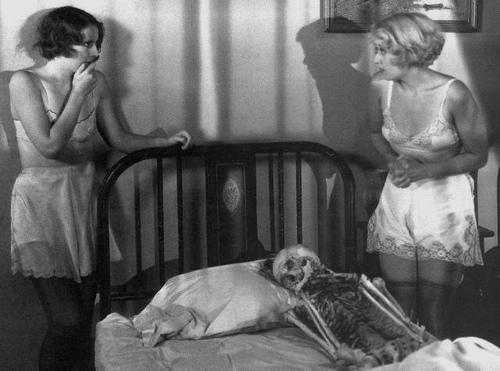
NIGHT NURSE, involving child endangerment, alcoholism, murder, and Barbara Stanwyck and Joan Blondell frolicking in their undergarments, is a great example of pre-Hays Code Hollywood
NIGHT NURSE (William A. Wellman, 1931)
Film Forum
209 West Houston St.
Thursday, February 16, 1:00 5:15 9:30
Series continues through March 1
212-727-8110
www.filmforum.org
 Film Forum’s excellent William A. Wellman festival continues with one of the best examples of a pre–Hays Code film, the rarely screened 1931 doozy, Night Nurse. The first of five collaborations between Wellman and Barbara Stanwyck, Night Nurse, based on Dora Macy’s 1930 novel, stars Stanwyck as Lora Hart, a young woman determined to become a nurse. She gets a probationary job at a city hospital, where she is taken under the wing of Maloney (Joan Blondell), who likes to break the rules and torture the head nurse, the stodgy Miss Dillon (Vera Lewis). Shortly after treating a bootlegger (Ben Lyon) for a gunshot wound and agreeing not to report it to the police, Lora starts working for a shady doctor (Ralf Harolde) taking care of two sick children (Marcia Mae Jones and Betty Jane Graham) whose proudly dipsomaniac mother (Charlotte Merriam) is being manipulated by her suspicious chauffeur (Clark Gable). Wellman pulls out all the stops, hinting at or simply depicting murder, child endangerment, rape, alcoholism, lesbianism, physical brutality, and Blondell and Stanwyck regularly frolicking around in their undergarments. It’s as if Wellman is thumbing his nose directly at the Hays Code in scene after scene. Although far from his best film — Wellman directed such classics as Wings (1927), The Public Enemy (1931), A Star Is Born (1937), Nothing Sacred (1937), Beau Geste (1939), and The Ox-Bow Incident (1943) — Night Nurse is an overly melodramatic, dated, but entertaining little tale with quite a surprise ending. Night Nurse is screening at Film Forum on February 16 as part of a triple feature with 1932’s The Purchase Price, starring Stanwyck and George Brent, and 1929’s The Man I Love, Wellman’s first all-talkie.
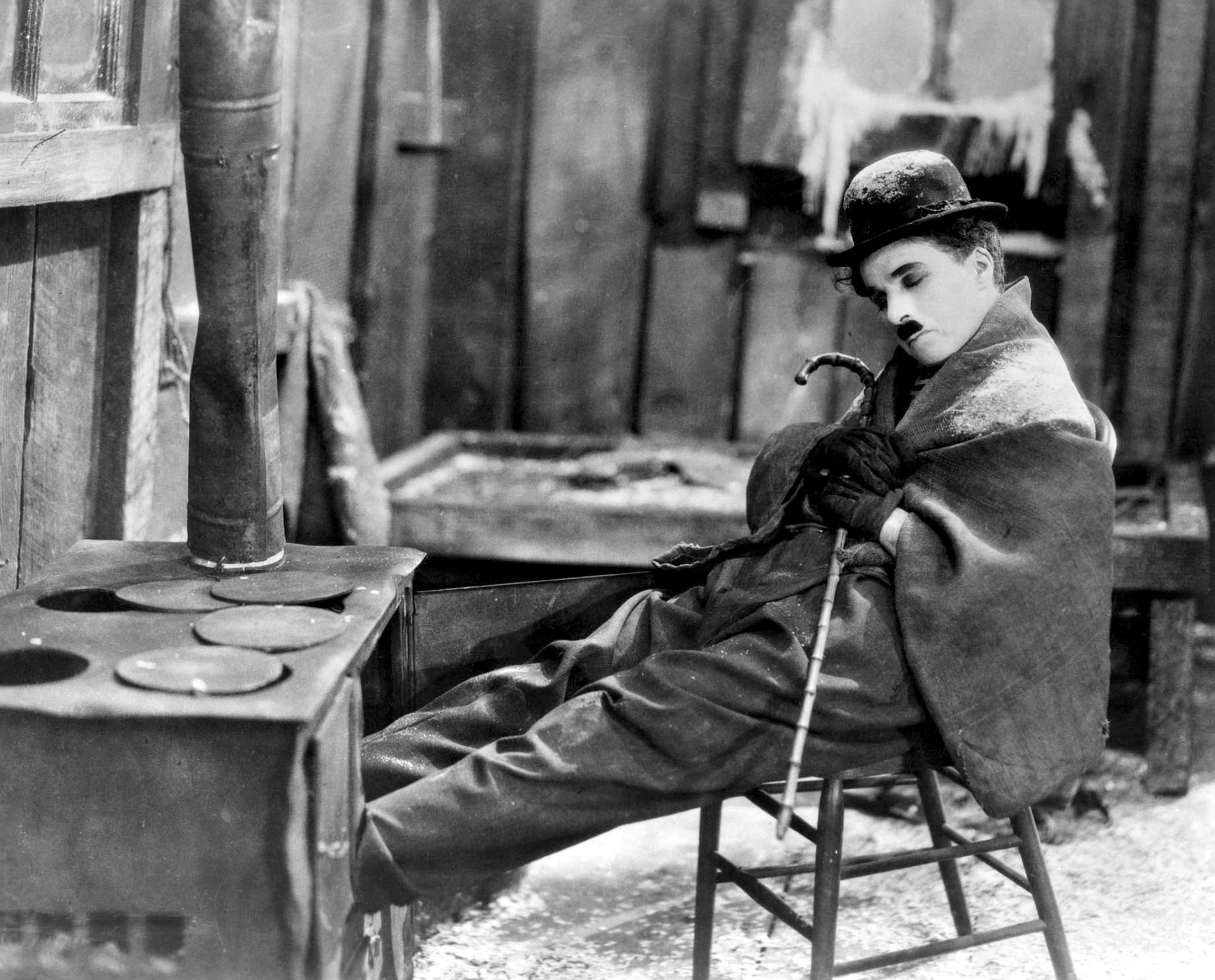
 Charlie Chaplin died thirty-four years ago on Christmas Day, at the ripe old age of eighty-eight, so Film Forum is paying tribute to the anniversary by screening a restored 35mm print of the complete version, with a newly recorded orchestral score, of what Chaplin called “the picture I want to be remembered by.” Made four years prior to the Great Depression, the slapstick comedy is still remarkably socially relevant, tackling unemployment, crime, hunger, and poverty. Chaplin, who wrote, produced, and directed the silent masterpiece, stars as the Lone Prospector, a little tramp who has set out to strike it rich during the Alaskan Gold Rush of 1848 but isn’t really having much luck. He takes shelter during a snowstorm in a small shack, does battle with a pair of much bigger men, turns into a chicken, and, yes, eats his shoe, doing whatever it takes to survive. The prescient film was originally to star Lita Grey as the love interest, but Chaplin impregnated (and later married) the sixteen-year-old, so she was replaced by Georgia Hale. Film Forum is screening The Gold Rush, which also features Mack Swain as Big Jim McKay, Malcolm Waite as ladies’ man Jack Cameron, and Tom Murray as Black Larsen, through December 29, including five times on Christmas Day. (And by the way, if you’ve only seen Charles Chaplin’s reedited 1942 version with his own treacly narration and score, well, you’ve never really experienced this American treasure.)

 On October 25, 2003, Russian oligarch Mikhail Khodorkovsky was arrested for tax fraud and has been in prison ever since. The controversial story of the eight-billion-dollar man is told in German director Cyril Tuschi’s political-thriller documentary Khodorkovsky. Combining Michael Moore’s rugged determination to meet with GM CEO Roger Smith in Roger & Me with a police-procedural narrative, Tuschi (Slight Changes in Temperature and Mind) desperately tries to speak with the imprisoned Khodorkovsky, but for most of the film he only gets to communicate him through letters while instead talking with his first wife, his mother, his son, former business partners, spies, and various politicians, some of whom share illuminating details about the life and career of the seemingly equally loved and despised socialist-turned-capitalist and others who adamantly refuse to say anything about the onetime head of the Yukos oil company, perhaps out of fear of retribution. Khodorkovsky is alternately shown to be a philanthropic businessman who founded the Open Russia Foundation charitable project and a ruthless tyrant whose giant ego resulted in his publicly butting heads with former Russian president Vladimir Putin, the reason why many think he is in jail — and might never get out. Tuschi supplements the film with black-and-white constructivist animation of Khodorkovsky, placing him firmly in between socialism and capitalism as he seeks to lead Russia into a new age. Featuring music by Estonian composer Arvo Pärt and narration by Jean-Marc Barr and Harvey Friedman, Khodorkovsky paints a fascinating portrait of contemporary Russia as well as of one of its most enigmatic and mysterious figures. Tuschi and Khodorkovsky’s son Pavel will be at Film Forum on November 30 to talk about the documentary and its subject following the 7:50 screening.