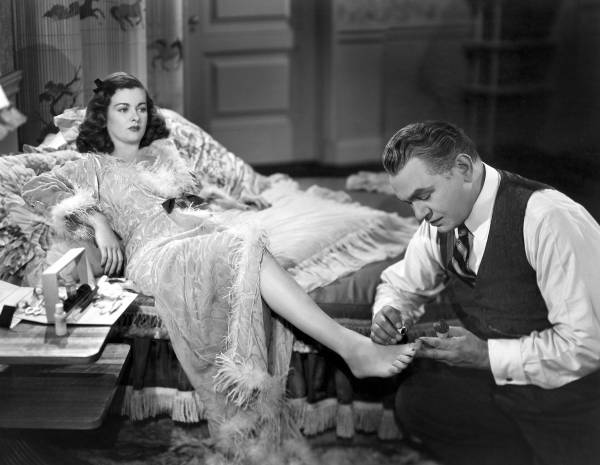
Femme fatale Joan Bennett gets her claws into meek amateur painter Edward G. Robinson in Fritz Lang’s psychological film noir SCARLET STREET (courtesy Photofest)
SCARLET STREET (Fritz Lang, 1948)
Film Forum
209 West Houston St.
Sunday, July 22, and Monday, July 23
Series continues through August 9
212-727-8110
www.filmforum.org
 Director Fritz Lang and screenwriter Dudley Nichols’s adaptation of Jean Renoir’s 1931 La Chienne, based on the novel by Georges de La Fouchardière, is a transplanted German street film moved to New York City. Edward G. Robinson stars as Christopher Cross, one of the all-time-great saps in the history of cinema. A henpecked cashier at a large clothing store where he has just been given his twenty-five-year gold watch, Cross instantly falls in love with a floozy he meets on a rainy night, Kitty March (Joan Bennett), who is soon conspiring with her sleazy boyfriend, Johnny (Dan Duryea), to bilk Cross, thinking that he is a wealthy painter whose canvases go for upwards of fifty grand apiece. Meanwhile, Cross continues to think that Kitty is a good girl who will marry him if he were free. But as Chris’s suspicions about Johnny grow, so does the tension, leading to a classic noir finale. Filmed on Hollywood sets designed to resemble Greenwich Village and Brooklyn, Scarlet Street is a dark, somber psychological thriller built around a mark and a femme fatale, reminiscent of Josef von Sternberg’s 1930 tale The Blue Angel, in which Emil Jannings is willing to sacrifice everything for Marlene Dietrich. Robinson, so good at playing tough gangsters, shows a surprisingly vulnerable, tender side as Cross, who refuses to see the truth staring him in the face, just as his paintings lack proper perspective. Duryea has a field day as Johnny, while Bennett is appropriately shady as the deceitful moll. Scarlet Street is screening July 22-23 with John Farrow’s 1948 thriller, The Big Clock, starring Charles Laughton and Ray Milland, as part of Film Forum’s Universal 100, a wide-ranging celebration of the studio’s centennial that continues with such other double features as Douglas Sirk’s Imitation of Life and All That Heaven Allows, James Whale’s Bride of Frankenstein and Edgar G. Ullmer’s The Black Cat, and Stanley Donen’s Charade and Michael Gordon’s Pillow Talk.

 They don’t come much bigger than Orson Welles in his dark potboiler Touch of Evil, as he nearly bursts through the frame as spectacularly dastardly police captain Hank Quinlan. A deliciously devious corrupt lawman, Quinlan is an enormous drunk who has no trouble breaking the rules to get his man. Charlton Heston took a lot of criticism playing Mike Vargas, a Mexican drug enforcement agent newly married to beautiful blonde Susan (Janet Leigh), who soon finds herself menaced by a dangerous gang as a weak-kneed, pre-McCloud Dennis Weaver looks the other way. The film famously opens with a remarkable crane shot that goes on for more than three minutes, setting the stage like no other establishing shot in the history of cinema. And the final scene with Marlene Dietrich as sultry hooker Tana is a lulu as well, highlighted by one of the great all-time movie lines. What goes on in between is a lurid tale of murder and revenge filled with unexpected twists and turns, featuring appearances by such Welles regulars as Joseph Cotten, Akim Tamiroff, Joseph Calleia, and Ray Collins. There was a lot of hype surrounding the film a few years ago when it was restored to match Welles’s original desires, but the final product lives up to its billing. A deeply affecting noir masterpiece, Touch of Evil is screening July 14 as part of Film Forum’s “Universal 100” festival, paying tribute to the major studio’s centennial with four weeks of double features and special presentations, opening on Friday the thirteenth with the original Frankenstein and Dracula and continuing with such other fine dual bills as Hitchcock’s Shadow of a Doubt and Saboteur, John Stahl’s Imitation of Life and Magnificent Obsession, Douglas Sirk’s Imitation of Life and All That Heaven Allows, and Monte Hellman’s Two-Lane Blacktop and Steven Spielberg’s Duel, in addition to the July 29-30 triple shot of The Wolf Man, The Invisible Man, and The Mummy.

 For forty years, Belgrade-born performance artist Marina Abramović has been presenting cutting-edge, often controversial live works that redefine what art is. For her highly anticipated major career retrospective at MoMA in 2010,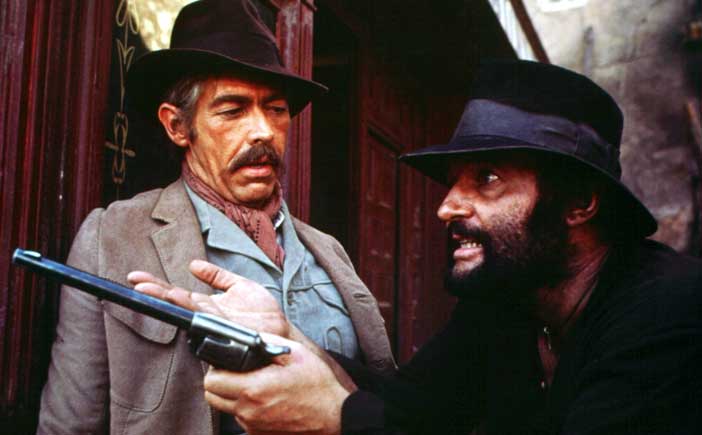
 Rod Steiger and James Coburn star in Sergio Leone’s final spaghetti Western, set during the Mexican Revolution in the 1910s. Steiger is Juan Miranda, the leader of a group of bandits who have stolen a stagecoach. Coburn is Sean Mallory, an IRA man on the run who likes blowing things up. The sweaty Juan wants to rob the Mesa Verde bank, while the cool Sean just wants to be left alone, but the two of them soon find themselves fighting together in the revolution. The film is way too long, and Ennio Morricone’s music is way too goofy, but Leone fans shouldn’t miss this rare chance to see the restored version of this film. Duck, You Sucker! is screening June 13, 19, and 21 as part of Film Forum’s Spaghetti Westerns series, which also features such well-known classics and under-the-radar gems as Damiano Damiani’s A Bullet for the General, Giulio Petroni’s Death Rides a Horse, Carlo Lizzani’s The Hills Run Red, and Giulio Questi’s Django Kill . . . If You Live, Shoot!