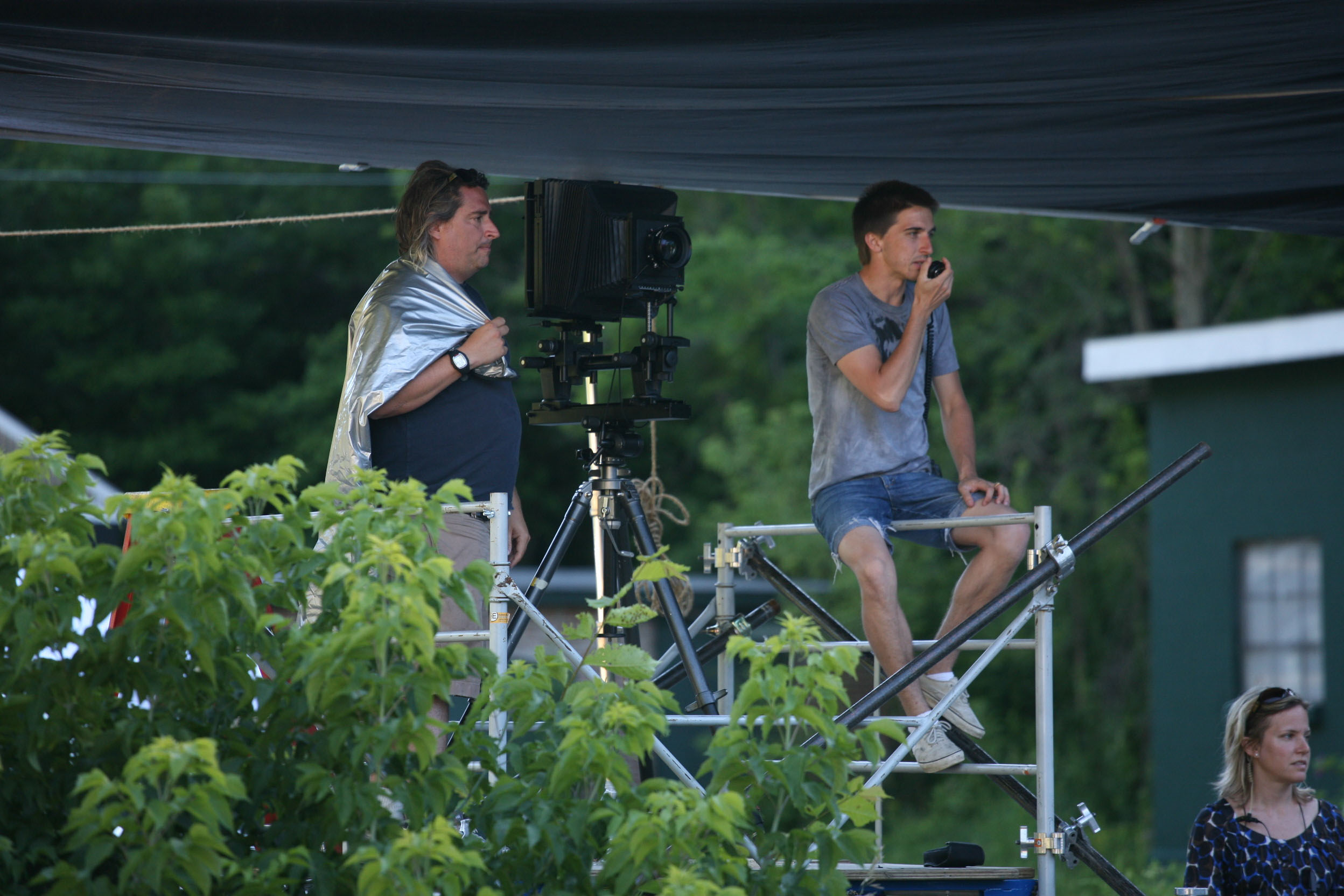
Gregory Crewdson carefully composes his next photograph in BRIEF ENCOUNTERS (courtesy Zeitgeist Films)
GREGORY CREWDSON: BRIEF ENCOUNTERS (Ben Shapiro, 2012)
Film Forum
209 West Houston St.
November 4-13
212-727-8110
www.filmforum.org
www.gregorycrewdsonmovie.com
 From 2002 to 2008, Gregory Crewdson created a sensational body of work he called “Beneath the Roses,” consisting of intricately arranged large-scale photographs that capture the mysterious underside of small-town, middle-class America. Filmed primarily in the Western Massachusetts community where his family spent their summers while he was growing up, the photographs, all taken at twilight, are powerful, emotional still shots that look like they’re from a movie, usually involving solitary figures on the street or in a tense room, staring out, often with a car nearby, its door or trunk flung open, compelling viewers to come up with their own narrative of what they’re seeing. For ten years, Ben Shapiro followed Crewdson around as he worked on that series and others, and he details the Park Slope-born photographer’s unique creative process in the vastly entertaining and informative documentary Gregory Crewdson: Brief Encounters. Crewdson, who shoots only at twilight, is obsessive about the shot he gets, agonizing first over the setting itself, then going over every little detail, from the turn of a character’s head to the proper amount of leg to reveal, with a crew that includes a director of photography, a production designer, a casting director, and other jobs usually more associated with film. “My pictures are about a search for a moment — a perfect moment,” he explains. “To me the most powerful moment in the whole process is when everything comes together and there is that perfect, beautiful, still moment. And for that instant, my life makes sense.”
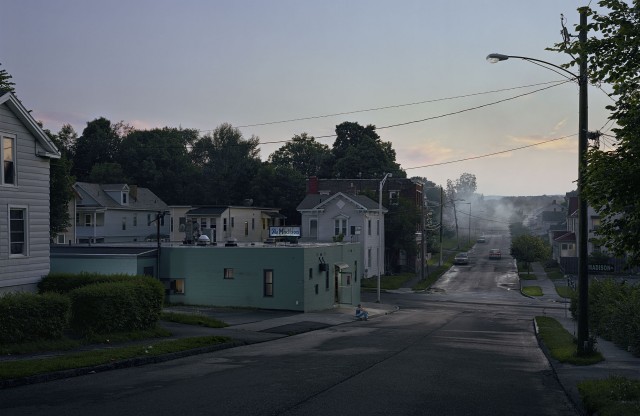
Gregory Crewdson, “Untitled (The Madison),” from “Beneath the Roses,” archival pigment print, 2007 (© Gregory Crewdson)
Crewdson also talks about his past as he drives around Pittsfield searching out locations or looks through a photo album, discussing how he was influenced by his psychologist father and a trip they made to see a Diane Arbus exhibition at MoMA in 1972, when Crewdson was ten. Among those who share their thoughts about Crewdson are writers Russell Banks and Rick Moody, photographer Laurie Simmons, Aperture editor in chief Melissa Harris, and Crewdson’s director of photography, Richard Sands. Shapiro also travels to Rome with Crewdson for his 2010 “Sanctuary” series, taken at the abandoned Cinecittà studio in Rome, furthering his interest in film. Just as it’s fascinating to spend time exploring Crewdson’s photographs, it’s equally fascinating spending time with the man himself, a complex, bigger-than-life character with an intriguing outlook on his medium as well as the world at large. Gregory Crewdson: Brief Encounters will screen at Film Forum November 3-13, its original October 31 opening having been delayed because of Hurricane Sandy.
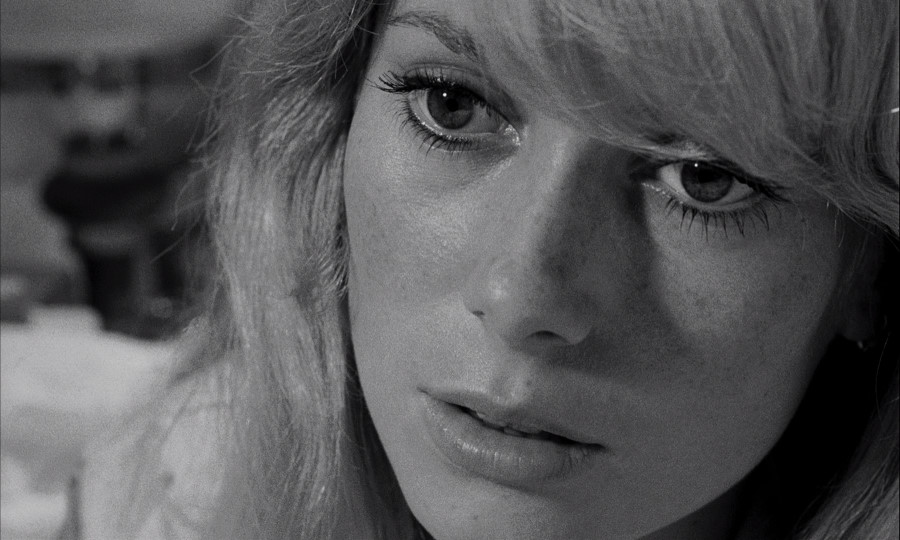
 If you think Lower Manhattan was scary this last week while the power was out, just wait till you see Roman Polanski’s first English-language film, the 1965 psychological masterpiece Repulsion. Catherine Deneuve gives a mesmerizing performance as Carol Ledoux, a deeply troubled, beautiful young woman who shies away from the world, hiding something that has turned her into a frightened childlike creature who barely speaks. A manicurist who lives in London with her sister, Hélène (Yvonne Furneaux), Carol becomes entranced by cracks in the sidewalk, suddenly going nearly catatonic at their sight; in bed at night, she is terrified of the walls, which seem to break apart as she grips tight to the covers. A proper gentleman (John Fraser) is trying to start a relationship with her, but she ignores him or forgets about their meetings, unable to make any genuine connections. Deneuve’s every movement, from the blink of an eye to a wave of her hand, reveals Carol’s submerged inner turmoil and desperation, leading to an ending that is both shocking and not surprising. Shot in a creepy black-and-white by Gilbert Taylor (A Hard Day’s Night, Dr. Strangelove or: How I Learned to Stop Worrying and Love the Bomb) and featuring a pulsating score by jazz legend Chico Hamilton, Repulsion is a brilliant journey into the limitations and possibilities of the human mind, with Polanski expertly navigating through a complex terrain. Winner of a pair of awards at the fifteenth Berlin International Film Festival, Repulsion, the first of Polanski’s Apartment Trilogy (followed by 1968’s Rosemary’s Baby and 1976’s The Tenant), will be screening in a new 35mm print November 3-8 at Film Forum, which is reopening this afternoon after having lost power because of Hurricane Sandy.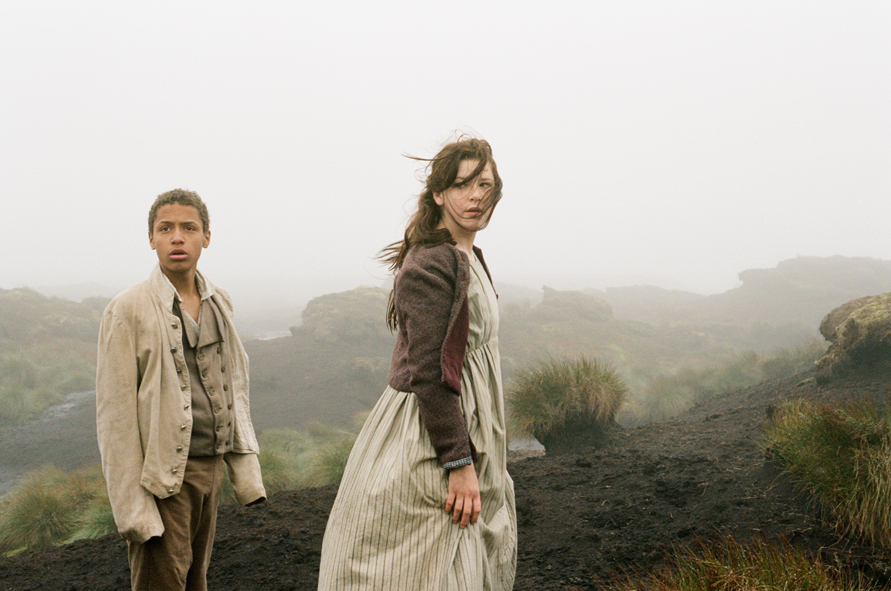
 Digging deep into Emily Brontё’s classic — and only — novel, writer-director Andrea Arnold creates a radically different Wuthering Heights from such previous versions starring Laurence Olivier and Merle Oberon (1939), Keith Michell and Claire Bloom (1962), and Ralph Fiennes and Juliette Binoche (1992). Setting the bar high following her exceptional first two films,