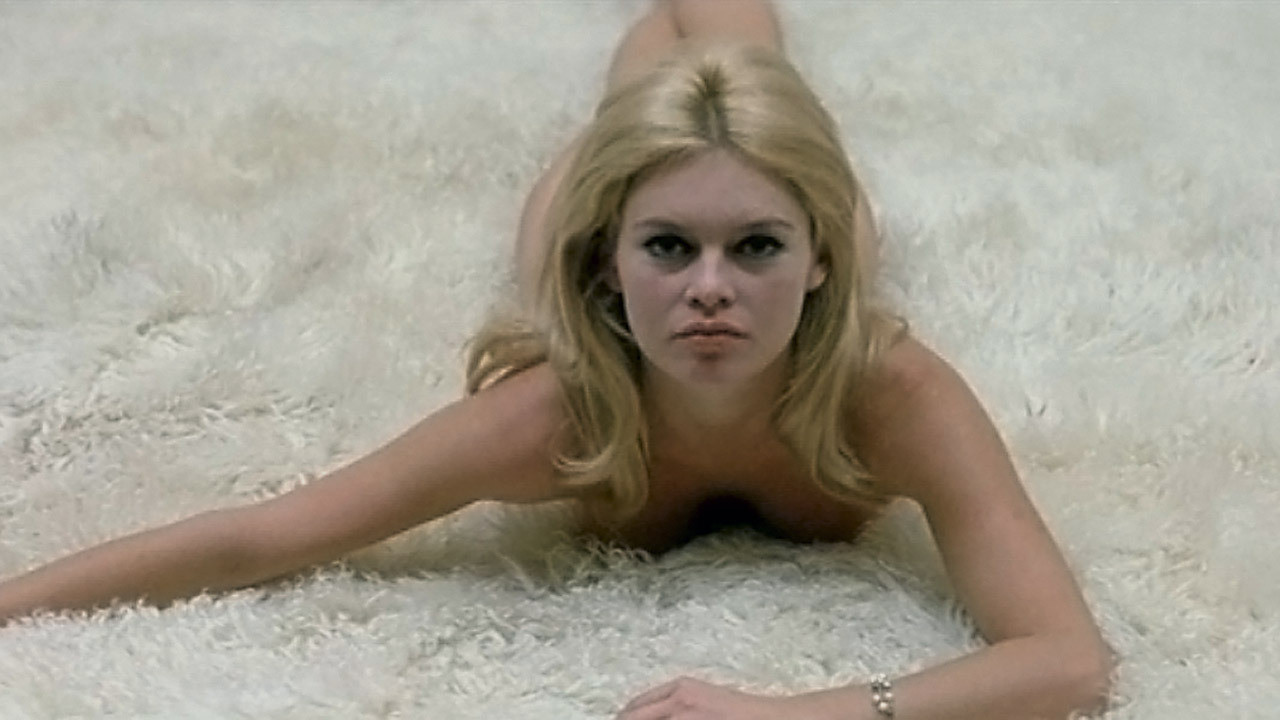
Brigitte Bardot shows off both her acting talent and beautiful body in Jean-Luc Godard’s CONTEMPT
CONTEMPT (LE MEPRIS) (Jean-Luc Godard, 1963)
Film Forum
209 West Houston St.
September 6-19
Series runs through September 5
212-727-8110
www.filmforum.org
 French auteur Jean-Luc Godard doesn’t hold back any of his contempt for Hollywood cinema in his multilayered masterpiece Contempt, which is being shown September 6-19 in a fiftieth-anniversary restoration at Film Forum. Loosely based on Alberto Moravia’s Il Disprezzo, Contempt stars Michel Piccoli as Paul Javal, a French screenwriter called to Rome’s famed Cinecittà studios by American producer Jeremy Prokosch (Jack Palance ) to perform rewrites on Austrian director Fritz Lang’s (played by Lang himself) adaptation of The Odyssey by ancient Greek writer Homer. Paul brings along his young wife, the beautiful Camille (Brigitte Bardot), whom Prokosch takes an immediate liking to. With so many languages being spoken, Prokosch’s assistant, Francesca Vanini (Giorgia Moll), serves as translator, but getting the various characters to communicate with one another and say precisely what is on their mind grows more and more difficult as the story continues and Camille and Paul’s love starts to crumble. Contempt is a spectacularly made film, bathed in deep red, white, and blue, as Godard and cinematographer Raoul Coutard poke fun at the American way of life. (Both Godard and Coutard appear in the film, the former as Lang’s assistant director, the latter as Lang’s cameraman — as well as the cameraman who aims the lens right at the viewer at the start of the film.)
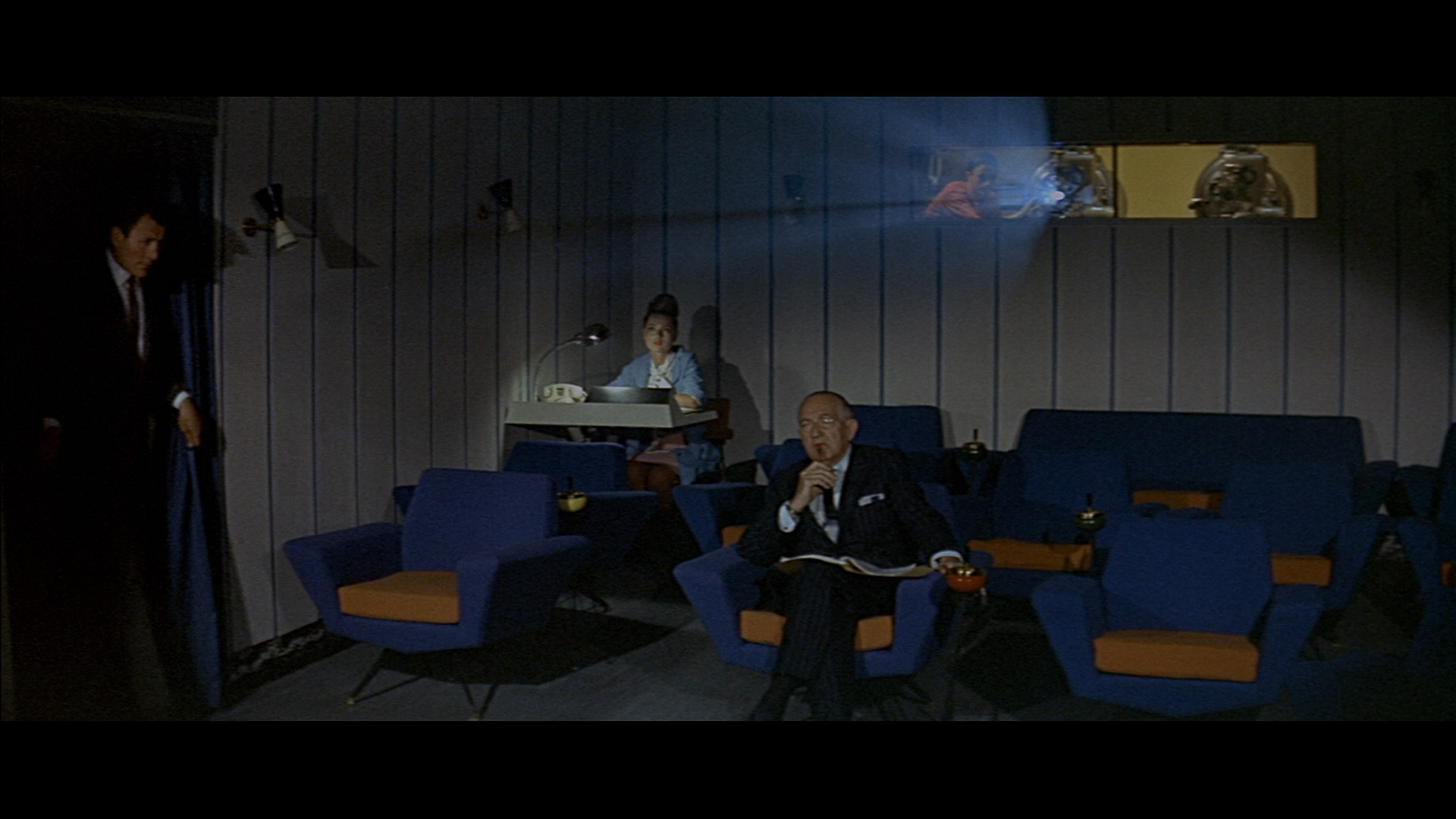
Producer Jeremy Prokosch (Jack Palance) doesn’t always have the kindest of words for director Fritz Lang in CONTEMPT
Bardot is sensational in one of her best roles, whether teasing Paul at a marvelously filmed sequence in their Rome apartment (watch for him opening and stepping through a door without any glass), lying naked on the bed, asking Paul what he thinks of various parts of her body (while Coutard changes the filter from a lurid red to a lush blue), or pouting when it appears that Paul is willing to pimp her out in order to get the writing job. Palance is a hoot as the big-time producer, regularly reading fortune-cookie-like quotes from an extremely little red book he carries around that couldn’t possibly hold so many words. And Lang, who left Germany in the mid-1930s for a career in Hollywood, has a ball playing a version of himself, an experienced veteran willing to put up with Prokosch’s crazy demands. Vastly entertaining from start to finish, Contempt is filled with a slew of inside jokes about the filmmaking industry and even Godard’s personal and professional life, along with some of the French director’s expected assortment of political statements and a string of small flourishes that are easy to miss but add to the immense fun, all set to a gorgeous romantic score by Georges Delerue.

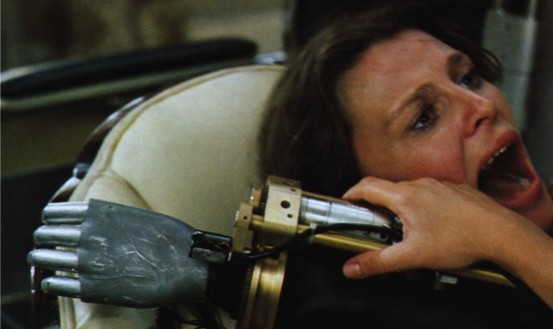
 Back at Film Forum for the first time in seventeen years, the “Son of Summer Sci-Fi, Fantasy & Horror” series continues on August 30 with an inspired double feature of movies dealing with alternative forms of motherhood. First up is Donald Cammell’s creepy, claustrophobic 1977 futuristic thriller Demon Seed. Based on the novel by Dean R. Koontz, the film stars a surprisingly game Julie Christie as Susan Harris, a frustrated housewife whose husband, Alex (Fritz Weaver), is the leader of a team that has built a master computer known as Proteus (voiced by Robert Vaughn). When Alex goes off for several months to further Proteus’s already impressive attributes, the supercomputer starts developing a mind of its own, locking Susan in the house and deciding she must give birth to its child. Cammell, who codirected Performance with Nicolas Roeg, fills Demon Seed with trippy, psychedelic visuals and cool technological flourishes, along with an electronic score by Ian Underwood and Lee Ritenour supplementing Jerry Fielding’s central musical themes. The film delves into suburban paranoia with Toffler-esque flare and an Orwellian fear of artificial intelligence. The film harkens back to Stanley Kubrick’s 2001: A Space Odyssey and Joseph Sargent’s Colossus: The Forbin Project while also influencing such future films as John Badham’s WarGames, which also names its supercomputer “Joshua” and casts Weaver look-alike John Wood as computer creator Dr. Stephen Falken.
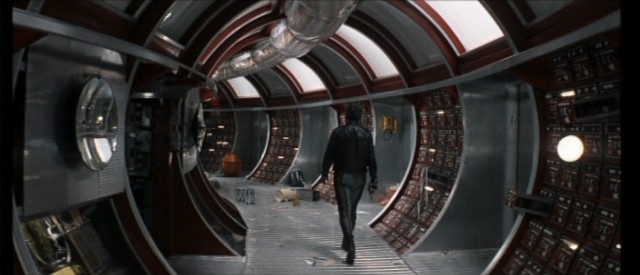
 In Andrei Tarkovsky’s Solaris, the Russian 2001: A Space Odyssey, Natalya Bondarchuk and Donatus Banionis star as a different kind of couple caught up in something very strange that is going on in outer space, unexplainable to both the characters in the film and the people in the audience. Banionis plays Dr. Kris Kelvin, a psychologist who is sent to the Solaris space station to decide whether to put an end to the solaristics project that Burton (Vladislav Dvorzhetsky) complicated twenty years before. What he discovers is one death, two possibly insane men, and his supposedly dead wife (Bondarchuk). Ambiguity reigns supreme in this gorgeously shot (in color and black and white by cinematographer Vadim Yusov) and scored (by Eduard Artemyev) film that, while technically science fiction, is really about the human conscience, another gem from master Russian director Tarkovsky (Ivan’s Childhood, Andrei Rublev, Nostalghia). See it whether or not you checked out Steven Soderbergh’s underrated remake with George Clooney and Natascha McElhone.