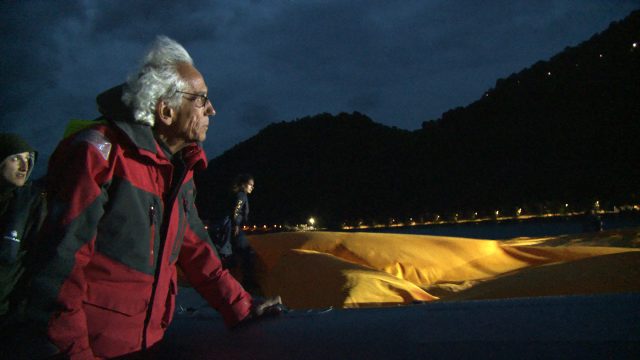
Christo takes a spin around his massive project in Andrey M Paounov’s Walking on Water
WALKING ON WATER (Andrey M Paounov, 2018)
Film Forum
209 West Houston St.
Opens Friday, May 17
212-727-8110 filmforum.org
Andrey M Paounov’s Walking on Water, opening this weekend at Film Forum, reveals a lot about large-scale installation artist Christo, and you can find out even more when the Bulgarian-born eighty-four-year-old curmudgeonly religious icon / rock star participates in Q&As with Paounov on Friday and Saturday at 7:00 and Sunday at 4:45. In 1961, Christo and his wife and artistic partner, Jeanne-Claude, started creating massive public works, wrapping fabric around the entire Reichstag in Berlin, placing hundreds of yellow umbrellas in Tokyo and blue umbrellas in California concurrently, and lining the pathways of Central Park with dozens of saffron-colored gates, among other impressive spectacles that gave a pop art sheen to land art, which had been the preserve of Robert Smithson, James Turrell, and Walter De Maria, among others. In 1969, Christo and Jeanne-Claude began trying to realize The Floating Piers project, an expansive walkway that would make visitors feel like they were strolling on the water itself. Jeanne-Claude passed away in 2009, and five years later Christo became determined to make The Floating Piers a reality.
The film follows him as he finds his location — Lake Iseo in Northern Italy — adamantly chooses his materials, meets with local politicians, and has something to say about each step of the process, giving Paounov near-total access as Christo experiences bumps and bruises and gets his eyelashes trimmed. He argues with his nephew and right-hand man, Vladimir Yavachev, over numerous details; gets frustrated with computers; complains about the cover of a catalog (“This is horror story,” he says); is thwarted by bad weather; and nearly has a meltdown when crowd control gets out of hand. He approaches everything with the exacting eye of an artist, taking in the beauty of nature while seeking perfection, and nothing less, from the large crew working for him.
Christo is worshipped everywhere he goes; not only does his name evoke Jesus’s but so does the purpose of The Floating Piers, inviting men, women, and children to traverse the lake on foot similarly to what Jesus did on the Sea of Galilee. Christo even has long (white) hair that flaps in the wind. His eyes light up when he visits the Vatican and marvels at Michelangelo’s Sistine Chapel ceiling and when he takes a helicopter ride to survey the installation, providing filmgoers with breathtaking views. There is also a terrific score by Danny Bensi and Saunder Jurriaans that ranges from sweet and gentle to percussive and pulsating. As ornery as Christo seems to be, he smiles when he needs to, like when he stops by a party loaded with rich collectors, is stopped by fans for selfies, or gazes lovingly at the rich natural landscape surrounding Lake Iseo; it’s all part of his genius.
Paounov (Georgi and the Butterflies, The Mosquito Problem and Other Stories) put the film together with seven hundred hours of footage that had already been recorded before he was hired in 2016, adding to that what he then shot, wisely eschewing talking heads and interviews and instead presenting Christo and his captivating world uncensored and unfiltered, which is a real treat. “Art is not a profession. You don’t work from nine to five,” Christo tells a classroom of small children in his broken English. “To be artist, you are all the time artist. There is no moment when you are not artist.” Walking on Water is an intimate fly-on-the-wall documentary about the creative process and one man’s intense determination to make the planet a better place, one work of art at a time.
Mads Mikkelsen has a tough go of it in Nicolas Winding Refn’s Pusher trilogy
THE PUSHER TRILOGY (Nicolas Winding Refn, 1996, 2004, 2005)
Film Forum
209 West Houston St.
April 26 & 27, May 4
Series runs April 19 – May 16
212-727-8110 filmforum.org
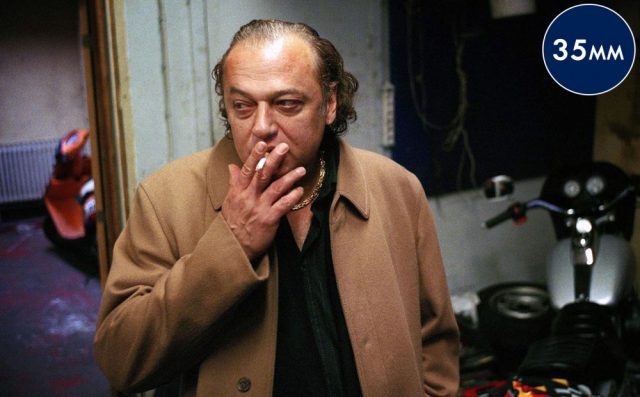
Danish filmmaker Nicolas Winding Refn’s Pusher trilogy is a gritty, violent, brutal, and brilliant look at the devastation wrought by drugs. In Pusher (1996), Kim Bodnia stars as Frank, a small-time hood who loses both the money and the drugs when a deal goes bad. Over the course of a week, he grows more and more desperate as druglord Milo (Zlatko Buric) and his henchman, Radovan (Slavko Labovic), grow more and more impatient, preparing to do some serious damage to Frank. Pusher II: With Blood on My Hands (2004) focuses on Tonny (Mads Mikkelsen), Frank’s former partner who has just been released from prison. Addled by a beating he took, Tonny gets lost in a drug haze, trying to prove himself a worthy criminal to his big-time father, the Duke (Leif Sylvester Petersen), while also refusing to accept that he might be the father of Charlotte’s (Anne Sorensen) child. With the whole world crashing in on him, Tonny goes to extreme measures that affect everybody in his sphere. The gritty, powerful trilogy concludes with Refn’s masterwork, Pusher III: I’m the Angel of Death (2005), this time with Milo in the forefront.
Nicolas Winding Refn’s Pusher trilogy concludes with Milo (Zlatko Buric) taking center stage in Pusher III: I’m the Angel of Death
While preparing for his daughter’s (Marinela Dekic) twenty-fifth birthday party, he discovers that a major score has changed significantly, and he is forced to deal directly with a new generation of drug dealers — and by himself, because his cooking has made his crew sick. Shuttling between the ever-worsening situation, NA meetings, and his daughter’s party, Milo is faced with some deadly choices. Buric is spectacular as the aging druglord who does not like what he sees as he takes stock of his life. While the first two films feature hard-driving punk music, classical music slows things down in the far more contemplative conclusion. To add to the remarkable realism, many of the supporting actors were actual criminals. The grand finale is unforgettable, a multilayered, deeply philosophical, and extremely violent statement on the nature of drugs and the men and women addicted to that life. You can see all three films April 26-27 and May 4 in Film Forum’s Trilogies series, which continues through May 16 with other three-packs from Mark Donskoy, John Ford, Fritz Lang, Carol Reed, Hou Hsiao-Hsien, and Krzysztof Kieslowski, among many others.
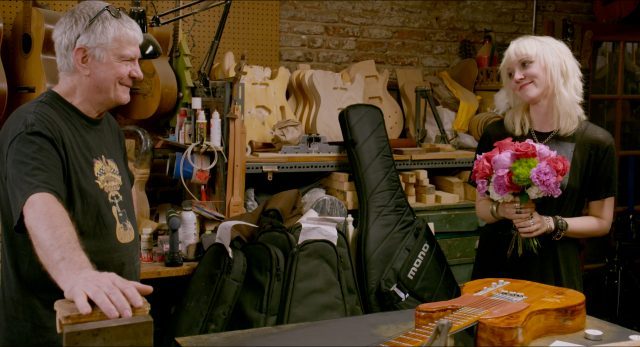
In the second half of Ron Mann’s utterly delightful and unique documentary Carmine Street Guitars, a well-dressed, well-groomed young man enters the title store in Greenwich Village and identifies himself as Adam Shalom, a Realtor who is selling the building next door. Shalom tries to talk about square footage, but Carmine Street Guitars founder and owner Rick Kelly barely looks up as he continues cleaning a fret. It’s a critical, uncomfortable moment in an otherwise intimate and inviting film; throughout the rest of the eighty-minute documentary, the soft-spoken Kelly talks guitars and craftsmanship with a stream of very cool musicians and his punk-looking young apprentice, Cindy Hulej. But Shalom’s arrival hearkens to one of the main reasons why Mann made the movie: to capture one of the last remaining old-time shops in a changing neighborhood, a former bohemian paradise that has been taken over by hipsters and corporate culture, by upscale stores and restaurants and luxury apartments. You’ll actually cheer that Kelly gives Shalom such short shrift, but you’ll also realize that Shalom and others might be knocking again at that door all too soon.
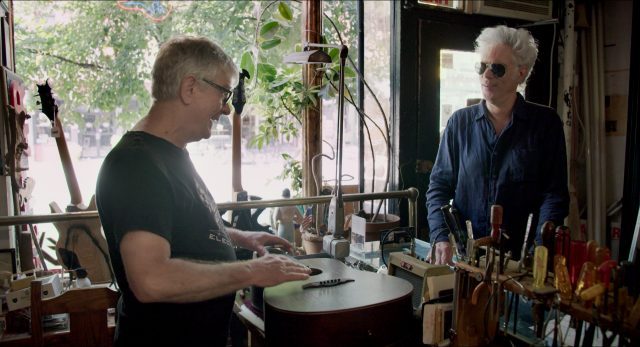
Rick Kelly welcomes “instigator” Jim Jarmusch to his Greenwich Village shop in Carmine Street Guitars
The rest of the film is an absolute treat. Mann follows five days in the life of Carmine Street Guitars; each day begins with a static shot of the store from across the street, emphasizing it as part of a community as people walk by or Kelly, who was born in Bay Shore, arrives with a piece of wood he’s scavenged. The camera then moves indoors to show Kelly and Hulej making guitars by hand, using old, outdated tools and wood primarily from local buildings that date back to the nineteenth century. Kelly doesn’t do computers and doesn’t own a cell phone; he leaves all that to Hulej, who posts pictures of new six-strings on Instagram. Meanwhile, Kelly’s ninetysomething mother, Dorothy, works in the back of the crazily cluttered store, taking care of the books with an ancient adding machine. Over the course of the week, they are visited by such musicians as Dallas and Travis Good of the Sadies (who composed the film’s soundtrack), “Captain” Kirk Douglas of the Roots, Eleanor Friedberger, Dave Hill of Valley Lodge, Jamie Hince of the Kills, Nels Cline of Wilco, Christine Bougie of Bahamas, Marc Ribot, and Charlie Sexton. Bill Frisell plays an impromptu surf-guitar instrumental version of the Beach Boys’ “Surfer Girl.” Stewart Hurwood, Lou Reed’s longtime guitar tech, talks about using Reed’s guitars for the ongoing “DRONES” live installation. “It’s like playing a piece of New York,” Lenny Kaye says about the guitars made from local wood while also referring to the shop as part of the “real village.”
Mann, the Canadian director of such previous nonfiction films as Grass, Know Your Mushrooms, and Comic Book Confidential, was inspired to make the movie at the suggestion of his friend Jarmusch, who in addition to directing such works as Stranger Than Paradise (which featured Balint), Down by Law, and 2016 NYFF selection Paterson is in the New York band Sqürl. Plus, it was Jarmusch who first got Kelly interested in crafting his guitars with wood from buildings, “the bones of old New York,” resulting in Telecaster-based six-strings infused with the history of Chumley’s, McSorley’s, the Chelsea Hotel, and other city landmarks. Carmine Street Guitars, which is far more than just mere guitar porn, opens April 24 at Film Forum, with Mann, Kelly, and Hulej participating in Q&As following the 7:45 show on Wednesday night, joined by Jarmusch, and after the 6:00 screening on Friday and 4:10 show on Saturday.
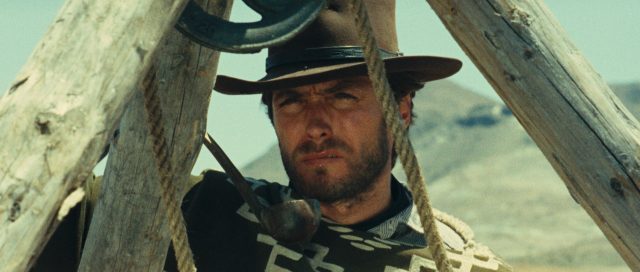
Clint Eastwood introduces the Man with No Name in Sergio Leone’s A Fistful of Dollars (photo courtesy MGM / Cineteca di Bologna / Park Circus)
A FISTFUL OF DOLLARS (PER UN PUGNO DI DOLLARI) (Sergio Leone, 1964)
Film Forum
209 West Houston St.
Saturday, April 20, 4:30, and Monday, April 22, 4:40
Series runs April 19 – May 16
212-727-8110 filmforum.org
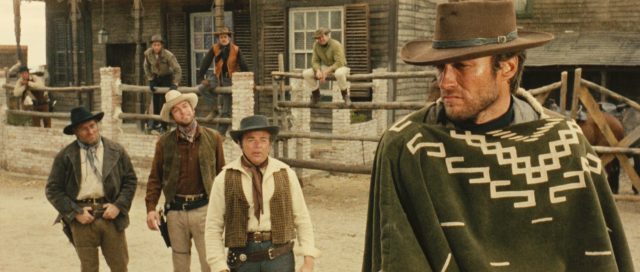
Clint Eastwood made a name for himself on the big screen playing the Man with No Name in Sergio Leone’s 1964 spaghetti Western, A Fistful of Dollars, which is being shown April 20-23 at Film Forum as part of its awesome Trilogies series. In his first lead movie role, Eastwood, the costar of the television series Rawhide, is a gunslinger draped in a poncho and smoking a small cigar who rides on a mule into San Miguel, a tiny town in the middle of nowhere, home to an ongoing feud between the gun-running Baxters and the liquor-dealing Rojos. The stranger decides to play both sides against the middle, caring only that he earns lots of cash. “Never saw a town as dead as this one,” the stranger tells saloon owner Silvanito (Jose Calvo), who explains, “The place is only widows. Here you can only get respect by killing other men, so nobody works anymore.” The stranger hears the sound of banging outside and says, “Somebody doesn’t share your opinion.” Silvanito opens the window to reveal old man Piripero (Joe Edger) making coffins. “You’ll be a customer,” Silvanito tells the stranger with assurance. The stranger goes back and forth between the Baxters, led by the sheriff (W. Lukschy), and the Rojos, who follow the dangerous, unpredictable Ramón (Gian Maria Volontè). Also caught up in the Hatfield-McCoy battle are the sheriff’s wife, Consuelo (Margherita Lozano), and brother, Antonio (Bruno Carotenuto), along with Rojo brothers Benito (Antonio Prieto) and Esteban (S. Rupp) and their enforcer, Chico (Richard Stuyvesant). Ramón, meanwhile, has his eyes set on Marisol (Marianne Koch), who is married to Julio (Daniel Martín), who does not want to get involved in any fighting. Carefully watching it all is Juan de Díos (Raf Baldassarre), who rings the church bell at every death.
The Italian-German-Spanish production is a remake of Akira Kurosawa’s Yojimbo, which led to legal entanglements when the Japanese auteur demanded, well, a fistful of dollars in financial compensation. According to Christopher Frayling’s Sergio Leone — Something to Do with Death, Leone received a note from Kurosawa that read, “Signor Leone — I have just had the chance to see your film. It is a very fine film, but it is my film. Since Japan is a signatory of the Berne Convention on international copyright, you must pay me.” Frayling also suggests that Leone was influenced by Dashiell Hammett’s Red Harvest and Carlo Goldoni’s Servant of Two Masters and did not feel he was stealing only from Kurosawa. In The BFI Companion to the Western, Frayling quotes Leone as saying, “Kurosawa’s Yojimbo was inspired by an American novel of the serie-noire so I was really taking the story back home again.” (For a montage of similarities between the two films, check out this video.). Regardless, A Fistful of Dollars, made for about two hundred grand, set the standard for the new genre, and Eastwood was its antihero. He and Leone would team up again on the sequel, For a Few Dollars More, which is not a direct remake of Kurosawa’s Yojimbo follow-up, Sanjuro, as well as The Good, the Bad, and the Ugly, the best of the Dollars Trilogy.
Clint Eastwood watches his back in first of the Dollars Trilogy (photo courtesy MGM / Cineteca di Bologna / Park Circus)
Fistful is steeped in violence and death, from Iginio Lardani’s rad title sequence of silhouettes in black, white, and blood red to an early shot of the stranger riding under a noose and giving it a long look. Whereas Toshirô Mifune played the bodyguard in Yojimbo with a devilish glee, Eastwood — in a role that had been previously offered to Henry Fonda, Charles Bronson, James Coburn, and others — is much more serious as the Man with No Name, who would become more sympathetic in future outings. The extremely poor dubbing only adds to the film’s magnificence. To enhance its foreign appeal to American audiences, several members of the cast and crew appear under pseudonyms in the credits, including Leone (Bob Robertson), cinematographer Massimo Dallamano (Jack Dalmas), actor Gian Maria Volontè (John Wells), and composer Ennio Morricone (Leo Nichols or Dan Savio). There is no mention of Kurosawa or Yojimbo anywhere.
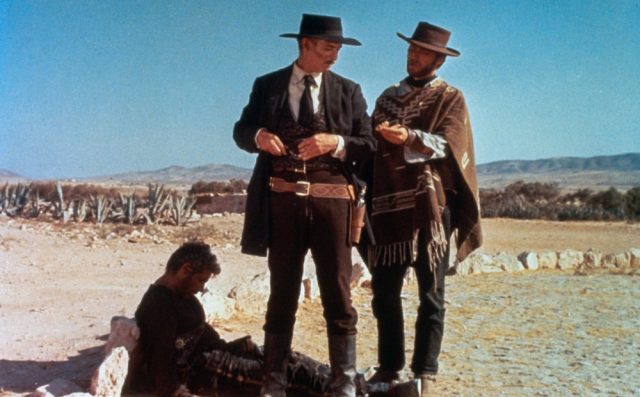
Rival bounty killers colonel Douglas Mortimer (Lee Van Cleef) and Manco (Clint Eastwood) join forces in Sergio Leone’s For a Few Dollars More
FOR A FEW DOLLARS MORE (PER QUALCHE DOLLARO IN PIÙ) (Sergio Leone, 1965)
Saturday, April 20, 4:30, and Tuesday, April 23, 4:40 filmforum.org
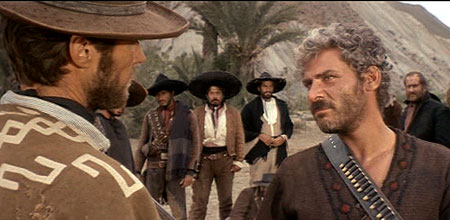
Determined to capitalize on the immediate success of A Fistful of Dollars, director and cowriter Sergio Leone and stars Clint Eastwood and Gian Maria Volonté quickly got back in the saddle to make the initially underrated, now celebrated follow-up, For a Few Dollars More. In the 1965 spaghetti Western, filmed in Almería, Spain, and at Rome’s Cinecittà Studios — and featuring a town doubling as El Paso built by production designer Carlo Simi that still stands today, part of the MiniHollywood theme park in Tabernas — Eastwood is a bounty killer that some call Manco, but he is essentially the Man with No Name again. He travels from wretched place to wretched place with his horse, poncho, cigar, squinty eyes, and guns, shooting criminals and collecting rewards. When he encounters a rival, former Confederate colonel Douglas Mortimer (Lee Van Cleef), they are initially at odds, going after the same trophies, but they ultimately decide to join forces to capture and kill El Indio (Volonté), a murderous psychopath who likes to use a pocket watch that plays a gentle tune when opened when he is getting ready to shoot someone, an element from his past (involving a mystery woman played by Rosemary Dexter) that haunts him. Manco embeds himself with Indio’s mangy gang, which includes Groggy (Luigi Pistilli), Niño (Mario Brega), Cuchillo (Aldo Sambrell), Tomaso (Lorenzo Robledo), Sancho Perez (Panos Papadopulos), Slim (Werner Abrolat), Blackie (Frank Braña), Chico (José Canalejas), Frisco (Antonio Molino Rojo), Hughie (Benito Stefanelli, who was in all three Dollars films), and Wild (the one and only Klaus Kinski). As Indio prepares to rob a bank in El Paso, a series of double crosses and personal vengeance lead to a memorable ending.
Manco (Clint Eastwood) becomes part of Indio’s (Gian Maria Volonté) gang in For a Few Dollars More
Written by Leone and Luciano Vincenzoni with added dialogue by Sergio Donati, For a Few Dollars More fits right in between A Fistful of Dollars and The Good, the Bad, and the Ugly, from its overall look and mood to Ennio Morricone’s stupendous score and Massimo Dallamano’s beautiful cinematography, both veterans of Fistful. Eastwood further established his ability to carry a film as a compelling antihero, Van Cleef (How the West Was Won, Escape from New York) earned one of the three title roles in Ugly, and Volonté, who would go on to make such classics as A Bullet for the General, Investigation of a Citizen Above Suspicion, and Christ Stopped at Eboli, is superbly grimy as a brutal villain hiding a soft spot. Genre tropes abound, highlighted by Leone’s love of close-ups of his characters’ eyes, shifting from one side to the other as they face their destinies.
Clint Eastwood is the Good in classic Sergio Leone operatic oater
THE GOOD, THE BAD AND THE UGLY (Sergio Leone, 1966)
Saturday, April 20, 9:00, and Sunday, April 21, 4:40 filmforum.org
One of the all-time-great spaghetti Westerns, Sergio Leone’s dusty three-hour operatic oater stars Clint Eastwood as the Good (Blondie), Lee Van Cleef as the Bad (Angel Eyes), and Eli Wallach as the Ugly (Tuco Benedicto Pacifico Juan Maria Ramirez, whose list of criminal offenses is a riot), three unique individuals after $200,000 in Confederate gold buried in a cemetery in the middle of nowhere. Nearly twenty minutes of never-before-seen footage was added to the film several years ago, with Wallach and Eastwood overdubbing brand-new dialogue, so if you haven’t seen it in a while, it might just be time to catch it again. Ennio Morricone’s unforgettable score and Torino delli Colli’s gorgeous widescreen cinematography were also marvelously enhanced; their work in the scene when Tuco first comes upon the graveyard will make you dizzy with delight. And then comes one of the greatest finales in cinema history. The Film Forum trilogy series continues through May 16 with official and unofficial hat tricks by Fritz Lang, Wim Wenders, Carol Reed, Whit Stillman, Lucretia Martel, Michelangelo Antonioni, Rainer Werner Fassbinder, and many others.
THE HUMAN CONDITION (Masaki Kobayashi, 1959-61)
Film Forum
209 West Houston St.
April 20-29
Series runs April 19 – May 16
212-727-8110 filmforum.org
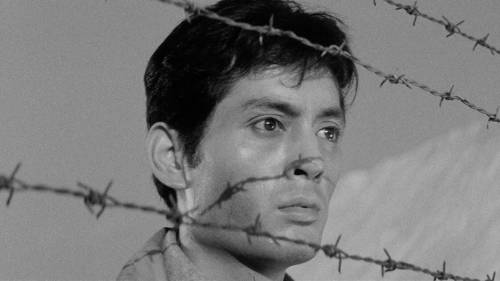
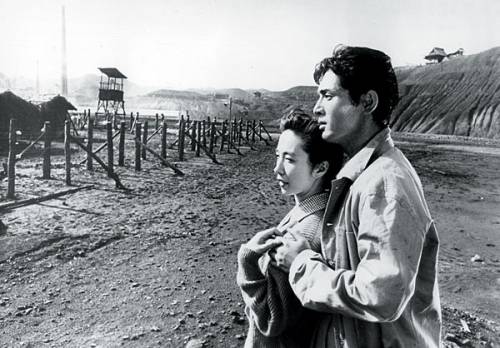
Some stories are just too big to be told in one film, let alone two, so from April 19 to May 16, Film Forum is showing well-known and under-the-radar official and unofficial trilogies, including three-packs from Francis Ford Coppola, Sergio Leone, Lucas Belvaux, Andrzej Wajda, Jean Cocteau, Ingmar Bergman, Nicolas Winding Refn, and Satyajit Ray, among others. (Note: There is separate admission to each film.) Masako Kobayashi’s ten-hour epic, The Human Condition, based on a popular novel by Jumpei Gomikawa, is one of the most stunning achievements ever captured on film. Shot over the course of three years, the film follows one man’s harrowing struggle to never give up his humanity as he is dragged deeper and deeper into the morass of WWII. Tatsuya Nakadai is remarkable as Kaji, a man who believes in common decency, personal discipline, and, above all else, that humanity will always triumph. In the first part, No Greater Love, the steadfastly practical Kaji is hesitant to marry his sweetheart, Michiko (Michiyo Aratama), for fear that he will be called to serve in the Japanese army and might not come back to her alive. But when his detailed plan to treat workers fairly is accepted by the government, he is made labor supervisor of a mine in far-off Southern Manchuria, where hundreds of Chinese prisoners are brought in as well — and regularly starved, beaten, and, on occasion, brutally killed in cold blood. Kaji’s methods, which have close ties to communism, leading many to refer to him as a “Red,” anger both sides — the Japanese want to treat the workers like animals, and the Chinese prisoners don’t trust that he has their welfare in mind. A series of escape attempts threatens the stability of the labor camp and comes between Kaji and Michiko, whose undying love is echoed in the yearning, unfulfilled desire between a Korean prisoner and a Japanese prostitute. Broken promises, lies, and betrayal reach a tense conclusion that sets the stage for the second part of Kobayashi’s masterpiece.
SPOILER ALERT: Skip the next paragraph if you don’t want to know what happens in parts II & III!
In Road to Eternity, Kaji has been drafted into the Kwantung Army, going through basic training in preparation for battle. Kaji hopes to find some semblance of humanity in the army, but the superiors are constantly slapping and hitting the recruits, punishing them in brutal ways. When Michiko suddenly shows up, Kaji suffers harassment as it is being decided whether he will be allowed to spend the night with her. With the Soviets on the march, a firefight beckons, but the Japanese troops are woefully short on weapons and ammunition — and confidence, with rumors of Japan’s demise rampant. The epic concludes with the powerful, emotional A Soldier’s Prayer. Kaji is determined to make it back to Michiko, even if it means desertion, but a long, treacherous trip awaits him and he is dangerously low on supplies. He is trying desperately to hang on to his dignity and humanity, but it becomes more and more difficult as the weather worsens, hopelessly lost people join him through the forest, and food is nowhere in sight.
The Human Condition, which has had a profound influence on such filmmakers as Stanley Kubrick, Steven Spielberg, Andrei Tarkovsky, and so many others, might take place during WWII, with Japan fighting for the Axis powers while also immersed in the Second Sino-Japanese War, but its story about man’s inhumanity to man is timeless. At its core, it’s not about Fascism, socialism, democracy, and ethnocentricity but humankind’s need for love and truth. Kaji and Michiko represent everyman and everywoman, separated by a cruel, cold world. Kobayashi provides no answers — the future he envisions is bleak indeed. At Film Forum a few years back for a tribute to his career, Nakadai talked about how brutal the making of The Human Condition was — it is also brutal to sit through, but it is a landmark work that must be seen.
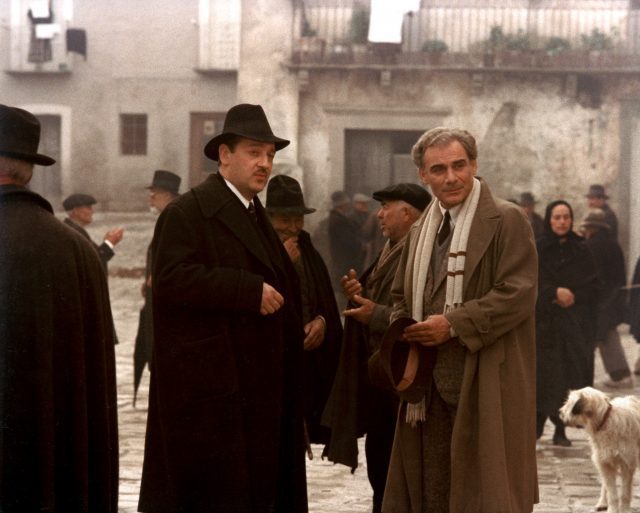
Mayor Don Luigi Magalone (Paolo Bonacelli) introduces political prisoner Carlo Levi (Gian Maria Volontè) to his remote Italian village in Christ Stopped at Eboli
CHRIST STOPPED AT EBOLI (CRISTO SI È FERMATO A EBOLI) (Francesco Rosi, 1979)
Film Forum
209 West Houston St.
April 3-18
212-727-8110 filmforum.org www.rialtopictures.com
Film Forum repertory programming director and Rialto Pictures founder and copresident Bruce Goldstein has spent some 30 years attempting to get the rights to restore and release the 220-minute television version of Francesco Rosi’s 1979 epic, Christ Stopped at Eboli. Now that he has succeeded in his personal quest for that holy grail, it’s easy to see why: The four-part foray into Fascism, faith, and forgotten peasants is a magnificent masterpiece. In 1935, Italian writer, painter, intellectualist, and anti-Fascist leader Carlo Levi (Gian Maria Volontè) was exiled to the remote mountain village of Lucania (now known as Basilicata) in the instep of Italy’s boot, where the small community lived much like its ancestors did. Levi recounted his experience there in his 1945 nonfiction novel, which Rosi adapted into a 150-minute theatrical film and the longer, more in-depth television version; the latter has its long-awaited US theatrical premiere April 3 at Film Forum in a glorious 4K restoration featuring a new translation by Michael F. Moore (who will introduce the 7:00 screening on Wednesday night).
“Christ stopped at Eboli. Where the road and the train abandon the coast and the sea, and venture into the wastelands of Lucania,” Levi says in early voiceover narration. “Christ never came here. Nor did time, the individual soul, or hope, nor did cause and effect, reason or history. No one has set foot on this land, except as a conqueror, an enemy, or an uncomprehending visitor. Today the seasons rush past over the toil of peasants, as they did three thousand years before Christ. In this dark land, without sin or redemption, where evil is not moral, but an earthly sorrow, in all things for eternity. Christ never descended. Christ stopped at Eboli.” It’s not that Jesus stopped in Eboli; he stopped at the edge of the town, without going into this godforsaken place.
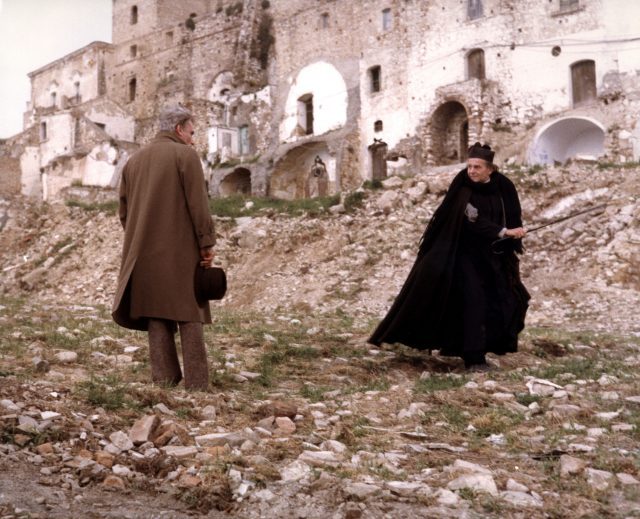
Priest Don Traiella (François Simon) shows Carlo Levi (Gian Maria Volontè) the ruins of his church in Christ Stopped at Eboli
The film opens beautifully, with a shot of one of Levi’s paintings, of a child peering over its left shoulder, mouth turned in sadness, mountains in the background, as Piero Piccioni’s lush, aching score plays underneath. (The image is on the cover of Levi’s book Le parole sono pietre, which means “Words are stones.”) Rosi cuts to Levi’s face; with his heavily gray beard and mustache and thick, wavy hair, he resembles a biblical figure. His eyes search off camera, then he shifts his head to gaze at the painting; Rosi zooms in on the child’s forlorn face, and Levi remembers. “Many years have gone by,” he says, sitting in his studio as Rosi focuses on other paintings of distraught men, women, and children. “Years of war . . . and what we call history. Tossed about by fate, I could not keep the promise I made, when I said goodbye to my peasants, that I would return. And I do not know if or when I can keep it. But closed in a room, in a closed world, I indulge in remembering that other world. Imprisoned in its pain and customs, forgotten by history, by the State, eternally patient. That land of mine, without comfort or kindness, where the peasant lives in misery and isolation, in his motionless civilization, on arid soil, in the presence of death.” It’s an elegiac moment of a man measuring regret as the narrative travels back to 1935.
Levi is a gentle soul who has accepted his temporary fate, exiled from his native Turin to the middle of nowhere in southern Italy. He is staying in a dank room with a family who occasionally gives the second bed to an old friend or a local drunk. He speaks very little, instead taking it all in with his penetrating, thoughtful eyes. He can’t fraternize with the other political prisoners in the village (its real name is Aliano; Levi calls it Gagliano), but he does have conversations with the mayor, Don Luigi Magalone (Paolo Bonacelli), a loyal Fascist who censors Levi’s letters; the priest, Don Traiella (François Simon), an alcoholic with a meager flock; and a clarinetist tax collector (played by a street cleaner from Matera) who fills Levi in on the dire situation of the peasants, who have been ignored by Rome. He goes on long walks with his new dog, Barone, who adopted Levi at the Eboli train station, but he is not allowed to go past the local cemetery.
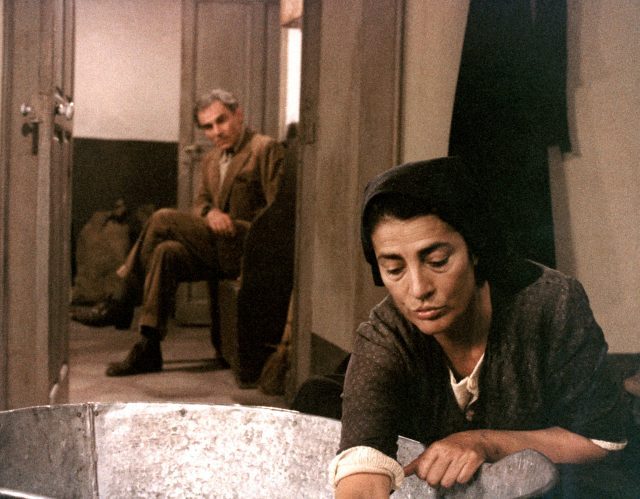
After his sister, Luisa (Lea Massari), pays him a visit, he gets better living quarters and starts painting again; he particularly wants to do a portrait of his housekeeper, Giulia Venere (Irene Papas), the only woman who is permitted to take care of his home because her virtue is already gone, as she has been pregnant seventeen times from numerous men. He takes a liking to Giulia’s young son Carmelino (Carmelo Lauria), who is curious about Levi. Meanwhile, when the townspeople find out that Levi is a doctor, they demand he treat them even though he tells them that despite his degree he has never practiced medicine. He looks around at the misery that is everywhere — gorgeously photographed by Pasqualino De Santis, using a muted, earthy palette that emphasizes the grayness that hovers over everyone as the camera focuses on a crumbling church, a small protest, the vast, desolate emptiness of the rocky landscape surrounding the village, complemented by Piccioni’s sweeping, melodramatic soundtrack — and tries to get by as basically as he can, without complaint or argument save for the occasional sly aside.
Giulia Venere (Irene Papas) is the only woman allowed to work for Carlo Levi (Gian Maria Volontè) in Francesco Rosi masterpiece
Volontè (A Fistful of Dollars, A Bullet for the General), who also appeared in Rosi’s Many Wars Ago, The Mattei Affair, Chronicle of a Death Foretold, and Lucky Luciano (which is screening at Film Forum on April 14), is impeccable as Levi, who carries himself with grace and dignity, participating in life with the peasants and holding his tongue as news reports announce Il Duce’s invasion of Abyssinia, although he sometimes can’t help but mildly scoff at many of the villagers’ uniquely strange rituals and beliefs. He recognizes his elitism but refuses to flaunt it. While Rosi (Salvatore Giuliano, Three Brothers) includes elements of neo-Realism, Christ Stopped at Eboli is a contemporary fable with surreal touches, with a cast of professional and nonprofessional actors who successfully form a cinematic community, encouraged to improvise to heighten reality. It’s a tenderly told tale of southern Italy — Rosi was born in Naples — and a town that has turned its back on a country that has turned its back on it. The film is imbued with a magical mysticism that is intoxicating; it’s clear why Goldstein spent decades trying to bring it back to life, and now it’s a gift for us all.
Spanish artist Pablo Picasso and French director Henri-Georges Clouzot collaborate on thrilling film about creative genius
THE MYSTERY OF PICASSO (Le mystère Picasso) (Henri-Georges Clouzot, 1956)
Film Forum
209 West Houston St.
Opens March 1
212-727-8110 filmforum.org milestonefilms.com
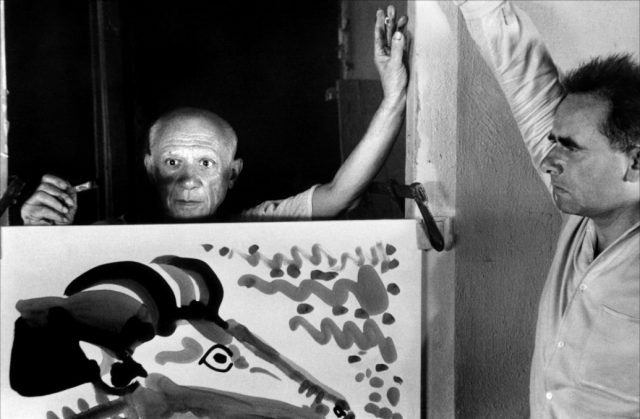
Suspense master Henri-Georges Clouzot’s The Mystery of Picasso, now playing at Film Forum in a beautiful 4K restoration from Milestone, is one of the most thrilling films ever made about art and the creative process. In the 1949 short Visit to Picasso, Belgian director Paul Haesaerts photographed Pablo Picasso painting on a glass plate. Picasso and his longtime friend Clouzot take that basic concept to the next level in The Mystery of Picasso, in which the Spanish artist uses inks that bleed through paper so Clouzot can shoot him from the other side; the works unfold like magic, evolving on camera seemingly without the genius present. “We’d give anything to have been in Rimbaud’s mind while he was writing ‘Le Bateau Ivre,’ or in Mozart’s while he was composing the Jupiter Symphony, to discover this secret mechanism that guides the creator in a perilous adventure,” Clouzot says at the beginning. “Thanks to God, what is impossible in poetry and music is attainable in painting. To find out what goes on in a painter’s head, you need to follow his hand. A painter’s adventure is an odd one!” It’s breathtaking as the pictures emerge, revealing Picasso’s remarkable command of line, altering images as he pleases with just a brushstroke or two.
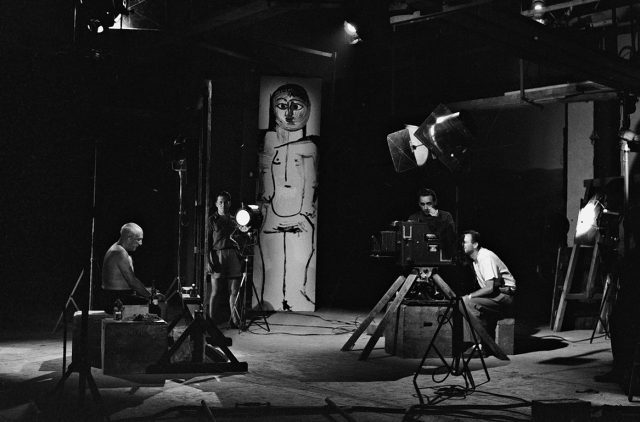
Pablo Picasso races against the clock to complete a painting as cinematographer Claude Renoir captures it all
Most of the works are accompanied by glorious music by composer Georges Auric, ranging from bold fanfares and classical lilts to jazzy riffs. (Several drawings have no music so the sounds of Picasso’s brushstrokes can be heard, a score unto itself.) Picasso is seen several times in the film, which is in black-and-white except for the colors in the paintings: Before the credits, he paints at an easel, closely examining the work with penetrating wide eyes; a moment later, he appears in a cloud of smoke (from his cigarette); in the middle, shirtless, he shows off his impressive seventy-five-year-old physique, battling the clock as Clouzot announces that a reel is running out, another camera revealing the basic method employed by Clouzot and cinematographer Claude Renoir, the nephew of filmmaker Jean Renoir and grandson of Impressionist master Auguste Renoir; and, at the end, Picasso boldly signs the film, which was shot over three months in the summer at Studios de la Victorine in Nice. (Among those stopping by to check out the progress were Jean Cocteau, Jacques Prévert, and Luis Buñuel.) At another point Picasso decides that he wants to switch from ink on paper to oil on canvas.
“I haven’t gone below the surface yet. We should go deeper. Risk all. Try to see one picture turning onto another,” he says as Clouzot (The Wages of Fear,Les Diaboliques) and Renoir (The Golden Coach, The Spy Who Loved Me) change to CinemaScope. The result is La Plage de la Garoupe, which was shot over eight days using a stop-motion technique so editor Henri Colpi could remove Picasso from the scene, since he had to make it the traditional way, in front of the canvas. All of the works were supposed to be destroyed once the film was completed, but it is rumored that a few still exist. Colpi wrote in Letters to a Young Editor that Picasso had kept many of the drawings but they were damaged in an accident involving his cat. In the final shot, Centaur, a sculpture Picasso made from such studio materials as a lens box, a light stanchion, an easel, and boxes, can be seen in the background; it is currently in the collection of the Los Angeles County Museum of Art. The Mystery of Picasso might not contain the artist’s finest works, it can feel repetitive even at seventy-five minutes, and it’s not all quite as spontaneous as it seems, but it offers a captivating look inside the mind of one of the most important and distinguished artists of the twentieth century.
 Andrey M Paounov’s Walking on Water, opening this weekend at Film Forum, reveals a lot about large-scale installation artist Christo, and you can find out even more when the Bulgarian-born eighty-four-year-old curmudgeonly religious icon / rock star participates in Q&As with Paounov on Friday and Saturday at 7:00 and Sunday at 4:45. In 1961, Christo and his wife and artistic partner, Jeanne-Claude, started creating massive public works, wrapping fabric around the entire Reichstag in Berlin, placing hundreds of yellow umbrellas in Tokyo and blue umbrellas in California concurrently, and lining the pathways of Central Park with dozens of saffron-colored gates, among other impressive spectacles that gave a pop art sheen to land art, which had been the preserve of Robert Smithson, James Turrell, and Walter De Maria, among others. In 1969, Christo and Jeanne-Claude began trying to realize The Floating Piers project, an expansive walkway that would make visitors feel like they were strolling on the water itself. Jeanne-Claude passed away in 2009, and five years later Christo became determined to make The Floating Piers a reality.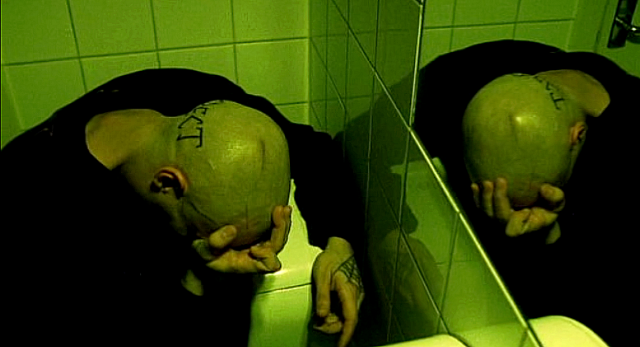
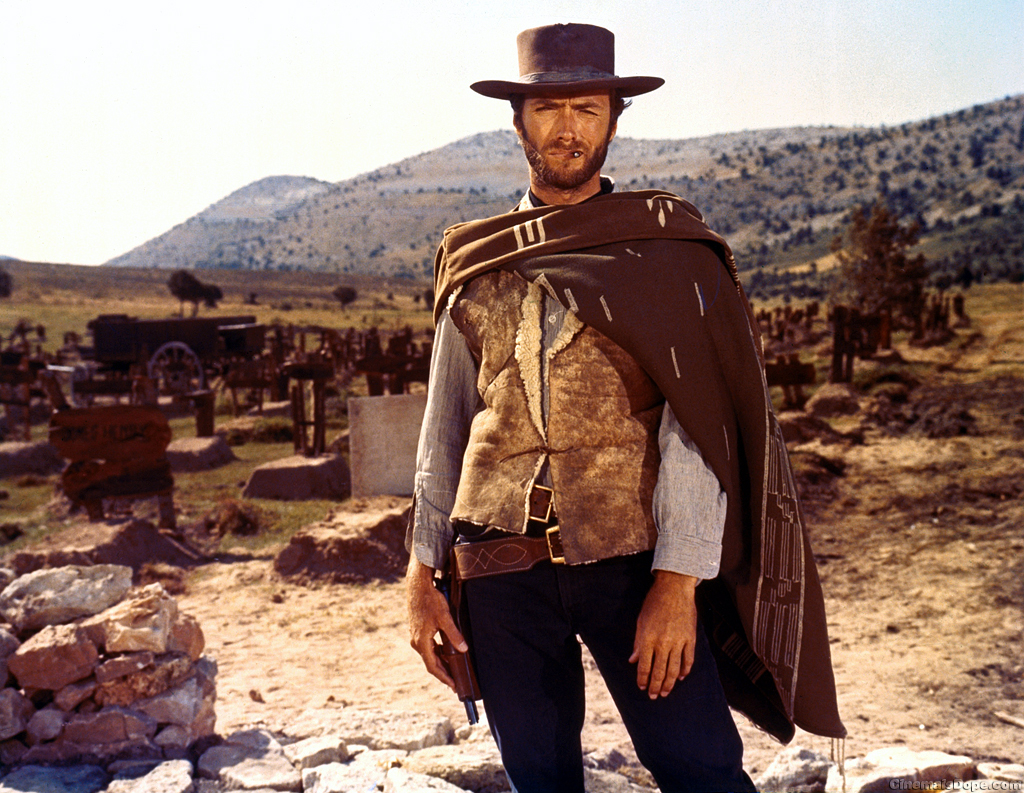
 One of the all-time-great spaghetti Westerns, Sergio Leone’s dusty three-hour operatic oater stars Clint Eastwood as the Good (Blondie), Lee Van Cleef as the Bad (Angel Eyes), and Eli Wallach as the Ugly (Tuco Benedicto Pacifico Juan Maria Ramirez, whose list of criminal offenses is a riot), three unique individuals after $200,000 in Confederate gold buried in a cemetery in the middle of nowhere. Nearly twenty minutes of never-before-seen footage was added to the film several years ago, with Wallach and Eastwood overdubbing brand-new dialogue, so if you haven’t seen it in a while, it might just be time to catch it again. Ennio Morricone’s unforgettable score and Torino delli Colli’s gorgeous widescreen cinematography were also marvelously enhanced; their work in the scene when Tuco first comes upon the graveyard will make you dizzy with delight. And then comes one of the greatest finales in cinema history. The Film Forum trilogy series continues through May 16 with official and unofficial hat tricks by Fritz Lang, Wim Wenders, Carol Reed, Whit Stillman, Lucretia Martel, Michelangelo Antonioni, Rainer Werner Fassbinder, and many others.