Tag Archives: brooklyn academy of music

BEIJING DANCE THEATER: WILD GRASS

WILD GRASS

Beijing Dance Theater returns to BAM with poetry-inspired WILD GRASS (photo by Li Huimin)

NEXT WAVE FESTIVAL
Brooklyn Academy of Music
BAM Harvey Theater
651 Fulton St. between Ashland & Rockwell Pl.
October 15-18, $20-$40, 7:30
718-636-4100
www.bam.org
www.beijingdancetheater.org

Three years ago, China’s Beijing Dance Theater made its U.S. debut with the three-part Haze, an emotional, abstract examination of environmental and economic crises that was part of BAM’s 2011 Next Wave Festival. Founded in 2008 by choreographer Wang Yuanyuan, visual artist Tan Shaoyuan, and lighting and set designer Han Jiang, BDT is back in Brooklyn for the 2014 Next Wave Festival this week with another three-part presentation, Wild Grass. In choreographing the work, which combines tradition with modernity, Wang found inspiration in Lu Xun’s seminal 1927 prose-poetry collection, Wild Grass, also known as Yecao and Weeds, which includes such poems as “The Shadow’s Leave-Taking,” “My Lost Love,” “Revenge,” “Hope,” “Snow,” “Tremors of Degradation,” and “The Awakening.” The three sections, “Dead Fire,” “Farewell, Shadows!” (aka “Farewell of the Shadow”), and “Dance of Extremity,” each of which will have a different kind of floor, delve into the nature of human spirit and perseverance. The first movement, in BDT’s own poetic description, “has burning form but no flickering. It stands frozen like corals, with black smoke curdled on its tips that makes you wonder whether it has just emerged from a house on fire — and that is why it looks burnt and dead.” That is followed by “Farewell, Shadows!,” in which “I linger between light and darkness; know not whether it is dusk or dawn. Let me raise my ashen grey hand and feign a toast; I shall journey far, far away, unbeknownst to all.” The evening concludes with “Dance of Extremity,” where “there remains only the vast wilderness; this dried couple, completely naked, sword in hand, stand in the middle. With dead men’s eyes they observe with gusto the withering passers-by in a great bloodless carnage. They are eternally plunged into life’s giddy, excruciating bliss.” Wild Grass runs October 15-18 at BAM’s Harvey Theater; on October 18, Wang will lead an afternoon class at the Mark Morris Dance Center for experienced and professional dancers ($25, 3:00).

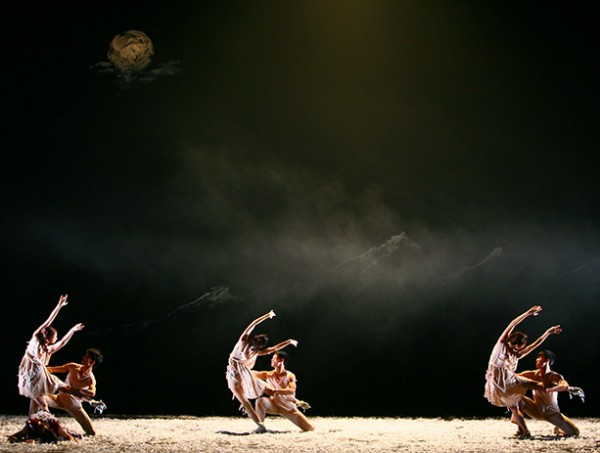
Dancers glide across the stage in “Farewell, Shadows,” second section of WILD GRASS (photo by Jan Jiang)

Dancers glide across the smooth stage in “Farewell, Shadows,” second section of WILD GRASS (photo by Jan Jiang)

Update: As with Beijing Dance Theater’s 2011 U.S. debut at BAM, Haze, the company’s 2014 Next Wave Festival presentation, Wild Grass, is very much about surface. However, while the three sections take place on three different floor surfaces, artistic director, choreographer, and cofounder Wang Yuanyuan and the dancers never quite get below the surface in the work, which was inspired by the prose poetry of writer and activist Lu Xun. The fourteen dancers are individually technically proficient, but they never really catch fire as a unit, although Wu Shanshan stands out when she invigorates the second part with passion and humor otherwise missing from the evening. At several points, it’s possible to see how the dancers prepare their bodies for what is going to happen next, like a baseball hurler telegraphing his pitches. The first movement, “Dead Fire,” set to a minimalist piano score composed by Su Cong and played by He Peixun, takes place on a standard black dance floor that is continually littered with paper confetti that evokes snow, with the moon and white-capped mountains on the backdrop; “Farewell, Shadows” features electronic music by Biosphere and Kangding Ray and a slippery white floor across which the women glide, towed by male dancers; and “Dance of Extremity” has music composed by Wang Peng, with Yahg Rui on violin and Wang Zhilin on cello, as the dancers trudge through a straw-covered field that rises slightly in one corner, where a man stands next to a hanging rope. To paraphrase what we said in our review of Haze, there’s a lot to admire about Wild Grass, but Wang never quite achieves the narrative flow she aspires to.

EMBERS

Andrew Bennett prepares to enter the mind of Henry in Samuel Beckett’s EMBERS (photo by Ros Kavanagh)

Andrew Bennett prepares to enter the mind of Henry in Samuel Beckett’s EMBERS (photo by Ros Kavanagh)

Brooklyn Academy of Music
BAM Harvey Theater
651 Fulton St. between Ashland & Rockwell Pl.
September 17-20, $35-$50
718-636-4100
www.bam.org
www.panpantheatre.com

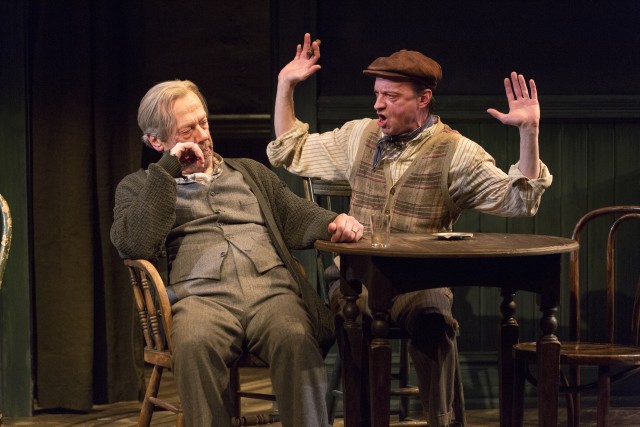
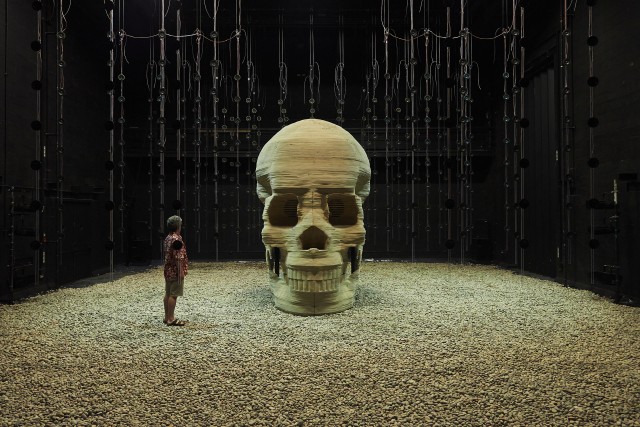
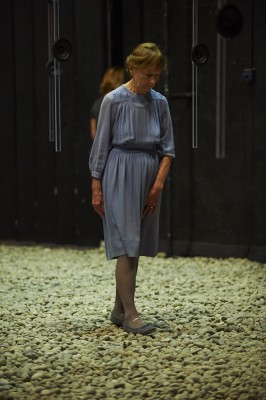
Revivals of the absurdist works of Samuel Beckett can almost always be found somewhere in the city, but there’s been a surfeit of fine productions of late, including C.I.C.T. / Théâtre des Bouffes du Nord’s Fragments at BAC, Trevor Nunn’s All That Fall with Eileen Atkins and Michael Gambon at 59E59, Krapp’s Last Tape with John Hurt at BAM, and, most famously, this year’s Broadway version of Waiting for Godot with Sirs Patrick Stewart and Ian McKellen. Now Pan Pan Theatre, based in Beckett’s hometown of Dublin, has added quite a dash of panache to their production of his second radio play, Embers, a 1959 work that Beckett himself was disappointed with; “My fault, text too difficult,” he wrote to American director Alan Schneider in a letter after its first airing. As the fifty-five-minute U.S. premiere, running at the BAM Harvey through September 20 as part of the Next Wave Festival, begins, three men and one woman walk around a stage strewn with rocks, a large object in the center covered by a tarp, as dozens of cables holding eight evenly spaced small speakers apiece dangle from the ceiling, essentially announcing that this is very much about sound. Gentle, soothing surf can be heard as one of the men pulls the tarp off the object, revealing a stunning skull. Then Andrew Bennett and Áine Ní Mhuirí step behind the skull, the former, as Henry, occasionally visible through the right eyehole, the latter, as his wife, Ada, behind the left. They remain there as Henry, in a deep, booming voice made for radio, relates stories from his life, concentrating on the mysterious death of his father, his relationship with Ada, and his thoughts about their daughter, Addie. Various phrases repeat — “white world, great trouble, not a sound,” along with calls for hooves that are answered and screams of “Christ!” that are not — in Henry’s long monologues that open and close the show, framing a conversation between husband and wife that brings up old memories.

Áine Ní Mhuirí wanders the rocky shore of memory in Peter Pan Theatre production at BAM (photo by Ros Kavanagh)

Áine Ní Mhuirí wanders the rocky shore of memory in Pan Pan Theatre production at BAM (photo by Ros Kavanagh)

“Laugh, Henry, it’s not every day I crack a joke,” Ada says. “Laugh, Henry, do that for me.” “You wish me to laugh?” he asks. “You laughed so charmingly once,” she responds. His attempt at laughter is both funny and sad as he chortles, “Any of the old charm there?” Among the stories that crop up in Henry’s mind as he contemplates his failure as a writer, father, husband, and son and his own impending death are Addie getting scolded by her piano teacher and the odd tale of Bolton and Holloway, two men who might or might not represent Henry and/or his father (as might Ada and Addie, two names that are not only oddly similar but are close to “Dad” and “Daddy”). Indeed, there is an ambiguity throughout Embers that both confuses and delights; those looking for specific meaning are unlikely to find it, much like Henry’s search through his mind-skull for the meaning of his own existence. Director Gavin Quinn keeps things visually interesting through Aedín Cosgrove’s lighting, which focuses on different parts of Andrew Clancy’s skull, and Jimmy Eadie’s sound design, which melds the lapping of the ocean with changes in Henry’s vocal pitch. Ultimately, all that is left are “embers, sound of dying, dying glow,” Henry poetically says, as death stares him in the face, as it does to each and every one of us. (For more Beckett in Brooklyn, BAM will be presenting the Royal Court Theatre’s trio of one-woman plays, Not I, Footfalls, Rockaby, October 7-12 starring Lisa Dwan and directed by longtime Beckett collaborator Walter Asmus.)

CEDAR LAKE CONTEMPORARY BALLET: TENTH ANNIVERSARY SEASON

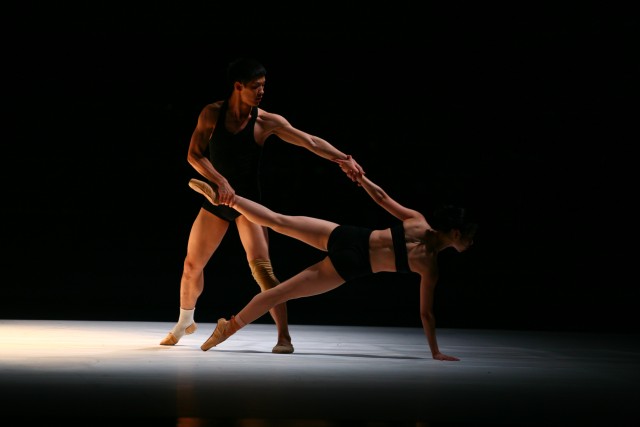
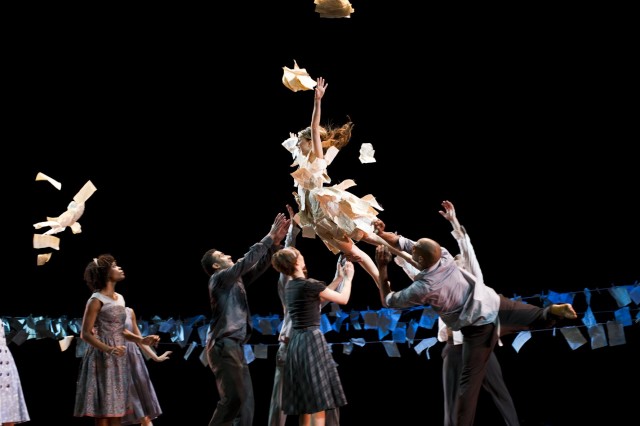
Cedar Lake will perform Jo Strømgren’s NECESSITY, AGAIN as part of tenth anniversary celebration at BAM (photo by Paula Lobo)

Cedar Lake will perform Jo Strømgren’s NECESSITY, AGAIN as part of tenth anniversary celebration at BAM (photo by Paula Lobo)

BAM Howard Gilman Opera House
30 Lafayette Ave. between Ashland Pl. & St. Felix St.
June 11-14, $20-$55, 7:30
718-636-4100
www.bam.org
www.cedarlakedance.com

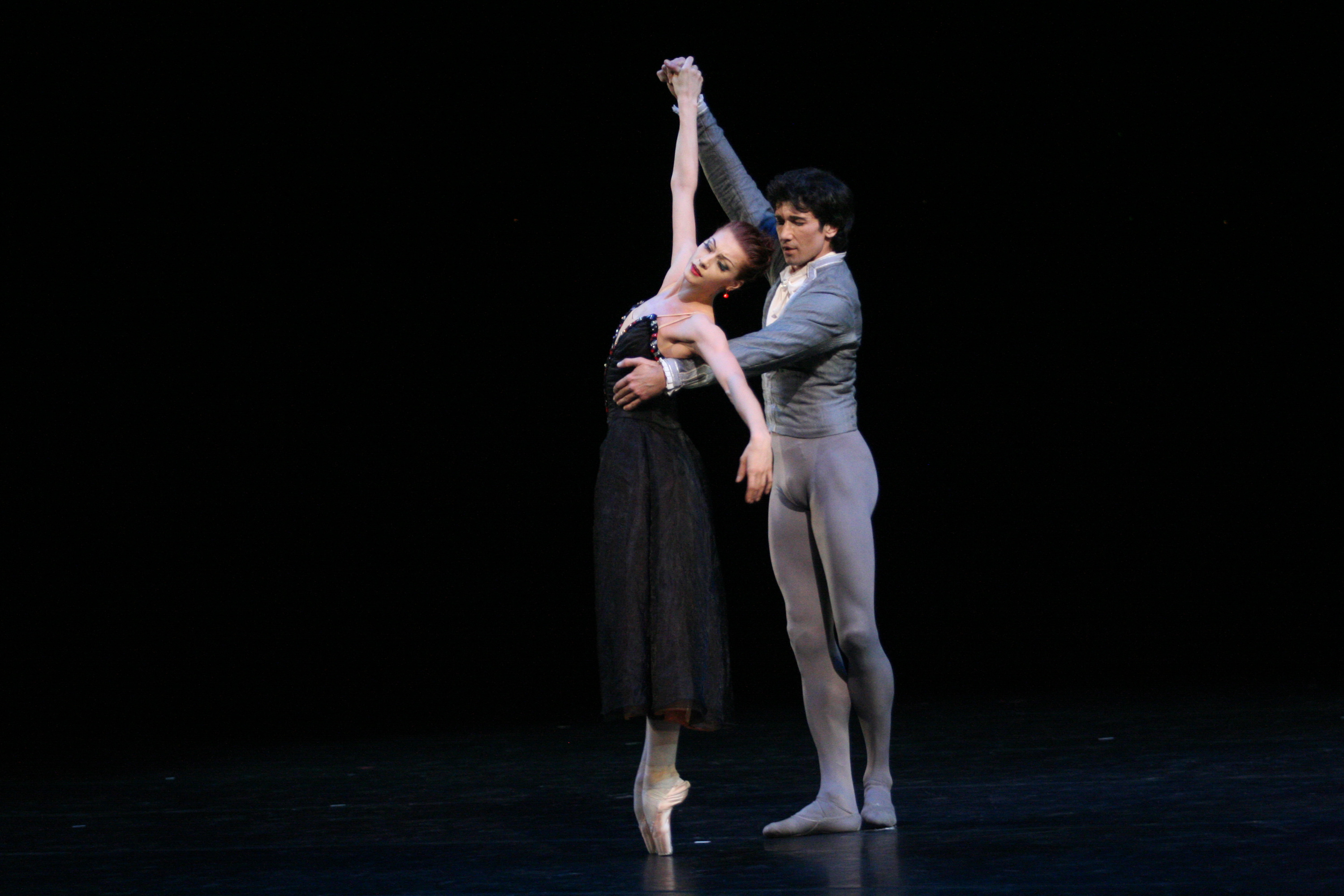
Chelsea-based Cedar Lake Contemporary Ballet is celebrating its tenth anniversary season by making its BAM debut this week. The company, which was founded by Wal-Mart heiress Nancy Laurie in 2003, is known for its intense physicality and often jaw-dropping athleticism, performing works by a wide range of international choreographers. Now under the leadership of longtime ballet master and rehearsal director Alexandria Damiani, who was recently named artistic director following Benoit-Swan Pouffer’s departure last year, the sixteen-member company will present five works over three programs June 11-14 at BAM’s Howard Gilman Opera House. The evening-length Orbo Novo (June 11 & 13), Sidi Larbi Cherkaoui’s adaptation of Dr. Jill Bolte Taylor’s book about her recovery from a stroke, is a spectacular piece, with music by Szymon Brzóska (played live by the Mosaic String Quartet) and a mind-blowing set by Alexander Dodge. Composer and choreographer Hofesh Shechter’s Violet Kid (June 12) has a postapocalyptic feel, with the score performed live by a cello, viola, and double bass ensemble. Alexander Ekman’s Tuplet (June 12 & 14) features Amith A. Chandrashaker’s lighting design with rectangular boxes, along with video projections and Mikael Karlsson’s jazzy music. Jo Strømgren’s playful Necessity, Again (June 12 & 14) includes flying papers, songs by Charles Aznavour, and text by Jacques Derrida. “The necessity to formulate everything in words, even the theme of necessity itself, is possibly a disease of our time,” Strømgren explains. “This piece is an homage to the free space between the words — to the moments when we just want to be emotional and not rational.” And associate choreographer Crystal Pite’s Grace Engine (June 14) combines Jim French’s lighting and Owen Belton’s score to let the company really show off its many strengths. (Cedar Lake will also present a free showcase of works in progress at its Chelsea headquarters July 29-30 as part of its inaugural Cedar Lab initiative, in which Cedar Lake dancers Jon Bond, Navarra Novy-Williams, Matthew Rich, Joaquim de Santana, and Vânia Doutel Vaz will create new pieces for the company.)

NOW: IN THE WINGS ON A WORLD STAGE

Kevin Spacey

Documentary goes around the world, following Kevin Spacey and company as they stage contemporary version of RICHARD III

NOW: IN THE WINGS ON A WORLD STAGE (Jeremy Whelehan, 2014)
IFC Center
323 Sixth Ave. at West Third St.
May 2-8
212-924-7771
www.ifccenter.com
www.kevinspacey.com

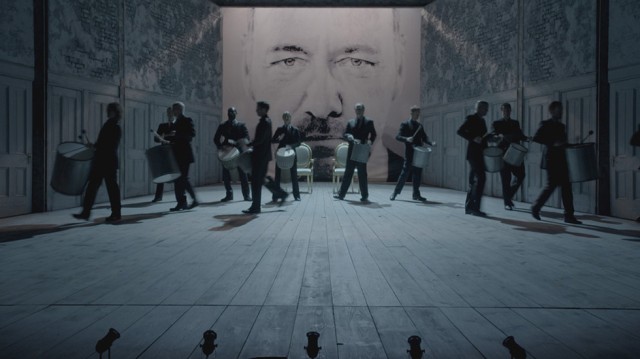
Now: In the Wings on a World Stage, the marvelous new documentary that follows a transatlantic company as it performs Richard III around the globe, did not get its name only because it’s the first word of Shakespeare’s classic tragedy — “Now is the winter of our discontent” — nor simply because it takes place in modern times in modern dress with nods to modern technology, but also because it’s a spine-tingling celebration of the immediacy of live theater. In 2009, Sam Mendes’s Neal Street Productions, the Old Vic under the leadership of Kevin Spacey, and the Brooklyn Academy of Music, led by Joseph Melillo, formed a partnership in which British and American actors would present five classic plays over three years. Dubbed the Bridge Project, the wildly successful venture concluded in 2012 with Spacey, an American living and working in London, starring in Richard III, directed by Mendes, a Brit living and working in America. It was the first time they had teamed up since 1999’s American Beauty, the Best Picture Oscar winner that also nabbed Academy Awards for Mendes (Best Director) and Spacey (Best Actor). Spacey hired first-time feature filmmaker Jeremy Whelehan, an assistant director at the Old Vic, to go behind the scenes of Richard III, following the cast and crew as they rehearse, then travel to such locations as Doha, Beijing, Istanbul, Sydney, Epidaurus, Naples, and Hong Kong before wrapping things up in Brooklyn.
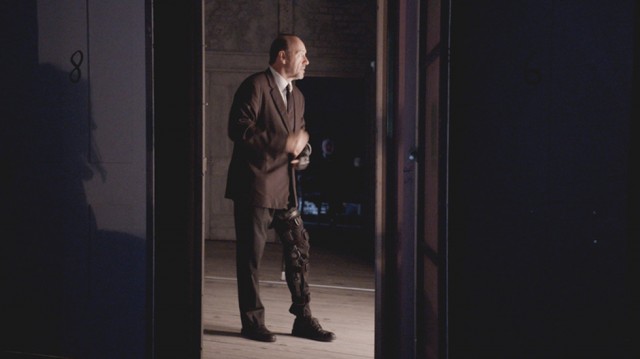
Kevin Spacey

Kevin Spacey gets ready to take the stage as Shakespeare’s most treacherous villain

Whelehan and editor Will Znidaric let the plot of the play unfold in chronological order over the course of the epic tour, which ranges from the Epidaurus Amphitheatre, the fourth-century BCE architectural wonder that seats fourteen thousand and has breathtaking acoustics, to dazzlingly modern venues in Qatar and China. In each city, the participants — which also include Gemma Jones as Queen Margaret, Haydn Gwynne as Queen Elizabeth, Chuk Iwuji as Buckingham, Jeremy Bobb as Sir William Catesby and the second murderer, Simon Lee Phillips as Norfolk, Jack Ellis as Hastings, and Annabel Scholey as Lady Anne — discuss their approach to their roles, how audiences react differently in different countries, and what it’s like to be on this theatrical journey. Whelehan shows them experimenting with different methods, applying their own makeup, joking around backstage, and enjoying some of the local culture: boating in Italy, walking along the Great Wall of China, and rolling down sand dunes in the desert. But what shines through it all is their intense love of theater, of taking this splendid production around the world, growing richer as actors and as people, forming a unique kind of special family, with Spacey as the central father figure. Spacey, who played Buckingham in Al Pacino’s 1996 documentary, Looking for Richard — and employs Richard’s style of directly addressing the audience in his hit Netflix show, House of Cards — is clearly having a blast, and his insurmountable joy and dedication are infectious. Theater is notoriously difficult to bring to the big screen, but Whelehan captures the moment, with no discontent, making viewers feel like they are onstage with the actors yet also jealous of the deep bonds they have formed. Now, which had its world premiere last month at the Tribeca Film Festival and opens at the IFC Center on May 2, will have you salivating to see — or perhaps even get involved in — live theater, which ultimately is Spacey’s goal, one that he majestically achieves. Spacey, who also is the executive producer of the film, will be at the IFC Center opening night for Q&As after the 7:00 and 7:30 shows and to introduce the 9:15 screening.

RIVER OF FUNDAMENT

(photo by Hugo Glendinning)

Matthew Barney’s five-and-a-half-hour epic debuts at BAM this week (photo by Hugo Glendinning)

Brooklyn Academy of Music
BAM Harvey Theater
651 Fulton St. between Ashland & Rockwell Pl.
February 12-16, $25-$50
718-636-4100
www.bam.org

“Crude thoughts and fierce forces are my state. I do not know who I am. Nor what I was. I cannot hear a sound. Pain is near that will be like no pain felt before,” Norman Mailer writes at the beginning of his 1983 novel, Ancient Evenings. “Is this the fear that holds the universe? Is pain the fundament? All the rivers veins of pain? The oceans my mind awash? I have a thirst like the heat of earth on fire. Mountains writhe. I see waves of flame. Washes, flashes, flashes, waves of flame.” New York-based visual artist Matthew Barney and Berlin-based composer and musician Jonathan Bepler have transformed Mailer’s seven-hundred-page epic about death and rebirth in Egypt into the five-and-a-half-hour cinematic spectacle River of Fundament, which is making its debut February 12-16 at the BAM Harvey. In his five-part, seven-hour Cremaster Cycle, Barney explored the ascension and descension of the cremaster muscle, which determines sexual differentiation, with a cast that included Mailer as Harry Houdini and Barney as Gary Gilmore in a section inspired by Mailer’s book The Executioner’s Song while focusing on cars and petroleum jelly in others.

RIVER OF FUNDAMENT is built around episodes in Los Angeles, Brooklyn, and Detroit (photo by Ivano Grasso)

RIVER OF FUNDAMENT is built around episodes in Los Angeles, Brooklyn, and Detroit (photo by Ivano Grasso)

River of Fundament begins with Mailer’s wake at an intricate reconstruction of his Brooklyn Heights home, with Mailer’s son John Buffalo Mailer playing his father’s spirit. The second act follows the reincarnation of Mailer (Milford Graves) as he is born in the River of Feces and meets medium Hathfertiti (Maggie Gyllenhaal). The third act returns to Brooklyn, with Mailer’s next reincarnation played by a 2001 Ford Crown Victoria Police Interceptor and Ellen Burstyn taking over as Hathfertiti. The primary cast also features Paul Giamatti, Cremaster star Aimee Mullins, Elaine Stritch, Lila Downs, Chief Dave Beautiful Bald Eagle, Joan La Barbara, and Madyn G. Coakley, with a multitude of cameos by Dick Cavett, Luc Sante, Larry Holmes, Salman Rushdie, Lawrence Weiner, Fran Lebowitz, Marti Domination, James Toback, David Amram, and dozens of others.

Cars once again are featured prominently in epic new Matthew Barney film (photo by Ivano Grasso)

Cars once again are featured prominently in epic new Matthew Barney film (photo by Ivano Grasso)

The action, much of which consists of filmed performance art presentations that were held in public spaces, moves from New York City to Los Angeles to Detroit as Egyptian mythology and ritual play out in unusual ways. Barney, whose multidisciplinary Cremaster exhibition at the Guggenheim in 2002-3 was one of the best of the decade, has given New Yorkers a sneak peek at the making of River of Fundament via the ”DJED” show at the Gladstone Gallery in the fall of 2011 and the wide ranging ”Subliming Vessel” at the Morgan Library last summer. Not that they gave any real indication of what to expect, because with Barney, the only thing to expect is the unexpected. And even then, don’t expect to understand what is unfurling before you.

KING LEAR

(photo by Richard Termine)

Frank Langella stars as a physically powerful Lear at BAM (photo by Richard Termine)

Brooklyn Academy of Music
BAM Harvey Theater
651 Fulton St. between Ashland & Rockwell Pl.
Through February 9, $25-$125
718-636-4100
www.bam.org

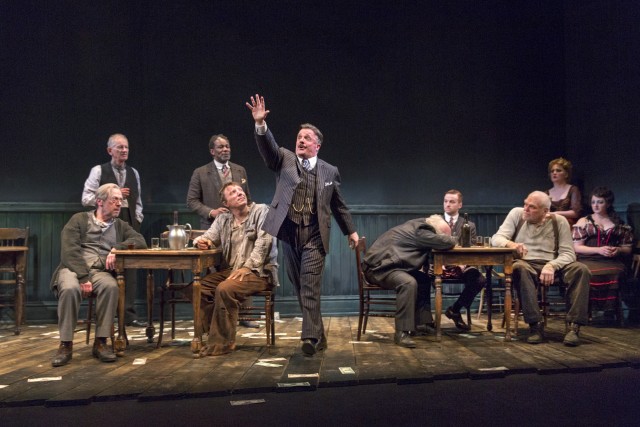
Bayonne-born Frank Langella has some rather big shoes to fill as he steps onto the stage as King Lear at BAM’s Harvey Theater, site of two recent memorable productions, the 2007 Royal Shakespeare Company version starring Sir Ian McKellen and the 2011 presentation from the Donmar Warehouse boasting Sir Derek Jacobi in the title role. But the three-time Tony winner is more than up to the task in the Chichester Festival Theatre’s intense production of Shakespeare’s greatest tragedy. Although there’s a sizable hitch in his gait when he first appears, hunched over a bit, Langella’s Lear is no feeble king at the start. There’s a strength and power to his body, the way he raises his arms and sits on the throne, that belies his seventy-six years. (In comparison, McKellen was sixty-eight when he played Lear at BAM, Jacobi seventy-four.) As he asks his daughters, Cordelia (Isabella Laughland), Goneril (Catherine McCormack), and Regan (Lauren O’Neil), to declare their love for him in return for their share of his kingdom, it’s clear Lear has not gone over the edge quite yet, even as he rails against his former favorite, Cordelia, who can only say she loves him as any daughter loves a father. But he soon feels his faculties starting to slip, begging the fool (a terrific Harry Melling), “Oh, don’t let me go mad; not mad, sweet heaven! Keep me sane. I don’t want to be mad!” But it’s too late. When Lear comes out for the second act, in tattered clothes and barefoot, wearing a ridiculous straw hat, it’s clear there’s no return from his downward spiral.

(photo by Richard Termine)

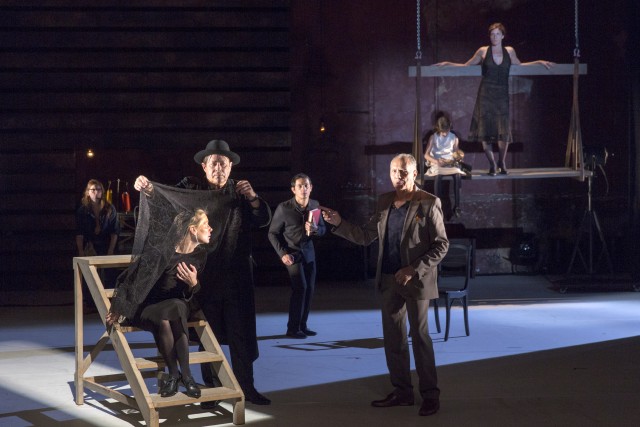
The fool (Harry Melling) and Kent (Steven Pacey) hold on to the king (Frank Langella) during brutal storm (photo by Richard Termine)

The closest Langella, who has not done a lot of Shakespeare in his long career, previously came to Lear was when Lee J. Cobb was playing the ill-fated king in 1968 at the Vivian Beaumont, in repertory with William Gibson’s A Cry of Players, in which Langella appeared as the Bard. But now that he has taken on the role himself, he attacks it with a hunger that energizes director Angus Jackson’s streamlined production. Robert Innes Hopkins’s spare set is backed by large wooden beams, some teetering, as if about to fall, like Lear. During the storm, a hard rain pours over Lear, bathed in a stunning blue light, the fool holding on to him as if trying to prevent him from melting away right then and there. Max Bennett is a splendidly conniving Edmund, while Sebastian Armesto excels as he transforms from the wronged Edgar to the wild creature Tom, leading his blinded father, Gloucester (Denis Conway), to his apparent doom. Langella’s early sturdiness makes his tragic fall all the more heartbreaking as he cradles Cordelia at the end, his body weak and frail, his mind realizing just what he’s done. It’s another memorable moment in yet another memorable Lear at the Harvey.

MLK DAY 2014

MLK Day features a host of special events and community-based service projects throughout the city (photo by twi-ny/mdr)

Multiple venues
Monday, January 21
www.mlkday.gov

In 1983, the third Monday in January was officially recognized as Martin Luther King, Jr. Day, honoring the birthday of the civil rights leader who was assassinated in Memphis on April 4, 1968. Dr. King would have turned eighty-five this month, and you can celebrate his legacy tomorrow by participating in a Martin Luther King, Jr. Day of Service project or attending one of several special events taking place around the city. BAM’s twenty-eighth annual free Brooklyn Tribute to Dr. Martin Luther King, Jr. includes a keynote speech by Angela Davis, live performances by José James and the Christian Cultural Center Choir, the NYCHA Saratoga Village Community Center student exhibit “Picture the Dream,” and a screening of Shola Lynch’s 2012 documentary Free Angela and All Political Prisoners. The JCC in Manhattan will host an MLK Day blood drive and “The Living Legacy of Dr. King,” consisting of the panel discussion “Leading a Socially Responsible Life” with Ruth Messinger, Harrie Bakst, and Rabbi Joanna Samuels, interactive workshops for teens, and the “Artists Celebrate the Living Legacy of Dr. King” performance with Judith Sloan, Susannah Heschel, and Joshua Nelson, the Prince of Kosher Gospel. (Admission is free but preregistration is recommended.)

The Museum of the Moving Image is screening THE NEGRO AND THE AMERICAN PROMISE on MLK Day

The Museum of the Moving Image is screening THE NEGRO AND THE AMERICAN PROMISE on MLK Day

The Museum of the Moving Image will be open on MLK Day, with two screenings of the 1963 documentary The Negro and the American Promise as part of its “Changing the Picture” series (free with museum admission). The Children’s Museum of Manhattan will teach kids about King’s legacy with the “Martin’s Mosaic” workshop, the “Heroic Heroines: Ruby Bridges” book talk, and live performances by the National Jazz Museum in Harlem All Stars Band, while the Brooklyn Children’s Museum has such special hands-on crafts programs as “Let’s March!,” “Let’s Join Hands,” and “Dream Clouds” and live music from the Berean Community Drumline. And the Museum at Eldridge Street will be hosting a free reading of Eloise Greenfield and Jan Spivey Gilchrist’s picture book The Great Migration: Journey to the North.