Tag Archives: brooklyn academy of music

REFUSE THE HOUR

(photo by John Hodgkiss)

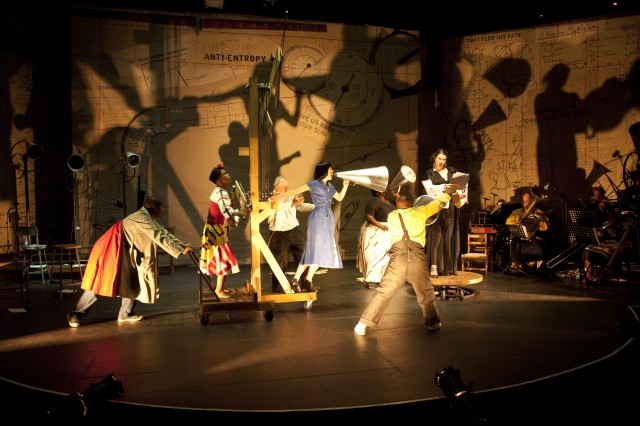
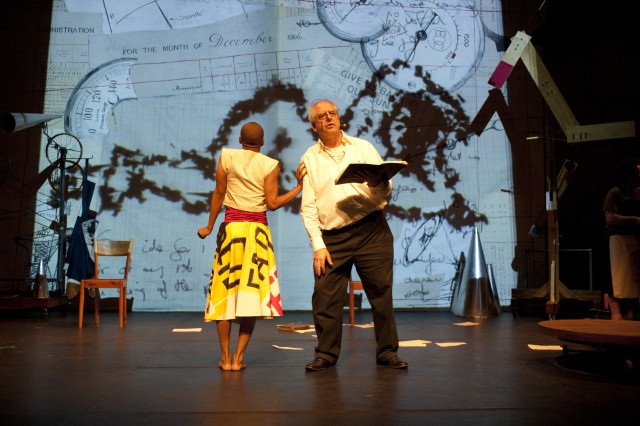
William Kentridge leads a troupe of dancers, vocalists, and musicians through a multimedia journey into the concept of time and space in REFUSE THE HOUR (photo by John Hodgkiss)

NEXT WAVE FESTIVAL
Brooklyn Academy of Music
BAM Harvey Theater
651 Fulton St.
October 22-25, $52-$110
718-636-4100
www.bam.org

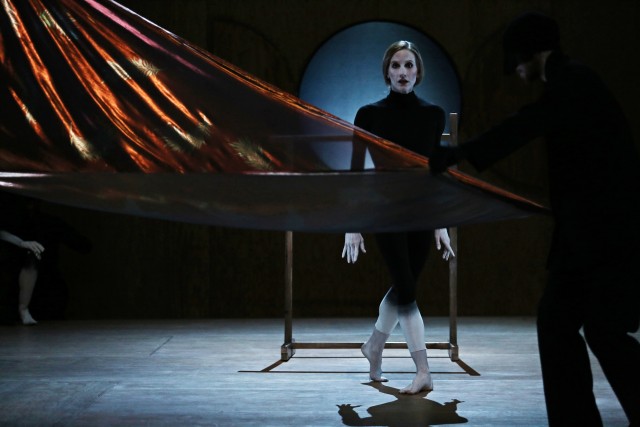
At one point in William Kentridge’s multimedia, multidisciplinary chamber opera, Refiuse the Hour, projections of three large metronomes all move at different speeds, an apt metaphor for the eighty-minute piece as a whole, a wildly inventive and unpredictable presentation of sounds and images built around such concepts as time, anti-entropy, science, and art in addition to coincidence and fate. “I walk around the studio, waiting for these fragments that have come in to appear, and make sense, repeating the elements again and again,” Kentridge says, standing onstage in his trademark white button-down shirt and black pants and shoes in front of a projection of himself walking through his studio. The dialogue, with dramaturgy by Harvard history of science and physics professor Peter Galison, collides with the imagery in abstract ways, as beautiful and mesmerizing as it is confusing and chaotic. Kentridge serves as storyteller, discussing the Perseus myth and black holes, as well as a kind of conductor — the hand of the artist is often visible in his drawings and films — interacting with kinetic sculptures and the other members of the cast, which include dancer and choreographer Dada Masilo, vocalists Ann Masina and Joanna Dudley, actor Thato Motlhaolwa, and musicians Adam Howard, Tlale Makhene, Waldo Alexander, Dan Selsick, Vicenzo Pasquariello, and Thobeka Thukane, performing a score by Kentridge’s longtime collaborator, composer Philip Miller. Meanwhile, a percussion kit hangs from above, mysteriously chiming in. Sabine Theunissen’s ragtag set feels right at home at the BAM Harvey, wonderfully integrating Catherine Meyburgh’s video design, Greta Goiris’s costumes, and Luc de Wit’s choreographed movement of humans and machines. A companion piece to his immersive, deeply intellectual yet playful exhibition “The Refusal of Time,” Refuse the Hour refuses categorization, instead leading the audience down a dramatic rabbit hole where science and art intersect in a complex yet delightful symphony of words, images, movement, and music. “Can we hold our breath against time?” Kentridge asks. Refuse the Hour is nothing if not breathtaking itself, challenging the notion of performance as only Kentridge can. (For more on Kentridge’s current invasion of New York City, go here.)

ANTIGONE

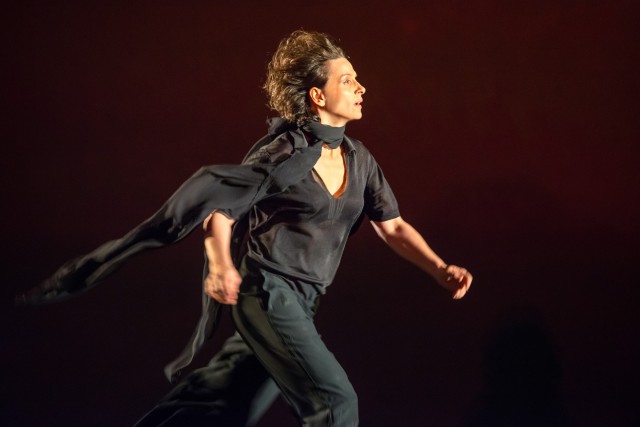
Juliette Binoche fights a chill wind in ANTIGONE (photo by Stephanie Berger)

Juliette Binoche fights a chill wind in ANTIGONE at BAM (photo by Stephanie Berger)

NEXT WAVE FESTIVAL
Brooklyn Academy of Music
BAM Harvey Theater
651 Fulton St. between Ashland & Rockwell Pl.
Through October 4, $30-$135
718-636-4100
www.bam.org

A chill runs through Belgian director Ivo van Hove’s adaptation of Sophokles’s classic tragedy Antigone, continuing through October 4 at BAM’s Harvey Theater. The sizzling-hot van Hove, who has dazzled audiences and critics alike with his recent, unusual presentations of Scenes from a Marriage, Angels in America, and Cries and Whispers, has stripped down the tale of power, family, loyalty, and responsibility in a new translation by Canadian poet Anne Carson (Agamemnon, Electra) that emphasizes the story’s relevance to today’s politics. As the play opens, Antigone (Juliette Binoche, who was last at BAM in 2009 in In-I), clad in black, is fighting off a brisk wind with her sister, Ismene (Kirsty Bushell). Their two brothers have killed each other in the Theban civil war fighting on opposite sides, Eteocles a hero, Polyneices a traitor. The new king, Kreon (Patrick O’Kane), has decreed that Polyneices’s body should be left outside to rot, but Antigone is determined to give her sibling a proper burial, although the punishment for doing so is death. Upon discovering that his niece and future daughter-in-law — Antigone’s father was Kreon’s brother, and she is engaged to marry Kreon’s son, Haimon (Samuel Edward-Cook) — has indeed buried Polyneices, Kreon shows no mercy, commanding Antigone’s execution, as well as that of anyone who supports her. Kreon’s chief adviser, Teiresias (Finbar Lynch), wants him to rethink his position, but Kreon is just as stubborn as Antigone, and it doesn’t take long for the bodies to start piling up.

(photo by Stephanie Berger)

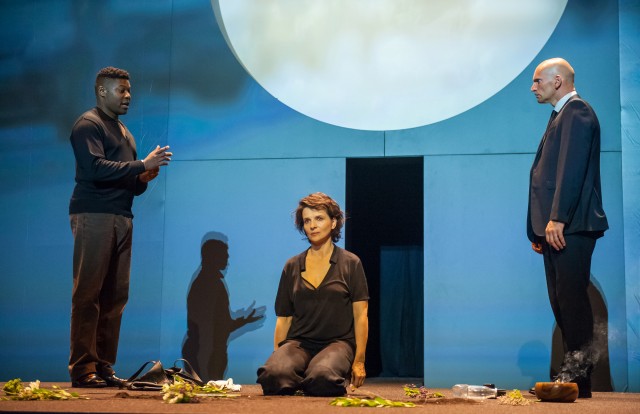
The guard (Obi Abili) and the king (Patrick O’Kane) look over Antigone (Juliette Binoche) at BAM (photo by Stephanie Berger)

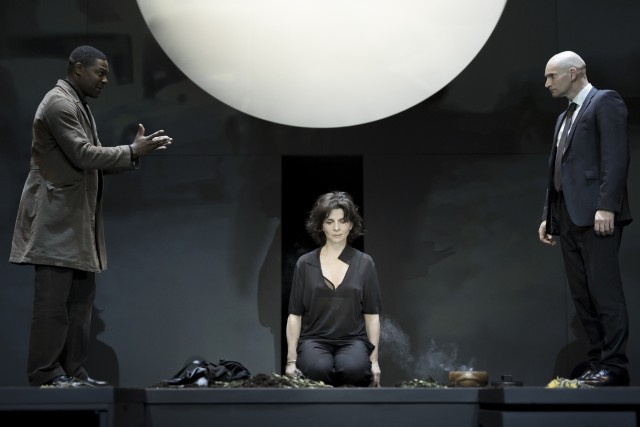
Jan Versweyveld’s stage features a giant circle at the top of the back wall that rotates to reveal a projection of sky and clouds, as if the gods are looking down, judging the trials and tribulations of humanity. In the center of the floor is a rectangular platform that sinks to serve as a grave, lowering Polyneices and Antigone down toward hell and rising up again; it is perpendicular to a narrow walkway and opening used by Kreon, as if he is emerging from the lair of the gods. At the front of the stage is a leather couch, congruent with the costumes by An d’Huys — the men are mainly in suits and jackets as if attending a board meeting. Binoche and O’Kane make fine adversaries, though Antigone shouts too much, and Kreon changes moods a little too randomly. All of the actors except for O’Kane also double as the Greek chorus, who never speak as a unit. Carson’s script contains several contemporary phrases that elicit chuckles from the audience at inopportune moments, and Tal Yarden’s projections are hit-or-miss; the scenes of the vast desert work well, while video of ghostly figures making their way through a present-day city is confusing and feels out of place, though the last shot is effective. Meanwhile, the score weaves in and out of music by Morton Feldman, Arvo Pärt, Henryk Gorecki, and Dmitri Shostakovich before concluding with a sonic blast from longtime BAM favorite Lou Reed as van Hove attempts to relate this story of the state vs. the individual to the twenty-first century. Overall, he only partly succeeds, but by never quite providing the audience with an emotional connection to the characters or narrative, this Antigone will leave you feeling a little too cold. (The September 29 performance will be followed by a talk with Binoche and other members of the company, free for same-day ticket holders.)

BAM NEXT WAVE FESTIVAL 2015

Juliette Binoche stars in new adaptation of ANTIGONE as part of BAM Next Wave Festival (photo by Jan Versweyveld)

Juliette Binoche stars in new adaptation of ANTIGONE as part of BAM Next Wave Festival (photo by Jan Versweyveld)

Brooklyn Academy of Music
BAM Howard Gilman Opera House, 30 Lafayette Ave.
BAM Harvey Theater, 651 Fulton St.
BAM Fisher, 321 Ashland Pl.
September 16 – December 20, $20-$135
718-636-4100
www.bam.org

Every fall, we practically move into BAM for its annual Next Wave Festival, three months of exciting, challenging, and cutting-edge dance, music, theater, and other arts. And this year is no exception, with a roster of events that has us salivating. The star attraction is Ivo van Hove’s Antigone, a multimedia adaptation of Sophokles’s classic Greek tragedy in a new colloquial translation by Anne Carson and featuring Oscar winner Juliette Binoche in the title role. Other theater highlights are Stan Douglas and Chris Haddock’s multimedia stage noir, Helen Lawrence; Carl Hancock Rux’s The Exalted, about German-Jewish writer and art historian Carl Einstein, genocide, and genealogy, directed by Anne Bogart and with live music by Theo Bleckman; Royal Shakespeare Company actor Paterson Joseph portraying Charles “Sancho” Ignatius in the one-man show Sancho: An Act of Remembrance; and John Jahnke and Hotel Savant’s Alas, the Nymphs, a modern reimagination of the story of Greek mythological figure Hylas.

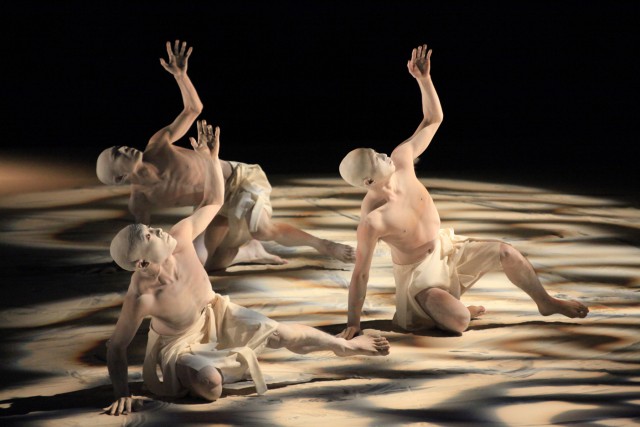
Sankai Juku returns to BAM for the first time in ten years with UMUSUNA (photo courtesy of Sankai Juku)

Sankai Juku returns to BAM for the first time since 2006 with UMUSUNA (photo courtesy of Sankai Juku)

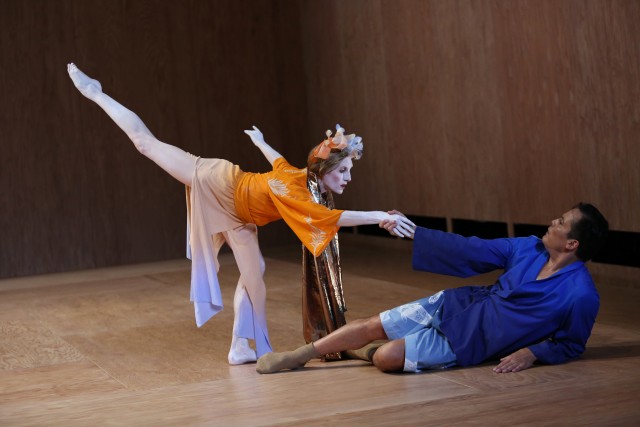
The dance lineup at the 2015 Next Wave Festival is extraordinary as always, led by the return of German choreographer Sasha Waltz with Continu, a wild piece of dance theater set to Edgard Varèse’s “Arcana,” and Japanese Butoh troupe Sankai Juku’s Umusuna: Memories Before History, Ushio Amagatsu’s meditative exploration of history through fire, water, air, and earth. The season also includes Finnish choreographer Kenneth Kvarnström’s experimental Tape, the Cloud Gate Dance Theatre of Taiwan’s Rice, U-Theatre’s Beyond Time, Souleymane Badolo’s Yimbégré, Urban Bush Women’s Walking with ’Trane, Mark Morris’s annual holiday favorite The Hard Nut, and Wendy Whelan and Jock Soto in David Michalek’s Hagoromo, with choreography by David Neumann, puppetry by Chris M. Green, and Nathan Davis’s score performed live by the International Contemporary Ensemble.

William Kentridge stars in his multimedia opera REFUSE THE HOUR (photo by John Hodgkiss)

William Kentridge stars in his multimedia opera REFUSE THE HOUR (photo by John Hodgkiss)

The music program features one of the most unusual works, Kid Koala’s adaptation of his graphic novel Nufonia Must Fall, about a robot in love with an office mate, for which Kid Koala will be joined by the Afiara Quartet. In All Vows, cellist Maya Beiser teams up with bassist Jherek Bischoff, drummer Zachary Alford, and filmmaker Bill Morrison. Timur and the Dime Museum say a glam farewell to the environment in Collapse. In Real Enemies, Darcy James Argue and his Secret Society big band join forces with filmmaker Peter Nigrini, writer-director Isaac Butler, and designer Maruti Evans to delve into American conspiracy theories. South African genius William Kentridge is back at BAM with the multimedia opera Refuse the Hour, a companion piece to his immersive “Refusal of Time” installation recently acquired by the Met. Drummer Jim White and Sasha Waltz & Guests dancer Claudia de Serpa Soares perform on one side of a two-way mirror in More up a tree. And Steppenwolf cofounder Terry Kinney turns Portland indie group Other Lives’ stage show into a multimedia experience. Tickets are going fast — Miranda July’s participatory New Society is already sold out, as is Théâtre de l’Atelier’s Savannah Bay, both of which take place at the small BAM Fisher, where all tickets are always a mere $25 — so don’t hesitate if you want to catch some of these fab presentations.

RadioLoveFest — SELECTED SHORTS: UNCHARTED TERRITORIES

Hope Davis, Bobby Cannavale, and Parker Posey will participate in thirtieth anniversary of Selected Shorts at BAM

Hope Davis, Bobby Cannavale, and Parker Posey will participate in thirtieth anniversary of Selected Shorts at BAM

Brooklyn Academy of Music
BAM Harvey Theater
651 Fulton St. between Ashland & Rockwell Pl.
Saturday, May 9, $30, 7:30
Festival runs through May 10
718-636-4100
www.bam.org
www.symphonyspace.org

BAM’s second annual RadioLoveFest, a collaboration presented with WNYC, continues with a special Selected Shorts evening celebrating the thirtieth anniversary of the popular Symphony Space series in which a roster of film and theater actors reads short fiction. On May 9 at 7:30, Hope Davis (American Splendor, In Treatment), Bobby Cannavale (Blue Jasmine, The Motherfucker with the Hat), Parker Posey (The House of Yes, Broken English), and host Robert Sean Leonard (The Music Man, House, M.D.) will focus on works dealing with unexpected encounters. RadioLoveFest continues through May 10 with such other programs as Hilary Frank’s “Speed Dating for Mom Friends,” Glynn Washington’s “Snap Judgment LIVE!,” Anna Sale’s “Death, Sex & Money,” John Schaefer’s “Mexrrissey: Mexico Loves Morrissey,” and “Leonard Lopate & Locavores: Brooklyn as a Brand.”

THE ICEMAN COMETH

(photo by Richard Termine)

Theodore “Hickey” Hickman (Nathan Lane) dispenses a whole lot more than just free drinks in THE ICEMAN COMETH (photo by Richard Termine)

Brooklyn Academy of Music
BAM Harvey Theater
651 Fulton St. between Ashland & Rockwell Pl.
Through March 15, $35-$180
BAM Talk with Brian Denney and Nathan Lane, moderated by Linda Winer, $25, 7:30
718-636-4100
www.bam.org

You’d be hard-pressed to find a sorrier collection of forgotten men, real or fictitious, than the group of pathetic drunks populating Eugene O’Neill’s great American tragedy, The Iceman Cometh, now enjoying a stirring four-hour, forty-five-minute revival at BAM (if the word “enjoy” can be used in describing this staggering work in any way). Written in 1939 but not produced until after WWII, in 1946, the play opens with most of a ragtag bunch of bums asleep on tables in Harry Hope’s (Stephen Ouimette) Last Chance Saloon and rooming house on the Bowery, awaiting the annual arrival of Theodore “Hickey” Hickman (Nathan Lane), a traveling salesman who comes to the bar once a year to celebrate Harry’s birthday by buying drinks for everyone. While the other poor souls are passed out, former anarchist Larry Slade (Brian Dennehy), pouring himself another shot of whiskey, tells bartender Rocky Pioggi (Salvatore Inzerillo), “I’ll be glad to pay up — tomorrow. And I know my fellow inmates will promise the same. They’ve all a touching credulity concerning tomorrows. It’ll be a great day for them, tomorrow — the Feast of All Fools, with brass bands playing! Their ships will come in, loaded to the gunwales with cancelled regrets and promises fulfilled and clean slates and new leases!” A moment later, Rocky, who speaks in a tough dem and doze New Yorkese, says to Larry, “De old Foolosopher, like Hickey calls yuh, ain’t yuh? I s’pose you don’t fall for no pipe dream?” To which Larry explains, “I don’t, no. Mine are all dead and buried behind me. What’s before me is the comforting fact that death is a fine long sleep, and I’m damned tired, and it can’t come too soon for me.”

That mood of hopelessness sets the tone of the play, with Larry the leading “Foolosopher” of men whose pipe dreams have long since turned into nightmares, with nothing to look forward to except the next, preferably free, drink. Slowly but surely, the others awake, wondering where Hickey is. “I was dreamin’ Hickey come in de door, crackin’ one of dem drummer’s jokes, wavin’ a big bankroll and we was all goin’ be drunk for two weeks. Wake up and no luck,” gambler Joe Mott (John Douglas Thompson) opines. Also arising are Hope, circus man Ed Mosher (Larry Neumann Jr.), Harvard Law alum Willie Oban (John Hoogenakker), former Boer Commando General Piet Wetjoen (John Judd), former British Infantry Captain Cecil Lewis (John Reeger), former anarchist editor Hugo Kalmar (Lee Wilkof), young former anarchist Don Parritt (Patrick Andrews), and former war correspondent James Cameron, better known as “Jimmy Tomorrow” (James Harms). But these men — along with day bartender Chuck Morello (Marc Grapey), his prostitute girlfriend, Cora (Kate Arrington), and two streetwalkers who work for Chuck, Margie (Lee Stark) and Pearl (Tara Sissom) — have long ago run out of tomorrows. So they spend their days and nights slowly drinking themselves to death, some hanging on to those pipe dreams, waiting for Hickey like Vladimir and Estragon will do a few years later in Samuel Beckett’s Waiting for Godot, except in this case, Godot/Hickey shows up, waving a wad of bills and waking everyone up — but it turns out to be not nearly as satisfying as they were anticipating.

Harry Hope (Stephen Ouimette) and Ed Mosher (Larry Neumann Jr.)  are holding on to their pipe dreams in THE ICEMAN COMETH (photo by Richard Termine)

Harry Hope (Stephen Ouimette) and Ed Mosher (Larry Neumann Jr.) try to hold on to their pipe dreams in a downtrodden Bowery bar (photo by Richard Termine)

Dressed in a sharp suit and wearing an even more impressive smile, Hickey bursts in at the end of act one, but he is not quite the good-time guy they have all come to know. Instead, Hickey is no longer drinking, and he has arrived with a message for each and every one of his minions, determined to tell them the truth about their sad lives. He is like a boisterous Bill W., the traveling stock speculator who founded Alcoholics Anonymous. He’s going to buy them all drinks but make them pay in other ways, forcing them to look at what they’ve become. “If anyone wants to get drunk, if that’s the only way they can be happy, and feel at peace with themselves, why the hell shouldn’t they? They have my full and entire sympathy,” Hickey tells Harry. “I know all about that game from soup to nuts. I’m the guy that wrote the book. The only reason I’ve quit is — well, I finally had the guts to face myself and throw overboard the damned lying pipe dream that’d been making me miserable, and do what I had to do for the happiness of all concerned — and then all at once I found I was at peace with myself and I didn’t need booze any more. That’s all there was to it.” Of course, that’s not all there is to it, as is revealed during the next three acts.

(photo by Richard Termine)

Larry Slade (Brian Dennehy) is determined to drink himself to death in Eugene O’Neill’s classic American tragedy (photo by Richard Termine)

In 1990, Chicago’s Goodman Theatre staged a revival of The Iceman Cometh, directed by Robert Falls and starring Dennehy as Hickey. More than twenty years later, Dennehy told longtime collaborator Falls that he wanted to play Larry in a new production. Upon hearing that, Lane contacted Falls, explaining that he had always dreamed of playing Hickey. The show was a huge success in Chicago in 2012, and it is now a huge success at BAM, where it fits in wonderfully with the Harvey’s artfully distressed shabby chic interior. The Harvey doesn’t usually use a curtain, but it does so for The Iceman Cometh, revealing a different set for each act, designed by Kevin Depinet (inspired by John Conklin); there is actually an audible gasp when the third act begins in the main bar area, shown in an unusual narrow perspective leading to a doorway that offers a kind of freedom — and real life — that no one in the play seems to want. Natasha Katz’s lighting design often keeps things in the dark, echoing the lost dreams of these miserable characters. This nearly five-hour production, with three full intermissions, might be epic in scope, but it is beautifully paced by Falls, never dragging, instead moving with a sometimes exhilarating gait.

Dennehy (Love Letters, Death of a Salesman) fully captures the heartbreaking duality that exists inside Larry, a clearly intelligent man who has given up his reason for being, someone who could make a difference in the life of all those around him — especially Don, who is seeking him out as a father figure — but he has instead buried himself in the bottle. Lane (It’s Only a Play, The Nance) shines as Hickey, bringing an exuberance to the role that occasionally goes over the top, particularly in the final monologue, not quite hitting its darker quality, but he and Dennehy have a beguiling camaraderie together in these iconic roles. (The play premiered on Broadway in 1946 and has been revived on the Great White Way in 1973, 1985, and 1999; over the years, Hickey has been portrayed by James Barton, James Earl Jones, Dennehy, Lee Marvin, Kevin Spacey, and, most famously, Jason Robards onstage and on film, while Slade has been played by Robert Ryan, James Cromwell, Conrad Bain, Tim Pigott-Smith, and Patrick Stewart.) The Iceman Cometh has never been an easy show to put on or to sit through; don’t be surprised when you see a handful of people exiting the theater and hailing cabs at each intermission. But it’s their loss, as this is a staggering production that looks deeply into the heart of America with a raw honesty that compels audiences to look deep into their own hearts as well.

THE MARIINSKY AT BAM

IN THE NIGHT (photo by N. Razina)

Jerome Robbins’s IN THE NIGHT is part of Chopin evening presented by the Mariinsky Ballet at BAM (photo by N. Razina)

BAM Howard Gilman Opera House
Peter Jay Sharp Building
230 Lafayette Ave.
January 14-25, $30-$185
718-636-4100
www.bam.org
www.mariinsky.ru/en

Now in its 232nd season, the Mariinsky Theatre in St. Petersburg has been home to Balanchine and Baryshnikov, Nijinsky and Nureyev. This month the Mariinsky Opera, Ballet, Orchestra, and Chorus will settle in for an exciting residency at the Brooklyn Academy of Music with four presentations January 14-25 that speak to its past, present, and future. On January 14, artistic director Valery Gergiev will conduct Rodion Shchedrin’s The Enchanted Wanderer, based on tale by Nikolai Leskov. The production is directed by Alexei Stepanyuk, with sets by Alexander Orlov, costumes by Irina Cherednikova, and choreography by Dmitry Korneyev. The Enchanted Wanderer is followed January 15-23 by Pyotr Tchaikovsky’s Swan Lake, a longtime staple that was originally choreographed by Marius Petipa and Lev Ivanov in 1895 and then revised in 1950 by Konstantin Sergeyev. Gergiev and Gavriel Heine conduct; the libretto is by Vladimir Begichev and Vasily Geltzer, with sets by Igor Ivanov and costumes by Galina Solovyova. Among the performers are Mariinsky principal dancers Viktoria Tereshkina, Ulyana Lopatkina, Yevgeny Ivanchenko, Yekaterina Kondaurova, and Vladimir Shklyarov, depending on which night you go. The Mariinsky’s 2002 production of Sergei Prokofiev’s Cinderella glides into BAM’s Howard Gilman Opera House January 17-20, choreographed by Alexei Ratmansky and conducted by Gergiev; the libretto is by Nikolai Volkov inspired by Charles Perrault’s fairy tale, with sets by Ilya Utkin and Yevgeny Monakhov and costumes by Elena Markovskaya. Principal dancers include Kondaurova, Shklyarov, and Diana Vishneva. The Russian invasion concludes January 24-25 with Chopin: Dances for Piano, comprising Michel Fokine’s 1908 Chopiniana, Jerome Robbins’s 1970 In the Night, and Benjamin Millepied’s 2011 Without, all set to the music of Frédéric Chopin, with Gergiev serving as musical director and Alexandra Zhilina, Liudmila Sveshnikova, and Philipp Kopachevsky taking turns at the piano. Principal dancers include Shklyarov, Kondaurova, Ivanchenko, and Lopatkina.

THÉÂTRE DE LA VILLE: SIX CHARACTERS IN SEARCH OF AN AUTHOR

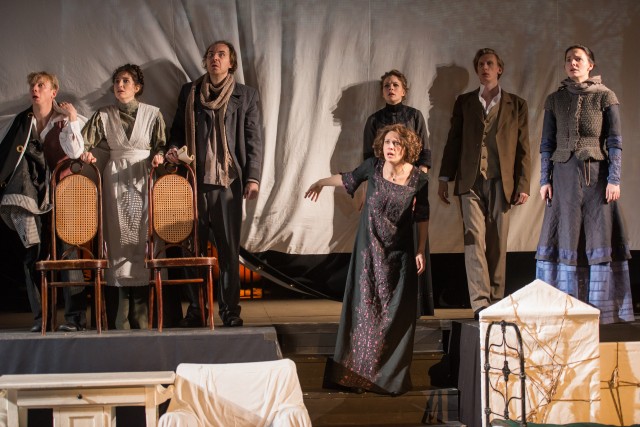
Théâtre de la Ville is back at BAM with an awe-inspiring production of Luigi Pirandello’s absurdist masterpiece (photo by Jean-Louis Fernandez)

Théâtre de la Ville is back at BAM with an awe-inspiring production of Luigi Pirandello’s absurdist masterpiece (photo by Richard Termine)

2014 NEXT WAVE FESTIVAL
Brooklyn Academy of Music
BAM Harvey Theater
651 Fulton St. between Ashland & Rockwell Pl.
October 29 – November 2, $20-$75
718-636-4100
www.bam.org
www.theatredelaville-paris.com

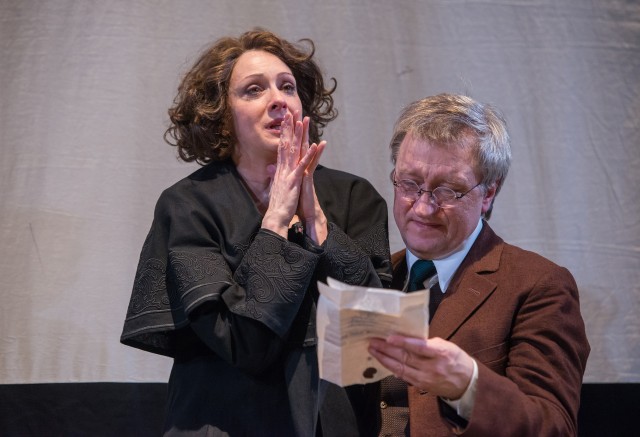
As audience members begin filing into the BAM Harvey to see Théâtre de la Ville’s awe-inspiring production of Luigi Pirandello’s absurdist classic Six Characters in Search of an Author, there is already a man onstage, suspended from above, painting a trompe-l’oeil blue sky backdrop; he is soon joined by a young woman who sits at a sewing machine, making costumes while quietly singing “O sole mio.” These two actions subtly announce that what we are about to see is artifice — what Pirandello called “the theater of the theater” — albeit multilayered artifice of the very highest order. For the next two hours, we are treated to a rapturous display of intensely clever stagecraft, filled with self-referential jokes about the theater, intellectual discussions of illusion vs. reality, and a search for nothing less than the very meaning of existence. A dictatorial director (Alain Libolt) is preparing his cast and crew to rehearse the second act of Pirandello’s The Rules of the Game when six mysterious people, all dressed in black, suddenly appear, claiming to be fictional characters abandoned by their author and now seeking a place where they can tell their story, which is the whole reason for their being. The director, the stage manager (Gérald Maillet), the actors (Charles-Roger Bour, Sandra Faure, Olivier Le Borgne, and Gaëlle Guillou), the carpenter (Pascal Vuillemot), and the assistant (Jauris Casanova) are at first dubious of the six strangers, but soon the father (Hugues Quester) convinces them to hear them out, so they delve into a soap-opera-like tale of faded love, mourning, incest, sibling rivalry, and horrific tragedy also involving the sexy stepdaughter (Valérie Dashwood), the grieving mother (Sarah Karbasnikoff), the estranged son (Stéphane Krähenbühl), the awkward teenager (Walter N’Guyen), and the adorable little girl (Sierra Blanco).

Glorious production seeks to life the veil on some of the many mysteries of the theater (photo by Richard Termine)

Glorious production seeks to lift the veil on some of the many mysteries of the theater (photo by Richard Termine)

No one onstage has a name, save for the surprise arrival of Madame Pace (Céline Carrère); everyone else represents a stock character determined to experience their individual purpose, their raison d’être, whether in the play, the play-within-a-play, or the play-within-a-play-within-a-play. There are no rules to this sly game directed by Théâtre de la Ville head Emmanuel Demarcy-Mota, who was last at BAM in October 2012 with another delightful absurdist classic, Eugène Ionesco’s Rhinocéros. This is his third time staging Six Characters in Search of an Author, and he clearly knows his way around this existential journey of life as theater, and theater as life, expertly translated and adapted by François Regnault. The cast is uniformly excellent, led by Libolt, Dashwood, and Quester, who won the Critics’ Award for Best Actor for Théâtre de la Ville’s original 2001 production. Throughout the play, which is itself, of course, set in a theater, various characters look out at the seats, which to them are empty but to the actors playing them are filled with onlookers, furthering the self-referential nature of the show and the relationships between actor and audience, creator and creation. The director even references the subtitles at one point, reminding everyone that this is, at its most basic, an Italian play put on by a French company in an American city. Every moment is pure genius, a palimpsest of metas that keep piling on in glorious ways, a celebration of just what the theater can do and be, from behind the scenes to the last row of the balcony.