Tag Archives: brooklyn academy of music

DanceAfrica — SENEGAL: DOORS OF ANCIENT FUTURES

WAATO SiITA will be celebrating its native Senegal at DanceAfrica at BAM this weekend (photo courtesy of the artist)

WAATO SiiTA will be celebrating its native Senegal at DanceAfrica at BAM this weekend (photo courtesy of the artist)

Brooklyn Academy of Music
BAM Howard Gilman Opera House, BAMcafé, BAM Rose Cinemas
30 Lafayette Ave. between Ashland Pl. & St. Felix St.
May 27-30, free – $60
718-636-4100
www.bam.org

For its thirty-ninth season, BAM’s extraordinary DanceAfrica program takes audiences to Senegal, celebrating “Doors of Ancient Futures.” The Memorial Day weekend festivities, under the leadership of new artistic director Abdel R. Salaam (from Forces of Nature) and beloved artistic director emeritus Chuck Davis, feature performances in the Howard Gilman Opera House by the Senegalese troupes Les Ballets de la Renaissance Africaine “WAATO SiiTA” and Compagnie Tenane, Senegalese legend Germaine Acogny (“the Mother of Contemporary African Dance”), and Brooklyn’s own BAM/Restoration DanceAfrica Ensemble, joined by Forces of Nature founding member Dyane Harvey-Salaam and Reverend Nafisa Sharriff. Be on the lookout for both traditional and contemporary movement, including krumping, popping, and breakdancing. There will also be a late-night dance party May 28 in the BAMcafé with DJ Tony Humphries, workshops on May 30 with WAATO SiiTA choreographer Pape Moussa Sonko, a FilmAfrica series consisting of ten films screening in BAM Rose Cinemas (including Nicolas Cissé’s Le Terreau de L’Espoir, Yared Zeleke’s Lamb, and Jason Silverman and Samba Gadjigo’s Sembene!), and the oh-so-fab outdoor DanceAfrica Bazaar (May 28-30), chock-full of vendors selling African products, from clothing and music to jewelry and food.

THE JUDAS KISS

(photo by Richard Termine)

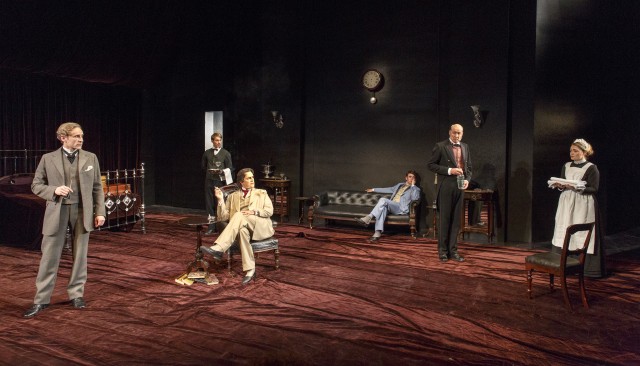
Oscar Wilde (Rupert Everett) contemplates what might be his last night of freedom in THE JUDAS KISS (photo by Richard Termine)

Brooklyn Academy of Music
BAM Harvey Theater
651 Fulton St.
Tuesday – Sunday through June 12, $30-$125
718-636-4100
www.bam.org

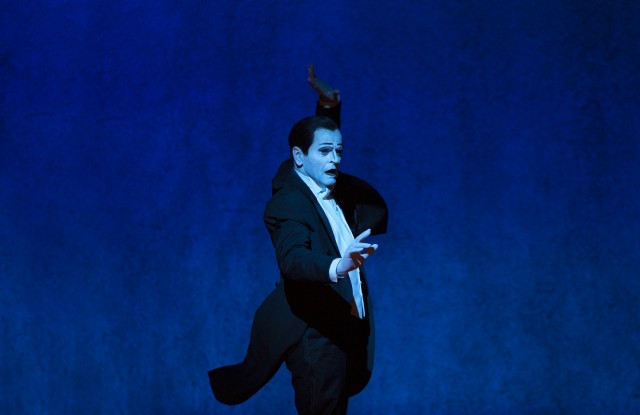
David Hare’s The Judas Kiss is a tale of two plays in more ways than one. The inaugural production in 1998 in London and on Broadway, starring Liam Neeson as Oscar Wilde, was such a critical flop that even Hare (Plenty, Skylight) himself admitted it was a failure. However, seeking to gain support for a film he wrote about Wilde, English actor Rupert Everett helped mount a 2012 revival of The Judas Kiss that has been garnering significantly better reviews as it tours the UK and Canada and has now settled in for a one-month run at the BAM Harvey through June 12. Everett (My Best Friend’s Wedding, An Ideal Husband) is triumphant as Wilde, but the disconnect between the first and second acts still prevents the play from being a complete success. (Interestingly, Hare made no changes to the script for this revival.) The Judas Kiss opens on April 5, 1895, at the Cadogan Hotel, as the staff, randy hotel employees Arthur Wellesley (Elliot Balchin) and Phoebe Cane (Jessie Hills) under the guidance of the staid and proper valet Sandy Moffat (Alister Cameron), prepares for the arrival of Wilde, who is being tried for “acts of gross indecency” by the Marquess of Queensberry, the father of Wilde’s lover, Lord Alfred Douglas (Charlie Rowe), affectionately known as Bosie. Wilde’s manager and former lover, Robert Ross (Cal MacAninch) soon arrives and the conflict is set in motion: Ross wants Wilde to leave England immediately in order to escape prosecution, while Bosie wants him to stay and fight the charges, as a way for the young lad to stand up to his father. “It appears that the whole of London is fleeing. I looked from my coach. Every invert in the metropolitan area is now packing his bags and heading for France,” Wilde says. “It is a veritable mass migration. I’d never imagined diaspora could be on this scale. The takings at certain fashionable restaurants will tonight be counted in pennies. At a single stroke, the opera will be stone-dead as an art form.” But before choosing his course of action, Wilde explains what is most important. “Let us be realistic. In the name of our common humanity, let us get our priorities straight. Let us pause, let us make the seminal decision: it seems that I still have time for my lunch.” Slapstick comedy mixes with graver matters of freedom and love as Ross and Bosie argue over Wilde’s fate and a phalanx of reporters attempts to storm the hotel. Through it all, Wilde is both witty and effete, courteous and haughty, but time is clearly running out on him, as evidenced by the clock in the room, which has no hands.

(photo by Richard Termine)

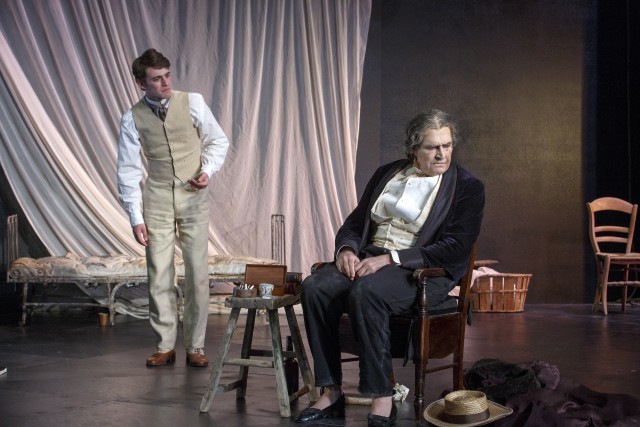
Bosie (Charlie Rowe) and Oscar Wilde (Rupert Everett) face some harsh realities in David Hare revival at BAM (photo by Richard Termine)

The second act is dreary and dour, set two years later in a ramshackle hotel in Naples. Recently released from Reading Gaol, Wilde looks decades older, barely able to move out of his chair. He is joined by Bosie and Bosie’s latest lover, local fisherman Galileo Masconi (Tom Colley), who casually walks around completely naked before sitting on the floor and eating a sugared bun still au naturel. “Oh, it’s wonderful, it’s like a child, isn’t it?” Wilde says, staring lustily at Galileo. “Who said one can never go back? If only I could go back to that! If I ever was like that! Like an animal, like a cat. Truly, one should throw him a ball of string. Look at the little fellow.” But there is no going back for Wilde, now a sad, nearly penniless recluse, wasting away in Italy. “There is no morality in what is called morality; there is no sense in what is called sense; and least of all is there meaning in what is held to be meaning,” he tells Bosie. Director Neil Armfield (Diary of a Madman, Exit the King) can’t quite find the right balance between the engaging first act and the more stationary second act, relying too much on Everett’s towering presence even as he shrinks away. But Everett’s performance makes this Judas Kiss more than worthy; he plays the role with relish and panache, breathing exciting life into a familiar figure, bringing humanity to an often caricatured personality. (In preparing for the role, he even slept in Wilde’s old room at the Cadogan.) You can’t take your eyes off him, whether he’s enjoying champagne and lobster, trapped in his chair, or seen in an enveloping shadow on the wall. (The lighting is by Rick Fisher, sets by Dale Ferguson.) Alan John’s soundtrack is relatively unnecessary; at times it was so soft and distant that it appeared to be a cell phone going off in the audience. But the play remains as relevant as ever, with the continuing controversies and bullying over gay marriage and LGBTQ discrimination. “Just a century ago a man — Oscar — could be imprisoned and ruined — killed off, basically — simply for being gay,” Everett wrote in a recent column for the New York Times, referring to the legalization of same-sex marriage in England. “But tonight a homosexual stood on equal ground with the rest of society, and I was, quite unexpectedly, extremely moved.” So it’s a genuine treat to have Wilde, in the personage of Everett, back at BAM, where, in 1882 in the institution’s original home on Montague St., Wilde spoke as part of his North American lecture tour.

KING AND COUNTRY — SHAKESPEARE’S GREAT CYCLE OF KINGS: RICHARD II AND HENRY V

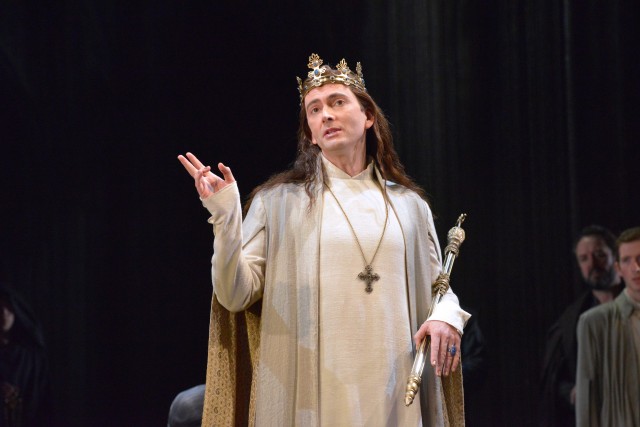
David Tennant wears the crown in RSC production of RICHARD II at BAM (photo by Richard Termine)

David Tennant wears the crown in RSC production of RICHARD II at BAM (photo by Richard Termine)

Brooklyn Academy of Music
BAM Harvey Theater
651 Fulton St.
Richard II: April 26 & 29
Henry V: April 24 & 28
Cycle continues through May 1, $30-$200
718-636-4100
www.bam.org

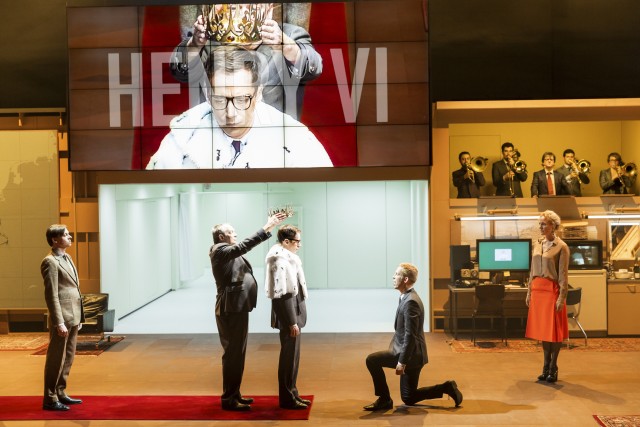
Marathons and binge-watching are nothing new to the Royal Shakespeare Company, incorporated in 1875 as the Shakespeare Memorial Theatre. In 2011, the RSC presented five shows at the Park Avenue Armory, part of the Lincoln Center Festival (Julius Caesar, As You Like It, King Lear, Romeo and Juliet, and The Winter’s Tale). The RSC has now taken over the BAM Harvey Theater in Fort Greene, where it is honoring the four hundredth anniversary of the death of the Bard with the four history plays that make up the Henriad, the continuing tales of the House of Lancaster. “King and Country: Shakespeare’s Great Cycle of Kings” begins with Richard II, featuring a fabulous David Tennant in the title role, portraying the dandy king with a bittersweet bisexual abandon and more than a touch of Jesus. The Duke of Gloucester is dead, and Henry Bolingbroke (Jasper Britton), Richard’s cousin, accuses Thomas Mowbray, the Duke of Norfolk (Christopher Middleton), of treason and murder. An almost-duel, exile, return, and revolt ensue, as Henry plots to take back the throne that he believes belongs to him, while Richard becomes obsessed with battling Ireland. Directed, as all four shows are, by Gregory Doran on a spare stage designed by Stephen Brimson Lewis, Richard II, which is told completely in verse, boasts particularly fine performances by Julian Glover as John of Gaunt, Oliver Ford Davies as the Duke of York, and Nicholas Gerard-Martin as Bagot, in addition to Britton, Middleton, and Tennant, the last following a long line of actors playing Richard II onstage (the play has never been made into a film), including John Gielgud, Paul Scofield, Derek Jacobi, Kevin Spacey, Mark Rylance, and Eddie Redmayne. Tennant (Doctor Who, Broadchurch, Jennifer Jones), who played the title character in Doran’s 2008 staging of Hamlet with Patrick Stewart as his father, is utterly charming as the frolicking king, his every step a delight even as everything starts falling apart around him. Above the audience stage right, trumpeters Chris Seddon, Andrew Stone-Fewings, and James Stretton announce scenes, while at stage left sopranos Charlotte Ashley, Helena Raeburn, and Alexandra Saunders sing as a chorus. (The music is by Paul Englishby.) The ending sets up the next two shows, Henry IV, Part I and Henry IV, Part II, with Britton again playing the ascendant ruler.

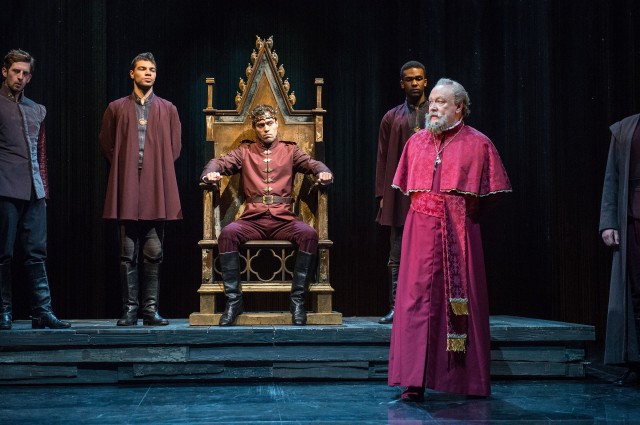
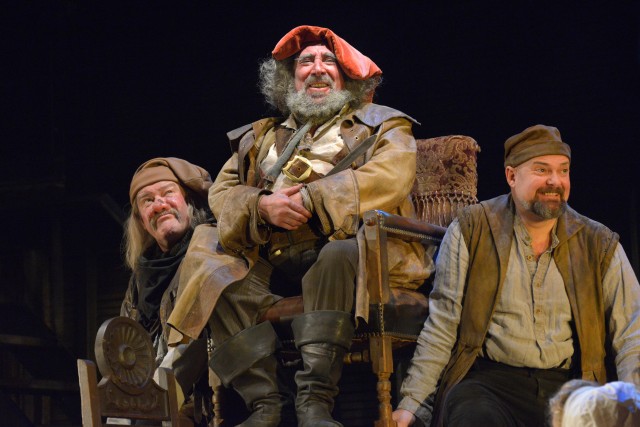
Alex Hassell takes the throne as Henry V in final work in Shakespeare’s Henriad (photo by Stephanie Berger)

Alex Hassell takes the throne as Henry V in final work in Shakespeare’s Henriad (photo © Stephanie Berger)

The Henriad concludes with Henry V, as Alex Hassell, who played Prince Hal in both parts of Henry IV, does a stern turn as the king, who is determined to take over France, regardless of what the Archbishop of Canterbury (Jim Hooper) and others might say. Meanwhile, the daffy dauphin (Robert Gilbert) essentially dares Henry to bring it on, even as King Charles VI (Simon Thorp) and Queen Isobel (Jane Lapotaire) of France consider other options, as does their daughter, the princess Katherine (Jennifer Kirby). Joining the fray on Henry’s side are Bardolph (Joshua Richards), Nym (Middleton), Pistol (Antony Byrne), and Mistress Quickly (Sarah Parks), who are renewing their purpose in life now that their leader, Sir John Falstaff, has died. It all comes to a head at the epic Battle of Agincourt, staged in marvelous minimalism by Doran. “We few, we happy few, we band of brothers; / For he to-day that sheds his blood with me / Shall be my brother,” Henry declares in the famous St. Crispin’s Day speech. As in Richard II, projections give depth and atmosphere to the surroundings, along with live music, and the acting is impeccable, with Hassell adding his name to a regal roster of Henrys that boasts Ralph Richardson, Laurence Olivier, Richard Burton, Ian Holm, Timothy Dalton, Kenneth Branagh, Tom Hiddleston, and Jude Law. Davies nearly steals the show as the self-aware chorus, a narrator in modern dress who introduces scenes, entering and leaving the drama, watching events unfold while giving such explanations as “Piece out our imperfections with your thoughts; / Into a thousand parts divide on man, / And make imaginary puissance; / Think when we talk of horses, that you see them / Printing their proud hoofs i’ the receiving earth; / For ’tis your thoughts that now must deck our kings, / Carry them here and there; jumping o’er times, / Turning the accomplishment of many years / Into an hour-glass: for the which supply, / Admit me Chorus to this history; / Who prologue-like your humble patience pray, / Gently to hear, kindly to judge, our play.” We can indeed judge the play kindly, bringing the Henriad to a memorable conclusion. All four works have at least two more performances each at BAM, where you can also see the exhibition “King and Country: Treasures from the Folger,” consisting of rare paper artifacts from the Folger Shakespeare Library in Washington, DC.

KING AND COUNTRY: SHAKESPEARE’S GREAT CYCLE OF KINGS

David Tennant stars as Richard II in Royal Shakespeare Company production at BAM (photo by Keith Pattison)

David Tennant stars as Richard II in Royal Shakespeare Company production coming to BAM (photo by Keith Pattison)

Brooklyn Academy of Music
BAM Harvey Theater
651 Fulton St.
March 24 – May 1, $30-$200
718-636-4100
www.bam.org

In a letter to his mistress, Lady Emma Hamilton, in 1800, Admiral Horatio Nelson wrote, “My greatest happiness is to serve my gracious King and Country, and I am envious only of glory; for if it be a sin to covet glory, I am the most offending soul alive.” BAM references that famous quote in its glorious program “King and Country: Shakespeare’s Great Cycle of Kings,” and it would be a sin not to covet it. In honor of the quadricentennial of the passing of William Shakespeare, who died in 1616 at the age of fifty-two, BAM has teamed up with the Royal Shakespeare Company and the Ohio State University to present the Henriad, four Shakespeare plays in repertory at the BAM Harvey over the course of thirty-nine days, concentrating on Kings Henry IV and V. All four works are directed by RSC artistic director Gregory Doran, with sets by Stephen Brimson Lewis, lighting by Tim Mitchell, music by Paul English, sound by Martin Slavin, movement by Michael Ashcroft, and fights by Terry King. David Tennant (Doctor Who, Broadchurch, Jessica Jones), who played the title character in Doran’s 2008 staging of Hamlet with Patrick Stewart as his father, has the lead role in Richard II, with Julian Glover as John of Gaunt, Leigh Quinn as the queen, Oliver Ford Davies as the duke of York, Sarah Parks as the duchess of York, and Jasper Britton as John of Gaunt’s son, later to become Henry IV. Britton continues his role in Henry IV, Part I, and Henry IV, Part II, with Alex Hassell as Prince Hal, Martin Bassindale as Peto and Prince John, Antony Sher (Doran’s longtime partner) as Sir John Falstaff, Parks as Mistress Quickly, and Sam Marks as Ned Poins. And Hassell then takes the throne in Henry V, with Jim Hooper as the archbishop of Canterbury, Simon Thorp as King Charles VI of France, Jane Lapotaire as Queen Isobel, Quinn as lady-in-waiting Alice, and Marks as the French constable.

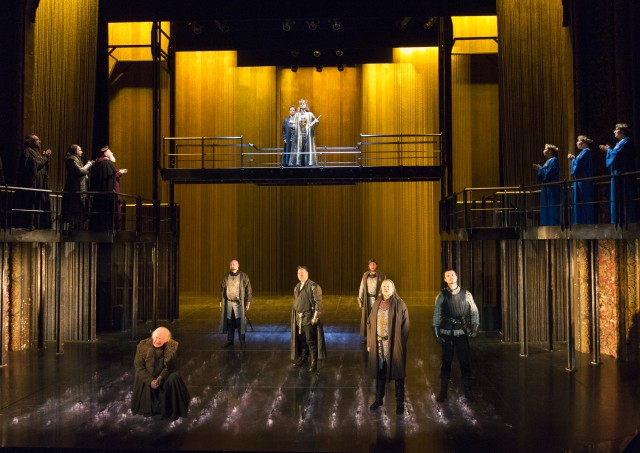
HENRY IV, PART I is one of four RSC plays running at BAM through May 1 (photo by Keith Pattison)

HENRY IV, PART I is one of four RSC plays running at BAM through May 1 (photo by Keith Pattison)

“The Henriad plays are a contemplation of power and leadership — how they are acquired, maintained, and lost,” BAM publicist Christian Barclay writes in a program essay. “A host of historical and fictional characters — both high- and lowborn — revolve around the monarchs in shifting alliances. . . . The Henriad is a study of the difficult personal and ethical choices that accompany political life.” In conjunction with the plays, the Mark Morris Dance Center is hosting the master class “Embodying Shakespeare” on April 5 with Owen Horsley, Hassell, and Quinn ($25, 2:00), Doran will be in conversation with Shakespeare scholar James Shapiro on April 7 at BAMcafé ($20, 6:00), Neil Kutner, Ryan Gastelum, and Ben Tyreman will participate in the seminar “Behind the Scenes: King and Country” at BAM Fisher on April 20 ($35, 5:00), astronomer Summer Ash will lead guided tours of the sky with telescopes in “A Look at the Stars: Shakespeare and the Cosmos” April 15-17 on the BAM Fisher rooftop terrace (free, 8:30 or 9:30), and the exhibition “King and Country: Treasures from the Folger,” consisting of rare paper artifacts from the Folger Shakespeare Library in Washington, DC, will be on view at the Harvey during the run of the performances. Tickets for the shows and the special events are going quickly, so act now if you want to catch any or all of what should be a glorious Shakespeare spectacle to covet.

THE CHERRY ORCHARD

(photo ©Stephanie Berger)

Lev Dodin and the Maly Drama Theatre of St. Petersburg inject the comedy back into THE CHERRY ORCHARD (photo © Stephanie Berger)

Brooklyn Academy of Music
BAM Harvey Theater
651 Fulton St. at Ashland Pl.
Through February 27, 7:30
718-636-4100
www.bam.org

In 1904, shortly after witnessing the premiere of what would be his last play, The Cherry Orchard, directed by Konstantin Stanislavski at the Moscow Art Theatre, Anton Chekhov wrote to his wife, Olga, who was playing Madame Ranevskaya, “Stanislavski has ruined my play. Oh well, I don’t suppose anything can be done about it.” Although the play was a hit, Chekhov believed it to be a comedy with farcical elements, while Stanislavski, who later became famous for his method acting system, staged it as a tragedy. But now innovative Siberian-born Russian theater director Lev Dodin has indeed done something about it, something wonderful, presenting The Cherry Orchard in all its (tragi)comic glory, continuing at BAM through February 27. Dodin and his St. Petersburg-based Maly Drama Theatre previously brought Uncle Vanya to BAM in 2010, followed by Three Sisters in 2012. For their version of The Cherry Orchard, which was named Best Large Scale Drama at Russia’s prestigious Golden Mask festival last year, Dodin and set designer Aleksander Borovsky have transformed the charmingly pseudo-dilapidated environment of the BAM Harvey into the formerly extravagant home of Madame Lyubov Ranevskaya (Ksenia Rappoport). Every seat is wrapped in a linen seat cover, evoking the ghostly white sheets draped over the family’s furniture gathered on the floor at the foot of the stage, from a billiards table, a bed, a piano, and a bookcase to chairs for some of the audience members, who occasionally find members of the cast sitting next to them. Lyubov has just been called home from Paris because the estate’s centerpiece, a lush, beautiful, well-known cherry orchard, is being put up for auction to help pay off the family’s debts. While Lyubov, her brother, Gayev (alternately played by Igor Chernevich and Sergei Vlasov), her biological daughter, Anya (Danna Abyzova), and her adopted daughter, Varya (Elizaveta Boiarskaia), go on about the past, don’t seriously consider the future, and flirt around with perpetual student Petr Trofimov (Oleg Ryazantsev), clerk Semen Yepikhodov (Andrei Kondratiev), and merchant Yermolai Lopakhin (Danila Kozlovskiy), only Lopakhin has come up with a plan of action. Lopakhin, a wealthy man whose father was a serf on the cherry orchard, tries to convince the family to chop down the trees and turn the area into summer rental cottages, or dachas, but Lyubov and Gayev fail to recognize what’s happening in the present, and throughout Russia, stuck in their old aristocratic ways and ignoring the oncoming revolution. Even when they lose the orchard and the estate at auction, they don’t truly understand the consequences as the victor celebrates his spoils.

(photo ©Stephanie Berger)

Madame Lyubov Ranevskaya (Ksenia Rappoport) and her brother, Gayev (Igor Chernevich) face the end of an era in fabulous new production of Chekhov classic (photo © Stephanie Berger)

In his 2005 book, Journey without End: Reflections and Memoirs, the Siberian-born Dodin wrote in a chapter entitled “Why I Don’t Direct Comedies”: “I am interested not in comic situations but in the amusement of self-recognition, even when it is tinged with anguish.” That is precisely how he approaches The Cherry Orchard, which boasts grand comic gestures amid the sadness. The uniformly outstanding cast — some of whom make their way up and down the orchestra steps at the Harvey, delivering lines while standing right next to audience members, Damir Ismagilov’s lighting illuminating sections of the crowd — also features Tatiana Shestakova as the governess, Charlotta; Andrei Kondratiev as Semen Yepikhodov, a clerk; Arina Von Ribben as Dunyasha, the piano-playing housemaid; Stanislav Nikolskii as Yasha, the young manservant; and a fabulously funny Sergei Kuryshev as Firs, the aging manservant who shuffles about ever-so-slowly while moaning about the good old days when he was an abused and mistreated slave. Rappoport is superb as Madame Lyubov, always dressed in black, in constant mourning for the drowning death of her son but occasionally getting caught up in silent slapstick, but the dapper Kozlovskiy steals the show, roaming the Harvey in his brightly colored outfit and yellow shoes, at one point dancing up and down the aisles and breaking out into a decidedly non-early-twentieth-century-Russian song. Another way Dodin injects fresh life into the old theatrical warhorse is by using film projections; when Lopakhin first presents his plan to the family, he does so by showing haunting footage of the orchard, as if bringing their fading memories, and their virtually unbreakable bond to the past, right out in the open. Although Chekhov was inspired by real-life situations when writing the play, including the story of an actual cherry orchard, the symbolism is still apparent, though subtle; cherry blossoms signal the coming of spring, but their brief existence reminds us of the impermanence of beauty, of material desires, of life itself. “My life’s gone by as if I’d never lived at all,” the doddering, elderly Firs mumbles at the start of the play. With their version of The Cherry Orchard, Dodin and the Maly Drama Theatre evoke all of that and more while making sure we have plenty of time to laugh at life’s endless foibles. The Cherry Orchard continues through February 27; on February 24 at 6:00 ($25) in BAM Rose Cinemas, Ethan Hawke, who played Trofimov in Sam Mendes and Tom Stoppard’s 2009 version of the play, and David Hyde Pierce, who was Yasha in Peter Brook’s 1988 production, both of which were seen at BAM, will participate in the discussion “Into the Archives: The Cherry Orchard” with BAM Hamm Archives director Sharon Lehner.

MLK DAY 2016

mlk day of service

Multiple venues
Monday, January 18
www.mlkday.gov

In 1983, the third Monday in January was officially recognized as Martin Luther King, Jr. Day, honoring the birthday of the civil rights leader who was assassinated in Memphis on April 4, 1968. Dr. King would have turned eighty-seven this month, and you can celebrate his legacy on Monday by participating in a Martin Luther King, Jr. Day of Service project or attending one of numerous special events taking place around the city. BAM’s thirtieth annual free Brooklyn Tribute to Dr. Martin Luther King, Jr. includes a keynote address and book signing by Michael Eric Dyson, live performances by the Brooklyn Interdenominational Choir and Kimberly Nichole, the NYCHA Atlantic Terminal Community Center student exhibit “Picture the Dream,” master of ceremonies Eric L. Adams, and a special film screening. The JCC in Manhattan will host “Artists Celebrate Martin Luther King, Jr.,” with a screening of Aviva Kempner’s documentary Rosenwald at 5:00, followed by a Q&A with the director, and “Idealism and Activism: A Conversation with Bill T. Jones” at 7:30 ($5, benefiting Saturday Morning Community Partners).

The Harlem Gospel Choir will play a special matinee at B.B. King’s on MLK Day

The Harlem Gospel Choir will play special matinees at B.B. King’s and the Children’s Museum of Manhattan on MLK Day

The Children’s Museum of Manhattan will teach kids about King’s legacy with the “Heroic Heroines: Coretta Scott King” book talk at 10:00 and 2:00 and the World Famous Harlem Gospel Choir at 3:00 and 4:00, while the Brooklyn Children’s Museum hosts the special hands-on crafts workshops “The Art of Protest” and “Protest Prints,” a noon screening of Rob Smiley and Vincenzo Trippetti’s 1999 animated film Our Friend, Martin, and the toddlers program “Storytime & Civil Movements.” The Museum at Eldridge Street will be hosting a free reading of Kobi Yamada and Mae Besom’s picture book What Do You Do with an Idea? along with a mural workshop. The Harlem Gospel Choir will also give a special MLK Day matinee at 12:30 ($22-$26) at B.B. King’s in Times Square, while Big Daddy Kane will take the mic with a live band at 9:00 ($15-$30).

BAM NEXT WAVE FESTIVAL: HAGOROMO

Wendy Whelan and Jock Soto are back together again at BAM in HAGOROMO (photo by Julieta Cervantes)

Wendy Whelan and Jock Soto are back together again at BAM in HAGOROMO (photo by Julieta Cervantes)

Brooklyn Academy of Music
BAM Harvey Theater
651 Fulton St.
November 3-8, $52-$110
718-636-4100
www.bam.org

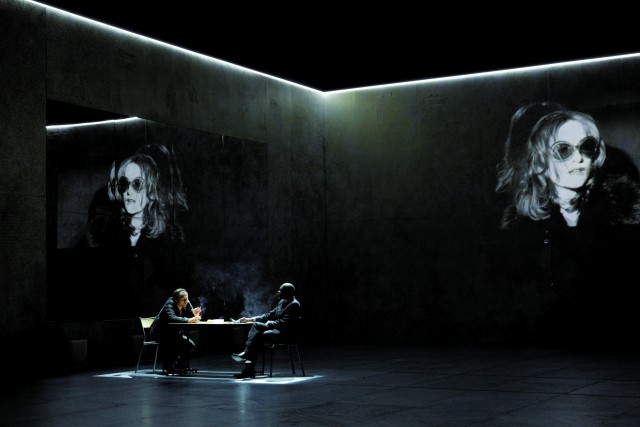
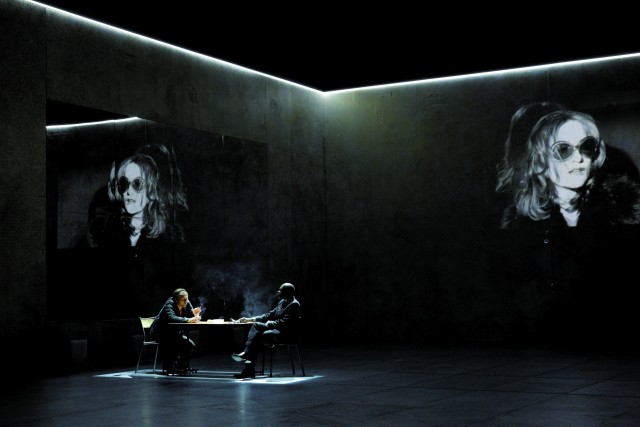
It’s a thrill seeing former New York City Ballet legends Wendy Whelan and Jock Soto perform together for the first time in a decade in Hagoromo; if only it were in a more thrilling production. Conceived and directed by David Michalek, Whelan’s husband, Hagoromo (“The Feathered Robe”) is an adaptation of a traditional Noh drama about an elegant celestial garment that drifts from the heavens to earth, where it is found by a fisherman (Soto). The angel (Whelan) whom it belongs to descends to reclaim the magical robe, but the fisherman demands an angelic dance in return. Sara Brown’s set is a large room with a pale wood floor and walls on two sides at the back and the right; the performers enter and exit from the left. At the front of the stage is an apron of black, suggesting a dark reflecting pool. At the back, a window opens up to reveal a circle of celestial light, while the beautiful silk robe sits regally on a frame at center stage. Above the wall are twenty members of the Brooklyn Youth Chorus, forming an angelic choir; contralto Katalin Károlyi, who sings the role of the angel, and tenor Peter Tantsits, who sings the fisherman; and the International Contemporary Ensemble (ICE), featuring company artistic director Claire Chase on flute, Rebekah Heller on bassoon, Jennifer K. Curtis on violin, Daniel Lippel on guitar, and Ross Karre on percussion and dulcimer, all conducted by Nicholas DeMaison.

Wendy Whelan stars as an angel trying to reclaim her magical feathered robe at BAM (photo by Julieta Cervantes)

Wendy Whelan stars as an angel trying to reclaim her magical feathered robe at BAM (photo by Julieta Cervantes)

The first part of the ninety-minute show, which takes place in the Palace of the Moon, is lovely, as Whelan, wearing an ashen black-and-white outfit in which her limbs seem to be disappearing (the costumes, which become more colorful, are by Dries Van Noten), makes inventive use of the title robe as she dances at first by herself, then joined by two life-size puppet versions of herself, designed by Chris M. Green and operated by puppeteers dressed in black. It’s utterly breathtaking when the angel and her two masked doppelgangers join at the front of the stage and look down at their reflections. Another segment with animals playing with the robe provides comic relief, but once the magical garment flutters down to earth, Nathan Davis’s chamber music and Brendan Pelsue’s libretto turn far too New Age-y, lacking the ethereal beauty of the first half while also feeling much more like a moralistic tale for children. Károlyi’s singing remains impressive, but Tantsits has trouble connecting with the audience. But that doesn’t stop Whelan and Soto from soldiering on, leading to a series of pas de deux that makes it all worthwhile.