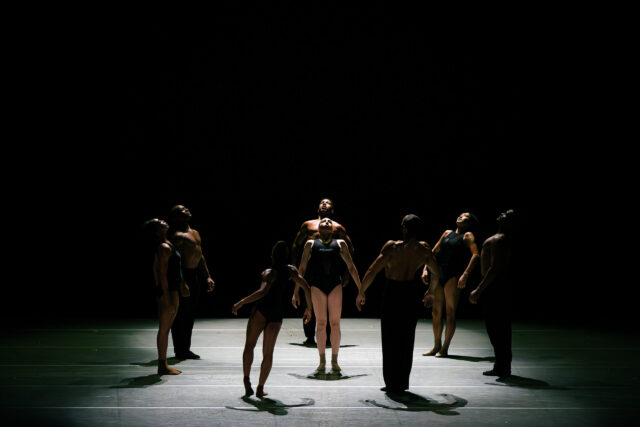
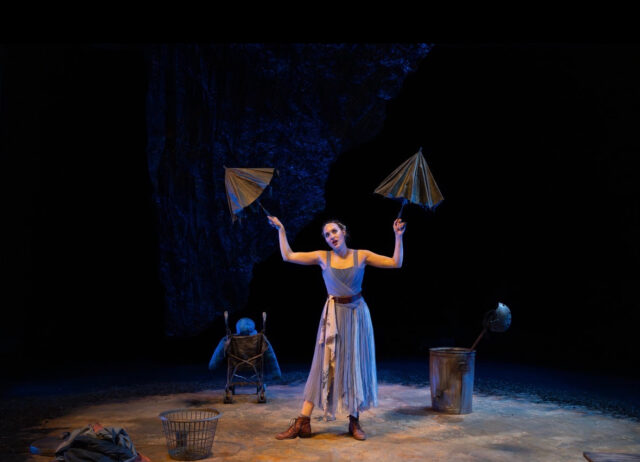
Fourth consecutive AAADT BAM season features company premiere of Medhi Walerski’s Blink of an Eye (photo by Georgia Modi)
ALVIN AILEY AMERICAN DANCE THEATER
BAM Howard Gilman Opera House
30 Lafayette Ave. between Ashland Pl. & St. Felix St.
June 4–7, $46-$156 www.bam.org ailey.org
New Alvin Ailey American Dance Theater artistic director Alicia Graf Mack leads the company into its fourth consecutive visit to BAM with an exciting program running June 4–7. A mix of the old and the new concludes Mack’s inaugural season, which included a terrific December/January season at City Center that featured the world premiere of Cuban American theater director and arts educator and activist Maija García’s dazzling, fabulously costumed Jazz Island, a fable celebrating the Afro-Caribbean diaspora, inspired by Geoffrey Holder’s book Black Gods, Green Islands, about Trinidad and Tobago, with original music by jazz trumpeter Etienne Charles; Matthew Neenan’s Ailey debut, Difference Between, set to emotive choral music by MacArthur fellow and two-time Obie winner Heather Christian; Jamar Roberts’s compelling narrative solo Song of the Anchorite, a reimagining of Alvin Ailey’s 1961 solo Hermit Songs, set to jazz trumpeter Avishai Cohen’s interpretation of a Ravel adagio; Fredrick Earl Mosley’s Embrace, which incorporates tunes by Stevie Wonder, Kate Bush, Etta James, Maxwell, Ed Sheeran, Des’ree, and P!nk in exploring the intimacy of human connection as a group of dancers in everyday dress make inventive use of tables; and the company premiere of Medhi Walerski’s Blink of an Eye, set to J. S. Bach’s violin sonatas and partita performed by Itzhak Perlman.
At BAM, AAADT will present a new production of Judith Jamison’s Emmy-winning Hymn, the 1993 thirty-seven-minute tribute to Ailey set to music by Robert Ruggieri and text by Anna Deavere Smith that uses the words of Ailey dancers and Ailey himself; the fifteen-minute Blink of an Eye; and the thirty-six-minute 1960 classic Revelations, a cultural touchstone inspired by Ailey’s childhood.
“I definitely can say to the audience to be present as much as our dancers because it will be over in the blink of an eye,” stager Valentina Scaglia says about Walerski’s piece in the above video. “I think it’s important to just be there and just breathe it in and see what it does. I think the music and the dancers together will bring it over in the most wonderful way.”
On June 4 at 6:00, there will be a free roundtable discussion with the original cast of Hymn in the Adam Space; you can RSVP here.
[Mark Rifkin is a Brooklyn-born, Manhattan-based writer; you can follow him on Substack here.]
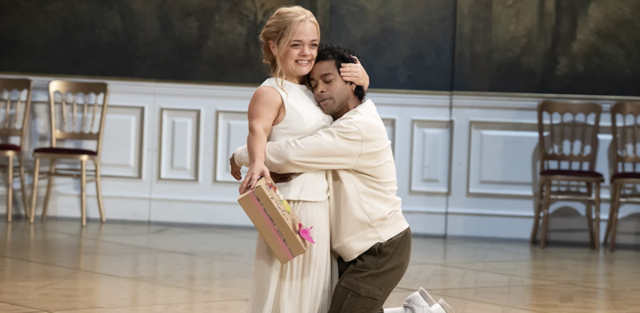
Ophelia (Francesca Mills) and Hamlet (Hiran Abeysekera) try to hold on to their love in National Theatre production at BAM (photo by Julieta Cervantes)
HAMLET
Brooklyn Academy of Music
BAM Strong Harvey
651 Fulton St.
Through May 17, $46-$226 www.bam.org/hamlet
One of the myriad great things about Shakespeare’s plays is their adaptability; they can be done as straightforwardly as possible or be transplanted into an endless number of settings, changing the time and place while staying true to the Bard’s words. Nevertheless, some productions get so caught up in their tinkering that they lose sight of the play itself.
Two current shows in New York City take different approaches to a pair of Shakespeare’s most popular tragedies, but each is a celebration of the language. I found myself discovering details in the National Theatre’s Hamlet at BAM and Bedlam’s Othello at the West End Theatre that made each work feel fresh and new across their nearly three hours.
BAM has a long history with Hamlet; it was their inaugural theatrical presentation, in 1861. It was also the National’s first play in London, in 1963. Continuing at the Harvey through May 17, director Robert Hastie (Operation Mincemeat) reimagines the dour Dane for the modern era in a dark and funny version with numerous delicate touches.
Hiran Abeysekera portrays Hamlet as a kind of nepo baby trying to find his way in a world that has suddenly shifted for him following the death of his father, the king (a terrific Ryan Ellsworth, also the Player King and the gravedigger), followed by his mother’s (Ayesha Dharker) almost immediate marriage to the king’s brother, Claudius (a splendid Alistair Petrie), who now wears the crown. It gets even more complicated when his father’s ghost appears and reveals that uncle Claudius poisoned him in order to ascend to the throne.
With vengeance on his mind, Hamlet doesn’t have enough room in his life for Ophelia (a sprightly Francesca Mills, donning angel wings), who loves him deeply. Her father, Polonius (Matthew Cottle), is Claudius’s chief counselor, and her brother, Laertes (Tom Glenister), is determined to defend her honor at any cost.
Hamlet finds comfort in his closest friend, Horatio (a delightful Tessa Wong), but is suspicious when two of his best buds from childhood, Rosencrantz (Hari Mackinnon) and Guildenstern (Joe Bolland), suddenly arrive; it’s not long before he gets them to admit that they were brought to Denmark by Gertrude to spy on him because of his recent odd behavior.
When a traveling theater troupe arrives to put on a play, Hamlet convinces the First Player (Maureen Beattie) to stage The Mousetrap with a bonus passage by Hamlet, telling the story of a man who kills his brother, the king, exactly how Claudius murdered his sibling, in order to wed his widow and become king himself. “The play’s the thing / Wherein I’ll catch the conscience of the King,” Hamlet says.
As Hamlet descends into madness, Fortinbras (Kiren Kebaili-Dwyer), the crown prince of Norway, prepares his troops to invade Denmark and bodies start piling up.
Hamlet begins in an elegant ballroom with realistic forest wallpaper and transforms into a theater for the fabulous play-within-a-play and a graveyard; the sets are by Ben Stones, who also designed the modern costumes, which for Hamlet includes a Blockbuster Video sweatshirt, a nod to Michael Almereyda’s 2000 film version in which Ethan Hawke delivers the “To Be or Not to Be” monologue while walking through a Blockbuster store, and a “Tobacco and Boys” T-shirt that references the unconfirmed Christopher Marlowe quote “All they that love not Tobacco and Boys are fools”; the phrase was also used by Shakespearean actor Stephen Fry in the title of his 1979 play, Latin! or Tobacco and Boys.
Hastie makes small tweaks to the script that practically leap off the page. Polonius tells Laertes, “To thine own selves be true,” altering “self” to “selves”; Ophelia loudly joins in when Polonius advises his son, “Neither a borrower nor a lender be”; and the “To Be or Not to Be” soliloquy is moved to later in the play, at a crucial point. The language is so front and center that the nearly endless stream of familiar phrases that became names of books, plays, and movies jumps out, from Infinite Jest and What Dreams May Come to The Undiscovered Country and Sleep No More.
As adorable as he is melancholic, Abeysekera (Life of Pi) grabs the audience’s attention from the beginning and never lets go, regularly making faces and gesturing at the crowd. When another character delivers a monologue directly to the audience, Abeysekera looks at them, and us, as if wondering what is going on, believing that only he can see and talk to us. And when he does speak to us, he has us in the palm of his hands, even with his millennial flourishes as he delivers some of Shakespeare’s most unforgettable soliloquies in his own style. He may not be Olivier, Burton, Branagh, Bernhardt, or Gielgud, but he doesn’t have to be; he just has to be Abeysekera, putting his own stamp on the part.
Through it all, the words stand tall, even conquering a few scenes that linger too long or go a bit off-kilter.
Of course, the play’s the thing.
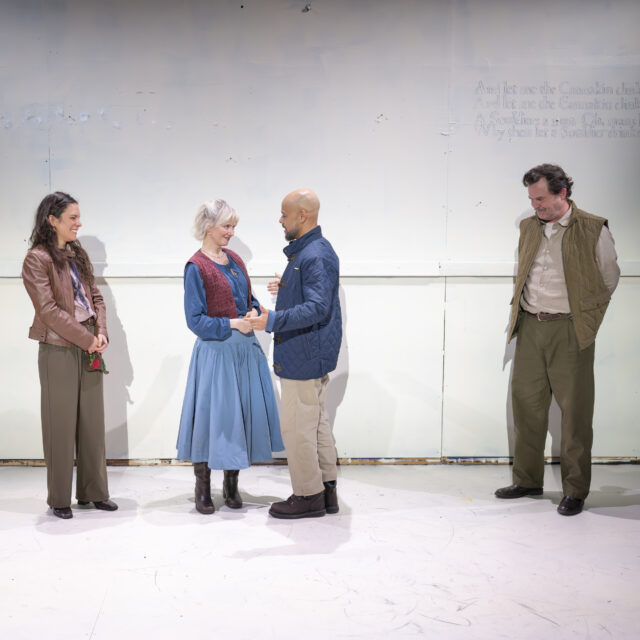
Susannah Millonzi, Susannah Hoffman, Ryan Quinn, and Eric Tucker play all the roles in Bedlam’s stripped-down Othello (photo by Ashley Garrett)
OTHELLO
West End Theatre at St. Paul & St. Andrew United Methodist Church
263 West Eighty-Sixth St. between Broadway & West End Ave.
Tuesday – Sunday through May 30, $24-$86 bedlam.org/w-o/othello
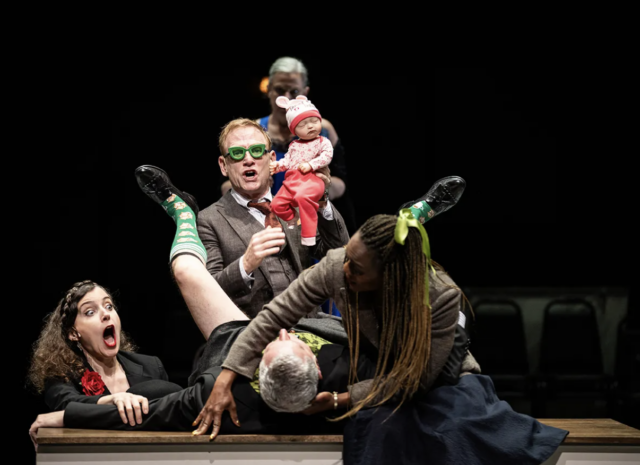
In the National Theatre’s Hamlet, eighteen actors take on twenty-six roles on multiple sets. In Bedlam’s Othello, a cast of four performs more than a dozen parts in a bare white space, with only a handful of small props: Susannah Hoffman is Desdemona and Cassio, Susannah Millonzi is Roderigo and Emilia, Ryan Quinn is Othello and Bianca, and director Eric Tucker is Iago. As with Hamlet, Shakespeare’s words take center stage, for nearly three captivating hours.
Angry that Othello named Cassio his first lieutenant instead of him, Iago is intent on bringing Othello down, through trickery and deceit. He conspires with the Venetian gentleman Roderigo to convince everyone that the Moorish general Othello used evil witchcraft to force Senator Brabantio’s daughter, Desdemona, into a secret marriage. “Your daughter and the Moor are now making the beast with two backs,” Iago tells the powerful politician, using race as a sword.
When Othello and Desdemona publicly declare their love for each other, Iago concocts a diabolical plan to persuade Othello that his beloved is having an affair with Cassio, thus ruining the general and his lieutenant, lifting Iago’s station, and allowing Roderigo to pursue his own lust for Desdemona.
“O beware, my lord, of jealousy! / It is the green-eyed monster which doth mock / The meat it feeds on,” Iago says to Othello. “That cuckold lives in bliss / Who, certain of his fate, loves not his wronger; / But O, what damnèd minutes tells he o’er, / Who dotes yet doubts, suspects yet soundly loves!”
To achieve his revenge, Iago must also pull the wool over the eyes of his wife, Emilia, who is Desdemona’s maidservant; Bianca, Cassio’s lover; the Duke of Venice; Gratiano, Brabantio’s brother; Lodovico, Desdemona’s cousin; and Montano, the governor of Cyprus.
That’s precisely what Iago seeks to destroy in anyone who gets in his way.
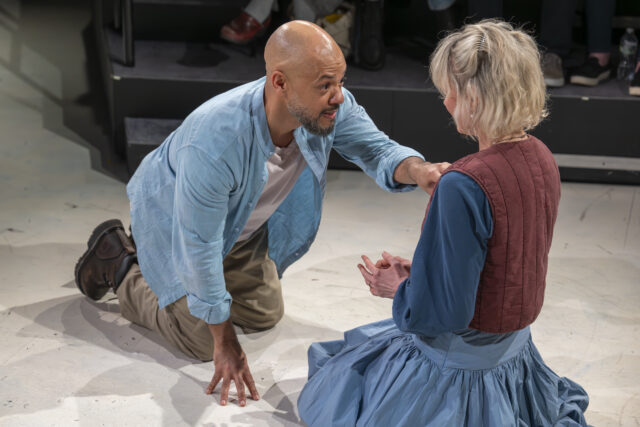
Othello (Ryan Quinn) and Desdemona (Susannah Hoffman) face doom and dread in Bedlam production (photo by Ashley Garrett)
The first act of Othello takes place with the actors performing on a dirty white floor in front of an unsteady white wall; initially, the only props are a bell and a black rope/noose, but a string of Christmas lights and a microphone are added for a karaoke scene. For the second act, the three rafters of seating are rearranged to form a circle closing in on the middle, where most of the action occurs, although the actors also stomp around behind the audience and up and down the aisles. Cheyenne Sykes’s lighting gets much darker, the characters at times using flashlights. The actors usually but not always make tiny adjustments to Sam Debell’s contemporary costumes to indicate when they are a different character, which can get a little awkward. The karaoke scene is awkward as well, straying from the simpler beauty of the rest of the show.
Hoffman and Millonzi excel in their multiple roles, and Quinn is an admirable, heart-wrenching Othello, but the key to the narrative lies in the hands of Iago, and Tucker, who also designed the tense sound, is a slyly devious master manipulator, his tongue often in his cheek as his plot unfolds; possessed of a rapier wit, he thinks quick on his feet, like an improv comic who’s not about to lose control of the upcoming punch line.
Bedlam’s first two productions, back in 2013, were four-actor versions of Bernard Shaw’s Saint Joan and Hamlet, so this Othello is a return to its roots following such other successful shows as Sense & Sensibility,Arcadia,The Good John Proctor, and Are the Bennet Girls OK? Because of the minimal staging, the words flow beautifully; you have to listen closely, resulting in picking up small elements you may have missed in bigger adaptations with major stars.
Through it all, the words stand tall, even conquering a few scenes that linger too long or go a bit off-kilter.
Of course, the play’s the thing.
[Mark Rifkin is a Brooklyn-born, Manhattan-based writer; you can follow him on Substack here.]
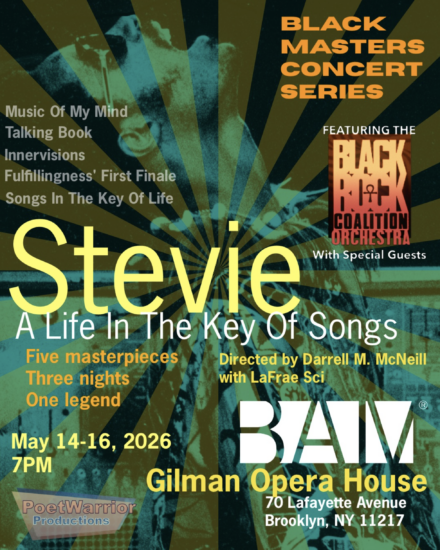
STEVIE: A LIFE IN THE KEY OF SONGS
Brooklyn Academy of Music
BAM Howard Gilman Opera House
30 Lafayette Ave. between Ashland Pl. & St. Felix St.
May 14–16, $36-$97, 7:30 www.bam.org
PoetWarrior Productions’ Black Masters Concert Series, which has paid tribute to such artists as Curtis Mayfield and Sly & the Family Stone, continues May 14–16 at BAM with “Stevie: A Life in the Key of Songs.”
On a Sunday in the fall of 1976, as part of my father’s bar mitzvah present to me — a record a week for one year — I picked up Stevie Wonder’s Songs in the Key of Life, and I was never the same again. The music industry, from the Billboard charts to radio airplay to live performance, would never be the same again either.
The double LP features such killer tracks as “Love’s in Need of Love Today,” “Village Ghetto Land,” and “Sir Duke” (as well as “I Wish,” “Pastime Paradise,” and “Isn’t She Lovely”) that crossed genres and racial boundaries. It was the culmination of a remarkable four-year period in which Wonder released five classic albums: Music of My Mind (1972, “Superwoman”), Talking Book (1972, “You Are the Sunshine of My Life,” “Superstition”), Innervisions (1973, “Living for the City,” “Higher Ground”), Fulfillingness’ First Finale (1974, “Boogie On Reggae Woman,” “You Haven’t Done Nothin’”), and Songs in the Key of Life. In the middle of it all, Wonder was in a car accident that left him in a coma, and he temporarily lost his sense of smell.
The albums will be celebrated by the BRC (Black Rock Coalition) Orchestra on May 14 (Music of My Mind and Talking Book), May 15 (Innervisions and Fulfillingness’ First Finale), and May 16 (Songs in the Key of Life) at BAM’s Howard Gilman Opera House. The band, under the music direction of Darrell M. McNeill and LaFrae Sci, consists of keyboardist Ray Angry, vocalists and guitarists David Ryan Harris and Peter Lord, singer-songwriter Sandra St. Victor, harmonica virtuoso Gregoire Maret, guitarist Mark Whitfield, and, for the last two shows, Corey Glover and Vernon Reid from Living Colour. The setlist will also include tunes from the same period that Wonder wrote for other artists.
The Michigan-born Wonder turns seventy-six on May 13, so this should be one fabulous birthday party.
[Mark Rifkin is a Brooklyn-born, Manhattan-based writer; you can follow him on Substack here.]
There are no actors on hand but the Mabou Mines production of All That Fall boasts a magnificent set (photo by twi-ny/mdr)
“Space is the place,” Sun Ra sang on the title track of his 1973 album, Space Is the Place. “There’s no limit to the things that you can do. . . . And your life is worthwhile.”
The jazz legend might have been referring to the cosmos, but one of the (many) things that makes my life worthwhile is entering a theater with no idea what to expect visually. I’m not talking about standard setups where the proscenium stage is in front of rows of affixed seats but rooms that can be reshaped and reconfigured in multiple ways. For example, I am filled with anticipation every time I walk into Park Ave. Armory’s Wade Thompson Drill Hall, TFANA’s Polonsky Shakespeare Center, the Shed’s McCourt, BAM Fisher, and the Signature’s Romulus Linney Courtyard Theatre, all of which can be transformed into fascinating rearrangements.
Below are four recent shows I’ve seen that offered unique spatial experiences.
The cast of All That Fall does not appear in person at the 122 Community Center (photos by Jeri Coppola)
UNDER THE RADAR: ALL THAT FALL
Mabou Mines@122CC
150 1st Ave. at Ninth St.
January 8–25, $20-$50 www.maboumines.org utrfest.org
Since 1970, the experimental avant-garde Mabou Mines troupe has been challenging the boundaries of theater, and they do it again with their adaptation of Samuel Beckett’s 1957 radio play, All That Fall. When audience members get off the elevator at the 122 Community Center, they encounter a series of objects in the hallway and a side room that prepare them for the show: a photo of the Orangedale train station next to a radio playing a Big Band–era instrumental; a poster of a railway man’s “hand, flag and lamp signals” with an actual rusty lamp; a photo of the train station interior, with empty benches, which hints at what we’ll soon see; horse-racing information; and a piece of paper with the opening quote from Beckett’s 1938 novel, Murphy, “The sun shone, having no alternative, on the nothing new,” along with a drawing of a tree by Harry Bliss with the caption “A tree greeting the morning sun, because it has no choice.”
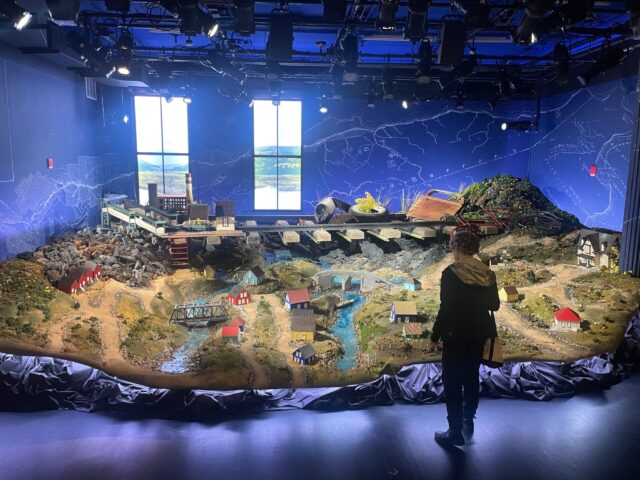
Inside the theater, the seats are arranged in a traditional manner, but the set is like an art installation, a large model of a miniature town with tiny houses, bumpy hills, rocky streets, a river, two bridges, hens near the tracks, and an elevated train station, all surrounded by a map on the walls; in the back are regular-size remnants, an abandoned bicycle and parts of some kind of moving vehicle. In front of the model, a man is projecting slides on an old carousel of costumed men and women — the characters the actors will be portraying. Shortly after the projections stop and the man leaves, we realize that there will be no actors for us to watch; in true radio-play fashion, they will only be heard, prerecorded, but we now know what they look like.
The narrative is fairly straightforward: Mrs Maddy Rooney (Randy Danson) is worried when her blind husband, Dan (Tony Torn), is late getting home. She finds out that the ever-dependable train has not arrived yet, and she is concerned why. Along her journey, she meets up with Christy the carter (Jesse Lenat), Mr Barrell the station master (Lenat), Mr Tyler the retired bill collector (Steven Rattazzi), Mr Slocum the racecourse manager (Torn), Tommy the railway porter (Tẹmídayọ Amay), the pious Miss Fitt (Wendy vanden Heuvel), the little girl Dolly (Lila Blue), and the little boy Jerry (Sylvan Schneiderman). They have absurdist conversations about dung, the Matterhorn, damnation, sex, bicycles and vans, the Titanic and the Lusitania, and “the horrors of home life.”
Mrs Rooney’s dialogue is filled with lovely snippets about human existence: “What kind of a country is this where a woman can’t weep her heart out on the highways and byways without being tormented by retired bill-brokers!” she complains to Mr Tyler. “Christ what a planet,” she declares to Miss Fitt. “I do not exist,” she says to Tommy. “I am not half alive nor anything approaching it,” she explains to Mr Tyler. “Have you no respect for misery?”
The breathtaking set is by Thomas Dunn, lit by Jennifer Tipton, with a bevy of sound effects by Bruce Odland, from animal noises to a storm that shakes your seat almost like Sensurround. Mabout Mines cofounder JoAnne Akalaitis directs with a wry sense of humor.
Wally Cardona and Molly Lieber revive David Gordon’s Times Four for its fiftieth anniversary (photo by Maria Baranova)
LIVE ARTERY: TIMES FOUR / DAVID GORDON: 1975/2025
New York Live Arts / Pick Up Performance Co. Studio
541 Broadway between Spring & Prince Sts.
January 11–13, $33.85 newyorklivearts.org
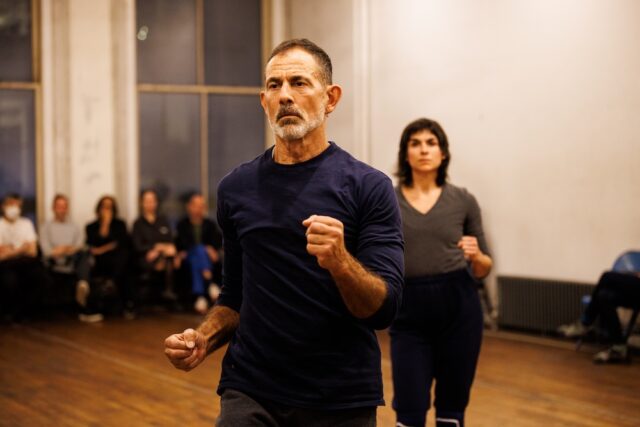
In May 1977, husband-and-wife dancers David Gordon and Valda Setterfield performed their 1975 piece, Times Four in the SoHo loft where they lived and worked. Their son-in-law, Wally Cardona, has brought their little-seen pas d’deux back for a fiftieth-anniversary tribute, teaming up with Molly Lieber to re-create it from a video rehearsal, Setterfield’s handwritten notes, photographs, and other ephemera, taking place in the same loft. It is like a 1960s happening: The limited seating is a single row of folding chairs around the periphery of the otherwise empty room; in addition, the night I attended, there were numerous familiar choreographers and dancers in the audience, all greeting one another. There is no score; the only sounds are Cardona’s (Interventions,The Set Up) and Lieber’s (Rude World,Gloria) breathing and their feet and other body parts touching the floor, sometimes landing softly, sometimes hard. They stare at the walls and windows, rarely making eye contact with the audience, as they glide primarily in unison to four beats, then deleting one move and replacing it with another.
Concentrating mostly on their legs and feet, they move forward, backward, sideways, lifting here, pounding there, almost always in unison. They fall to the ground, extend their bodies, come within inches of the audience. When slight differences occur, you can feel it in your bones. You never know which direction they are going to turn in, resulting in a thrilling suspense to it all.
They both exert remarkable strength as they perform difficult maneuvers, their muscles rippling, sweat forming. It’s a compelling feat of human endurance that last about sixty tense, exhilarating minutes. A poem associated with the dance explains, “well worn wood floor / smooth burnished brown / the kind of floor that begs to be danced on / that wants to seduce me out of my shoes and socks. . . . I face my back to the windows / I imagine 1975.”
Consider me seduced.
Paul Lazar and Annie-B Parson stage first revival of Richard Foreman’s What to wear at BAM (photo by Stephanie Berger)
PROTOTYPE: WHAT TO WEAR
Brooklyn Academy of Music
BAM Strong Harvey Theater
651 Fulton St. at Ashland Pl.
January 15-18 www.bam.org www.prototypefestival.org
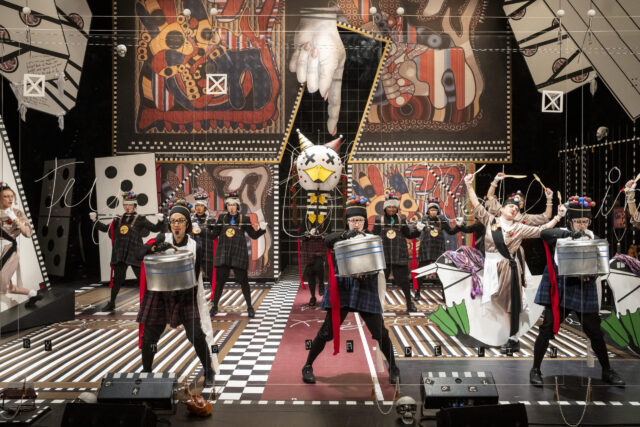
In September 2006, experimental avant-garde legend Richard Foreman and composer Michael Gordon debuted their surreal post-rock opera, What to wear, at the Redcat in LA. It took twenty years, but the show has finally made it to New York at the BAM Strong Harvey Theater as part of the Prototype festival, in its first-ever revival. To prepare everyone for what awaited inside the theater, in the lobby was Foreman’s detailed original concept design model for the complex, fabulously overstuffed stage, a kind of mind-blowing melding of Monty Python, Pablo Picasso, and Alice in Wonderland. It is thrilling to walk into the Harvey and see how that set has been painstakingly re-created at full size by Michael Darling, like magic; Darling also did the props, and the wild costumes are again by E. B. Brooks. Big Dance Theater’s Paul Lazar and Annie-B Parson direct, honoring the 2006 production, which you can watch online here.
The show begins with fancy lighting coming down from the ceiling as a giant cartoonish duck emerges from a doorway and the deep voice of Richard Foreman booms from the heavens: “As of this moment, this ugly duckling is now effectively banished from the realm of the oh so beautiful people.” The duck exits, and sopranos Sarah Frei and Sophie Delphis, mezzo Hai-Ting Chinn, and tenor Morgan Mastrangelo sing, “This is Mad’line X” eight times, then adding, “In a terrible world / One unpleasant world / Such a bad, bad world.” Over the next sixty-plus minutes, those four are joined by St. Vincent, an ensemble of more than a dozen vocalists and dancers, and the seven-piece Bang on a Can orchestra caged in one corner as the story goes through such chapters as “Mad’line X, who understands now,” “So sad but I reject you,” and “When a duck enters a fine restaurant.”
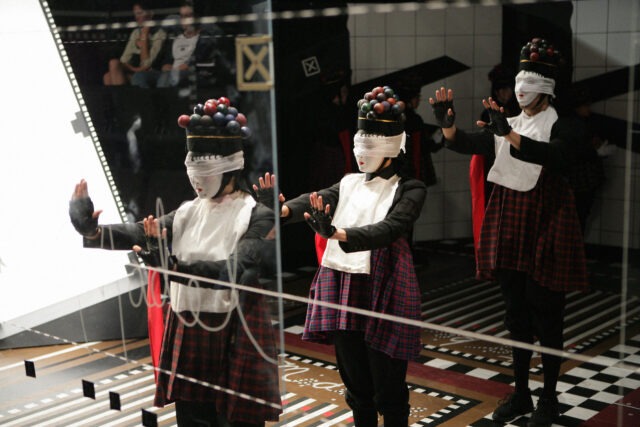
Marchers in kilts hold signs with a big X on them, a pointing finger drops down from above like the hand of G-d, skulls abound, headpieces feature little colored balls on top, a character walks around in a barrel, golf clubs become weapons, a head is locked in a box, and cool wizardry occurs just about everywhere. The unsatisfying ending does not diminish the triumph of this engaging revival. We are told that “Madeline X lives in this terrible world,” but any world that includes works by Foreman can’t be all bad.
AN ARK
The Griffin Theater at the Shed
The Bloomberg Building at Hudson Yards
545 West 30th St. at Eleventh Ave.
Tuesday – Sunday through March 1, $45 theshed.org
“Don’t panic. Don’t be scared. This must feel strange to you. It felt strange to me,” an unnamed character played by Sir Ian McKellen says at the beginning of British playwright Simon Stephens’s An Ark, continuing at the Shed through March 1.
Too late.
In the summer of 2021, Stephens’s Blindness was reimagined for the pandemic, presented at the Daryl Roth Theatre in Union Square, where a maximum of eighty-six masked and blindfolded people were seated in chairs in pods of two, either facing the same or opposite directions, each couple at least six feet away from other pairs. Everyone listened to the play, about a spreading virus that leads to chaos, through individual binaural headphones; the prerecorded narrative was performed by Juliet Stevenson.
In the summer of 2023, Tin Drum brought Kagami to the Shed’s Griffin Theater, which began with a historical multimedia installation that led to a mixed-reality concert in which everyone put on specially designed optically transparent devices that made it appear that the late pianist Ryuichi Sakamoto was playing live, enveloped in augmented reality art. In actuality, the room was completely empty except for a row of chairs along the perimeter where audience members could sit and watch, although it was much better to walk around and get up close and personal with Sakamoto — you could even go right through him.
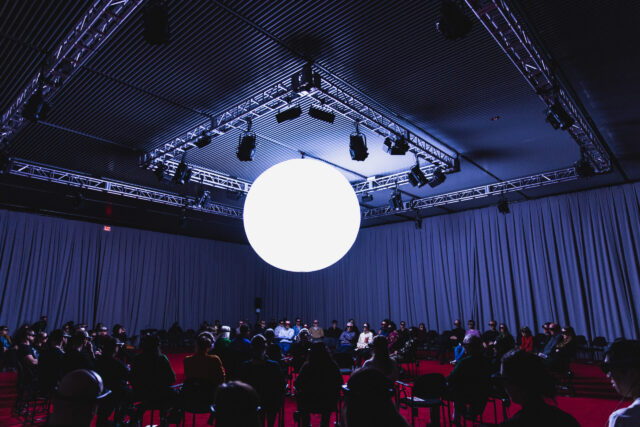
The prep for the show is mind-bogglingly annoying. The audience is encouraged to arrive at least fifteen or twenty minutes before showtime in order to check their coats and bags, which is mandatory; however, the line was so long when we go there that we were advised to just bring our stuff in with us. At the Griffin, a sign announced, “wipe your feet / check your glasses / store your shoes / enter through the curtain / find a seat / put on your headset / sit back / enjoy the ride.” There was no curtain; the open doorway revealed a large room with plush red carpeting, a giant glowing orb hanging in the center from the ceiling, and three circular rows of chairs with a pathway through the middle. While my guest waited for corrective lenses — glasses won’t work with the headset — I took off my shoes and jacket, placed them on the floor, and tried to grab a specific seat, then come back and store my garb in one of the small cubby-hole benches, but I was told by a guide that I couldn’t do that; first I had to put the shoes and coat away, then someone would guide me to a chair. The shoes fit in the little cubby, but I had to really force the coat into another slot, only to be told that I had placed them in the wrong bench and had to move them. By then, my guest was already seated — with her jacket, which she was allowed to keep on her lap, and bag, which she could put under her chair.
Mixed reality An Ark at the shed is a confusing jumble (photo by Marc J. Franklin)
Next, you put on the headsets, and four white holographic chairs appear in front of you; mine had to be adjusted by a guide because the chairs were enormous and floating in the ether. I was disappointed that I could also see everyone else in the room, which detracted from the personal nature of the show, even though theater is usually meant to be a communal experience. Then, guides wheeled the cubby benches straight through the middle of the theater and out the curtain on the other side of the room, further disturbing the alternate reality that was being created. As the play proper began, with the four characters, all barefoot and wearing white, entering the space and sitting down, it was hard not to wonder why the floor had to be carpeted and why we had had to take off our shoes; perhaps it was some kind of ASMR thing.
For forty-seven minutes, the actors perform just for you, making intense direct eye contact, reaching out with their hands, and using the second person as they recount multiple versions of a life, from birth, childhood, and adolescence to adulthood, the senior years, and death. For example: “At school you work hard but you never really feel like you belong,” “You’ll want to tell people about the things that have happened to you in here,” and “You get on first name terms with your pharmacist.” The dialogue is filled with detailed descriptions of objects and scenarios that involve all five senses; while poetic, they don’t propel the plot, which remains mysterious through the end.
Recorded in one take and directed by Sarah Frankcom (Our Town,Punk Rock) with sound by Ben and Max Ringham, set and costumes by Rosanna Vize, and lighting by Seth Reiser, An Ark has numerous beautiful moments, and the interaction between the characters and you can be utterly chilling (Sir Ian McKellen is only a few feet away!); when Sheehy reached a hand out to me, I reached back, attempting to grasp it.
But too much of it was confusing and unnecessary; I’m eager to see where the technology goes. Hopefully the kinks will be smoothed out and creators will have more faith in the story itself, without all the bells, whistles, and rules.
As McKellen says early on, “When this is over . . . things will have changed forever.” Well, hopefully not too much.
[Mark Rifkin is a Brooklyn-born, Manhattan-based writer and editor; you can follow him on Substack here.]
Elevator Repair Service’s Ulysses is a highlight of the January performance festival season (photo by Maria Baranova)
Every January, many of us begin the new year with resolutions to make positive changes in our lives; I find the best way to start that is by checking out the latest in cutting-edge and experimental theater, music, dance, opera, film, and other forms of entertainment. Performance festivals abound this month, at tiny venues you’ve never heard of, places you’ve always wanted to go to but haven’t yet, and well-known spaces you haven’t been to in years.
You now have the chance to fill those voids at such festivals as Under the Radar, Prototype, Exponential, Out-Front!, Live Artery, Winter Jazzfest, New Ear, the Fire This Time, and PhysFestNYC, none of them costing nearly as much as a Broadway show. As sound designer Mark Anthony Thompson says in the below video, “Get out of your house and be with people.”
Here are only some of the highlights of this exhilarating time to try something that might be outside your comfort zone — or right up your alley.
UNDER THE RADAR: IN HONOR OF JEAN-MICHEL BASQUIAT
New York Theatre Workshop
79 East Fourth St. between Second & Third Aves.
Tuesday – Sunday, January 7–18, $35 www.nytw.org utrfest.org
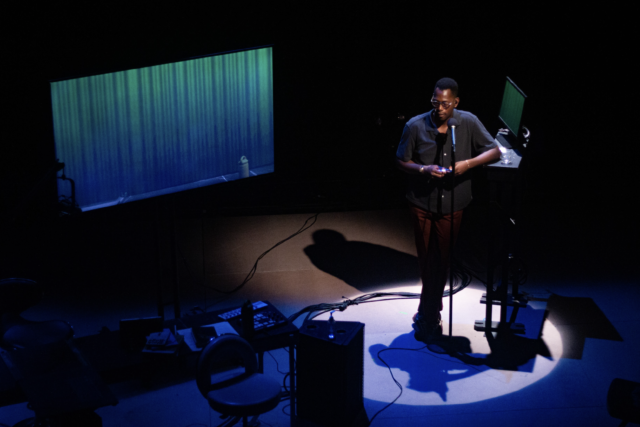
Obie-winning actor, playwright, rapper, and director Roger Guenveur Smith has staged such solo shows as A Huey P. Newton Story, about the founder of the Black Panthers, Frederick Douglass Now, in which he embodies the nineteenth-century abolitionist and orator, and Juan and John, which explored the real-life 1965 fight between Major League pitcher Juan Marichal and catcher John Roseboro. For the 2026 Under the Radar festival, he will perform In Honor of Jean-Michel Basquiat, about his friendship and collaboration with the highly influential Brooklyn-born artist and musician who died of a heroin overdose in 1988 at the age of twenty-seven. Smith and Basquiat met during their LA club years in the 1980s; Smith created the character of Smiley, inspired by Basquiat, for the 1989 Spike Lee film Do the Right Thing. The sixty-minute piece features live sound design by Mark Anthony Thompson; the January 8 and 15 performances will be followed by a Q&A.
UNDER THE RADAR: KANJINCHO
Japan Society
333 East 47th St. at First Ave.
January 8–11, $63 japansociety.org utrfest.org
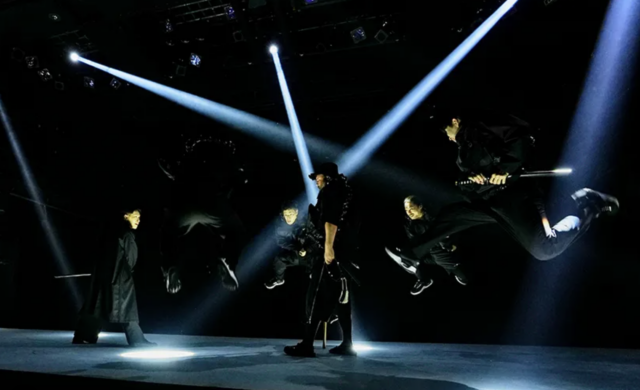
Yuichi Kinoshita reimagines the 1840 Kabuki classic Kanjincho (“The Subscription List”) as a contemporary hip-hop and pop-culture-infused theatrical experience, making its North American premiere at Japan Society January 8–11 as part of Under the Radar. The eighty-minute show is set in the twelfth century, around the Genpei War, a civil clash between the Taira and Minamoto clans. The work is performed by the Kyoto-based Kinoshita Kabuki, all dressed in black, and directed by Sugio Kunihara on a runway-like hanamachi (“flower path”) platform that juts into the audience, with the first two rows on the stage itself. The story concerns war, betrayal, race, and class as refugees attempt to cross borders, giving it a modern-day relevance. The company’s previous works include Musume Dojoji,Shinju Ten no Amijima, and Sannin Kichisa. The 7:30 show on January 8 will be followed by a reception; the 7:30 performance on January 9 will conclude with an artist Q&A. Ticket holders are invited to visit the immersive exhibition “Chiharu Shiota: Two Home Countries” with complementary same-day admission.
UNDER THE RADAR: ALL THAT FALL
Mabou Mines@122CC
150 1st Ave. at Ninth St.
January 8–26 www.maboumines.org utrfest.org
“It is our desire to create, as Beckett says, ‘a text written to come out of the dark,’” director JoAnne Akalaitis says about Mabou Mines’s tenth production of a work by Samuel Beckett, the absurdist black comedy All That Fall, following such presentations as Cascando,Happy Days,Play, and Worstward Ho over the course of the company’s fifty-six-year history. The seventy-five-minute one-act radio play will be performed by Randy Danson, Jesse Lenat, Steven Rattazzi, Tony Torn, Tẹmídayọ Amay, Wendy vanden Heuvel, Lila Blue, and Sylvan Schneiderman as part of Under the Radar. “What have I done to deserve all this, what, what?” the frail Mrs Maddy Rooney moans to bill broker Mr Tyler, later adding, “Have you no respect for misery?” I saw Trevor Nunn’s splendid version in 2013 starring Michael Gambon and Eileen Atkins and can’t wait to see what Akalaitis (Beckett’s First Love,BAD NEWS! I was there . . .) has in store for us this time around, with a set by Thomas Dunn, lighting by Jennifer Tipton, sound by Bruce Odland, costumes by Andreea Mincic, and projections by Jeri Coppola. Expect the unexpected.
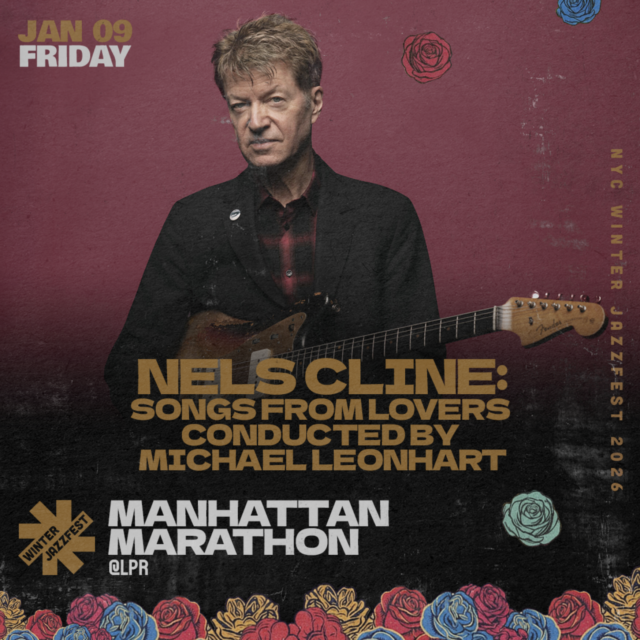
Founded in 2005, “Winter Jazzfest celebrates the music as a living entity, wherein history collides with the future in every note. Creative improvisation in the digital age continues to stimulate thought and emotion of its listeners, embracing innovation, defying instrumental boundaries and the old cliches of ‘What is Jazz?’” The festival runs January 8–13 and is highlighted by the Manhattan Marathon on January 9, boasting forty-five shows at Le Poisson Rouge, Nublu, DROM, City Winery, Close Up, Zinc, and the Bitter End, featuring Nels Cline’s “Songs from Lovers,” the Getdown, James Carter, David Murray, Lady Blackbird, and many more.
Drita Kabashi stars in Sara Farrington’s Euripides adaptation at the Tank (photo by Carol Ostrow)
APAP: A TROJAN WOMAN
Theater 98 at the Tank
312 West Thirty-Sixth St. between Eighth & Ninth Aves.
January 10-11, $23-$42 apap365.org/conference thetanknyc.org
“A Trojan Woman exists inside an act of modern warfare, inspired by an early moment in the Russian war against Ukraine that affected me deeply,” playwright Sara Farrington explains in a note about her adaptation of Euripides’s 415 BCE Greek tragedy The Trojan Women. Originally performed at the outdoor Theatro Attikou Aldous/Katina Paxinou Attica Grove Theater in Athens, Greece, in July 2023, A Trojan Woman will be at the Tank January 10-11 as part of the APAP (Association of Performing Arts Professionals) festival, directed by Meghan Finn and starring Drita Kabashi as Irina; the costumes are by Suzanne Bocanegra, with video by Ana Veselic. Farrington has previously collaborated with her husband, Reid Farrington, on such productions as BrandoCapote,CasablancaBox, and Dora Maar, always providing a unique take on the world and theater itself; Sara is currently working on Dr. Uncanny Presents: Moreau ’96, a musical based on the 2014 documentary Lost Soul: The Doomed Journey of Richard Stanley’s Island of Dr. Moreau. She is also the author of the popular Theater Is Hard. on Substack.
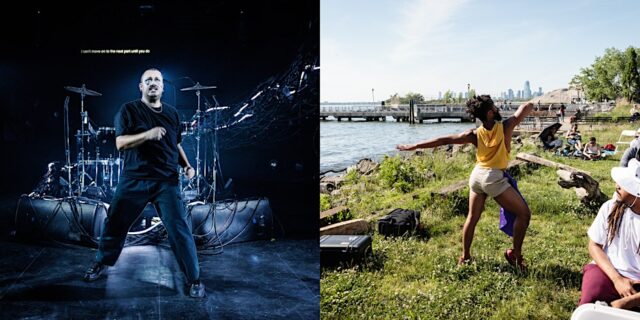
Ian Andrew Askew and Johnnie Cruise Mercer will present world premieres at Out-FRONT! Fest (photos by Maria Baranova and Johnnie Cruise Mercer)
OUT-FRONT! FESTIVAL: IAN ANDREW AND JOHNNIE CRUISE MERCER
Judson Memorial Church
243 Thompson St. at 55 Washington Square South
Saturday, January 10, and Sunday, January 11, free with advance RSVP (suggested donation $28.52) pioneersgoeast.org www.judson.org
Pioneers Go East Collective’s multidisciplinary Out-FRONT! Fest “champions the voices of LGBTQ and Feminist artists for a lively exchange of art and culture.” Curated by Gian Marco Riccardo Lo Forte, Remi Harris, Philip Treviño, and Joyce Isabelle, the 2026 edition runs January 5–11, with works by such performers as Dominica Greene, Suzzanne Ponomarenko, Alexa Grae, Sugar Vendil, Jo Warren, Owen Prum, and Corentin JPM Leven at Judson Memorial Church. On January 10 and 11, Ian Andrew Askew will present the world premiere of SLAMDANCE punk lessons, which explores sociopolitical aspects of moshing and violence, followed by the world premiere of Johnnie Cruise Mercer’s Mercies of a Butterfly, “a movement allegory about resilience.” All tickets are free with suggested donation and are going fast.
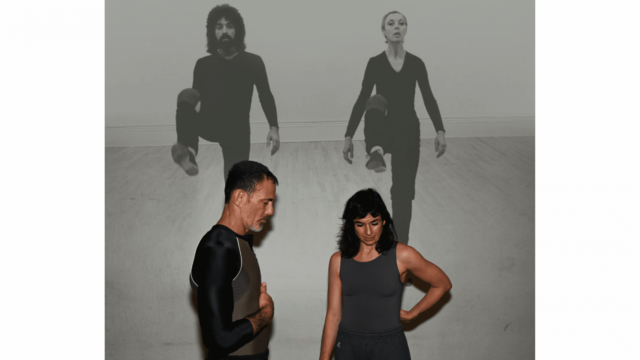
Wally Cardona and Molly Lieber restage David Gordon’s 1975 duet in original SoHo loft (b&w photo by Babette Mangolte; color photo by Daqi Fang)
LIVE ARTERY: TIMES FOUR / DAVID GORDON: 1975/2025
New York Live Arts / Pick Up Performance Co. Studio
541 Broadway between Spring & Prince Sts.
January 11–13, $33.85 newyorklivearts.org
Two of my favorite dancer-choreographers, Wally Cardona and Molly Lieber, have teamed up for Times Four / David Gordon: 1975/2025, an adaptation of David Gordon’s 1975 duet with his wife and muse, Valda Setterfield, that will run January 11–13 as part of New York Live Arts’ Live Artery festival. The work will be presented in the same SoHo loft where Obie and Bessie winners Gordon and Setterfield debuted it fifty years ago; Times Four has not been seen in its entirety since then. In 2021, Gordon asked Cardona, who is married to playwright Ain Gordon, David and Valda’s son, if he wanted to perform something from his archives. Cardona was instantly interested in Times Four, an unusual, relatively unknown piece, but Gordon rejected that. However, after both Gordon and Setterfield died, the former in 2022 at the age of eighty-five, the latter in 2023 at eighty-eight, Cardona decided to resurrect Times Four in their honor. “I think that they, especially Valda, would be very happy that we are doing this piece and that we are performing something,” Cardona told choreographer, dancer, director, and NYLA head Bill T. Jones in an online interview. Cardona (Interventions,The Set Up) and Lieber (Rude World,Gloria) reconstructed the piece from a video rehearsal, Setterfield’s handwritten notes, photographs, and other ephemera, as no footage of the full original duet, which is done in silence, exists. The audience will sit in folding chairs on all four sides of the loft.
Eric Berryman shares African American toasts in Wooster Group’s Get Your Ass in the Water and Swim Like Me (photo by Marika Kent)
UNDER THE RADAR: GET YOUR ASS IN THE WATER AND SWIM LIKE ME
Joe’s Pub, the Public Theater
425 Lafayette St. at Astor Pl.
Monday, January 12, and Tuesday, January 13, $36 utrfest.org publictheater.org
In 2019, the Wooster Group production of The B-Side: “Negro Folklore from Texas State Prisons,” a Record Album Interpretation earned a Drama Desk nomination for Unique Theatrical Experience for Eric Berryman’s multimedia adaptation of a 1965 LP compiled by Bruce Jackson, consisting of performances by inmates of color on segregated agricultural prison farms. Writer and actor Berryman and director Kate Valk followed that up with Get Your Ass in the Water and Swim Like Me, which is having an encore presentation at Joe’s Pub as part of Under the Radar. This time Berryman dives deep into Jackson’s 1974 book and 1976 disc, Get Your Ass in the Water and Swim Like Me: Narrative Poetry from Black Oral Tradition, a collection of folktales known as toasts, made for heroes and antiheroes in the Black storytelling canon. The tales are filled with tawdry sex and extreme violence — bullets are flying everywhere — but as funny as they are, there’s also an underlying sense of discomfort, particularly with a primarily white audience, as the stories contain stereotypes reminiscent of minstrelsy. Berryman compares over-the-top characters to Greek myths, where such figures as Hercules and Jason “would do stupid shit because they knew it would help them uh, uh, more quickly achieve kleos, and get kleos . . . A community creates the heroes that they need.” Berryman (Primary Trust,Toni Stone) is not just sharing old fables but exploring Black identity then and now. At one point he digresses into a discussion of his own name, how disappointed he is to be anchored with the plain “Eric” when he has relatives called Qasim, Idris, Indira, Akeem, Alenka, and Adia. (He does note that there is a Gary but does not share that it’s his uncle, Grammy-winning jazz saxophonist Gary Bartz.) The show concludes with the all-time favorite “Stackolee,” a tale of murder and mayhem that has been recorded in different versions by Mississippi John Hurt, Doc Watson, Wilbert Harrison, Long Cleve Reed, Lloyd Price, and Nick Cave and the Bad Seeds, among others, its familiarity spotlighting the centrality rather than the marginalization of the Black experience in American popular culture.
PhysFestNYC: BILL BOWERS: IT GOES WITHOUT SAYING
Stella Adler Center for the Arts
65 Broadway
Tuesday, January 13, $20, 7:30 & 9:00 www.physfestnyc.org
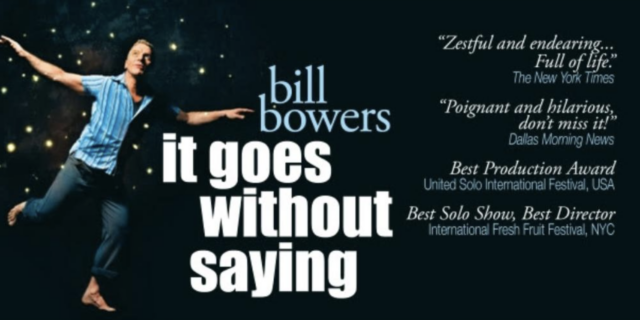
PhysFestNYC was started in 2024 as “a community-focused festival that celebrates, enriches, and envisions our field of physical theater . . . [which] tends to be experimental, innovative, and genre-breaking.” The third annual event, taking place January 8–18 at the Stella Adler Center for the Arts, consists of workshops, panel discussions, masterclasses, and live performances. On January 13, Bill Bowers will present the one-man show It Goes without Saying, which delves into his life and career from his childhood in Montana to studying with Marcel Marceau and appearing in several Broadway productions.
Christopher-Rashee Stevenson, Vin Knight, and Scott Shepherd rehearse for NYC premiere of ERS’s Ulysses (photo by Joan Marcus)
UNDER THE RADAR: ULYSSES
Martinson Theater, the Public Theater
425 Lafayette St. at Astor Pl.
January 13 – February 15, $109 publictheater.org utrfest.org
Elevator Repair Service follows up its farewell performance of the eight-hour Gatz at the Public with its adaptation of James Joyce’s Ulysses, clocking in at a mere two hours and forty minutes. Directed by John Collins, who has previously tackled such literary biggies for ERS as The Sound and the Fury and The Sun Also Rises in addition to Gatz, the show stars Dee Beasnael, Kate Benson, Maggie Hoffman, Vin Knight, Christopher-Rashee Stevenson, Stephanie Weeks, and codirector and dramaturg Scott Shepherd, with sets by dots, costumes by Enver Chakartash, and projections by Matthew Deinhart. Joyce is having a bit of a renaissance onstage recently, with a rare revival of Joyce’s only play, Exiles, last winter and Colin Murphy’s The United States vs. Ulysses at the Irish Arts Center last spring; ERS’s Ulysses, part of Under the Radar, promises to be the best of the bunch.
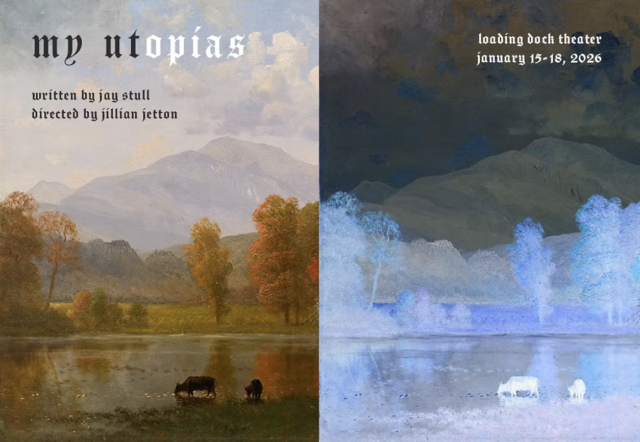
Writer Jay Stull (The Capables,Rantoul and Die) and director Jillian Jetton have put together a fantastic cast for my utopias, running at the Loading Dock Theatre as part of the Exponential Festival: Brittany Bradford, Ugo Chukwu, Fernando Gonzalez, Melissa Hurst, Jon Norman Schneider, Colleen Werthmann, and Julyana Soelistyo. The show is about a kind of postapocalyptic nightmare in New York City as a group of survivors wonder what the future holds.
Paul Lazar and Annie-B Parson stage first revival of Richard Foreman’s What to wear at BAM (photo by Scott Groller)
PROTOTYPE: WHAT TO WEAR
Brooklyn Academy of Music
BAM Strong Harvey Theater
651 Fulton St. at Ashland Pl.
January 15-18 www.bam.org www.prototypefestival.org
“Don’t finish what you start,” reads one of ninety-four notecards collected in experimental theater maestro Richard Foreman’s posthumously published book No Title. Fortunately, Foreman, the founder of the Ontological-Hysteric Theater who died last January at the age of eighty-seven, finished much of what he started, including more than eighty plays, operas, films, and books. The seven-time Obie winner and Guggenheim and MacArthur Fellow turned the theater and opera community inside out and upside down with such influential avant-garde works as Sophia = (Wisdom) Part 3: The Cliffs,Pandering to the Masses, and Elephant Steps. In the past year and a half, Object Collection presented the world premiere of Foreman’s Suppose Beautiful Madeline Harvey, the Wooster Collective staged 1987’s Symphony of Rats, and the Segal Center Film Festival on Theater and Performance held a retrospective of Foreman’s movies and videos. Big Dance Theater’s Paul Lazar and Annie-B Parson are now reviving, for the first time since its premiere, Foreman and Michael Gordon’s 2006 surreal post-rock opera What to wear, running January 15–18 at the Harvey as part of the Prototype and BAM’s Next Wave festivals. Foreman wrote the libretto and directed the original; Gordon composed the music, which will be performed by Bang on a Can All-Stars. The cast is highlighted by St. Vincent, sopranos Sarah Frei and Sophie Delphis, mezzo Hai-Ting Chinn, and tenor Morgan Mastrangelo, along with an ensemble of more than a dozen vocalists and dancers.
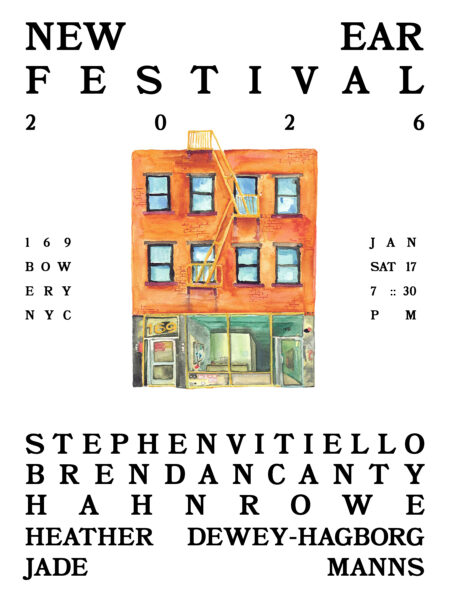
NEW EAR FESTIVAL: NIGHT 02
Fridman Gallery
169 Bowery between Delancey & Broome Sts.
Saturday, January 17, $22.46–$43.57, 8:00 withfriends.events
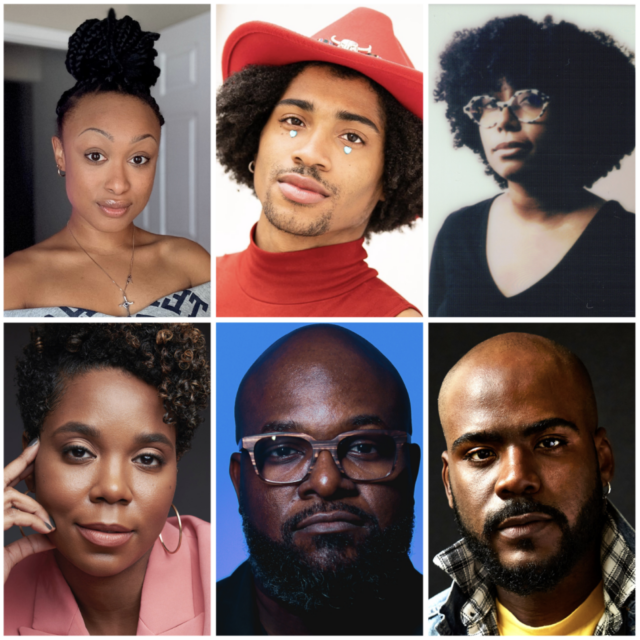
The Fridman Gallery’s annual New Ear multimedia festival showcasing “time-based art in all its forms” is highlighted by an impressive roster of performers on January 17, consisting of dancer and choreographer Jade Manns, artist and biohacker Dr. Heather Dewey-Hagborg, and the live debut of the trio of sound artist Stephen Vitellio, Fugazy drummer Brendan Canty, and multi-instrumentalist and producer-engineer Hahn Rowe, supporting their sophomore LP, Second. Talullah Calderwood, Sue Huang, and Konjur Collective open the three-day fest on January 16, while La Frae Sci, Ben Shirken x Dorothy Carlos, and Lucky Dragons close things out on January 18.
Fire This Time fest features ten-minute works by six playwrights
THE FIRE THIS TIME FESTIVAL: TEN-MINUTE PLAY PROGRAM
The Apollo Stages at the Victoria
233 West 125th St. between Frederick Douglass & Adam Clayton Powell Jr. Blvds.
January 23–31, $51.25 www.firethistimefestival.com
Founded in 2009 by Kelley Nicole Girod, the Fire This Time Festival, now in its seventeenth year, “provides a platform for early career playwrights of African and African American descent.” The 2026 iteration comprises six ten-minute shows at the Apollo Stages at the Victoria: Teniia Micazia Brown’s Everything But–, Preston Crowder’s Black to Save the Day, Mo Holmes’s Clumsy, Naomi Lorrain’s DNR, DeLane McDuffie’s Goose, and Donathan Walters’s White Diamond.
[Mark Rifkin is a Brooklyn-born, Manhattan-based writer and editor; you can follow him on Substack here.]
Whitney White reimagines Shakespeare tragedy in rousing Macbeth in Stride at BAM (photo by Marc J. Franklin)
MACBETH IN STRIDE
Brooklyn Academy of Music
Harvey Theater at the BAM Strong
651 Fulton St.
April 15-27, $29-$85 www.bam.org/macbeth
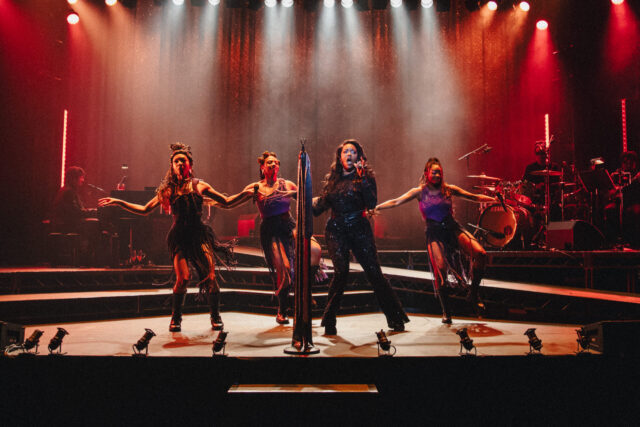
Whitney White’s Macbeth in Stride is an exhilarating hijacking of Shakespeare’s Scottish play, transforming it into an empowering and unrelenting Black feminist rock opera that serves as a takedown of the traditional roles assigned to women not only in the Bard’s canon but in theater and the world itself.
“Irreverence is everything,” White notes at the beginning of her multilayered, irreverent script. Best known as the award-winning director of such plays as Jaja’s African Hair Braiding,On Sugarland,soft, and Liberation, White is both the author and star of this dazzling production at BAM’s Harvey Theater. The ninety-minute show is fervently directed with plenty of winks and nods by Taibi Magar (Help,Twilight: Los Angeles, 1992) and Tyler Dobrowsky, who previously collaborated with White (and Peter Mark Kendall) on the virtual pandemic concert play Capsule.
In Macbeth in Stride, White portrays an unnamed woman who is the dazzling lead singer of a hot band and an actress playing Lady Macbeth. Holli’ Conway, Phoenix Best, and Ciara Alyse Harris are a trio of backup vocalists, the three witches, and a kind of Greek chorus; everyone interacts with the audience, starting with the sensational opening number, “If Knowledge Is Power.”
“So what’s the story?” the woman, dressed in a tight-fitting black sparkling pantsuit, asks in her speech following the song. “For me . . . tonight there is one story — one play in particular that kicked it all off / The funky little chain reaction that led someone like me / To be standing before you now / That led someone like me from where I’m from / To school and stage and work and rehearsals / And kept me up many nights / But for now let’s get back to all of you / Let’s stick with you. / What’s the story you told yourselves to get here?”
Macbeth is introduced in the next song, “Reach for It,” in which several characters sing, “So if foul is fair then fair is foul / Ambition’s not a sin at all!,” after which the woman proclaims she wants ambition and love, no matter that the witches tell her women cannot have both. She also is intent on flipping the switch on Shakespeare, since all of his “great women never seem to make it out of these plays alive!”
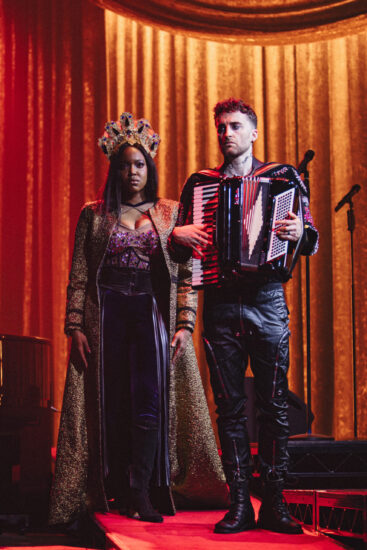
The man playing Macbeth (Charlie Thurston) arrives, a white accordionist clad in black leather. Learning that he is destined to be king, she realizes that she in turn would become queen and wants the power that comes with that, to be more than the secondary character Lady M is through much of the original play. She asks the audience, “Women, queer folk, and othered people out there? / What are you willing to do to get what you need? / To get what you want?” She admits that violence might be the answer.
When Macbeth tells Lady M that King Duncan will be staying the night at their castle, she advises her husband, “I’m pretty sure we’re gonna have to kill him.” He does the deed, she frames the guards, and they become king and queen. As he deals with a heavy dose of fear, suspicion, and guilt, she is determined to be more than an appendage who just gets to host dinner parties; instead, she is going to “reclaim everything.”
Whitney White and Charlie Thurston star as the doomed couple in meta-heavy Macbeth in Stride (photo by Marc J. Franklin)
Macbeth in Stride is a rousing reimagining of Shakespeare’s 1606 tragedy, a clever, passionate, and downright fun show that celebrates the freeing of women from the shackles of literature as well as the chains of real life. White’s Lady M is a symbol of changing the narrative and taking control of the story, in this case in the guise of a spectacular concert. Songs such as “Dark World,” “Doll House,” and “I for You” help place the tale in contemporary times. “You gon’ rework a four hundred year old play just for your ego?” the first witch asks White, who replies, “Yup. / Sure did! Sure did!”
Dan Soule’s set features several platforms and a diagonal walkway cutting through the middle. Jeanette Oi-Suk Yew lights the show like a concert, including vertical strips of colored lights, while Nick Kourtides’s sound balances the loud music with the less raucous dialogue. Qween Jean’s costumes are fashionably glitzy, as is Raja Feather Kelly’s choreography.
The crack band consists of music director Nygel D. Robinson on keyboards, Kenny Rosario-Pugh on guitar, Bobby Etienne on bass, and Barbara “Muzikaldunk” Duncan on drums. Conway (Six,Tina), Best (Dear Evan Hansen,Teeth), and Harris (Dear Evan Hansen,White Girl in Danger) excel as the chorus, who are worthy of their own show. Thurston (Liberation,Here There Are Blueberries) succeeds in a nearly impossible task, surrounded by strong, tenacious women.
White, who also sits at the piano for a few tunes, is right at home center stage. She might not always have the range the songs require — “Reach for It” is a bit of a reach for her — but she embodies her character with an intense grandeur that is as intoxicating as it is fierce.
Shakespeare purists will notice occasional iambic pentameter in the streamlined text, and most of the famous quotes are in there, in one form or another. However, since this is Lady M’s story, aside from Duncan, whose murder is described in some detail, there is no mention of Macduff and his family, no King Edward, no Donalbain and Malcolm, no visible ghosts, no Earl of Northumberland, no noblemen and doctors, no Birnam Wood, and only one mention of Banquo and his son.
As the end approaches, the woman wonders, “Why do they write us this way? / Why do they imagine us this way?”
White has picked up a sharp quill and stands boldly under the spotlight to write it her way. The script notes that Macbeth in Stride is the first of a four-part series; I can’t wait to see what she has in store for us next.
[Mark Rifkin is a Brooklyn-born, Manhattan-based writer and editor; you can follow him on Substack here.]
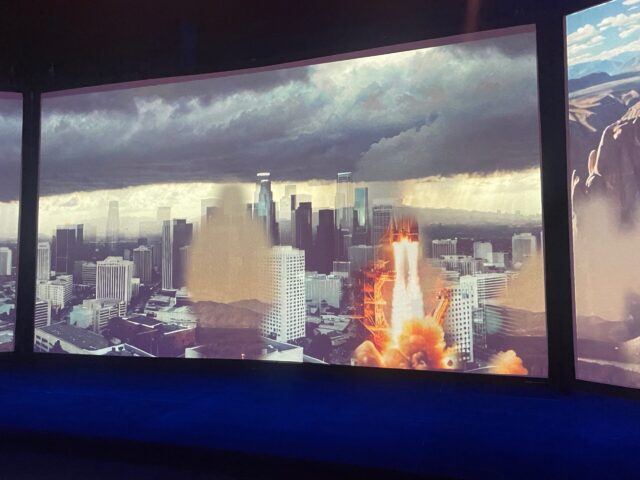
The Vivid Unknown uses generative AI and immersive sound to reimagine Godfrey Reggio’s Koyaanisqatsi (photo by twi-ny/mdr)
TECHNE: THE VIVID UNKNOWN
Under the Radar Festival / BAM Next Wave
BAM Fishman Space
321 Ashland Pl.
January 4-7, $10
Series continues through January 19 utrfest.org www.bam.org
“I like people to break things. I’m always interested in how kids interact with things because they’re going to do things that someone else might not do,” artist John Fitzgerald told me at the inaugural presentation of TECHNE: The Vivid Unknown at BAM’s Fishman Space, a multimedia reimagining of Godfrey Reggio’s 1982 documentary Koyaanisqatsi, which means “life out of balance,” “life disintegrating,” and “a state of life that calls for another way of living” in the Hopi language.
Fitzgerald was not referring to the hardware but “the rules of engagement” that he’s designed with an expert team. “Anyone can bring their own story to it. That’s something I learned from Godfrey, who calls it the autodidactic experience of watching Koyaanisqatsi,” he said. “He’s not telling you, ‘technology bad, humans good — the natural world is safe.’ He’s giving you the opportunity to have thoughts about things, to experience things. Everyone will always watch it differently. I’ve seen that movie dozens and dozens of times; there are a lot of different ways that you can interpret it. So I’m excited to see how this evolves and unfolds. People might want to come in here and sit down on the floor, they might want to go out and get some fresh air and come back in; it’s an open experience.”
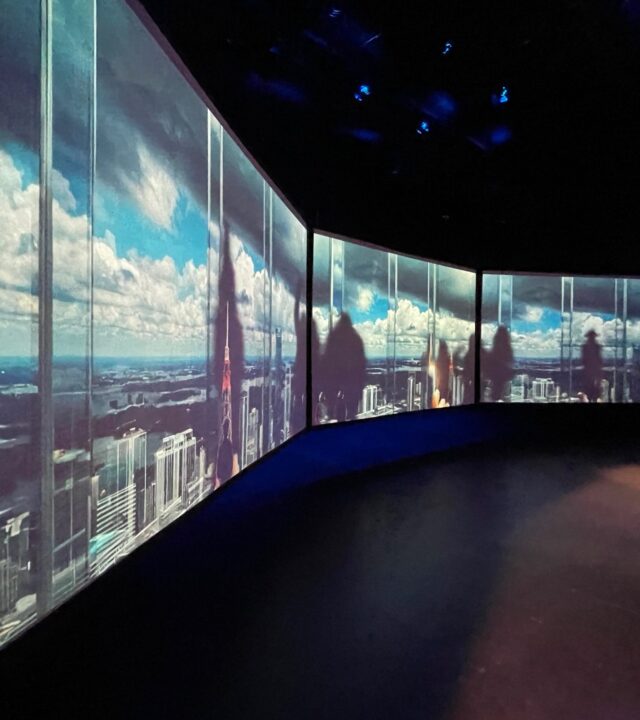
There are numerous ways to experience The Vivid Unknown, and it’s left up to each individual to decide, mimicking how we approach life. AI-generated images speed across three large screens as immersive AI sound envelops the room. You can sit on the floor right in front, move around, or take a regular seat in the back. If you decide to participate — and I highly recommend you do — you will discover that when you are in an oval of light, the shape of your body will be picked up by sensors behind you and your onscreen silhouette will eventually be filled by an image different from what is already being projected.
For example, amid slow-motion and time-lapse shots of beachgoers, mountains, metropolitan cities, airplanes, waterfalls, clouds, traffic, the demolition of a housing project, and other scenes, a rocket taking off fit into my outline and followed me onscreen as I walked across the room. Meanwhile, a woman stood near the middle, moving like a dancer. Couples posed together. A few kids jumped up and down. Humanity fused together with technology and the environment as some of us participated and others merely watched from the back.
Almost all the young boys and girls chose to become involved with the art, which brought out the child in the adults who got up from their seats and interacted with it as well. Noticing that, Fitzgerald, who has a five-year-old and a four-month-old, said that the older one is “the best product tester out there. He’s the first to be, like, ‘That’s too long,’ or ‘I want to see more of that.’ He speaks without a filter.”
Curated by Onassis ONX, TECHNE consists of four digital installations that are part of BAM’s Next Wave Festival and Under the Radar; it begins January 4-7 with The Vivid Unknown and continues January 8-11 with Marc Da Costa and Matthew Niederhauser’s The Golden Key, January 12-15 with Margarita Athanasiou’s Voices, and January 16-19 with Stephanie Dinkins’s Secret Garden. (Tickets for each is $10; a series pass is $35.) BAM Rose Cinemas will be showing Koyaanisqatsi on January 7 at 7:30, with Fitzgerald and Vivid Unknown codirector Reggio on hand for the conversation “Terra techno firma” afterward.
Onassis ONX NY program director Jazia Hammoudi shared information with me about how it all works, but I opted to discover much of The Vivid Unknown on my own, which was extremely satisfying. In the program, she writes, “The refined interactivity of the work’s music and visuals subverts the source material’s linear minimalism and subtly engages the body in epic vistas from mountainscapes to oil fields. Within The Vivid Unknown’s zone of immersion, the connection between individual and collective action reflects the complex relationships between human agency and planetary outcomes.” In addition to TECHNE, Onassis ONX is presenting Christiana Kosiar’s RUNWAY and Viola He’s A {room} of one’s own January 10-14 at the Olympic Tower on Fifth Ave. as part of Under the Radar’s Under Construction series.
Fitzgerald met Reggio about two years ago, when he went out to Santa Fe to visit the now-eighty-four-year-old filmmaker, who also made the sequels Powaqqatsi in 1988 and Naqoyqatsi in 2002; all three films in the series feature original soundtracks by Philip Glass.
Audience participation enhances experience of multimedia The Vivid Unknown by John Fitzgerald and Godfrey Reggio (photo by twi-ny/mdr)
Since this was the first public presentation of the work at BAM, I asked Fitzgerald what he thought about the audience’s response.
“It’s exceeding expectations on all levels,” he said. “We’ve never had this many people in it. One of the things about making creative technology art is that it’s always half broken until it’s not, until you have to press play and make sure everything comes together. The idea was that Koyaanisqatsi is a depiction of the state of the world in the latter half of the twentieth century as chaos unfolded. So I was just playing around with this idea of how you don’t really control anything but you do have an impact on this.”
That concept is also represented by a video sculpture off to one side, a refurbished slot machine that was transformed into an interactive artwork by the fabrication studio Chateau Brooklyn. When you pull down the S2000 lever, images speed by a trio of small monitors; it offers an additional moment of connection, but it has no effect on the film. It exists on its own, but it offers a sense of power and involvement even though the results are random. One boy was having a blast with it, pulling the lever a few dozen times, too young to consider the metaphor of how we gamble in life, taking or avoiding risk.
At several points, the barrage of images dropped out and the screens went dark; only the shapes of the audience members standing in the oval of light could be seen. “I want people to feel like they’re making an impact on the images,” Fitzgerald said. “That’s why the last state is left this way; the film disappears, and it’s fuel to give a reflection of your presence.”
He was also quick to share credit. “This is a project made by a dozen artists; it’s truly a collaborative effort,” Fitzgerald explained. “Everyone is unified behind Godfrey and his vision to show humans where we are right now. It’s like a mirror into ourselves.”
[Mark Rifkin is a Brooklyn-born, Manhattan-based writer and editor; you can follow him on Substack here.]