Tag Archives: brooklyn academy of music

PATRICIO GUZMÁN, DREAMING OF UTOPIA: 50 YEARS OF REVOLUTIONARY HOPE AND MEMORY

Series explores the political documentaries of Chilean filmmaker Patricio Guzmán

PATRICIO GUZMÁN, DREAMING OF UTOPIA: 50 YEARS OF REVOLUTIONARY HOPE AND MEMORY
Anthology Film Archives, Brooklyn Academy of Music (BAM), IFC Center
September 7—15
www.cinematropical.com
www.patricioguzman.com

“A country without documentary cinema is like a family without a photo album,” Chilean filmmaker Patricio Guzmán has said. In conjunction with the fiftieth anniversary of General Augusto Pinochet’s coup d’état on September 11, 1973, when the military overthrew the government of democratically elected Chilean president Salvador Allende, Icarus Films and Cinema Tropical are presenting “Patricio Guzmán, Dreaming of Utopia: 50 Years of Revolutionary Hope and Memory,” consisting of nine works by the award-winning eighty-two-year-old Santiago-born, France-based director. Screening at Anthology Film Archives, BAM, and IFC Center, the festival opens September 7-10 at Anthology with 2004’s Salvador Allende, followed September 8-15 by the US premiere of a new restoration of 1972’s The First Year, which documents Allende’s initial twelve months as president, with the 6:45 show of the latter on September 8 followed by a Q&A with Chilean artist Cecilia Vicuña and Lehigh University professor of art history Florencia San Martín and a reception.

BAM highlights Guzmán’s three-part The Battle of Chile September 8-14, with filmmakers Pamela Yates, Paco de Onís, and Bernardita Llanos participating in a conversation after the 5:15 screening of part three on September 9 at 5:15. And on September 13-14, IFC screens Guzmán’s Chile Trilogy, consisting of 2010’s Nostalgia for the Light, 2015’s The Pearl Button, and 2019’s The Cordillera of Dreams, along with his latest film, 2022’s My Imaginary Country, about recent social unrest and protests. “A piano sonata cannot be heard in a large room. Documentary works need a different framework, a space and an intelligent programming formula,” Guzmán told Uruguayan critic Jorge Ruffinelli for a 2001 book. That’s just what Icarus Films and Cinema Tropical have given us with “Dreaming of Utopia.”

Nostalgia for the Light offers a breathtaking look at memory and the past, from above and below

NOSTALGIA FOR THE LIGHT (NOSTALGIA DE LA LUZ) (Patricio Guzmán, 2010)
IFC Center
323 Sixth Ave.
Wednesday, September 13, 6:30
www.ifccenter.com
www.nostalgiaforthelight.com

Master documentarian Patricio Guzmán’s Nostalgia for the Light is a brilliant examination of memory and the past, one of the most intelligent and intellectual films you’re ever likely to see. But don’t let that scare you off — it is also a vastly entertaining, deeply emotional work that will blow you away with its stunning visuals and heartbreaking stories. Guzmán, who chronicled the assassination of Salvador Allende and the rise of Augusto Pinochet in the landmark three-part political documentary The Battle of Chile, this time visits the Atacama Desert in his native Chile, considered to be the driest place on Earth. Situated ten thousand feet above sea level, the desert is home to La Silla and Paranal Observatories, where astronomers come from all over the world to get unobstructed views of the stars and galaxies, unimpeded by pollution or electronic interference. However, it is also a place where women still desperately search for the remains of their loved ones murdered by Pinochet’s military regime and hidden away in mass graves. In addition, archaeologists have discovered mummies and other fossilized bones dating from pre-Columbian times there. Guzmán seamlessly weaves together these three journeys into the past — as astronomers such as Gaspar Galaz and Luis Hernandez note, by the time they see stars either with the naked eye or through the lens of their massive telescopes, the celestial bodies have been long dead — creating a fascinating narrative that is as thrilling as it is breathtaking.

Constructing a riveting tale of memory, Guzmán speaks with architect Miguel Lawner, who draws detailed maps of the Chacabuca desert concentration camp where he and so many other political prisoners were held; Valentina, a young astronomer whose grandparents had to give up her parents in order to save her when she was a baby; archaeologist Lautaro Nunez, who digs up mummies while trying to help the women find “los desaparecidos”; and Victoria and Violeta, who regularly comb the barren landscape in search of their relatives. “I wish the telescopes didn’t just look into the sky but could also see through the earth so that we could find them,” Violeta says at one point. Spectacularly photographed by Katell Dijan, Nostalgia for the Light is a modern masterpiece, an unparalleled cinematic experience that has to be seen to be believed. The screening will be introduced by San Francisco State University School of Cinema assistant professor Elizabeth Ramírez Soto, author of (Un)veiling Bodies: A Trajectory of Chilean Post-dictatorship Documentary.

[Mark Rifkin is a Brooklyn-born, Manhattan-based writer and editor; you can follow him on Substack here.]
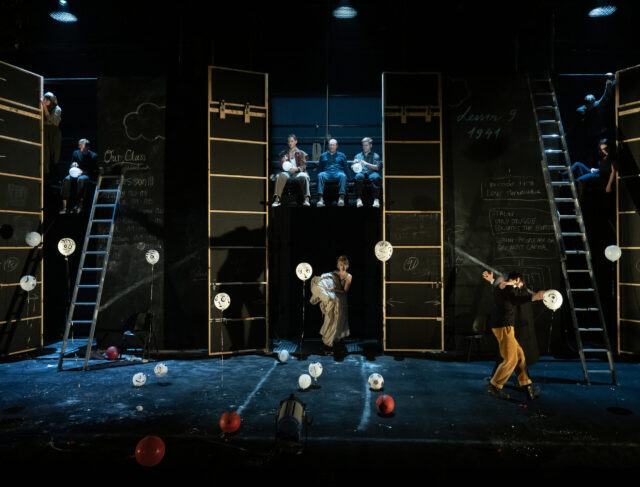
BAM NEXT WAVE: TRANSVERSE ORIENTATION

Dimitris Papaioannou returns to BAM with another extravaganza, Transverse Orientation (photo by Julian Mommert)

Who: Dimitris Papaioannou
What: US premiere of dance-theater work
Where: Brooklyn Academy of Music, BAM Howard Gilman Opera House, 30 Lafayette Ave. between Ashland Pl. & St. Felix St.
When: November 7-11, $44.50 – $144, 7:30
Why: In 2019, Greek painter, comics artist, director, choreographer, performer, and set, costume, makeup, and lighting designer Dimitris Papaioannou made his BAM debut with The Great Tamer, which was heavily influenced by the legacy of Pina Bausch; in fact, Papaioannou was the first person invited to create a piece for Tanztheater Wuppertal following Bausch’s passing in 2009. Papaioannou is back at BAM, in the Howard Gilman Opera House, for the US premiere of Transverse Orientation, running November 7-11.

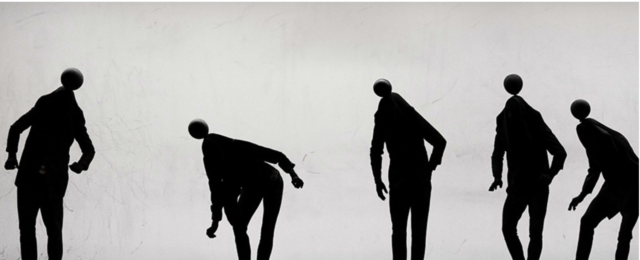
The 105-minute work, which delves into concepts of myth and religion in unusual ways, is performed by Damiano Ottavio Bigi, Šuka Horn, Jan Möllmer, Breanna O’Mara, Tina Papanikolaou, Łukasz Przytarski, Christos Strinopoulos, and Michalis Theophanous, with music by Antonio Vivaldi, sets by Tina Tzoka and Loukas Bakas, sound by Coti K., costumes by Aggelos Mendis, lighting by Stephanos Droussiotis, sculptures and special constructions by Props Nectarios Dionysatos, and mechanical inventions by Dimitris Korres. Bausch fans, and other lovers of experimental dance theater, are sure to delight in what looks to be a mind-blowing experience.

BAM NEXT WAVE: HAMLET

Thomas Ostermeier and Theater Schaubühne Berlin’ Hamlet continues at BAM through November 5 (photo © Stephanie Berger)

Who: Theater Schaubühne Berlin
What: Hamlet
Where: Brooklyn Academy of Music, Harvey Theater at the BAM Strong, 651 Fulton St.
When: October 27 – November 5, $74-$175
Why: Five years ago, Lars Eidinger electrified Brooklyn with his stunning portrayal of Richard III, the wildest and best I have ever seen, in Thomas Ostermeier and Theater Schaubühne Berlin’s ferocious adaptation at the BAM Harvey Theater. Eidinger, Ostermeier, and Schaubühne Berlin are back at the Harvey with their frantic take on the Bard’s Hamlet, running through November 5. The tragedy has been seen here in New York in numerous recent versions and reimaginings, from Robert Icke’s staging at Park Ave. Armory in repertory with The Oresteia and James Ijames’s Pulitzer Prize–winning Fat Ham at the Public to Potomac Theatre Project’s revival of Tom Stoppard’s Dogg’s Hamlet at Atlantic Stage 2, Dead Centre’s Hamnet at BAM Fisher, and Yaël Farber’s variation starring Ruth Negga at St. Ann’s Warehouse.

You can expect Eidinger to be a prince of Denmark unlike any other in this 165-minute adaptation, directed by Thomas Ostermeier and translated into German by dramaturg Marius von Mayenburg. The cast pairs Damir Avdic as Horatio and Guildenstern, Konrad Singer as Laertes and Rosencrantz, Robert Beyer as Osric and Polonius, amid other dual depictions, but it is Eidinger front and center, a mesmerizing actor who never holds anything back. You have been warned.

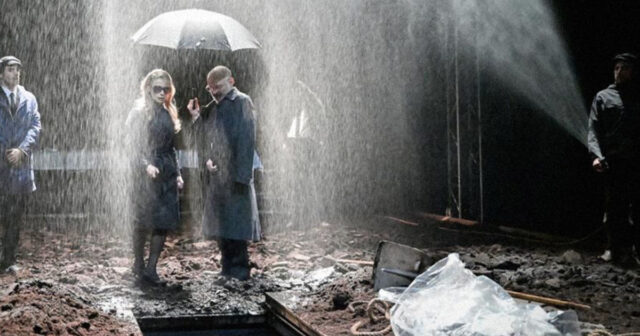
Lars Eidinger reinvents the prince of Denmark in Hamlet at BAM (photo © Stephanie Berger)

Update: It takes only minutes to realize that this Hamlet will resemble nothing you’ve ever seen. It opens with Eidinger, who at forty-six is about twice the age of his title character, beginning the “To Be, or Not to Be” soliloquy, which is supposed to unfurl in Act III. But he delivers only a few lines before joining the funeral of his murdered father, the former king, while his mother, Gertrude, and uncle, Claudius, stand under an umbrella at the burial. A cemetery worker has trouble with the coffin, water is sprayed from a hose, and the already unbalanced Hamlet, looking a bit doofy in his suspenders, falls face-first into the dirt over his father’s grave.

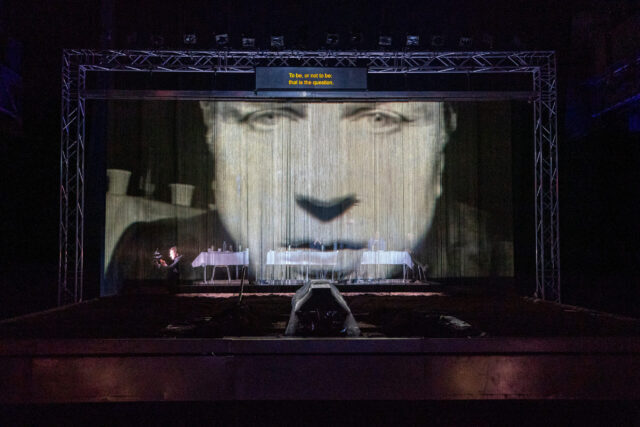
It’s Hamlet as vaudeville shtick, but with a camera that Hamlet uses to film himself and others as nefarious truths come out. Jan Pappelbaum’s set features lots of dirt and two white tables that move between the front and back of the stage, separated by a hanging curtain on which the live video is projected. (The costumes are by Nina Wetzel, music by Nils Ostendorf, video by Sébastien Dupouey, and lighting by Erich Schneider.)

A few moments later, when Claudius says, “But now, my nephew Hamlet, and my son — ,” a shocked Hamlet, unaware that his mother is betrothed to his uncle, does a double take and wonders aloud, “What? I didn’t get that,” then says to himself the more well known line, “A little more than kin, and less than kind.”

Eidinger is given free rein by Ostermeier, like an improv comic portraying the prince of Denmark. At one point, Eidinger jumped off the stage and approached a young man sitting front and center in the first row, wearing a black mask and a hoodie. Eidinger, who speaks German as Hamlet but English when he goes off-script, tried to get the man to interact with him, with no luck, leading to some yucks. Later, Eidinger tossed a shovel that accidentally bounced off the stage and landed near a woman in the audience. In the middle of his dialogue, Eidinger realized what happened and asked the woman if she was okay. It’s often hard to know what is scripted and when Eidinger is going with his instincts; just wait till you see his fencing battle with Laertes.

Even when he’s not lumbering across the stage (and off it), Hamlet is toying around, as if he has ADHD, banging on the table like a spoiled child and putting silly things on his face. The rest of the cast — Damir Avdic as Horatio and Guildenstern, Konrad Singer as Laertes and Rosencrantz, Robert Beyer as Osric and Polonius, Urs Jucker or Thomas Bading as Claudius and the ghost king, and Jenny König as Gertrude and Ophelia, a pairing that intensifies Hamlet’s cries of incest — is merely in service of Eidinger.

It can be a bit much in the 105-minute first act, which can get so chaotic it loses the narrative thread; if you’re not familiar with the story, you’re unlikely to know what’s going on all the time, especially with the doubling of characters who don’t change costumes. But the show comes together fabulously in the forty-five-minute second act — Eidinger even assures us that it’s much shorter than the first act — as the plot is more apparent and Hamlet (and Eidinger) is somewhat more focused if still as wildly unpredictable. There’s a method to his madness, even if Polonius’s classic pronouncement, “Though this be madness, yet there is method in’t,” has been cut from the production. You also won’t hear anything about a “rogue and peasant slave,” “pernicious woman,” or “damned villain,” but Hamlet will command you to “please switch off your mobile phones!”

Hamlet explains, “It’s all just theater and yet also reality.” Throughout Shakespeare’s tragedy, Hamlet is battling reality, encountering ghosts and interpreting events through his own warped world view. But Ostermeier and Eidinger continually remind us that we are watching theater. And what theater it is, unique, original, flabbergasting, exciting, hilarious, and downright strange.

BAM NEXT WAVE: A LITTLE LIFE

Ivo van Hove brilliantly stages Hanya Yanagihara’s epic novel at BAM (photo © Julieta Cervantes)

A LITTLE LIFE
Brooklyn Academy of Music
BAM Howard Gilman Opera House
30 Lafayette Ave. between Ashland Pl. & St. Felix St.
October 20-29, $45-$180
718-636-4100
www.bam.org
ita.nl/en

“You are so damaged,” Willem Ragnarsson (Maarten Heijmans) tells Jude St. Francis (Ramsey Nasr) in Ivo van Hove’s brilliant staging of Hanya Yanagihara’s 2015 bestselling novel, A Little Life, continuing at BAM’s Howard Gilman Opera House through October 29. It’s 250 minutes — with one blessed intermission — of torture porn of the highest order, a tragic tale that takes the emotional tenor of Lars von Trier’s Breaking the Waves and Aki Kaurismäki’s The Match Factory Girl to another level.

Adapted by Koen Tachelet and translated by Kitty Pouwels and Josephine Ruitenberg, the play is presented in Dutch with English supertitles. The first act can be confusing as the story develops; as with many works by von Hove and his Internationaal Theater Amsterdam, you’re not always sure where to look. Jan Versweyveld’s set is a large room with a sink and doctor’s office on one side, a desk and couch at the other, a cast-iron sink standing at the center. A pair of videos by Versweyveld and Mark Thewessen, repeating, slow footage of narrow, empty New York streets, flank the stage, playing throughout the show. The only live video — a mainstay of van Hove’s productions — is of a record spinning on a turntable in the back, behind which sit five rows of audience members. Supertitles are projected above the stage and off to the right and left.

Thus, for the first hour or so, I wasn’t sure where to direct my vision. The matter was further complicated when there was a disturbance among several audience members in the back and an usher that lasted for several minutes. Ultimately, the usher escorted a few people off by walking across the length of the stage. At first I wondered if it was part of the play, van Hove adding to my confusion. It might have just been a sick person.

Four friends discuss life and love in A Little Life at BAM (photo © Julieta Cervantes)

Eventually, I started figuring out who is who. Four close friends from college are hanging out, talking about life and love. Willem Ragnarsson (Maarten Heijmans) is a handsome actor. Malcolm Irvine (Edwin Jonker) is a talented architect deciding whether he should leave a small company and work for a corporate firm. Jean-Baptiste “JB” Marion (Majd Mardo) is an artist who takes photographs of his friends and paints them on canvas. And Jude St. Francis (Ramsey Nasr) is a lawyer under the tutelage of his mentor, Harold (Jacob Derwig). Their banter is reminiscent of Mart Crowley’s queer classic, The Boys in the Band.

But as the plot turns primarily to Jude and his horrific past, adversity piled on adversity at the hands of men he trusted, a darkness hovers over everything. Jude refuses to talk about what happened to him as a child except with his therapist, Ana (Marieke Heebink), who he imagines is almost always there with him. As he recalls in flashback his treatment by Brother Luke, Caleb, and a man named Traylor (all played by Hans Kesting), involving sexual abuse and brutal violence, he turns more and more inward, unable to face truths that can set him free from the prison he has built around himself, one in which he has to cut himself to fight off the inner pain. He seeks help from his doctor, Andy Contractor (Bart Slegers), but that is only for the physical damage inflicted on him, and inflicted by him.

In the far superior second act, Willem attempts to bring some kind of solace to Jude, who wears the same bloodied shirt throughout, except when he’s naked, which is often. As he digs deeper into his troubled existence, every time there is the possibility of hope, misfortune rears its ugly head. But it makes for gripping theater; it is intense and thrilling, anchored by a stunning performance by Nasr, who is also a poet, writer, and director. He portrays Jude with a yearning agony that echoes throughout the theater and into your soul.

But then the man sitting two rows in front of me annoyingly turned his phone on and held it up, and I saw that it was eleven o’clock. I am not a clock watcher at shows; I don’t want to know how much time is left, as it can impact my experience and expectations. But knowing that there were still about fifteen minutes till the end, I had no idea where von Hove could take it from there. In the short remaining span, I counted five places where I thought the play was over — wanted it to be over — but it kept going, even adding a completely unnecessary coda that angered me, manipulating my emotions, telling me how I was supposed to feel. Tony, Obie, and Oliveier winner van Hove (A View from the Bridge, Scenes from a Marriage, Kings of War) had trusted us until then, so the finale felt like he was piling on, in some ways echoing the constant torment that engulfed Jude.

In a program note, van Hove explains, “A Little Life is not a book, it is an excess, an excess of words, feelings, sexual abuse, automutilations, and heroic attempts at love and friendship.” It is all that and more, in a play with an excess of about fifteen minutes.

BAM NEXT WAVE / FIAF CROSSING THE LINE: CROWD

Fifteen characters share their stories during a rave in CROWD (photo © Estelle_Hanania)

CROWD
Brooklyn Academy of Music
BAM Howard Gilman Opera House
30 Lafayette Ave. between Ashland Pl. & St. Felix St.
October 13-15, $34-$85, 7:30
718-636-4100
www.bam.org/crowd
www.g-v.fr/en/shows/crowd

Franco-Austrian choreographer, filmmaker, photographer, and installation artist Gisèle Vienne’s propulsive, euphoric CROWD makes its US premiere at BAM from October 13 to 15, with three highly anticipated performances in the Howard Gilman Opera House. A joint presentation of BAM’s Next Wave and FIAF’s Crossing the Line Festivals, the ninety-minute 2017 work, which has traveled from Tokyo, Rome, and Dublin to Stockholm, Singapore, and Sao Paulo, features fifteen performers whose dialogue-free stories emerge amid a time-jumping 1990s-style Detroit rave. Lucas Bassereau, Philip Berlin, Marine Chesnais, Sylvain Decloitre, Sophie Demeyer, Vincent Dupuy, Massimo Fusco, Rehin Hollant, Georges Labbat, Oskar Landström, Theo Livesey, Louise Perming, Katia Petrowick, Linn Ragnarsson, Jonathan Schatz, Henrietta Wallberg, and Tyra Wigg move around a filthy floor littered with dirt and detritus to music by Underground Resistance, KTL, Vapour Space, DJ Rolando, Drexciya, the Martian, and others; the sound design, edits, and playlist are by Peter Rehberg, with Stephen O’Malley the sound diffusion supervisor and lighting by Patrick Riou.

Inspired by her time dancing in clubs in early 1990s Berlin, creator, choreographer, and scenic designer Vienne (I Apologize, Kindertotenlieder, Jerk) developed the characters and narrative with longtime collaborator Dennis Cooper, the American poet and novelist who has written such books as the George Miles Cycle and was the founder and editor of the 1970s–’80s punk zine Little Caesar. “If you see CROWD live, audiences have said they feel a little bit different afterwards than before they came into the theatre, a slightly altered way of being,” Vienne told the UK Guardian in September 2019. “I think there is this double feeling of being very sharp — because it has slowed down, you can see detail in a sharper way than usual — and then a little bit of this stoned feeling.”

CYRANO DE BERGERAC

Jamie Lloyd’s reimagining of Cyrano de Bergerac continues at BAM through May 22 (photo by Marc Brenner)

CYRANO DE BERGERAC
Brooklyn Academy of Music
BAM Strong, Harvey Theater
651 Fulton St. between Ashland & Rockwell Pl.
Tuesday – Sunday through May 22, $45-$310
718-636-4100
www.bam.org/cyrano

Jamie Lloyd reimagines Edmond Rostand’s Cyrano de Bergerac for the twenty-first century in his electrifying, Olivier-winning production that continues tearing down the house at the BAM Harvey through May 22.

As the play opens and a swarm of young people in contemporary street clothes congregate on a stark white stage, one man sits in a chair with his back to the audience, gazing into a mirror as if he can’t look away. We know it’s James McAvoy, the gorgeous Scottish superstar, portraying nobleman, soldier, and poet Cyrano de Bergerac sans the character’s famously large and ugly proboscis. But still, when he finally turns around, there’s an audible gasp from the audience; McAvoy, in tight-fitting black jeans, boots, and jacket, is even hotter than we imagined. If he has a problem with the way he looks, what does that say about the rest of us?

However, Ligniere (Nima Taleghani) declares, “The Parisian isn’t superior / just everyone else is inferior.” Thus, director Lloyd and translator and adaptor Martin Crimp are leveling the playing field from the start; we all have things about ourselves that we think are ugly, on the surface and/or inside.

Meanwhile, university student Roxane (Evelyn Miller) demands to be recognized as more than just a pretty face, insisting on being respected for her brains more than her beauty, although she has fallen head-over-heels for the simpleton Christian (Eben Figueiredo), who is most definitely not the brightest bulb in the chandelier. Roxane is not always portrayed as a strong, intelligent character who exists outside of her cousin, Cyrano, and Christian, but she is very much her own woman here. “I am so, so bored with not being taken seriously by men,” she says.

Rostand’s 1897 original is a tribute to the power and glory of speech and the written word; Lloyd and Crimp now further that to the spoken word via rap, as if Cyrano is taking place in a hip-hop battle straight out of Eminem’s 8 Mile. “They say when he came through his mother’s vagina / his nose poked out first as a painful reminder / of all the agony to come,” one character explains.

Roxane (Evelyn Miller) and Cyrano (James McAvoy) enjoy a rare laugh together in electrifying adaptation at BAM (photo by Marc Brenner)

“When you first see it you say to yourself NO! ―/ that is a party-trick ― take it off, Cyrano,” the poet and pastry chef Ragueneau (Michele Austin) says about the nose. “You expect him to reach up and somehow unscrew it. / But the damage is done: He can never undo it.” Ragueneau, played by a woman in this version, is Roxane’s best friend and regular companion.

Cyrano is madly in love with Roxane, who is being unsuccessfully set up by the villainous De Guiche (Tom Edden) to wed the young nobleman Valvert and thereafter be shared with De Guiche, who sends Cyrano and Christian off to a military conflict they might not return from. Cyrano himself declares, “If style points you in a sexual direction / You might want to refer, Valvert, to my nasal erection.”

Through all its iterations, including the 1950 film with José Ferrer, the 1987 rom-com with Steve Martin, and the 2019 theater musical (and later film) with Peter Dinklage, Cyrano is about the unrequited love of a lover of language who has to hide behind his ugly facade to help another man capture the heart of a not necessarily strong-willed, self-capable woman he believes he is destined to be with.

Lloyd (Betrayal, Three Days of Rain), who presented a more traditional Cyrano for Roundabout in 2012, complete with a balcony scene and Douglas Hodge wearing a fake nose, this time has streamlined the visuals. Soutra Gilmour’s set is a big white box in which stairs move in and out, with overhead fluorescent lights creating haunting shadows. (Gilmour also designed the costumes; the lighting is by Jon Clark, with music and sound by Ben and Max Ringham.) Instead of parrying with their swords, characters fight it out with microphones, either attached to their head, held in their hand, or on a stand.

A beatboxer (Vaneeka Dadhria) serves as a kind of narrator throughout, but the rapping, which can be thrilling, gets to be too much. Like Cyrano, Rostand is a master wordsmith with an infectious love of the lexicon, which doesn’t always come through, even when the phrase “I love words, that’s all,” is projected onto the back wall. The play works significantly better when it slows down and focuses on the relationships, when the music stops and the tension between Cyrano, Roxane, Christian, De Guiche, and Ragueneau takes center stage (although one intimate scene with Cyrano and Christian goes wildly awry).

McAvoy (The Ruling Class, The Last King of Scotland), in a role previously performed by Martin, Ferrer, Hodge, Ralph Richardson, Derek Jacobi, Richard Chamberlain, Christopher Plummer, Gérard Depardieu, and Kevin Kline, among others over the last century-plus, sizzles as Cyrano; he dominates the Harvey with a magnetic power, his intense sensuality increasing with his every move. Miller (Flowers in the Attic, Jane Eyre) brings depth and a fierce perceptiveness to Roxane, although it is never clear why such a strong, brave woman is enraptured with the dimwitted Christian, who is no hot hunk, but that is all part of Lloyd’s twisting of expectations.

And in the end, like most of us, despite Cyrano’s romance with language itself, he is at a loss of words when expressing his desire for Roxane. He stumbles, “I’m speechless, speechless, all I can say is I want — I want — I want — there is no poetry — there is no structure that can make any sense of this — only I want — I want — I want — I want you.” It’s that passion that drives Lloyd’s unique reinterpretation of a classic.