Tag Archives: Bray Poor

SARAH JONES: SELL/BUY/DATE

(photo © Joan Marcus 2016)

Sarah Jones plays multiple characters in futuristic one-woman show about commercial sex trade (photo © Joan Marcus 2016)

New York Live Arts
219 West 19th St. between Seventh & Eighth Aves.
September 12-15 & 18-21, $15-$50, 7:30
212-924-0077
newyorklivearts.org
www.sarahjonesonline.com

Following its 2016 Manhattan Theater Club presentation, Sarah Jones’s Sell/Buy/Date is back in the city for an encore engagement at New York Live Arts. Below is an update of twi-ny’s original review, with relevant information added.

In 2006, British playwright and actress Sarah Jones won a Special Tony Award (and an earlier Obie) for her one-woman show Bridge and Tunnel, in which she played multiple characters, shining a light on New York City’s immigrant population. It took a decade, but she returned three years ago with her follow-up, another one-woman multiple-identity tour de force, Sell/Buy/Date, which revives some characters from her previous works while adding new ones; the production is now back by popular demand, running at New York Live Arts September 12-15 and 18-21. It’s late-twenty-first-century America, and Dr. Serene Campbell is teaching a class on the sex business, leading her students through a series of BERT modules, bio-empathetic resonant technology that dates back to 2017. Using this imaginary technology like oral histories, she tells her students, “We will be experiencing different bodies, different ages, what were then called ‘races’ or ‘ethnic groups,’ as you’ll remember from Unit One, and along the gender continuum, we’ll be encountering males as well as females — it was quite binary at that time. Remember, these are Personal History modules — the focus today is on feeling each person’s experience, so, before we begin, how many people have your emotional shunts engaged?”

She then proceeds to embody seventeen characters interviewed throughout the decades about the commercial sex trade, examining the reaction in the recent past to prostitution, pornography, and exotic dancing. “Chronologically advanced” Jewish bubbe Lorraine L. talks about trying to enhance her sexual relationship with her husband by searching for porn on the internet. Post–Valley Girl Bella, named after feminist activist Bella Abzug, is a “sex work studies major, minoring in social media with a concentration on notable YouTube memes” who cohosts “the biweekly pole-dancing party . . . called ‘Don’t Get All Pole-emical.” Jamaican No Fakin’ is a Caribbean prostitute at a sex workers rally who is carrying an unseen sign that says “No Justice, No Piece.” She defends what she does, noting, “You find me somebody who don’t hate some part of their job. There’s a lotta things I hate about doing this, but the money is not one of them.” And New York Domini-Rican Nereida angrily declares, “It just makes me so sick that we are all supposed to care about the same human rights, at least, that’s why we’re all here for this Feminist Plenary, but I mean, if one more of these so called ‘sex work advocates’ calls me anti-sex, I swear to god. I’m gonna be, like, first of all, I love sex. Sex is amazing. But what you are having is not sex.

Dr. Campbell also calls up interviews of members of the male species as she walks around Dane Laffrey’s futuristic set, a spare, antiseptic classroom with a podium, a file cabinet, a floor sparsely outlined with lights, and a projection screen at the back. “Yes, of course men were having sex as well, but you’ll remember from the reading, what were male sluts called?” she asks the class. “Very good, they were called ‘men.’” Among the male characters in the show are frat boy and Grand Theft Auto fan Andrew “AV” Vanderbeek, Russian raunchpreneur Sergei Ledinov, Los Angeles pimp Cookie Chris (“Even with what I was doing, you know, exploiting women and whatnot, I had a rep for being real sweet about it”), and Native American comedian Gary (“I’m usually most popular on college campuses, whenever they wanna do their Diversity Day or Hey, We’re Not All White week”). But as much as the treatment of women and sex workers needs to change, not all change turns out to be progress.

Sarah Jones explores the history of the (photo © Joan Marcus 2016)

Sarah Jones explores a controversial aspect of human sexuality in Sell/Buy/Date (photo © Joan Marcus 2016)

Jones (The Foundation, Surface Transit), who was born in Baltimore and raised in Boston, DC, and Queens in a multiracial family, has created a fascinating future devoid of organized religion, bachelor parties, unpaid internships, personal security guards, violent video games, a livable New Jersey, and mobile phones, where people can travel freely between countries and there is no discrimination of any kind. “They did not believe one has an automatic right to live equally,” Dr. Campbell says about people from the past. It’s a potent point, especially given the vitriol present in this year’s lurid presidential election campaign. In researching Sell/Buy/Date, Jones met with sex workers around the world, visiting Sweden, Germany, Korea, India, Las Vegas, France, Ireland, Scotland, the Netherlands, and the Dominican Republican, helping her create believable men and women who share a wide range of thoughts about commercial sex. She smartly captures the humanity in the industry, even if it is a bit lighthearted at times for such a serious topic, while Drama Desk–nominated director Carolyn Cantor (Fly by Night, Indian Summer) ably uses sound (by Bray Poor) and light (by Eric Southern) to smoothly transition between time periods. However, a subplot involving Dr. Campbell’s mother’s identity as a “survivor” feels like a forced tribute to those who have paved the way for gender equality. Jones, who once declared, “The revolution will not happen between these thighs” (the late Gil Scott-Heron was a family friend), gives a superb performance, instantly taking control of the audience; she has a natural confidence as a teacher that is intoxicating. Sell/Buy/Date offers a lively and timely look at a controversial subject that has continued to raise eyebrows throughout the centuries.
ANNA ZIEGLER: LOVE, ACTUALLY

(photo © Matthew Murphy)

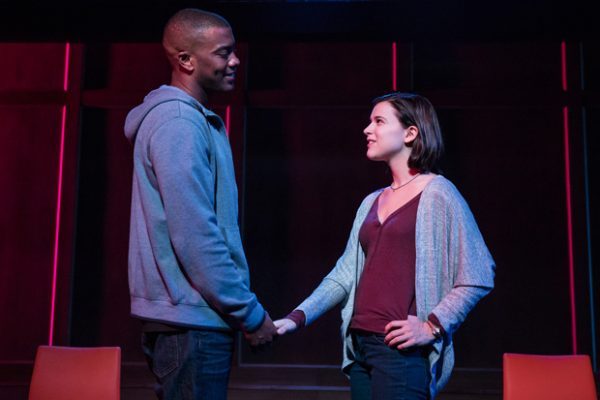
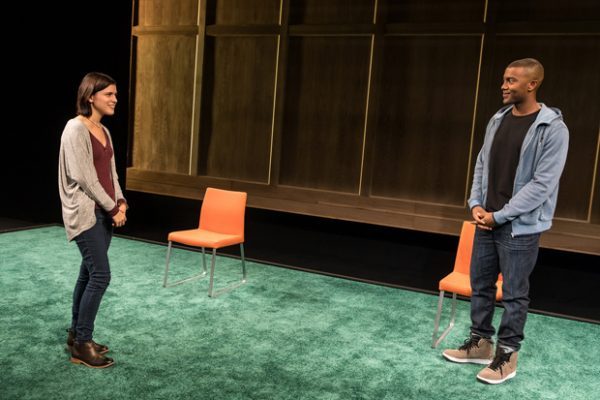
Tom (Joshua Boone) and Amber (Alexandra Socha) cannot quite agree what happened one night in Actually (photo © Matthew Murphy)

ACTUALLY
Manhattan Theatre Club
New York City Center: The Studio at Stage II
Tuesday – Sunday through December 10, $30
212-581-1212
manhattantheatreclub.com
actuallyplay.com

Watching a talky play with relatively few characters, say, only two or four, can be like watching a tennis match. When the writing and directing is exceptional, it’s like seeing a championship bout between Nadal and Federer, Borg and McEnroe, Evert and Navratilova, your head going back and forth as the shifting dialogue consists of aces, expert passing shots, exciting net play, and thrilling overhead smashes. Of course, just as every play is not going to qualify for award status, not every tennis match is going to be memorable, something I can vouch for, having attended the U.S. Open for more than twenty years. Brooklyn-born playwright Anna Ziegler serves up both ends of the spectrum with two current off-Broadway shows, Actually and The Last Match, both of which involve the characters breaking the fourth wall and speaking directly to the audience, with very different results. The Manhattan Theatre Club production of Actually, continuing at City Center’s Stage II through December 10, is a timely, intense look at what actually happened the night two Princeton freshmen, Tom (Joshua Boone) and Amber (Alexandra Socha), hooked up at a party. While Tom believed their coupling was completely consensual, Amber thinks it turned into rape and reported it to the university.

Alexandra Socha and Joshua Boone star in gripping play by Anna Zielger

Alexandra Socha and Joshua Boone star in gripping play by Anna Ziegler (photo © Matthew Murphy)

Tom is a black classical pianist who says, “In some ways, I’ve been on trial my entire life.” Amber is white and Jewish, a mediocre squash player who explains, “We all fill some stupid niche, which reduces us to something much less than what we are, but that’s the way it goes.” The play begins with them playing the game Two Truths and a Lie; Tom is reluctant, but Amber demands he participate if he wants to sleep with her. For ninety taut minutes, they reenact events from that night and share their thoughts with the audience, discussing consent, race, religion, Title IX, gender, and other key topics, turning viewers into a kind of jury of public opinion. When Amber says that her default state is “this zone of wanting something and not wanting it at the same time,” it really hits home, getting to the core of how so many people feel. Boone (Holler If You Hear Me, Mother Courage and Her Children) and Socha (Spring Awakening, Fun Home) are outstanding caught up in a long deuce, each one taking, then losing, the advantage as they volley back and forth. Ziegler’s (Photograph 51, Boy) dialogue is sharp and focused, while Obie winner Lileana Blain-Cruz (Pipeline, The Death of the Last Black Man in the Whole Entire World) directs with pinpoint accuracy on Adam Rigg’s spare set. Actually is no mere Bobby Riggs vs. Billie Jean King, he said / she said contest; it is a powerful exploration of possible sexual misconduct in an age when Americans learn more and more about the issue every day, as more and more predators are revealed.

(photo by Joan Marcus)

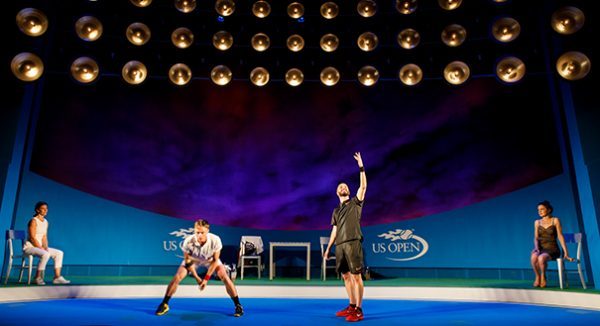
The Last Match takes place during the semifinals of the U.S. Open (photo by Joan Marcus)

THE LAST MATCH
Laura Pels Theatre
Harold and Miriam Steinberg Center for Theatre
111 West 46th St. between Sixth & Seventh Aves.
Tuesday – Sunday through December 23, $79
212-719-1300
www.roundabouttheatre.org

Unfortunately, the Roundabout production of The Last Match, running at the Laura Pels Theatre through December 23, is not nearly as incisive and gripping as Actually. It’s the semifinals at the U.S. Open, and six-time champion Tim Porter (Wilson Bethel), who might be on the downside of his career at the tender age of thirty-four, is playing younger up-and-comer Sergei Sergeyev (Alex Mickiewicz), a hotheaded Russian who wants to dethrone the even-tempered American star and crowd favorite. They serve and volley on Tim Mackabee’s tennis court set, with the familiar blue, white, and green colors of the Open and scoreboards on either side, while Bray Poor’s audio design includes the sound of imaginary swinging rackets striking imaginary yellow balls. In between and during points, Tim and Sergei argue with each other in ways that don’t feel real during a live match; share their thoughts directly with the audience; and reenact scenes from their past, primarily Tim’s relationship with fellow tennis player Mallory (Zoë Winters) as they marry and try to have a baby, and Sergei’s courtship of the fiery Galina (Natalia Payne). The women cheer their partners on from the sides of the stage as the men fight it out. But whereas Amber and Tom in Actually were complex characters who had their charms along with their shortcomings, both gaining the audience’s sympathy at different times, only Mallory is able to elicit much catharsis in The Last Match.

(photo by Joan Marcus)

Tim Porter (Wilson Bethel) and Sergei Sergeyev (Alex Mickiewicz) battle it out on court and off in Anna Ziegler play (photo by Joan Marcus)

“You don’t want people to know you’re an asshole. But anyone who does this sport at this level is gigantic asshole of worst gigantic asshole variety,” Sergei says early on, adding, “You have to care only for yourself.” It’s hard to care about Sergei, Galina, and Tim, who are self-obsessed; Ziegler (A Delicate Ship, The Wanderers) and director Gaye Taylor Upchurch (Animal, The Year of Magical Thinking) give them back stories that don’t help humanize them but turn each one into more of a caricature. While Actually made smart, subtle references to societal issues and did not proclaim any grand statements about who was right, The Last Match is melodramatic and obvious, like a love match in tennis. “So many game points, on my racquet,” Sergei says. “This should be my game so many times over. I have earned it! But life does not actually work that way. You actually have to win.” But you’re likely to decide who you want to win from the very start, rendering the competition relatively mute. “Some people don’t even love their babies right away so it’s just relentless and boring. And we already have tennis for that, right?” Mallory asks Tim, who replies. “Well, I don’t find tennis boring.” But any tennis match, like any sporting event, can be relentless and boring. Just like any play.

SELL / BUY / DATE

(photo © Joan Marcus 2016)

Sarah Jones plays multiple characters in futuristic one-woman show about commercial sex trade (photo © Joan Marcus 2016)

Manhattan Theatre Club
New York City Center: The Studio at Stage II
Tuesday – Sunday through December 3, $30 through October 30, $75 after
212-581-1212
manhattantheatreclub.com
www.nycitycenter.org

Ten years ago, British playwright and actress Sarah Jones won a Special Tony Award (and an earlier Obie) for her one-woman show Bridge and Tunnel, in which she played multiple characters, shining a light on New York City’s immigrant population. It took a decade, but she is now back with her follow-up, another one-woman multiple-identity tour de force, Sell/Buy/Date, which revives some characters from her previous works while adding new ones. It’s late-twenty-first-century America, and Dr. Serene Campbell is teaching a class on the sex business, leading her students through a series of BERT modules, bio-empathetic resonant technology that dates back to 2017. Using this imaginary technology like oral histories, she tells her students, “We will be experiencing different bodies, different ages, what were then called ‘races’ or ‘ethnic groups,’ as you’ll remember from Unit One, and along the gender continuum, we’ll be encountering males as well as females — it was quite binary at that time. Remember, these are Personal History modules — the focus today is on feeling each person’s experience, so, before we begin, how many people have your emotional shunts engaged?” She then proceeds to embody seventeen characters interviewed throughout the decades about the commercial sex trade, examining the reaction in the recent past to prostitution, pornography, and exotic dancing. “Chronologically advanced” Jewish bubbe Lorraine L. talks about trying to enhance her sexual relationship with her husband by searching for porn on the internet. Post–Valley Girl Bella, named after feminist activist Bella Abzug, is a “sex work studies major, minoring in social media with a concentration on notable YouTube memes” who cohosts “the biweekly pole-dancing party . . . called ‘Don’t Get All Pole-emical.” Jamaican No Fakin’ is a Caribbean prostitute at a sex workers rally who is carrying an unseen sign that says “No Justice, No Piece.” She defends what she does, noting, “You find me somebody who don’t hate some part of their job. There’s a lotta things I hate about doing this, but the money is not one of them.” And New York Domini-Rican Nereida angrily declares, “It just makes me so sick that we are all supposed to care about the same human rights, at least, that’s why we’re all here for this Feminist Plenary, but I mean, if one more of these so called ‘sex work advocates’ calls me anti-sex, I swear to god. I’m gonna be, like, first of all, I love sex. Sex is amazing. But what you are having is not sex.

Dr. Campbell also calls up interviews of members of the male species as she walks around Dane Laffrey’s futuristic set, a spare, antiseptic classroom with a podium, a file cabinet, a floor sparsely outlined with lights, and a projection screen at the back. “Yes, of course men were having sex as well, but you’ll remember from the reading, what were male sluts called?” she asks the class. “Very good, they were called ‘men.’” Among the male characters in the show are frat boy and Grand Theft Auto fan Andrew “AV” Vanderbeek, Russian raunchpreneur Sergei Ledinov, Los Angeles pimp Cookie Chris (“Even with what I was doing, you know, exploiting women and whatnot, I had a rep for being real sweet about it”), and Native American comedian Gary (“I’m usually most popular on college campuses, whenever they wanna do their Diversity Day or Hey, We’re Not All White week”). But as much as the treatment of women and sex workers needs to change, not all change turns out to be progress.

Sarah Jones explores the history of the (photo © Joan Marcus 2016)

Sarah Jones explores a controversial aspect of human sexuality in Manhattan Theatre Club production at City Center (photo © Joan Marcus 2016)

Jones, who was born in Baltimore and raised in Boston, DC, and Queens in a multiracial family, has created a fascinating future devoid of organized religion, bachelor parties, unpaid internships, personal security guards, violent video games, a livable New Jersey, and mobile phones, where people can travel freely between countries and there is no discrimination of any kind. “They did not believe one has an automatic right to live equally,” Dr. Campbell says about people from the past. It’s a potent point, especially given the vitriol present in this year’s lurid presidential election campaign. In researching Sell/Buy/Date, Jones met with sex workers around the world, visiting Sweden, Germany, Korea, India, Las Vegas, France, Ireland, Scotland, the Netherlands, and the Dominican Republican, helping her create believable men and women who share a wide range of thoughts about commercial sex. She smartly captures the humanity in the industry, even if it is a bit lighthearted at times for such a serious topic, while Drama Desk–nominated director Carolyn Cantor (Fly by Night) ably uses sound (by Bray Poor) and light (by Eric Southern) to smoothly transition between time periods. However, a subplot involving Dr. Campbell’s mother’s identity as a “survivor” feels like a forced tribute to those who have paved the way for gender equality. Jones, who once declared, “The revolution will not happen between these thighs” (the late Gil Scott-Heron was a family friend), gives a superb performance, instantly taking control of the audience at the intimate and comfortable Studio at Stage II at New York City Center; she has a natural confidence as a teacher that is intoxicating. Part of the Manhattan Theatre Club’s Harold and Mimi Steinberg New Play Series, Sell/Buy/Date offers a lively and timely look at a controversial subject that has continued to raise eyebrows throughout the centuries.