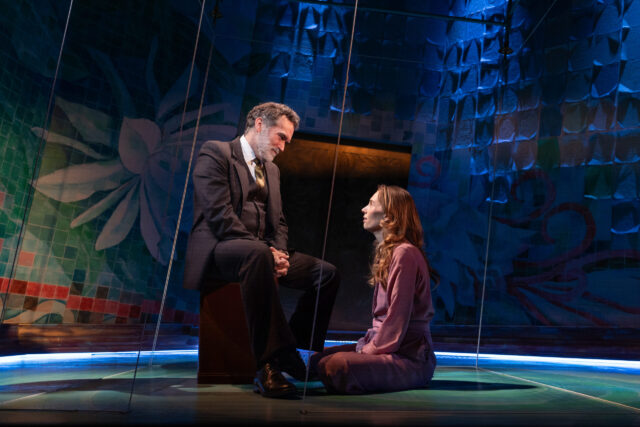
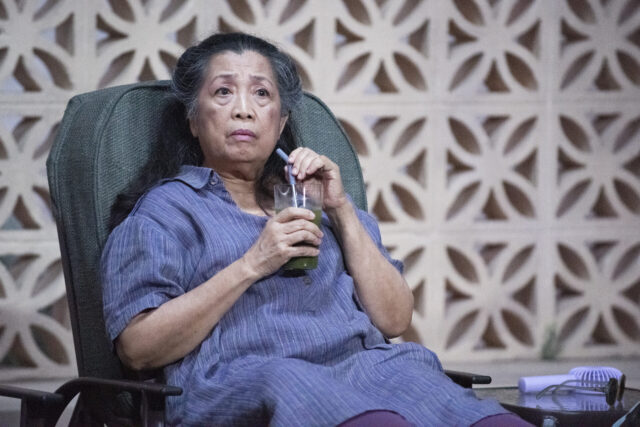
Big Stone (David Ryan Smith), Loud Stone (Maria Elena Ramirez), and Little Stone (Jon Norman Schneider) serve as an oddball Greek chorus in Sarah Ruhl’s Eurydice at the Signature (photo by HanJie Chow)
EURYDICE
The Pershing Square Signature Center
The Romulus Linney Courtyard Theatre
480 West 42nd St. between Tenth & Eleventh Aves.
Tuesday-Sunday through June 27, $105-$172 www.signaturetheatre.org
The Signature Theatre’s revival of Sarah Ruhl’s Eurydice is nothing if not “interesting.” In fact, that word appears in the ninety-minute show nearly two dozen times.
Originally staged in 2003, the play reimagines the Ancient Greek legend of the master musician Orpheus; his true love, Eurydice; and Hades, lord of the underworld, reframing it from the point of view of Eurydice and adding her father to the story, making their relationship the center of the narrative. Also known as a Nasty Interesting Man, the lord of the underworld is single, his wife, Persephone, having been eliminated from this plot, in which he sets his desires on Eurydice.
Eurydice: I read a book today. Orpheus: Did you? Eurydice: Yes. It was very interesting. . . . It had very interesting arguments. Orpheus: Oh. And arguments that are interesting are good arguments? Eurydice: Well — yes. . . . Orpheus: I made up a song for you today. Eurydice: Did you!? Orpheus: Yup. It’s not interesting or not-interesting. It just — is.
Eurydice (Maya Hawke) and Orpheus (Caleb Eberhardt) decide to get married, and on their wedding day she is lured by the Nasty Interesting Man (T. Ryder Smith) to his nearby fancy loft with the promise of seeing a letter from her deceased father (Brian d’Arcy James). “I’m not interesting, but I’m strong. You could teach me to be interesting. I would listen,” the man tells Eurydice. “Orpheus is too busy listening to his own thoughts. There’s music in his head. Try to pluck the music out and it bites you. I’ll bet you had an interesting thought today, for instance. I bet you’re always having them.” The meeting, in which the man declares his love for her, results in Eurydice’s death.
She arrives in the underworld via an elevator during a downpour. She is greeted by a trio of odd munchkin-like clowns who serve as an unhelpful Greek chorus: Big Stone (David Ryan Smith), Little Stone (Jon Norman Schneider), and Loud Stone (Maria Elena Ramirez). Her trip across the River of Forgetfulness has erased her memories; she does not recognize her father, who is excited to see her and must teach her the language of the underworld so she can remember who she is. He builds her a room made of string and they bond all over again, including reading to her from King Lear, not exactly the best example of a father’s relationship with his daughters: “We two alone will sing like birds i’ the cage. / When thou dost ask my blessing, I’ll kneel down / And ask of thee forgiveness; so we’ll live, / And pray and sing.”
Up above, Orpheus writes her letters and composes a symphony that he is able to get to her through a mail slot. Meanwhile, the Nasty Interesting Man is determined to make Eurydice his bride, wooing her by riding around on a tricycle like he’s a deranged young kid at a birthday party. Orpheus figures out a way to enter hell without dying, and he and the lord of the underworld battle for Eurydice’s affections as her father wants whatever she thinks is best for her.
Father (Brian d’Arcy James) and daughter (Maya Hawke) reconnect in the underworld in Signature revival (photo by HanJie Chow)
Ruhl wrote the play as a way to connect with her father, who passed away in 1994 when she was twenty. Much of the ninety-minute show feels overly personal and esoteric, difficult to follow, as if we are being taught a different language that will take more time to understand. Les Waters (Dana H.,Recent Alien Abductions), who has directed the play numerous times over the years, might be too close to it, unable to smooth out the many bumps in the narrative. Set designer Scott Bradley and sound designer Bray Poor return from Waters’s 2007 production at Second Stage; the action takes place in a tilted, tiled spa with exposed piping. Oana Botez’s costumes range from Eurydice’s father’s tailored suit to the lord of the underworld’s bizarre get-ups and the Stones’ devilishly clownish, colorful attire.
Five-time Tony nominee d’Arcy James (Shrek: The Musical,Something Rotten) is the star of the show, portraying the kind of caring father anyone would want; from constructing the string room to pretending to walk Eurydice down the aisle, he is hypnotic and charming. Hawke is enticing in her off-Broadway debut, but she and Eberhardt (The Comeuppance,On Sugarland) never quite ignite. Smith (Oslo,Our Lady of Kibeho) is game but appears to have pedaled in from another theater. The character’s appearances made me think of a favorite Looney Tunes cartoon, Hair-Raising Hare, in which Bugs Bunny, giving the orange Gossamer a manicure, says, “My, I’ll bet you monsters lead innnteresting lives. . . . I’ll bet you meet a lot of innnteresting people too. I’m always innnterested in meeting innnteresting people.”
The Orpheus story has been dazzling Broadway audiences since Hadestown opened in 2019; Ruhl’s Eurydice, the conclusion to her three-play series at the Signature following Letters from Max and Orlando, is, well, to put it in one word, “interesting.”
[Mark Rifkin is a Brooklyn-born, Manhattan-based writer and editor; you can follow him on Substack here.]
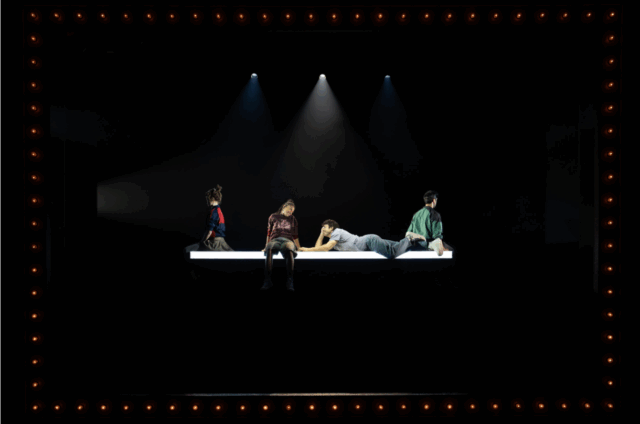
Caryl Churchill’s Glass. takes place on a glowing, floating platform (photo by Joan Marcus)
GLASS. KILL. WHAT IF IF ONLY. IMP.
Martinson Theater, the Public Theater
425 Lafayette St. at Astor Pl.
Tuesday through Sunday through May 25, $89
212-539-8500 publictheater.org
British playwright Caryl Churchill burrows into the fragility of human life and the concept of impermanence in Glass. Kill. What If If Only. Imp., four short works being performed together at the Public’s Martinson through May 25.
For more than fifty years, Churchill, now eighty-six, has been writing inventive, experimental plays that challenge audiences through abstract narratives and unique, unexpected stagings, from Cloud Nine and Top Girls to Vinegar Tom and Love and Information, creating her own genre, with flourishes of Beckett, Pinter, and Brecht mixed in. The four-time Obie winner has penned more than fifty works for the stage, radio, and television; three of the pieces at the Public were written in 2019, the fourth in 2021. (Glass.,Kill., and Imp. were originally performed with Bluebeard’s Friends at the Royal Court Theatre in September 2019 but has been replaced here by What If If Only, her latest play.)
The 135-minute show (with intermissions) is a triumph for both Churchill and Miriam Buether, whose breathtaking sets lift Churchill’s themes to the next level, along with stunning lighting by Isabella Byrd and compelling sound by Bray Poor, making it a visual and sonic treat. First up is Glass., which unfolds on a glowing rectangular platform hanging in the middle of the space, surrounded by darkness. It’s a kind of mantel where a Girl Made of Glass (Ayana Workman), a Clock (Sathya Sridharan), a Vase (Japhet Balaban), and a Red Plastic Dog (Adelind Horan) interact, attempting to define their existence and importance.
“She doesn’t want to be touched. She’s afraid of being broken,” the Girl’s protective mother says, explaining how there are many cracks in her daughter, who needs bubble wrap to go out.
The defensive Clock tells the Girl, “You’re beautiful but I’m also useful.” The Girl responds, “A clock isn’t useful anymore. Who looks at you? Time’s on the phones.” The Clock answers back, “They look at me because I’m worth looking at. Time from me is richer because I’m old and time’s run through me since before their parents were born. And you see it flow because my second hand goes round and my minute hand goes round and my hour hand goes slowly round and there’s none of this digital jumping. You gaze at me and think how long a minute lasts. Pain for a whole minute would be torture. Joy for a whole minute would be exceptional. And even if I stopped I’d be kept as an object because my history is intriguing and my shape is graceful and my value is unquestioned.”
The Dog says she is a reminder of happy times, even if she’s dusty and hasn’t been played with in years. The Vase is thrilled when the Girl says he is beautiful even without flowers. A group of schoolgirls stop by and taunt the Girl. A friend tells her a secret.
The play ends with a moving monologue in which the Girl expresses her fears in a way we can all relate to, how easy it is to become physically and emotionally damaged.
During the first break, hand balancer Junru Wang performs remarkable feats on canes in the pit in front of the stage as the set is changed behind the red velvet curtain. Wang pushes herself high into the air, stretching, switching hands, and contorting her limbs, a dazzling display of what the human body is capable of, a thrilling counterpoint to the delicate Girl Made of Glass.
Deirdre O’Connell relaxes on a cloud while talking about death in Kill. (photo by Joan Marcus)
In the solo Kill., Tony winner Deirdre O’Connell, wearing all white, sitting comfortably on a floating cloud in a black sky, delivers a treatise on the gods’ power over humans, treating them as playthings as they watch them murder one another as if orchestrating a Greek tragedy for fun. Fathers, mothers, husbands, brothers, cousins, lovers, and kings are brutally murdered, sent to hell, eaten, brought back for more punishment — it’s a vicious cycle of death and destruction put on for pleasure, a sly comment on the theater itself as well as the violence inherent in everyday life.
She begins, “We take this small box and shut the furies up in it, they’re furious and can’t get out, they say let us out and we’ll be kind. We gods can do that sometimes, quieten the furies, we can’t do everything, we don’t exist, people make us up, they make up the furies and how they bite. They’re after the boy, they won’t let him sleep or wake or sleep and he suffers. He suffers and suffers because he kills his mother, which we’re against and so is everyone but he has his reason so he’s right and wrong. He kills his mother, hoping she’ll die quickly, it can’t be over quickly enough, he doesn’t want her unrecognisable but still here, both slipping in the blood, his duty to do it, everyone thinks that and so do we, and he kills her lover happy to kill him but taking out the knife he remembers loving his mother and the nonsense words they’d say to each other though he still has the same hate in his heart coming home as when he’s little and runs away when she’s killing his father.”
It’s a tour de force for O’Connell, the words spilling out in a nonstop poetic assault that underlines humanity’s penchant for real and fictional violence; Churchill also questions the notion of faith, people’s belief that someone else is pulling the strings, be it a supreme being or, perhaps, a playwright, from Ancient Greece or twenty-first-century England. As the god says multiple times, “We don’t exist.”
During the second break, Maddox Morfit-Tighe juggles clubs, involving a few audience members; it’s not as awe-inspiring as what Wang did, and the metaphor is more obvious, but it is still entertaining as the stage is prepared for the third tale.
A man (Sathya Sridharan) faces loss in What If If Only. at the Public (photo by Joan Marcus)
What If If Only. is set in a mysterious large white cube reminiscent of Churchill’s Love and Information. A man identified in the script as Someone on Their Own (Sridharan) is sitting at a small table with a bottle of wine and two chairs; it is apparent that he is waiting for a person who is unlikely to come.
“If I was the one who was dead would you still be talking to me? We once said if one of us died if there was any way of getting in touch we should do it, I thought we’d be old. Are you not trying?” he says. “If you’d wanted to talk to me you could have stayed alive. I’ve nothing to say really, I just miss you. I once thought I saw a ghost, not spooky like Halloween, just a wisp of something standing in the door. I’ve told you this already, do you remember? Is remembering something you can do or has it all gone now? I miss you I miss you I miss you I miss you. I miss you. Please, can you? Just a wisp would be fine. If you can, please. Please, I miss you. A small thing, just any small thing, let me know you’re there somewhere. If you can.”
A woman (Workman) does arrive, but the man is not sure what or who she is. They agree she is at least a little like his lost love, then talk about regrets and possibilities, living and dying. She tells him, “I’m the ghost of a dead future. I’m the ghost of a future that never happened. And if you can make me happen then there would be your beloved real person not a ghost your real real living because what happened will never have happened what happened will be different will be what you want will be a happy happy.”
Soon the walls of the white cube rise and others enter, including a young girl (Cecilia Ann Popp), Asteroid, Empire, Silver, Nature, Small, and a calm, supportive older man (John Ellison Conlee) who tries to help the younger man face the reality of his situation, that there are so many futures but only one that will happen. It’s a gorgeous existential conversation with a surprise conclusion.
Imp. concludes quartet of existential works by Caryl Churchill (photo by Joan Marcus)
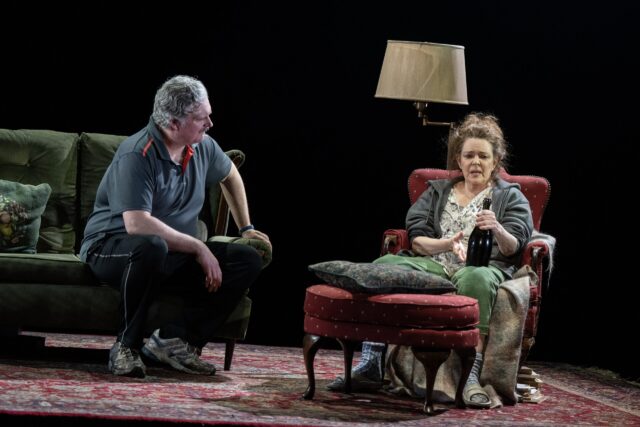
Imp. follows a full intermission (without acrobatics), featuring another brilliant set, this time a raggedy living room with a couch, a comfy chair, a floor lamp, and a red oriental rug on a slanted platform. It is the home of nonkissing cousins Jimmy (Conlee) and Dot (O’Connell), who bicker like an old married couple with nothing better to do. While the widowed Jimmy occasionally gets up to go running, training for a half marathon, the divorced Dot never leaves her chair.
Their several-times-removed Irish niece, Niamh (Adelind Horan), was recently orphaned, so she is visiting Jimmy and Dot while making a new life for herself in England. When Niamh says she needs to lose a stone by summer, Dot disagrees and says, “You’re lovely how you are. Don’t do it.” Jimmy argues, “Leave her alone, goals are good, you want everyone not to be fit so they’re no better than you. Just like you want everyone to be miserable.” Dot barks back, “You’re fattist is what he is, not he’s the fattest, Niamh, I mean like racist.” It’s rarely easy to parse Dot’s logic.
Another day they are speaking with the homeless Rob (Sridharan), a world traveler who’s been sleeping in a cemetery, wanting to go back to his son and estranged wife. The ever-suspicious Dot worries that if they let him stay in their house, he might kill them and take the residence for himself. “Why would he want to do that? He’s not stupid,” Jimmy says. Dot replies, “But if he could get away with it and have the flat. Don’t tell me you’ve never thought it.” Rob deadpans, “I’ve never thought it.” Soon Dot and Jimmy are hoping that Niamh and Rob get together.
They delve into faith and religion, with Niamh wondering what being Catholic ever did for her except make her terrified of sin and hell. Dot, a former nurse, is afraid of her temper, which might have cost her her marriage and career. Rob is deeply worried about his immediate future. Meanwhile, Jimmy is an eternal optimist.
But when Jimmy tells Rob about the bottle Dot keeps that she claims has a wish-giving imp in it, new questions arise about what’s next.
There might be a period after the name of each part of Glass. Kill. What If If Only. Imp., but they form a cohesive whole in this stellar production, gorgeously directed by longtime Churchill collaborator James Macdonald (Infinite Life,Escaped Alone). In three of the four plays, the characters wear Enver Chakartash’s casual, naturalistic costumes (O’Connell is in heavenly garb in Kill.), equating them with the audience, making the otherworldliness more believable. The pain of loss, the brittleness of life, the lack of power humans have over their destiny hover over all four plays. In each one, there is also trepidation about the future of each character, the sets tilted and suspended in ways that make it seem like the actors could at any moment fall off into the darkness or be trapped in blazing white light.
Churchill and Macdonald practically implore us to take a look at ourselves and examine how we deal with faith, grief, and, perhaps most important, time. “I sit on the mantelpiece and time goes by,” the Girl says in Glass. The characters in the other three works also are often sitting down, not taking action but watching and waiting.
It’s enough to force you to face your own future once you get out of your theater seat and venture back into the real world.
[Mark Rifkin is a Brooklyn-born, Manhattan-based writer and editor; you can follow him on Substack here.]
Six campers and a counselor search for healing in Grief Camp (photo by Ahron R. Foster)
GRIEF CAMP
Atlantic Theater Company, Linda Gross Theater
336 West 20th St. between Eighth & Ninth Aves.
Tuesday – Sunday through May 11, $56.50-$111.50
866-811-4111 atlantictheater.org
There has been a surfeit of plays about grief the last few years, most of them involving children and/or adults sitting around in circles in group or family therapy, sharing their personal stories. In her off-Broadway debut, twenty-seven-year-old Eliya Smith, who is in her final semester in the University of Texas at Austin’s MFA playwriting program, takes a different approach in the fiendishly clever Grief Camp, continuing at the Atlantic through May 11.
Bereavement camps have been popping up all over, offering healing for those who have lost loved ones; they have such names as Camp Good Grief, Comfort Zone Camp, and Camp Hope. Smith sets her tale at an unnamed summer camp in the real town of Hurt, Virginia. (It was named for a local landowner and attorney, not the pain of loss.)
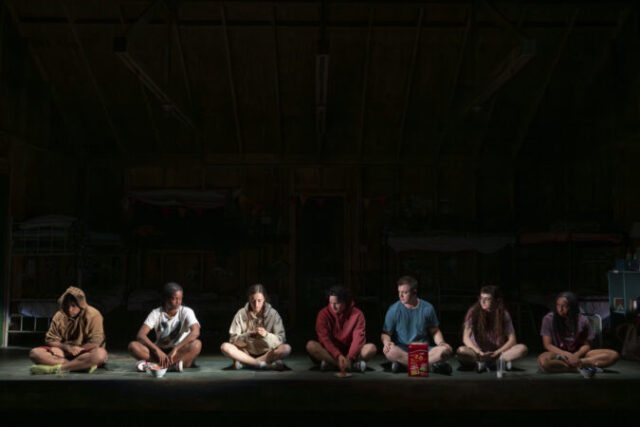
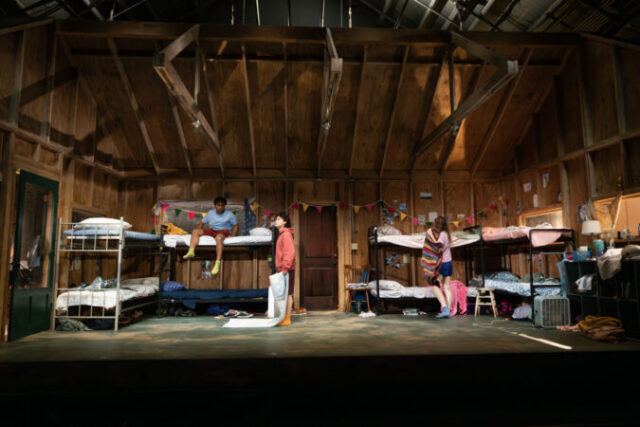
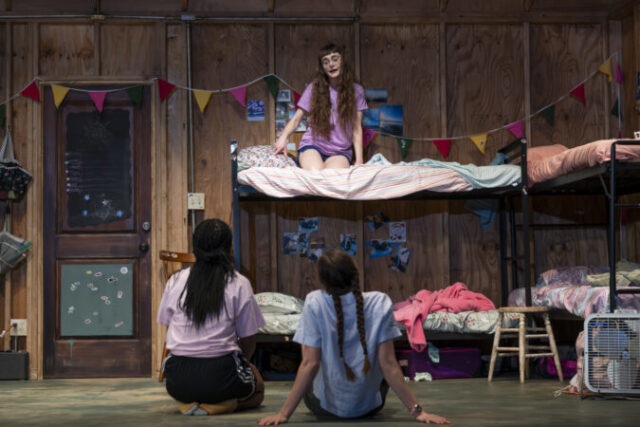
Louisa Thompson’s set is a large, somewhat disheveled cabin with four double bunk beds, two electric box fans on the floor, a bathroom in the back, and a small porch with a swing chair outside. On the natural wood walls are pages torn out of magazines, postcards, and a string of colored pennants.
It is home to six campers and one counselor: Bard (Arjun Athalye), who is addicted to Duolingo; Luna (Grace Brennan), a Los Angeles vegetarian who wants to be an artist; Blue (Maaike Laanstra-Corn), who is writing the rather strange musical untitled mansion island purple house project for her high school; Gideon (Dominic Gross), a cool dude who can’t swim and is worried about his missing green dinosaur; Olivia (Renée-Nicole Powell), who doesn’t look forward to any of the scheduled activities; her younger sister, Ester (Lark White), who hates grief camp; and Cade (Jack DiFalco), a former camper who is now a counselor, living and working with the others in the cabin.
Grief Camp continues at the Atlantic through May 11 (photo by Ahron R. Foster)
Each morning, everyone is woken up by the camp’s founder, the never-seen Rocky, who blows a terrible reveille on the trumpet, makes announcements, gives the weather report, and advises some form of “Rise and shine, kids! Welcome to another perfect day from which to begin the rest of your lives.” It’s not the most encouraging or original bromide.
Over the course of about ten days — the script calls it a “time soup” — the campers bond, argue, battle with the counselors, and avoid getting caught up in woe-is-me self-pity. Esther is afraid she is a terrible person and confides in Luna. Blue holds readings of her ever-morphing musical. Campers are sick of chores, pray to the toenail god, and fight over the bathroom. A guitarist sits in the swing chair and sings Debbie Friedman’s rendition of “Mi Shebeirach,” the Jewish prayer for healing. The campers don’t mope around in mourning or compare one another’s tragedies, although there is a palpable feeling of grief permeating the atmosphere.
In a one-on-one with Olivia, Cade tells her to take out her journal and address the following prompt: “Sometimes, in our grief, we invent guilt in order to feel control over a situation. Sound familiar? Of course it does. So go ahead. Address that guilt head on. Apologize to the person to whom you feel guilt. Explain how you would —”
Olivia cuts him off, wanting to just talk instead. They discuss college, flirting, and Olivia’s different-colored eyes. Olivia asks Cade why he keeps coming back to the camp; he replies, “This place saved my life.” A moment later, Olivia says, “If I had to come back here I suspect I would kill myself.”
Blue (Maaike Laanstra-Corn) discusses the high school musical she’s writing in Eliya Smith’s off-Broadway debut at the Atlantic (photo by Ahron R. Foster)
In another scene, Cade strongly advises, “At some point, Olivia, you’re gonna have to stop acting like you’re broken.” That line serves as the centerpiece of the ninety-minute play. Smith and Tony-nominated director Les Waters (Dana H.,Big Love) carefully avoid any lapses into sentimentality or solipsism, treating Cade and the campers like unique characters in their own right and not as plot points to rhapsodize about grief. In fact, we don’t even learn the specific loss that each camper experienced, only some of them. In addition, Blue’s oddball musical slowly twists into focus but without becoming obviously metaphorical.
The ensemble, several of whom are making their off-Broadway debut, engagingly portray complex characters about to move on with their lives but not yet ready to face the world. The realistic costumes are by Oana Botez, with sharp lighting by Isabella Byrd and terrific sound design by Bray Poor, from rainstorms to Rocky’s staticky announcements to Luna singing into a floor fan.
Early on, Luna encourages Bard to curl up in the fetal position. He is tentative at first, but when he eventually tries it, he declares he is the biblical Moses in a basket on a river. “Why can’t you just be like a regular baby,” Luna says. Smith explains in the script, “The children are not precocious wunderkind iconoclasts or tiny prophets. They are not special. Something extraordinarily bad happened to each of them. They are ordinary.”
In other words, just like the rest of us.
[Mark Rifkin is a Brooklyn-born, Manhattan-based writer and editor; you can follow him on Substack here.]
“If we both describe the same thing at the same time, will one of our descriptions be more true than the other?” Isaac says to Nikolai in Rajiv Joseph’s 2017 time-leaping play Describe the Night. Later, Feliks tells Mariya, “You love to make up stories that are more interesting than what the truth is.”
The concept of “the truth” is also central to Joseph’s latest work, Dakar 2000, a gripping cat-and-mouse contemporary noir presented by Manhattan Theatre Club at New York City Center’s Stage 1 through March 23.
It’s December 31, 2024, and a fifty-year-old man (Abubakr Ali) walks onstage and delivers a monologue detailing a series of life-altering events that happened to him twenty-five years earlier, during the last few days leading up to Y2K, when some people thought the world might end.
Standing on a swirling ramp, he begins, “This is a story within a story, about a person within a person, in a time within another time. In a galaxy far, far away. All of it . . . is true. Or most of it, anyway. Names have been changed. Some of the places have been changed. Some of the boring parts snipped away. Some other stuff has been added to make it . . . theoretically more interesting. But otherwise all of it is almost entirely true.”
After telling us about a secret job he had that has taken him across the globe, he concludes, “The truth — the dumb, boring truth — is that this is mostly the story of a kid who just wanted to make a difference. And the truth is . . . he didn’t. I mean, I didn’t. Or I hadn’t . . . I hadn’t done much of any consequence, ever. Until I flipped my truck, just before the millennium . . . And met a woman who worked at the State Department.”
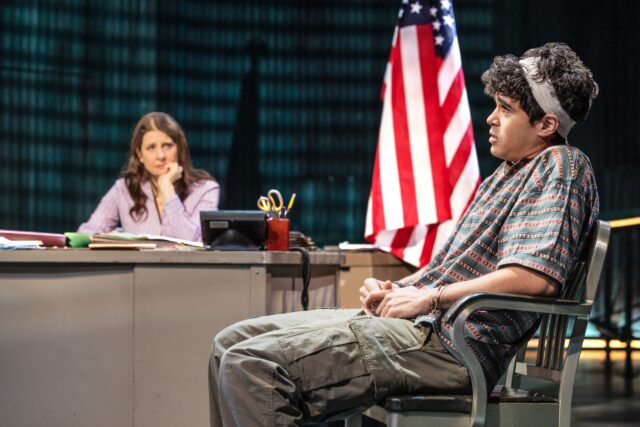
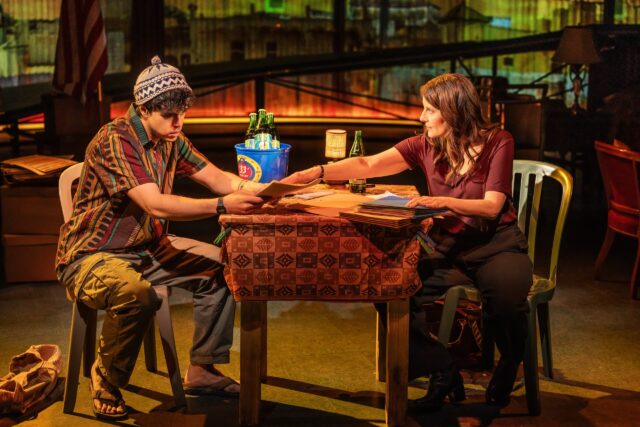
The narrative shifts to late December 1999, and Boubacar (Ali), known as Boubs (pronounced “boobs”), is a Peace Corps volunteer in Senegal, stationed in Kaolack and building a fenced-in community garden in the nearby village of Thiadiaye. Sporting a bandage around his injured head following the accident, he has been called in to meet with Dina Stevens (Mia Barron), who identifies herself as the Deputy Regional Supervisor of Safety & Security for Sub-Saharan Africa. Dina watches Boubs carefully as he shares the details of what led to the crash; she then starts asking pointed questions that tear holes in his story. He keeps up what turns out to be a ruse until she accuses him of lying about his situation, and he ultimately admits to repurposing materials that were meant for other projects.
Threatening to send him back home to America, Dina, who is hell bent on avenging the murder of several of her friends in the 1998 embassy bombing in Tanzania, offers Boubs the option of performing an odd task for her instead, which leads to another task, and another, each one more mysterious and perilous — and bringing Boubs and Dina closer and closer. As Y2K approaches, Boubs doesn’t know what to believe, and neither does the audience.
Boubs (Abubakr Ali) and Dina Stevens (Mia Barron) grow close working together in Rajiv Joseph’s Dakar 2000 (photo by Matthew Murphy)
Dakar 2000 is a riveting thriller reminiscent of Stanley Donen’s 1963 Hitchcockian favorite Charade, in which Audrey Hepburn stars as an American expat unexpectedly caught up in a dangerous spy drama in Paris after her husband is killed and she is pursued by multiple men, one of whom (Cary Grant) claims he is trying to help her even though she catches him in lie after lie. Which is not to say that Barron and Ali have the same kind of chemistry as Hepburn and Grant, but the quirky relationship between Dina and Boubs is appealing. At one point, when they’re on Boubs’s roof, face-to-face, you want them to kiss but also want them not to, as neither one is ultimately trustworthy.
Two-time Obie winner Rajiv Joseph (Bengal Tiger at the Baghdad Zoo,King James) and director May Adrales (Vietgone,Poor Yella Rednecks) keep us guessing all the way to the finale. Tim Mackabee’s turntable set moves from Dina’s office and a restaurant to the roof and a hotel bedroom, with small props occasionally surreptitiously added when it rotates from scene to scene. Shawn Duan’s projections range from a starry sky and outdoor African locations to text that establishes the precise time and location. A metaphor linking the 1997 Hale Bopp Comet to fate is confusing, but the choice of Culture Club’s 1983 hit “Karma Chameleon” as the song connecting Boubs with his ex-girlfriend is inspired, with Boy George singing, “There’s a loving in your eyes all the way / If I listen to your lies, would you say / I’m a man without conviction / I’m a man who doesn’t know / How to sell a contradiction / You come and go, you come and go.”
Ever-dependable Obie winner Barron (The Coast Starlight,Dying for It) effectively captures Dina’s enigmatic nature, representing an unethical government that holds all the cards. Ali (Toros) portrays Boubs’s younger self with a tender vulnerability that makes his actions understandable, although his overall characterization is ultimately a bit uneven, his voice too often switching pitches, his youth making him less than convincing as the modern-day Boubs.
Joseph has noted that Dina and Ali are based on actual people, but that doesn’t mean Dakar 2000 is a documentary play, particularly as words such as truth and lie show up over and over again. During the course of the work’s brisk eighty minutes, Dina tells Boubs, “You’re a good liar,” “Trust me, I wouldn’t lie to you about this,” and “Do you ever wonder if it’s all a big lie?” Meanwhile, Boubs wonders, “How could it be a lie?” when Dina questions humanity’s general consciousness.
Theater by its very definition presents a fictional version of reality, no matter how factual it might be. But in the case of Dakar 2000 and other plays by Joseph, we should be grateful that he “loves to make up stories that are more interesting than what the truth is.”
[Mark Rifkin is a Brooklyn-born, Manhattan-based writer and editor; you can follow him on Substack here.]
Annie Baker’s Infinite Life takes place at a pain clinic in Northern California (photo by Ahron R. Foster)
INFINITE LIFE
Atlantic Theater Company
Linda Gross Theater
336 West 20th St. between Eighth & Ninth Aves.
Tuesday – Sunday through October 14, $50-$127 atlantictheater.org
“This is agony in its purest form,” Eileen (Marylouise Burke) says in Pulitzer Prize winner Annie Baker’s exquisite new play, Infinite Life, which opened this week at the Atlantic. “A minute of this is an infinity.”
It is never agony watching anything by Baker, whose previous wide-ranging and insightful works include The Flick,Circle Mirror Transformation,The Antipodes,John, and The Aliens. She made her off-Broadway debut at the Atlantic in 2008 with Body Awareness, about which she told the New York Times, “My goal for the play is to not judge anyone, to get at that point where everyone is equally right and equally wrong, so the humor comes from that.” The same can be said for Infinite Life, about six characters who are deeply aware of their bodies, riddled with pain.
The play takes place in 2019 at a Northern California clinic run by an unseen man named Erkin, who treats chronic pain sufferers, mainly women, with water or juice fasts for days or weeks at a time. Eileen, Yvette (Mia Katigbak), Ginnie (Kristine Nielsen), and Elaine (Brenda Pressley) spend most of their time lying on deck chairs and gossiping, but this is no day at the beach. When they are joined by younger newcomer Sofi (Christina Kirk), they are intrigued and pepper her with questions; at first Sofi doesn’t want to share too much but soon reveals more, which tickles the other women’s curiosity. She is reading George Eliot’s final novel, Daniel Deronda, which deals with culture and identity, class and morality, centered by a seemingly heroic male figure and written by a woman who had to pretend she was a man in order to get published.
Eileen (Marylouise Burke) and Sofi (Christina Kirk) discuss life in Atlantic world premiere (photo by Ahron R. Foster)
Ginnie is a flight attendant from the local area who has “auto-immune thyroid stuff,” vertigo, and no filter, freely discussing pornography, carbonation, cantaloupes, rape, and how many sphincters humans have. Elaine, from New Hampshire, is a grandmother who has chronic Lyme disease and likes to draw. Yvette is a Michigander who is in surprisingly good spirits given her severe bladder issues and other health problems. Eileen, the oldest, is a Christian from Wichita who doesn’t appreciate cursing and walks very slowly, her constant pain palpable.
The women are thrown off balance when Nelson (Pete Simpson) arrives, a hunk of a fortysomething man, barefoot and bare-chested, surrounded by an air of mystery. “Who’s Daniel Deronda?” he asks Sofi. “Yeah, I think he’s actually the main character — we met him at the very beginning of the book — but he hasn’t reappeared yet so I don’t know that much about him.” The two of them build a flirtatious relationship that somewhat echoes Eliot’s book as each of the characters delve deeper into their personal situations.
A coproduction with London’s National Theatre, Infinite Life is not just about pain; it specifically focuses on the psychological, emotional, and physical pain inflicted on women by society. When Nelson ultimately shares his illness with Sofi and describes his most painful night, he explains, “I don’t know if you’ve been through childbirth but I met this lady who had the same thing happen to her and she said it was way worse than childbirth.” Sofi, who does not have children, replies, “You don’t actually know if your level of pain that night was worse than my level of pain on my worst night. It’s like impossible to know.” It’s also insulting for a man to compare his pain to a woman’s; Sofi later tells Eileen, “You know, I always feel like I’m lying when I say I’m in pain,” as if it’s just part of her existence that she has to accept. But Eileen counters, “The pain is an error. . . . We have to resist pain because resisting pain is resisting what isn’t true. The only true thing is the Infinite Idea, forever repeating itself.”
Earlier, in one of the many voice messages Sofi leaves for her silent husband, she says, “You must think I’m a monster. Maybe I am a monster. My body is monstrous. My mind is monstrous. So I’m a monster. Congratulations. You married a monster.” In Daniel Deronda, the protagonist, Gwendolen Harleth, argues, “People talk of their motives in a cut and dried way. Every woman is supposed to have the same set of motives, or else to be a monster. I am not a monster, but I have not felt exactly what other women feel — or say they feel, for fear of being thought unlike others.” Eliot’s novel might be set in Victorian England, but the sentiments still ring true today regarding societal expectations of women.
Yvette (Mia Katigbak) shares her astounding health history in Infinite Life (photo by Ahron R. Foster)
Director James Macdonald (Cloud Nine,The Children,Escaped Alone) masterfully guides each scene with with an intoxicating confidence that illuminates every moment. The comfy set by dots features seven chaises longues, ensuring that at least one is always empty, leading audience members to wonder what it would like to occupy one. Ásta Bennie Hostetter’s costumes are casual but not relaxed; only Ginnie and Nelson are dressed as if they are poolside, while the others are fully clothed and wear shoes. Isabella Byrd’s sharp lighting delineates the time of day, with Sofi calling out the shifts: “Twenty minutes later,” “Five hours later,” “Two days later. Maybe three days later?” Bray Poor’s sound includes crickets in the background, as if no one is listening to the women’s problems.
“I had to accept being in pain all the time,” Yvette says early on, as if speaking for all women. That acceptance, passed on from generation to generation, is questioned by Baker in the gorgeous finale, which, if it doesn’t promise relief, at least promises a more generous way to hold our human suffering.
[Mark Rifkin is a Brooklyn-born, Manhattan-based writer and editor; you can follow him on Substack here.]
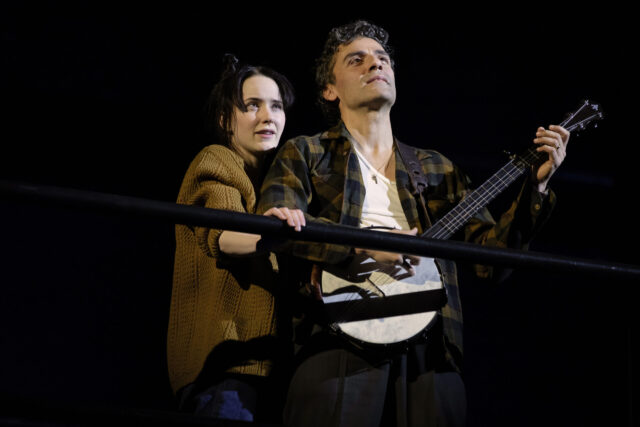
Iris (Rachel Brosnahan) and Sidney (Oscar Isaac) get playful in long-overdue Lorraine Hansberry revival at BAM (photo by Julieta Cervantes)
THE SIGN IN SIDNEY BRUSTEIN’S WINDOW
Brooklyn Academy of Music
BAM Strong, Harvey Theater
651 Fulton St. between Ashland & Rockwell Pl.
Tuesday – Sunday through March 24, $84.50-$385
718-636-4100 www.bam.org
One of the first things you will ask yourself after seeing Lorraine Hansberry’s The Sign in Sidney Brustein’s Window is, Why haven’t I ever seen or read this before? Or even, Why have I never heard of it until now?
Hansberry changed theater forever with her 1959 masterpiece, A Raisin in the Sun. Five years later, her second play, The Sign in Sidney Brustein’s Window, debuted on Broadway, starring Gabriel Dell as the title character and Rita Moreno as his wife, Iris. It ran for 14 previews and 101 performances; the last New York City revival was more than fifty years ago, playing nine previews and a paltry five performances at the Longacre, with Hal Linden as Brustein and Zohra Lampert as Iris. Whereas Raisin dealt with a Black family struggling to survive on the South Side of Chicago following the death of its patriarch, Sign is about a white couple in Greenwich Village trying to maintain their Bohemian lifestyle; racism and discrimination are only subplots to the central narrative.
The provocative play is now back in a stellar production at BAM’s Harvey Theater that continues through March 24 and stars Emmy nominee Oscar Isaac as Sidney, a New York City Jewish intellectual, and Rachel Brosnahan as his non-Jewish wife, Iris; the story is built around Sidney’s efforts to make a living and the travails of his friends and his wife’s family.
When the play opens, his latest business venture, a folk music café called Walden Pond, has failed, so he immediately decides to buy the local newspaper the Village Crier. The deal annoys Iris, a wannabe actress he has nicknamed Mountain Girl because of her Appalachian upbringing. “Where in the world are you going to get the money to pay for a newspaper?” a bewildered Iris asks. “It’s a small newspaper. A weekly,” Sidney explains. “Sidney, you can’t afford a yearly leaflet!” Iris declares.
Joining Sidney at the newspaper are his right-hand man, Alton Scales (Julian De Niro), and artist and designer Max (Raphael Nash Thompson), who has contempt for revolutionaries like Alton.
Alton (Julian De Niro) and Wally (Andy Grotelueschen) are a bit on edge in The Sign in Sidney Brustein’s Window (photo by Julieta Cervantes)
Sidney is a former idealist who no longer believes that he can save the world. “Since I was eighteen I’ve belonged to every committee to Save, to Free, to Abolish, Preserve, Reserve, and Conserve that ever was,” he tells Alton, who is a light-skinned Black man, and his friend Wally O’Hara (Andy Grotelueschen), a bushy haired white man running for local office as a reformer. Sidney goes on, “And the result — is that the mere thought of a ‘movement’ to do anything chills my bones! I simply can no longer bear the spectacle of power-driven insurgents trying at all cost to gain control of — the refreshment committee!”
Sidney calls Iris’s older sister, the bigoted and fashionable Mavis (Miriam Silverman), “the Bulwark of the Republic. The Mother Middleclass itself standing there revealed in all her towering courage.” Mavis responds, “I am standing here and I am thinking: how smug it is in bohemia,” blaming people such as Sidney for society’s ills, declaring, “Since you have all so busily got rid of God for us!”
Alton has fallen in love with Gloria (Gus Birney), Mavis and Iris’s younger sister, who works as a call girl in Miami, although Alton doesn’t know that. Because Mavis had difficulty accepting Iris’s marriage to a Jew, Iris and Sidney decide not to tell Mavis about Alton, assuming she’ll not respond well to the possibility of a Black brother-in-law, either. Meanwhile, gay playwright David Ragin (Glenn Fitzgerald), who lives upstairs from the Brusteins, occasionally drops by for some writing supplies or just to say hello and shake things up.
And things do indeed get shaken up immediately before and after the primary.
Obie-winning director Anne Kaufman (The Bedwetter,The Nether) gives Hansberry’s sharp dialogue and clever character development the room they need to breathe and grow, avoiding clichéd situations and stereotypes. The action unfurls on dots’ multifloor set, which is propped up from beneath as if it is floating in a mysterious space, a cramped Village apartment with a fire escape outside one window and a rooftop view. John Torres’s lighting and Bray Poor’s sound maintain the believability of it all.
Iris (Rachel Brosnahan) and Sidney (Oscar Isaac) can make only so much beautiful music together (photo by Julieta Cervantes)
Isaac (Hamlet,Grace) is sensational as Sidney, completely immersing himself in this complex and unpredictable man who essentially wants to do the right things for the right reasons, who feels he is part of a bigger community that needs people like him. Brosnahan (The Marvelous Mrs. Maisel,Othello) is a delight as Iris, who is ready to flower but is constantly thwarted. Silverman (Anatomy of a Suicide,A Delicate Ship) nearly steals every scene she’s in, representing how too many Americans feel toward people who are not like them but also how they are not innately evil and, perhaps, willing to adjust their views. Tony nominee Grotelueschen (Tootsie,Into the Woods) continues to prove he’s one of the best supporting players around as the politician seeking a newspaper endorsement. Birney brings a sweet innocence to Gloria, Fitzgerald is bold as the cocky David, De Niro is gentle as Alton, and Nash Thompson has a rousing good time as Max.
But at the center of it all, a daring humanity emanates from every moment. The play was inspired by a real election in Hansberry’s district in the Village; the Chicago native lived on Bleecker St. for many years prior to her death in 1965 at the age of thirty-four. BAM supplements the show with the biographical exhibit “‘Art Is Energy’: Lorraine Hansberry, World Builder” in the Rudin Family Gallery, consisting of photos, unpublished writings, recordings, drawings, Alison Saar’s sculpture To Sit a While, and more, lending insight into the playwright’s real life.
Theatergoers and critics might have been disappointed that The Sign in Sidney Brustein’s Window didn’t address racism directly like Raisin did as they tried to pigeonhole the Black woman writer, but her sophomore play has plenty to say about the human condition, and perhaps she was aware that the work would not be as successful as her first hit. About halfway through, Sidney and David have a key conversation in which Hansberry seems to be defending herself in David’s words.
Sidney: Tell me. What is your play about, David? David: It’s not for me to say. Sidney: Each person will “get from it what he brings to it?” Right? David: To be real simple-minded about it — yes. Sidney: Then, what makes you the artist and the audience the consumer if they have to write your play for you? David: I know what it’s about. I told you, my plays have to speak for themselves. Sidney: But to whom? For whom are they written and, above all, why are they written? David: You hate my kind of writing because it goes beyond the walls of Ibsen’s prisons and Shaw’s lectures — that’s your problem, Sid. Mavis: I just don’t know whatever happened to simple plays about simple people with simple problems.
Welcome to the wonderful world of Lorraine Hansberry and The Sign in Sidney Brustein’s Window.
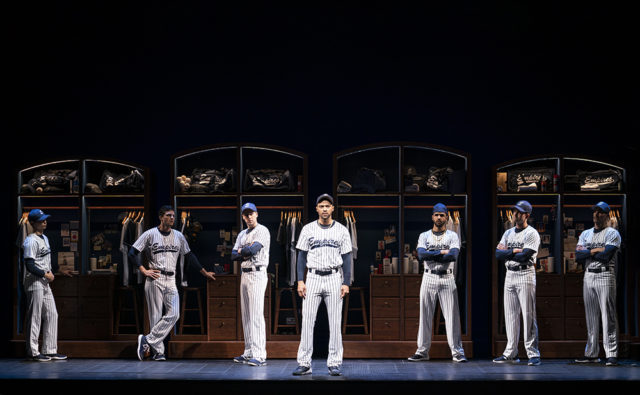
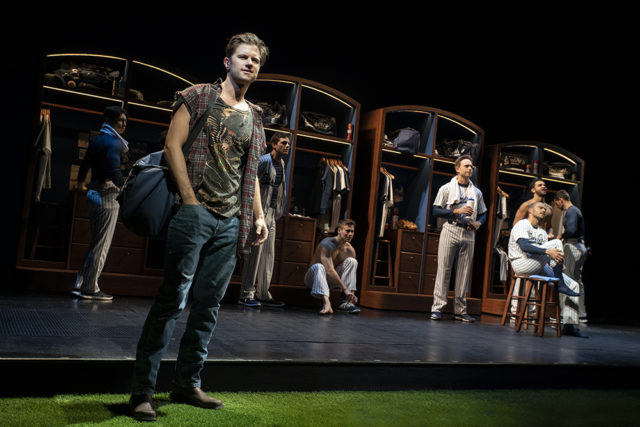
Much of Take Me Out happens in the locker room — with and without uniforms (photo by Joan Marcus)
TAKE ME OUT
Helen Hayes Theater
240 West 44th St.
Tuesday – Sunday through June 11, $79-$199 2st.com/shows
Scott Ellis’s hit Broadway revival of Richard Greenberg’s Tony-winning Take Me Out is well on its way to the playoffs (Tony nominations) and the World Series (Tony wins), but you don’t have to know anything about baseball to root for this compelling tale of ego, homophobia, and winning and losing.
It all starts with the brilliant title itself, which refers to: the traditional 1908 tune “Take Me Out to the Ball Game,” sung by fans during the seventh-inning stretch of every contest; a reverse riff on the chorus of John Fogerty’s 1985 hit, “Centerfield,” in which the former CCR leader declares, “Put me in, coach / I’m ready to play, today”; going out on a date; the public revelation that someone is gay; and the slang for a mob hit, as in “take him out.”
It’s 2002, and the world champion Empires, a stand-in for the Yankees — one backdrop features a silhouette of the Yankee Stadium wooden facade — are off to another good season. The story is narrated in flashback by shortstop Kippy Sunderstrom (Patrick J. Adams), a good friend of superstar Darren Lemming (Jesse Williams), a five-tool centerfielder who comes out of the closet with a sudden, unexpected announcement that he is gay. Darren did not do it to become a role model, to fight for gay rights, or to make a sociocultural statement; throughout the play, Darren’s motivations are private, driven primarily by ego and self-importance.
“Now, I’m not a personal sort of guy, really, and that’s not gonna be any different,” Darren, a handsome mixed-race player reminiscent of Bronx Bomber legend Derek Jeter, tells his teammates. “I mean, don’t expect the free flow of information. Don’t expect the daily update. I’m just here to play ball. I’m just here to have a good time. That’s no different. . . . And if, incidentally, there’s any kid out there who’s struggling with his identity, I hope this sends a message that it’s okay. They can follow their dream, no matter what. Any young man, creed, whatever, can go out there and become a ballplayer. Or an interior decorator.”
But he also tells Kippy, “You think you know me? You think you know my secret? Shit, that wasn’t a secret — that was an omission. I’ve got a secret — but that’s not it.” Even his last name, Lemming, is a warning for others not to follow him.
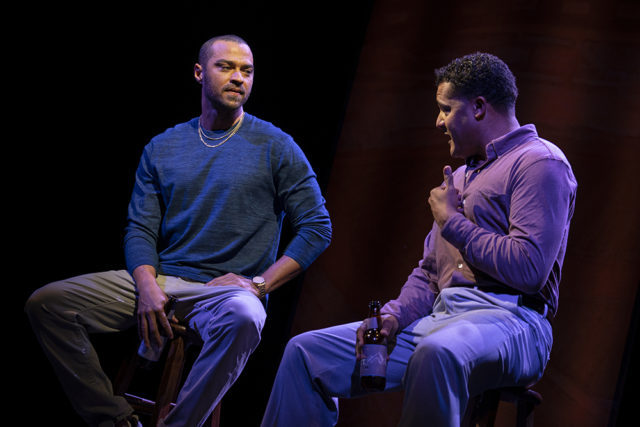
Friends and rivals Darren Lemming (Jesse Williams) and Davey Battle (Brandon J. Dirden) sit down for a chat in Take Me Out (photo by Joan Marcus)
As one would expect, his declaration creates significant problems in the locker room. Emerging from the shower to find a naked Darren, Toddy Koovitz (Carl Lundstedt) complains, “So now I gotta go around worrying that every time I’m naked or dressed or whatever you’re checking out my ass.” Because, of course, every gay man immediately wants to sleep with every male he sees. But Darren always gives better than he gets, telling Toddy, “Why’re ya lookin’ at it’s the question.” As the quippy Kippy noted earlier, after Darren confirmed, “I don’t want to fuck any of you,” he responded, “It’s not about that, Darren. It’s about us wanting to fuck you.”
When their ace pitcher, Takeshi Kawabata (Julian Cihi), slumps, they call up hard-throwing closer Shane Mungitt (Michael Oberholtzer) from Double A, who leads them back on track until he opens his mouth one day and spews forth bigoted remarks that would make even former Braves reliever John Rocker wince.
The tension in the locker room grows to epic proportions as no one can have a civil conversation, exacerbated by Kawabata’s, Martinez’s (Hiram Delgado), and Rodriguez’s (Eduardo Ramos) inability to speak English, a sports trope that enrages more conservative fans who believe that if you play ball in America, you need to speak the language — and the same fans are likely to have problems with a gay player.
“We were Men,” Kippy slyly philosophizes to his teammates. “This meant we could be girlish. We could pat fannies, snap towels; hug. Now . . . What do we do with our stray homosexual impulses?” After not-too-bright new catcher Jason Chenier (Tyler Lansing Weaks) asks if he was talking specifically to him and then turns red out of embarrassment because of the topic, Kippy adds, “We’ve lost a kind of paradise. We see that we are naked.” It’s as if they have taken a bite out of that apple and are being cast out of the garden.
Meanwhile, Darren keeps meeting with his new business manager, Mason Marzac (Jesse Tyler Ferguson), a gay accountant who at first knows nothing about baseball except that Darren is also gay, which makes him fall in love with the sport and worship his client. “A couple of weeks earlier I would have barely recognized the name! Then the announcement — that incredible act of elective heroism — and it was as if I’d known him my whole life — as if he’d been something latent in my subconscious.”
As the Empires prepare for a big game against the club that Darren’s best friend, Davey Battle (Brandon J. Dirden), is on, the world around Darren and the Empires turns into a lot more than just “the mess” Kippy alluded to at the start of the show.
Shane Mungitt (Michael Oberholtzer) has a rude awakening in store in Broadway revival of Richard Greenberg play (photo by Joan Marcus)
Take Me Out is an exceptional drama that uses baseball as an apt analogy for the state of the country. “I have come (with no little excitement) to understand that baseball is a perfect metaphor for hope in a Democratic society,” Mason says. “It has to do with the rules of play. It has to do with the mode of enforcement of these rules. It has to do with certain nuances and grace notes of the game. . . . Everyone is given exactly the same chance. . . . And baseball is better than Democracy — or at least than Democracy as it’s practiced in this country — because unlike Democracy, baseball acknowledges loss.”
In the history of the four major sports leagues, only one NBA player and one NFL player have revealed they were gay and kept playing: Brooklyn Nets center Jason Paul Collins in 2013 and current LA Raiders defensive end Carl Nassib in 2021. The revelation that a baseball superstar in his prime is gay would be a major deal today, but in the twenty years since Take Me Out premiered at the Public, no MLB player and only one umpire, Dale Scott, has come out and stayed on the diamond. Greenberg’s (The Assembled Parties,Three Days of Rain,The Perplexed) play feels fresh and alive in 2022, like it could have been written yesterday, save for the lack of cellphones onstage (and, thanks to strict rules, in the audience as well).
The two-hour play (plus intermission) moves much faster and more smoothly than baseball games. Ellis (On the 20th Century,The Elephant Man) is a superb manager, guiding the actors through David Rockwell’s splendid sets, which range from the ballpark and the locker room to a lounge and actual showers. Linda Cho’s costumes, primarily baseball uniforms, spend nearly as much time off the actors as on. (The nudity is the reason audience members must have their phones sealed in a Yondr pouch that the staff will open for you during intermission and then upon exiting.)
In their Broadway debuts, Adams (Suits,Equivocation) displays an easygoing, likable charm as Kippy, earning the audience’s devoted attention from his very first words, while Williams (Grey’s Anatomy,The Sandbox) shows off his numerous tools as the secretive hotshot Darren. (He will reprise the role in an upcoming television series, according to Deadline.) Dirden (Skeleton Crew,Jitney) excels in his supporting role, like a solid, dependable DH who always gets good wood on the ball and comes through in the clutch.
But the MVP might just be Ferguson (Modern Family,The 25th Annual Putnam County Spelling Bee), who knocks it out of the park every chance he gets. Mason is the glue that holds it all together, the only one who seems to really understand Darren as both a wealthy athlete and a gay man. Ferguson’s growing enthusiasm is infectious, spreading throughout the theater; he’s just the kind of person every locker room needs.