Tag Archives: Adina Verson

WIVES

(photo by Joan Marcus)

Diane de Poitiers (Aadya Bedi) and archrival Queen Catherine de’ Medici (Purva Bedi) fight over the affections of King Henri II (Sathya Sridharan) in Wives (photo by Joan Marcus)

Playwrights Horizons
Peter Jay Sharp Theater
416 West 42nd St. between Ninth & Tenth Aves.
Tuesday – Sunday through October 6, $49-$89
www.playwrightshorizons.org

Jaclyn Backhaus follows up her widely acclaimed Men on Boats and India Pale Ale, which earned her the Horton Foote Prize for Most Promising New American Play, with the world premiere of Wives, a disjointed, disappointing look at the women behind powerful men. The eighty-minute production, which opened Monday night at Playwrights Horizons, consists of four disparate scenes; the first three focus on the wives, ex-wives, and lovers of historical figures either near death or dead. In mid-sixteenth-century France, Queen Catherine de’ Medici (Purva Bedi), the wife of King Henri II (Sathya Sridharan), fights with his lover, Diane de Poitiers (Aadya Bedi), as he prepares for a jousting tournament, and the cook (Adina Verson) shares her secret for chopping onions. “Go to the larder and reach into a sack for a pair of yellow onions,” she says as if on a cooking show. “Find the ones that are not soggy because a soggy onion is a rotten onion and in sixteenth-century France a rotten onion will kill you.”

Four hundred years later, the recently deceased Ernest Hemingway (Sridharan) reads his own eulogy in Idaho, then his current and former spouses, Hadley Richardson (Purva Bedi), Martha Gellhorn (Aadya Bedi), and Mary Welsh (Verson), discuss various aspects of Big Ern’s life. “Don’t you just wonder like sometimes like how chewy and hot it would be to like be married to like such a thick slab of masculinity?” Martha says. “Just to like be tethered to a monolith that happens to be like the pinnacle of all manhood? But also, like, to own him? Like to be married is to be like property of someone but also like to own them is like the technical term. Sometimes I just totally fucking wondered what it would be for him to be mine. Well, he was mine for a time. It sucked.”

The action then shifts back to early-nineteenth-century Rajasthan, India, where hyper-moralistic British colonialist Aloysious Patterson (Verson) is spying on Maharajadhiraja Sawai Madho Singh II (Sridharan) to document his immorality with “his fave concubine, the noted witch Roop Rai” (Purva Bedi), despite being married to the Maharani (Aadya Bedi), who understands her husband’s needs and has no problem with his culturally acceptable visits to the zenana to seek additional sex partners. The Maharaja is ill and knows he is no longer in control. “Who are you dedicated to?” Roop Rai asks. “You,” the Maharaja answers. “Who do you serve?” she asks. “You,” he responds. “AGAIN!!” “YOU. YOU!!! You!!!”

(photo by Joan Marcus)

Maharajadhiraja Sawai Madho Singh II (Sridharan) seeks healing from Roop Rai (Purva Bedi) and his wife, the Maharani (Aadya Bedi), in world premiere at Playwrights Horizons (photo by Joan Marcus)

The first three acts don’t flow together smoothly but have smart, funny moments in this often slapstick battle of the sexes, but it all falls apart in a frustrating and tame finale. In my otherwise favorable review of India Pale Ale, I wrote, “The play is dragged down by late pedantic speeches by Deepa and Sunny that are wholly unnecessary, merely explaining what we’ve already seen.” I can say the same thing about Wives, which moves to the present, where Oxbridge junior Swarn (Aadya Bedi) arrives at a meeting of a commune of witches led by sophomore Clarisse (Verson) and overseen by a portrait of Virginia Woolf. When asked what she hopes to accomplish, Swarn says, “I want to untether myself from the visions made by men.” It’s an admirable desire that quickly devolves into dogmatic pretension. “We’re here to help you learn who you’ve been in order to help you see who you’ll be,” a character tells Swarn, seeking to empower her in clichéd and didactic ways.

Reid Thompson’s previous playful sets and Valérie Thérèse Bart’s adorable costumes now get serious and Margot Bordelon’s (Something Clean, Eddie and Dave) appropriately loosey-goosey direction becomes heavy-handed and unctuous as Backhaus is determined to make her point by driving it home over and over again. Wives began life as three separate plays, and the ending makes you feel that, anchored by a forced conclusion that preaches at an audience that the cast and crew have already won over.
EDDIE AND DAVE

(photo by Ahron R. Foster)

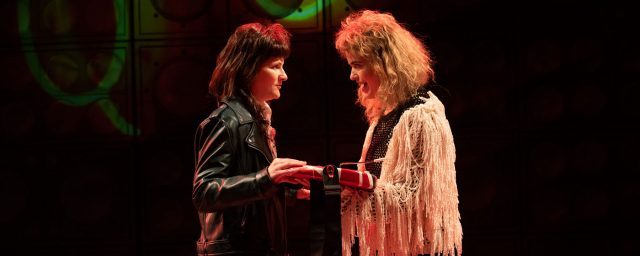
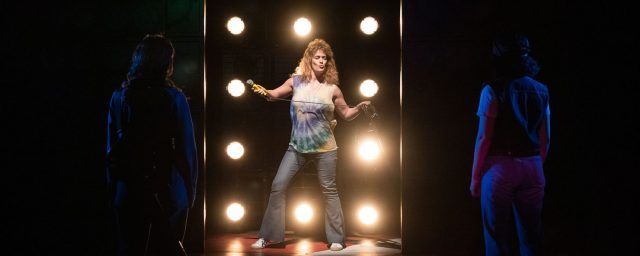
Playwright Amy Staats is Eddie Van Halen and Megan Hill is David Lee Roth in new play about 1970s hard rockers (photo by Ahron R. Foster)

Atlantic Stage 2
330 West 16th St. between Eighth & Ninth Aves.
Tuesday – Sunday through February 17, $56.50
atlantictheater.org

I have a difficult confession to make: I have never been a fan of Van Halen, the 1970s/’80s hard rockers with such hits as “Jump,” “Jaimie’s Cryin’,” “Hot for Teacher,” and “Runnin’ with the Devil.” But I am a big fan of Eddie and Dave, first-time playwright Amy Staats’s very funny show about the on-again, off-again relationship between the band’s songwriters, guitarist and composer Eddie Van Halen and lyricist and lead singer David Lee Roth — which has been extended at Atlantic’s Stage 2 through February 17. The story is told in flashback by a former MTV VJ based somewhat on Kurt Loder (“This is my memory play,” she says), centering on the group’s very brief reunion at the 1996 MTV Video Music Awards, when Eddie; his brother, drummer Alex Van Halen; bassist Michael Anthony; and Roth got together for the first time in more than a decade to present a prize. At the podium, Alex leans over and whispers something to Dave; what was said is the mystery behind the play and a solid-enough excuse to dig into the band’s strange and bizarre history. But Staats pulls an outrageous gender switch in her casting: She plays Eddie, Megan Hill is Dave, Adina Verson is Alex, Omer Abbas Salem is Valerie Bertinelli (Eddie’s eventual wife), and Vanessa Aspillaga is the VJ, a roadie, the Van Halens’ father, Quincy Jones, and other minor male characters. Anthony is portrayed by a framed photograph.

(photo by Ahron R. Foster)

Van Halen brothers Eddie (Amy Staats) and Alex (Adina Verson) look on as David Lee Roth (Megan Hill) struts his stuff at Atlantic Stage 2 (photo by Ahron R. Foster)

Scenic designer Reid Thompson has filled the theater with posters and flyers advertising such other 1970s/’80s groups as Pantera, Misfits, Iron Maiden, Dead Kennedys, Bruce Springsteen and the E Street Band, and the Ramones; as the audience enters the space, music by Journey, AC/DC, Black Sabbath, and Aerosmith is likely to have attendees of a certain age singing along and playing air guitar. Montana Levi Blanco’s costumes are send-ups of what the band really wore, including Eddie’s overalls and flannel shirt and Diamond Dave’s flashy over-the-top style. Cookie Jordan is responsible for the fab hair and wigs, featuring some damn fine mullets. Whether because of rights issues or as an artistic (financial?) choice, there is no actual Van Halen music in the show, only instrumental snippets (by Michael Thurber) heard here and there or seen in Shawn Boyle’s projections; in fact, no original Van Halen songs or albums are even mentioned by name except for their 2012 comeback record, A Different Kind of Truth.

(photo by Ahron R. Foster)

Van Halen rocks out — and fights — all over again in new play Eddie and Dave (photo by Ahron R. Foster)

None of the actors attempts to impersonate the famous people they portray, instead turning them into eccentric characters who say and do a lot of dumb but endearing stuff, the key word being “dumb.” Thus, Anthony comes off as the most intelligent member of the group, since he never speaks. (“We can’t talk about him; there’s not enough time,” the VJ explains.) Gleefully directed by Margot Bordelon, Eddie and Dave is a highly original mini-soap-rock opera that would delight Wayne and Garth (“Wayne’s World! Excellent!”), a fun and snarky account of a group of grown-up men, and one woman, who are not the brightest bulbs in the chandelier but managed to carve out some pretty successful careers. I’m still not a Van Halen fan, but I definitely have a newfound admiration for their wild and wacky tale.

COLLECTIVE RAGE: A PLAY IN 5 BETTIES

Betty 1 (Dana Delany) lets it all out in Collective Rage (photo by Joan Marcus)

Betty 1 (Dana Delany) lets it all out in Collective Rage (photo by Joan Marcus)

MCC Theater at the Lucille Lortel Theatre
121 Christopher St. between Bleecker & Hudson Sts.
Sunday – Friday through October 7, $49-$125
212-352-3101
www.mcctheater.org

For hundreds of years, the name “Betty” has been used to describe various types of women, from hot and stylish to relaxed and self-confident, from schoolteachers and the girl-next-door to wholesome and plain; it can also refer to a man who performs household duties, a gay man, and a light-skinned black man, according to Cassell’s Dictionary of Slang. The term has been linked to Betty Grable, Bettie Page, Betty Rubble from The Flintstones, Betty Cooper from the Archie comics, Betty Boop, and Betty Crocker and has been popularized in such films as Clueless and Encino Man. The word, with its wide range of meaning, can be a metaphor for the obscured individuality of women, one name covering the vast diversity and lack of sameness for a gender that has been treated as second-class citizens for millennia. But the second sex, as Simone de Beauvoir called women, has been fighting back in new ways in recent years, as depicted in Jen Silverman’s outrageously funny and perceptive play, Collective Rage: A Play in 5 Betties, an MCC production that continues at the Lucille Lortel through October 7. In the show, Silverman also reclaims the word “pussy,” which has multiple meanings too but has become a kind of feminist call to arms given its controversial usage by President Trump. The word appears about fifty times in the play, including in the subtitle: In Essence, a Queer and Occasionally Hazardous Exploration; Do You Remember When You Were in Middle School and You Read About Shackleton and How He Explored the Antarctic?; Imagine the Antarctic as a Pussy and It’s Sort of Like That.

Collective Rage features five characters from across the spectrum: Betty 1 (Dana Delany) is white and uptight, an erudite and elegant woman in a loveless marriage with the wealthy Richard; Betty 2 (Adina Verson) is white and unsophisticated, in a boring marriage with Charles; Betty 3 (Ana Villafañe) is a tough-talking bisexual Latinx who says what’s on her mind; Betty 4 (Lea DeLaria) is a heavily tattooed white butch lesbian who spends most of her time working on her truck and pining for Betty 3; and Betty 5 (Chaunté Wayans) is an African American boxing gym owner who self-identifies as a “gender-non-conforming masculine-presenting female-bodied individual.”

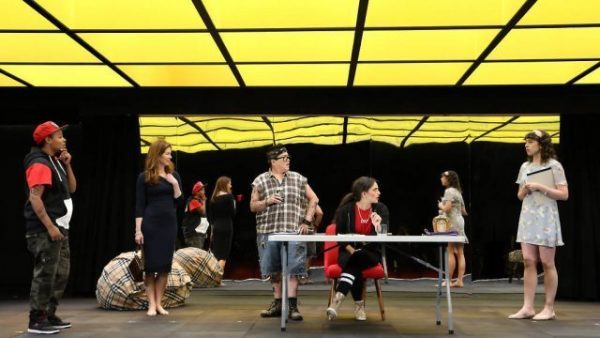
Five Betties gather together to stage their own play in biting work by Jen Silverman (photo by Joan Marcus)

Five Betties gather together to stage their own play in biting work by Jen Silverman (photo by Joan Marcus)

Betty 1 sets the tone in her opening monologue, in which she states after watching the news, “This world is terrible. This world is awful. / I am Very Very Concerned about the State of Things. / My husband Richard came home and I said to him RICHARD / I said RICHARD / I am Very Very Concerned About the State of Things. / My husband Richard is a calm person. / He is a logical and a rational person and He Wears a Suit. / And Richard said to me: BETTY / Richard said: BETTY / Richard said: Betty, Don’t Worry. / AND THAT DIDN’T MAKE ME FEEL BETTER.”

Each Betty busts female stereotypes; yet even as each is different, they all share a common loneliness, which is revealed at several women-only dinner parties. The intimate gatherings are not for men; in fact, the play itself was not written for the male gender, and in particular not straight white men. At one party, after Betty 3 raves about the first time she had sex with a woman, Betty 1 says, “That’s not good conversation for a dinner party.” Betty 3 says, “No?” Betties 1 and 2 answer in unison, “No.” Betty 3 asks, “How come?” Betty 1 says, “We don’t talk about sex at dinner parties.” Betty 3 responds, “What else you talk about?” Betty 2 replies, “We aren’t having sex, so we can’t talk about it.” Betty 3 offers, “Maybe you should start having it.” Betty 1 ends the discussion by saying, “We’re married.”

(photo by Joan Marcus)

Betty 5 (Chaunté Wayans) teaches Betty 1 (Dana Delany) how to fight back in Collective Rage (photo by Joan Marcus)

At another dinner party, Betty 3 gives Betty 2 and Betty 4 hand mirrors so they can look at their vaginas up close and personal. Betty 2 is terrified, claiming she has never done that before. “What if it’s ugly?” she says. “What if there’s teeth? What if it’s lopsided? What if it’s lumpy? Or flat? Or geometrically displeasing? Or what if I don’t have one at all and there’s just a small animal who lives there, like a lizard or a dwarf-hamster, and all I see are the gleam of its little eyes as it stares back up at me?” It’s a hysterically funny scene, but it also brilliantly depicts a woman’s fear of her sexuality and control of her own body. “Look at your pussy,” Betty 3 tells her. “Both eyes,” Betty 4 adds.

After Betty 3 goes to a play with a rich white woman — they see what she calls “Summer’s Midnight Dream” — Betty 3 decides to quit her job and stage her own piece of “Thea-tah”; entranced by the play-within-a-play narrative (of Shakespeare’s A Midsummer Night’s Dream,), she is going to do the same thing, a sly reference to Collective Rage, which now also has a similar structure. All five Betties become involved in the venture, for different reasons, furthering their relationships with one another and cleverly developing their individual characters as Silverman explores their innermost desires and their sense of self, as well as their thoughts on theater. “I think a lotta things that seem like art are maybe actually just about pussy. And then also, things that are mostly about pussy might actually be about art,” Betty 4 tells Betty 3, getting right to the point.

Collective Rage unfolds over ninety riotous yet poignant minutes, in chapters with such descriptive names as “Betty 2 Acts Out Her Feelings with a Puppet Because She Has No Real Friends,” “Betty 1 Has More Rage, and Does Something About It,” and “Betty 4 and 5 Work on Their Trucks and Talk About Relationships, Which Is Just Another Word for Pussy,” the titles projected above the stage. Dane Laffrey’s relatively spare set, just a few chairs and a desk, constantly surprises as items fall down through open grids in the ceiling, from truck engines and a punching bag to other key props, like gifts from heaven. (Kudos to prop master Joshua Yocom.) Director Mike Donahue (The Legend of Georgia McBride, Silverman’s The Moors) lets the women strut their stuff, and Delany (China Beach, Dinner with Friends), DeLaria (Orange Is the New Black, The Rocky Horror Show), Verson (Indecent, The Lucky Ones), Villafañe (On Your Feet, In the Heights), and Wayans (50 Shades of Black, Hollywood Misconceptions) don’t disappoint, shining a light on gender identity, sexuality, lust, love, societal expectations, and power in the twenty-first century. It’s about how to be a Betty, and how not to be a Betty, whatever that means. “I feel like things are changing,” Betty 4 says to Betty 5, who responds, “I hope so.” Betty 4 adds, “But everything was good the way it was. Wasn’t it?” Betty 5 replies, “Change is exciting.” And Betty 4 opines, “Change is sad. Change is things getting forgotten. Change is people getting left behind.” Exactly.

INDECENT

INDECENT takes audiences behind the scenes of controversial drama THE GOD OF VENGEANCE (photo by Carol Rosegg)

Indecent takes audiences behind the scenes of controversial drama GOD OF VENGEANCE (photo by Carol Rosegg)

Cort Theatre
138 West 48th St. between Sixth & Seventh Aves.
Tuesday – Sunday through August 6, $39 – $129
indecentbroadway.com

In late 1922, Sholem Asch’s controversial 1907 Yiddish play, God of Vengeance, premiered in an English-language version at the Provincetown Playhouse in the Village. On February 19, 1923, it moved uptown to the Apollo Theatre on Broadway. On March 5, the cast and producer were indicted on obscenity charges. (The play closed on April 14.) Ninety-three years later, on April 27, 2016, Paula Vogel and Rebecca Taichman’s Indecent, about the making of God of Vengeance, opened at the Vineyard Theatre by Union Square Park. The following April, it moved uptown to the Cort Theatre on Broadway. On May 3, the show received three Tony nominations, including Best Play (Vogel, in her Broadway debut) and Best Director (Taichman). How times have changed. I was moved by Indecent when I saw it at the Vineyard last June. However, since then, I caught the New Yiddish Rep revival of God of Vengeance, and the new U.S. administration has clamped down on immigration while anti-Semitism is on the rise around the world. Those aspects have led me to fall in love with the Broadway version, which is bigger and better at the Cort. Richard Topol again stars as Lemml, an immigrant who is so taken with Asch’s (Max Gordon Moore) play that he becomes the stage manager for the show as it travels through Eastern Europe and ultimately to New York City; he also serves as the narrator, addressing the audience directly as he shares his memories — although he cannot remember how it all ends. (The audience, however, is unlikely to forget the elegiac, haunting conclusion.) In the play within a play, Yankl (Tom Nelis), a devout Jewish man, is running a brothel in his basement in order to be able to afford a better life for his daughter, Rifkele (Adina Verson), as well as a new Torah, which he hopes will protect her virtue. Much to his chagrin, however, Rifkele falls in love with Menke (Katrina Lenk), one of the prostitutes. Nelis is also Rudolph Schildkraut, the famous Austrian actor who headlined and directed the show. The famous lesbian kiss from God of Vengeance, one of the most romantic moments I have ever seen onstage, is handled beautifully by Pulitzer Prize winner Vogel (How I Learned to Drive, The Baltimore Waltz) and Taichman (How to Transcend a Happy Marriage, Familiar), as is the entire production.

 (photo by Carol Rosegg)

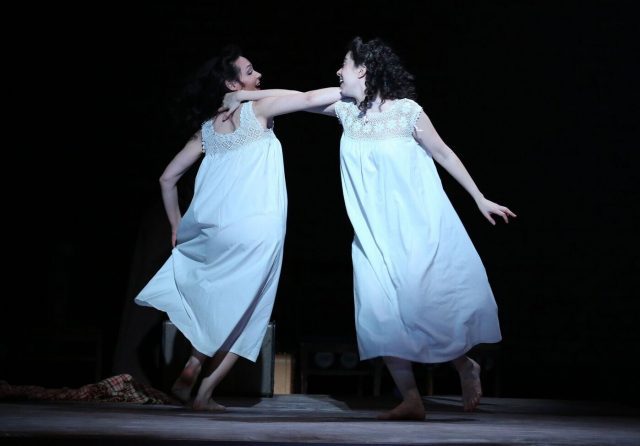
Menke (Katrina Lenk) and Rifkele (Adina Verson) share a beautiful moment in Indecent (photo by Carol Rosegg)

As you enter the theater, the cast is already seated in a row of chairs at the back of the stage. There is a slightly raised platform in the center, where most of the action takes place. (The dark, ominous stage design is by Riccardo Hernandez.) Most of the dialogue is in English, with Tal Yarden’s projections explaining what language is actually being spoken. The play features several surreal elements, including the dispensation of sand from the characters’ sleeves, a clever use of suitcases, and sudden breakouts into joyous klezmer songs and Jewish folk dances during which a trio of musicians (clarinetist Matt Darriau, violinist Lisa Gutkin — who gets a bonus surprise — and accordionist Aaron Halva) gets involved. The choreography, which ranges from playful to portentous, is by David Dorfman; Christopher Akerlind’s stunning lighting is virtually a character unto itself. Much of the excellent cast is the same from the Vineyard, with standout performances by Topol (The Merchant of Venice, The Normal Heart), who is both observer and participant, and the sultry, sexy Lenk (Once, The Band’s Visit), who can set the hearts of men and women aflutter. The exhaustively researched Indecent, which was inspired by Taichman and Rebecca Rugg’s 2000 The People vs. The God of Vengeance at Yale, raises questions of freedom of speech, immigration, the suppression of art, homosexuality, and faith, as well as the power of theater itself. With all that’s going on in the world today, the play also serves as a warning that this could all happen again if we’re not careful.

THE SERVANT OF TWO MASTERS

(photo by Henry Grossman)

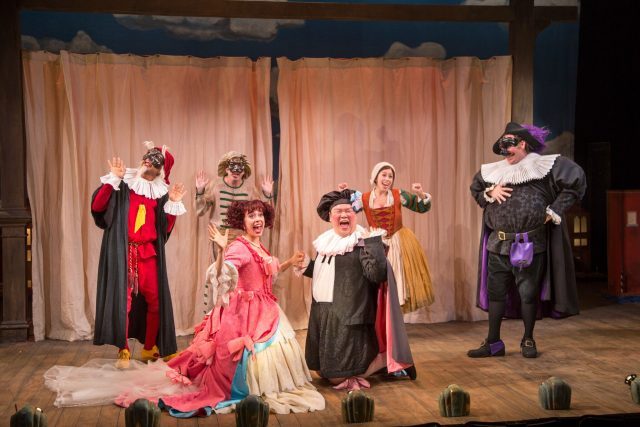
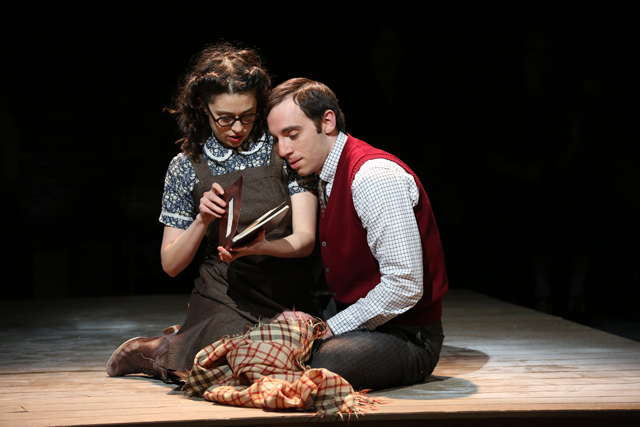
Clarice (Adina Verson) and Silvio’s (Eugene Ma) true love is threatened in THE SERVANT OF TWO MASTERS (photo by Henry Grossman)

Theatre for a New Audience, Polonsky Shakespeare Center
262 Ashland Pl. between Lafayette Ave. & Fulton St.
Tuesday – Sunday through December 4, $85
866-811-4111
www.tfana.org

“For nitwits are we all,” the cast declares early on in Theatre for a New Audience’s wacky version of Carlo Goldoni’s eighteenth-century commedia dell’arte classic, The Servant of Two Masters, only the second time the show has ever been presented in English in New York City. The strange and crazy antics, involving lots of nitwits and numbskulls, take place over one very long day in Venezia, as the masked Truffaldino Batocchio from Bergamo (Steven Epp) serves up chaos while secretly serving two masters. The very hungry Truffaldino’s predicament derives from a typically byzantine plot: the supposed death of Federigo Rasponi from Torino is followed by the appearance of Federigo’s sister, Beatrice (Liz Wisan) — disguised as her brother in order to marry his betrothed, Clarice (Adina Verson), the daughter of his business partner, Pantalone (Allen Gilmore), and collect a promised dowry. Truffaldino immediately signs on to serve Federigo/Beatrice. Meanwhile, Clarice wants to marry her true love, Silvio (Eugene Ma), the pampered and overly twee progeny of Dr. Lombardi (Andy Grotelueschen). Later, when the valiant Florindo Aretusi (Orlando Pabotoy) shows up, Truffaldino accepts a position with him as well after Florindo’s aging porter (Liam Craig) proves inadequate. But even though Florindo and Beatrice are madly in love, neither knows the other is in town, and Truffaldino, who has become smitten with Smeraldina (Emily Young), Clarice’s maidservant, struggles to keep it that way so they won’t discover that he’s serving both of them. Over the course of two and a half hours (with intermission), there is masked mayhem, mistaken identity, slapstick comedy, devious deception, satirical songs (with onstage music by Christopher Curtis and Aaron Halva), and improvisation galore, some that works, and some that doesn’t.

(photo by Gerry Goodstein)

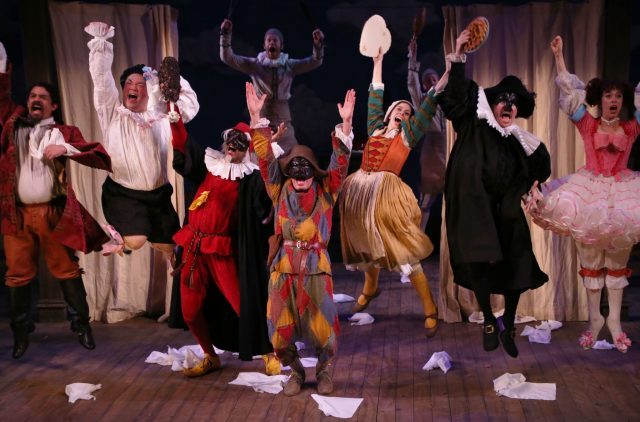
The cast of THE SERVANT OF TWO MASTERS has a blast in commedia dell’arte classic (photo by Gerry Goodstein)

In 2011, playwright Richard Bean and director Nicholas Hytner transformed The Servant of Two Masters into the hit Broadway comedy One Man, Two Guvnors, which earned James Corden a Tony for Best Actor. At TFANA’s Polonsky Shakespeare Center, director Christopher Bayes (This Ridiculous Dreaming, The 39 Steps) and star Epp (Tartuffe, Figaro), veterans of Theatre de la Jeune Lune, have gone back to Goldoni’s more improvisational original, further adapting Constance Congdon’s version of Christina Sibul’s translation, eschewing a more structured narrative for large amounts of ad libbing. Thus, the play is different every night; right now it is rife with references to the presidential election that can range from wickedly funny to random and repetitive, along with nods to current commercial jingles that get chuckles but feel out of place. Valérie Thérèse Bart’s period costumes are a hoot, colorful and dankly elegant, while Katherine Akiko Day’s set is centered by a curtain through which the characters enter and exit, with a trompe l’oeil sky in the background in front of which are miniature houses. The cast, many of whom have worked together before either at Yale Rep or Juilliard, displays an infectious camaraderie and a willingness to try just about anything; Epp is a terrific physical comedian, harkening back to the days of vaudeville, while Pabotoy, Gilmore, and Fiasco Theater’s Grotelueschen and Young are stand-out commedia dell’arte practitioners. The play is probably about a half hour too long, and the anti-Trump jokes were often too easy and obvious, detracting from the overall atmosphere of chaotic fun. In the beginning, Truffaldino asks several times, “When’s the play going to start?” Near the conclusion, he declares, “This play’s never gonna end!” Of course, it does end, and you’ll leave the theater in a gleeful mood, if not completely satiated.

INDECENT

(photo by Carol Rosegg)

INDECENT takes audiences behind the scenes of controversial drama THE GOD OF VENGEANCE (photo by Carol Rosegg)

Vineyard Theatre
Gertrude and Irving Dimson Theatre
108 East 15th St. between Union Square East & Irving Pl.
Extended through June 19
www.vineyardtheatre.org

A quartet of current or returning shows in New York City are as much about their back stories as the central plays themselves, all of which date from the 1920s. The first two are straight-up revivals, reconstructed after years of intense research: The National Yiddish Theatre has resurrected The Golden Bride, from the Golden Age of Yiddish theater; the operetta returns to the Museum of Jewish Heritage in July following a widely hailed production at the end of last year. I’ll Say She Is at the Connelly Theater revives the Marx Brothers’ long-lost Broadway debut, lovingly patched together by Groucho impersonator Noah Diamond. The two others are plays-within-plays. On Broadway at the Music Box Theatre, Shuffle Along goes behind the scenes to detail “the Making of the Musical Sensation of 1921 and All That Followed.” And now, in the Vineyard Theatre’s New York premiere of Indecent, Pulitzer Prize-winning playwright Paula Vogel (How I Learned to Drive) and director Rebecca Taichman (Familiar, Marie Antoinette) take a powerful look at Sholem Asch’s controversial drama The God of Vengeance, which, when it came to Broadway in 1923, resulted in the arrest of members of the cast and crew on obscenity charges. (The new play was inspired by Taichman and Rebecca Rugg’s 2000 The People vs. the God of Vengeance.) The hundred-minute show alternates between scenes from Asch’s (Max Gordon Moore) first play and what went into the creation of The God of Vengeance, which was decried as being anti-Semitic even by Asch’s friends and colleagues, as it tells the story of a devout Jewish man (Tom Nelis) who is running a brothel in his basement in order to be able to afford a better life for his daughter (Adina Verson), who instead falls in love with one of the prostitutes (Katrina Lenk). Lemml (Richard Topol) serves as the narrator of Indecent, explaining how he became the stage manager of The God of Vengeance as it toured Europe and America but is unable to remember how the play ends.

(photo by Carol Rosegg)

Madje (Adina Verson) and Sholem (Max Gordon Moore) have no idea what a furor his first play will cause (photo by Carol Rosegg)

Much of the cast takes on multiple roles; Nelis also portrays Asch’s mentor as well as Rudolph Schildkraut, the star of The God of Vengeance, Verson is also Asch’s wife, Madje, and Steven Rattazzi plays another colleague of Asch’s in addition to producer Harry Weinberger. (The excellent cast also features Mimi Lieber.) Even the Klezmer musicians, violinist Lisa Gutkin, accordionist Aaron Halva, and clarinetist Mike Cohen, occasionally double down. The primary controversy revolves around a lesbian kiss, which is reenacted over and over with poetic grace, the women dressed in angelic white costumes (by Emily Rebholz). Most of the action occurs on a slightly raised wooden platform (the scenic design is by Riccardo Hernandez), with the cast often sitting on chairs lined up against the back wall, on which Tal Yarden’s projections give the time and place, announce when there’s a “blink in time,” and tells the audience what language is theoretically being spoken, which is particularly effective when Lemml speaks in his non-native tongue and suddenly is talking in broken English. There are a few musical numbers, including “Bei Mir Best du Schon (Means That You’re Grand),” and David Dorfman’s choreography is subtly sensational, especially a breathtaking moment when the cast members of the show-within-a-show each grabs their suitcase, which are piled on top of one another, evoking a vertical Zoe Leonard installation. And when it’s all over, it becomes clear why Lemml doesn’t remember the ending, a haunting conclusion that you won’t soon forget.