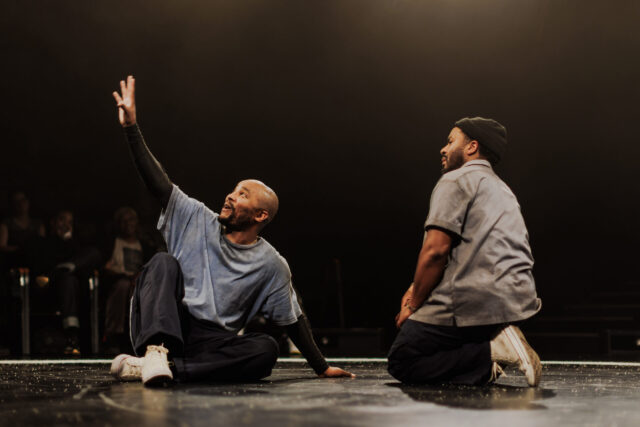
Oshoosi (Alani iLongwe) shares his dreams with his brother, Ogun (André Holland), in sizzling drama at the Shed (photo by Marc J. Franklin)
THE BROTHERS SIZE
The Shed’s Griffin Theater
545 West 30th St. at Eleventh Ave.
Tuesday – Sunday through September 28, $25-$129
646-455-3494
theshed.org
Halfway through the scintillating revival of Tarell Alvin McCraney’s The Brothers Size at the Shed, Ogun Size (André Holland) says to his younger brother, Oshoosi (Alani iLongwe), “He call me Size,” referring to the local sheriff. Oshoosi replies, “Call me Size, too.” Ogun adds, “Like we twins.” Oshoosi responds, “Or the same person.”
Based on Yoruba myth, the play is set in San Pere, Louisiana, near the Bayou, in the distant present, about a pair of very different siblings who deeply care for each other but are on decidedly separate paths: Ogun, named after the god of metal and fire, is a practical, hardworking man who owns an auto repair shop, specializing in bringing damaged cars back to life. Oshoosi, the divine spirit of hunting and contemplation, is a dreamer who just finished a two-year prison stint and is hanging around with his fellow parolee, Elegba (Malcolm Mays), the divine messenger and guardian. “We was like brothers,” Elegba says to Oshoosi, referring to how close they grew while behind bars, adding, “Brothers in need.”
Performed in the round, the story begins with Elegba slowly walking the staging area, pouring out white sand in a large, sacred circle that serves as a kind of spiritual and physical boundary; in Yoruba lore, a magic circle could represent healing, communication with the deities, or ritual sacrifice. The three characters sing a Gospel song, “This road is rough . . . / This road is rough and hard —” Accompanying them is percussionist Munir Zakee, who contributes rhythms that date back to the thirteenth-century diaspora.
Ogun, Oshoosi, and Elegba often stand outside the circle when they’re not part of the action, watching the others, then announcing their entrance; in fact, much of the text is told in the third person, switching from dialogue to stage directions without a blink.
Ogun: Ogun Size Enters / Osi! / Calling for his brother / Osi . . . / Oshoosi!
Oshoosi: Waking from his dream! / What man, what?
Ogun: Get up.
Oshoosi: Comin’ in here turning on lights!
Ogun: That’s the sun.
Oshoosi: Kissing his teeth
Ogun: Oshoosi!
Oshoosi: Don’t you get tired of going through this? / Every morning we go through this.
Ogun: Get yo ass up!
Oshoosi: This hard? / Early in the morning you gotta be this hard?
Ogun: Man don’t bring me that!
After two years in prison, Oshoosi resents being told what to do by his brother. Although Ogun has provided him with a job and a place to live, Oshoosi seems ungrateful, more interested in spending his time with Elegba, finding a woman, and getting a car so he can experience more freedom. Ogun doesn’t trust Elegba, who works at a funeral parlor and who has again attracted the attention of the racist sheriff, who is just waiting for Elegba and Oshoosi to make a mistake.
Ogun has good reason to worry.
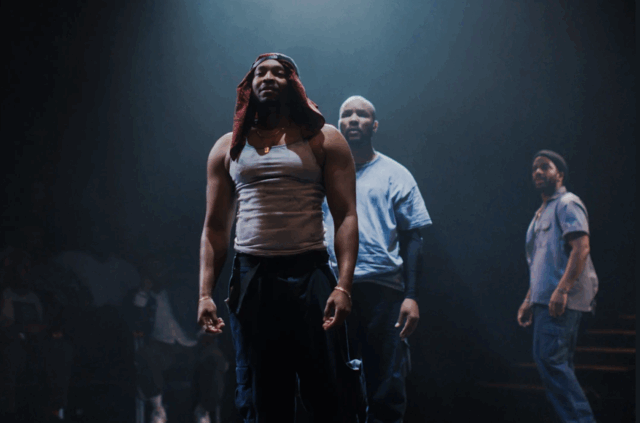
Elegba (Malcolm Mays), Oshoosi (Alani iLongwe), and Ogun (André Holland) explore family and responsibility in The Brothers Size (photo by Marc J. Franklin)
The Brothers Size debuted in 2005, when McCraney was still in graduate school. The first of his “Brother/Sister Plays,” which continued with 2008’s In the Red and Brown Water and 2015’s Marcus; or the Secret of Sweet, this revival, a coproduction between the Shed and the Geffen Playhouse, is a searing exploration of male friendship and family responsibility viewed through the lens of racial injustice and rehabilitation. Without becoming preachy, it unfolds at a beautifully rhythmic and poetic pace, with nary a word out of place, highlighted by several stunning dream/nightmare monologues.
There are no props, no furniture on Suzu Sakai’s bold set; the actors never change out of their gray shirts, dark pants, and white sneakers, evoking prison uniforms; Ogun also wears a black knit hat and Elegba a durag-like bandanna. The stark costumes are by Tony winner Dede Ayite, with sharp sound and interstitial music by Stan Mathabane, softly dramatic lighting by Spencer Doughtie, and occasional choreography by Juel D. Lane inspired by Alvin Ailey.
For the first time, McCraney, who shared an Oscar with director Barry Jenkins for Best Adapted Screenplay for the 2016 film Moonlight, is codirecting the play, with Bijan Sheibani (Barber Shop Chronicles, Till the Stars Come Down), and the minimalist production sizzles through all ninety minutes. There’s an excitement each time one of the performers steps over the circle and the plot progresses with a fierce yet touching intimacy.
Mays, a musician, filmmaker, and actor best known for the television series Power Book III: Raising Kanan and Snowfall, imbues Elegba with just the right hint of potential trouble as he inserts himself between the two brothers. iLongwe (Paradise Blue, Antebellum) is gentle and touching as Oshoosi, a young man who wants to turn around his life but has difficulty seeing things through and understanding potential consequences. And Holland (Jitney, Othello), who portrayed Elegba twenty years ago and played the adult Kevin in Moonlight, is electric as Ogun, a proud man who has sacrificed his personal life to help his brother, but while he can fix any car, he’s running out of options with Oshoosi.
The Brothers Size is worthy of an esteemed place in the pantheon of such classic plays about siblings as Suzan-Lori Parks’s Topdog/Underdog, Sam Shepard’s True West, and August Wilson’s The Piano Lesson, a powerful, gripping, timeless tale of freedom and brotherhood.
[Mark Rifkin is a Brooklyn-born, Manhattan-based writer and editor; you can follow him on Substack here.]