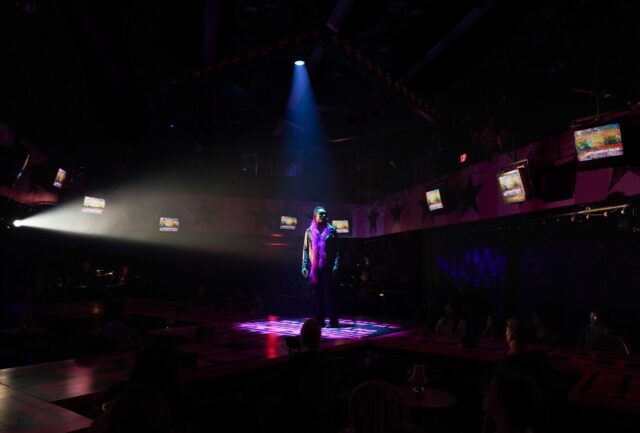
Ato Blankson-Wood stars as a real-life 1990s political activist in Ms. Blakk for President (photo by Carol Rosegg)
MS. BLAKK FOR PRESIDENT
Vineyard Theatre
Gertrude and Irving Dimson Theatre
108 East 15th St. between Union Square East & Irving Pl.
Tuesday – Sunday through November 29, $37.80-$150.12
vineyardtheatre.org
Ms. Blakk for President is a wild extravaganza, a queer fantasia inspired by the true story of activist and drag queen Terence Alan Smith, who, as Joan Jett Blakk, ran for mayor of Chicago in 1991, then for president in 1992 and 1996. Written by Oscar winner Tarell Alvin McCraney (The Brothers Size, Moonlight) and Tony nominee Tina Landau (Floyd Collins, Big Love) and directed by Landau, the show debuted in 2019 at Steppenwolf in the Windy City with McRaney in the title role. Running at the Vineyard through November 29, the off-Broadway premiere features Tony nominee Ato Blankson-Wood (Slave Play, The Total Bent) in a tour-de-force performance as Blakk.
The experience begins in the Vineyard lobby, where a blackboard invites visitors to finish the statement “I want a president who:” centered by Zoe Leonard’s 1992 declaration in favor of Eileen Myles’s presidential bid. On either side of the steps leading to the theater are the names of AIDS victims. Downstairs is an illustrated timeline of the AIDS crisis, eight Queer Nation repurposed Barbie dolls, and a corner where Nic Ashe performs “All of The Wiz in 5 Minutes.” (You might want to save part of the timeline for after the show to avoid any potential spoilers.)
You then head through a dark hallway filled with protest posters about AIDS, queerness, and war, leading to a collection of plushies; a mini-stage where Gideon Glick, in angel wings, recites excerpts from Queers Read This: The Queer Nation Manifesto; and trans artist Sawyer Smith and Adina Verson are already performing drag and cabaret on David Zinn’s extraordinary set, based on actual 1990s Chicago clubs Berlin and Lower Links, comprising crisscrossed catwalks with such phrases on them as “An attack on one of us is an attack on all of us” and “Fag power”; limited table seating; and old TVs playing music videos and news clips. Meanwhile, Kelvin Moon Loh hovers on the fringes stirring up the audience, and keyboardist Steven Cuevas, guitarist Annie Taylor Sloan, and drummer Brandon Jackson play live music. The script refers to the location as “part gay nightclub and part the inside of the mind-heart (and memory) of Joan Jett Blakk,” and that is just what Cha See’s lighting, Lindsay Jones’s sound, and Rasean Davonté Johnson’s projections capture.
The show proper begins with Terence lip-syncing Janis Joplin’s “Piece of My Heart” in drag in 1990 Chicago. He meets Mark (Glick), a fan who soon becomes his campaign manager and best friend. “In the weeks that followed, Mark and I talked about life, our lives, queer things . . . hopeful things . . . things we wanted to try, shit we knew we had to change, and then . . . ,” Terence tells the audience, “It’s true remembering gets a lil sad but . . . our first rule, on this ride: no pity. Empathy maybe but no pity. You hold me to that, okay? Or just hold me. Okay?”
Over the course of the next one hundred minutes, Terence transforms into Joan Jett Blakk, a fashion plate who runs against Chicago mayor Dick Daley, then takes a shot at the White House, battling Bill Clinton and incumbent George H. W. Bush with such slogans as “Lick Bush in ’92!” Along the way, she meets JJ (Ashe), a young gay man who joins the revolution; Lenny (Verson), who owns a gay cable TV station in New York; cable TV host Glennda Orgasm (Loh); and various Radical Faeries, Queer Nation activists, cops, Marsha P. Johnson protesters, and the Not So Secret Service as she vows to make a speech on the stage of the Democratic National Convention, focusing on AIDS and queerness.
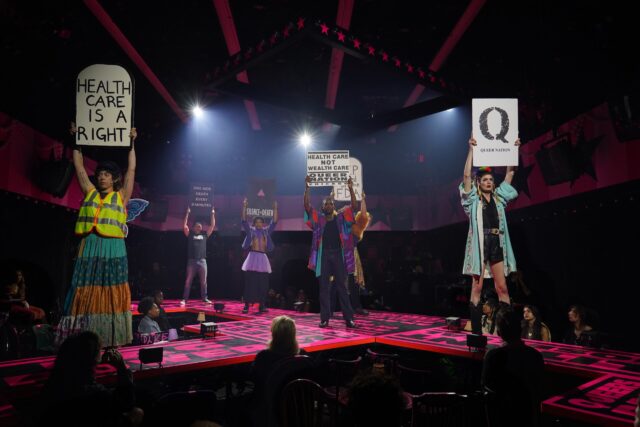
A fab cast re-creates 1990s protests in Chicago and New York City in immersive show at the Vineyard (photo by Carol Rosegg)
Ms. Blakk for President boasts a rollicking soundtrack, with songs by Chicago, David Bowie, William Byrd (Gloria Mass for Four Voices), the Rolling Stones, New Edition, Madonna, and Fleetwood Mac. Ari Fulton’s costumes are delightful, from trashy to sexy to professional, effectively placing us in the era, as does Ashley Wise’s wig and hair design. There are phallic jokes galore among many other double entendres, adding some in-your-face humor to the extremely serious messages Blakk delivers. (“I’m Joan Jett Blakk — and I’m running against your Mayor Dick Daley. Listen up, listen close, listen here, do you really think Chicago needs more Dick? Well, do you? . . . I was about to give you thirteen fucking inches more!” The drama does occasionally get overly sentimental, but it has important points to make that need to be heard, then and now.
“We’re forming Queer Nation to reclaim space and visibility for all of us. Hell, even reclaiming that word . . . Queer — that’s been used to tease and beat and closet us, let’s . . . we . . . take it back!” Mark declares at one point. “‘We’re here, we’re queer!’ and our obligation is to a radical queer community that cannot and will not fucking assimilate!”
Blankson-Wood (Slave Play, The Total Bent) holds nothing back as Blakk, fully embodying the unique force that was Terence Alan Smith. Tony nominee Glick (Significant Other, Spring Awakening) is heartwarming as the more practical and realistic Mark, who provides a fine balance to Terence’s unpredictability. Ashe, Loh, Verson, and Sawyer Smith excel in multiple roles; Smith’s long legs are a character unto themselves, justly celebrated by choreographer Darrell Grand Moultrie.
As you exit, be sure to check out a 2019 video interview with Terence Alan Smith as well as a collection of photos that goes behind the scenes of the original Chicago production. Smith and Blakk may be a mere footnote in the history of late-twentieth-century sociopolitical activism, but it’s a vital story that pays tribute to and honors those on the fringes fighting to be heard when most of the country, and the world, turns their backs.
[Mark Rifkin is a Brooklyn-born, Manhattan-based writer; you can follow him on Substack here.]