this week in theater

PIONEERS GO EAST COLLECTIVE: CROSSROADS

The next edition of gorno’s Yonsei f*ck f*ck is part of Pioneers Go East Collective “Crossroads” series at Judson Memorial Church

Who: Pioneers Go East Collective
What: Performance series
Where: Judson Memorial Church, 55 Washington Square South between Thompson & Sullivan Sts.
When: Thursday, December 9 & 16, free – $50 (sliding scale), 8:00
Why: Pioneers Go East Collective was founded in 2010 as “an arts and cultural organization inspiring a lively exchange of queer art and culture by connecting people to ideas and experiences.” Focusing on social engagement, collaboration, accessibility, and relevance, the Manhattan-based group has put on such multimedia performances as My name’sound, Virgo Star, and American Mill No. 2 at such venues as La MaMa, Ars Nova, A.R.T/ New York Theatre, and Triskelion Arts. On December 9 and 16, PGEC returns to Judson Memorial Church for the performance and video series “Crossroads,” building a community of art, poetry, music, dance, film, and more around the work of multigenerational queer, BIPOC, and feminist artists.

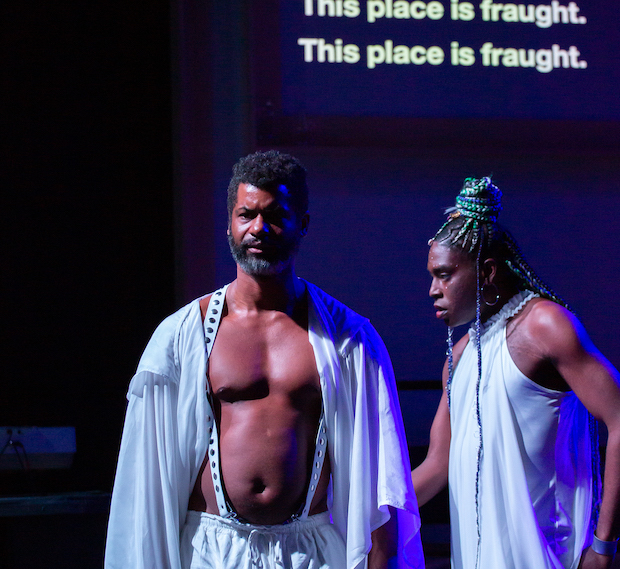
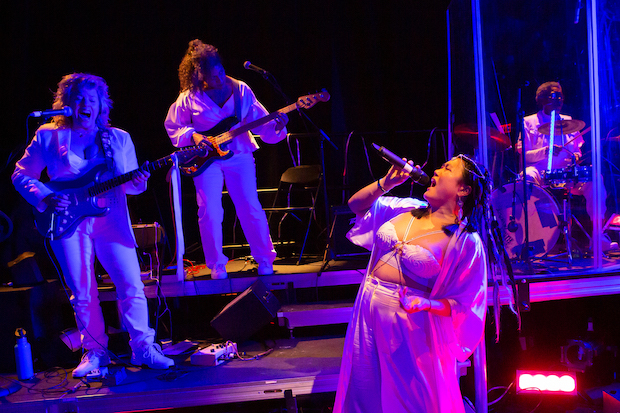
On December 9 at 8:00, curator Hilary Brown-Istrefi brings together ALEXA GRÆ’s eve’s witness. 2 soliloquies to the night, created by GRÆ, Jon Wes, and Matthew Ozawa with text by Connie Edgemon; Arien Wilkerson’s climate change performance installation Equators, made in collaboration with David Borawski, Jon-Paul LaRocco, and Domenic Pellegrini; and gorno’s (Glenn Potter-Takata) Yonsei f*ck f*ck pt. 12, a collaboration with evan ray suzuki and Kimiko Tanabe. The program on December 16 consists of dancer Lydia Mokdessi and musician Jason Bartell’s Devotion Devotion IV, joined by vocalist Syd Island; Marija Krtolica’s Infinite Subjectivity, a dance-theater piece performed by Michael Mangieri and Krtolica, with live music and reading by Jason Ciaccio and text by Søren Kierkegaard; and Janessa Clark’s film Future Becomes Past, with dancer Courtney Drasner revisiting a 2003 solo, photographed by Kathleen Kelley with music by Ben Lukas Boysen and Sebastian Plano, along with an untitled work in progress by Clark.

AND WHAT HAPPENS IF I DON’T

The Cherry is back with the hybrid What Happens if I Don’t through December 12

AND WHAT HAPPENS IF I DON’T
Cherry Artspace and online
102 Cherry St., Ithaca
December 3-12, $25-$35 in person, $20 livestream
www.thecherry.org

The pandemic lockdown might have shuttered venues around the country, but it also offered theater lovers the opportunity to see innovative online productions from companies that are out of one’s geographic range. Since April 2020, I have enjoyed works from Baltimore Center Stage, San Francisco Playhouse, DC’s Studio Theatre and Woolly Mammoth, Steppenwolf in Chicago, Hartford Stage in Connecticut, Boston Court Pasadena and Barrington Stage in Massachusetts, and Chichester Festival Theatre and the Bristol Old Vic in England, among others, all while sitting at my computer.

One of the little gems has been Ithaca’s nonprofit Cherry Artists’ Collective, which has presented Felt Sad, Posted a Frog (and other streams of global quarantine), which interwove six stories dealing with isolation, A Day, a hybrid green-screened show that cleverly revealed its process between scenes, and the two-character onstage Hotel Good Luck, which looked at time, space, and loss in surprising ways.

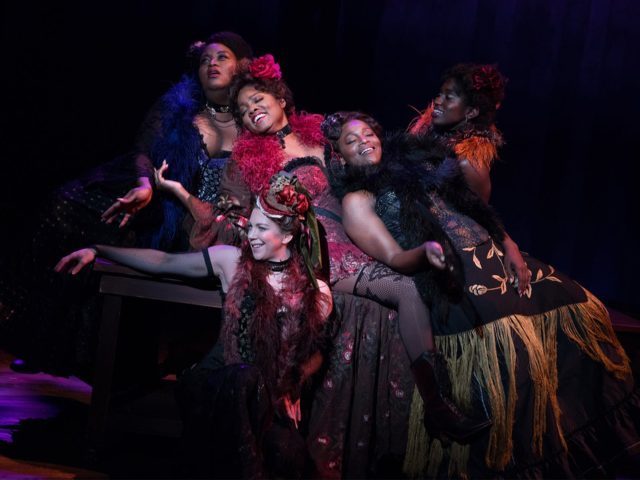
The company’s latest work is its first indoor show in front of an audience since the coronavirus crisis closed everything down. Berlin-based Serbian playwright and screenwriter Iva Brdar’s And What Happens if I Don’t is being performed in the theater and streaming live through December 12 from the Cherry Artspace. I saw one of the streams, filmed with multiple cameras (including one overhead); the play begins with the small audience entering the intimate space, sitting on chairs and risers on three sides of the room, and ends with the crowd leaving, adding to the overall live experience for those at home. The sixty-minute narrative features eight actresses — Adara Alston, Barbara Geary, Naandi Jamison, Elizah Knight, RJ Lavine, Elizabeth Mozer, Jen Schilansky, and Amoreena Wade — portraying thirteen girls and women who, as they grow older, from birth to seventy-eight, share stories about life lessons, both good and bad, they learned from their mothers; each scene also involves a threatening male figure, from a father and a traffic officer to a creepy man at a public pool and a Customs agent.

What Happens if I Don’t explores outdated gender roles in a series of monologues

In “On Ears, age 0,” the only thing a father can say to his newborn daughter (Jamison) is that she has nice ears, which warps her view of the rest of her body. In “On Concrete, age 18,” a teenager (Alston) is told by her mother to avoid sitting on concrete or else she will become a “sterile, hysterical, unfulfilled woman.” In “On Toilet Seats, age 29,” a woman’s (Wade) mother insists she not sit directly on toilet seats unless she wants to get a disease. Other words of advice relate to urinating` in pools, people with dimples, eating fruit, and plucking out gray hairs.

Each scene starts with the character, dressed in modern-day casual clothing, attempting to jump rope held by two of the other actors, a constant reminder of the joys and fun associated with childhood that go away as one ages and discovers more about the not-so-carefree world. Each character is also joined at one point by three angels who remind her that she is “polite, kind, and very well behaved,” understanding what is expected of her as a girl and a woman. Places to sit (a chair, a small bench, a large wooden farm spool) are moved around to sharp sound effects for every vignette, under eighteen lightbulbs in lampshades hanging from the ceiling at different heights. (The sound and music is by Lesley Greene, with lighting by Chris Brusberg, costumes by Iris Estelle and Sasha Oliveau, and livestream design by Greg Levins and Karen Rodriguez.)

Director Susannah Berryman (Holy Ghosts, Daisy Pulls It Off) gives the cast an ample amount of freedom, resulting in a loose, natural feel despite the serious turns; it’s a show by women, about women, but the male need for power and control hovers over all of it as Brdar (Geraniums Can Survive Anything, Rule of Thumb) explores sexism, misogyny, and old-fashioned gender roles. And What Happens if I Don’t also asks the question “Is mother always right?” (The answer is decidedly no.) The show consists of a series of monologues, but the eight cast members stand together throughout, supporting one another as they battle systemic stereotypes that are still all too real in 2021.

ARLEKIN PLAYERS THEATRE: WITNESS

Lauren Elias, Anna Gottlieb, Nathan Malin, and Gene Ravvin on board the virtual MS St. Louis in Witness

Who: Arlekin Players Theatre
What: Interactive livestreamed show
Where: Zero Gravity (zero-G) Virtual Theater Lab
When: December 10 – January 23, $25
Why: Perhaps no other theater company has taken to virtual, interactive productions like Arlekin Players Theatre. The Boston-based troupe first presented the powerful solo show State vs. Natasha Banina, followed by chekhovOS /an experimental game/, which featured Mikhail Baryshnikov, Jessica Hecht, and Darya Denisova, who had played Natasha Banina. Next up for the innovative, forward-thinking company, which incorporates aspects of gaming into its work, is Witness, conceived and directed by Arlekin founder Igor Golyak. The livestreamed, interactive show, developed through Arlekin’s Zero Gravity (zero-G) Virtual Theater Lab, was inspired by the true story of the MS St. Louis, the German ship carrying nearly a thousand Jewish refugees in May 1939 escaping the approaching Holocaust, only to be turned away by Cuba, Canada, and the United States.

Camera operator Austin de Besche films some of the cast during the making of Witness

Golyak was born in Kiev, but his family moved to Boston when he was eleven to get away from rampant anti-Semitism. He later returned to Russia to study theater. Witness is written by Nana Grinstein with Blair Cadden and Golyak, with scenic design and costumes by Anna Fedorova, virtual design by Daniel Camino, and a live and filmed cast that includes Denisova as Lady Liberty, Gene Ravvin as the emcee, Lauren Elias as Leah, Anne Gottlieb as Rachel, Nathan Malin as Joseph, Polina Vikova as Gisela Klepl, Alex Petetsky as Fritz Buff, and others, along with voice actors. “Where do unwanted people go?” the play asks. It’s a question that is still critical today, given the ongoing immigration crisis. The interactive drama runs December 10 through January 23, with every performance followed by a talkback with members of the cast and creative team and/or experts on Jewish migration. Tickets are $25; several performances are already sold out, so get your tickets now to see the company I’ve called “The future of online productions.”

A VERY MODERN CLASSICAL EVENING AT THE PICNIC HOUSE STARRING SAMIRA WILEY

A VERY MODERN CLASSICAL EVENING AT THE PICNIC HOUSE
The Picnic House in Prospect Park
40 West Dr. behind Litchfield Villa
Thursday, December 9, and Friday, December 10, free with advance RSVP, 7:00
www.moliereinthepark.org
www.prospectpark.org

In May 2019, Molière in the Park put on its inaugural event, a staged reading of The Misanthrope by Jean-Baptiste Poquelin, aka Molière, at Lefrak Center at Lakeside in Prospect Park, followed in August by a staged reading of the French playwright’s The School for Wives at the Picnic House in Prospect Park. In 2020, because of the pandemic lockdown, the troupe presented four virtual Zoom readings, The Misanthrope with Heidi Armbruster, Kaliswa Brewster, Chris Henry Coffey, Naomi Lorrain, Jared McNeill, Jennifer Mudge, Postell Pringle, Tamara Sevunts, and Samira Wiley; The School for Wives with Tonya Pinkins, Brewster, Cristina Pitter, Tamara Sevunts, Mirirai Sithole, Carolyn Michelle Smith, and Corey Tazmania; a fun adaptation of Molière’s Tartuffe, with Raúl E. Esparza, Wiley, Brewster, Toccarra Cash, Coffey, Lorrain, McNeill, Chloé Noble, Mudge, Rosemary Prinz, and Carter Redwood; and Christina Anderson’s terrific new play, pen/man/ship, which takes place in 1896 aboard a ship bound for Liberia, featuring Crystal Lucas-Perry, Kevin Mambo, McNeill, and Pringle.

The company returned to in-person outdoor shows this past May with Tartuffe at Lefrak Center, with Andy Grotelueschen, Kate Rigg, Pringle, McNeill, Lizzy Brooks, Mudge, Nicole Ansari, Redwood, Coffey, and Marjan Neshat. Next up is “A Very Modern Classical Evening at the Picnic House,” an exciting pairing on December 9 and 10 at 7:00 of Richard Wilbur’s translation of Molière’s one-act comedy in verse, The Imaginary Cuckold, and Martinique-born Gaël Octavia’s Family — which asks the question “What is the disease that spreads through us and our families when social conventions of any kind force us into hiding?” — translated by Katharine Woff and MIP founding artistic director Lucie Tiberghien, with Wiley, Brewster, Brooks, Alanna Darby, Lisa Gorlitsky, and Nate Miller appearing in both; each work will be followed by a Q&A with members of the cast and crew. Admission is free with advance RSVP.

CONTEMPORARY JAPANESE PLAY READING SERIES: COOKING UP

COOKING UP (KOSHIRAERU
Japan Society
333 East Forty-Seventh St. at First Ave.
Monday, December 6, $10/$15, 7:30
japansociety.org

Japan Society will present the sixteenth installment of its annual play reading series, “Contemporary Japanese Plays in English Translation,” with Shoko Matsumura’s Cooking Up, directed by Jordana De La Cruz. Originally scheduled for March 2020 and postponed because of the pandemic lockdown, the staged reading will take place December 6 at 7:30. The story, which combines the surreal with naturalism, is set in a restaurant where the pastry chef is missing, the cook is cheating on his wife, and his mistress becomes a housecat. “Every time you think you understand the story line or the plot, something else happens,” the Brooklyn-based De La Cruz (Jack) says in a Japan Society video. “It’s a very intricate play, and it’s powerful, and it talks about isolation and companionship and really makes you think about the people that you have in your corner.”

The Yokohama-born Matsumura (Hanpuku to Junkan ni Fuzui suru Bon’yari no Boken) has acted with Toshiki Okada’s chelfitsch company and founded her own troupe, Momeraths, in 2013. Translated by Amanda Waddell, Cooking Up is part of Japan Society’s fiftieth anniversary celebration honoring New York City woman writers with ties to Japan and will be followed by an audience Q&A with De La Cruz.

THE ALCHEMIST

Manoel Felciano, Reg Rogers, and Jennifer Sánchez play a trio of swindlers in Red Bull revival of Ben Jonson’s The Alchemist (photo by Carol Rosegg)

THE ALCHEMIST
New World Stages
340 West Fiftieth St. between Ninth & Tenth Aves.
Wednesday – Monday through December 19, $70
Available for streaming January 12-26
www.redbulltheater.com
newworldstages.com

Red Bull Theater was one of the most active companies during the pandemic, presenting livestreamed reunion readings of previous productions, the online interview series RemarkaBULL Podversations, and deep explorations into Othello and Pericles. So it’s disappointing that its return to live, in-person theater is an overbaked version of Ben Jonson’s 1610 Jacobean farce, The Alchemist.

Adapted by Jeffrey Hatcher and directed by Jesse Berger — the same team that gave us the superb 2017 revival of Nikolai Gogol’s The Government InspectorThe Alchemist is a hot mess, a frantic, unrelenting satire laden with anachronistic references and modern speech that bury what Samuel Taylor Coleridge famously referred to as one of the “three most perfect plots ever planned.” (The other two, in his opinion, were Sophocles’s Oedipus Rex and Henry Fielding’s Tom Jones.)

The tale is set in 1606 in the Lovewit mansion in London as plague rips through the land; the wealthy master has left for the countryside, reminding us that the rich haven’t changed much, considering their response to the current coronavirus pandemic. A voiceover announces at the start, “Some wear masks, just like you do, that cover the nose and mouth and comply with CDC guidelines at all times, including during the show, except while actively drinking at your seat, so if you’re going to drink, drink actively.”

Lovewit’s manservant, the rogue Face (Manoel Felciano), has teamed up with the charlatan alchemist Subtle (Reg Rogers) and their bawdy colleague, Dol Common (Jennifer Sánchez), to con members of the local community out of their money. When the trio learns that Lovewit is unexpectedly returning in two hours, they ramp up their schemes as they attempt to defraud the tobacconist Abel Drugger (Nathan Christopher), the law clerk Dapper (Carson Elrod), the deacon Ananias (Stephen DeRosa), and the knight Sir Epicure Mammon (Jacob Ming-Trent) and his butler from Brooklyn, the surly skeptic known as Surly (Louis Mustillo).

Red Bull returns to in-person theater with The Alchemist at New World Stages (photo by Carol Rosegg)

Subtle might think he is in charge, but Face is quick to remind him, “Recollect, sir: you were not long past known to all the neighborhood as that scurvy beetle who nothing did but loiter at the corner in moldy rags so thin scarce covered they your buttocks. I took pity on you, gave you roof and a bed, replaced your tatters with well-cut cloth, and introduced you to that household item called the bathing tub.” Subtle responds, “Recollect, sir: you were not long past that lowly servant who nothing did but sit your master’s house with no one to converse with save your brooms and dustpans. Twas I took pity on you, raised you up to your potential, taught you to present yourself so convincingly as a captain with a beard so nautical it could fool a blind man who’s never been to sea. Twas I conceived the scheme, tis I should take the largest share!” Meanwhile, Dol points out about their Venture Tripartite, “Well, if we three do not this treasure equal share, you two shall not share mine.”

Despite already having a heavy chest brimming with ill-gotten gains and Lovewit’s arrival fast approaching, Face and Subtle can’t control their greed when they learn of a wealthy widow, Dame Pliant (Teresa Avia Lim), who has come to town with her protective brother, Kastril (Allen Tedder). So they set out to scam her as well, agreeing not to tell Dol. Their nefarious plans play out in real time, a grandfather clock ticking away throughout the nearly two-hour show as things grow more and more frenetic and overwrought.

Red Bull and founding artistic director Berger know their way around classic works, as evidenced by their stellar adaptations of John Ford’s 1630s drama, ‘Tis Pity She’s a Whore, Richard Brinsley Sheridan’s 1777 comedy of manners, The School for Scandal, and Jonson’s 1606 English Renaissance satire, Volpone. But they try too hard to make The Alchemist relevant to this moment in time, sacrificing story for slapstick. Alexis Distler’s two-floor set is filled with doorways, a staircase, and surprise entryways, but the timing of the various door slams is too often slightly off. At one point Rogers ad-libbed about having to run up and down the stairs again, and we feel his pain. As always with Red Bull, the costumes (by Tilly Grimes) are wonderfully extravagant, as is Tommy Kurzman’s wig and makeup design.

The show suffers from being in the 199-seat Stage 5 at New World Stages, which is too small and intimate for such a broadly played farce; you’re liable to get whiplash from swiveling your head back and forth and up and down so much, particularly as Subtle changes from “a mystic newly come from Rotterdam” to “a fortune teller late of Portugal” to “a Swedish hypnotist learned in financial planning.” Perhaps it will be easier to take when it is available for streaming January 12-26.

In a program note, Hatcher wryly admits, “Of course, I did screw around with the plot. Ours is a slimmed down version of the play, with fewer characters and one setting instead of four. So, apart from dumbing down the highbrow jokes, ruining the perfect plot, tossing in anachronisms, and adding a song very much like one sung by Shirley Bassey in 1964, the play is pretty much your grandmother’s The Alchemist.” The talented cast, led by Obie winner Rogers, does its best with this dumbing down, seeming to enjoy themselves immensely, as did much of the audience the night I went. I wish I felt the same.

THE SHAPE OF THINGS: LAND OF BROKEN DREAMS CONVENING & CONCERT SERIES

LAND OF BROKEN DREAMS
Park Ave. Armory
643 Park Ave. at Sixty-Seventh St.
Concerts and convenings: December 9-11, $25
Installation: Tuesday – Sunday through December 31, $18
www.armoryonpark.org

As part of Carrie Mae Weems’s “The Shape of Things” monumental multimedia installation at Park Ave. Armory, there will be three days of live music, conversations, and performances that activate the space. Tickets are going fast for the “Land of Broken Dreams” series, which features nighttime concerts by singer-songwriter Somi on December 9, the jazz trio of Vijay Iyer, Arooj Aftab, and Linda May Han Oh on December 10, and Terri Lyne Carrington and Lisa Fischer, whose latest project is “Music for Abolition,” on December 11. Tickets also include admission to a “Daytime Convening” from 1:00 to 7:00, with pop-up performances by more than 150 artists in the Wade Thompson Drill Hall, the Board of Officers Room, the Veterans Room, and the Colonels Room.

Among those participating are photographer Dawoud Bey, tap dancer Maurice Chestnut, painter Torkwase Dyson, theater director Scott Elliott, Reggie “Regg Roc” Gray and the D.R.E.A.M. Ring, philanthropist Agnes Gund, poet, playwright, and novelist Carl Hancock Rux, dancer and choreographer Francesca Harper, musician and author Nona Hendryx, civil rights leader Ben Jealous, interdisciplinary artist Rashid Johnson, visual artist Joan Jonas, set designer Christine Jones, artist Deborah Kass, painter Julie Mehretu, cultural theorist, poet, and scholar Fred Moten, visual artist Shirin Neshat, curator, critic, and art historian Hans Ulrich Obrist, multimedia installation artist Tony Oursler, poet, essayist, playwright, and editor Claudia Rankine, sculptor Alyson Shotz, conceptual artist Hank Willis Thomas, performance artist Carmelita Tropicana, rapper, actor, and Roots MC Tariq Trotter, author Quincy Troupe, director Whitney White, and the Peace Poets. You might just have to move in to the armory for seventy-two hours so you don’t miss a minute of what promises to be a memorable event.