this week in theater

ELEVATOR REPAIR SERVICE: SEAGULL

Elevator Repair Service puts its unique spin on Anton Chekhov’s The Seagull (photo by Ian Douglas)

SEAGULL
NYU Skirball Center for the Performing Arts
566 La Guardia Pl. between Third & Fourth Sts.
Through July 31, $50-$60 (use code FB25 for $25 tickets)
212-945-2600
nyuskirball.org
www.elevator.org

I’m beginning to think I might never see another traditional production of Anton Chekhov’s 1895–96 classic, The Seagull. Perhaps more than any other playwright, Chekhov’s works almost demand reinvention for the stage in the twenty-first century. His tragicomic take on human relationships and society’s ills invite modern, often extensive reinterpretation and experimentation.

As often as Shakespeare’s plays are reimagined, they almost always still contain the Bard’s original dialogue; it’s the staging that changes. The same is not necessarily true about Chekhov, as evidenced by such recent successes as Arlekin Players Theatre’s hybrid The Orchard (The Cherry Orchard), Aaron Posner’s Life Sucks. (Uncle Vanya), and Halley Feiffer’s Moscow Moscow Moscow Moscow Moscow Moscow (Three Sisters).

As far as The Seagull goes, over the last ten years I’ve seen Posner’s Stupid Fucking Bird at the Pearl in 2016, a deliriously chaotic yet controlled rave-up sticking to the main plot but told with an intoxicating irreverence; Jeffrey Hatcher’s Ten Chimneys, at St. Clement’s in 2012, which goes behind the scenes of an upcoming Broadway revival of The Seagull starring Alfred Lunt and Lynne Fontanne; and Christopher Durang’s Vanya and Sonia and Masha and Spike, a delightful all-star mashup of The Seagull, Three Sisters, and Uncle Vanya that ran on and off Broadway in 2013.

Elevator Repair Service, the downtown company whose literary adaptations include William Faulkner’s The Sound and the Fury, Shakespeare’s Measure for Measure, James Joyce’s Ulysses, and F. Scott Fitzgerald’s The Great Gatsby — the much-admired eight-hour Gatz — now turns its unusual techniques on Chekhov with Seagull, continuing at NYU Skirball through July 31. Nearly three hours with one intermission, the play self-referentially refers to itself regularly, with actors occasionally speaking to the audience as themselves, not as their characters. It begins with a long monologue by company member Pete Simpson, who talks about the Skirball space itself. “One of these two corkscrew, fluted, gold leaf columns is structural and holds up the building above us. The other is hollow, insubstantial, and does nothing but sit there and look pretty in an attempt to make things look symmetrical.”

When he said that under each chair are three flags, a red one that “will tell us you feel physically threatened or uncomfortable,” a checkered one to use if you just “wanna talk,” and a third to order food, I saw the woman sitting across the aisle from me reach below her seat to see if the flags were really there. (They’re not.) But it signals that this production is going to veer wildly between the real and the imagined, although all of it turns out to be Chekhovian in one way or another, even if, as Simpson, who also plays the teacher Semyon, explains, “95% of tonight’s text both original and adapted has been written by our company’s own Gavin Price,” who portrays wannabe playwright Konstantin.

Director John Collins leaves the central plot intact: The twentysomething Konstantin has invited friends and family over to a lovely lake house to watch his latest play, to be performed by Nina (Maggie Hoffman), a nervous actress he is desperately in love with. Konstantin is hoping to prove to his mother, famous actress Irina (Kate Benson), that he has talent and a purpose in life; Irina, who chastises him regularly in front of everyone, has arrived with her new beau, well-respected and successful writer Boris Trigorin (Robert M. Johanson), who takes a liking to Nina.

Also at the presentation are Patricia (Laurena Allan), Irina’s ailing sister; farmer Ilya (Julian Fleisher), who is a big fan of Irina’s, and his wife, Paulina (Lindsay Hockaday); Masha (Susie Sokol), the farmers’ daughter who is in love with Konstantin but might be married off to Semyon; Yakov (John Gasper), who works at the lake house; and Gene (Vin Knight), a doctor who has an innate charm that lures the ladies, including Paulina.

In the middle of the play-within-a-play, Irina asks, “Is this supposed to be symbolic?” A moment later, she says, “Something smells. Is that part of the effect?” A disgusted Konstantin eventually has to stop the show because of his mother’s interruptions.

Shortly after Patricia has an asthma attack, Benson, Hoffman, and Susie have a discussion as themselves, commenting on how much they enjoyed the previous scene and what Chekhov’s play is about. The play resumes as Konstantin presents Nina with a seagull he just shot.

Masha (Susie Sokol) leads the characters in a strange game in Seagull (photo by Ian Douglas)

Following intermission, Sokol points out how long she has been with ERS, explains the set design, and expresses her disappointment that one of Masha’s key lines has been cut: “I’m in mourning for my life.” Soon various characters consider leaving the lake house, Irina insists she has no money to help anyone, and Konstantin sports a bloody bandage wrapped around his head. “You . . . Symbolist!” Irina again accuses her son. “Miser!” he replies. “You amateur!” she declares. It all goes downhill from there.

The set by dots, so ably described by Sokol, features a row of folding chairs in the front that the characters move about depending on the action. Downstage right is a table with electronic equipment, while upstage left is a cozy dinner table with pictures on the wall. The lighting is by Marika Kent, with sound by Price and Gasper and purposely mismatched costumes by Kaye Voyce, ranging from Nina’s elegant red dress to Irina’s short skirt, heels, and tights.

Collins’s direction may appear disordered as the fictional plot battles it out with the actors’ thoughts and some events happen either offstage or in the background — as when several characters sit down to eat but we can’t make out exactly what they are saying to one another, although it does turn into a terrific bingo-style dance number. But there is a method to his madness, even if it’s not necessarily always clear what he’s up to; numerous pieces of dialogue reflect back on the play we’re watching, as if ironically commenting on what is happening in Seagull at Skirball.

“It’s not easy, you know, acting in your play. There aren’t any ordinary people in it,” Nina tells Konstantin, who responds, “Ordinary people! We have to show life not the way it is, or the way it should be, but the way it is in dreams!” Nina retorts, “But nothing happens in your play! It’s all one long speech. And I think a play ought to have a love story.” Meanwhile, Collins emphasizes Chekhov’s Hamlet references, with Konstantin echoing the young prince, Irina a different kind of Gertrude, Boris representing Claudius, and Nina an embellished Ophelia.

“It was a strange play, wasn’t it?” Nina asks Boris about Konstantin’s show. Boris replies, “I’m afraid I didn’t understand a thing. But it was interesting to watch. You were wonderful. And of course, the set was magnificent!” Most people in the audience seemed to agree with that analysis of ERS’s production, although a handful walked out during the first act and others did not return after intermission; however, those who stayed, the vast majority of the crowd, gave the performers a standing ovation at the end.

Seagull is not for everyone’s taste. It is long — 173 minutes, as Simpson tells us — it is confusing, it is pedantic, and it can be self-referential to a fault, particularly as the cast passes around a microphone and cord, going in and out of character. And don’t get me started on the awful noise made when Patricia is pushed around in a chair. But it all continues founding artistic director Collins’s thirty-plus-year mission of experimenting with new theatrical forms, in original works and unique adaptations.

Hamlet asked himself, “To be or not to be.” In Seagull, Patricia answers, “Just go on living, whether you feel like it or not.” The same can be said for theater itself.

MR. SATURDAY NIGHT

Buddy Young Jr. (Billy Crystal) needs to prove to everyone he’s still got it in Mr. Saturday Night (photo by Matthew Murphy)

MR. SATURDAY NIGHT
Nederlander Theatre
208 West 41st St. between Seventh & Eighth Aves.
Tuesday – Sunday through September 4, $69-$179
877-250-2929
mrsaturdaynightonbroadway.com

Don’t get me started. So I’m sitting in a theater a few weeks ago, waiting for a play to begin, when I overhear the three people next to me, who are from Toronto, discussing what else they want to see while they’re in New York. “What about Mr. Saturday Night?” the oldest one asks. “Oh, I love Billy Crystal, but I’d rather see a musical,” his grown daughter says. “Who’s Billy Crystal?” her twentysomething son says, as if he could not care any less. What are they, meshugeneh?

In 1984, burgeoning superstar William Edward Crystal got his own HBO special, A Comic’s Line, in which he created Buddy Young Jr., an aging, antiquated comedian with a gruff voice and an even gruffer manner. Crystal, who played the barrier-shattering gay character Jodie Dallas on Soap from 1977 to 1981, further developed Buddy on Saturday Night Live (1985-85) and then in the 1992 film Mr. Saturday Night, which he also cowrote (with Lowell Ganz and Babaloo Mandel) and directed. By then Buddy was a fully fledged, long-out-of-date Borscht Belt has-been whose outsize ego continually results in lack of success.

Crystal, who won a Tony for his 2004 one-man autobiographical show, 700 Sundays, has now turned Mr. Saturday Night into an utterly charming and fun Broadway musical — yes, Toronto friends, a musical, with plenty of shtick — reteaming with Ganz and Mandel (Splash, Parenthood, A League of Their Own), who also worked with Crystal on the two hit City Slickers flicks and the forgettable Forget Paris. In addition, David Paymer, who won an Oscar as Buddy’s long-suffering brother and agent, Stan Yankleman, in the movie, is back in the same role onstage. For the film, Crystal, who was in his early forties at the time, had to go through nearly six hours of makeup every day to play the seventy-three-year-old comedian; for the Broadway show, which runs through September 4 at the Nederlander, Crystal, now seventy-four, requires very little makeup to play the younger Young.

A onetime television star in the 1950s, Buddy has been reduced to telling lame jokes at retirement homes to less-than-enthusiastic audiences. “So, the other day, my wife says, ‘Buddy, come upstairs and make love to me.’ So I said, ‘Make up your mind — I can’t do both.’” Met with crickets, he adds, “Hey, come on. I know you’re out there — I can hear you decomposing.”

Watching the Emmy Awards in his New York City apartment, Buddy is shocked when he sees himself highlighted at the end of the in-memoriam segment that lists all the famous people who died in the previous year. “Look! They killed me!” he tells his wife, Elaine (Randy Graff). “I’m not dead, you bastards!”

But instead of wallowing in self-pity, Buddy decides he can turn the mistake into his last chance to prove to the world what he’s got before he really dies. He sings, “No more playing brises and bar mitzvahs, / Sundays at the Szechuan buffet, / All that starts changing tomorrow when I’m on Today!” After going on the morning show, Buddy is a hot commodity again, taking meetings at the Friars Club and getting a movie offer but, as flashbacks reveal, the hardheaded comedian can’t stop getting in his own way on the road to fame and fortune.

Meanwhile, he tries to reestablish a connection with his forty-year-old daughter, Susan (Shoshana Bean), who has a history of drugs and arrests and is excited that she is up for a PR job. Buddy: “What’s it pay?” Susan: “Okay, you see?! I’m leaving.” Buddy: “That’s a normal question about a job. What does it pay?” Susan: “It pays ten cents a year, okay?! That’s what it pays. Ten cents a year!” Buddy: “Okay, that’s something. That’s ten cents more than last year.”

Buddy Young Jr. (Billy Crystal) keeps Jordan Gelber, Brian Gonzales, and everyone else laughing in hit Broadway musical (photo by Matthew Murphy)

Scott Pask’s set smoothly moves from the Youngs’ home to the Friars Club to a talk show to Young’s good old days, with costumes by Paul Tazewell and Sky Switser and video and projections by Jeff Sugg, taking us back and forth between past and present. Generously directed by Tony winner John Rando (Urinetown, On the Town), Mr. Saturday Night is great fun. Ganz, Mandel, and the endlessly irresistible Crystal — the most delightfully appealing comedian of the last fifty nears — never miss an opportunity to go for the quick laugh but without sacrificing the narrative. The show is all about Crystal; it’s unlikely to be remembered for its cast album, although three-time Tony winner Jason Robert Brown’s (Parade, The Last Five Years) music and orchestrations and Tony nominee Amanda Green’s (Hands on a Hardbody, Bring It On) lyrics are a fine match for the players.

Crystal and Paymer are not there for the singing or dancing; the more intensive numbers are left for Tony winner Graff (City of Angels, A Class Act) and Bean (Hairspray, Wicked), who are both superb. Choreographer Ellenore Scott keeps it mostly simple, not trying to give Crystal and Paymer too much tsuris. Jordan Gelber, Brian Gonzales, and Mylinda Hill excel as multiple characters, serving up, of all things, comic relief. Chasten Harmon (Hair, Les Misérables) is agent Annie Wells, who at first has no idea who Buddy Young Jr. is but is doomed to find out. I hope the same happened to the guy from Toronto. To use one of Young’s catchphrases, did you see what I did there?

Early on, Young declares, “Sure, I’m old but look, my mic hand is steady, / Still upright and I’m ready, / Do I pack away the tux and tie / and lie here growing fungus? / That’s what they want me to do!” And Crystal’s singing as much about himself as Young when he adds, “I got to hear them saying: / He’s still got it! / He’s still got it! / Balls you can’t lift with a crane.”

SEX, GRIFT, AND DEATH

A group of grifters plans a heist in Caryl Churchill’s Hot Fudge

SEX, GRIFT, AND DEATH
PTP/NYC: Potomac Theatre Project
Atlantic Stage 2
330 West Sixteenth St. between Eighth & Ninth Aves.
Tuesday – Sunday through July 31, $21.50-$31.50
ptpnyc.org

The Potomac Theatre Project (PTP/NYC) is celebrating its thirty-fifth anniversary with two programs running in repertory at Atlantic Stage 2 through the end of July. I saw “Sex, Grift, and Death,” which begins with the New York premiere of Steven Berkoff’s 1983 Lunch and continues with two short works by Caryl Churchill, 1989’s Hot Fudge and the New York premiere of 2015’s Here We Go. The other program, “Reverse Transcription,” consists of Robert Chesley’s 1989 Dog Plays and the world premiere of Jim Petosa and Jonathan Adler’s A Variant Strain, one-act plays that thematically link the AIDS crisis and the Covid-19 pandemic.

PTP/NYC presented a prerecorded virtual production of Lunch last summer, starring Bill Army as Tom and Jackie Sanders as Mary, two strangers who meet at the beach. They engage in absurdist conversation and share their thoughts directly with the audience as they explore their loneliness and contemplate hooking up. He is a salesman who sells “space, acres of nothing”; she is a married woman who can’t decide whether she minds being bothered by him. Oddly, the forty-minute play, directed by PTP/NYC cofounder Richard Romagnoli with the same cast, lacks the dramatic impact it had online. Mark Evancho’s set features a bench, a garbage can, and a lamppost in front of a screen on which video of a calm shore repeats; the projection, by Courtney Smith, is accompanied by the soft, soothing hums of the sea, courtesy sound designer Sean Doyle.

Jackie Sanders and Bill Army star as two strangers meeting at the beach in Steven Berkoff’s Lunch

“What do you want?” Tom asks. “Nothing,” Mary replies. A moment later he asks, “What were you waiting for?” She answers, “No one — I just like sitting here — alone.” Not giving up, he says, “Don’t you ever want something else?” She insists, “You’re not looking for me — you’re looking for it! Any it.” During the pandemic, we were all waiting, not necessarily sure what we wanted. One thing we did ache for was live, in-person theater; however, this live, in-person Lunch feels strained; it never quite hits its stride, lacking the passion and humor of the virtual edition.

However, things get much better after intermission with a compelling pair of Churchill works, beginning with Hot Fudge. The four-part play follows Ruby (Tara Giordano) as she gathers with friends and lovers (and others) during one long, wild night. First she joins Matt (Gibson Grimm), Sonia (Molly Dorion), Charlie (Chris Marshall), and June (Danielle Skraastad) at 7:00 at a pub, where they are planning a unique series of robberies. “You have to be quite brave to lie so much,” Ruby says at one point, a line that is central to the narrative.

Two hours later Ruby is at a winebar with her stylish new boyfriend, Colin (David Barlow), who appears to be some kind of international businessman, while Ruby has untruthfully told him that she owns a travel agency. Ruby and Colin continue the partying at a club at 11:00 with Hugh (Marshall), Grace (Wynn McClenahan), and Jerry (Teddy Best), where they discuss connections, global industry, ecology, and tennis. The play concludes at 1:00 at Colin’s place, where an unexpected visitor (Skraastad) interrupts the festivities and threatens to uncover some harsh realities they’ve been dancing around all evening.

Caryl Churchill’s Here We Go is a three-part meditation on death

Hot Fudge was originally paired with Churchill’s Ice Cream, but PTP/NYC extremely successfully replaces that with Here We Go, a three-part meditation on death. In the first section, eight characters (Marshall, Skraastad, Army, Sanders, Maggie Connolly, Meili Huang, Annabelle Iredale, Charlie Porto) are at a funeral, talking about the deceased while, one at a time, they take center stage and share how they will depart from this mortal coil. After that, a man (Barlow) delivers a complex monologue, trying to figure out his place in the universe as he realizes, “I’m on my own.” Hot Fudge ends with an ailing man (Barlow) being attended to by a caregiver (Keith) in a harrowing, silent finale that is nearly overwhelmed by an all-pervasive sense of loneliness that questions whether any of us, or all of us, can really exist on our own.

Directed by Cheryl Faraone, who is married to Romagnoli and cofounded PTP with him and playwright-director Jim Petosa in 1987, Hot Fudge and Here We Go flow seamlessly into each other, as if they were meant to be together. They feel tailor made for this precise moment in time, as America is clouded by ever-increasing dishonesty, led by the Big Lie, and the citizenry emerges from two years of a pandemic, reevaluating their lives and careers while dealing with so much death, including more than one million Covid-19 victims in this country alone.

Evancho’s set design consists primarily of a variety of chairs that are moved on- and offstage by the cast after each scene under a shadowy darkness. There’s a lot of sitting and standing, culminating in the poignant finale that puts it all into illuminating, and frightening, perspective.

PTP/NYC has been presenting works by Churchill for nearly thirty years, beginning with The After-Dinner Joke in 1993 (and again in 2002 and 2018) and continuing with Mad Forest in 1998, Serious Money in 2012-13, Vinegar Tom in 2015, and a virtual Far Away in 2020, all directed by Faraone, who knows just what to do with Churchill’s complex dialogue and story lines. The eighty-three-year-old British writer has penned more than fifty plays and radio dramas, so I can’t wait to see what PTP/NYC has in store for us in the future, particularly since the company is reconfiguring its annual format going forward.

THE MAN WHO SHOT LIBERTY VALANCE

It’s not exactly love at first sight for Hallie (Stephanie Craven) and Ransome Foster (Leighton Samuels) in The Man Who Shot Liberty Valance (photo by Joshua Eichenbaum)

THE MAN WHO SHOT LIBERTY VALANCE
Gene Frankel Theatre
24 Bond St. at Lafayette St.
Wednesday – Sunday through July 31, $15-$25
www.genefrankeltheatre.com
www.theonomatopoeiatheatrecompany.com

“The hairs on your arm will stand up / At the terror in each sip and in each sup / Will you partake of that last offered cup / Or disappear into the potter’s ground? / When the man comes around,” Johnny Cash warned on the title track of his 2002 American IV album. The song is one of many by the Man in Black that echo in the Gene Frankel Theatre before the start and during intermission of Onomatopoeia Theatre Company’s stirring New York premiere of Jethro Compton’s The Man Who Shot Liberty Valance. In this case, the man coming around is Liberty Valance.

British playwright Compton’s 2014 play is based on the 1953 short story by Dorothy M. Johnson; the twenty-two-page tale was turned into a popular 1962 John Ford film packed with an all-star cast — John Wayne, James Stewart, Vera Miles, Lee Marvin, Edmond O’Brien, Andy Devine, John Carradine, Jeanette Nolan, Woody Strode, Denver Pyle, Strother Martin, Lee Van Cleef — but Compton’s adaptation brings the play into the twenty-first century, twisting many of the movie’s genre clichés inside out as he takes on social and racial injustice while toning down the movie’s political rhetoric, general Hollywood misogyny, and freedom of the press blather.

The two-and-a-half-hour show begins in 1910, as Sen. Ransome Foster (Leighton Samuels) and his wife, Hallie (Stephanie Craven), arrive in Twotrees for the funeral of Bert Barricune (Samuel Shurtleff), who seems to have been an insignificant forgotten man in an insignificant one-horse town. Young reporter Jake Dowitt (Jeff Brackett) wants an exclusive with the senator, leading to a flashback to 1890, when a severely injured Foster is brought into the Prairie Belle Saloon by Barricune. After he is tended to by Jackson and Jim “the Reverend” Mosten (Daniel Kornegay), who works for her, he explains that he was beaten by three men who turn out to be the villainous murderer Liberty Valance (Derek Jack Chariton) and his henchmen.

Foster is a peaceful man from New York, a law scholar traveling not with a gun but with legal texts, Shakespeare sonnets, Greek tragedies, and a Bible. When Marshal Johnson (Scott Zimmerman) refuses to arrest Valance, Foster considers going up against the feared gunslinger himself. “I am no law man, sir,” Foster admits. The marshal responds, “Seems from what I’ve heard you ain’t much good at defending yourself, let alone a town.”

Soon Foster is teaching some residents of Twotrees to read, which angers others, especially since Jackson is a woman and Mosten is the only Black man around; book learning is not for the likes of them. Much of the strength of the play comes from the power Compton invests in the two characters; in the short story and movie, Jackson is a restaurant employee, while Mosten is Barricune’s loyal helper and doesn’t even appear in Johnson’s tale. In the play, Jackson speaks her mind with a razor sharpness, while Mosten is a well-respected man who has the ability to memorize whatever anyone says or reads to him.

Barricune is not happy when he sees Foster and Jackson spending a lot of time together; Bert believes he is destined to marry her. “She’s always been my girl,” Barricune says. “Does she know that?” Foster replies.

After Valance and his two sycophants commit a horrific act, Foster is more intent than ever to face him down and let the chips fall where they may.

Ransome Foster (Leighton Samuels) and Liberty Valance (Derek Jack Chariton) are headed to a final showdown in Onomatopoeia production (photo by Joshua Eichenbaum)

The Man Who Shot Liberty Valance takes place primarily on Nino Amari’s intimate set, a small Western saloon with a bar in the far corner, one table, two windows on either side of a piano, and swinging wooden doors in the back (which audience members must walk through to use the restrooms, but not during the performance). Most of the action occurs at the angled bar, including two sizzling scenes with Valance, the first between him and Mosten, the second him and Foster. Neither scene is in the short story or film, so the suspense is ratcheted up.

In his New York stage debut, Charlton is a magnetic force, his every word and move electrifying. He knows exactly who Valance is and what he wants, a villain who has no veneration for the law or for Blacks. When Foster raises the possibility of his defeating him in a showdown, the cocky Valance says, “Unless the hand of God comes down and strikes me dead there ain’t much chance of that.” Foster, knowing he doesn’t really have a shot, responds, “Or the earth opens up and the Devil takes you under.” Valance retorts, “No. We have an agreement, me and him.” When those words are spoken by Charlton, you don’t doubt it.

The rest of the cast holds up its end of the bargain; Samuels and Craven have a sweet chemistry, Shurtleff portrays Barricune with an inner loneliness, and Zimmerman’s marshal is neither coward nor buffoon. (Assistant director Chandler Robyn ably portrays numerous small roles.)

The play is expertly helmed by Onomatopoeia artistic director Thomas R. Gordon, maintaining a thrilling tension throughout. Susan Yanofsky’s period costumes are effective, while Reid Sullivan’s lighting hints at a danger always lurking, although the changing colors in the two windows are sometimes confusing. The narration occasionally gets in the way of the plot, explaining what we already know or making a point that is better left for the audience to decide for themselves.

Compton has also adapted F. Scott Fitzgerald’s The Curious Case of Benjamin Button into a Celtic musical and Jack London’s White Fang into Wolf’s Blood; his Frontier Trilogy is set in the American West in the mid-nineteenth century, while The Bunker Trilogy delves into Arthurian legend, classical Greek tragedy, and Shakespearean drama. In Liberty Valance he has created a stage Western for our times, cleverly referencing the conflicts of contemporary America, as red states battle blue states over jobs, immigration, and education; rights for women, people of color, and LGBTQIA+ are in serious jeopardy; gun control is being hotly debated; and liberal urban elites and the conservative south and Midwest seem immersed in an endless duel. The arguments the citizens of Twotrees are having are not unlike what we see every day on social media and partisan news outlets.

In the play, Foster teaches his class Shakespeare’s seventy-first sonnet, which reads in part: “No longer mourn for me when I am dead / Than you shall hear the surly sullen bell / Give warning to the world that I am fled / From this vile world with vilest worms to dwell.” Johnny Cash couldn’t have said it any better.

THE SUPPLIANTS PROJECT: UKRAINE

Who: Oscar Isaac, Willem Dafoe, David Strathairn, Kira Meshcherska, Dmytro Zaleskyi, Lyudmila Yankina, Olena Martynenko, Tatiana Tolpezhnikov, Roman Tolpezhnikov, Bryan Doerries, Oksana Yakushko
What: Live, dramatic reading followed by community discussion
Where: Theater of War Zoom
When: Saturday, July 16, free with RSVP, 1:00
Why: “Zeus! Lord and guard of suppliant hands / Look down benign on us who crave / Thine aid — whom winds and waters drave / From where, through drifting shifting sands, / Pours Nilus to the wave. / From where the green land, god-possest, / Closes and fronts the Syrian waste, / We flee as exiles, yet unbanned / By murder’s sentence from our land; / But — since Aegyptus had decreed / His sons should wed his brother’s seed, — / Ourselves we tore from bonds abhorred, / From wedlock not of heart but hand, / Nor brooked to call a kinsman lord!” So the chorus chimes at the beginning of Aeschylus’s The Suppliants, the 460s BCE play involving immigration, the military, borders, and political activism.

Theater of War Productions, which performs Greek tragedies and contemporary texts with all-star casts, followed by community discussions on topics related to the works, including climate change, the pandemic, racialized police violence, caregiving, mental health, incarceration, substance abuse, and homelessness, now turns its attention to the emergency situation in Ukraine. On July 16 at 1:00, Oscar Isaac, Willem Dafoe, Kira Meshcherska, and David Strathairn will headline a staged reading on Zoom of The Suppliants, part of Aeschylus’s Danaid Tetralogy, after which Theater of War artistic director Bryan Doerries will facilitate an interactive discussion with Dr. Dmytro Zaleskyi of the Mobile Medical Center of Ukrainian Territorial Defense, Lyudmila Yankina of the ZMINA Human Rights Center in Ukraine, Kyiv-based communication manager Olena Martynenko, and Mariupol refugees Tatiana Tolpezhnikov and Roman Tolpezhnikov. Admission is free with advance RSVP.

SHAKESPEARE IN THE PARK: RICHARD III

Robert O’Hara’s Richard III is set among moving gothic arches (photo by Joan Marcus)

RICHARD III
Central Park, Delacorte Theater
Tuesday – Sunday through July 17, free, 8:00
publictheater.org

There’s a moment early on in Robert O’Hara’s Shakespeare in the Park production of Richard III that defines the rest of the play. When Richard (playwright and actor Danai Gurira), the Duke of Gloucester, is wooing Lady Anne (Ali Stroker) after having murdered her husband, the prince, and her father, the king, he gives her his dagger so she can kill him. “If thy revengeful heart cannot forgive, / Lo, here I lend thee this sharp-pointed dagger, / Which if thou please to hide in this true breast / And let the soul forth that adoreth thee, / I lay it naked to the deadly stroke / And humbly beg the death upon my knee—” Richard says. She plunges the dagger into his chest, but alas, it is merely a prop that Richard takes back and fake stabs himself with a few times.

Richard smiles and the crowd laughs, but it prepares us for a different kind of Richard III, and a different kind of Richard. The scene is key to the success of the play; if Richard can woo Lady Anne, who passionately despises him, then he can in turn win over the audience to root him on while he treacherously lays waste to anyone and everyone in his way on his journey to acquiring the crown.

Richard is usually portrayed by a white man with a humped back and a menacing limp. But here he is played by a Zimbabwean American woman, looking magnificent in black leather with gold details and a closely shaved head with ominous designs. There’s no limp and no hunch, recalling Jamie Lloyd’s recent staging of Edmond Rostand’s Cyrano de Bergerac at the BAM Harvey, where a stunning James McAvoy wore no embarrassing proboscis, perhaps the hottest Cyrano in history.

So it’s a hard sell when Gurira admits, “I, that am not shaped for sportive tricks, / Nor made to court an amorous looking glass; / I, that am rudely stamped and want love’s majesty / To strut before a wanton ambling nymph; I, that am curtailed of this fair proportion, / Cheated of feature by dissembling nature, / Deformed, unfinished, sent before my time / Into this breathing world scarce half made up, / And that so lamely and unfashionable / That dogs bark at me as I halt by them.”

Ratcliffe (Daniel J. Watts) has some stern words with Richard III (Danai Gurira) in Shakespeare in the Park production (photo by Joan Marcus)

Despite that anomaly, we are with Gurira’s Gloucester from the very start, in a prologue taken from the third part of Henry VI as he stabs the king. Gurira’s monologues to the audience are not as intense as we are used to; this is a more likable Richard, and that works, for the most part. Gurira, who is well known as Michonne on The Walking Dead and Okoye in Black Panther and has appeared on Broadway in Joe Turner’s Come and Gone and at the Delacorte in Measure for Measure, has a charismatic mystique as she marches across Myung Hee Cho’s minimalist set, consisting of eleven large gothic arches that rotate around the stage and occasionally flicker with colored lights. (The lighting is by Alex Jainchill, with fashionable costumes by Dede Ayite and sound and music by Elisheba Ittoop.)

But O’Hara (Slave Play, Barbecue), who has previously directed Gurira’s Eclipsed and The Continuum, never finds the right pace as the show labors through its two hours and forty minutes (with a twenty-minute intermission). We are too often waiting for something to happen instead of it just happening; the electricity rarely sparks.

There are stylish moments, but too many scenes feel like set pieces that stand on their own but do not flow into one another. Tony winner Stroker (Oklahoma! Spring Awakening) is lovely as Lady Anne, especially when she shows up later in a blinged-out wheelchair. Monique Holt (Cymbeline, Romeo & Juliet), who is deaf, adds a unique aspect to the Duchess of York, but not everything she signs is translated. One of the assassins, played by Maleni Chaitoo, is also deaf. And Rivers is portrayed by Matthew August Jeffers, who has a rare form of dwarfism.

Danai Gurira and Matthew August Jeffers rehearse in masks for Richard III (photo by Joan Marcus)

Interestingly, while Gurira’s Richard has no physical disabilities, Richmond and King Edward IV are played by Gregg Mozgala (Cost of Living, Merchant of Venice), who has cerebral palsy, which affects how he walks; Mozgala starred as a high school version of Richard III in Teenage Dick at the Public in 2018.

Sharon Washington (Feeding the Dragon Wild with Happy), who portrayed Lady Anne at the Delacorte in 1990, brings down the house as Queen Margaret, who sees through Richard immediately. She lets loose after declaring, “I can no longer hold me patient,” making us yearn for her return after she exits. The cast also features Sanjit De Silva as Buckingham, Skyler Gallun as the Prince of Wales, Paul Niebanck as George, Michael Potts as Lord Stanley, Ariel Shafir as Lord Hastings, Heather Alicia Simms as Queen Elizabeth, Matthew August Jeffers as a standout among the ensemble, and Daniel J. Watts as Catesby / Ratcliffe.

Richard III kicks off the sixtieth anniversary season of Shakespeare in the Park at the Delacorte; the inaugural presentation, in 1962, was The Merchant of Venice with George C. Scott as Shylock and James Earl Jones as the Prince of Morocco. Richard III has been staged at the Delacorte in 1966 with Philip Bosco, 1983 with Kevin Kline, and 1990 with Denzel Washington. Among the others who have portrayed the devious duke onstage are Scott, Laurence Olivier, Ian McKellen, Kevin Spacey, Al Pacino, Benedict Cumberbatch, Alec Guinness, Peter Dinklage, Mark Rylance, and Lars Eidinger, who was spectacular in Thomas Ostermeier’s adaptation at BAM in 2017. Gurira is a worthy addition to that list, even if the production itself leaves too much to be desired in a hopefully glorious summer.

EPIPHANY

Brian Watkins’s Epiphany takes place at an awkward dinner party (photo by Jeremy Daniel)

EPIPHANY
Lincoln Center Theater at the Mitzi E. Newhouse
150 West 65th St. between Broadway & Amsterdam Ave.
Tuesday – Sunday through July 24, $92
212-362-7600
www.lct.org

In Brian Watkins’s Epiphany, continuing at Lincoln Center’s Mitzi E. Newhouse Theater through July 24, Aran (Carmen Zilles) reads from a letter to guests at a dinner party, “‘A new generation is growing up in our midst, a generation actuated by new ideas and new principles. But we are living in a special . . . ’ — sorry — “‘we are living in a skeptical and, if I may use the phrase, a thought-tormented age: and sometimes I fear that this new generation, educated as it is, will lack those qualities of humanity, of hospitality, of kindly humour which belonged to an older day. It seems to me, I must confess, that we were living in a less spacious age.’ No, that’s not right: ‘that we are living in a less spacious age.’ Well, I can’t tell if it says are or were.

The quote is taken nearly verbatim from James Joyce’s 1914 short story “The Dead,” which served as inspiration for Watkins’s play. But Watkins and director Tyne Rafaeli transport the tale, which also takes place at a dinner party, to modern times; in fact, though it premiered in 2019 in Ireland, the plot has been tweaked to comment on how the Covid-19 pandemic impacted the way humans relate to one another in what may or may not be a less spacious age.

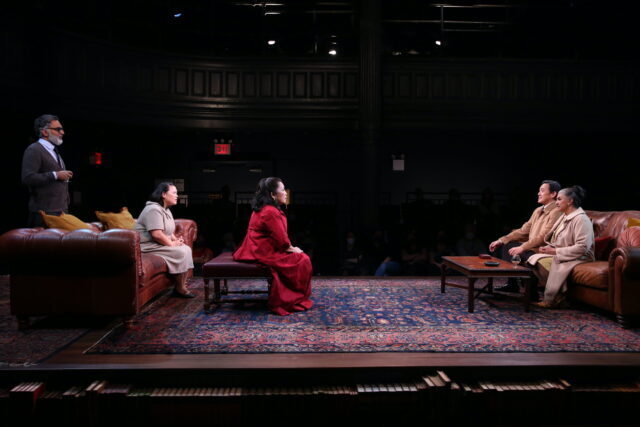
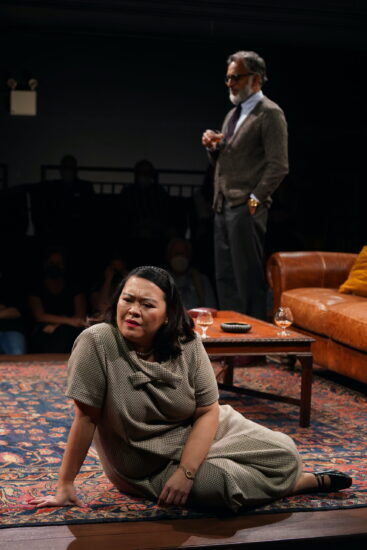
Morkan (a sensational Marylouise Burke) is a woman of a certain age who has invited a diverse group of people to a dinner party celebrating the epiphany: Freddy (C. J. Wilson), a disheveled math teacher whom Morkan is afraid might drink too much; Sam (Omar Metwally), a well-respected psychiatrist, and his partner, the younger Taylor (David Ryan Smith), who is in marketing; a second couple, lawyer Charlie (Francois Battiste) and pianist Kelly (Heather Burns); Ames (Jonathan Hadary), one of Morkan’s oldest and dearest friends; and Gabriel, Morkan’s nephew and a famous writer who has promised to present a new work and is the main reason everyone has trudged through a snowstorm to come to the party at Morkan’s large country house outside an unidentified major city. Morkan has asked the twentysomething Loren (Colby Minifie) to help her with the food and drinks.

While they’re waiting for Gabriel, Morkan tells them that they have to surrender their phones — she refers to them as “thingamajigs” — and puts them in a box that is tantalizingly close. The guests, none of whom is well acquainted with anyone other than Morkan and the person they came with, are instantly rattled, acting as if a part of their body has been temporarily removed. They feel even more uncomfortable after it becomes evident that no one read any of the attachments Morkan included with the invitation, so they’re not prepared for all the activities she has planned, and they don’t know how to tell her. In addition, no one, including Morkan, knows what the word epiphany means or refers to.

Marylouise Burke is sensational as a dinner party host forced to improvise (photo by Jeremy Daniel)

Charlie: Where did the whole celebration idea come from anyway?
Morkan: Well, that’s the question! I actually have very little idea of what epiphany actually is.
Loren: Oh. I thought this was part of your religion or something.
Morkan: Oh no no no, not at all, it’s just sort of a new curiosity, because . . . well, it’s been an odd twelve months. . . . I’m really so forgetful these days, which is why Gabriel is going to do a whole . . . overview thingy and give a speech with the history and all the answers to the whole yadda yadda.
Taylor: Of course he is.
Kelly: Fucking . . . brilliant man.
Morkan: But so, ok, show of hands, who has celebrated Epiphany?
Kelly: Like the idea? The idea I guess, privately, yes — the what? Oh no.
Morkan: The holiday. The holiday. Show of hands for the holiday.

No one raises their hand.

Morkan: Alright so, before I sent you all the stuff with the invitation . . . who knew what epiphany was?
Kelly: The idea or the holiday?
Morkan: The holiday of Epiphany.
Taylor: The general concept or —
Morkan: The holiday.
Taylor: Oh. No.
Freddy: Not me!
Morkan: Ok. Well. I have no idea what Epiphany is. We have no idea what Epiphany is. But the thing that struck my head was, ya know like . . . creating a tradition . . . How does that work?! Or even just creating a reason, to ya know, get together in a terrible month like January to celebrate life!

As if that weren’t enough, Aran, Gabriel’s partner, soon shows up to explain that Gabriel will not be coming after all, which adds further disappointment and awkwardness. But Morkan is determined to soldier on with music, poetry, intellectual conversation, and the goose she has cooked, leading to some prickly physical and verbal exchanges as the snow keeps falling.

At nearly two hours without intermission, Epiphany is too long, and some of the awkwardness onstage leaks into the audience; at times you might feel like you’re at a dinner party that is going nowhere but you can’t leave. In addition to Joyce, it’s got a bit of Luis Buñuel’s The Discreet Charm of the Bourgeoisie mixed in with Samuel Beckett’s Waiting for Godot, Agatha Christie’s And Then There Were None (without the murders), and the disastrous parties Mary Richards used to throw on The Mary Tyler Moore Show, all of which play with the idea of expectations.

A lot of those expectations have changed significantly since the pandemic lockdown, as people wrestle with who to gather with and where. Gabriel chooses not to go because of a deep depression; it’s not a stretch to think that it may have been caused, at least in part, by the coronavirus crisis and a fear of meeting up with people. I have great friends who still refuse to go to gatherings, whether indoors or outdoors. It can be hard to know when to hug, when to shake hands, when to kiss, and when to bump elbows, which is addressed in Epiphany.

The show also plays with the idea of time, something that was difficult to keep track of during the lockdown and still today, when many of us are working from home. Although the story appears to unfold in something close to real time, Morkan makes several confusing references near the end about how much time has passed that will leave you scratching your head and wondering whether her statements are plain mistakes or have another, not immediately clear meaning.

You’re unlikely to reach any epiphanies while at the Newhouse, but it’s not so bad when you’re spending time with such a terrific cast, comprising some of the city’s finest character actors. Drama Desk winner Burke (Ripcord, Fuddy Meers), in the starring role, is phenomenal, short of stature but long on doddering charm and effervescence, her creaky voice reaching poetic heights. Tony nominee and Obie winner Hadary (Gypsy, As Is) excels as Ames, especially after suffering what could be a serious injury that is handled with slapstick humor. Tony nominee and Obie winner Metwally (Sixteen Wounded, Guards at the Taj) is smooth as silk as the curious neuroscientist. And Minifie (The Boys, Punk Rock), dressed in a yellow outfit that just might have been the old color of the dining room, is wonderful as Loren, who has no idea what she has gotten herself into. (The costumes are by Montana Levi Blanco.)

John Lee Beatty’s set has a gothic charm to it, bar carts and tables hovering close to the audience seated in the first row, who could reach out and grab a drink or snack (but shouldn’t). The snow can be seen through two large windows; mysterious stairs go down to the front door and up to the bedrooms and bathroom, lending the house a ghostly atmosphere. Isabella Byrd’s moody lighting reminds everyone that the storm might knock out the electricity at any second, while Daniel Kluger’s sound often adds a chill to the air.

“Life has just felt so wobbly, so even though I’ve lived here over forty years I feel . . . dislocated . . . exiled, I suppose . . . And I’m not sure why,” Morkan says, essentially speaking for many in the theater. “But maybe that’s the world, I dunno . . . I feel like I’m not making any sense.” Perhaps the same can be said of our “thought-tormented age” itself.