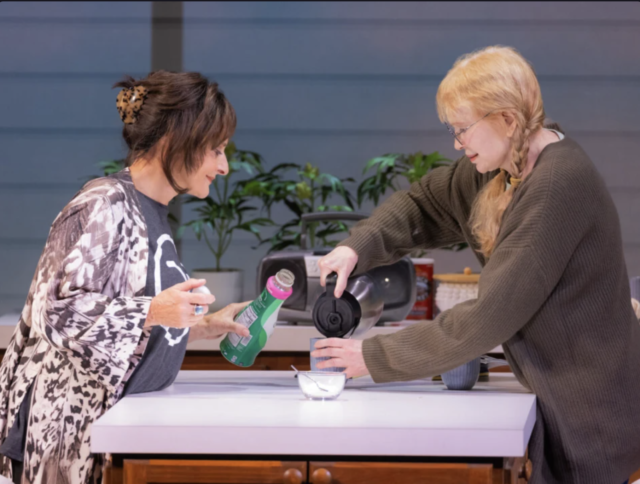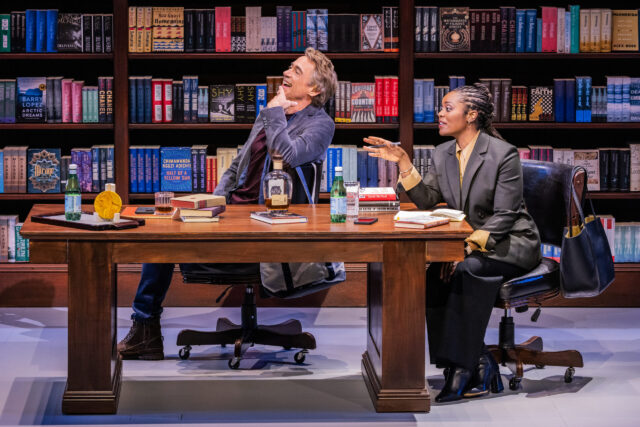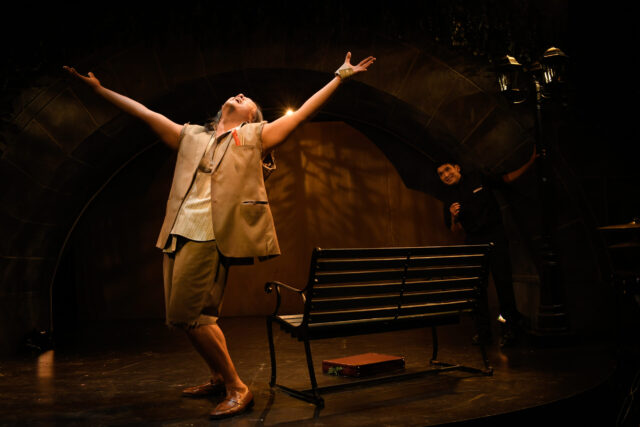
Who:Charles Busch,Melissa Errico What: Book talk Where:The National Arts Club, 15 Gramercy Park South When: Monday, April 15, free with advance RSVP, 6:30 Why: In the first chapter of his memoir, Leading Lady: A Memoir of a Most Unusual Boy (Smart Pop, September 2023, $27.95), Charles Busch is writing about meeting up with Joan Rivers. “Dining with a group of friends at Joe Allen, Joan expressed wistfully, ‘I wish I had a gay son I could phone at midnight and discuss whatever movie was on TCM.’ Everyone laughed. I fell silent, but inside I was pleading, Take me. I’ll be your gay son. Joan was the most prominent in a long line of smart, bigger-than-life mother figures I’ve attached myself to. All my life, I’ve been in a search for a maternal woman whose lap I could rest my head on.”
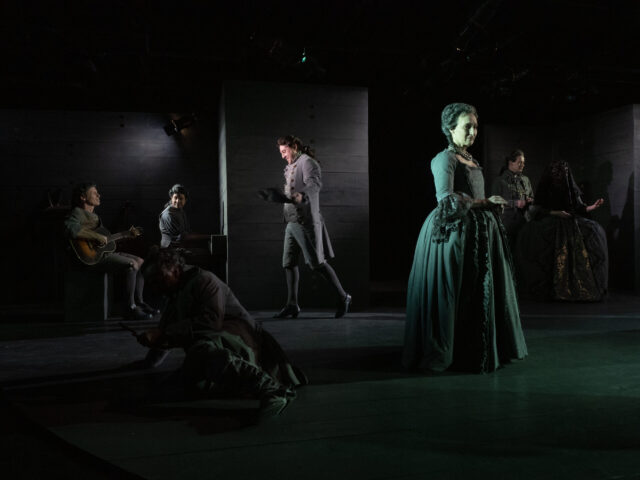
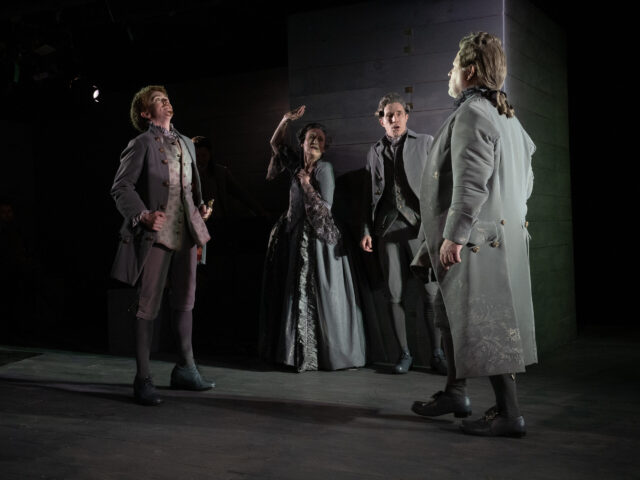
New York native Busch has been part of the entertainment scene in the city since the late 1970s, writing and appearing in numerous plays and films, often in drag. The Tony nominee and Drama Desk Award winner has dazzled audiences with such plays as The Tale of the Allergist’s Wife,Vampire Lesbians of Sodom,The Tribute Artist, and The Confession of Lily Dare as well as Psycho Beach Party and Die, Mommie, Die!, both of which transferred from stage to the big screen. He currently can be seen in Ibsen’s Ghost at 59E59 through April 14.
On April 16, Busch will be at the National Arts Club to talk about his life and career, in conversation with Manhattan-born, Tony-nominated actress and singer Melissa Errico, who has starred in such shows as My Fair Lady,High Society,Dracula the Musical,Amour,Sunday in the Park with George, and Aunt Dan and Lemon. Expect lots of great stories featuring many all-time theater greats.
[Mark Rifkin is a Brooklyn-born, Manhattan-based writer and editor; you can follow him on Substack here.]

Toby Stephens stars as “Hatchet Man Watson” in J. T. Rogers’s Corruption (photo by T. Charles Erickson)
CORRUPTION
Lincoln Center Theater at the Mitzi E. Newhouse
150 West 65th St. between Broadway & Amsterdam Ave.
Tuesday – Sunday through April 14, $108 www.lct.org
In the last ten years, a handful of plays have successfully taken on the financial industry, the media, and politics in intriguing and involving productions often based on real-life events. In such works as Ayad Akhtar’s The Invisible Hand and Junk, Sarah Burgess’s Dry Powder, and James Graham’s Ink, capitalism trumps basic humanity in pursuit of money and power.
Brooklyn-based playwright J. T. Rogers follows the money and power in the provocative thriller Corruption, making its world premiere at Lincoln Center’s Mitzi E. Newhouse Theater.
Rogers delved into the Rwandan genocide in The Overwhelming, the Soviet war in Afghanistan in Blood and Gifts, and the Middle East peace process in the Tony-winning Oslo. Inspired by Tom Watson and Martin Hickman’s 2012 book, Dial M for Murdoch: News Corporation and the Corruption of Britain, he now turns his attention to the ripped-from-the-headlines true story behind the News International phone hacking scandal, in which the British tabloid News of the World was accused of breaking into thousands of people’s phones, from average citizens to politicians, celebrities, law enforcement, competitors, and the royal family, in order to get dirt and, essentially, blackmail them in order to sell more papers and gain further influence.
At the center of it all is Rebekah Brooks (usually portrayed by Saffron Burrows but I saw her understudy, Eleanor Handley), the ruthless editor of the paper and the company’s CEO. The show begins at her gala wedding, where she marries socialite and former horse trainer Charlie Brooks (John Behlmann); among the guests at the Sarsden Estate in Oxfordshire are Prime Minister Gordon Brown (Anthony Cochrane), Tory leader David Cameron, and freshly promoted News Corp head James Murdoch (Seth Numrich), the younger son of media mogul Rupert Murdoch, who remains unseen in the play but is a key figure throughout.
“Newspapers are a relic, Rebekah,” James says. Rebekah argues, “Now, James, the News of the World and the Sun are the backbone of this company. They are the engine that powers everything else.” James responds, “Save that speech for my father. You two can continue your newsprint romance when I’m not around. I’m here to grow this company. Going forward, change is the order of the day. From now on, our focus is television and new media. Everything else is expendable.”
Rebekah Brooks (Saffron Burrows) in under the microscope in ripped-from-the-headlines play (photo by T. Charles Erickson)
Meanwhile, after being excoriated in the Sun as a “hatchet man” for Prime Minister Brown, Watson (Toby Stephens), a member of Parliament, tells the PM that he needs a less visible role because the newspaper’s vitriol is affecting his wife, Siobhan (Robyn Kerr), and their young son. He instead accepts what is supposed to be a lackluster position on the Culture, Media, and Sport Select Committee. But when it is revealed that Gordon Taylor, president of the Professional Footballers’ Association, accepted a seven-figure payoff from News International to keep quiet about phone hacking, the committee starts investigating the case, which leads them to Brooks, former News of the World editor Andy Coulson (Numrich), and assistant police commissioner John Yates (T. Ryder Smith).
Despite pleas from his wife to let it go, Watson is driven to expose the corruption at nearly any cost, working with Guardian journalist Nick Davies (Smith), political foe Chris Bryant (K. Todd Freeman), New York Times reporter Jo Becker (usually Eleanor Handley but I saw a fine Doireann Mac Mahon), tainted multimillionaire Max Mosley (Michael Siberry), Independent journalist Martin Hickman (Sanjit De Silva), lawyer Charlotte Harris (Sepideh Moafi), and Paul (Behlmann) and Karie (Mac Mahon) from Watson’s staff. Leading the charge against them is News International chief counsel Tom Crone (Dylan Baker), who has Uncle Rupert’s ear, which enrages James, who thinks he is now running his father’s business.
Many of the key players risk their careers — and the lives of themselves and their families — as Watson can’t stop digging for the truth.
Paul (John Behlmann), Jo Becker (Eleanor Handley), and Tom Watson (Toby Stephens) uncover damning evidence in Corruption (photo by T. Charles Erickson)
Corruption is a taut cloak-and-dagger-style drama that makes a bold statement about where we are as a society as technology offers opportunities for abuse in the name of leverage, control, and domination. Cover-ups abound as strong-willed and determined men and women maneuver themselves, unable, or unwilling, to see the damage they are causing, personally and/or professionally. It’s the kind of story you wish couldn’t be true, but it’s all too real.
Michael Yeargan’s set consists of distressed walls evoking long-faded newsprint; movable, rearrangeable curved tables; and, above the stage, a circle of television monitors delivering a barrage of actual reports from multiple channels. Projections on the walls by 59 Productions reveal breaking news, social media posts, and important evidence. Jennifer Moeller’s costumes capture the essence of the characters, while Justin Ellington’s sound immerses the audience in the gripping narrative. Donald Holder’s lighting features three pairs of dazzling crisscrossing horizontal lines on the floor that change color, particularly as scenes shift, accentuating the fast pace as startling details emerge.
Tony-winning director Bartlett Sher (South Pacific,Joe Turner’s Come and Gone) builds the tension with skill and precision; even if you’re familiar with the story, there are many surprises in Rogers’s razor-sharp script, which feels economical even with a running time of more than two and a half hours (with intermission). The ensemble is excellent, led by Stephens (The Forest,Oslo), who refuses to quit regardless of the consequences; Handley (The Hard Problem,Jericho), who is superb as Brooks, a woman obsessed with expanding her influence; Kerr (The Great Society,Dark Vanilla Jungle) as Siobhan, who doesn’t understand why Tom cannot choose his family over his job; and Baker (La Běte,Not About Horses) as both the smarmy, egotistical lawyer Crone and the mysterious investigator Glen Mulcaire. Siberry seems right at home as Mosley, following his appearances in such other hard-hitting financial works as Ink and Junk.
The one-word title is not as simple as it may at first seem; the play is specifically about the News International phone hacking scandal, but it also alludes to rampant business and political crime that is growing throughout so many sectors of society, with no end in sight, particularly because the media itself is among the guilty.
[Mark Rifkin is a Brooklyn-born, Manhattan-based writer and editor; you can follow him on Substack here.]

Jeremy Strong stars in new translation of Henrik Ibsen’s cautionary An Enemy of the People (photo by Emilio Madrid)
AN ENEMY OF THE PEOPLE
Circle in the Square Theatre
1633 Broadway at 50th St.
Tuesday – Sunday through June 23, $99 – $499 anenemyofthepeopleplay.com
What price truth?
That is the question that drives Henrik Ibsen’s 1882 drama An Enemy of the People, which can currently be seen in an intense new translation by Obie winner and Tony nominee Amy Herzog, directed by her husband, Tony and two-time Obie winner Sam Gold, at Circle in the Square; this is the first time the couple has worked together, and hopefully not the last.
The story takes place in the late nineteenth century in a small Norwegian town in late winter, but it could also be set anytime, anywhere, including America in 2024. The fortysomething Dr. Thomas Stockmann (Jeremy Strong), a widower, lives a quiet life with his daughter, Petra (Victoria Pedretti), a schoolteacher in her early twenties. They have an open house, welcoming friends and colleagues to stop by for a drink, a smoke, a meal, or stimulating conversation.
The play opens with Petra and the family maid serving dinner to an eager Billing (Matthew August Jeffers). When Petra points out how hard it can be teaching her class of sixteen boys “anything of value,” Billing replies, “So take a load off, sit with me. Teach me something, I’m very ignorant, it’s a real shame.” Value, ignorance, and shame will become key themes to the show.
Billing’s boss, Hovstad (Caleb Eberhardt), arrives, followed by Peter Stockmann (Michael Imperioli); the former is the editor of the local paper, the People’s Messenger, while the latter is the mayor and Thomas’s older brother.
Town mayor Peter Stockmann (Michael Imperioli) doesn’t like what he hears in Broadway revival (photo by Emilio Madrid)
The town’s future has been built on the success of the Baths, the main attraction at the new spa resort. The local economy is about to boom as spring and summer approach, but Thomas has some bad news. “The water at the Baths is rife with bacteria, tiny micro-organisms that cause disease. It’s completely unsafe,” he tells Petra, Billing, Hovstad, and Captain Horster (Alan Trong). Petra says, “Thank goodness you discovered it in time.” They toast Thomas as a local hero, but Petra’s response is not necessarily shared by the rest of the town, including her maternal grandfather, Morten Kiil (David Patrick Kelly), who owns a tannery that might be contributing to the water pollution.
Hovstad is excited “to expose these clowns” by publishing Thomas’s article about the poisonous water and what it will take to save the spa. The printer, Aslaksen (Thomas Jay Ryan), who is also the chair of the Property Owners’ Association and a temperance leader, offers Thomas his full support but suggests he proceed carefully, in moderation.
But when Peter finds out what it will take to make the Baths safe, Thomas goes from hero to villain as he’s publicly declared an Enemy of the People.
Herzog, whose 4000 Miles was a Pulitzer Prize finalist and whose Mary Jane begins Broadway previews April 2, last year adapted Ibsen’s 1879 masterpiece, A Doll’s House, earning six Tony nominations, including Best Revival of a Play. Gold, who won an Obie and a Tony for directing Fun Home at the Public and Circle in the Square, respectively, and another Obie for Annie Baker’s Circle Mirror Transformation, was also nominated for a Tony for helming Lucas Hnath’s A Doll’s House, Part 2. You can expect a boatload of Tony nods for their inaugural collaboration.
The audience sits on three sides of the narrow rectangular stage, which runs down the middle. Thomas’s home is plainly furnished, with simple tables and chairs; small changes are made when the scene moves to the printing press and a large meeting room. A white building facade surrounds the space at the top, seemingly unnecessary except to hide a surprise that arrives at intermission. The set is by dots, with tender lighting, featuring several gas lamps, by Isabella Byrd, sound by Mikaal Sulaiman that incorporates dialogue and musical performances, and fine period costumes by David Zinn.
Dr. Thomas Stockmann (Jeremy Strong) is afraid everything will all fall apart unless local town listens to him (photo by Emilio Madrid)
Taking a page out of Daniel Fish’s 2019 Tony-winning revival of Oklahoma! at Circle in the Square, which invited the audience onto the stage during intermission for cornbread and a cup of chili, An Enemy of the People offers shots of a prominently featured Nordic liqueur while several ensemble members (Katie Broad, Bill Buell, David Mattar Merten, Max Roll, Kelly) sing Norwegian folk songs. After intermission, more than a dozen audience members remain onstage, becoming citizens at the town meeting where the mayor maneuvers to silence his brother, along with the rest of the audience, as the speakers address all of us directly with the lights on, each person in the theater involved in the controversy.
Emmy winner Strong (A Man for All Seasons,The Great God Pan), best known for his role as Kendall Roy on Succession, gives a profoundly measured performance as Thomas, a gentle, considerate, if somewhat elusive man, at the edge of exploding, whose life turns upside down when he becomes a whistleblower, standing nearly alone as he staunchly refuses to surrender his principles; it’s a cautionary tale that’s ripe for the modern age, given the spread of fake news over social media and the rejection of truth in favor of money and power by politicians and corporations.
In his Broadway debut, Emmy winner Imperioli (The Sopranos,The White Lotus) is a fine foil as Peter, an arch-conservative to his liberal brother. The ever-dependable Ryan (Dance Nation,The Nap) is phenomenal as Aslaksen, whose belief in freedom of the press goes only so far.
All that said, Herzog is not able to solve some of the play’s inherent problems, a significant reason why it is performed relatively rarely. Arthur Miller’s adaptation debuted on Broadway in 1950 with Fredric March as Thomas and Morris Carnovsky as Peter and was turned into a 1978 film with Steve McQueen and Charles Durning; a 2012 revival with Boyd Gaines and Richard Thomas as the brothers was disappointingly trite. Unfortunately, Robert Ickes’s inventive, interactive 2021 solo version starring Ann Dowd at the Park Ave. Armory was cut short when Dowd had to leave for unstated personal reasons.
Herzog excises the doctor’s wife, and we never see their two sons, making Thomas more of a lone wolf. The town hall scene gets a bit ludicrous at the end with the addition of awkward props. And there is far too much editorializing as the narrative reaches its overly simplistic resolution.
But the play’s relevancy still hits home in 2024, amid domestic and international crises that continue to shake the stability of the world as we realize it will take a lot more than just one brave man to save us from our destiny.
[Mark Rifkin is a Brooklyn-born, Manhattan-based writer and editor; you can follow him on Substack here.]

Latricia (Torée Alexandre), LaRonda (Mikayla LaShae Bartholomew), Lakkayyah (Morgan Siobhan Green), and LaNeeyah (Margaret Odette) take the same elevator to different schools in Fish (Valerie Terranova Photography)
In the prologue to her debut novel, 1970’s The Bluest Eye, Toni Morrison recalls Dick and Jane and their children, a fictional, white middle-class family created in 1930 to help kids learn to read; for nearly four decades, they represented the American dream. Morrison writes, “Here is the house. It is green and white. It has a red door. It is very pretty. Here is the family. Mother, Father, Dick, and Jane live in the green-and-white house. They are very happy.” She shares further details of their idyllic existence, then repeats the paragraph twice, the words getting closer and closer until they are essentially unreadable. The dream is not for everyone.
The Bluest Eye plays a key role in Kia Corthron’s Fish, a coproduction of Keen Company and Working Theater that opened last night at Theatre Row. The hundred-minute show takes place primarily at a public school in an unidentified city in the present. It begins with four teenage girls, Latricia (Torée Alexandre), LaRonda (Mikayla LaShae Bartholomew), Lakkayyah (Morgan Siobhan Green), and LaNeeyah (Margaret Odette), meeting in an elevator. Latricia, who now prefers to be called Tree, is heading to the terrible public school on the fifth floor, where teachers come and go, there are little or no supplies, students don’t care about their classes, the nurse is only part-time, and every day is a struggle. The other three girls have managed to avoid that hell by being chosen in a lottery to attend the prim and pristine Peak and Pinnacle charter school on the heavenly sixth floor, known as the Penthouse, where they have all the bells and whistles, including clean bathrooms, new textbooks, musical instruments, devoted teachers, and a computer lab.
Tree’s latest homeroom teacher, Jasmine Harris (Rachel Leslie), has given her detention. Tree already has an assignment to write a short paper on a historical or contemporary Black woman, but Ms. Harris adds to her load by telling her she has to write another essay, on The Bluest Eye.
Tree argues, “I ain’t got time to write no hundred-word report! I gotta pick up my brother sixteen minutes, I gotta make the mac n cheese dinner and half the cheese clumps together! I ain’t some suburb desktop PC swimming pool, I’m real!” With her mother in jail and no father in the picture, Tree is taking care of her eleven-year-old asthmatic brother, Zay (Josiah Gaffney); she angrily explains that she doesn’t have a computer at home, has no time to go to the library, and can’t afford to buy any book. Ms. Harris unlocks her desk — she doesn’t trust the students, expecting them to steal from her — and hands Tree her personal copy, but she insists that Tree come in early and stay late each day to read it; she won’t just lend it out.
When tragedy strikes, Tree can only rely on herself to get through it.
Jasmine Harris (Rachel Leslie) tries to get through to Tree (Torée Alexandre) in play about failing education system (Valerie Terranova Photography)
Later, Tree tells Ms. Harris, “Oh wait, don’t tell me. First you was all idealism, all ‘I wanna make a change.’ But the years make you hard. Bitter. Now just bidin till retirement. That your cliché?” For much of the play, Corthron (Tempestuous Elements,A Cool Dip in the Barren Saharan Crick) and Williams (The Gospel Woman,A Limbo Large and Broad) successfully exploit clichés to make their points about an unfair, racially biased education system and social structure. Each scene is named after subjects, but they have multiple meanings — Homeroom deals with life at home, Speech and Debate involves an argument between Ms. Harris and Tree that gets personal, Social Studies explores friendship in and out of the classroom, Women’s Studies reveals surprising facts about Ms. Harris, and Geography is about searching for one’s place in the world.
But the last third of the play becomes mired in clichéd scenarios that are stale and obvious, hampered by concluding scenes that offer overly simplistic solutions while casting aside the conflicts that had driven the narrative up to that point. Corthron touches on such contemporary issues as standardized testing, budget cuts, teacher strikes, grading scandals, and school shootings in a kitchen-sink barrage, trying to squeeze in too much instead of concentrating on her well-developed characters.
The strong all-BIPOC ensemble does its best, but there’s not much they can do as the dialogue devolves into platitudes. The production lacks subtlety even in its smallest details, as when teacher Nabila Muhammad (Green) is quietly reading Other People’s Shoes, a memoir by award-winning white British actress Harriet Walter. The name “Tree” itself raises ideals of establishing roots and blooming, And I’m still trying to forget when Nadeem (Christopher B. Portley) asks Jasmine, “What’s a ‘scar city’?” upon seeing the word “scarcity” on a test.
Teachers Jasmine Harris (Rachel Leslie) and Nabila Muhammad (Morgan Siobhan Green) take a break in Fish (Valerie Terranova Photography)
Fish comes on the heels of two recent plays that explore similar issues in more nuanced and effective ways, Donja R. Love’s soft and Dave Harris’s Exception to the Rule, powerful works that challenge the audience while taking on the education system.
The evening I saw Fish, the fluorescent lights on the left side of Jason Simms’s set — divided into a classroom, a center section that changes from an elevator to a living room, and a table in the teachers lounge — flickered on and off. I thought it was representative of the shoddy state of the public school, but it turned out that it was a technical problem and the play had to be paused for several minutes. (The lighting is by Nic Vincent, with sound by Michael Keck and realistic costumes by Mika Eubanks.)
One of the show’s leitmotifs is the adage “Give a man a fish, you’ll feed him for a day. Teach a man to fish, he’ll eat for a lifetime,” which is where the title of the play comes from, but here it feels trite and unnecessary. Meanwhile, the P&P students are assigned Ernest Hemingway’s 1952 novella, The Old Man and the Sea, in which the protagonist catches a marlin but has a battle on his hands to bring it to shore. Fish casts a wide net, but it ultimately comes away empty-handed.
[Mark Rifkin is a Brooklyn-born, Manhattan-based writer and editor; you can follow him on Substack here.]

The Wiz is back on Broadway for its fiftieth anniversary (photo by Jeremy Daniel)
THE WIZ
Marquis Theatre
210 West Forty-Sixth St. between Seventh & Eighth Aves.
Tuesday – Saturday through August 18, $88.75-$319.25
Monthly Monday nights: free with advance RSVP wizmusical.com
The Wiz is back on the Great White Way, in a fiftieth-anniversary version at the Marquis Theatre that just began previews prior to an April 17 opening.
The world has been following the Yellow Brick Road since 1939, when Victor Fleming’s beloved film, The Wizard of Oz, dazzled audiences in theaters. Adapted from L. Frank Baum’s 1900 children’s novel The Wonderful Wizard of Oz, the first of fourteen books that would continue through 1920 — including the presciently titled Tik-Tok of Oz — the story was previously told in a 1902 Broadway musical and a series of silent films.
In October 1974, The Wiz: The Super Soul Musical “Wonderful Wizard of Oz” opened in Baltimore before moving to the Majestic Theatre on Broadway in January 1975. The all-Black cast featured Stephanie Mills as Dorothy, Hinton Battle as the Scarecrow, Tiger Haynes as the Tin Man, Ted Ross as the Cowardly Lion, Tasha Thomas as Aunt Em, Dee Dee Bridgewater as Glinda the Good Witch, Mabel King as the Wicked Witch of the West, and André De Shields as the Wiz. The production was nominated for eight Tonys and won seven, for Best Musical, Best Original Score, Best Direction, Best Choreography, Best Costume Design, and Best Performances by a Featured Actor and Actress in a Musical.
Director Sidney Lumet and screenwriter Joel Schumacher adapted the show into an all-star film in 1978, with Diana Ross as Dorothy, Michael Jackson as the Scarecrow, Nipsey Russell as the Tin Man, Ross as the Cowardly Lion, King as the Wicked Witch of the West, Lena Horne as Glinda, and Richard Pryor as the title character.
Beginning today, April 1, and happening the first Monday night of every month during the show’s run, the Marquis will replace the current live Broadway performers with holographic AI images of the actors from the film as they sing and dance on Hannah Beachler’s set. The technology was first used when a holographic Prince joined the real Justin Timberlake at the 2018 Super Bowl halftime show in Minneapolis and has since shown up in commercials with John Wayne, Tupac Shakur, and others.
“We believe this is a wonderful way to honor Baum’s original story and how it has impacted American culture, from 1900 to the 1970s up to today,” said Cloten Costard, spokesperson for the international AI conglomerate Le Premier Avril. “The Wiz is very much about belief in oneself and acknowledging that you are allowed to have your own feelings; you might not be able to reach out and touch these characters, but they will fill you with emotions, turning you inside out and upside down.”
Charles Busch is elegant as a très chic widow trying tp protect her late husband’s legacy in Ibsen’s Ghost (photo by James Leynse)
IBSEN’S GHOST
Primary Stages, 59E59 Theaters
59 East 59th St, between Park & Madison Aves.
Tuesday – Sunday through April 14, $66-$131
212-279-4200 www.59e59.org
“Some novelist or playwright might conjure forth an irresponsible fantasy inventing relationships and conflicts that don’t exist,” Suzannah Thoresen Ibsen says in Ibsen’s Ghost. “He might remove Hanna from the wings and place her center stage. Imagine, my love, what diabolical tomfoolery could be made of us.”
There’s “diabolical tomfoolery” aplenty in the play, written by Charles Busch, who portrays Henrik Ibsen’s widow, served up with a plethora of camp, Busch’s stock in trade. But there’s a lot more to the story, a hilarious testament to gender identity and women’s sexuality.
Henrik Johan Ibsen is Norway’s most famous and respected playwright. In such works as Brand,Peer Gynt,A Doll’s House,Ghosts,An Enemy of the People,The Wild Duck,Rosmersholm, and Hedda Gabler — each of which is referenced directly or indirectly in Ibsen’s Ghost — Ibsen explored class struggle, the social order, religious intolerance, politics, family life, and women’s place in society. “Castles in the air — they are so easy to take refuge in. And easy to build, too,” the revolutionary dramatist and father of realism wrote in The Master Builder.
A coproduction of Primary Stages and George Street Playhouse running at 59E59 through April 14, the two-hour show (with intermission) is set in the Ibsen home in Oslo in June 1906, shortly after Henrik died at the age of seventy-eight. His longtime publisher, George Elstad (Christopher Borg), has arrived at the house and asked Suzannah (Busch), her husband’s literary executrix, to examine the personal letters the couple had exchanged over the course of their nearly fifty-year marriage.
“We will see him in every future play that lifts the iron lid off polite society,” George boasts. Suzannah offers, “To contribute to that legacy, I have decided to relinquish these letters that have been moldering in a safe deposit box over at the Royal Oslo Bank. I see them as the foundation for a compelling and important book.” The excited George replies, “The letters of Henrik Ibsen are of immense literary importance and, I might add, as his publisher, of remunerative value.” But he is disappointed to discover that the letters are merely everyday domestic conversations that contribute no insight into Henrik’s genius, so he rejects them. An outraged Suzannah declares, “How dare you, George Elstad, how dare you slap me across the face with my insignificance! You, a pretentious, ineffectual bourgeois!”
That exchange gets to the heart of the play, the position of the wife, or any woman, as it relates to a famous man’s contributions to the world. Suzannah was a writer herself, having translated German author Gustav Freytag’s Graf Waldemar into Norwegian, but she gave up that potential career in order to assist in her husband’s labors, serve as muse, and raise their son, Sigurd, a lawyer and statesman who has become the prime minister. (Busch adjusts the actual timeline here, as Sigurd was prime minister from 1903 to 1905 so was not in office when his father died.)
Suzannah encounters a sailor sneaking about who turns out to be Wolf (Thomas Gibson), Henrik’s illegitimate son from an old dalliance, long before he met Suzannah, with an Irish servant girl; Suzannah tells Wolf that she was aware of his existence. He is seeking a keepsake from his father, but Suzannah soon involves him in more illicit behavior. (Henrik did have an illegitimate son with a maid, but Wolf’s tale is invented.)
Suzannah is visited by Magdalene Kragh Thoresen (Judy Kaye), her stepmother, a successful author in her own right and a thorn in Suzannah’s side. Apparently apologizing, Magdalene says, “Suzannah, I feel dreadful that I haven’t seen you since the funeral. And my blundering rudeness in criticizing your appearance as the coffin was being lowered into the ground. . . . But, Suzannah, my darling, that wrinkled polka dot veil.” Suzannah responds, “I wasn’t wearing a veil.” A moment later, Magdalene describes a dinner party she attended at which she “spent nearly an hour devouring each heavenly morsel.” Suzannah remarks, “Your favorite pastime. Picking the flesh off bones.”
The next day, Suzannah meets with George, Magdalene, and Hanna Solberg (Jennifer Van Dyck), who is peddling a tell-all about her relationship with Henrik. Suzannah explains that “she was the first of my husband’s princesses. . . . His acquaintanceship with these women was purely intellectual.” Hanna says that although she might have been “a vestal virgin at Ibsen’s altar,” she promises, “My diary will shed light on some unwelcome truths.” Suzannah and Hanna, who is harboring another major secret, debate over who was more of a muse to Henrik, arguing especially over who was the inspiration for Nora in A Doll’s House; Suzannah is enraged that Hanna’s book is entitled I, Nora.
In the second act, the Rat Wife (Borg) — a character in Ibsen’s 1894 play, Little Eyolf — knocks on the door, asking, “Have you good people any troublesome thing that gnaws here?” Suzannah demands that she leave, but she snoops around the room, noting, “There is something sad and grey lurking within the walls.”
Meanwhile, through it all, Gerda (Jen Cody), the housekeeper, never stops catering to the guests, entering and leaving with a torturous, twisted limp that is painful to watch but also, surprisingly, brings her pleasure. “Didn’t Dr. Esbjornsen diagnose that the curvature of your spine might lead to unwanted sensations in the pubis?” Suzannah asks her early on. Gerda answers, “That humiliating diagnosis is etched in my memory.” Later, Gerda explains, “I’ve done my best to keep [the house] neat and clean. I am just one person with a crooked patella, a tilted coccyx, and a flat foot with a plantar’s wart.” But she is more than just additional comic relief in this clever comedy.
Ibsen’s Ghost features a marvelous cast at 59E59 (photo by James Leynse)
Ibsen’s Ghost is a fast and furious feminist romp. The fictionalized but all-too-true world created by writer and star Busch (The Confession of Lily Dare,The Tribute Artist) and his longtime director, Carl Andress (The Divine Sister,Die, Mommie, Die!), tackles numerous women’s issues with grandiose humor that reveals historical and contemporary truths. Speaking to Wolf, who says his “surname has always been up for question,” Suzannah rhetorically replies, “We have much in common. Am I Suzannah Ibsen or Suzannah Thoresen? Who is Suzannah Ibsen?”
Each of the female characters in the play wrestle with who they are, professionally, personally, and sexually. Hanna wears trousers, writes books as a man, and has left her husband for a young painter “who loves me first as a human being and then as a woman.” Magdalene is a widow intent on making a name for herself as a writer, working at the same time on “a play, a novel, an opera libretto, a cycle of poems, a ballet scenario, and three short stories.” The Rat Wife is known as “the Rat Woman, Mother Rat, Madame La Rat, and, in some quarters, Lady Rat-Face,” not exactly kind sobriquets given the services she actually renders. Suzannah is trying to assert her part in her husband’s career while also exploring her future as a single woman who is ravenous for sex. And Gerda can barely move an inch without experiencing horrific pain and tantalizing orgasms.
Shoko Kambara’s set is a lovely living room with Victorian furniture, including a vertical porcelain stove. Two tall trees rise from either side, extending their branches and leaves over the space, melding interior and exterior. The outside neighborhood is projected onto the walls and back of the room, making it appear that the large doors stage right lead directly into the National Theatre, where, in real life, a statue of Ibsen stands guard. Ken Billington’s lighting and Jill BC Du Boff and Ien DeNio’s sound amp up the kitsch with cinematic flair. Gregory Gale’s costumes and Bobbie Zlotnik’s hair, wig, and makeup are fun and fanciful, from Suzannah’s black capelet and flowing gown and her bright-colored bedclothes to Hanna’s archery outfit, the Rat Wife’s fussy frock, and Magdalene’s extreme hats and coifs.
Tony nominee Busch (The Tale of the Allergist’s Wife,Vampire Lesbians of Sodom) is fabulous as Suzannah, articulating her fears and desires, her hopes and dreams, her pride and shame in a turn of the head, a blink of an eye, the raising of an brow, or a knowing glance at the audience. Busch has full command of the stage and the character; he performs in drag so well that his standby is Kate Hampton, a woman.
Two-time Tony winner Kaye (Phantom of the Opera,Nice Work If You Can Get It) is resplendent as the gossipy Magdalene, Borg (The Confession of Lily Dare,Judith of Bethulia) is a blast as the serious George and the mysterious Rat Wife, Gibson (Chicago Hope,Dharma & Greg) is appropriately hunky as the not-so-bad Wolf, and Cody (Shrek,Urinetown) is uproarious as the physically hampered Gerda, but Van Dyck (Hedda Gabler,Dancing at Lughnasa) gives Busch the most run for his money as the bold and brazen Hanna; the two actors chew up as much scenery as is humanly possible, matching their characters’ intense rivalry. I can’t remember the last time so many scenes in a play were greeted with instant, joyous applause.
Hovering over it all is Henrik Ibsen himself, ever-present in a large portrait on the back wall behind the settee. I’d like to think his ghost is enjoying the show as much as audiences are, if not more.
[Mark Rifkin is a Brooklyn-born, Manhattan-based writer and editor; you can follow him on Substack here.]
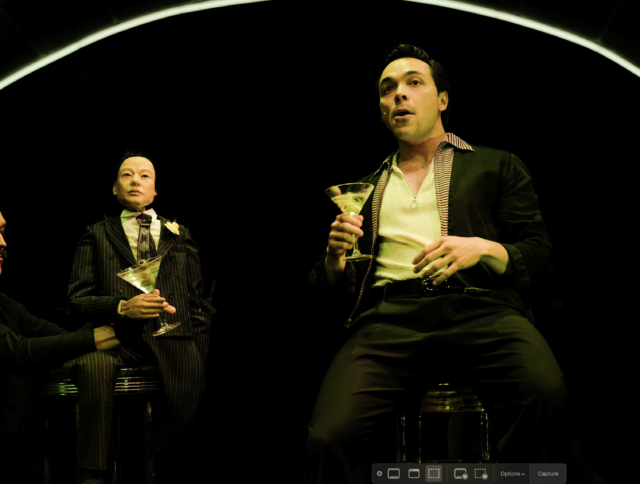
Laurence Fishburne debuts one-man show at PAC NYC (photo by Joan Marcus)
LIKE THEY DO IN THE MOVIES
Perelman Performing Arts Center (PAC NYC)
251 Fulton St.
Through March 31, $64-$158 pacnyc.org
I’ve been closely following the career of Laurence Fishburne since I saw Apocalypse Now when it premiered at the Ziegfeld in the summer of 1979, paying an exorbitant five bucks for a ticket and a special program. Fishburne, who was fourteen when filming got underway, played Mr. Clean, a crew member from the Bronx aboard a Navy river patrol boat heading up the Nùng River on a dangerous secret mission during the Vietnam War. On June 2, 1992, I was at the Walter Kerr Theatre, seeing August Wilson’s Two Trains Running, its first show since Fishburne had won a Tony for Best Performance by an Actor in a Featured Role in a Play two days earlier, only the second Black man to earn that honor, following Zakes Mokae in Master Harold . . . and the Boys ten years earlier. I am not a fan of entrance applause, but that night Fishburne was greeted with one of the longest and loudest ovations I’ve ever been a part of.
So I had high expectations for the world premiere of his one-man show, Like They Do in the Movies, continuing at PAC NYC through March 31. In the nearly two-and-a-half-hour presentation (including intermission), Fishburne once again displays his vast talents as a compelling storyteller; his resume consists of more than 130 film, television, and stage appearances, with five Emmys, the Tony, and an Oscar nomination to his credit.
The show gets off to a terrific beginning as Fishburne, in a black sequined dress and hood, introduces himself after a projection of dozens of his films flash past on a large rectangular screen behind him. He calls his acting career “a polite way of saying I’ve been a bullshit artist all my life.” He then tells the audience that he is going to share a series of stories in which “some are true, some pure fiction, and some are a mix of both.”
Amiable and warm, Fishburne starts by recounting his childhood; he was born in Augusta, Georgia, on July 31, 1960, and later moved to Brooklyn. His mother, Hattie Bell Crawford, was an eccentric character who operated a charm school in their home; his father, known as Big Fish, was a corrections officer and womanizer. Fishburne relates tales about his parents and grandparents as photographs of them appear on the screen. He describes his mother as having narcissistic personality disorder type 2 and says that she was sexually abusive toward him. He ends numerous deeply personal anecdotes by promising, “More about that later.” Alas, that is not always the case.
The center section, which makes up the bulk of the play, comprises five long tales that seem to have been told directly to Fishburne or that he witnessed. He enacts them in exquisite detail, performing multiple roles with great skill and changing costumes, from a casual blazer and slacks to a lush caftan to an ill-fitting sweater and street clothes. No costume designer is credited, so perhaps the duds come from his own closet.
Each of the vignettes, which might or might not be completely true, is engrossing. A tough-talking ex-con named Fitzpatrick who works for the Daily News impersonates a cop on the subway. A homeless man discusses his plans for the future as he washes cars. A lawyer wants to get his family out of New Orleans as Katrina hits but his wife, an OB/GYN nurse, has three patients ready to give birth. A retired policeman rambles on as he attempts to keep fans away from Fishburne while the actor is taking a break on a movie set. And a British ex-pat explains how he is not a pimp as he offers Fishburne his choice of women at an Australian bordello.
Director Leonard Foglia (Thurgood, which earned Fishburne a Best Leading Actor Tony nomination for his portrayal of Thurgood Marshall) keeps Fishburne moving about on Neil Patel’s set, which contains a few chairs and a table that are reconfigured for each segment. Elaine J. McCarthy’s projections display photographic backdrops helping identify locations. Tyler Micoleau’s lighting and Justin Ellington’s sound, with interstitial clips from jazz, R&B, gospel, and rock songs, are on target.
As well done as the scenes are, they don’t lend insight into Fishburne’s own character, his real self; the Australian anecdote is particularly disconcerting as the audience wonders whether Fishburne is relating an actual experience he had at a brothel.
He then returns to his personal narrative, delving into several startling family revelations and his parents’ late-in-life illnesses. He doesn’t talk about his career, and he says nothing about his partners and mentions his son Langston only once. (Fishburne has been divorced twice and has three children.) We already know that Fishburne is one of the best American actors of his generation, through his myriad outstanding performances; we want to learn more about him as an individual, as a human being, especially after he teases us in the first act. He doesn’t tie up enough loose ends, which is of course his prerogative, but days after I saw the play, I’m still wanting more. I had a similar experience at John Lithgow’s 2018 solo show, Stories by Heart, in which too much time was spent on his reenacting — brilliantly — two short stories that his father would read to him and his siblings.
In the program, Fishburne thanks Whoopi Goldberg, John Leguizamo, and Anna Deavere Smith for “showing me the way.” That trio of stalwart solo performers have mastered going between autobiography and exploring the state of contemporary culture and politics. Fishburne is eminently likable and riveting, but Like They Do in the Movies might have benefited from a better balance of the two.
[Mark Rifkin is a Brooklyn-born, Manhattan-based writer and editor; you can follow him on Substack here.]