this week in theater

ADRIENNE WESTWOOD: RECORD

Adrienne Westwood’s RECORD uses the LP to explore time, space, and memory (photo by Seth Easter)

One Arm Red
10 Jay St., ninth floor
May 24-27, $15
718-222-1601
www.onearmred.com
www.adriennewestwood.com

Adrienne Westwood’s evening-length multimedia dance piece Record explores memory, much as the joy of listening to vinyl LPs is a memory to many (and a mystery to others). Collaborating with sound artist Jim Briggs III and designer Seth Easter, Westwood, the Brooklyn-based cofounder of VIA Dance Collaboration (Lullaby in Surrealism, Beside: Ourselves), says of Record, “When you enter the room with the record player, it is playing a song you have never heard. Yet, it sounds familiar. The tone of it tells you it is old. The scratchiness tells you of its history. And since none of us know the song, we know the record wasn’t ours. It never belonged to us. It has brought with it the traces of those we don’t know.” Conceived and choreographed by Westwood, the work, running May 24-27 at Brooklyn’s One Arm Red, incorporates live video, projected images, directional audio, childhood toys, and, yes, a record player; the show is performed by Jung-eun Kim, Lauren Bakst, Julia Kelly, Kathryn Logan, Helen Simoneau, Jacob Slominski, and Katie Swords. On Friday and Saturday, One Arm Red will also present 3 Sticks Theatre Company’s Paper Plane,, along with special performances by AH! HA! Physical Theater and the Iris Ensemble; admission is pay-what-you-can.

TRIBES

TRIBES examines language and communication in a severely dysfunctional family

Barrow Street Theatre
27 Barrow St. at Seventh Ave. South
Through September 2, $75-$95
barrowstreettheatre.com

Nominated for Outstanding Play and Outstanding Director by the Drama Desk, Nina Raine’s Tribes is an intimate examination of communication, language, and family. Originally presented at London’s Royal Court Theatre in 2010, Tribes delves into the trials and tribulations of a wildly dysfunctional family that emerge when prodigal son Billy (Russell Harvard) suddenly returns home. Although Billy was born deaf, his parents, Christopher (Jeff Perry) and Beth (Mare Winningham), tried not to raise him differently, deciding not to have him learn sign language or be treated as if he has a handicap. Back home, Billy reconnects with his brother, Daniel (Will Brill), a bitter, ne’er-do-well wannabe writer, and his sister, Ruth (Gayle Rankin), who has dreams of becoming an opera singer, while his father spouts off against the establishment and his mother attempts to improbably keep the peace. But when Billy meets Sylvia (Susan Pourfar), a young woman who is slowly losing her hearing because of a genetic condition, he takes a closer look at his upbringing and doesn’t like what he sees. Tribes is a searing, poignant drama that takes place around a central table surrounded on all four sides by the audience, as if the crowd is part of the characters’ extended family. Director David Cromer (Orson’s Shadow, When the Rain Stops Falling) makes excellent use of the tiny space, which subtly references the claustrophobic nature of this rather unwelcoming, extremely selfish and self-absorbed family, then takes things to another level in a series of later scenes that ingeniously explore the world of the deaf. Tribes is a splendid achievement, one of the best plays of the year on or off Broadway.

SPIDER-MAN: TURN OFF THE DARK

SPIDER-MAN flies both high and low on Broadway

Foxwoods Theatre
213 West 42nd St. between Broadway & Eighth Ave.
Tuesday – Sunday through January 4, $77.50 – $157.50
spidermanonbroadway.marvel.com

Forget about all the controversy, the delayed official openings, the injuries to performers from equipment problems, the departure of original director Julie Taymor, and all of the other bizarre elements that made Spider-Man: Turn Off the Dark the talk of Broadway for months and months on end. What it all really comes down to is this: Is it any good? And the answer is a resounding: No, it’s not really very good at all. The big-budget musical about a teenage science geek who suddenly becomes a superhero is an overblown spectacle with forgettable music and lyrics by Bono and the Edge, a meandering book by Taymor, Glen Berger, and Roberto Aguirre-Sacasa, and an uncomfortable mix of low-budget DIY staging and high-tech gadgetry. Reeve Carney stars as Peter Parker, a nerdy kid who is bitten by a spider while on a school trip to the lab of cutting-edge scientist Norman Osborn (Drama Desk-nominated Patrick Page). Peter quickly develops special powers that soon find him soaring over the Big Apple, protecting New York City from evil. Like every superhero, he needs an arch villain, who arrives in the form of the Green Goblin (Page), the result of one of Osborn’s experiments gone terribly wrong. As the Green Goblin and his Sinister Six ― Swarm (Drew Heflin), the Lizard (Julius C. Carter), Electro (Maxx Reed), Kraven the Hunter (Emmanuel Brown), Carnage (Adam Roberts), and Swiss Miss (Reed Kelly) ― terrorize the city, Spider-Man must choose between fighting crime or settling down with the love of his life, Mary Jane Watson (Rebecca Faulkenberry).

There are some dazzling moments ― director Philip Wm. McKinley and choreographers Daniel Ezralow and Chase Brock do a wonderful job introducing Arachne (Christina Sajous) and her small contingent, who magically descend from above on fabulously flapping fabric inspired by weaving techniques, and an unfolding Chrysler Building is breathtaking ― but most of the scenes are flat and uninspired. Even the justly celebrated flying gets played out and repetitive, and the supposed showstopping act two opener, “A Freak Like Me Needs Company,” in which the Green Goblin introduces his crew of baddies, insultingly breaks down the barrier between performer and audience, a mistake from which it never recovers. Nominated for two Tonys (for Best Scenic Design and Best Costume Design of a Musical), Spider-Man: Turn Off the Dark, which recently welcomed its one millionth visitor, is unable to break free from a tangled web of its own making. (In honor of the show’s two Tony nominations, the first one hundred people with the name Anthony, Tony, Antoinette, Toni, Antonia, or Antonio who come to the Foxwoods Theatre box office on June 4 at 10:00 am will receive a coupon for a pair of free tickets to the Sunday matinee on June 10.)

THE CARETAKER

Jonathan Pryce, Alex Hassell, and Alan Cox star in THE CARETAKER at BAM (photo by Richard Termine)

Brooklyn Academy of Music
BAM Harvey Theater
651 Fulton St. between Ashland & Rockwell Pl.
Through June 17, $25-$100
718-636-4100
www.bam.org

Jonathan Pryce gives a whirlwind tour-de-force performance in the latest revival of Harold Pinter’s The Caretaker, running at BAM’s Harvey Theater through June 17. In the Liverpool Everyman and Playhouse/Theatre Royal Bath production, Pryce (Miss Saigon, Comedians) stars as the tramp Davies, a homeless man in tatters who is just looking for a good pair of shoes and a place to rest his weary bones. He is offered both by Aston (Alan Cox), a friendly sort of chap Davies met in a pub who takes Davies to his apartment, a ramshackle space overloaded with dusty, moldy black-and-white and gray objects, the only color a brightly painted ceramic Buddha. Davies is soon being harassed by a strange man who turns out to be Aston’s younger brother, Mick (Alex Hassell), who enjoys teasing the elderly Davies. Over the course of several weeks, the trio engages in existential philosophical discussions à la Beckett’s Waiting for Godot, speaking about nothing and everything as both brothers separately ask him to serve as the apartment building’s caretaker, leading to confusion over who’s really in charge. Meanwhile, Davies keeps talking about having to get to Sidcup to reclaim his identity papers, as his real name is not actually Davies. Directed by Christopher Morahan, The Caretaker is worth seeing just for Pryce’s extraordinary performance as the title character, an endearingly eccentric figure who likes things his own extremely particular way. The first half is filled with eclectic humor and slapstick, but the second half gets bogged down in repetition and plot twists that come out of left field, not really going anywhere ― even though that’s part of the point. “I can take nothing you say at face value,” Mick says to Davies. “Every word you speak is open to any number of different interpretations.” And so it is with the play and Pinter himself. The Caretaker was his breakthrough, premiering in London in 1960 with Donald Pleasence as Davies, Alan Bates as Mick, and Peter Woodthorpe as Aston; Robert Shaw took over the role of Aston on Broadway and in Clive Donner’s 1963 film. Pryce will participate in an Artist Talk following the May 24 performance, speaking with Pinter scholar Austin E. Quigley.

BIG DANCE THEATER: COMME TOUJOURS HERE I STAND

Big Dance Theater reinvents Varda classic onstage in multimedia production

New York Live Arts
219 West 19th St. between Seventh & Eighth Aves.
May 16-19, $15-$30, 7:30
212-691-6500
www.newyorklivearts.org
www.bigdancetheater.org

Agnès Varda’s 1961 Nouvelle Vague classic, Cléo from 5 to 7, is as much about filmmaking as it is about its subject, a small-time chanteuse wandering the streets of Paris as she fearfully awaits the results of a biopsy. New York-based Big Dance Theater, under the artistic direction of husband-and-wife team Annie-B Parson and Paul Lazar, reinvents the seminal real-time film onstage in the vastly entertaining Comme Toujours Here I Stand. Turning the process itself into the narrative, BDT creates a multimedia mix of dance, music, and video centered around the making of the film, with a diva star playing the diva star. Parson and Lazar, who based the production on Varda’s screenplay — they didn’t watch the movie itself until things were well under way — brilliantly incorporate a wonderful set featuring three vertical multipurpose screens and a rolling staircase, along with original songs by Robyn Hitchcock. Evoking New Wave master Jean-Luc Godard, much of the action takes place in between shots, “off camera,” involving the cast and crew, focusing on Cléo’s ever-more-frustrated costars, one of whom is in a continuing phone drama with her boyfriend. Fans of the film won’t be disappointed — BDT includes all the familiar scenes, from visits to a fortune-teller and a hat shop to a musical interlude with Cléo’s pianist and a walk in the park with a poetic soldier. Refreshingly, Comme Toujours Here I Stand, which was first presented at the Kitchen in October 2009 and will now be performed May 16-19 at New York Live Arts, also maintains Varda’s focus on women’s experience and interaction with each other. (There will be a preshow talk on May 16 with Brian Rogers and a postshow talk May 18 with Cathy Edwards.)

AN EARLY HISTORY OF FIRE

Danny (Theo Stockman) and Karen (Claire van der Boom) are in for a long night in David Rabe’s AN EARLY HISTORY OF FIRE (photo by Monique Carboni)

The Acorn Theatre at Theatre Row
410 West 42nd St. between Ninth & Tenth Aves.
Monday – Saturday through May 26, $61.25
212-560-2183
www.thenewgroup.org
www.theatrerow.org

Despite all the talk of burning hilltops and yearning young passion, award-winning playwright David Rabe’s An Early History of Fire never quite ignites at the Acorn Theatre at Theatre Row. Lightning doesn’t strike twice for the New Group, which staged a popular revival of Rabe’s Tony-nominated Hurlyburly in 2005, featuring the all-star cast of Bobby Cannavale, Josh Hamilton, Ethan Hawke, Parker Posey, and Wallace Shawn. Rabe, who has penned such other works as Sticks and Bones, The Basic Training of Pavlo Hummel, and In the Boom Boom Room, goes back to 1962 in his first new play since 2001’s The Dog Problem, but it turns out to be a rather mundane time-capsule drama. Theo Stockman stars as Danny, a serious young man living with his immigrant father, Emil (Gordon Clapp), in a working-class town in Middle America. When Danny begins dating Karen (Claire van der Boom), the daughter of a wealthy family in a nearby ritzy neighborhood, his best friend, Terry (Jonny Orsini), is insulted, claiming that Danny is turning his back on his roots. But Danny is enlightened by Karen’s discussions of literature and politics, although he starts finding out a lot more about her on one very long night. An Early History of Fire is a coming-of-age drama that never comes of age itself, instead emerging flat and old-fashioned. When Karen waxes poetic about Salinger and Kerouac, or when the play comes to an uncomfortable stop as everyone pauses to listen to an Elvis Presley song on the hi-fi, it feels like Rabe is forcing his own personal heroes into the story, resulting in moments that are unnatural and inorganic. An Early History of Fire does have the air of autobiography about it ― Rabe was born and raised in Dubuque, Iowa, in a working-class family, and he would have been twenty-two in 1962 ― but it has trouble escaping its own insecurities, much as Danny has trouble escaping his.

DON’T DRESS FOR DINNER

Highly anticipated DON’T DRESS FOR DINNER disappoints on Broadway (photo by Joan Marcus)

American Airlines Theatre
227 West 42nd St. between Broadway & Eighth Ave.
Through June 17, $67-$117
212-719-1300
www.roundabouttheatre.org

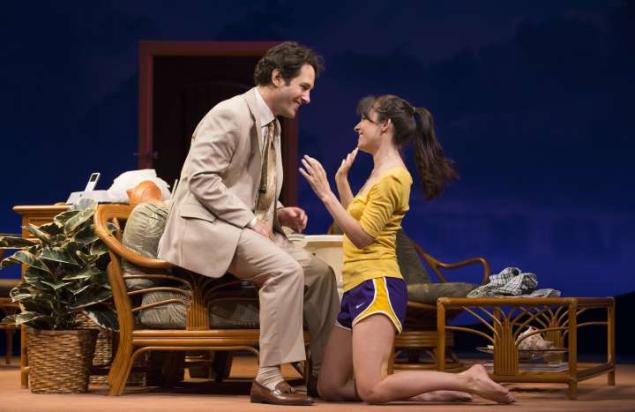
In April 2008, Marco Camoletti’s 1962 French farce, Boeing-Boeing, flew onto Broadway, eventually landing six Tony nominations and earning statuettes for Best Revival of a Play and Best Leading Actor (Mark Rylance). Capitalizing on that success, the Roundabout has brought back Camoletti’s Don’t Dress for Dinner, but there’s little appetizing about this supposed comedy. This tepid follow-up features several characters from Boeing-Boeing, once again caught up in romantic shenanigans. In a lovely chateau two hours outside of Paris, Bernard (Adam James) has planned to have his mistress, Suzanne (Jennifer Tilly), spend the weekend since his wife, Jacqueline (Tony nominee Patricia Kalember), will be visiting her mother. But when Jacqueline discovers that her lover, Robert (Ben Daniels), who also happens to be Bernard’s best friend, will be coming by as well, she cancels with her mother and instead decides to stay home, sending Bernard into a frenzy. When Suzette (Spencer Kayden), a cook Bernard hired for the evening, shows up, Robert mistakes her for his friend’s mistress, and soon everyone is caught up in an endless — indeed, it feels like it will never end — game of mistaken identity, overt and covert deception, and overblown slapstick. There are barely a few chuckles in Robin Hawdon’s adaptation, repetitively directed by John Tillinger. Don’t Dress for Dinner feels more like an extended episode of Three’s Company than a legitimate Broadway show, although the actors do try their darnedest with the ridiculously convoluted plot and drastically overcooked script.