this week in theater

TEN CHIMNEYS

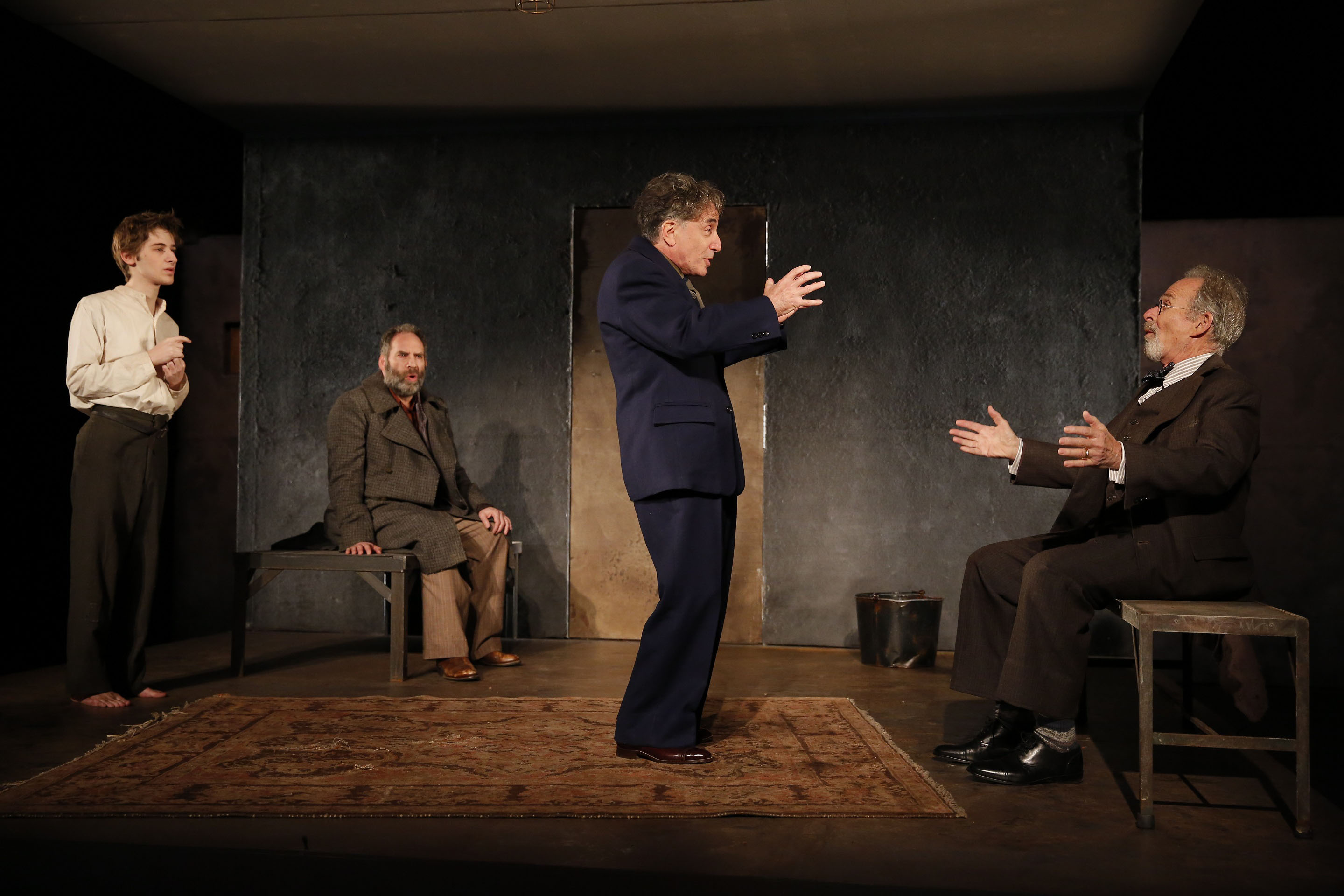
Real-life couple Byron Jennings and Carolyn McCormick play real-life couple Alfred Lunt and Lynn Fontanne in exhilarating TEN CHIMNEYS (photo by Carol Rosegg)

Theatre at St. Clement’s
423 West 46th St. between Ninth & Tenth Aves.
Wednesday – Sunday through October 27, $65
www.thepeccadillo.com

One of the best plays of the new season is taking place off Broadway, set in a Wisconsin country home but firmly entrenched on the Great White Way. Real-life husband-and-wife acting couple Byron Jennings and Carolyn McCormick do a splendid job starring as real-life husband-and-wife acting couple Alfred Lunt and Lynn Fontanne in the Pecadillo Theater Company’s rollicking Ten Chimneys. It’s 1937, and Alfred and Lynn are beginning rehearsals for their upcoming Broadway production of Anton Chekhov’s The Seagull, with Lunt playing Trigorin, Fontanne playing Arkadina, Uta Hagen (Julia Bray) as Nina, and Sydney Greenstreet (Michael McCarty) as Sorin. Also joining them at the farmhouse are Alfred’s demanding mother, Hattie (Lucy Martin); his half-sister, Louise (Charlotte Booker), who does all the cooking and cleaning (and complaining); and his half-brother, Carl (John Wernke), a handyman who moonlights as a pool shark. As they delve into the play, as well as the play within a play, jealousy breaks out in many forms — between siblings, between lovers, between parents and children, between actors, and between fictional characters, resulting in a multilayered story that is simply exhilarating.

Jeffrey Hatcher’s razor-sharp dialogue is fanciful and whip smart, wonderfully playing with theatrical conventions and revealing tantalizing secrets. Dan Wackerman’s direction is breezy and inviting, while Harry Feiner’s rustic stage design provides just the right setting for the proceedings. Ten Chimneys is a fascinating behind-the-scenes look at Lunt and Fontanne’s working process, particularly when Greenstreet commandingly directs the couple through one scene and when Lunt and Hagen examine another run-through that ends in a kiss. The actors’ deconstruction of The Seagull stokes the fires of Ten Chimneys, a thrilling play about the theater that celebrates itself without becoming pedantic or melodramatic. Instead, it’s great fun, romantic and insightful, a must-see for lovers of theater. Don’t be surprised if after the show, which continues at the Theatre at St. Clement’s through October 27, you see Jennings and McCormick dashing down West 46th St. and jumping into a taxi together, just as Lunt and Fontanne must have done so many times during their long careers.

AN ENEMY OF THE PEOPLE

Richard Thomas and Boyd Gaines star as brothers at odds in Broadway revival of Ibsen’s AN ENEMY OF THE PEOPLE (photo by Joan Marcus)

Manhattan Theatre Club at the Samuel J. Friedman Theatre
261 West 47th St. between Broadway & Eighth Aves.
Tuesday – Sunday through November 11, $67-$120
www.anenemyofthepeoplebroadway.com

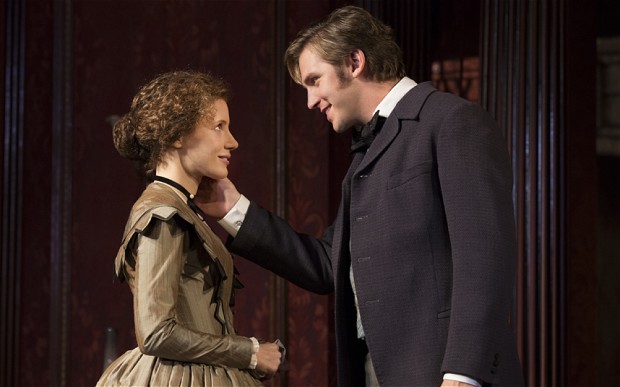
When Dr. Thomas Stockmann (four-time Tony winner Boyd Gaines) discovers that the water in the baths of his spa town is dangerously contaminated, he thinks he will be celebrated as a hero, a supreme protector of the public health. But he is shocked when his brother, Peter (Emmy winner Richard Thomas), the mayor, decides to cover up the findings, more interested in ensuring the future financial success of the small Norwegian coastal town than in saving lives, setting off an all-too-familiar battle between the government and the individual, the public welfare versus corporate greed, the rich against the poor, and the role of the media in the controversy. Written in 1882 by Henrik Ibsen, An Enemy of the People is now running at the Samuel J. Friedman Theatre in a streamlined, hackneyed adaptation by British playwright Rebecca Lenkiewicz (The Night Season) that attempts to be relevant to modern-day concerns but instead, after a somewhat promising first act, falls flat on its clichéd bottom. Gaines is strong as the determined yet conceited doctor, refusing to believe that the truth will get buried, but Thomas is far too weaselly as the mayor, strutting about like Snidely Whiplash in his top hat, cape, and cane. Doug Hughes’s flaccid direction turns the proceedings into a ridiculous series of overblown, pedantic scenes that culminates in a cringe-inducing town meeting in which everyone piles on the good doctor.

Following 1878’s A Doll’s House and 1881’s Ghosts, Ibsen continued his scathing indictment of various aspects of contemporary society in An Enemy of the People, but it is not one of his better plays, as evidenced by how infrequently it turns up in major productions onstage and onscreen; in 1950, Arthur Miller’s adaptation ran on Broadway with Fredric March and Morris Carnovsky, and a little-seen 1978 film starred Steve McQueen and Charles Durning. This 2012 version also features Kathleen McNenny as the doctor’s wife, Catherine; Maïté Alina as their idealistic daughter, Petra; John Procaccino as newspaper publisher Hovstad; and Gerry Bamman as Aslaksen the printer, whose constant calls for “restraint” grow as tiresome as the production’s overwrought political statements. Lenkiewicz’s An Enemy of the People can’t decide whether it’s an ironic black comedy or a serious treatise on power and corruption, winding up as neither.

JACK FERVER: MON MA MES

Jack Ferver will examine his life and his work in special Crossing the Line Festival presentation at FIAF (photo by Yaniv Schulman)

CROSSING THE LINE
Le Skyroom, French Institute Alliance Française
22 East 60th St. between Madison & Park Aves.
Saturday, October 6, $20-$25, 8:00
Festival runs through October 14, free- $45
212-355-6160
www.fiaf.org

Back in May, New York City-based dancer, choreographer, and writer Jack Ferver told us, “The ego begins with ‘Me, not me.’ As an artist I make my work so that people donʼt feel as lonely as I have felt. Therefore my work expands into something more akin to ‘I am you.’” The man behind such well-received shows as Rumble Ghost, A Movie Star Needs a Movie, Swann!!!, I Am Trying to Hear Myself, and Two Alike will once again be looking at his life in Mon Ma Mes, which is being presented October 6 at the French Institute Alliance Française as part of the 2012 multidisciplinary Crossing the Line Festival. Ferver, who regularly crosses the line between fantasy and reality, fiction and nonfiction, will analyze himself while also performing and deconstructing one of his pieces. Ferver’s work always cleverly balances chaos, humor, introspection, movement, intelligence, and playful stagecraft in entertaining ways, so this promises to be another unique and memorable night in his growing ouevre.

IF THERE IS I HAVEN’T FOUND IT YET

Anna (Annie Funke) and her uncle George (Jake Gyllenhaal) try to make a connection in IF THERE IS I HAVEN’T FOUND IT YET (photo by Joan Marcus)

Roundabout at Laura Pels Theatre
Harold and Miriam Steinberg Center for Theatre
111 West 46th St. between Sixth & Seventh Aves.
Tuesday – Sunday through November 25, $100
212-719-1300
www.roundabouttheatre.org

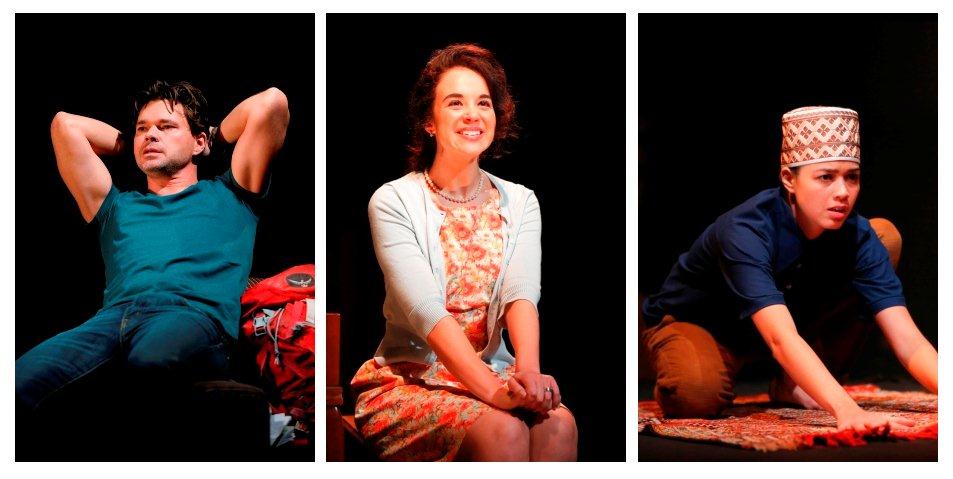
Oscar-nominated actor Jake Gyllenhaal is making his New York theater debut in Nick Payne’s If There Is I Haven’t Found It Yet, but it’s director Michael Longhurst’s staging that dominates the proceedings, for both good and bad. A hirsute Gyllenhaal (Brokeback Mountain) stars as Terry, an Irish drifter who suddenly shows up at the home of his older brother, George (Tony winner and Emmy nominee Brían F. O’Byrne), an environmentalist writing a book called How Green Are Your Tomatoes? that is taking up most of his time. George’s wife, Fiona (Michelle Gomez), is alienated by his continuing absences while also having trouble dealing with their daughter, Anna (Annie Funke), a severely overweight fifteen-year-old who is being bullied at the school where Fiona teaches. Anna soon finds a friend in her uncle, a beer-guzzling, pot-smoking ne’er-do-well who has a very different idea of parenting. Although the play sets up some interesting relationships in the first act, the second act spirals downward in a mess of clichéd dialogue and trite plot twists, leading to an obvious climax audiences will pray won’t happen but does. Longhurst, in his New York debut, teams with Tony-winning set designer Beowulf Boritt (The Scottsboro Boys) to come up with an exciting way to change scenes. As the play begins, a mountain of furniture and odds and ends are piled in the center of the stage, which is claustrophobically closed in by walls on three sides. As each new scene starts, the actors pull a chair, table, or other element out of the pile to use. However, when the scene ends, the characters angrily push or kick the chairs, tables, and even a refrigerator into an encased moat filled with water at the edge of the stage. It’s a powerful conceit, but one that never really establishes a reason other than to allow the characters to display emotions that would be better served within the constructs of the play itself. Indeed, as the audience enters the Laura Pels Theatre, a spray of rain is filling the moat, and Anna walks up to the falling water and puts her hand out to touch it. Payne and Longhurst are using the life-giving nature of water to try to establish a connection between the family’s future and the melting of the polar ice caps that George is so obsessed with, an environmental calamity that could eventually flood the world, but it’s a staging tool that ultimately drowns in its own metaphor.

NEXT WAVE FESTIVAL: RHINOCEROS

Théâtre de la Ville, Paris, will present Eugène Ionesco’s classic absurdist tale RHINOCÉROS this week at BAM (photo by Jean-Louis Fernandez)

BAM Howard Gilman Opera House
30 Lafayette Ave. between Ashland Pl. & St. Felix St.
October 4-6
718-636-4100
www.bam.org
www.theatredelaville-paris.com

As much as Jean-Paul Sartre is associated with the idea of existentialism, playwright Eugène Ionesco is linked with the word absurd. Born in Romania in 1909 and raised primarily in France, Ionesco changed the face of dramatic narrative with such works as The Lesson, The Chairs, The Killer, and Exit the King. One of his most famous plays, 1959’s Rhinocéros, which was turned into a 1973 film starring Zero Mostel, Gene Wilder, and Karen Black, can now be seen in an inventive adaptation by Emmanuel Demarcy-Mota and Théâtre de la Ville, Paris, running at BAM’s Howard Gilman Opera House October 4-6 as part of the thirtieth Next Wave Festival. “I like to come back to playwrights who question the place and role of the individual in collective history, on his responsibility, his freedom of thought, beyond any form of individualism,” Demarcy-Mota, who has also recently directed works by Horváth and Brecht, explains on the company website. The allegory about totalitarianism features set and lighting by Yves Collet, music by Jefferson Lembeye, and costumes by Corinne Baudelot, with François Regnault serving as artistic collaborator; Serge Maggiani plays Bérenger, Hugues Quester is Jean, and Valérie Dashwood takes on the role of Daisy. “”Ionesco knows how to depict dialectically every man’s cowardice, conformism and hypocrisy,” Demarcy-Mota adds. Rhinocéros “is a funereally burlesque play that we wish to render with full energy.” As a bonus, on October 5 at 5:00 at the Rosenthal Pavilion at NYU’s Kimmel Center, the esteemed panel of Demarcy-Mota, Edward Albee, Israel Horovitz, and Marie-France Ionesco will participate in the free “Next Wave Talk: On Ionesco,” moderated by NYU French literature professor Tom Bishop.

Nowhere is safe in Théâtre de la Ville’s thrilling production of Eugène Ionesco’s absurdist classic (photo by Pavel Antonov)

Update: Théâtre de la Ville director Emmanuel Demarcy-Mota promised a Rhinocéros rendered “with full energy,” and he and the company deliver all that and more in their engaging version of Eugène Ionesco’s 1959 absurdist classic, running October 4-6 at BAM’s Howard Gilman Opera House as part of the thirtieth Next Wave Festival. Following a short introductory excerpt from Ionesco’s sole novel, The Hermit, the curtain opens on a group of people in a town square just going about their daily business. Jean (a big, blustery Hugues Quester) bikes in to meet his friend Bérenger (Serge Maggiani), a bedraggled man recovering from a hangover, not able to remember much of what occurred the night before. A rhinoceros suddenly roars through the town like a tsunami, leaving in its wake a stunned crowd not quite sure what it really just saw, instead getting caught up in existential discussions of cats’ paws. Eventually life goes on, with Bérenger, who has a crush on Daisy (Valérie Dashwood), arriving at the publishing house where he works, only to encounter another stampeding rhino. As everyone around him starts turning into rhinos, the hapless Bérenger is determined not to succumb to the mass hysteria. Featuring terrific staging (courtesy of Yves Collet) that includes a raised-level office, collapsing rooms, and a majestically morphing figure in addition to a slowly building score by Jefferson Lembeye that nearly explodes at the end, Théâtre de la Ville’s Rhinocéros cleverly captures the philosophical underpinnings of Ionesco’s tale of the fight for individualism in the face of growing totalitarianism and an ever-increasing conformity that is overwhelming a consumer-driven society. Evoking Franz Kafka’s novella The Metamorphosis, Don Siegel’s sci-fi classic Invasion of the Body Snatchers, and such recent disasters as Hurricane Katrina and the 2011 Japanese earthquake and tsunami, the show combines humor, pathos, and playful investigations of logic as the community is overcome by a collective consciousness that seems unstoppable. Ionesco might have written Rhinocéros because of what he saw occurring in Eastern Europe in the 1930s, but it still feels as fresh and relevant as ever in this outstanding production.

TICKET GIVEAWAY: THE OTHER JOSH COHEN

Steve Rosen stars as Josh Cohen in THE OTHER JOSH COHEN

THE OTHER JOSH COHEN
SoHo Playhouse
15 Vandam St.
Previews October 10-20, $35; October 21 – November 11, $65
www.theotherjoshcohen.com

Based on a true story, The Other Josh Cohen is a new musical comedy about bad luck, Jewish guilt, and Neil Diamond. David Rossmer (Peter and the Starcatcher, the Misconceptions) and Steve Rosen (Spamalot, The Farnsworth Invention) collaborated on the book, music, and lyrics and both play the title character, who is broke and lonely as Valentine’s Day approaches, the only thing left after his apartment was robbed being a Neil Diamond CD. A presentation of Amas Musical Theatre, The Other Josh Cohen is directed by Ted Sperling, choreographed by Andrew Palermo, and features Kate Weatherhed as a Lot of People, music director Vadim Feichtner as a Bunch of People, Hannah Elless as a Bunch of Other People, and Ken Triwush as the Rest of the People.

David Rossmer stars as Josh Cohen in THE OTHER JOSH COHEN

TICKET GIVEAWAY: The Other Josh Cohen, begins previews at the SoHo Playhouse on October 10 prior to an October 21 opening, and twi-ny has four pairs of tickets to give away for free. Just send your name, daytime phone number, and all-time favorite Neil Diamond song to contest@twi-ny.com by Thursday, October 4, at 5:00 to be eligible. All entrants must be twenty-one years of age or older; four winners will be selected at random.

CHAPLIN

Rob McClure embodies the Little Tramp in new Broadway musical about Charlie Chaplin (photo by Joan Marcus)

Ethel Barrymore Theatre
243 West 47th St. between Broadway & Eighth Ave.
Through February 3, $49.50 – $135.50
www.chaplinbroadway.com

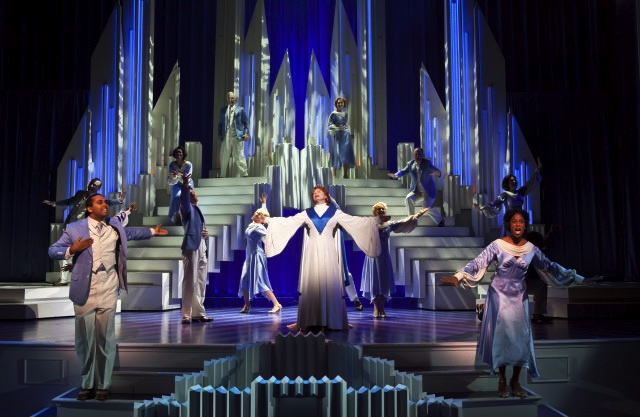
From his Dickensian upbringing to Hollywood stardom to his penchant for underage women and his long exile overseas, followed by a final redemption, Charles Spencer Chaplin lived quite a life, something book writers Christopher Curtis and Thomas Meehan are only partially successful in bringing to the big stage with Chaplin. The new musical, directed and choreographed by Warren Carlyle, glories, perhaps a bit too much, in Rob McClure’s dazzling performance as Chaplin, embodying the multitalented actor, writer, director, musician, composer, political rebel, and womanizer whose socially relevant silent comedies brightened up hard times in America during the 1920s and 1930s. The show starts in London, as young Charlie (a charming Zachary Unger) grows up in the seedy alleys and burlesque clubs with his mother, Hannah (an outstanding Christiane Noll), a bawdy performer whose husband has essentially abandoned the family. An older Charlie soon catches a break and is working for Mack Sennett (a strong Michael McCormick) in Hollywood; the scene in which Charlie is ordered to be funny and transforms into the Little Tramp is splendidly done, adding a deft touch of magic to the invention of this seminal character. Hiring his brother, Sydney (Wayne Alan Wilcox), as his business manager, Charlie finds massive success with such films as The Kid, The Gold Rush, and The Circus, but the musical oddly chooses which to focus on; while Carlyle does a good job equating The Kid with Chaplin’s real-life experiences as a child (clever casting has Unger also playing Jackie Coogan), shorter (or stranger) shrift is given to such critical works as City Lights and Modern Times, and later films such as Monsieur Verdoux and Limelight warrant nary a mention, despite their many inside references to his personal situations.

The musical does, however, devote a major sequence to The Great Dictator that reveals the development of his public political persona. But in the second act, Chaplin spends way too much time concentrating on Hedda Hopper’s (Jenn Colella) mission to destroy Chaplin by labeling him a communist in order to get even for his refusal to be interviewed by her. And the musical deals with Chaplin’s ultimately disastrous marriages to Mildred Harris (Hayley Podschun), Lita Grey, and Paulette Goddard in a baffling boxing scene that sideswipes the show, while his relationship with Oona O’Neill (Erin Mackey) swoops in from nowhere and then essentially disappears. Beowulf Boritt’s sets, Amy Clark and Martin Pakledinaz’s costumes, and Ken Billington’s lighting, along with Jon Driscoll’s inventive video projections, give Chaplin the look and feel of a black-and-white movie, but few of the songs stand out, aside from Noll’s “Look at All the People” and the ensemble piece “Just Another Day in Hollywood.” Much like Chaplin’s career, Chaplin kicks off with quite a bang but eventually dissipates into the disappointment of what could have been.