this week in theater

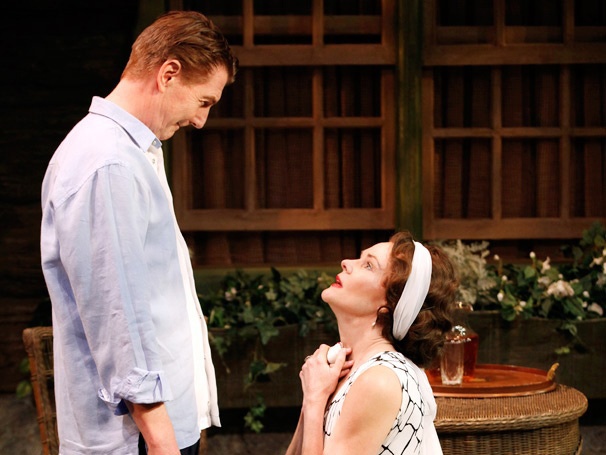
THE LYONS

Black comedy about family dysfunction roars onto Broadway (photo by Carol Rosegg)

Cort Theatre
138 West 48th St. between Sixth & Seventh Aves.
Through July 31, $31.50 – $176.50
www.thelyonsbroadway.com

The Vineyard Theatre production of The Lyons has made a splendid transition to Broadway, where the severely dysfunctional Jewish family has settled comfortably into the Cort Theatre. Linda Lavin stars as matriarch Rita Lyons, a brash, direct woman who sits at the side of her husband Ben’s (Dick Latessa) hospital bed casually leafing through magazines as he faces impending death, his terminal cancer about to claim him. While she seems more concerned with redoing the living room, he spits out a hysterical barrage of extreme curses at her; it’s hard at first to tell whether the two of them really love or hate each other, but the truth eventually comes out in playwright Nicky Silver’s (Pterodactyls, The Altruists) wild and woolly Broadway debut. Rita and Ben are soon joined by their extremely troubled children: Curtis (Michael Esper), a gay short story writer who’d rather be with his lover than his family, which isn’t hard to understand, and Lisa (Kate Jennings Grant), an alcoholic mother experiencing serious marital woes. The more time the four of them spend together, the more secrets are revealed, each one more brutal and darkly funny than the last. The first act of The Lyons is a laugh-out-loud riot as Latessa keeps shouting out invectives and Lavin adds just the right spin, from cynical and ironic to guilt-building and nonchalant, to every line. Even the way she sits down and crosses her legs is loaded with emotion. The second act loses a little steam as Silver and director Mark Brokaw (Cry-Baby, The Constant Wife) shift their attentions more on Curtis and his innate problems, but the show picks up again when his mother returns to share the bizarre turn her life has taken. Nominated for a pair of Drama Desk Awards for Outstanding Play and Outstanding Actress in a Play (Lavin, who also received a Tony nod), The Lyons reveals just how much fun family dysfunction can be.

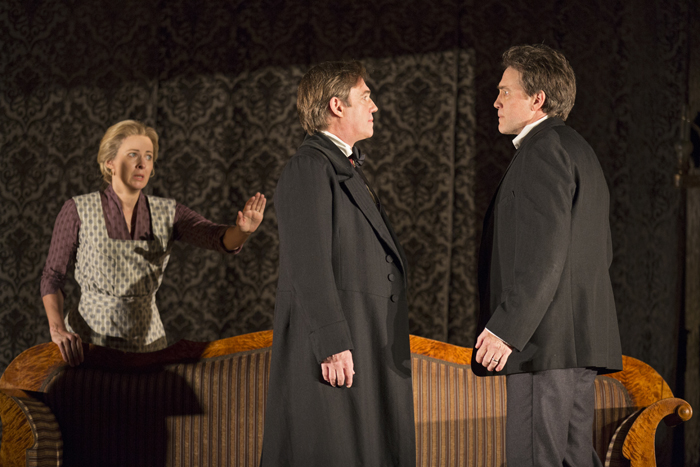
THE COLUMNIST

The Alsop brothers (John Lithgow and Boyd Gaines) toast to happier times in THE COLUMNIST (photo by Joan Marcus)

Manhattan Theatre Club at the Samuel J. Friedman Theatre
261 West 47th St. between Broadway & Eighth Aves.
Through June 24, $67-$121
thecolumnistbroadway.com

Based on the real life of American journalist Joseph Alsop, David Auburn’s The Columnist is a rather sterile exercise in twentieth-century historical fiction. Multitalented Tony and Emmy winner and Oscar nominee John Lithgow, a Rochester-born Harvard grad who in recent years has played a serial killer on Dexter, published a series of popular children’s books, and penned his autobiography (An Actor’s Education), gives a wonderful performance as the erudite Alsop, an acerbic columnist who believes he is more powerful than the president. A staunch conservative, he is surprisingly delighted with JFK’s victory, celebrating with his wife, Mary (Margaret Colin), stepdaughter, Abigail (Grace Gummer), and brother and sometime writing partner, Stewart (Boyd Gaines), convinced that the new president will show up at his house on the night of the inauguration. But Alsop’s power and influence begin to wane as he very publicly pushes for greater U.S. involvement in Vietnam, directly challenged by such up-and-coming journalists as David Halberstam (Stephen Kunken), while Stewart tries to protect his brother from a potential scandal surrounding a sexual fling Joe had with a young Russian man (Brian J. Smith) several years before, depicted in a very strong scene that opens the play. Auburn, who won the Pulitzer Prize for his 2000 play, Proof, never quite gets below the surface in The Columnist, resulting in a series of predictable, clichéd moments that feel stale and unnecessary, particularly when delving into the Vietnam war, something in interviews he claimed to know very little about, which shows. He does somewhat better handling the practical marriage between Alsop, a closeted homosexual, and Mary, a respected DC party hostess, although he changes several important facts about their relationship, including its length, and turns Mary’s two daughters into one. Directed by Shakespeare veteran Daniel Sullivan, The Columnist, despite a terrific lede and a Tony-nominated lead actor, is still in need of significant editing.

A STREETCAR NAMED DESIRE

New STREETCAR pulls into Broadway lacking the necessary desire

Broadhurst Theatre
235 West 44th St. between Broadway & Eighth Ave.
Through July 22, $49.50 – $199
www.streetcaronbroadway.com

Tennessee Williams’s steamy Pulitzer Prize-winning classic, A Streetcar Named Desire, has had a long, storied history on Broadway and on film. Unfortunately, this latest production, directed by Emily Mann at the Broadhurst Theatre, is unlikely to add to that legacy. A buff Blair Underwood stars as Stanley (the usual last name of Kowalski is dispensed with here), a raw, brutish man married to Stella (the always dependable Daphne Rubin-Vega), who loves her husband despite his animalistic nature. When Stella’s sister, Blanche Du Bois (Nicole Ari Parker), arrives to stay with them in their small, ramshackle home in New Orleans’s Elysian Fields, things begin to get complicated as Blanche tells Stella that the family’s country home has been lost and it soon becomes apparent that Blanche is having trouble living in reality. Streetcar needs to be played with fierce passion and careful nuance, but Mann’s version feels flat and uninspired. The two main couples — Stanley and Stella, and Blanche and Mitch (Wood Harris) — lack chemistry, so the fire never ignites, even when Stanley ultimately grabs Blanche. Everything about the production is admirable, including Terence Blanchard’s score and Eugene Lee’s set, but there’s an overwhelming straightforwardness from which it can’t escape — and one that has nothing to do with comparisons to previous Streetcars, featuring such leading foursomes as Marlon Brando, Jessica Tandy, Kim Hunter, and Karl Malden (1947), Aidan Quinn, Blythe Danner, Frances McDormand, and Frank Converse (1988), Alec Baldwin, Jessica Lange, Amy Madigan, and Timothy Carhart (1992), and John C. Reilly, Amy Ryan, Natasha Richardson, and Chris Bauer (2005). And the production’s primary conceit, that it is the first Broadway version to boast a multiracial cast, adds little to the proceedings.

ONE MAN, TWO GUVNORS

James Corden tries to get ahold of himself in uproarious ONE MAN, TWO GUVNORS

Music Box Theatre
239 West 45th St. between Broadway & Eighth Aves.
Through September 2, $66.50 – $196.50
onemantwoguvnorsbroadway.com

In the uproarious British farce One Man, Two Guvnors, James Corden stars as Francis Henshall, a simple, extremely hungry young man who gets himself into the complicated situation of serving as guvnor to two people at the same time in 1963 Brighton. But it’s Corden who has Broadway audiences eating out of the palm of his hand, delivering a riotous, unforgettable performance filled with wild improvisation, wickedly funny pratfalls, glorious wordplay, and slapstick galore. Desperate for some money — and for something to eat — Francis is soon working as a personal manservant to the demanding, upper-crust Stanley Stubbers (Oliver Chris) and local gangster Roscoe/Rachel Brabbe (Jemima Rooper). He gets caught up in some heavy drama as Pauline (Claire Lams) wants to marry her true love, ambitious (over)actor Alan (Daniel Rigby), but her father, Charlie the Duck (Fred Ridgeway), has promised her to Roscoe Crabbe to settle a large debt. Meanwhile, Francis just wants something to eat. Corden (The History Boys, Gavin and Stacey) is masterful as Francis, whether directly addressing the audience (and pulling some members onstage to participate in the frantic madness), devouring a letter, or running between two private rooms, trying to serve meals to both of his guvnors at the same time without them finding out about each other. He displays a good-natured charm and a rapid-fire comedic wit that makes Francis eminently likable no matter how much he screws up, which is a lot. As spectacular as Corden is, Tom Edden nearly steals the show as Alfie, an old, hunched-over waiter who takes quite a licking but somehow keeps on ticking. The first act is one of the funniest on Broadway in quite some time, a nonstop parade of belly laughs that might very well have you falling out of your seat; things are significantly slower in the shorter second act, which concentrates more on the silly plot. The festivities are accompanied by live music by the Craze, a skiffle band that plays original music starting ten minutes before showtime as well as during scene changes and intermission. Written by Richard Bean (Harvest) and directed by Nicholas Hytner (The History Boys, The Madness of King George) of the National Theatre and based on the 1743 commedia dell’arte farce The Servant of Two Masters by Italian playwright Carlo Goldoni, One Man, Two Guvnors is outrageous British farce of the highest order.

GORE VIDAL’S THE BEST MAN

Dirty politics is the name of the game in Broadway revival of Gore Vidal’s THE BEST MAN

Gerald Schoenfeld Theatre
236 West 45th St. between Broadway & Eighth Aves.
Through July 8, $66.50-$226.50
thebestmanonbroadway.com

The second revival of Gore Vidal’s 1960 Tony-nominated The Best Man arrives in an election year that has witnessed a bizarre race for the Republican presidential nomination, as a series of candidates kept leap-frogging one another for the opportunity to take on an incumbent president whose popularity is highly tenuous and whose grasp on the White House might be extremely vulnerable. Inspired by Adlai Stevenson and the Kennedy-Nixon campaign of 1960, Vidal’s drama is still filled with relevance more than fifty years later as a Clintonesque figure battles a Santorum-like up-and-comer for the presidential nomination at an unnamed party convention in Philadelphia in 1960. John Larroquette is phenomenal as William Russell, a former secretary of state who is intelligent, charismatic, and honest to a fault, as well as a womanizer who recently suffered a secret nervous breakdown. His main competition is Senator Joseph Cantwell (Eric McCormack), a firebrand who is ready, willing, and able to play as dirty as is necessary in order to win.

John Larroquette, Angela Lansbury, and Candice Bergen get down to business in THE BEST MAN

Although not as acerbic and darkly cynical as one might expect, The Best Man is a well-acted, splendidly paced, thoroughly entertaining evening of theater and politics. Built for a star-studded cast — past versions have featured such stalwarts as Melvyn Douglas and Frank Lovejoy in the original 1960 production, Elizabeth Ashley, Charles Durning, Christine Ebersole, Spalding Gray, and Chris Noth in the 2000 revival, and Henry Fonda, Cliff Robertson, Ann Sothern, and Shelley Berman in the 1964 film — the 2012 edition too is jam-packed with big names. In addition to Emmy and Tony winner Larroquette and Emmy winner McCormack, the show boasts five-time Tony winner Angela Lansbury as Mrs. Sue-Ellen Gamadge, who controls the female vote and so is courted by Alice Russell (a wry Candice Bergen, who also teamed up with Larroquette on Boston Legal) and Mabel Cantwell (a bubbly Kerry Butler); an appropriately blustery James Earl Jones, who played the first black president in the 1972 film The Man, as former president Arthur Hockstader, whose endorsement both candidates are after; Grammy winner and Oscar nominee Michael McKean as Russell’s press secretary, Dick Jensen; and Tony winner Jefferson Mays, who is wonderfully jumpy as Sheldon Marcus, a quirky man who claims to have some interesting information about Cantwell’s past. Director Michael Wilson and set designer Derek McLane have turned the Gerald Schoenfeld Theatre into a bustling convention, with banners hanging from the rafters and old-fashioned black-and-white monitors following the action inside the main hall as the backroom wheeling and dealing unfolds onstage in Cantwell’s and Russell’s hotel rooms. And at a mere two and a half hours with two intermissions, The Best Man goes down a lot more easily than the ridiculously prolonged campaigns and conventions of the current era. (On Monday, April 30, at 8:00, Jones, Larroquette, McCormack, McKean, Mays, and Wilson will convene at the 92nd St. Y for a panel discussion moderated by Caryn James about the play and the state of contemporary American politics.)

JESUS CHRIST SUPERSTAR

JESUS CHRIST SUPERSTAR has been resurrected at the Neil Simon Theatre (photo by Joan Marcus)

Neil Simon Theater
250 West 52nd St. between Broadway & Eighth Ave.
Tickets: $79-$142
www.superstaronbroadway.com

Des McAnuff’s revival of Jesus Christ Superstar is a rousing resurrection of the Andrew Lloyd Webber and Tim Rice flower-power rock opera. McAnuff, who cowrote and directed The Who’s Tommy, imbues this Superstar with a keen balance of over-the-top glitz and salt-of-the-earth drama that serves the bumpy musical well, as it’s always been more a series of set pieces than a character-driven narrative. A digital news ticker counts down the days to Passover as Judas (a powerful Josh Young) considers betraying Jesus (a solid if unexceptional Paul Nolan) because he believes that things have gotten way out of control — and he is jealous of his friend and master’s extremely close relationship with Mary Magdalene (an alluring Chilina Kennedy). As the seder/last supper approaches, Caiaphas (the deep-voiced Marcus Nance) and his council plot to arrest Jesus while Pontius Pilate (a regal Tom Hewitt) prepares to wash his hands of it all. Music coordinator John Miller and orchestra conductor Rick Fox don’t mess too much with the music, updating it a bit but primarily letting such familiar songs as “What’s the Buzz,” “Hosanna,” and “Everything’s Alright” stand on their own. Kennedy delivers a beautiful “I Don’t Know How to Love Him,” Tony nominee Hewitt (The Rocky Horror Show) nobly talk-sings his way through a brutally violent “Trial by Pilate/39 Lashes,” and Nolan is gloriously lifted to the heavens in “Crucifixion,” but it’s Bruce Dow who steals the show as the wonderfully campy King Herod, his signature song exploding in a bevy of bright lights and kitschy glamour. “So, you are the Christ / You’re the great Jesus Christ,” he declares in the production’s biggest dance number, “Prove to me that you’re no fool / Walk across my swimming pool.” McAnuff and choreographer Lisa Shriver place the action on Robert Brill’s two-story set built around a pair of multipurpose movable metallic bleachers that tend to get overused, with cast members continually climbing up and down, and some of the songs fall flat, but this is still a very welcome return for one of Broadway’s most unusual period pieces.

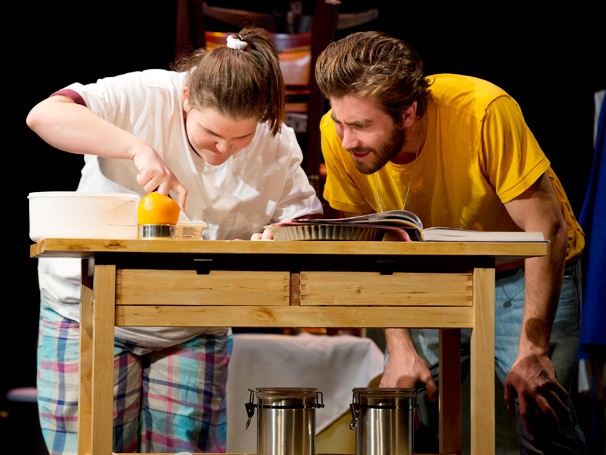
ONCE: A NEW MUSICAL

Steve Kazee and Cristin Milioti make beautiful music together in Broadway adapation of ONCE (photo © 2011 by Joan Marcus)

Bernard B. Jacobs Theatre
242 West 45th St. between Broadway & Eighth Ave.
Tickets: $59.50 – $186.50
oncemusical.com

In 2006, writer-director John Carney had a surprise hit with his intimate low-budget drama Once, the touching story of an Irish vacuum repairman (musician Glen Hansard of the Frames) and a Czech flower seller (singer-songwriter Markéta Irglová) who meet in Dublin and make beautiful music together. Hansard and Irglová won the Oscar for Best Original Song for the ballad “Falling Slowly,” and the duo went on to form the band the Swell Season. The film has now been turned into a Broadway musical directed by John Tiffany (Black Watch) and with a book by playwright Enda Walsh (The Walworth Farce), but in expanding the eighty-five-minute movie into a two-and-a-half-hour show, they have stretched the story way too thin. Once actually begins twenty minutes before curtain time, when ticket holders are invited to buy a drink onstage as the house band plays traditional tunes amid Bob Crowley’s set, the interior of a pub shaped like a half-moon with more than seventy mirrors hanging on the walls, centered by a large rectangular one right in the middle. Steve Kazee (Spamalot) and Cristin Milioti (The Lieutenant of Inishmore) play the Guy and the Girl, two lonely souls, he a shy guitarist who works in his father’s shop, she a very direct pianist surrounded by family and friends but missing something in her life. Girl instantly becomes Guy’s muse, encouraging him to not give up on his music, which she thinks can make him a success in New York. As they spend more and more time together, their unrequited love begins to overwhelm them.

The Guy and the Girl dream about a better future in ONCE (photo © 2011 by Joan Marcus)

Kazee and Milioti are terrific in the lead roles, forming a believable team that audiences will pull for not only as a musical pair but hopefully as a romantic one as well. The staging is also excellent, with everything taking place on the same set with small furniture changes signaling such other locations as a piano shop, a recording studio, and Guy’s and Girl’s apartments. Whenever the Girl speaks in Czech, she actually says the words in English, with the Czech translation projected onto the top of the bar, which leads to a memorable moment when she discusses love with the Guy. The members of the house band double as the show’s minor characters, sitting on chairs on either side of the stage until their participation is required. But while some of these characters offer fine support, particularly David Patrick Kelly as the Guy’s father and Elizabeth A. Davis as the Girl’s sexy friend Réza, others drain the show of its subtle intimacy, , with silly, repetitive, over-the-top comic relief from Paul Whitty as the owner of the piano store and Andy Taylor as a bank manager. In addition, much of the second act feels added on and repetitive, including reprises of songs. The score features such familiar tunes from the film as “Falling Slowly,” “If You Want Me,” “Broken Hearted Hoover Fixer Sucker Guy,” “Gold,” and “The Hill” as well as several new ones; the production admirably doesn’t Broadway-fy the music or lapse into over-choreographed dance numbers, keeping things relatively simply for the most part. There’s a lot to like about Once, and fans of the film are likely to be charmed. But there’s also a lot that could have been trimmed, paying heed to the more personal warmth and honesty of the original.