this week in theater

REVENGE AND GUILT

(photo by Bryan Robert Smith)

Cal (Peter Buck Dettmann) and Gina (Emily Russell) have it in for Marvin “Major” Cohen (Tom Vaught) in REVENGE AND GUILT (photo by Bryan Smith)

Kraine Theater
85 East Fourth St. between Bowery & Second Ave.
Thursday – Saturday through October 19, $!8, 8:00
www.facebook.com/RevengeandGuilt

Three lonely losers, each one haunted by a single episode from their past that has defined their miserable lives, come together in Marc Spitz’s latest play, Revenge and Guilt. As the show opens, the nervous, jittery Cal (Peter Buck Dettmann) arrives in the ratty Long Island home of onetime local guitar hero Marvin “Major” Cohen (Tom Vaught). Just as Major seems to recognize Cal, Gina (Emily Russell) enters and cracks Major in the head with a liquor bottle, knocking him out. The story then shifts back in time to a dive bar where Cal and Gina, both broke, argue over whether they just had sex as well as debating the value of Cal’s prized watch. While Cal is tentative and unsure of himself, Gina is strong-willed and angry, ready to do whatever it takes to get out of her terrible situation. As they seemingly grow more comfortable with each other, they share the secrets that have been tearing them apart inside, and Gina comes up with a plan to rid Cal of his inner demon, involving going back to the scene of the “crime,” Major’s house, to finally right a wrong. Longtime music journalist Spitz, who has written such books as We Got the Neutron Bomb: The Untold Story of L.A. Punk, Poseur: A Memoir of Downtown New York City in the ’90s, and How Soon Is Never? and such plays as The Rise and Fall of the Farewell Drugs, The Hobo Got Too High, and Your Face Is a Mess, makes his directorial debut with Revenge and Guilt, a well-written and solidly paced black comedy filled with musical references (the Clash, Gene Loves Jezebel, Thin Lizzy, Nirvana, Morrissey, Steely Dan). The title comes from a quote by Elvis Costello, who early in his career said, “The only two things that motivate me and that matter to me are revenge and guilt.” Both of those things figure prominently in the 105-minute play (with intermission), as all three characters blame a past event for their current failure. Vaught outshines his competent costars, giving a thoroughly convincing and entertaining performance as Major, a fading relic of a time gone by. Revenge and Guilt, which contains more than a few elements of Lyle Kessler’s Orphans, is a thought-provoking work that just might make you look back into your own past and finally try to get over that one thing that has been stuck in your gut for years, because you definitely don’t want to wind up like Cal, Gina, or Major. (To read our twi-ny talk with Spitz from earlier this year, go here.)

BAM NEXT WAVE FESTIVAL: ANNA NICOLE

(photo by Stephanie Berger)

Sarah Joy Miller is front and center in glamorous production of ANNA NICOLE at BAM (photo by Stephanie Berger)

BAM Howard Gilman Opera House
30 Lafayette Ave. between Ashland Pl. & St. Felix St.
Through September 28, $25-$235
718-636-4100
www.bam.org
www.roh.org.uk

If Anna Nicole ends up being New York City Opera’s final presentation, then the organization (founded in 1943 and dubbed the People’s Opera by Mayor Fiorello La Guardia) is certainly going out with quite a, well, bang. Commissioned by London’s Royal Opera House and originally performed at Covent Garden, Anna Nicole is a playfully entertaining pop operetta based on the life of celebrity diva Anna Nicole Smith, following her life from her early years as Vickie Lynn Hogan in Mexia, Texas, through her apprenticeship as a stripper in Houston and then her success as a model in print ads and as Playboy Playmate of the Year. Composer Mark-Anthony Turnage, librettist Richard Thomas, and director Richard Jones tell the tale chronologically as Anna Nicole (Sarah Joy Miller) argues with her mother (Susan Bickley), marries and divorces her first husband, Billy Boy (Ben Davis), visits Doctor Yes (Richard Troxell) to get a huge pair of golden Winnebagos, meets and marries billionaire octogenarian J. Howard Marshall II (Robert Brubaker), and becomes a tabloid regular and reality TV superstar. It’s all bright lights and flashy colors on Miriam Buether’s wonderfully cheesy sets and Nicky Gillibrand’s riotous costumes while the cast, which includes sixty-six members of the New York City Opera, belt out self-referential, tongue-in-cheek lyrics that contain the kind of language not usually heard at opera houses around the world, highlighted by F-bombs galore and a host of naughty nicknames for breasts. The story skips around in often confusing ways, too much time is spent on some relatively insignificant sections just for shock effect (for example, the stripper scene), and Thomas, who cowrote Jerry Springer: The Opera, never really gets inside Anna Nicole’s head, which keeps the audience at a distance. In addition, Miller doesn’t quite embody Anna Nicole, and it is occasionally hard to interpret what she’s singing, forcing the audience to read the surtitles, which is not necessary for all the vocalists. The standout performers are Bickley and tenor Brubaker, who is a hoot, especially in his glam outfit. This coproduction with BAM continues at the Howard Gilman Opera House through September 28; it would indeed be a shame if this were New York City Opera’s swan song, as they are willing to take on challenges that other companies wouldn’t touch with a ten-foot (stripper?) pole. (You can contribute to keep their 2013-14 season alive here.)

THE OLD FRIENDS

(photo by Joan Marcus)

Sybil (Hallie Foote), Gertrude (Betty Buckley), and Howard (Cotter Smith) desperately try to find happiness in Horton Foote’s THE OLD FRIENDS (photo by Joan Marcus)

The Pershing Square Signature Center
The Irene Diamond Stage
480 West 42nd St. between Tenth & Eleventh Aves.
Through October 13, $75
212-244-7529
www.signaturetheatre.org

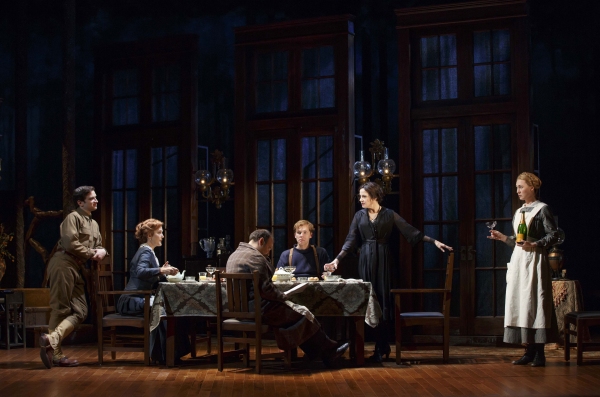
The world premiere of The Old Friends at the Signature Theatre gathers together some old friends indeed. The play was written by Horton Foote, stars his daughter Hallie Foote, and is directed by longtime Foote collaborator Michael Wilson (The Trip to Bountiful, Talley’s Folly). In addition, the play, which began life as The Dispossessed in the mid-1960s, had a staged reading at the Signature in 2002. After that long gestation, it finally is having its first full-scale production, which has been extended at the Signature’s Irene Diamond Stage through October 13. Set in 1965 in Harrison, Texas, The Old Friends is a stark tale of greed, disloyalty, selfishness, envy, drunkenness, and infidelity that is part Tennessee Williams, part Dallas. Lois Smith stars as family matriarch Mamie Borden, who lives with her bon vivant daughter, Julia Price (Veanne Cox), and her oversized, very wealthy husband, Albert (Adam LeFevre). They are joined by the brash, blustery, and extremely rich Gertrude Hayhurst Sylvester Ratliff (Betty Buckley) and her companion, the gentle Howard Ratliff (Cotter Smith), as they await the arrival of prodigal daughter Sybil (Hallie Foote), who has spent the last decade with her husband, Hugo, in Venezuela. Sybil shows up alone, setting into motion jealousy, flirtations, lies, deception, gunshots, and lots and lots of drinking while they all battle over the family farm and other matters, mostly involving love and money.

Gertrude (Betty Buckley), Albert (Adam LeFevre), and Julia Price (Veanne Cox) don’t exactly see eye-to-eye in dysfunctional family drama (photo by Joan Marcus)

Gertrude (Betty Buckley), Albert (Adam LeFevre), and Julia Price (Veanne Cox) don’t exactly see eye-to-eye in dysfunctional family drama (photo by Joan Marcus)

Buckley beautifully chews up the scenery as Gertrude, a deeply unhappy, lonely woman who uses her power and money to get what she wants, which includes Howard, her former brother-in-law, and young stud Tom Underwood (Sean Lyons), whom she fights over with her former sister-in-law, the pseudo-elegant Julia. Smith (The Trip to Bountiful onstage, East of Eden on film) has a weak first act as Mamie, but she gets much stronger in the far superior second act, as long-held secrets emerge and relationships get even more explosive. At the center of it all is Foote’s solid portrayal of the complex Sybil, a quiet woman who is disappointed in how her life has turned out and tries her best to avoid getting caught up in the others’ nonsense, but she has a plan of her own as well. Wilson, who helmed Horton Foote’s epic Orphans’ Home Cycle with Hallie Foote at Signature in 2009, never lets things slow down as the characters make their way through a trio of lovely sets by Jeff Cowie, leading to a powerful ending that changes everyone’s lives. In this poignant Signature production, The Old Friends feels like, well, an old friend.

WOMEN OR NOTHING

(photo by Joan Marcus)

Gretchen (Halley Feiffer) and Laura (Susan Pourfar) come up with a crazy way to have a child in Ethan Coen’s WOMEN OR NOTHING (photo by Joan Marcus)

Atlantic Theater Company
Linda Gross Theater
336 West 20th St. between Eighth & Ninth Aves.
Extended through October 13, $20-$65
866-811-4111
www.atlantictheater.org

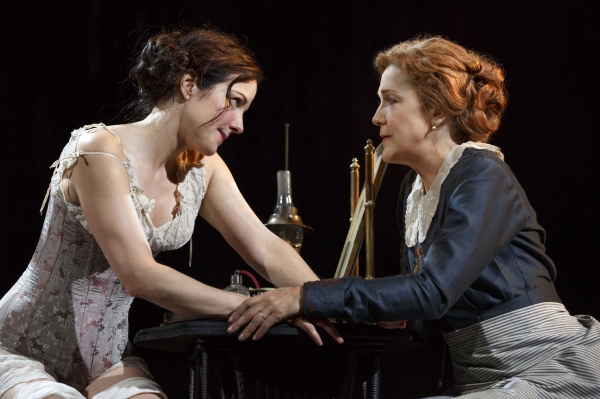
Despite a sitcom-y plot and a trio of severely affected female characters who take a while to warm up to, Ethan Coen’s first full-length play, Women or Nothing, manages to be mildly entertaining and pleasantly amusing. Lawyer Gretchen (Halley Feiffer) and concert pianist Laura (Susan Pourfar) want to have a baby, but they don’t want to adopt or go to a clinic and use an anonymous sperm donor; instead, Gretchen has researched a coworker, Chuck (Robert Beitzel), and decided that Laura, a gold-star lesbian who has never been with a man, should sleep with him in order to get inseminated by someone with desirable genes. “Believe me, this man’s semen is superb,” Gretchen tells her girlfriend. “You’re a wine taster now?” Laura responds. Gretchen comes up with a wacky, somewhat devious, and fairly ridiculous plan that she is positive will land the unknowing Chuck in bed with Laura; unfortunately for the audience, things don’t seem so crystal clear, one of many leaps of faith that Coen and director David Cromer (who directed Pourfar in Tribes, Beitzel in Our Town, and Feiffer in The House of Blue Leaves) ask the audience to accept in this uneven but ultimately likable production. The scene between the easygoing Chuck and the pent-up, elitist, and self-deprecating Laura is a gem, with razor-sharp dialogue and outstanding performances as she tries to get him drunk and not give away the reason behind their carefully arranged meeting. The following morning, Laura’s nosy mother, Dorene (Deborah Rush in a star turn), arrives, and the situation gets even more complicated, as each woman learns surprising things about the other.

Chuck (Robert Beitzel) has no idea what Laura (Susan Pourfar) has in store for him in WOMEN OR NOTHING (photo by Joan Marcus)

Chuck (Robert Beitzel) has no idea what Laura (Susan Pourfar) has in store for him in WOMEN OR NOTHING (photo by Joan Marcus)

But unanswered questions abound, preventing Women or Nothing from reaching the next level. There are no mentions of condoms or ovulation, and there are numerous red herrings, from a poorly hidden group of family photos to a fancy piano on an upper platform that is never brought into play in any manner whatsoever, toying with the audience’s expectations. Coen, who with his brother, Joel, has made such award-winning films as Barton Fink, Fargo, and No Country for Old Men, has also published a book of short stories and a collection of poetry and has written several one-act plays, including Talking Cure, which was one of three works, along with Elaine May and Woody Allen, that made up the 2011 Broadway flop Relatively Speaking. Thus, on his own, Ethan Coen specializes in the short form, and he has trouble sustaining Women or Nothing for its one-hundred-minute running time, with a brief intermission (even though the program says there will not be one). He and Cromer just can’t quite get past the R-rated Three’s Company set-up, though they try their best, resulting in an amiable, if not wholly satisfying, rendezvous, which has been extended through October 13 at the Atlantic Theater Company’s Linda Gross Theater.

stop. reset.

A Chicago publisher fights for survival in Regina Taylor's STOP. RESET. (photo by Joan Marcus)

A Chicago publisher fights for survival in Regina Taylor’s STOP. RESET. (photo by Joan Marcus)

The Pershing Square Signature Center
The Romulus Linney Courtyard Theatre
480 West 42nd St. between Tenth & Eleventh Aves.
Tuesday – Sunday through September 29, $75
212-244-7529
www.signaturetheatre.org

Playwright and actress Regina Taylor (I’ll Fly Away, Crowns) examines social and technological change through a literary lens in the Afrofuturistic stop. reset. The contemporary drama takes place inside Alexander Ames Chicago Black Book Publishers, where times are tough, especially with the growing popularity of ebooks. Company founder Ames (Carl Lumbly) is an old-fashioned publisher who still treasures the look, touch, and smell of a physical book, but the firm’s financial situation has forced him to cut one staff member from his few remaining employees. He meets with each one alone, letting them tell their personal and professional stories while he also shares his, which is dominated by the loss of his son a few years earlier. One by one, Deb (Michi Barall), Chris (Teagle F. Bougere), Jan (Latanya Richardson Jackson), and Tim (Donald Sage Mackay) make their case why they should stay and someone else should go. Meanwhile, J (Ismael Cruz Córdova), the young hip-hop janitor, just does his own thing, oblivious to what is going on around him — or perhaps not quite. Taylor, who wrote stop. reset. as part of the Residency Five program at the Signature Theatre, never quite gets past the clichéd aspects of her characters and plot points, letting Neil Patel’s inventive set, which includes a clever elevator, glassed-in offices, a large window through which a fierce snowstorm can be seen, and, projections (by Shawn Sagady) of quotations from Ralph Ellison and the Rev. Dr. Martin Luther King, Jr., overwhelm the play. The production does have its moments, but various transitions, as well as the ending, are too confusing, leaving too much unresolved.

THE COMPASS ROSE

Donall (David Mitchell) and Tiffany (Olivia Horton) wonder what could have been in THE COMPASS ROSE (photo by Steven Schreiber)

Donall (David Mitchell) and Tiffany (Olivia Horton) wonder what could have been in THE COMPASS ROSE (photo by Steven Schreiber)

Ryan’s Daughter
350 East 85th St. between First & Second Aves.
Thursday – Sunday through September 29, $18
212-868-4444
www.fatviolettheater.com
www.1stirish.org

Two lonely souls look back at what might have been in Ronan Noone’s sensitively drawn two-character drama The Compass Rose. The site-specific seventy-minute play takes place in the upstairs pub at Ryan’s Daughter on the Upper East Side, doubling for the Compass Rose on Martha’s Vineyard, as the audience sits at small tables, on stools, or on chairs at the bar. (Drinks are available before and after the show but not during it.) The story begins as Tiffany (Olivia Horton) walks into the Compass Rose, surprising the bartender, Donal (David Mitchell). “What are you doing here?” he says with a combination of anger and trepidation. The play shifts between the present and ten years in the past, when a free-spirited Tiffany invites Donal to accompany her on a cross-country trip to San Francisco, merely for company because her father does not want her to drive so far by herself. Each has a significant other, and they are not interested in starting a relationship, something Tiffany makes clear immediately, and repeatedly. But as they journey through Maine, New York City, Washington, DC, Tennessee, Texas, Las Vegas, and other locations, they share intimate secrets, tell lies, and get to know each other better than they ever thought possible.

the compass rose 2

The time shifts occur instantaneously, signaled by the blink of an eye, a shift of a body, or the movement of sunglasses. It’s a bit jarring at first but ends up working smoothly as the play, directed by David Sullivan, goes on and the changes in time and place more clearly relate to elements of the story. Mitchell (Fair City) and Horton (Tiny Dynamite) have an alluring chemistry that builds to a sizzle, his character dark, moody, cynical, and brooding, hers flirtatious, idealistic, and sometimes brutally cold. They walk all around the bar, stopping right next to members of the audience, but they are careful never to make eye contact with anyone, maintaining the invisible wall between performer and viewer. The natural setting is enhanced by noises going on outside; the night we attended, there was a whole lot of horn blowing from cars on the street, but it had no effect on the actors and added an extra dose of reality to the proceedings. A tender-hearted, insightful, and involving play about, as Donal says, “creating your own myth,” The Compass Rose continues at Ryan’s Daughter through September 29 as part of Origin’s annual 1st Irish Theatre Festival, which also includes The Life & Sort of Death of Eric Argyle and I Can See Clearly Now at 59E59 and McGoldrick’s Thread, The Morons, and A Lady Is Waiting at the Cell in addition to other special music, poetry, and theatrical events.

THE MACHINE

THE MACHINE depicts the epic battle between grandmaster Garry Kasparov and IBM computer Deep Blue (photo by Stephanie Berger)

THE MACHINE depicts the epic battle between grandmaster Garry Kasparov and IBM computer Deep Blue (photo by Stephanie Berger)

Park Avenue Armory, Wade Thompson Drill Hall
643 Park Ave. at 67th St.
Through September 18, $45-$90
212-933-5812
www.armoryonpark.org
www.donmarwarehouse.com

In The Machine, playwright Matt Charman and director Josie Rourke turn the 1997 chess match between grandmaster Garry Kasparov and IBM’s Deep Blue computer into a lively, riveting, edge-of-your-seat multimedia sports event. With the audience sitting on raised bleachers on all four sides of the stage in the Park Avenue Armory’s massive Wade Thompson Drill Hall, Kasparov (Hadley Fraser) battles Deep Blue, operated by its cocreator Dr. Feng-Hsiung Hsu (Kenneth Lee). As the hard-fought six-game match continues, flashbacks reveal critical moments in the main competitors’ lives. Kasparov, who lost his father at a young age, is still a child when he takes on grandmaster Anatoly Karpov (Cornelius Booth), his mother (Francesca Annis) determined to have him be accepted to Karpov’s famous school. Hsu, at Carnegie Mellon, teams up with fellow student Murray Campbell (Trevor White) to attempt to improve a chess computer built by their professor, Dr. Hans Berliner (John Ramm), while struggling to commit to his cheerleader girlfriend, Tamsin (Antonia Bernath). During the match itself, cameras move around Lucy Osborne’s inventive set, projecting images onto an overhead Jumbotron while a pair of announcers detail the action. Two of the most thrilling moments occur when at first chessboards, then computers are pushed around the square stage along lighted tracks, beautifully choreographed scenes (by Jonathan Watkins) that continue the theme of man vs. machine, equating the two fields. Fraser plays Kasparov with a nervous energy that highlights his growing fear and worry as the games go on, while Lee’s Hsu is jumpy and awkward as he gives up any chance of a personal life in order to invent the best. During the course of the show, Kasparov is alternately referred to as both “too human” and a “monster,” while he accuses the IBM team of cheating because Deep Blue made what he believes to clearly be human moves in the second game, as this engaging Donmar Warehouse production once again focusing on the similarities between the machine that is man and the machine that is built by man. Be sure to arrive early, as there are many chess sets at the armory where visitors are encouraged to sit down and play.