this week in theater

QUEER NEW YORK INTERNATIONAL ARTS FESTIVAL

Sineglossa’s REMEMBER ME is part of second Queer New York International Arts Festival

Sineglossa’s REMEMBER ME is part of second Queer New York International Arts Festival

Abrons Arts Center and other venues
466 Grand St. at Pitt St.
October 23 – November 3, free – $18 (many shows $10 suggested donation)
212-598-0400
www.queerny.org
www.abronsartscenter.org

In a 2012 Huffington Post blog about the first Queer New York International Arts Festival, artistic codirector André von Ah wrote, “Queerness, in perhaps its barest and most basic concept, is about breaking the rules, shaking things up, and challenging preconceived ideas.” The second QNYIA continues to shake things up with twelve days and nights of performances, panel discussions, film screenings, workshops, and other events at such venues as Abrons Arts Center, the Invisible Dog, La MaMa, Joe’s Pub, and New York Live Arts, but sadly, it will be proceeding without von Ah, who curated this year’s programming with artistic director Zvonimir Dobrović but sadly passed away suddenly last month, still only in his mid-twenties. This year’s festival, which is dedicated to von Ah, opens October 23 with the U.S. premiere of Ivo Dimchev’s P-Project at Abrons Arts Center, the Bulgarian artist’s interactive piece that uses words that begin with the letter P to investigate societal taboos. Italy’s Sineglossa uses mirrored screens in Remember Me, based on Henry Purcell’s opera about Dido and Aeneas. Audience favorite Raimund Hoghe pays special tribute to von Ah with An Evening with Judy, in which he channels Judy Garland, Maria Callas, and others. Poland’s SUKA OFF investigates skin shedding in its multimedia Red Dragon. Brazil’s Ângelo Madureira plays “the dreamer” in his contemporary dance piece Delírio. Croatia’s Room 100 presents the U.S. premiere of its dark, experimental C8H11NO2. Dan Fishback offers a concert reading of The Material World at Joe’s Pub, the sequel to You Will Experience Silence; Fishback will also participate in the October 26 panel discussion “Creating Queer / Curating Queer” at the New School with Carla Peterson, Tere O’Connor, TL Cowan, Susana Cook, and Dobrović. The Club at La MaMa will host the New Music Series, featuring M Lamar, Shane Shane, Enid Ellen, Nath Ann Carrera, and Max Steele. The festival also includes works by Bojana Radulović, Elisa Jocson, Guillermo Riveros, Daniel Duford, Bruno Isaković, Gabriela Mureb, Heather Litteer, CHOKRA, Antonia Baehr, and Antoni Karwowski, with most shows requiring advance RSVPs and requesting a $10 suggested donation.

A NIGHT WITH JANIS JOPLIN

Mary Bridget Davies channels Janis Joplin in disappointing Broadway musical (photo by Joan Marcus)

Mary Bridget Davies channels Janis Joplin in disappointing Broadway musical (photo by Joan Marcus)

Lyceum Theatre
149 West 45th St. between Sixth & Seventh Aves.
Tuesday – Sunday through March 30, $28- $140
anightwithjanisjoplin.com

Mary Bridget Davies was seemingly born to play Janis Joplin. When she was a teenager in Cleveland, she dressed as Joplin for Halloween. Later, she toured as a singer with Joplin’s band, Big Brother and the Holding Company. And now she has the lead role in the Broadway musical A Night with Janis Joplin. Davies looks like Joplin, she moves like Joplin, and, most impressive, she sounds like Joplin. Unfortunately, writer-director Randy Johnson barely glosses over the personal aspects of Joplin’s life, never really delving into necessary details, instead concentrating ad nauseam on her love of the blues and her musical influences. The show is arranged as a one-night concert in which Joplin, backed by a trio of singers and a live band, blasts out classic songs, with in-between patter that quickly grows repetitive. As she talks about her heroes, they take the stage and perform, including Bessie Smith (Taprena Michelle Augustine), Nina Simone (De’Adre Aziza), Aretha Franklin (Allison Blackwell), Etta James (Nikki Kimbrough), and Odetta (Aziza again), but these numbers seem to be an excuse for Davies to rest her voice, as they add nothing to the Joplin legend. In fact, A Night with Janis Joplin occurs in a vacuum, set in no particular time period. There is no mention of the civil rights movement, sex, drugs, alcohol (Davies does take a single swig from a bottle, sans commentary), Monterey Pop, Woodstock, Jimi Hendrix, or Jim Morrison, although F. Scott and Zelda Fitzgerald show up twice, even once projected onto a screen in the back. The setlist is, of course, sensational, although too many songs are heard in incomplete versions: “Summertime,” “Down on Me,” “Piece of My Heart,” “Try (Just a Little Bit Harder),” “Cry Baby,” “Ball and Chain,” etc., in addition to the unfortunately prophetic “I’m Gonna Rock My Way to Heaven,” which Joplin was working on when she died and has never been previously performed or recorded. Set and lighting designer Justin Townsend fills the stage with dozens of lamps of all shapes and sizes, along with a row of vertical fluorescent lights in the back and yet more long, narrow fluorescent bulbs arranged askew around the front, but it’s not exactly clear why. But it does fit in with the general feel of the production, which ends up being a whole lot more style than substance. Johnson has claimed that this is not a tribute show, but it would fit in better at a venue such as B.B. King’s Blues Club, which hosts regular tributes to the Beatles, James Brown, Motown, Simon & Garfunkel, the Doors, Santana, Bruce Springsteen, and others, than at a Broadway theater, where a lot more depth is expected.

THE GLASS MENAGERIE

GLASS MENAGERIE

Cherry Jones and Zachary Quinto play mother and son in glorious revival of Tennessee Williams’s THE GLASS MENAGERIE (photo by Michael J. Lutch)

Booth Theatre
222 West 45th St. between Broadway & Eighth Ave.
Tuesday – Sunday through February 23, $42 – $147
theglassmenageriebroadway.com

In the past eighteen months, two of America’s greatest playwrights have experienced glorious Broadway revivals — Mike Nichols’s version of Arthur Miller’s Death of a Salesman, starring Philip Seymour Hoffman, and Pam MacKinnon’s Steppenwolf production of Edward Albee’s Who’s Afraid of Virginia Woolf?, with Tracy Letts and Amy Morton battling it out for three hours — but Tennessee Williams has not fared nearly so well. Until now. On the heels of disappointing adaptations of A Streetcar Named Desire and Cat on a Hot Tin Roof, John Tiffany’s The Glass Menagerie, which originated at Harvard’s American Repertory Theater earlier this year, is a spectacular celebration of one of Williams’s best plays, a haunting examination of a fragile family and the concept of memory. In depression-era St. Louis, Tom Wingfield (Zachary Quinto, of American Horror Story and the Star Trek reboot) and his sister, Laura (two-time Tony nominee Celia Keenan-Bolger), live in a small apartment with their caring yet domineering mother, Amanda (two-time Tony winner Cherry Jones). Tom works in a local warehouse but dreams of becoming a writer and traveling the world. Laura has a lame foot that has turned her into a shy, mousey girl who collects glass animal figurines and treats them like friends. Amanda, who has never quite gotten over the departure of her husband, is desperate for Laura to entertain “gentleman callers” and get married. So when Tom brings home a coworker, Jim (Stargate Universe’s Brian J. Smith), Amanda jumps all over the sudden opportunity to make sure things are just right for this potential suitor.

GLASS MENAGERIE

Amanda Wingfield (Cherry Jones) will do anything she can to find her daughter (Celia Keenan-Bolger) a suitor (photo by Michael J. Lutch)

The story unfolds on Bob Crowley’s relatively spare set, which includes a refrigerator and a small kitchen table on the left, a couch in the middle, and a Victrola and a fire escape on the right, the latter seemingly rising to the heavens. Front and center is a small table on which Laura keeps a single figurine that stands in for her larger collection, which is occasionally represented by glittering specs on a reflecting pool of water that surrounds the stage. Every so often the neon shape of a shark’s fin rises ominously above the surface, psychologically threatening the proceedings. Natasha Katz’s lighting demarcates the past (memory) from the present (reality), and Nico Muhly’s music adds texture between scenes. While Quinto, in his Broadway debut, and Smith are both exceptional, Jones and Keenan-Bolger virtually redefine these long-familiar characters, Jones delivering a performance for the ages as Amanda, words rolling off her tongue as if they were written just for her, Keenan-Bolger embodying Laura’s fears in subtle ways that offer a kind of catharsis for the audience. It’s heartbreaking when she kneels down in front of her figurine and its glow spreads across her face as if illuminating her soul. In his opening monologue, Tom explains that the “play is memory,” and that relates to both the story and Williams himself, as Laura is based on Williams’s sister, Rose (at one point, Laura remembers a high school boy calling her “Blue Roses” after mishearing her say that she has “pleurosis”), and Williams’s given name is Thomas. Tiffany’s version of this deeply personal play is indeed unforgettable, a sparkling example of the power of live theater and a mesmerizing examination of the conflicting emotions that complicate memory.

BAD JEWS

Cousins fight over a family heirloom in Joshua Harmon’s powerful BAD JEWS (photo by Joan Marcus)

Cousins fight over a family heirloom and more in Joshua Harmon’s powerful BAD JEWS, which has moved upstairs to the Roundabout’s Laura Pels Theatre (photo by Joan Marcus)

Laura Pels Theatre
Harold and Miriam Steinberg Center for Theatre
111 West 46th St. between Sixth & Seventh Aves.
Tuesday – Sunday through December 22, $89
212-719-1300
www.roundabouttheatre.org

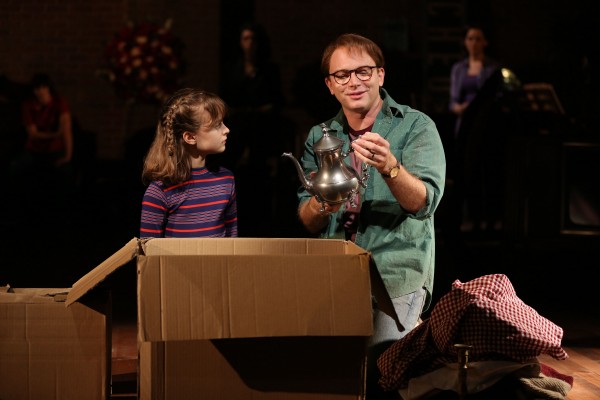
Joshua Harmon’s Bad Jews has made a relatively smooth transition from the Roundabout’s small Black Box Theatre, where it played to sold-out crowds last year, to the significantly larger upstairs Laura Pels, going from 62 to 424 seats nightly. The dark comedy has lost a bit of its intimacy — in the Black Box, the audience felt like it was practically part of the family, waiting for breakout star Tracee Chimo to pounce on them the way she pounced on just about everything and everyone else in sight — but Harmon’s sharp, incisive dialogue is given more room to breathe in the new environs. In an apartment on Riverside Dr. and Eighty-Fourth St., Daphna Feygenbaum (Chimo) and her cousin Jonah Haber (Philip Ettinger) are awaiting the arrival of Jonah’s older brother, Liam (Michael Zegen), who was skiing in Colorado and missed their beloved grandfather Poppy’s funeral. When Liam shows up, along with his shiksa girlfriend, Melody (Molly Ranson), he and Daphna immediately start going at it, verbally sparring over every little detail, from who was closer to Poppy to who is more Jewish to who deserves to have Poppy’s prized chai, which is loaded with historical and sentimental value. With Jonah trying to stay out of the fray, Daphna has plenty of vitriol for Melody as well. A flurry of things are said (and shouted and screamed) that can never be taken back, leading to a powerful, emotional climax.

Returning director Daniel Aukin (4000 Miles, The Bad and the Better) once again centers the action on Daphna, as Chimo, despite appearing to be fighting a cold the night we attended, stomps all over the stage, her physicality matching her spoken massacre in an awe-inspiring, unforgettable performance. Zegen has upped the ante as Liam, more than holding his own against his brutally honest and often thoughtless cousin. Ranson, the only actual Jewish member of the cast, handles her role with great care, while Ettinger is again excellent as the tentative, ever-jittery younger brother. Ultimately, Bad Jews is about a lot more than how Jewish one is or who should get Poppy’s chai; it’s also about family, responsibility, class, dignity, culture, faith, and respect while focusing on a pair of selfish, self-righteous characters who might not be as far apart as they imagine.

ALL FOR ONE THEATER FESTIVAL

Kelly Carlin

Kelly Carlin talks about growing up with her famous comedian father in solo show

Cherry Lane Studio Theater
38 Commerce St.
October 11 – November 9, $15-$25 (festival pass $150)
www.afofest.org

“You are not alone!” declares All for One Theater Festival executive director Michael Wolk on the AFO website. “Yes, solo performance can be lonely, for creators and for theatergoers who fear stepping into a self-therapizing soliloquy. But the All for One Theater Festival is here to take away the sting and stigma of solo performance by building community and nurturing work that inspires, informs, moves, and matters.” The third annual AFO features ten shows taking place October 11 – November 9 at the Cherry Lane Studio Theater, including Aaron Mark’s Another Medea, starring Tony nominee Tom Hewitt (The Rocky Horror Show, Jesus Christ Superstar); Kelly Carlin’s A Carlin Home Companion: Growing Up with George, in which George Carlin’s daughter discusses life with the famed comic, directed by Paul Provenza; Sylvia Milo’s The Other Mozart, about Wolfgang’s sister, Nanneri, featuring a dazzling costume; René Marie’s Slut Energy Theory, with Marie playing an elderly woman sharing her life experiences; and David Harrell’s The Boy Who Would Be Captain Hook, which is geared toward younger audiences. There are also workshops taught by Marie, Carlin, Gretchen Cryer (I’m Getting My Act Together and Taking It on the Road), and others, along with such workshops as “Know Thyself: The Autobiographical Solo Show,” “Her(untold)story,” and “Something Wicked: Writing and Performing Dangerous Characters.”

TICKET GIVEAWAY: DISASTER!

disaster

DISASTER! A 70s DISASTER MOVIE . . . MUSICAL!
St. Luke’s Theater
308 West 46th St.
October 14 – December 31 (Monday, Tuesday, Wednesday, and Friday), $39.50 – $79.50
www.disastermusical.com
www.stlukestheatre.com

Ah, those beautiful disaster flicks of the 1970s. With the country emerging from Vietnam and getting ready for Reaganism, Hollywood turned to star-studded epics loaded with death and destruction, on ground, sea, and air, with such classic fare as The Poseidon Adventure (Gene Hackman, Shelley Winters, Ernest Borgnine), Airport 1975 (Charlton Heston, Linda Blair, George Kennedy, Karen Black, Helen Reddy), The Towering Inferno (Steve McQeen, Paul Newman, William Holden, Faye Dunaway, Fred Astaire, O. J. Simpson), and Earthquake (Heston, Kennedy, Victoria Principal, Lorne Greene, Ava Gardner, Richard Roundtree, in Sensurround!), among a slew of other minor league efforts. With the country going down the tubes, the time is right to revisit those halcyon days, and Disaster! A 70s Disaster Movie…Musical! does just that, riffing on those popular movies along with period songs, including such unforgettable 1970s hits as Donna Summer’s “Hot Stuff,” Reddy’s “I Am Woman,” Gilbert O’Sullivan’s “Alone Again (Naturally),” Amii Stewart’s “Knock on Wood,” and ELO’s “Don’t Bring Me Down.” Written by Seth Rudetsky and Jack Plotnick, directed by Plotnick, and choreographed by Denis Jones, Disaster! originally ran at the Triad in early 2012 and is now back for an encore engagement at St. Luke’s Theatre, with a cool cast that features the ubiquitous Mary Testa, Tom Riis Farrell, Michele Ragusa, Jennifer Simard, and Rudetsky.

TICKET GIVEAWAY: Disaster! begins previews October 14 prior to a November 4 opening, and twi-ny has four pairs of tickets to give away for free. Just send your name, daytime phone number, and all-time-favorite disaster movie to contest@twi-ny.com by Friday, October 11, at 3:00 to be eligible. All entrants must be twenty-one years of age or older; four winners will be selected at random.

ROMEO AND JULIET

ROMEO AND JULIET

Orlando Bloom and Condola Rashad star as ill-fated young lovers in new Broadway version of ROMEO AND JULIET (photo by Carol Rosegg)

Richard Rodgers Theatre
226 West 46th St. between Seventh & Eighth Aves.
Tuesday – Sunday through December 8, $87-$142
877-250-2929
www.romeoandjulietbroadway.com

The first Broadway production of Shakespeare’s Romeo and Juliet in more than a quarter century might have fire, but it lacks sizzle. On Jesse Poleshuck’s relatively stark stage, which includes a large bell (hanging through the entire show), sand on either side, and a three-piece fresco that serves as a climbing wall, an artistic backdrop, and a doorway, the slick Romeo Montague (Orlando Bloom, in his Broadway debut) arrives on a motorcycle, making it clear from the start that this will not necessarily be a traditional version of the play. It’s love at first sight when he comes upon Juliet Capulet (Condola Rashad) at a party, but their families are sort of like the Hatfields and the McCoys, with a long history of not exactly getting along with each other. A fight ensues between the white Montagues and the black Capulets involving switchblades and chains, more West Side Story than Shakespeare, leaving several dead and Romeo in a heap of trouble. Meanwhile, Juliet flies high on a swing and later declares her love for Romeo on a balcony that juts out from the right like a deus ex machina. In addition, two horizontal poles occasionally show up, spitting out flames.

Benvolio (Conrad Kemp) offers advice to Romeo (Orlando Bloom) (photo by Carol Rosegg)

Benvolio (Conrad Kemp) offers advice to Romeo (Orlando Bloom) as rope for bell hangs down ominously (photo by Carol Rosegg)

Directed by David Leveaux, who specializes in Broadway revivals (Nine, The Real Thing, Fiddler on the Roof), this version of Romeo and Juliet ends up falling flat, with only flashes of excitement, even if it does include one of the longest kisses in Broadway history. Rashad, who was nominated for Tonys for her first two performances on the Great White Way, in Stick Fly and The Trip to Bountiful, is too innocent and wide-eyed as Juliet, and the chemistry between her and Bloom, who is fine if not exceptional, never quite ignites. The always reliable Jayne Houdyshell is a powerhouse as Juliet’s nurse, Brent Carver makes for a caring Friar Laurence, and Christian Camargo has a blast as the wisecracking Mercutio, dry-humping everything in sight. The cast also includes Corey Hawkins as Tybalt, Conrad Kemp as Benvolio, Chuck Cooper as Lord Capulet, Roslyn Ruff as Lady Capulet, Michael Rudko as Lord Montague, and Tracy Sallows as Lady Montague. Leveaux wisely avoids turning this into a story about race, even casting Justin Guarini, the son of an African American father and an Italian American mother, as Paris, Romeo’s rival for Juliet’s hand in marriage. (The previous Broadway production of Romeo and Juliet in 1986 had a multicultural cast led by Rene Moreno and Regina Taylor as the star-crossed lovers.) But the inconsistent and often confusing staging, along with little or no spark from the leads, leaves this Romeo and Juliet sadly lacking.