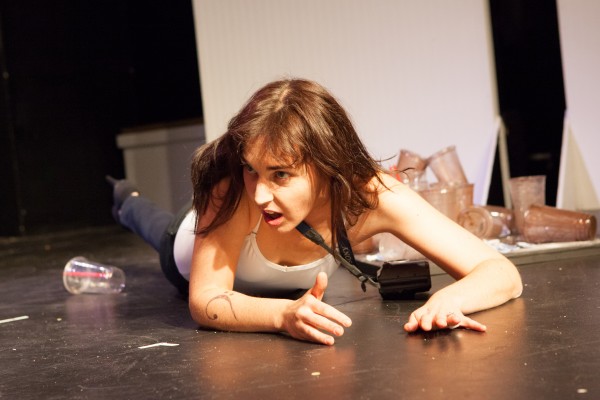
Nora Woolley channels multiple characters in Williamsburg-set one-act HIP (photo by Sarah Rogers)
HIP / DARKLING
IRT Theater
154 Christopher St. near Washington St.
Through January 12, $12-$15
www.irttheater.org
A pair of one-woman multicharacter shows that explore self-identity and searching for one’s place in the world, Nora Woolley’s thirty-minute Hip and Kim Katzberg’s hour-long Darkling were developed to run in tandem with each other, and they are doing so beautifully at the tiny IRT Theater on Christopher St., where they continue through January 12. In Hip, Woolley first appears as Wythe, an angry, leather-jacketed, mustached Williamsburg musician who claims that Julian Casablancas and the Strokes stole songs from him. She also plays Wythe’s temporarily bed-ridden grandmother, a trendy lifestyle photographer whose child Wythe baby-sits, and an Eastern European landlord attempting to rent an apartment to the cash-poor musician. Woolley’s knowing, spot-on portrayals of hipsters in their unique little worlds are searingly recognizable as well as extremely funny. As she changes costume for each character, videos by the Strokes and Wythe’s band are projected onto a back screen; the short films were made by Mariclare Lawson.
In Darkling, Katzberg appears as Trinity, a thirteen-year-old girl with terrible buck teeth who is just beginning to experiment with boys, especially an older hottie named Kevin. It’s 1987, and Trinity is deep into the awkward phase of adolescence, although she doesn’t realize it. A bold girl with seemingly no boundaries, she worships her older sister, Morgan (Katzberg), who has been sent off to a home for troubled girls but has escaped with her friend Chiara (Maia Cruz Palileo); their exploits are shown in a series of video postcards Morgan sends to Trinity. Katzberg also plays their mother in a very clever scene as well as a Goth marketing witch on-screen. Darkling is breathtaking in its ability to both attract and repel the audience’s identification with this most unusual yet quintessentially archetypal adolescent; Katzberg dives right into that nameless raw emotion that exists between laughing at and crying over something, at times evoking Todd Solondz’s cult classic, Welcome to the Dollhouse, in addition to the multimedia oeuvre of artist and filmmaker Ryan Trecartin.
Under Raquel Cion’s confident, smartly paced direction, Hip and Darkling work extremely well together. Cion — who is also an actor and cabaret performer performing as herself and sometimes as her alter ego, Cou-Cou Bijoux — knows how to get the best out of Woolley and Katzberg, who show off their mad skillz as they go from character to character and scene to scene, holding nothing back. The three women recently discussed collaboration, the Strokes, virginity, and more with twi-ny.
twi-ny: The three of you met back in 1998. Did you immediately hit it off?
Raquel Cion: Oh, we’re going back to the twentieth century, now are we? Okay, so, in ’98 my dear friend Raïna von Waldenburg’s play Das Kaspar Theatre was produced at the Experimental Theater Wing (ETW) at NYU. I was the associate director. Raïna was my classmate at ETW and then became both Kim and Nora’s acting teacher there. I can say from the moment Nora and Kim auditioned that they made a huge impression on me. The show dealt with very intense subjects: family dysfunction, sexual abuse, how one survives and heals. They were both so incredibly facile with their acting and willingness to jump into anything thrown at them. We later did a reading of a revised version of Raïna’s play for the hotINK Festival in 2006 that I directed.
Nora Woolley: Raquel and Kim have always been two of my favorite artists. I remember being blown away by Kim’s brave and charged work in acting school. Raquel directed us in a play and I could tell she was intensely gifted at getting actors to hone in on the meat. I asked Raquel to direct another show of mine (Selling Splitsville, cowritten by Christine Witmer) and she really understands me as a performer, so of course I hoped she’d direct Hip.
Kim Katzberg: I was pretty intimidated by Nora when I was in college in 1998. I had an inferiority complex back then, not to mention zero self-esteem. Plus, Nora was one of the stars in the drama department at NYU. Raquel scared me as well. She was very blunt as a director and she didn’t let you get away with any bullshit acting.
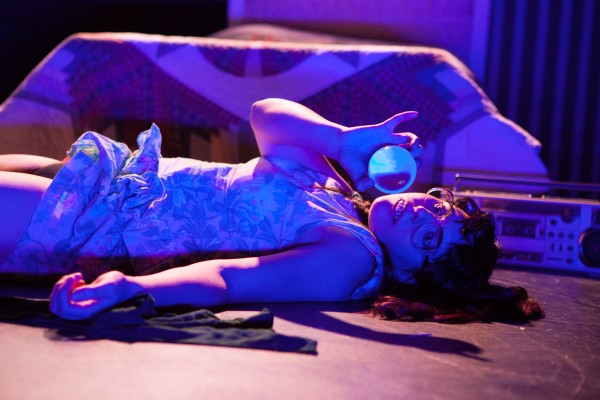
The very strange thirteen-year-old Trinity (Kim Katzberg) gazes into her future in DARKLING (photo by Sarah Rogers)
twi-ny: How did this collaboration come about?
NW: I saw Kim in Penetrating the Space and thought it was one of the most beautiful solo plays I had ever seen. Still do. She was doing and saying things I had never seen before. Referencing white tigers, taping her eyes for effect, talking about suicide with humor — it blew me away. I had never made a solo piece before, so I asked Kim if she wanted to get together and just play around in a rehearsal studio. We each brought some work we had been thinking about and then we began improvising for each other. This continued every couple of weeks for a couple of years. Our rehearsals were so important to me — they were a space to take huge risks and to challenge ourselves emotionally, physically, etc., a mini acting school. I secretly hoped, but for the first year or so I never considered, that we would present them together. Then it became clear to me that I wanted to create a shorter piece and perform both pieces in the same evening. That sounded fun and really interesting — a structure I had never done before. Plus, I was kind of terrified to devote a whole evening to myself. 🙂
RC: Though New York is a huge city, it’s also a very small town amongst the like-minded and we just were in each others’ circles, I suppose. Nora asked me to direct Selling Splitsville at the undergroundzero festival at PS122 in 2009. Kim came to that show and was beginning work on Penetrating the Space. We discussed working together then but schedules didn’t allow it. Kim and Nora had told me that they were developing work together. They kept me in the loop and here we are in 2014 collaborating and it is pure joy! We’re having a blast, all three of us.
KK: A bunch of years ago I saw Selling Splitsville. I thought it was brilliant and hilarious. I could relate to the kind of character work that Nora was doing and I loved Raquel’s bold direction and thought maybe both of them would be interested in my kind of characters too. Then Nora saw Penetrating the Space and liked it and asked me if I wanted to meet up twice a month in a studio space so that we could bounce work off of each other. Then Nora reintroduced me to Raquel and the rest is herstory.
twi-ny: What’s the single best piece of advice you’ve received from one another?
NW: I learn so much from Kim on a daily basis — for real. I don’t know any performers who own silence like Kim does. Her timing is profound in that she creates these incredibly moving, suspended moments that land in your heart. She takes her time in a way that is supremely rare and extremely hard to pull off. At some point early on in our rehearsal process, I remember watching her work and thinking that I should challenge myself to take lots more time in my own work — it was a revelation. Also, of course, Kim’s characters are beyond comparison. She has always encouraged me to let my characters say what they were afraid to say. I could go on. . . .
Raquel is an acting savant, so it is hard to define one piece of her advice as “best.” She has an impeccable eye and can navigate any moment onstage — from helping me find the deepest, most interesting route to emotional-connectedness to filling in the occasional flimsy playwriting with the perfect single word or two. I always feel like Raquel is an acting surgeon with X-ray vision. It blows my mind how often she hones in on that heartbreaking space between funny and sad, then makes it possible for me to repeat. After a show the other day, she called out the exact moment in the performance when I was not enjoying the work. Raquel reminds me not to take myself too seriously.
KK: The best advice I got from Nora was more that she didn’t offer advice but instead gave me unconditional support throughout the process. I felt free to be a bad actor sometimes and to bring in work that totally failed. We were able to create a safe space in which to take risks and explore. I also felt incredibly challenged by Nora being that the work she brought in was always at such a high level. I felt that I had to at least try to match that in order for her to want to keep working with me. I was also continually inspired by Nora, as a human being and as an artist, so that made the rehearsals thrilling and motivating.
Working with Raquel felt equally safe, challenging, and inspiring. Raquel pushed me to go farther than I thought was possible. The audition dance in Darkling where I put on the horse head and get down to Patti Smith’s “Horses” scared the shit out of me, and at first I didn’t want to do it. It was Raquel’s idea to put that dance in and I felt so embarrassed by it and didn’t think I could go there. That is one of the riskiest moments in the play for me as an actor, and it’s because of Raquel’s genius and bravery that moments like that burst through in the show.
twi-ny: Raquel, you met Nora and Kim some fifteen years ago. What were they like then, compared to how they are now?
RC: Hmmm, when we met, I believe, there was an implied hierarchical structure in place since I was coming into a school. However, I do feel that both Nora and Kim are profoundly themselves and have always been. They are both huge risk takers as performers. Now, though, we are fully equals, friends, all artists making our own work. I don’t know, it may be an age thing. When you’re older the commonalities become more present. Once one’s passed thirty, the years all kind of meld together anyhow. I am still blown away by their talent, as I was when we initially met, but being let into someone’s process for their own work is a very different dynamic than being cast in another’s play. Simply put, they are freaking amazing creators of theater with very distinct points of view. Not to mention that they are incredibly versatile and just damn good actors and writers. So whip-smart, funny as hell, and so poignant. That comes with time and trust for themselves and each other. I am so honored that they trust me with their work. I really am in awe of what they create.
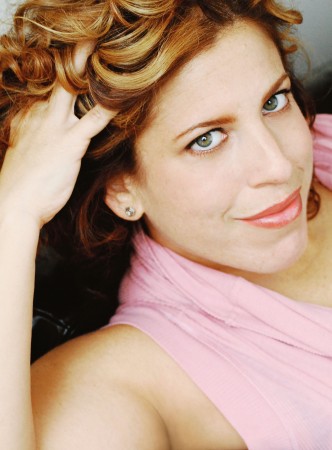
Actor and cabaret performer Raquel Cion directs intimate doubleheader at IRT (photo by Colman Domingo)
twi-ny: What’s the difference between the Raquel of 1998 and the Raquel of 2014?
KK: The Raquel of 1998 was a scary, cool, untouchable older sister–like figure. The Raquel of 2014 is a close friend and colleague that I feel very bonded to. She is an equal now, as opposed to an authority figure.
NW: I have always called Raquel “the smartest girl in the room.” She is one of those people who knows not even a little, but a lot, about most topics. It is kind of amazing, actually. I am not sure I have ever referenced something that she didn’t have some solid familiarity with. When she is directing, those smarts are, of course, funneled into the scene, so working on original material is especially fun with her because she will encourage me to take it in the most interesting (and scariest) direction. I remember feeling that way in 1998 but was more shy around her and probably a little intimidated because I wanted her to think I was “good.” Actually, let’s be real: I still want her to think I am “good,” but I can laugh really hard with her nowadays.
twi-ny: Hip partly revolves around Wythe’s obsession with the Strokes. Why the Strokes?
NW: It’s funny. I didn’t really listen to the Strokes when they first came out. I liked one or two songs I had heard, but I never actually owned any of their music or gave them much thought. When I first started conceiving of this piece, I thought a lot about what it means to be “cool,” like cool as hell — something I have never been. The image of a musician came to mind and when I started physicalizing him, the dark side of cool — self-consciousness — really came out, and with it a flood of pain and heartbreak. I happened to know that one of the Strokes was in my class at Tisch, and dramaturgically that meant that I could tap into the feeling that all struggling artists have in regard to the fact that so-and-so “made it” and why haven’t I. I did some research, which consisted mostly of watching lots of early Strokes videos ad nauseam and listening to their music day and night and found that they were the exact embodiment of cool that I was looking for in that early 2000s era — young and absolutely on fire, raised in NYC and Europe, children of supermodels, seemingly really nice guys, and distinctive looking.
twi-ny: How much of Darkling is autobiographical — or, at least, how much are you willing to admit to?
KK: My sister did go to a lock-up boarding school and ran away. She was punk and I did worship her. I did lose my virginity to a punk on acid and it did hurt like hell. Lots of other things in the piece are true too….
twi-ny: While you both go through numerous costume changes, Nora, you do it behind temporary walls, where the audience can’t see you, but Kim, you change in front of the walls, in the corners, where the audience can peek if they want to. Is there any specific reason for the difference, or is it merely a case of time and/or personal modesty?
NW: Modesty? Please. I was very adamant early on about each piece using the stage space itself very differently. Kim’s piece needs to breathe and I wanted mine to feel a bit claustrophobic, hence the walls and their configurations. I only change behind the walls because they are there and changing in front of them would quite literally take center stage.
RC: Modesty?!? You should see the dances Nora does in her white leotard for us. She’s said that one night she’ll take her bow in said leotard. We are working in a tiny black-box theater, putting up two very different shows. Each of the shows has a very distinct aesthetic. We worked very closely with our wonderful lighting and set designer, Josh Iacovelli, who has made magic with our small budget and space. We have four flats and a box with a two-sided “headboard” that serves as two beds and a car. Both shows use projections and video to further expand the narrative. In Hip, along with video there are projections that are very funny and very text heavy. It’s tough to read when you see someone off to the side in their underwear. So it simply serves the piece better to give that reprieve. Kim’s videos are filled with fast cuts and multiple characters. There is a very DIY quality to them that is very compelling, so seeing Kim change becomes another aspect to that visual component and doesn’t detract from it.
KK: I liked the idea of Darkling being kind of Brechtian in that the audience can also see me in a stripped-down aesthetic as just myself. I stole it from Karen Finley. Every time I saw her perform she changed right in plain view; it was part of the performance, and I always thought it was punk rock.