this week in theater

WOMEN OR NOTHING

(photo by Joan Marcus)

Gretchen (Halley Feiffer) and Laura (Susan Pourfar) come up with a crazy way to have a child in Ethan Coen’s WOMEN OR NOTHING (photo by Joan Marcus)

Atlantic Theater Company
Linda Gross Theater
336 West 20th St. between Eighth & Ninth Aves.
Extended through October 13, $20-$65
866-811-4111
www.atlantictheater.org

Despite a sitcom-y plot and a trio of severely affected female characters who take a while to warm up to, Ethan Coen’s first full-length play, Women or Nothing, manages to be mildly entertaining and pleasantly amusing. Lawyer Gretchen (Halley Feiffer) and concert pianist Laura (Susan Pourfar) want to have a baby, but they don’t want to adopt or go to a clinic and use an anonymous sperm donor; instead, Gretchen has researched a coworker, Chuck (Robert Beitzel), and decided that Laura, a gold-star lesbian who has never been with a man, should sleep with him in order to get inseminated by someone with desirable genes. “Believe me, this man’s semen is superb,” Gretchen tells her girlfriend. “You’re a wine taster now?” Laura responds. Gretchen comes up with a wacky, somewhat devious, and fairly ridiculous plan that she is positive will land the unknowing Chuck in bed with Laura; unfortunately for the audience, things don’t seem so crystal clear, one of many leaps of faith that Coen and director David Cromer (who directed Pourfar in Tribes, Beitzel in Our Town, and Feiffer in The House of Blue Leaves) ask the audience to accept in this uneven but ultimately likable production. The scene between the easygoing Chuck and the pent-up, elitist, and self-deprecating Laura is a gem, with razor-sharp dialogue and outstanding performances as she tries to get him drunk and not give away the reason behind their carefully arranged meeting. The following morning, Laura’s nosy mother, Dorene (Deborah Rush in a star turn), arrives, and the situation gets even more complicated, as each woman learns surprising things about the other.

Chuck (Robert Beitzel) has no idea what Laura (Susan Pourfar) has in store for him in WOMEN OR NOTHING (photo by Joan Marcus)

Chuck (Robert Beitzel) has no idea what Laura (Susan Pourfar) has in store for him in WOMEN OR NOTHING (photo by Joan Marcus)

But unanswered questions abound, preventing Women or Nothing from reaching the next level. There are no mentions of condoms or ovulation, and there are numerous red herrings, from a poorly hidden group of family photos to a fancy piano on an upper platform that is never brought into play in any manner whatsoever, toying with the audience’s expectations. Coen, who with his brother, Joel, has made such award-winning films as Barton Fink, Fargo, and No Country for Old Men, has also published a book of short stories and a collection of poetry and has written several one-act plays, including Talking Cure, which was one of three works, along with Elaine May and Woody Allen, that made up the 2011 Broadway flop Relatively Speaking. Thus, on his own, Ethan Coen specializes in the short form, and he has trouble sustaining Women or Nothing for its one-hundred-minute running time, with a brief intermission (even though the program says there will not be one). He and Cromer just can’t quite get past the R-rated Three’s Company set-up, though they try their best, resulting in an amiable, if not wholly satisfying, rendezvous, which has been extended through October 13 at the Atlantic Theater Company’s Linda Gross Theater.

stop. reset.

A Chicago publisher fights for survival in Regina Taylor's STOP. RESET. (photo by Joan Marcus)

A Chicago publisher fights for survival in Regina Taylor’s STOP. RESET. (photo by Joan Marcus)

The Pershing Square Signature Center
The Romulus Linney Courtyard Theatre
480 West 42nd St. between Tenth & Eleventh Aves.
Tuesday – Sunday through September 29, $75
212-244-7529
www.signaturetheatre.org

Playwright and actress Regina Taylor (I’ll Fly Away, Crowns) examines social and technological change through a literary lens in the Afrofuturistic stop. reset. The contemporary drama takes place inside Alexander Ames Chicago Black Book Publishers, where times are tough, especially with the growing popularity of ebooks. Company founder Ames (Carl Lumbly) is an old-fashioned publisher who still treasures the look, touch, and smell of a physical book, but the firm’s financial situation has forced him to cut one staff member from his few remaining employees. He meets with each one alone, letting them tell their personal and professional stories while he also shares his, which is dominated by the loss of his son a few years earlier. One by one, Deb (Michi Barall), Chris (Teagle F. Bougere), Jan (Latanya Richardson Jackson), and Tim (Donald Sage Mackay) make their case why they should stay and someone else should go. Meanwhile, J (Ismael Cruz Córdova), the young hip-hop janitor, just does his own thing, oblivious to what is going on around him — or perhaps not quite. Taylor, who wrote stop. reset. as part of the Residency Five program at the Signature Theatre, never quite gets past the clichéd aspects of her characters and plot points, letting Neil Patel’s inventive set, which includes a clever elevator, glassed-in offices, a large window through which a fierce snowstorm can be seen, and, projections (by Shawn Sagady) of quotations from Ralph Ellison and the Rev. Dr. Martin Luther King, Jr., overwhelm the play. The production does have its moments, but various transitions, as well as the ending, are too confusing, leaving too much unresolved.

THE COMPASS ROSE

Donall (David Mitchell) and Tiffany (Olivia Horton) wonder what could have been in THE COMPASS ROSE (photo by Steven Schreiber)

Donall (David Mitchell) and Tiffany (Olivia Horton) wonder what could have been in THE COMPASS ROSE (photo by Steven Schreiber)

Ryan’s Daughter
350 East 85th St. between First & Second Aves.
Thursday – Sunday through September 29, $18
212-868-4444
www.fatviolettheater.com
www.1stirish.org

Two lonely souls look back at what might have been in Ronan Noone’s sensitively drawn two-character drama The Compass Rose. The site-specific seventy-minute play takes place in the upstairs pub at Ryan’s Daughter on the Upper East Side, doubling for the Compass Rose on Martha’s Vineyard, as the audience sits at small tables, on stools, or on chairs at the bar. (Drinks are available before and after the show but not during it.) The story begins as Tiffany (Olivia Horton) walks into the Compass Rose, surprising the bartender, Donal (David Mitchell). “What are you doing here?” he says with a combination of anger and trepidation. The play shifts between the present and ten years in the past, when a free-spirited Tiffany invites Donal to accompany her on a cross-country trip to San Francisco, merely for company because her father does not want her to drive so far by herself. Each has a significant other, and they are not interested in starting a relationship, something Tiffany makes clear immediately, and repeatedly. But as they journey through Maine, New York City, Washington, DC, Tennessee, Texas, Las Vegas, and other locations, they share intimate secrets, tell lies, and get to know each other better than they ever thought possible.

the compass rose 2

The time shifts occur instantaneously, signaled by the blink of an eye, a shift of a body, or the movement of sunglasses. It’s a bit jarring at first but ends up working smoothly as the play, directed by David Sullivan, goes on and the changes in time and place more clearly relate to elements of the story. Mitchell (Fair City) and Horton (Tiny Dynamite) have an alluring chemistry that builds to a sizzle, his character dark, moody, cynical, and brooding, hers flirtatious, idealistic, and sometimes brutally cold. They walk all around the bar, stopping right next to members of the audience, but they are careful never to make eye contact with anyone, maintaining the invisible wall between performer and viewer. The natural setting is enhanced by noises going on outside; the night we attended, there was a whole lot of horn blowing from cars on the street, but it had no effect on the actors and added an extra dose of reality to the proceedings. A tender-hearted, insightful, and involving play about, as Donal says, “creating your own myth,” The Compass Rose continues at Ryan’s Daughter through September 29 as part of Origin’s annual 1st Irish Theatre Festival, which also includes The Life & Sort of Death of Eric Argyle and I Can See Clearly Now at 59E59 and McGoldrick’s Thread, The Morons, and A Lady Is Waiting at the Cell in addition to other special music, poetry, and theatrical events.

THE MACHINE

THE MACHINE depicts the epic battle between grandmaster Garry Kasparov and IBM computer Deep Blue (photo by Stephanie Berger)

THE MACHINE depicts the epic battle between grandmaster Garry Kasparov and IBM computer Deep Blue (photo by Stephanie Berger)

Park Avenue Armory, Wade Thompson Drill Hall
643 Park Ave. at 67th St.
Through September 18, $45-$90
212-933-5812
www.armoryonpark.org
www.donmarwarehouse.com

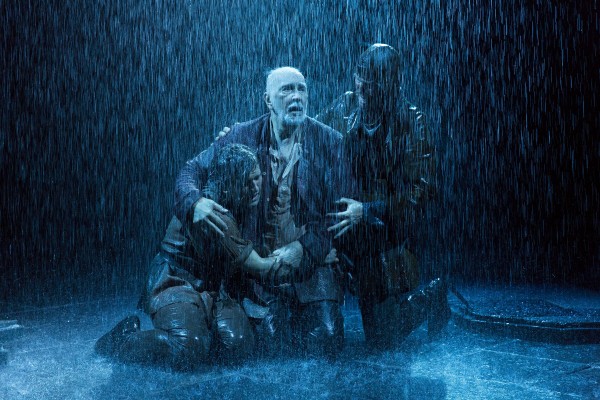
In The Machine, playwright Matt Charman and director Josie Rourke turn the 1997 chess match between grandmaster Garry Kasparov and IBM’s Deep Blue computer into a lively, riveting, edge-of-your-seat multimedia sports event. With the audience sitting on raised bleachers on all four sides of the stage in the Park Avenue Armory’s massive Wade Thompson Drill Hall, Kasparov (Hadley Fraser) battles Deep Blue, operated by its cocreator Dr. Feng-Hsiung Hsu (Kenneth Lee). As the hard-fought six-game match continues, flashbacks reveal critical moments in the main competitors’ lives. Kasparov, who lost his father at a young age, is still a child when he takes on grandmaster Anatoly Karpov (Cornelius Booth), his mother (Francesca Annis) determined to have him be accepted to Karpov’s famous school. Hsu, at Carnegie Mellon, teams up with fellow student Murray Campbell (Trevor White) to attempt to improve a chess computer built by their professor, Dr. Hans Berliner (John Ramm), while struggling to commit to his cheerleader girlfriend, Tamsin (Antonia Bernath). During the match itself, cameras move around Lucy Osborne’s inventive set, projecting images onto an overhead Jumbotron while a pair of announcers detail the action. Two of the most thrilling moments occur when at first chessboards, then computers are pushed around the square stage along lighted tracks, beautifully choreographed scenes (by Jonathan Watkins) that continue the theme of man vs. machine, equating the two fields. Fraser plays Kasparov with a nervous energy that highlights his growing fear and worry as the games go on, while Lee’s Hsu is jumpy and awkward as he gives up any chance of a personal life in order to invent the best. During the course of the show, Kasparov is alternately referred to as both “too human” and a “monster,” while he accuses the IBM team of cheating because Deep Blue made what he believes to clearly be human moves in the second game, as this engaging Donmar Warehouse production once again focusing on the similarities between the machine that is man and the machine that is built by man. Be sure to arrive early, as there are many chess sets at the armory where visitors are encouraged to sit down and play.

ANNA NICOLE

(photo by ROH/Bill Cooper)

The Royal Opera House’s award-winning, lavish production of ANNA NICOLE comes to BAM this month (photo by ROH/Bill Cooper)

NEXT WAVE FESTIVAL
BAM Howard Gilman Opera House
30 Lafayette Ave. between Ashland Pl. & St. Felix St.
September 17-28, $25-$235
718-636-4100
www.bam.org
www.roh.org.uk

Opera can tend to be a bit high-brow, but British musician, composer, and actor Richard Thomas tends not to choose the most erudite, cerebral subjects for his operas. Ten years ago, Thomas collaborated with Stewart Lee on Jerry Springer: The Opera, which was indeed about the daytime talk-show host; the show went on to win a Laurence Olivier Award for Best New Musical. Next, Thomas turned his attention to another controversial pop-culture figure, Anna Nicole Smith. Anna Nicole, which premiered in February 2011 at the Royal Opera House in Covent Garden, comes to BAM for seven hotly anticipated performances September 17-28. The two-and-a-half-hour show is presented with New York City Opera, whose chorus and orchestra are part of the production; Sarah Joy Miller plays the title character, who lived a tragic only-in-America tabloid life, with James Barbour as her father, Ben Davis as her first husband, Robert Brubaker as her second husband, Mary Testa as her aunt Kaye, and John Easterlin as Larry King. The score was composed by Mark-Anthony Turnage (Greek, The Silver Tassie), while Thomas wrote the libretto; Richard Jones (Lady Macbeth of Mtsensk, the Bitter Tears of Petra von Kant) directs, with Steven Sloane conducting. Nicky Gillibrand designed the costumes, with sets by Miriam Buether and choreography by Aletta Collins. On September 16 at 7:00 ($15), Turnage, Thomas, and Jones will be at BAMcafé for the discussion “The Making of Anna Nicole,” moderated by Elaine Padmore. And on September 22 at noon, in conjunction with the Brooklyn Book Festival, Simon Critchley will host the free talk “On Truth (and Lies) in Beauty” with Hilton Als and Alexander Nehamas.

FIAF FALL FSTVL: CROSSING THE LINE

Eliane Radigue and Xavier Veilhan’s SYSTEMA OCCAM kicks off FIAF’s seventh annual Crossing the Line festival

Eliane Radigue and Xavier Veilhan’s SYSTEMA OCCAM kicks off FIAF’s seventh annual Crossing the Line festival

French Institute Alliance Française and other locations
Florence Gould Hall, 55 East 59th St. between Madison & Park Aves.
Le Skyroom and FIAF Gallery, 22 East 60th St. between Madison & Park Aves.
September 19 – October 13, free – $30
212-355-6160
www.fiaf.org

Curators Lili Chopra, Simon Dove, and Gideon Lester have once again put together an impressive, wide-ranging program for the Crossing the Line festival, now in its seventh year. Sponsored by the French Institute Alliance Française and taking place there as well as at other venues around the city, CTL features cutting-edge art, dance, music, theater, discussion, and more from an international collection of multidisciplinary performers, with many events free and nothing costing more than $30. The twenty-five-day festival begins September 19 with electronic music composer Eliane Radigue and artist Xavier Veilhan collaborating on Systema Occam (Florence Gould Hall, $30), a multimedia performance installation that is part of CTL’s “New Settings” series, a joint venture with Hermès; the fashion company will be hosting Martine Fougeron’s “Teen Tribe” photo exhibition at the Gallery at Hermès from September 20 to November 8. In Capitalism Works for Me! True/False (September 20, October 6-9, free), Steve Lambert will keep score in Times Square as people vote on whether capitalism indeed works for them. The award-winning Nature Theater of Oklahoma presents episodes 4.5 and 5 at FIAF of their massive undertaking, Life and Times (September 20-21, $30), accompanied by the FIAF Gallery show “10fps,” consisting of 1,343 hand-colored drawings (September 21 – November 2, free). For “The Library,” Fanny de Chaillé invites people to FIAF’s Haskell Library on September 24 and 26 and the NYPL’s Jefferson Market Branch on September 27 (free), where they can choose books that are actually men and women who will share their stories verbally one on one.

Boyzie Cekwana and Panaibra Canda look at postcolonial Africa in THE INKOMATI (DIS)CORD

Boyzie Cekwana and Panaibra Canda look at postcolonial Africa in THE INKOMATI (DIS)CORD

In The Inkomati (dis)cord (September 25-26, New York Live Arts, $20), Boyzie Cekwana and Panaibra Canda use contemporary dance to examine postcolonial Africa. De Chaillé teams up with Philippe Ramette for Passage à l’acte / Acting Out (September 26-28, Invisible Dog, $30), using absurdist human sculpture to “rationalize the irrational.” Dancer and choreographer Nora Chipaumire will perform the CTL-commissioned solo piece rite riot (October 3-5, Le Skyroom, $30), exploring African stereotypes, collaborating with writer Teju Cole and visual artist Wangechi Mutu. Pascal Rembert’s large-scale A (micro) history of world economics, danced (October 11-13, La MaMa, $20) features New Yorkers discussing how the financial crisis impacted their lives. The festival also includes works by Annie Dorsen, Ernesto Pujol and Carol Becker, Bouchra Ouizguen, Tim Etchells, and Kyle deCamp and Joshua Thorson, in addition to a series of talks and conversations.

ALL THE FACES OF THE MOON

Mike Daisey mixes reality and fantasy in ambitious, epic twenty-nine-night tale at Joe’s Pub (photo by Joan Marcus)

Mike Daisey mixes reality and fantasy in ambitious, epic twenty-nine-night tale at Joe’s Pub (photo by Joan Marcus)

Joe’s Pub
425 Lafayette St.
Nightly through October 3, $26.50 ($20 with code DAISEY), no food or drink minimum, 7:00
212-967-7555
www.joespub.com
www.mikedaisey.blogspot.com

Monologist Mike Daisey is currently in the midst of an epic New York story at Joe’s Pub, a twenty-nine-consecutive-night “theatrical novel” that continues through October 3. Each evening, Daisey sits at a table for between sixty and seventy-five minutes, with a glass of water, a handkerchief to mop his perpetually sweaty face and brow, and a pad on which he has written an outline of what he is going to talk about. Behind him on an easel is a painting by Larissa Tokmakova (There There), who created a different canvas for each night. Daisey, whose last piece, The Agony and the Ecstasy of Steve Jobs, stirred up quite a controversy when it was revealed that not every word in his story of Chinese workers who make Apple products at the massive Foxconn facility in Shenzhen was true, this time very deliberately mixes fact and fiction, reality and fantasy. The first part of each show generally deals with Daisey’s personal and professional life, as he discusses his childhood in Maine, self-deprecatingly talks about his girth, cynically examines life in the American theater, relates his bout with suicidal thoughts, makes fun of the price of food audience members are eating (unlike most shows at Joe’s Pub, there is no food or drink minimum), and brings up the potential of having sex in strange places with his wife, Jean-Michele Gregory, who is also the director.

(photo by Sabrina Fonseca)

Mike Daisey and painter Larissa Tokmakova in the studio, preparing for ALL THE FACES OF THE MOON (photo by Sabrina Fonseca)

Working from an outline, Daisey veers off into riotous tangents, his inflections suddenly going from soft and gentle to loud and sharp as he rants, raves, and rages about Dungeons and Dragons, Bob Dole, McDonald’s, Apple, McSweeney’s, vampires, the First Church of Christ IKEA Redeemer, Manhattan Theatre Club, and, at the center of it all, a changing New York City. But then, about halfway through, Daisey shifts gears, delving into a fantastical, surreal world where parties go on for years, Death follows him, and a mysterious character known as the Big Guy hires an even more mysterious figure named Jack to kill him (the Big Guy). At first this transition is confusing, seemingly arriving out of nowhere, but it eventually all comes together, especially if you see or listen to multiple shows. (A podcast of each performance is posted online by noon the next day.) Daisey is an engaging performer who is not afraid to take risks, a master storyteller who puts it all out there, adapting to the situation as necessary, whether sensing a lull in the proceedings or making a reference that very few people get. There’s an immediacy and intimacy about his presentation that instantly grabs the audience, which is willing to forgive Daisey his past problems and join him on this wildly ambitious ride, which features such intriguing chapter titles as “The Naked Emperor Is Still Laughing,” “Jupiter Is a King Who Never Came Back,” “Saturn Is a Father Devouring His Children,” and “The World Is More Than We Will Ever Know.” As a bonus, ticket holders receive a special tarot card for that specific show, featuring the name of the chapter and a color image of Tokmakova’s painting for that night; the tarot cards are also available to those who write legitimate reviews of individual podcasts.