this week in theater

TWI-NY TALK: NORA WOOLLEY / KIM KATZBERG / RAQUEL CION OF “HIP” / “DARKLING”

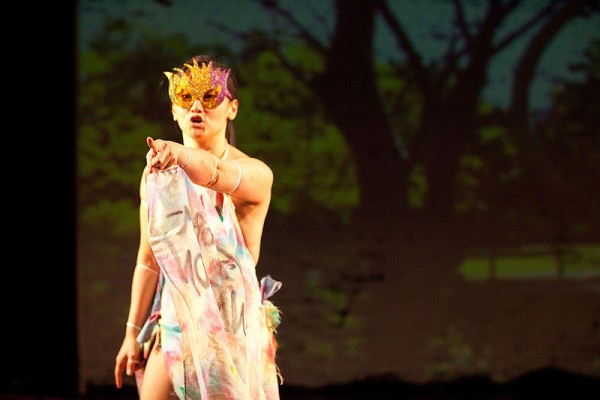
Nora Woolley channels multiple characters in Williamsburg-set HIP

Nora Woolley channels multiple characters in Williamsburg-set one-act HIP (photo by Sarah Rogers)

HIP / DARKLING
IRT Theater
154 Christopher St. near Washington St.
Through January 12, $12-$15
www.irttheater.org

A pair of one-woman multicharacter shows that explore self-identity and searching for one’s place in the world, Nora Woolley’s thirty-minute Hip and Kim Katzberg’s hour-long Darkling were developed to run in tandem with each other, and they are doing so beautifully at the tiny IRT Theater on Christopher St., where they continue through January 12. In Hip, Woolley first appears as Wythe, an angry, leather-jacketed, mustached Williamsburg musician who claims that Julian Casablancas and the Strokes stole songs from him. She also plays Wythe’s temporarily bed-ridden grandmother, a trendy lifestyle photographer whose child Wythe baby-sits, and an Eastern European landlord attempting to rent an apartment to the cash-poor musician. Woolley’s knowing, spot-on portrayals of hipsters in their unique little worlds are searingly recognizable as well as extremely funny. As she changes costume for each character, videos by the Strokes and Wythe’s band are projected onto a back screen; the short films were made by Mariclare Lawson.

In Darkling, Katzberg appears as Trinity, a thirteen-year-old girl with terrible buck teeth who is just beginning to experiment with boys, especially an older hottie named Kevin. It’s 1987, and Trinity is deep into the awkward phase of adolescence, although she doesn’t realize it. A bold girl with seemingly no boundaries, she worships her older sister, Morgan (Katzberg), who has been sent off to a home for troubled girls but has escaped with her friend Chiara (Maia Cruz Palileo); their exploits are shown in a series of video postcards Morgan sends to Trinity. Katzberg also plays their mother in a very clever scene as well as a Goth marketing witch on-screen. Darkling is breathtaking in its ability to both attract and repel the audience’s identification with this most unusual yet quintessentially archetypal adolescent; Katzberg dives right into that nameless raw emotion that exists between laughing at and crying over something, at times evoking Todd Solondz’s cult classic, Welcome to the Dollhouse, in addition to the multimedia oeuvre of artist and filmmaker Ryan Trecartin.

Under Raquel Cion’s confident, smartly paced direction, Hip and Darkling work extremely well together. Cion — who is also an actor and cabaret performer performing as herself and sometimes as her alter ego, Cou-Cou Bijoux — knows how to get the best out of Woolley and Katzberg, who show off their mad skillz as they go from character to character and scene to scene, holding nothing back. The three women recently discussed collaboration, the Strokes, virginity, and more with twi-ny.

twi-ny: The three of you met back in 1998. Did you immediately hit it off?

Raquel Cion: Oh, we’re going back to the twentieth century, now are we? Okay, so, in ’98 my dear friend Raïna von Waldenburg’s play Das Kaspar Theatre was produced at the Experimental Theater Wing (ETW) at NYU. I was the associate director. Raïna was my classmate at ETW and then became both Kim and Nora’s acting teacher there. I can say from the moment Nora and Kim auditioned that they made a huge impression on me. The show dealt with very intense subjects: family dysfunction, sexual abuse, how one survives and heals. They were both so incredibly facile with their acting and willingness to jump into anything thrown at them. We later did a reading of a revised version of Raïna’s play for the hotINK Festival in 2006 that I directed.

Nora Woolley: Raquel and Kim have always been two of my favorite artists. I remember being blown away by Kim’s brave and charged work in acting school. Raquel directed us in a play and I could tell she was intensely gifted at getting actors to hone in on the meat. I asked Raquel to direct another show of mine (Selling Splitsville, cowritten by Christine Witmer) and she really understands me as a performer, so of course I hoped she’d direct Hip.

Kim Katzberg: I was pretty intimidated by Nora when I was in college in 1998. I had an inferiority complex back then, not to mention zero self-esteem. Plus, Nora was one of the stars in the drama department at NYU. Raquel scared me as well. She was very blunt as a director and she didn’t let you get away with any bullshit acting.

Thirteen-year-old Trinity (Kim Katzberg) gazes into her future in DARKLING

The very strange thirteen-year-old Trinity (Kim Katzberg) gazes into her future in DARKLING (photo by Sarah Rogers)

twi-ny: How did this collaboration come about?

NW: I saw Kim in Penetrating the Space and thought it was one of the most beautiful solo plays I had ever seen. Still do. She was doing and saying things I had never seen before. Referencing white tigers, taping her eyes for effect, talking about suicide with humor — it blew me away. I had never made a solo piece before, so I asked Kim if she wanted to get together and just play around in a rehearsal studio. We each brought some work we had been thinking about and then we began improvising for each other. This continued every couple of weeks for a couple of years. Our rehearsals were so important to me — they were a space to take huge risks and to challenge ourselves emotionally, physically, etc., a mini acting school. I secretly hoped, but for the first year or so I never considered, that we would present them together. Then it became clear to me that I wanted to create a shorter piece and perform both pieces in the same evening. That sounded fun and really interesting — a structure I had never done before. Plus, I was kind of terrified to devote a whole evening to myself. 🙂

RC: Though New York is a huge city, it’s also a very small town amongst the like-minded and we just were in each others’ circles, I suppose. Nora asked me to direct Selling Splitsville at the undergroundzero festival at PS122 in 2009. Kim came to that show and was beginning work on Penetrating the Space. We discussed working together then but schedules didn’t allow it. Kim and Nora had told me that they were developing work together. They kept me in the loop and here we are in 2014 collaborating and it is pure joy! We’re having a blast, all three of us.

KK: A bunch of years ago I saw Selling Splitsville. I thought it was brilliant and hilarious. I could relate to the kind of character work that Nora was doing and I loved Raquel’s bold direction and thought maybe both of them would be interested in my kind of characters too. Then Nora saw Penetrating the Space and liked it and asked me if I wanted to meet up twice a month in a studio space so that we could bounce work off of each other. Then Nora reintroduced me to Raquel and the rest is herstory.

twi-ny: What’s the single best piece of advice you’ve received from one another?

NW: I learn so much from Kim on a daily basis — for real. I don’t know any performers who own silence like Kim does. Her timing is profound in that she creates these incredibly moving, suspended moments that land in your heart. She takes her time in a way that is supremely rare and extremely hard to pull off. At some point early on in our rehearsal process, I remember watching her work and thinking that I should challenge myself to take lots more time in my own work — it was a revelation. Also, of course, Kim’s characters are beyond comparison. She has always encouraged me to let my characters say what they were afraid to say. I could go on. . . .

Raquel is an acting savant, so it is hard to define one piece of her advice as “best.” She has an impeccable eye and can navigate any moment onstage — from helping me find the deepest, most interesting route to emotional-connectedness to filling in the occasional flimsy playwriting with the perfect single word or two. I always feel like Raquel is an acting surgeon with X-ray vision. It blows my mind how often she hones in on that heartbreaking space between funny and sad, then makes it possible for me to repeat. After a show the other day, she called out the exact moment in the performance when I was not enjoying the work. Raquel reminds me not to take myself too seriously.

KK: The best advice I got from Nora was more that she didn’t offer advice but instead gave me unconditional support throughout the process. I felt free to be a bad actor sometimes and to bring in work that totally failed. We were able to create a safe space in which to take risks and explore. I also felt incredibly challenged by Nora being that the work she brought in was always at such a high level. I felt that I had to at least try to match that in order for her to want to keep working with me. I was also continually inspired by Nora, as a human being and as an artist, so that made the rehearsals thrilling and motivating.

Working with Raquel felt equally safe, challenging, and inspiring. Raquel pushed me to go farther than I thought was possible. The audition dance in Darkling where I put on the horse head and get down to Patti Smith’s “Horses” scared the shit out of me, and at first I didn’t want to do it. It was Raquel’s idea to put that dance in and I felt so embarrassed by it and didn’t think I could go there. That is one of the riskiest moments in the play for me as an actor, and it’s because of Raquel’s genius and bravery that moments like that burst through in the show.

twi-ny: Raquel, you met Nora and Kim some fifteen years ago. What were they like then, compared to how they are now?

RC: Hmmm, when we met, I believe, there was an implied hierarchical structure in place since I was coming into a school. However, I do feel that both Nora and Kim are profoundly themselves and have always been. They are both huge risk takers as performers. Now, though, we are fully equals, friends, all artists making our own work. I don’t know, it may be an age thing. When you’re older the commonalities become more present. Once one’s passed thirty, the years all kind of meld together anyhow. I am still blown away by their talent, as I was when we initially met, but being let into someone’s process for their own work is a very different dynamic than being cast in another’s play. Simply put, they are freaking amazing creators of theater with very distinct points of view. Not to mention that they are incredibly versatile and just damn good actors and writers. So whip-smart, funny as hell, and so poignant. That comes with time and trust for themselves and each other. I am so honored that they trust me with their work. I really am in awe of what they create.

Burlesque and cabaret performer Raquel Cion directs HIP and DARKLING at IRT

Actor and cabaret performer Raquel Cion directs intimate doubleheader at IRT (photo by Colman Domingo)

twi-ny: What’s the difference between the Raquel of 1998 and the Raquel of 2014?

KK: The Raquel of 1998 was a scary, cool, untouchable older sister–like figure. The Raquel of 2014 is a close friend and colleague that I feel very bonded to. She is an equal now, as opposed to an authority figure.

NW: I have always called Raquel “the smartest girl in the room.” She is one of those people who knows not even a little, but a lot, about most topics. It is kind of amazing, actually. I am not sure I have ever referenced something that she didn’t have some solid familiarity with. When she is directing, those smarts are, of course, funneled into the scene, so working on original material is especially fun with her because she will encourage me to take it in the most interesting (and scariest) direction. I remember feeling that way in 1998 but was more shy around her and probably a little intimidated because I wanted her to think I was “good.” Actually, let’s be real: I still want her to think I am “good,” but I can laugh really hard with her nowadays.

twi-ny: Hip partly revolves around Wythe’s obsession with the Strokes. Why the Strokes?

NW: It’s funny. I didn’t really listen to the Strokes when they first came out. I liked one or two songs I had heard, but I never actually owned any of their music or gave them much thought. When I first started conceiving of this piece, I thought a lot about what it means to be “cool,” like cool as hell — something I have never been. The image of a musician came to mind and when I started physicalizing him, the dark side of cool — self-consciousness — really came out, and with it a flood of pain and heartbreak. I happened to know that one of the Strokes was in my class at Tisch, and dramaturgically that meant that I could tap into the feeling that all struggling artists have in regard to the fact that so-and-so “made it” and why haven’t I. I did some research, which consisted mostly of watching lots of early Strokes videos ad nauseam and listening to their music day and night and found that they were the exact embodiment of cool that I was looking for in that early 2000s era — young and absolutely on fire, raised in NYC and Europe, children of supermodels, seemingly really nice guys, and distinctive looking.

twi-ny: How much of Darkling is autobiographical — or, at least, how much are you willing to admit to?

KK: My sister did go to a lock-up boarding school and ran away. She was punk and I did worship her. I did lose my virginity to a punk on acid and it did hurt like hell. Lots of other things in the piece are true too….

twi-ny: While you both go through numerous costume changes, Nora, you do it behind temporary walls, where the audience can’t see you, but Kim, you change in front of the walls, in the corners, where the audience can peek if they want to. Is there any specific reason for the difference, or is it merely a case of time and/or personal modesty?

NW: Modesty? Please. I was very adamant early on about each piece using the stage space itself very differently. Kim’s piece needs to breathe and I wanted mine to feel a bit claustrophobic, hence the walls and their configurations. I only change behind the walls because they are there and changing in front of them would quite literally take center stage.

RC: Modesty?!? You should see the dances Nora does in her white leotard for us. She’s said that one night she’ll take her bow in said leotard. We are working in a tiny black-box theater, putting up two very different shows. Each of the shows has a very distinct aesthetic. We worked very closely with our wonderful lighting and set designer, Josh Iacovelli, who has made magic with our small budget and space. We have four flats and a box with a two-sided “headboard” that serves as two beds and a car. Both shows use projections and video to further expand the narrative. In Hip, along with video there are projections that are very funny and very text heavy. It’s tough to read when you see someone off to the side in their underwear. So it simply serves the piece better to give that reprieve. Kim’s videos are filled with fast cuts and multiple characters. There is a very DIY quality to them that is very compelling, so seeing Kim change becomes another aspect to that visual component and doesn’t detract from it.

KK: I liked the idea of Darkling being kind of Brechtian in that the audience can also see me in a stripped-down aesthetic as just myself. I stole it from Karen Finley. Every time I saw her perform she changed right in plain view; it was part of the performance, and I always thought it was punk rock.

AMERICAN REALNESS 2014

Adrienne Truscott moves from her day job at the Kitchen to live performance at Abrons Arts Center in ...TOO FREEDOM...

Adrienne Truscott moves from her day job at the Kitchen to live performance at Abrons Arts Center in …TOO FREEDOM…

Abrons Arts Center and other venues
466 Grand St. at Pitt St.
January 9-19, $20
212-598-0400
www.americanrealness.com
www.abronsartscenter.org

January in New York City is a veritable feast of live performance festivals, including PS 122’s Coil, the Public’s Under the Radar, Here’s Prototype, and Winter Jazzfest. Over at Abrons Art Center, American Realness will be celebrating its fifth anniversary with seventeen new movement-based shows and encore presentations as well as several off-site events. Tina Satter’s House of Dance (also part of Coil) follows a tense tap-dance competition. Ishmael Houston-Jones and Emily Wexler team up for the world premiere of 13 Love Songs: dot dot dot, which involves deconstructing romantic lyrics by Bryan Adams, Mary J. Blige, Ja Rule, Stephen Merritt, Nina Simone, Madonna, and others. Miguel Gutierrez explores gay sex and lost love in the intimate myendlesslove. Eleanor Bauer combines text, music, and movement in Midday and Eternity (The Time Piece); she’ll also lead the “Dancing, not the Dancer” class and host the anything goes Bauer Hour on January 19. Choreographer Juliana F. May and dancers Benjamin Asriel, Talya Epstein, and Kayvon Pourazar explore the physical and emotional naked body in Commentary=not thing. The Kitchen house manager Adrienne Truscott delves into day jobs and artistic creativity in . . . Too Freedom . . . , which also features Neal Medlyn, Gillian Walsh, Laura Sheedy, and Mickey Mahar. Lucy Sexton (the Factress), Anne Iobst (the Naked Lady), Scott Heron, and DANCENOISE join forces for Prodigal Heroes: An Evening of Legendary New York. Moriah Evans and Sarah Beth Percival play with human-connection tropes in Out of and Into (8/8): Stuff. Medlyn’s King concludes his seven-part foray into iconic stars, this time taking on Michael Jackson. And Melinda Ring’s Forgetful Snow and Roseanne Spradlin’s Indelible Disappearance — A Thought not a Title will be presented together for free on January 12.

Moriah Evans and Sarah Beth Percival team up in OUT OF AND INTO (8/8): STUFF for American Realness festival

Moriah Evans and Sarah Beth Percival team up in OUT OF AND INTO (8/8): STUFF for American Realness festival

Also on the schedule are Adam Linder’s Cult to the Built on What, Michelle Boulé’s Wonder (Boulé will also lead a “Persona & Performance” class on January 17), Rebecca Patek’s ineter(a)nal f/ear, Jillian Peña’s Polly Pocket, and Dana Michel’s Yellow Towel. The festival heads to MoMA PS1 on January 10-12 for Mårten Spångberg’s four-and-a-half-hour La Substance, but in English and to MoMA’s main Midtown location on January 15-16 for Eszter Salamon’s Dance for Nothing, based on John Cage’s Lecture on Nothing. In addition, there will be art exhibits throughout Abrons (Sarah Maxfield’s “Nonlinear Lineage: Over/Heard,” Ian Douglas’s “Instant Realness,” Medlyn and Fawn Krieger’s “The POP-MEDLYN Hall of Fame,” and Ann Liv Young’s interactive “Sherry Art Fair”), and Coil, Under the Radar, Prototype, and American Realness will be copresenting free live concerts every night from January 9 to 19 in the Lounge at the Public Theater, including Invincible, Christeene, Ethan Lipton, Heather Christian & the Arbonauts, Sky-Pony, Timur and the Dime Museum, the Middle Church Jerriesse Johnson Gospel Choir, M.A.K.U. Sound System, DJ Acidophilus, and Nick Hallett, Space Palace, and Woahmone DJs.

UNDER THE RADAR 2014

The Public Theater and other venues
425 Lafayette St. by Astor Pl.
January 8-19, $20-$28 (UTR Packs $75 for five shows)
212-967-7555
www.undertheradarfestival.com

The tenth edition of the Public Theater’s Under the Radar Festival is another diverse collection of unique and unusual international theatrical productions, roundtable discussions, and free live music, from the strange to the familiar, the offbeat to the downright impossible to describe. Among the sixteen shows, most of which take place at the Public, are 600 Highwaymen’s The Record, a dance-theater work that brings together a roomful of strangers to comment on the relationship between performer and audience; John Hodgman’s one-man piece, I Stole Your Dad, in which the Daily Show “resident expert” shares intimate, personal stories about his family and technology while baring himself onstage; psychiatrist Kuro Tanino and his Niwa Gekidan Penino company’s The Room Nobody Knows (at Japan Society), about two brothers getting ready for the older one’s birthday party; Andrew Ondrejcak’s Feast, in which a king and his court (starring Reg E. Cathey) have a farewell dinner as Babylon collapses; and the American premiere of hip-hopper Kate Tempest and Battersea Arts Centre’s Brand New Ancients (at St. Ann’s Warehouse), a multidisciplinary show about everyday life in a changing world. Also on the roster is Sacred Stories, Toshi Reagon’s thirtieth annual birthday celebration with special guests; Roger Guenveur Smith’s one-man improvisation, Rodney King; a reimagining of Sekou Sundiata’s blessing the boats with Mike Ladd, Will Power, and Carl Hancock Rux; Cie. Philippe Saire’s Black Out (at La MaMa), Edgar Oliver’s Helen and Edgar, Lola Arias’s El Año en que nací / The year I was born (at La MaMa), SKaGeN’s BigMouth, tg STAN’s JDX — a public enemy, Sean Edward Lewis’s work-in-progress Frankenstein (at the Freeman Space), excerpts from ANIMALS’ The Baroness Is the Future, and Daniel Fish’s Eternal, the last three also part of the Incoming! Festival within a Festival.

Kate Tempest will rap about the state of the world in BRAND NEW ANCIENTS (photo by Christine Hardinge)

Kate Tempest will rap about the state of the world in BRAND NEW ANCIENTS (photo by Christine Hardinge)

In addition, there will be numerous postshow talkbacks, a pair of workshops with Sara De Roo and Jolente De Keersmaker of tg STAN on January 10-11, four noon Culturebot conversations January 11-12 and 18-19, and Coil, Under the Radar, Prototype, and American Realness have joined forces to present free live concerts every night from January 9 to 19 in the Lounge at the Public, including Invincible, Christeene, Ethan Lipton, Heather Christian & the Arbonauts, Sky-Pony, Timur and the Dime Museum, the Middle Church Jerriesse Johnson Gospel Choir, M.A.K.U. Sound System, DJ Acidophilus, and Nick Hallett, Space Palace, and Woahmone DJs.

COIL 2014

Multiple venues
January 3 – February 1, $15-$20
212-352-2101
www.ps122.org

PS122’s East Village home might be under renovation, but that isn’t stopping the organization from presenting the ninth annual incarnation of its winter performance festival, Coil. This year’s festivities comprise nine cutting-edge works in various disciplines, with tickets for all shows only $20, so there’s no reason not to check out at least one of these unique, unusual productions. Reid Farrington stages the ultimate heavyweight match in the world premiere of Tyson vs. Ali at the 3LD Art & Technology Center (January 3-19), in which live action and multiple screens pit Mike Tyson against Muhammad Ali. Mac Wellman’s Muazzez at the Chocolate Factory (January 7-17), from “A Chronicle of the Madness of Small Worlds,” transports the audience, and actor Steve Mellor, into outer space. Heather Kravas’s a quartet at the Kitchen (January 8-12) consists of four dancers performing four dances in four parts each. Director Phil Soltanoff, systems designer Rob Ramirez, and writer Joe Diebes boldly go where no one has gone before in An Evening with William Shatner Asterisk at the New Ohio Theatre (January 9-12), creating a hybrid work highlighted by humans interacting with video clips of words spoken by Shatner as Captain James T. Kirk on Star Trek but strung into new thoughts and statements. Tina Satter’s highly stylized House of Dance at Abrons Arts Center (January 9-13) investigates a tap-dance contest and the relationship between a teacher and his student. The performance series CATCH 60 celebrates its tenth anniversary with the one-night-only CATCH Takes the Decade at the Invisible Dog Art Center (January 11), with works by Cynthia Hopkins, Molly Lieber & Eleanor Smith, Anna Sperber, Ivy Baldwin, and others. Okwui Okpokwasili’s solo Bronx Gothic at Danspace Project (January 14 – February 1) is a song-and-movement-based coming-of-age story about two eleven-year-old girls. All three parts of Jeremy Xido’s solo piece The Angola Project will take place at the Invisible Dog (January 14-17). And family tragedy lies at the center of Brokentalkers’ Have I No Mouth at Baryshnikov Arts Center (January 14-26), with company director Feidlim Cannon and his mother trying to put things back together. In addition, the Red + White Party will get folks mingling as SPIN New York on January 12 ($30 and up) with Elevator Repair Service, and the SPAN conversation series will be held at NYU on January 18.

TWELFTH NIGHT / RICHARD III

(photo © Joan Marcus)

Mark Rylance is simply spectacular as Olivia in old-fashioned version of TWELFTH NIGHT on Broadway (photo © Joan Marcus)

MR. WILLIAM SHAKESPEARES TWELFE NIGHT, OR WHAT YOU WILL /
THE TRAGEDIE OF KING RICHARD THE THIRD

Belasco Theatre
111 West 44th St. between Sixth & Seventh Aves.
Tuesday – Sunday through February 16, $25 – $165
www.shakespearesglobe.com

Shakespeare’s Globe makes its Broadway debut by turning back the clock some four hundred years with stellar versions of Twelfe Night, or What You Will and The Tragedie of King Richard the Third. Running in repertory at the Belasco through February 16, the productions hearken back to the Bard’s time, featuring onstage candlelight, hand-stitched costumes made out of authentic materials, such period instruments as the rauschpfeife, the sackbut, the cittern, and the theorbo, and men playing all the roles, highlighted by a pair of spectacular performances by two-time Tony winner Mark Rylance (Boeing-Boeing, Jerusalem). Rylance is a riot as Olivia in the mistaken-identity comedy Twelfth Night, wearing a dazzlingly detailed full-length gown that makes it look as though the character is gliding across the floor like a true noblewoman, rather than doing anything as common or manly as merely walking. Near the beginning of a seven-year mourning period for her father and brother, the Countess Olivia is being courted by Duke Orsino (Liam Brennan) and Sir Toby Belch (Colin Hurley) while developing the hots for Cesario (Samuel Barnett), who is in the service of Orsino — but the youth Cesario is actually the shipwrecked Viola in disguise, twin sister of Sebastian (Joseph Timms), who survived the disaster as well, although each sibling believes the other to be dead. In the meantime, Olivia’s gentlewoman, Maria (the deliciously wonderful Paul Chahidi, baring impressive cleavage), has conspired with Sir Toby, Sir Andrew Aguecheek (Angus Wright), and servant Fabian (Jethro Skinner) to dupe Olivia’s loyal and dedicated steward, Malvolio (the wickedly funny Stephen Fry), into thinking that Olivia is in love with him, leading to lots of mayhem and surprise discoveries. But at the center of it all is Rylance, whose every movement is a joy to behold. Director Tim Carroll keeps it all light and lively on a relatively sparse stage backed by an oak screen with two-level stalls on either side where members of the audience can sit — and even become part of the show.

(photo © Joan Marcus)

Mark Rylance has a blast as the conniving Duke of Gloucester in seriocomic RICHARD III (photo © Joan Marcus)

Rylance is playfully malevolent as the Duke of Gloucester in Richard III, although it’s all just a bit too lighthearted for Shakespeare’s dark tale of a power-hungry deformed creature murdering friends and family on his way to the throne. With a stiff left hand hanging lifeless against his body, the ultra-paranoid Richard woos the freshly widowed Lady Anne (Timms), whose husband he killed; betrays his brothers Clarence (Brennan) and Edward (Colin Hurley); disparages Queen Elizabeth (Barnett); falsely accuses Lord Hastings (Chahidi) of treason; and orchestrates other lies and deception as the crown dangles within his grasp during the winter of his discontent. Rylance has a ball uttering devilishly humorous asides and offering a white rose to an audience member in the multilevel stage seating, repeating a charming laugh that belies his deviousness. The supporting cast, consisting of many of the same actors appearing in Twelfth Night — including lone American Matt Harrington playing multiple small roles in each work — is outstanding in both productions, playing their parts, whether male or female, with a robust gusto. Among the other stars are Claire van Kampen’s score and Jenny Tiramani’s sleek stage design and period-specific costumes, which the audience can watch being put on the actors by their expert dressers, starting about twenty minutes before curtain time. If you have a choice, the marvelously inventive Twelfth Night is the one to see, but if you can manage it, you should try to see both, preferably as close together as possible.

THE LIFE AND DEATH OF MARINA ABRAMOVIC

Willem Dafoe and Marina Abramovic examine the seminal performance artists life in Robert Wilson spectacle (photo © Lucie Jansch)

Willem Dafoe and Marina Abramović examine the seminal performance artist’s life — and death — in Robert Wilson spectacle (photo © Lucie Jansch)

Park Avenue Armory, Wade Thompson Drill Hall
643 Park Ave. at 67th St.
Through December 21, $135, 7:30
212-933-5812
www.armoryonpark.org

As the audience enters the Park Ave. Armory’s massive Wade Thompson Drill Hall to find their seats in the rising bleachers, three figures are already onstage, a trio of white-faced women representing Marina Abramović lying in coffins, motionless, hands clasped over their chests. On each seat is a copy of the Seventh Regiment Gazette newspaper, which announces, “Artist Marina Abramović Dies at 67.” Soon three dogs are onstage, sniffing at the red bones scattered around the coffins. For the next two and a half hours, episodes from the life of the seminal performance artist are depicted as only director Robert Wilson can do it: visually stunning and psychologically confounding, gorgeous and infuriating, rousing and frustrating, hysterically funny and annoyingly repetitive. Looking like a cross between Joel Grey in Cabaret,, the Joker from Batman, and the Heat Miser from The Year without a Santa Claus, Willem Dafoe narrates the story, primarily from a heavily littered platform in front of the right-hand side of the stage, calling out biographical tidbits from Abramović’s professional and personal life, some of which are then played out with a cast that includes Abramović first as her domineering mother, then as herself. Tales of her family being the first in their neighborhood in the former Yugoslavia to have a washing machine, her mother throwing an ashtray at her head, Marina considering getting a nose job, and her breakup walk with Ulay across the Great Wall of China are accompanied by music by Baby Dee, Scott Joplin, Paul Anka, and others, original compositions by William Basinski, and live performances of haunting songs by musical director, composer, and lyricist Antony, looking robust in a large, dark gown, and the Svetlana Spajić Group. The compelling second act is far more successful than the disappointing first, with a less abstract narrative and greater involvement from Dafoe. It is of course a visual spectacle, with wild costumes by Jacques Reynaud, crazy makeup by Joey Cheng, fab lighting by A. J. Weissbard, and video projections by Tomasz Jeziorski that feature snippets of some of Abramović’s durational performances. Although clear connections can be made between events in Abramović’s childhood and certain works, especially those that involve physical attacks on her body, The Life and Death of Marina Abramović is not meant to be mere biography, autobiography, or obituary; instead, it is another unique and unusual collaborative performance in a provocative career that has been experiencing a quite a resurgence over the last decade, with more to come.

CHÉRI

(photo by Joan Marcus)

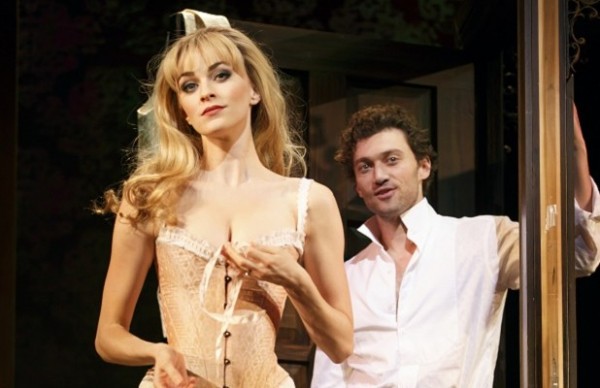
ABT veterans Alessandra Ferri and Herman Cornejo play passionate lovers in Martha Clarke’s unique adaptation of Colette’s CHÉRI (photo by Joan Marcus)

The Pershing Square Signature Center
The Irene Diamond Stage
480 West 42nd St. between Tenth & Eleventh Aves.
Extended through December 29, $75
212-244-7529
www.signaturetheatre.org

In 1920, Sidonie-Gabrielle Colette published the short novel Chéri, the story of a love affair between a young man and an older woman that she had first told in a series of short stories for Le Matin. Baltimore-born director and choreographer Martha Clarke (The Garden of Earthly Delights) has now transformed the beloved tale into a minimalist performance piece that is the first of her three Residency Five productions for the Signature Theatre. Chéri stars current American Ballet Theatre principal dancer Herman Cornejo as the title character, a twenty-four-year-old man in the midst of a torrid six-year affair with Lea (former ABT principal dancer Alessandra Ferri), the forty-nine-year-old best friend of his mother, Charlotte (Amy Irving); both women are courtesans in Belle Époque France. “Was he my gift to her? Or did she take him from me?” Charlotte says to the audience in one of four monologues adapted by Tina Howe (Painting Churches, Coastal Disturbances) from Colette’s Chéri and its sequel, The Last of Chéri. Over the course of sixty-five minutes, Cornejo and Ferri perform a series of solos and pas de deux that display their fiery emotions, which grow ever more complicated when Charlotte marries her son off to a virgin from a wealthy family. Chéri and Lea move passionately in rhythm, as if they are the only two people in the world, but when he comes back from fighting in WWI, nothing is quite the same. Although much of the dancing is splendid, particularly when Cornejo lifts Ferri against a wall and his face makes its way down her body, it becomes repetitive, an at-times confounding mix of silent-film acting and operatic panache. Irving is calm and steady as Charlotte, but her words feel unnecessary, as if they could have been trimmed down to spare surtitles instead. Set and costume designer David Zinn’s stage melds the colorful lightness of Bonnard with a Caligari-like German Expressionism, highlighted by long, slanted doorways and mirrors that more than hint at an approaching darkness. The gentle, tender score is played live by pianist Sarah Rothenberg and features selections from Maurice Ravel, Claude Debussy, Richard Wagner, Morton Feldman, and, most prominently, Federico Mompou. Unfortunately, Clarke’s Chéri winds up being less than the sum of its parts, a collaboration that never reaches its potential.