this week in theater

ODE TO JOY

(photo © Sandra Coudert)

Kathryn Erbe and Arliss Howard star as alcoholics in love in new Craig Lucas play (photo © Sandra Coudert)

Cherry Lane Mainstage Theatre
38 Commerce St.
Extended through April 16, $66
212-989-2020
www.rattlestick.org
www.cherrylanetheatre.org

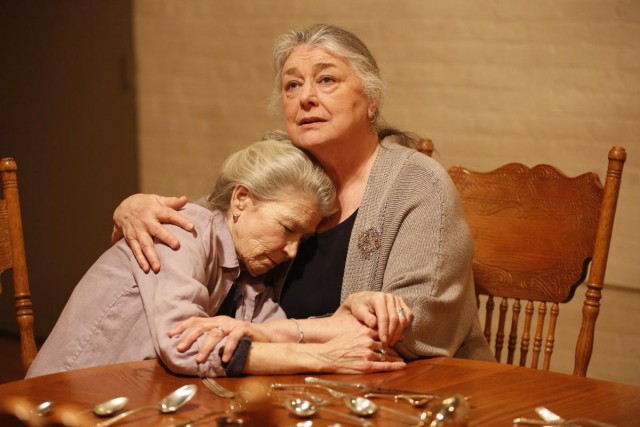
“If nobody walks out of a new play (before the reviews appear), something is almost certainly wrong,” Craig Lucas writes in the March issue of American Theatre. I was dismayed recently to see several people put on their coats and leave the Cherry Lane Theatre during intermission of Lucas’s new work, Ode to Joy. The first act of his investigation of love and addiction is edgy and exciting, taking chances with the dialogue and the action as two lonely problem drinkers, cardiac surgeon Bill (Arliss Howard) and painter Adele (Kathryn Erbe), meet in an otherwise empty bar (even the bartender is mostly offstage), talking about their lives, their desires, their failures, and, ultimately, their hope for a better future, perhaps together. They also discuss Kierkegaard, irony, boundaries, God, dogs, art, money, and booze, which they help themselves to by jumping over the bar. They have a whirlwind one-night romance, part awkward first date, part Days of Wine and Roses sheer unadulterated glee, Lucas’s razor-sharp dialogue hitting its mark time and time again, flowing beautifully with his fast-paced, unpredictable direction. The first act doesn’t end prettily — these are two big-time drunks, after all — but I couldn’t wait to see what would happen in the next act, as I found myself in love with the two main characters, even if I wasn’t sure I actually liked them. Adele is also joined in flashbacks by Mala (Roxanna Hope), her former girlfriend, but I hadn’t made my mind up about her yet.

(photo © Sandra Coudert)

Mala (Roxanna Hope) and Adele (Kathryn Erbe) experience the ups and downs of love in ODE TO JOY (photo © Sandra Coudert)

Unfortunately, the second act pales in comparison with the first. Lucas (Prelude to a Kiss, The Dying Gaul) turns his attention to the relationship between Adele and Mala, which is not nearly as interesting or entertaining as the one between Adele and Bill, which has now been reduced to Adele going through AA steps and making amends. The audience saw Adele and Bill’s story in thrilling action in the first act; in the second, we only hear of past misdeeds, sorrows, and tragedies. Suddenly the writing feels more forced, the action more stagnant. Lucas is a recovering addict himself, having given up drugs and alcohol less than ten years ago, around the same time his marriage was ending. Perhaps the play is too close to him, too personal. In the American Theatre piece, he explains that Ode to Joy is his attempt at his own Long Day’s Journey into Night. “I believe that meant I intended to tell the truth about my story. I sort of have, and I sort of haven’t,” he writes, “because I made the play’s protagonist a woman and a painter, and her relationships aren’t really mine. Or maybe they are.” It feels as if the play might be about Lucas’s own amends, and whether it actually is or isn’t doesn’t really matter, as he loses in the second act much of what he gained in the first. “Joy all creatures drink / At nature’s bosoms; / All, Just and Unjust, / Follow her rose-petalled path. / Kisses she gave us, and Wine,” Friedrich Schiller wrote in his 1785 poem “Ode to Joy,” which was later set to music by Beethoven as part of the Ninth Symphony. By all means you should stay for the second act; though it does run dry quickly, it has its clever moments and a few scattered joys, especially as Y2K approaches. It’s also the only way to get a program, given out only after the play, per Lucas’s instructions, a conceit that I found extremely appealing and one I hope more productions adopt.

LONDON WALL

(photo by Richard Termine)

John van Druten’s 1931 charming comedy about office politics is finally making its U.S. debut (photo by Richard Termine)

Mint Theater
311 West 43rd St. between Eighth & Ninth Aves.
Tuesday – Sunday through April 26, $55-$65
866-811-4111
www.minttheater.org

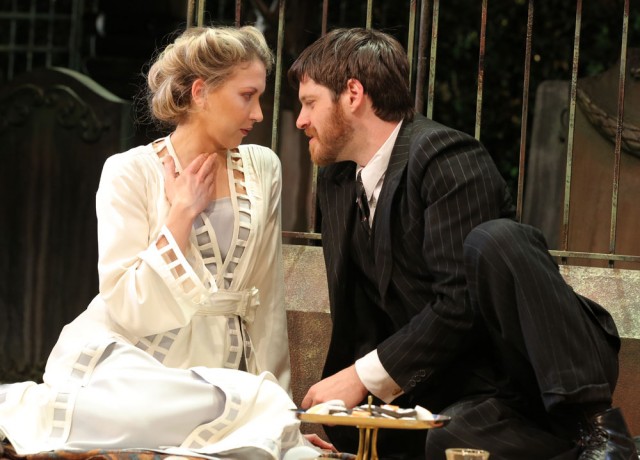
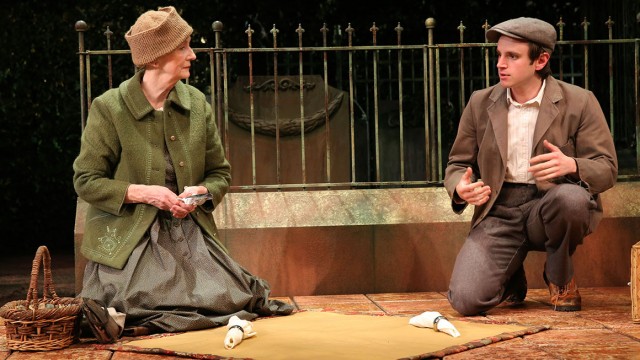
British playwright John Van Druten wrote some popular works — his oeuvre includes I Remember Mama; The Voice of the Turtle; Bell, Book and Candle; and I Am a Camera, which became the smash musical Cabaret, and all of which became films — but it has still taken more than eighty years for his 1931 romantic comedy London Wall to make its American debut. Its new production at Jonathan Bank’s Mint Theater makes one wonder, what took so long? In the London law firm of Walker, Windermere & Co., four shorthand typists gossip and discuss life and love in between working for young upstart and utter cad Mr. Brewer (Stephen Plunkett) and old man Walker (Jonathan Hogan). Cynical Miss Janus (Julia Coffey) has been with the firm for ten years and might or might not be dating a foreign diplomat. Sexy Miss Bufton (Katie Gibson) is a blonde bombshell who enjoys going out on the town. Miss Hooper (Alex Trow) is the ever-dependable employee who is not afraid to express occasional displeasure. And Miss Pat Milligan (Elise Kibler) is the youngest and most naïve of the typists, still finding her way in the world. The smooth-talking Brewer sets his sights on Pat, who has been spending time with the somewhat clueless Mr. Hec. Hammond (Christopher Sears), a twenty-year-old law clerk who works in the same building. Everything is overseen by Birkenshaw (Matthew Gumley), the young office boy who listens in on people’s phone conversations and brashly says whatever’s on his mind. When the case of wealthy but daffy client Miss Willesden (Laurie Kennedy) takes a sudden, unexpected turn, all of the characters are forced to reexamine who they are and what they want out of life.

(photo by Richard Termine)

Mr. Brewer (Stephen Plunkett) deals with troublesome but wealthy client Miss Willesden (Laurie Kennedy) in superbly acted and directed Mint revival (photo by Richard Termine)

Director Davis McCallum (The Whale, A Bright New Boise) keeps things moving at a near-farce pace, like fingers making their way across a typewriter, as buzzers sharply summon the women and many a door is slammed. The acting is exceptional throughout, from Hogan’s (As Is, Burn This) wise, understanding yet stern Walker and Horton Foote veteran Plunkett’s smooth, nearly effortless portrayal of would-be ladies’ man Brewer to Coffey’s (The Widowing of Mrs. Holroyd) motherly Miss Janus and NYU student Kibler’s splendidly timid Miss Milligan, who is the centerpiece of the story and serves as a kind of proxy for the audience. Despite its eighty-plus years, London Wall — which was made into the 1932 film After Office Hours — doesn’t feel old, dealing with office politics and romances and the unfair treatment of women in the workplace in clever, prescient ways that are still relevant today. It’s a sheer delight that it has finally made its way across the pond, courtesy of the master revivalists at the Mint, and it turns out that it’s part of a Van Druten barrage, as the Transport Group’s I Remember Mama is set to open in March at the Gym at Judson, and the Roundabout’s Cabaret is returning to the Kit Kat Klub at Studio 54 next month, with Alan Cumming reprising his role as the Emcee and Michelle Williams playing Sally Bowles. In addition, on March 17, the New York Public Library for the Performing Arts is hosting the free discussion “John Van Druten: A Writer’s Writer,” which will include readings from his papers as well as his correspondences with Christopher Isherwood, Tennessee Williams, Richard Rodgers, and others.

THE TRIBUTE ARTIST

THE TRIBUTE ARTIST

Things get more than a little wacky in Charles Busch’s latest romp, THE TRIBUTE ARTIST (photo by James Leynse)

59E59 Theaters
59 East 59th St. between Park & Madison Aves.
Tuesday – Sunday through March 29, $70
212-279-4200
www.59e59.org

Twenty years ago, writer, actor, and female impersonator Charles Busch donned pants for the first time in his career in his debut Primary Stages production, You Should Be So Lucky, to play a gay electrologist. In his latest work for Primary Stages and third overall (following 2011’s Olive and the Bitter Herbs), The Tribute Artist, Busch pulls off another personal first, portraying a female impersonator instead of a female character. Busch (Vampire Lesbians of Sodom, The Tale of the Allergist’s Wife) stars as Jimmy, a middle-aged Vegas “tribute artist” whose time impersonating Bette Davis, Marlene Dietrich, Marilyn Monroe, Judy Garland, et al., is coming to an end. Jimmy and his friend Rita (longtime Busch colleague Julie Halston), a sarcastic lesbian Realtor, have been staying at the gorgeous Greenwich Village home of wealthy widow and former fashion designer Adriana (Cynthia Harris), but when the grande dame suddenly dies, Jimmy and Rita concoct a plan to hide the body and give Jimmy his biggest role yet, playing Adriana long enough for Rita to sell the townhouse, with the two of them pocketing the potential $12 million windfall. But their scam hits a roadblock when Adriana’s niece, Christina (Mary Bacon), shows up with her transgender daughter, Oliver (Keira Keeley), and the wickedly bitter, woe-is-me Christina claims that in fact she is now the owner of her aunt’s estate. Jimmy soon has to dig even deeper into his bag of tricks when Oliver contacts Adriana’s onetime flame, Rodney (Busch mainstay Jonathan Walker), a man’s man up to some no good of his own.

Longtime collaborators Julie Halston and Charles Busch team up in caftan-laden farce (photo by James Leynse)

Longtime collaborators Julie Halston and Charles Busch team up again in caftan-laden farce (photo by James Leynse)

The Tribute Artist is a wonderfully entertaining homage to the classic screwball comedies and films noir of the 1930s and ’40s, as Jimmy throws in riotous references to movies from Hollywood’s Golden Age as the plot, which in part recalls Joe Orton’s Loot as well as You Should Be So Lucky, unfolds on Anna Louizos’s elegant living-room set. Busch (Die Mommie Die!) is a hoot as Jimmy, chewing up the scenery in Gregory Gale’s fab costumes and Katherine Carr’s wacky wigs while mixing in the wacky slapstick of Lucille Ball and the grace of Katharine Hepburn, and Halston (Red Scare on Sunset, The Lady in Question) has a field day as his loud, acerbic, quick-witted sidekick. Busch veteran Walker (The Assembled Parties, The Third Story) supplies a big dose of testosterone to the proceedings, including a scene-stealing monologue late in the second act. Director Carl Andress, who has worked with Busch, Halston, and Walker previously on The Divine Sister and other Busch productions, keeps things breezing along, embracing the cast’s familiarity with one another without letting it get out of hand while also keeping the more melodramatic moments in check, although the plot sometimes threatens to go off the deep end and it takes too long to warm up to Christina. A worthy addition to his canon, The Tribute Artist also succeeds as an homage to Busch himself and his, and our, love of all things camp.

BRONX BOMBERS

The Babe (C. J. Wilson) is better off packing up his things and going home in Broadway bomb about the Yankees (photo by Joan Marcus)

The Babe (C. J. Wilson) is better off packing up his things and going home in Broadway bomb about the Yankees (photo by Joan Marcus)

Circle in the Square Theatre
1633 Broadway at 50th St.
Tuesday – Sunday through March 2, $67 – $137
www.bronxbombersplay.com

Earlier this week, New York Yankees shortstop Derek Jeter announced over Facebook that he will be hanging up his cleats following the 2014 season. It’s a pity it wasn’t the new Broadway show Bronx Bombers — which features a fictional version of the pinstripes captain — calling it quits instead, immediately. Eric Simonson’s play, which transferred to Circle in the Square after fall training at the Duke on 42nd St., is nearly inconceivably dull and pointless, coming off more like an MLB-sponsored advertorial than an intuitive, intelligent look at baseball’s most storied franchise. The first act focuses on manager Billy Martin’s removal of Reggie Jackson from the outfield in the middle of an inning after Jackson loafed after a Jim Rice fly ball at Fenway Park on June 18, 1977. Yankees coach Yogi Berra (Peter Scolari) calls together captain Thurman Munson (Bill Dawes), Martin (Keith Nobbs), and Jackson (Francois Battiste) in a Boston hotel room to try to get the manager and the hot-dogging superstar to kiss and make up, but that’s not about to happen anytime soon. In the second act, Berra is caught up in a dreamlike fantasy in which he and his wife, Carmen (Tracy Shayne, who is married to Scolari in real life), host a dinner party with the greatest players in Yankees history, supposedly showing up to help Berra solve the Martin-Jackson dilemma and save the Yankees’ reputation and season. But not even the arrival of Lou Gehrig (John Wernke), Joe DiMaggio (Chris Henry Coffey), Elston Howard (Battiste), Babe Ruth (C. J. Wilson), Mickey Mantle (Bill Dawes), and Jeter (Christopher Jackson) can help playwright-director Simonson’s minor-league tale rise out of the cellar (as most of the sets do). Aside from Dawes, who captures the Mick’s wild personality, and Battiste, who nails Jackson’s braggadocio, none of the other actors turn in all-star performances, never embodying the famous, and familiar, athletes they are portraying. Simonson, the man behind such other sports-related Broadway productions as Lombardi and Magic/Bird, muddles the relationships among the players, with some dressed in uniform, others in suits, some in the prime of their careers, others nearing death, for no apparent dramaturgical reason. And in a 2008 coda, he includes no mention of Berra’s fourteen-year feud with owner George Steinbrenner, making Bronx Bombers feel even more like a promotional piece. Indeed, merchandise authorized by Major League Baseball is available for sale in the lobby, as are collectibles from an officially licensed memorabilia company. Unfortunately, the only souvenir worthy of this Broadway bomb is a Bronx cheer.

OFF BROADWAY WEEK 2014

Charles Busch’s THE TRIBUTE ARTIST is among off Broadway shows offering two-for-one tickets (photo © James Leynse)

Charles Busch’s THE TRIBUTE ARTIST is among off Broadway shows offering two-for-one tickets (photo © James Leynse)

February 17 – March 2
Tickets 2-for-1
www.nycgo.com

As such theater promotions as 20at20 and Broadway Week wind down, Off Broadway Week is just getting started. Two-for-one tickets are now on sale for nearly fifty off Broadway productions, from old favorites to shows still in previews. Among the old-timers are Blue Man Group at the Astor Place Theatre, The Fantasticks at the Snapple Center, and Stomp at the Orpheum. Twofers are also available for the highly touted Buyer & Cellar at Barrow Street, about a struggling actor who gets a job as an assistant to Barbra Streisand; Riding the Midnight Express at the Players Theatre, in which the real Billy Hayes tells the true story of his Turkish imprisonment; the New Group’s world premiere of Thomas Bradshaw’s extremely graphic Intimacy at the Acorn; Caryl Churchill’s Love and Information at the Minetta Lane; Craig Lucas’s Ode to Joy at the Cherry Lane; Bikeman: A 9/11 Play at Tribeca Performing Arts Center; Charles Busch’s The Tribute Artist at Primary Stages, starring Busch and Julie Halston; the new musical Transport at the Irish Rep; John Van Druten’s London Wall at the Mint; and the AA play Bill W. and Dr. Bob at SoHo Playhouse. There’s also plenty of family friendly shows, including The Berenstain Bears in Family Matters, the Musical; Piggy Nation: The Musical; The Amazing Max and the Box of Interesting Things; and The Greatest Pirate Story Never Told!

A GENTLEMAN’S GUIDE TO LOVE AND MURDER

GENTLEMAN

One of the D’Ysquiths (Jefferson Mays) celebrates with his potential murderer (Bryce Pinkham) in vengeful musical comedy

Walter Kerr Theatre
219 West 48th St. between Broadway & Eighth Ave.
Through September 7, $35-$137
www.agentlemansguidebroadway.com

Not even a ridiculously loud family sitting behind us, crunching on candy and talking throughout the first act, could dampen our thorough enjoyment of the wonderful new Broadway musical A Gentleman’s Guide to Love & Murder. The show follows the trials and travails of one Monty Navarro (Bryce Pinkham), who is in prison, writing his memoirs. The story then turns back to Monty’s mother’s funeral, where chatty Miss Shingle (Jane Carr) tells him that his mother was disowned by the noble D’Ysquith family when she married a man her relatives disapproved of. When Monty discovers that he is eighth in the line of succession to become earl, those men and women in between him suddenly start dropping like flies, each one played with a hearty wink and a nod by Jefferson Mays (I Am My Own Wife, Blood and Gifts) in ever-more-clever set-ups, from various lords and ladies to a dentally challenged reverend. Meanwhile, Monty can’t let go of the woman he adores, the spectacularly beautiful, self-centered, and manipulative Sibella Hallward (Lisa O’Hare), who is engaged to marry the never-seen Lionel Holland. Social mores of Edwardian England come tumbling down as Monty nears his vengeful goal. (If any of this sounds familiar, it’s because Gentleman’s Guide is based on Roy Horniman’s 1907 novel, Israel Rank: The Autobiography of a Criminal, the inspiration for Robert Hamer’s classic 1949 British black comedy, Kind Hearts and Coronets, in which Alec Guinness plays eight members of the D’Ascoyne family.)

GENTLEMAN

Sibella (Lisa O’Hare) and Monty (Bryce Pinkham) reevaluate their relationship in A GENTLEMAN’S GUIDE TO LOVE & MURDER

Robert L. Freedman (books and lyrics) and Steven Lutvak (music and lyrics), with director Darko Tresnjak and scenic designer Alexander Dodge, have created a lovely little tale, part The Mystery of Edwin Drood, part Gilbert & Sullivan operetta, with some Monty Python flourishes added for good measure. Pinkham (Ghost, Bloody Bloody Andrew Jackson) has devilish fun as Navarro, thinking up new ways to do away with his potential victims, while Mays — well, it’s often hard to figure out just how he changes from character to character so quickly, not only in wardrobe but in accent and style, a mind-boggling tour de force. Most of the action takes place on a stage within the stage, with red curtains and faces that occasionally come alive. Intentionally cheesy backdrops and playful video projection add to the fun of such numbers as “You’re a D’Ysquith,” “Poison in My Pocket,” and “The Last One You’d Expect,” while riotous slapstick propels a marvelous scene in which Monty is with Sibella but Phoebe D’Ysquith (Lauren Worsham) unexpectedly arrives, her sights also set on Monty, who does his best trying to keep each woman from finding out about the other. A Gentleman’s Guide to Love & Murder is a delicious mélange of music and mayhem, with plot twists that hold surprises even for those who adore Kind Hearts and Coronets.

DR. DU BOIS AND MISS OVINGTON

(photo by Ronald L. Glassman)

Miss Mary White Ovington (Kathleen Chalfant) and Dr. W. E. B. Du Bois (Timothy Simonson) discuss the state of the NAACP and more in world premiere play (photo by Ronald L. Glassman)

Castillo Theatre
543 West 42nd St. between Tenth & Eleventh Aves.
Thursday – Sunday through February 16, $25
212-941-1234
www.castillo.org
www.newfederaltheatre.com

On an early summer Sunday morning on Fifth Ave. in 1915, a white woman and a black man both unexpectedly show up at their place of employment, unable to rest from their crusade for justice and equality. Clare Coss’s slight but affecting Dr. Du Bois and Miss Ovington, presented by Woodie King Jr.’s New Federal Theatre at the Castillo, offers the unique opportunity of spending ninety minutes with social activists Mary White Ovington (Kathleen Chalfant) and Dr. William Edward Burghardt (W. E. B.) Du Bois (Timothy Simonson) as they discuss racism, politics, war, family, and more in the office of the NAACP, which they helped cofound and where Dr. Du Bois writes and edits The Crisis, the organization’s controversial magazine. Angered once again by disagreements with the board, Dr. Du Bois has come to the office to revise his resignation letter, while Miss Ovington is there because she was troubled as well by the previous evening’s board meeting. Ever determined, she says, “Fate has thrown us together now. Let us take advantage of this propitious moment.” And take advantage they do, often speaking in pedagogical, resolute phrases as Miss Ovington tries to convince Dr. Du Bois that he must stay with the NAACP. “Here, we unite against the greatest odds, because we value the worth of every single human being, We must not fail,” she says. “We must not fail, for our task is to transform three hundred years of alienation between black and white in our country,” he replies poetically, “and stir a great awakening in the American Negro — an inner revolution.” As they continue sharing their passions, they grow closer physically as well. Directed by longtime Castillo veteran Gabrielle L. Kurlander (Sally and Tom [The American Way]), the play is anchored by solid performances from Chalfant (Wit, Angels in America) and Simonson (Adam), who instill their characters with an endearing grace and warm familiarity, although Simonson includes an additional dose of earnestness. Chris Cumberbatch’s set is an office torn in half; on the left is Miss Ovington’s desk, with a typewriter and a window that looks out onto the city, while on the right is Dr. Du Bois’s darker, more claustrophobic space, with a dictaphone and a record player with an old horn speaker, echoing their respective roles in changing America’s views on racism. Dr. Du Bois and Miss Ovington is an intimate look at a critical moment in time whose ultimate impact can still be felt today.