this week in theater

BIG FISH

(photo by Paul Kolnik)

Father Edward (Norbert Leo Butz) introduces son Will (Zachary Unger) to a mermaid (Sarrah Strimel) in BIG FISH (photo by Paul Kolnik)

Neil Simon Theater
250 West 52nd St. between Broadway & Eighth Ave.
Through March 9, $49-$142
www.bigfishthemusical.com

Based on Daniel Wallace’s slim 1998 novel and Tim Burton’s overwrought 2003 film, Big Fish the musical has arrived on Broadway, but it doesn’t leave much of a splash. The story of fathers and sons and family legacies, Big Fish takes place in Alabama, opening with Will Bloom (Bobby Steggert) preparing to marry his sweetheart, Josephine (Krystal Joy Brown). Will asks his father, Edward (Norbert Leo Butz), not to tell any of his endless collection of stories at the wedding, but Edward can’t help himself, boldly spilling a secret that angers his son. The rest of the show goes back and forth between the present, in which Edward finds himself ill, and the past, as he fills his child’s (alternately played by Anthony Pierini and Zachary Unger) head with fantastical adventures that include witches, giants, mermaids, and dragons, all of which he claims to be true. Edward also details his romance with the love of his life, Will’s mother, Sandra (Kate Baldwin). Unfortunately, most of these tall tales come up short in the entertainment department.

Sandra (Kate Baldwin) and Edward (Norbert Leo Butz) fall in love in BIG FISH (photo by Paul Kolnik)

Sandra (Kate Baldwin) and Edward (Norbert Leo Butz) fall in love in BIG FISH (photo by Paul Kolnik)

From the opening number, Big Fish establishes itself as a completely standard Broadway musical, featuring a treacly, uninteresting score by Andrew Lippa (I Am Harvey Milk, The Addams Family), a book by August that confuses more than it intrigues, unnecessary video projections by Benjamin Pearcy, and flashy choreography by director Susan Stroman (The Scottsboro Boys, The Producers) that manages to be both tired and overdone. Like lesser Burton films, of which Big Fish is certainly one, style trumps substance; not even such Broadway favorites as Butz (Catch Me If You Can, Dirty Rotten Scoundrels), Baldwin (Finian’s Rainbow, Giant), and Brad Oscar (The Producers) as circus ringmaster Amos Calloway can save such drowning, hook-free numbers as “Be the Hero,” “Daffodils,” and “Start Over,” although Ciara Renée conducts herself well as the Witch in her Broadway debut and JC Montgomery is likable as Dr. Bennett. Despite its grand ambitions, this Big Fish ends up being all wet.

EAGER TO LOSE

(photo by Marielle Solan)

A Shakespearean catfight breaks out at Ars Nova in EAGER TO LOSE (photo by Marielle Solan)

EAGER TO LOSE: A FARCE IN BURLESQUE
Ars Nova
511 West 54th St. between Tenth & Eleventh Aves.
Extended through November 9, $30
212-352-3101
www.arsnovanyc.com

The fantastically inventive Ars Nova — home to 2011’s crazy The Lapsburgh Layover and 2012’s wildly successful Tolstoy adaptation Natasha, Pierre & the Great Comet of 1812, pulls off another amazing transformation, this time into the Tim Tam Room, a burlesque house where the utterly delightful Eager to Lose takes place. Tables and benches for patrons cluster around the Tim Tam’s glittering stage and runway, where the tall, handsome MC (John Behlmann) makes goofy jokes while introducing burlesque performers Tansy (Tansy Tan Dora), Glinda (Emily Walton), and Trixie (Stacey Yen), in addition to a guest dancer every night. But when Tansy, the star of the show and owner of the club, suddenly announces she is quitting in order to jet off on an international burlesque tour with Friends star David Schwimmer, Eager to Lose morphs into a Shakespearean farce told in ribald iambic pentameter as Trixie and Glinda fight over which one of them will take over and the MC realizes he is in love with Tansy and must profess his desire before she leaves, entrusting his oddball buddy, Peeps (Richard Saudek), to deliver a heartfelt note to her. But, of course, nothing goes quite as planned.

Richard Saudek brings down the house as the speech-impaired Peeps in EAGER TO LOSE (photo by Marielle Solan)

Richard Saudek brings down the house as the speech-challenged Peeps in EAGER TO LOSE (photo by Marielle Solan)

Written by Matthew-Lee Erlbach and directed by Wes Grantom and Portia Krieger, Eager to Lose is an immense amount of fun, mixing ample doses of sex and silly humor into its deliciously decadent tale. The plot evokes such Bard works as Macbeth, A Midsummer Night’s Dream, and A Comedy of Errors while incorporating classic vaudeville and silent-film bits referencing Buster Keaton, the Three Stooges, and the Marx Brothers. Walton is sweetly innocent as Glinda, Behlmann (The 39 Steps) is endearingly charming as the MC, part Jim Carrey, part David Duchovny, and cocreator and choreographer Tansy, known as the Elizabeth Taylor of Burlesque, has a field day as the sexy diva in the middle of it all. Even the band — musical director Cody Owen Stine on piano, Ben Arons on drums, Chris Bastian on bass, and Danny Jonokuchi on trumpet — gets in on the action. But Saudek virtually steals the show as the mute fool Peeps, displaying impressive pantomime skills that bring down the house several times. Mark Erbaugh’s set design and Tilly Grimes’s flashy costumes add to the many pleasures, as does a bar that remains open throughout the show. Be sure to arrive early for an extra little bonus.

NEXT WAVE FESTIVAL: NOSFERATU

(photo by Stefan Okolowicz)

Grzegorz Jarzyna’s unique take on the Dracula legend will keep trying to wake the audience up at BAM through November 2 (photo by Stefan Okolowicz)

Brooklyn Academy of Music
BAM Harvey Theater
651 Fulton St. between Ashland & Rockwell Pl.
Through November 2, $20-$65
718-636-4100
www.bam.org

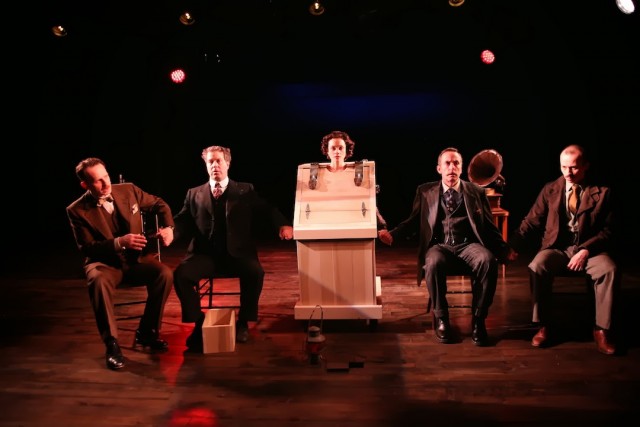
Somehow, in trying to create a fresh new way for audiences to experience the familiar vampire tale of Nosferatu, aka Dracula, theater master Grzegorz Jarzyna ended up with an absurdly slow-paced and downright dull production. Running at the BAM Harvey through November 2, TR Warszawa and Teatr Narodowy’s multimedia Nosferatu starts out well enough, establishing a contemporary social context while introducing the main characters in a large room with three floor-to-ceiling oval windows, two beds, a long table, and numerous mirrors with drastically different reflective qualities. But after a lively beginning, things slow down to sleep-inducing levels as a bland vampire preys on this small group of friends who at first discuss science, religion, fear, and death in intriguing, nonlinear ways before things give way to frustration, confusion, and boredom. Jarzyna, who has adapted such other works as Thomas Mann’s Doctor Faustus, Thomas Vinterberg’s Festen, Fyodor Dostoevsky’s The Idiot, and, together, Mozart’s Don Giovanni and Molière’s Don Juan, sucks the life out of the vampire legend over the course of 110 intermissionless, interminable minutes, leaving behind little more than smoke and mirrors.

THE SNOW GEESE

(photo by Joan Marcus)

The Gaesling clan gathers at their upstate lodge for the start of hunting season (photo by Joan Marcus)

Manhattan Theatre Club at the Samuel J. Friedman Theatre
261 West 47th St. between Broadway & Eighth Aves.
Tuesday – Sunday through December 15, $67-$120
www.manhattantheatreclub.com
www.thesnowgeesebroadway.com

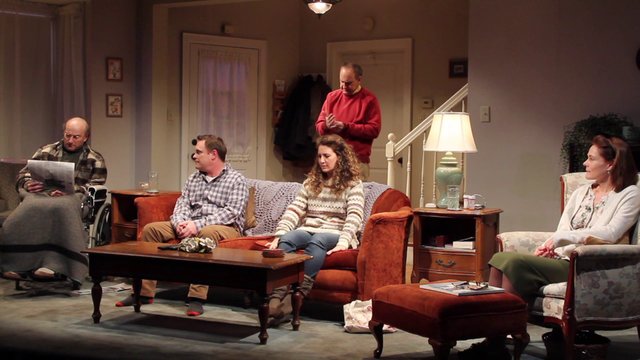
Late last year, Sharr White’s gripping The Other Place, a searing look inside the mind of a marketing executive lost in her own alternate reality, opened on Broadway after a 2011 run at MCC Theatre. White’s follow-up, The Snow Geese, another coproduction of Manhattan Theatre Club and MCC at the Samuel J. Friedman, is a dreary mashup of Alan Bridges’s 1985 film The Shooting Party and Chekhov’s The Cherry Orchard, a just-plain-dull WWI-era tale focusing on a woman having difficulty facing reality after the unexpected loss of her beloved husband. Despite the sudden death of Teddy, Elizabeth Gaesling (Mary-Louise Parker) thinks she is ready to go on with her life as the family comes together at their lodge in upstate New York for their traditional toast at the opening of snow goose season. Elizabeth is joined by her two sons: the patriotic, prodigal Duncan (Evan Jonigkeit), who goes to Princeton and has joined the war effort, and Arnold (Brian Cross), who has stayed home to take care of their mother and the family finances, which are not in very good shape.

(photo by Joan Marcus)

Two sisters (Mary-Louise Parker and Victoria Clark) try to get by in Sharr White’s new Broadway play (photo by Joan Marcus)

Also with them is Elizabeth’s sister, Clarissa (Victoria Clark), a very Christian woman who thinks that Elizabeth should still be in mourning, and her husband, Max (Danny Burstein), a German-born doctor with a thick accent who can no longer practice medicine because of anti-Axis sentiment, even though he has been an American for decades. Most of the meandering story plays out on John Lee Beatty’s stodgy dining-room set, with occasional boring scenes out in bare woods where Duncan and Arnold verbally spar while not shooting at snow geese, who fly by in a metaphorical gaggle of freedom. The most interesting figure in the play is the Gaeslings’ maid, Viktorya Gryaznoy (Jessica Love), a bright young woman from a wealthy family who escaped the Ukraine and has taken a job well below her; how she is treated by the others establishes not only her character but theirs as well. Director Daniel Sullivan (Proof, Orphans) is not able to do much with the material or the mediocre performances, surprising from such a talented cast. The Snow Geese takes aim at examining the human condition in a changing America during WWI but unfortunately ends up firing mostly blanks.

THE WINSLOW BOY

(photo by Joan Marcus)

The Winslow family faces a series of crises in revival of 1946 Terence Rattigan play (photo by Joan Marcus)

American Airlines Theatre
227 West 42nd St. between Broadway & Eighth Ave.
Tuesday – Sunday through December 1, $52-$137
212-719-1300
www.roundabouttheatre.org

The Roundabout production of Terence Rattigan’s 1946 drawing-room drama The Winslow Boy is like a fine episode of Masterpiece Theatre brought to life on the Broadway stage. Originally presented at the Old Vic, this new version of the rarely revived play, which was inspired by a true story and made into films twice (Anthony Asquith, 1948; David Mamet, 1999), follows the trials and tribulations of the Winslow clan just before World War I. Younger son Ronnie (Spencer Davis Milford), his father’s favorite, returns home after having been expelled from a prominent naval school for stealing a five-shilling postal order. The boy professes his innocence to his stern father, Arthur (Roger Rees), and his understanding mother, Grace (Mary Elizabeth Mastrontonio), so Arthur sets off on a quest to protect the family name, writing letters, going to the press, and hiring big-time lawyer Sir Robert Morton (Alessandro Nivola). But Arthur’s determination to get justice is soon negatively impacting the family, affecting daughter Catherine’s (Charlotte Parry) engagement to John Watherstone (Chandler Williams) as well as older son Dickie’s (Zachary Booth) future at Oxford. Meanwhile, Ronnie doesn’t really seem to care all that much, oblivious to all that is going on around him.

(photo by Joan Marcus)

Ronnie (Spencer Davis Milford) takes a rest while his father (Roger Rees) fights to save the family name (photo by Joan Marcus)

Written just after World War II about a period right before World War I and dealing with an anxiety-ridden middle class, The Winslow Boy still feels fresh and relevant. In his Broadway bow, director Lindsay Posner, who has previously helmed more than fifty shows in England — including several by Mamet — delicately balances humor with seriousness while guiding the action on Peter McKintosh’s lovely living-room set. Rees (Nicholas Nickleby, Indiscretions) is excellent as a father on a mission, willing to do whatever it takes to prove Ronnie’s innocence, no matter the personal and financial cost. Parry (Look Back in Anger, The Importance of Being Earnest) nearly steals the show as Catherine, a suffragist who always puts the cause ahead of her own desires. The solid cast also features Michael Cumpsty (End of the Rainbow) as family friend and solicitor Desmond Curry, an endlessly dull man who harbors a longtime fondness for Catherine, and Henny Russell (The Other Place, Lombardi) as Violet, the Winslows’ rather chatty maid. From top to bottom, The Winslow Boy is a wonderfully involving trip into another time that is really not that different from our own.

UNSPEAKABLE: A DRAMATIC FANTASIA

UNSPEAKABLE

UNSPEAKABLE looks at the tumultuous life and career of comedian Richard Pryor

Apollo Theater Soundstage
253 West 125th St.
November 1-3, $20
800-745-3000
www.apollotheater.org
www.facebook.com

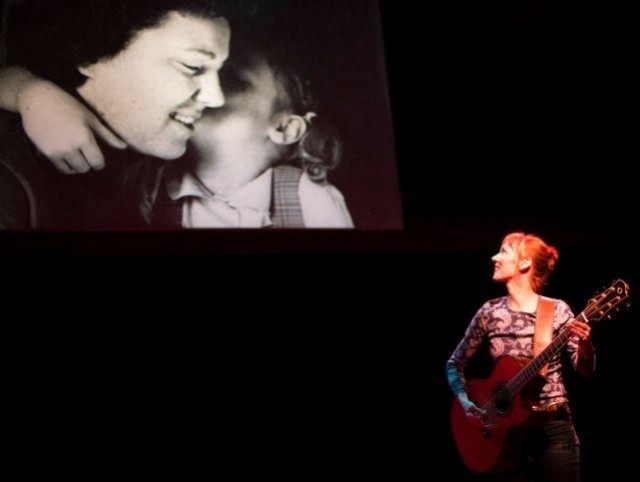
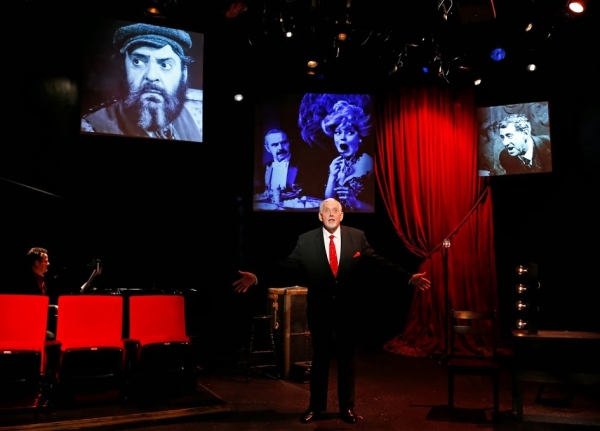
One of the most influential and controversial comics of his generation, Richard Pryor was not afraid to take on difficult issues of race and class in his brilliant stand-up routines. Born in Peoria, Illinois, in 1940, Pryor made such films as Richard Pryor: Live on the Sunset Strip, Blue Collar, and Silver Streak and such records as That N*gger’s Crazy and Outrageous, quickly earning a reputation for someone who says exactly what’s on his mind. Earlier this year, Marina Zenovich’s documentary Richard Pryor: Omit the Logic played at the Tribeca Film Festival and on Showtime, and now comes Unspeakable: A Dramatic Fantasia, a stage show inspired by Pryor’s tumultuous life, which ended in 2005 at the age of sixty-five. Written by Rod Gailes OBC and James Murray Jackson, Jr., Unspeakable is a work in development that explores Pryor’s life from childhood to death, focusing on the era between 1967 and 1982. Jackson, Jr., who was named Outstanding Lead Actor for playing the role in a 2005 version at the New York International Fringe Festival, is reprising the part this weekend at the Apollo, with Gailes OBC directing. The cast also includes Benja Kay Thomas, Margot White, Alvin Keith, Nedra McClyde, Adam Couperthwaite, and Nyahale A. Allie. “Richard Pryor broke down barriers, and stereotypes once thought unimaginable, said the unspeakable and did the unthinkable,” Gailes OBC said in a statement. “He taught us by holding a mirror to the conscience of America while self-destructing, and imploding on his own pain and grief. Though flawed in life, he lived uninhibited onstage. He was part preacher, social commentator, political activist, addict, and a whole lot of devil.” Unspeakable runs November 1-3 at the Apollo Theater’s Soundstage; tickets are $20.

A TIME TO KILL

(photo by Carol Rosegg)

Rupert Holmes’s stage version of John Grisham novel gets off to an exciting start at Golden Theatre (photo by Carol Rosegg)

Golden Theatre
252 West 45th St. between Broadway & Eighth Ave.
Tuesday – Sunday through November 17, $49 – $132
www.atimetokillonbroadway.com

In A Time to Kill, Rupert Holmes’s adaptation of John Grisham’s 1989 debut novel, Tony winner Holmes (The Mystery of Edwin Drood) and director Ethan McSweeny set things up well in the first act, but it all falls apart very quickly in a second act that could have been called A Time to Overkill. In fictional Clanton, Mississippi, two white racists, Billy Ray Cobb (Lee Sellars) and Pete Willard (Dashiell Eaves), have just been arrested by Sheriff Ozzie Walls (Chiké Johnson) for raping and beating a ten-year-old black girl. After a bail hearing, the girl’s father, Carl Lee Hailey (John Douglas Thompson), shoots and kills both of them in the courthouse. Arrested for double homicide, Hailey hires local defense attorney Jake Brigance (Sebastian Arcelus) to represent him. With the help of law student Ellen Roark (Ashley Williams) and disbarred lawyer Lucien Wilbanks (Tom Skerritt), Brigance battles hotshot prosecutor and potential gubernatorial candidate Rufus R. Buckley (Patrick Page) to save Hailey from the death penalty. The first act flows smoothly, with short scenes and quick set changes that mimic the pace of a movie; in fact, A Time to Kill was a successful 1996 film directed by Joel Schumacher and starring Matthew McConaughey (Brigance), Samuel L. Jackson (Hailey), Sandra Bullock (Roark), Kevin Spacey (Buckley), Kiefer Sutherland (Cobb), Donald Sutherland (Wilbanks), and Charles S. Dutton (Walls).

(photo by Carol Rosegg)

Mississippi courtroom drama runs out of gas in overly zealous second act (photo by Carol Rosegg)

But in the second act, which focuses on the trial overseen by Judge Noose (a stumbling Fred Dalton Thompson), unnecessary video projections, manipulative emotional twists, and an annoying conceit in which Buckley and Brigance address the audience as if it’s the jury grow tiresome. The plot and characterizations get more, well, black and white as the lines become more heavily drawn between good and bad, and any sense of nuance vanishes. Skerritt, in his Broadway debut, isn’t given much to do, and none of the actors (the cast also includes Tonya Pinkins as Hailey’s wife and John Procaccino as a drunk insanity expert) deliver standout performances as the cardboard-cutout of a story continues. Grisham fans — who very likely are in the midst of reading his brand-new novel, Sycamore Row, which features the return of Brigance — will notice the deletion of certain characters, most prominently Ethel Twitty, Harry Rex Vonner, Stump Sisson, and Carla Brigance, making for a more streamlined version, but there are better ways to kill time than by seeing this overly zealous treatment of A Time to Kill. [ed note: On November 7, it was announced that the final performance will be held on November 17. In addition, John Grisham will host the November 14 performance, discussing the original novel, the play, and the sequel, Sycamore Row.]