this week in theater

THE LIFE AND DEATH OF MARINA ABRAMOVIC

Willem Dafoe

Marina Abramović’s life — and death — takes center stage with the help of Willem Dafoe, Antony, Robert Wilson, and others

Park Avenue Armory, Wade Thompson Drill Hall
643 Park Ave. at 67th St.
December 13-21, $135, 7:30
212-933-5812
www.armoryonpark.org

Performance artist extraordinaire Marina Abramović has been undergoing a career renaissance this century, highlighted by an exciting, vibrant 2010 MoMA retrospective, “The Artist Is Present,” and the 2012 documentary about the making of the exhibition. The Serbian-born, New York-based Abramović is a regular at fancy galas, and she even recently performed at Pace Gallery with Jay-Z. So what does the sixty-seven-year-old artist do, just as her life and career have become rejuvenated? Well, she stages her own funeral, of course. Actually, Abramović has decided to hand her biography over to experimental theater maestro Robert Wilson, the man behind such innovative and unique collaborations as The Black Rider with William S. Burroughs and Tom Waits, Einstein on the Beach with Philip Glass and Lucinda Childs, and The Temptation of Saint Anthony with Bernice Johnson Reagon and Geoffrey Holder. In The Life and Death of Marina Abramović, the woman behind the “Rhythm” series and so many other cutting-edge works plays herself and her mother, with Willem Dafoe serving as narrator and songs by Antony Hegarty. Conceived and directed by Wilson, it is another audiovisual spectacle that has already had a documentary made about its creation; “Marina is the landscape, Bob the mind, Antony the heart, Willem the body,” director Giada Colagrande explains. The Life and Death of Marina Abramović will fill the Park Ave. Armory’s Wade Thompson Drill Hall December 12-21; on December 15 at 6:15, armory artistic director Alex Poots will moderate an artist talk with Abramović and Dafoe in the Veterans Room as part of the Malkin Lecture Series.

AUGUST WILSON’S HOW I LEARNED WHAT I LEARNED

(photo by Joan Marcus)

Ruben Santiago-Hudson was August Wilson’s personal choice to take over one-man show (photo by Joan Marcus)

The Pershing Square Signature Center
The Alice Griffin Jewel Box Theatre
480 West 42nd St. between Tenth & Eleventh Aves.
Extended through December 29, $55
212-244-7529
www.signaturetheatre.org

August Wilson’s one-man show, How I Learned What I Learned, has arrived in New York at last, and like any Wilson work, it’s a very welcome event. When the two-time Pulitzer Prize-winning playwright passed away from cancer at the age of sixty in 2005, plans were already under way for a season of his works as part of the fifteenth anniversary celebration of the Signature Theatre. For that 2005 season, Wilson was going to present the New York premiere of his own one-man show and personal memoir, How I Learned What I Learned, which he premiered in Seattle in 2002. Following his death, the season turned into a tribute to Wilson’s vast legacy, with productions of Seven Guitars, Two Trains Running, and King Hedley II. Seven years later, How I Learned What I Learned is finally making its New York debut, in an intimate, intoxicating version running at the Signature through December 29, directed by Todd Kreidler, who conceived the project with Wilson and directed the original. Ruben Santiago-Hudson, Wilson’s personal choice to take over the play, gets to step into Wilson’s shoes and put on his hat and coat — the costumes were chosen by Wilson’s widow, Constanza Romero — for eighty thrilling minutes, sharing fascinating tidbits from Wilson’s life growing up as Frederick August Kittel Jr. in Pittsburgh’s Hill District.

HOW I LEARNED WHAT I LEARNED celebrates the genius of August Wilson (photo by Joan Marcus)

HOW I LEARNED WHAT I LEARNED celebrates the genius of August Wilson (photo by Joan Marcus)

Longtime Wilson set designer David Gallo arranged the sparse stage, featuring just a desk, a chair, and a coat rack set against a backdrop of hundreds of pieces of paper dangling from the ceiling. Santiago-Hudson, who won a Tony as Canewell in Seven Guitars and directed last year’s stellar Signature revival of Wilson’s 1990 Pulitzer Prize winning The Piano Lesson, portrays Wilson with an easygoing, natural grace as he talks poignantly about episodes from his past, including quitting numerous jobs to preserve his dignity, meeting people who would help shape his future, and getting locked up in jail. He strolls amiably across the stage, sits on the desk, and watches as the title of each new section is projected onto the papers behind him, each letter accompanied by the sound of a typewriter stroke. As always, Wilson’s words shine; he doesn’t go out of his way to connect the dots, get heavy-handed about the racism and poverty he experienced, or lament what could have been. Instead, he lets the stories create a path for the viewer to follow to his majestic body of work, which he never brings up, as the play ends prior to his writing his first play. Everything about How I Learned What I Learned feels just right, a labor of love from his friends and colleagues that is a gift to the rest of us.

ALEC DUFFY: OUR PLANET

OUR PLANET (photo by Julie Lemberger / www.julielemberger.com)

Luna (Jenny Seastone Stern) and Terri (Julian Rozzell Jr.) take audience on multimedia journey through Japan Society and the universe in OUR PLANET (photo by Julie Lemberger / www.julielemberger.com)

Japan Society
333 East 47th St. at First Ave.
November 20-24, December 5-8, $28, 7:30
212-715-1258
www.japansociety.org

In the past few years, several site-specific shows have led audiences through historic, landmarked, and/or unusual buildings, going into rooms not otherwise open to the public. An adaptation of Joseph Roth’s Hotel Savoy took place throughout the Goethe-Institut, Sleep No More is still packing them in all over the McKittrick Hotel, and Manna-Hatta served as a guided tour not only of the history of Manhattan but of much of the James A. Farley Post Office as well. Now Our Planet, inspired by Thornton Wilder’s Our Town, uses the lobby, pond, offices, basement, exhibition rooms, stage, and more of Japan Society to tell its audiovisual story of the birth — and eventual death — of the world. “I think everyone should see this building . . . in a really peculiar, interesting way and have this text be the vehicle for that exploration,” director Alec Duffy, who fell in love with the building while working there for a year, explains in a promotional video for the site-specific show. And Our Planet, a Japan Society commission in celebration of the sixtieth anniversary of its performing arts program, is certainly peculiar and interesting. Julian Rozzell Jr. stars as Terri, who leads thirty visitors through the beginning of the play; he is soon met by Jenny Seastone Stern as Luna, the moon. The two play house and discuss the state of the world in a fun scene that takes place inside Mariko Mori’s appropriately titled “Rebirth” exhibition. Speaking both metaphorically and metaphysically, Terri and Luna explore life on the micro level, involving Luna’s family, and on the macro level, involving the entire universe. In several of the locations, Nobuyuki Hanabusa’s motion graphics, consisting of geometric shapes and patterns, lines, stars, and more, are projected onto unique spaces, from elevator doors to a specially designed platform on the floor that reflects onto a ceiling mirror, taking the audience on a cosmic trip through the galaxy. The text, translated by Katsunori Obata and Miharu Obata and adapted by Aya Ogawa from Yukio Shiba’s award-winning Japanese production, Wagahoshi, is often mysterious and sometimes way out there, but just go with it, putting your faith in Rozzell J. and Seastone Stern, who are both beguiling and enchanting as they each deliver long monologues and take the audience on a multimedia journey through space, time, and the historic Japan Society building. Our Planet continues with six performances December 5-8, with each show limited to thirty people, so get your tickets now if you want to see this very peculiar, interesting work.

THE CONTENDERS 2013: CUTIE AND THE BOXER

CUTIE AND THE BOXER

Documentary tells the engaging story of a pair of Japanese artists and the life they have made for themselves in Brooklyn

CUTIE AND THE BOXER (Zachary Heinzerling, 2013)
MoMA Film, Museum of Modern Art
11 West 53rd St. between Fifth & Sixth Aves.
Tuesday, November 26, 8:00
Series continues through January 16
Tickets: $12, in person only, may be applied to museum admission within thirty days, same-day screenings free with museum admission, available at Film and Media Desk beginning at 9:30 am
212-708-9400
www.moma.org
www.facebook.com/cutieandtheboxer

Zachary Heinzerling’s Cutie and the Boxer is a beautifully told story of love and art and the many sacrifices one must make to try to succeed in both. In 1969, controversial Japanese Neo Dada action painter and sculptor Ushio Shinohara came to New York City, looking to expand his career. According to the catalog for the recent MoMA show “Tokyo 1955-1970: A New Avant-Garde,” which featured four works by Ushio, “American art had seemed to him to be ‘marching toward the glorious prairie of the rainbow and oasis of the future, carrying all the world’s expectations of modern painting.’” Four years later, he met nineteen-year-old Noriko, who had left Japan to become an artist in New York as well. The two fell in love and have been together ever since, immersed in a fascinating relationship that Heinzerling explores over a five-year period in his splendid feature-length theatrical debut. Ushio and Noriko live in a cramped apartment and studio in DUMBO, where he puts on boxing gloves, dips them in paint, and pounds away at large, rectangular canvases and builds oversized motorcycle sculptures out of found materials. Meanwhile, Noriko, who has spent most of the last forty years taking care of her often childlike husband and staying with him through some rowdy times and battles with the bottle, is finally creating her own work, an R. Crumb-like series of drawings detailing the life of her alter ego, Cutie, and her often cruel husband, Bullie. (“Ushi” means “bull” in Japanese.) While Ushio is more forthcoming verbally in the film, mugging for the camera and speaking his mind, the pig-tailed Noriko is far more tentative, so director and cinematographer Heinzerling brings her tale to life by animating her work, her characters jumping off the page to show Cutie’s constant frustration with Bullie.

Ushio Shinohara creates one of his action paintings in CUTIE AND THE BOXER

Ushio Shinohara creates one of his action paintings in CUTIE AND THE BOXER

During the course of the too-short eighty-two-minute film — it would have been great to spend even more time with these unique and compelling figures — the audience is introduced to the couple’s forty-year-old son, who has some issues of his own; Guggenheim senior curator of Asian Art Alexandra Munroe, who stops by the studio to consider purchasing one of Ushio’s boxing paintings for the museum; and Chelsea gallery owner Ethan Cohen, who represents Ushio. But things never quite take off for Ushio, who seems to always be right on the cusp of making it. Instead, the couple struggles to pay their rent. One of the funniest, yet somehow tragic, scenes in the film involves Ushio packing up some of his sculptures — forcing them into a suitcase like clothing — and heading back to Japan to try to sell some pieces. Cutie and the Boxer is a special documentary that gets to the heart of the creative process as it applies both to art and love, focusing on two disparate people who have made a strange yet thoroughly charming life for themselves. Cutie and the Boxer is screening November 26 at 8:00 as part of MoMA’s annual series “The Contenders” and will be followed by a discussion with Heinzerling. “The Contenders,” which consists of exemplary films that MoMA believes will stand the test of time and continues with such films as Haifaa Al-Mansour’s Wadjda, Ryan Coogler’s Fruitvale Station, Alexander Payne’s Nebraska, and Richard Linklater’s Before Midnight.

THE MOBILE SHAKESPEARE UNIT: MUCH ADO ABOUT NOTHING

The Public Theater
425 Lafayette Ave.
November 25 – December 15, $20 general admission
212-967-7555
www.publictheater.org

The Public Theater’s Mobile Shakespeare Unit is back from its three-week tour of all five boroughs and other locations, bringing its free production of Much Ado About Nothing to places where people have limited or no access to the arts, including the Park Avenue Armory Women’s Mental Health Shelter in Manhattan, the Queensboro Correctional Facility and the Fortune Society in Queens, the Rose M. Singer Center and the Eric M. Taylor Center on Rikers Island, the DreamYard Project in the Bronx, and the Bedford Hills Correctional Facility in Westchester. The last stop is the Public Theater itself, where the Bard’s 1598-99 comedy about romantic mischief, mystery men, and marital mayhem will run from November 25 through December 15. The show is directed by Kwame Kwei-Armah (Detroit ’67, Elmina’s Kitchen), with choreography by Chase Brock (The Tempest, Spider-Man: Turn Off the Dark) and original music by Shane Rettig (The Unknown, the Atomic Grind Show). The cast features Michael Braun as Benedick, Samantha Soule as Beatrice, A. Z. Kelsey as Claudio and Conrade, Kerry Warren as Hero, Marc Damon Johnson as Don Pedro and Verges, Ramsey Faragallah as Leonato, Lucas Caleb Rooney as Dogberry and Don John, and Rosal Colón as Margaret, Borachia, and Friar Francis. Tickets are only $20, and there are only twenty-three performances, so you better act fast.

DOMESTICATED

(photo by Joan Marcus)

Laurie Metcalf and Jeff Goldblum play characters at opposite ends of the spectrum in Bruce Norris’s searing DOMESTICATED (photo by Joan Marcus)

Lincoln Center Theater at the Mitzi E. Newhouse
150 West 65th St. between Broadway & Amsterdam Ave.
Tuesday – Saturday through January 5, $87
212-362-7600
www.lct.org

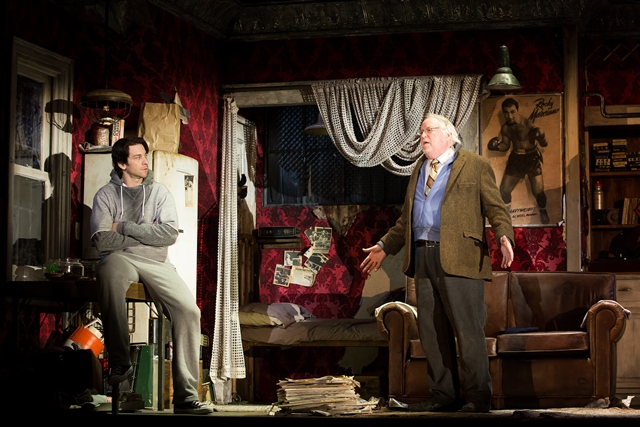
In his previous play, the Tony- and Pulitzer Prize-winning drama Clybourne Park, Bruce Norris presented an examination of race and community in two distinct halves, the first act taking place in 1959, the second in 2009. In his follow-up, Domesticated, Norris (The Pain and the Itch, The Parallelogram) again divides his story into two parts, but this time it’s a bitter battle of the sexes, with the wife stating her case in the first act and the husband making his in the second. The torn-from-the-headlines plot begins as a disgraced cabinet member, gynecologist Bill “the Pulverizer” Pulver (Jeff Goldblum), holds a press conference to announce his resignation because of a sex scandal, with his wife, Judy (Laurie Metcalf), by his side but looking none too pleased. For nearly the rest of the first act, Judy does not allow Bill to say a word as she lets him have it, reevaluating their life together as more of Bill’s extracurricular activities come out and a young woman lies in a coma. Their high school age daughter, the rather chatty and self-involved Casey (Emily Meade), is furious about the whole situation, while their adopted Asian daughter, asthmatic thirteen-year-old Cassidy (Misha Seo), speaks only to introduce certain scenes, discussing the mating habits of various animals as if delivering a school report, with the female of the species growing more and more powerful over the course of the play. “The purpose of this presentation is to examine the nature of sexual dimorphism and the advantages and disadvantages thereby conferred,” she says early on, speaking into a microphone as video images are projected onto small screens hanging from the ceiling. “Sexual dimorphism is the physical differentiation by gender within a given species, and may include such diverse manifestations as size, color, and the presence or absence of anatomical parts such as ornamental feathers, horns, antlers, or tusks.”

The Pulverizer (Jeff Goldblum) has a whole lot of explaining to do in tense family drama (photo by Joan Marcus)

The Pulverizer (Jeff Goldblum) has a whole lot of explaining to do in tense family drama (photo by Joan Marcus)

By the end of the first act, Bill has pretty much been plucked clean, but in the second act he explains himself to anyone who will listen, from a bartender to a transgendered individual to a patient at the health clinic he cofounded. (The cast also includes Vanessa Aspillaga, Lizbeth Mackay, Mary Beth Peil, Karen Pittman, and Aleque Reid playing multiple roles, with Mia Barron as the Pulver family’s attorney and Robin De Jesus as the bar patron.) Judy and Bill then fight it out one last time in a brutal war of words that is both complex and surprising. For Domesticated, the Mitzi Newhouse has been arranged in a circle, with the action taking place in the small center space. Steppenwolf member Anna D. Shapiro, who’s directed five previous Norris plays in addition to winning a Tony for August: Osage County, has each scene overlap the next in the first act, creating a fast, fluid atmosphere that slows down considerably in the far more static second act. The show is set up like a classic courtroom drama, the prosecution presenting its case first, then the defense, and it holds up well despite the apparent one-sidedness of the argument. Some scenes fall flat, especially the ones involving an Oprah-like talk show host (Pittman), and the second act drags on too long as it documents Bill’s downfall, but it becomes alive again during its fiery conclusion. Metcalf (The Other Place) once more shows why she’s become one of New York’s most dependable, gifted, and eminently watchable stage actors, giving beautifully subtle nuances to a character who could have been one-note and repetitive. Goldblum is solid as well, easily transitioning from a silent film comedian in the first act to an overblown misogynist in the second, although the script occasionally lets him down as he does indeed grow repetitive. The play also features an important warning to all couples: Beware the triplewart seadevil. (On December 19, Goldblum and Metcalf will take part in a free Platform Series discussion in the Vivian Beaumont lobby at 6:00.)

THE MUTILATED

(photo by Scott Wynn)

Trinket (Mink Stole) and Celeste (Penny Arcade) are looking for love and friendship on Christmas Eve in Tennessee Williams one-act (photo by Scott Wynn)

New Ohio Theatre
154 Christopher St.
Tuesday – Sunday through December 1, $35
888-596-1027
www.newohiotheatre.org

“We all have our mutilations,” Celeste Delacroix Griffin says in Tennessee Williams’s The Mutilated. The ninety-minute one-act, which flopped on Broadway in 1966 as part of a double bill with The Gnädiges Fräulein collectively titled Slapstick Tragedy, is currently playing to sold-out audiences at the intimate New Ohio Theatre, its first New York revival in thirty-eight years. An ample dose of slapstick and tragedy, the play features Warhol Factory star Penny Arcade (B*TCH!DYKE!FAGHAG!WH*RE!) as Celeste and John Waters muse Mink Stole (Pink Flamingos, Female Trouble) as her best friend / feared enemy, Trinket Dugan. With those leads — in roles originated by Kate Reid and Margaret Leighton, respectively — one might expect director Cosmin Chivu’s version to be a camp fest, but this adaptation ends up taking things fairly seriously. It’s Christmas Eve in 1940s New Orleans, and Celeste has just gotten out of the hoosegow only to find herself locked out of her room at the low-rent Silver Dollar Hotel. A buxom broad in a torn mink wrap, she’s more than down on her luck, but she’s tireless, setting her sights on burying the hatchet with Trinket, a lonely oil heiress (of sorts) with a shameful secret only Celeste knows about. But it’s clear that Celeste and Trinket belong together, despite their bitter feud; in fact, the play is very much about how two is more desirable than one. “In life there has to be two!” Trinket declares in a long soliloquy. When a pair of sailors (Niko Papastefanou and Patrick Darwin Williams) come around looking for some fun, both Celeste and Trinket jump at the opportunity to have male company on Christmas Eve, but love is not exactly in the cards for these two very different yet oddly similar women.

Downtown legends Penny Arcade and Mink Stole team up in Tennessee Williams's THE MUTILATED (photo by Cosmin Chivu)

Downtown legends Penny Arcade and Mink Stole team up in Tennessee Williams’s THE MUTILATED (photo by Cosmin Chivu)

The Mutilated actually gets going about twenty minutes before its official start time, with trumpeter Jesse Selengut and his Tin Pan band (Sam Kulik, Adam Brisban, and Anders Zelinski) serenading the arriving audience with raunchy New Orleans–style jazz and blues; they also accompany a group of carolers throughout the show who sing original songs as well as Williams’s own carol, which begins, “I think the strange, the crazed, the queer / Will have their holiday this year / And for a while, a little while / There will be pity for the wild / A miracle, a miracle! / A sanctuary for the wild.” Anka Lupes’s open set includes lighted doorless entries to the hotel, the Bohème nightclub (aptly named, as Celeste and Trinket are a kind of alternate Mimi and Francine), and Trinket’s tiny apartment. Whatever other scenery there might have been has apparently been chewed up by Arcade, who overplays her part with relish, looking like Roseanne Barr gone on a rampage. But Stole provides a gentle counterpoint as Trinket, the two coming together to find a necessary balance, their own version of Blanche and Stella. They also bring to mind a tragic Laurel and Hardy or Abbott and Costello duo, with Stole tall and thin and Arcade short and stout. Even their real names are opposites: “Mink Stole” evoking the rich and fashionable, “Penny Arcade” suggesting the cheap and old-fashioned. (And, furthering the actor-character integration, it’s Arcade who is wearing the mink in the show.) There’s been an abundance of Williams on and off Broadway over the last few years, including the current dazzling production of The Glass Menagerie at the Booth with Cherry Jones and Zachary Quinto, but it’s a treat that such lesser-known yet compelling and integral works as The Two-Character Play and The Mutilated are getting their due as well.