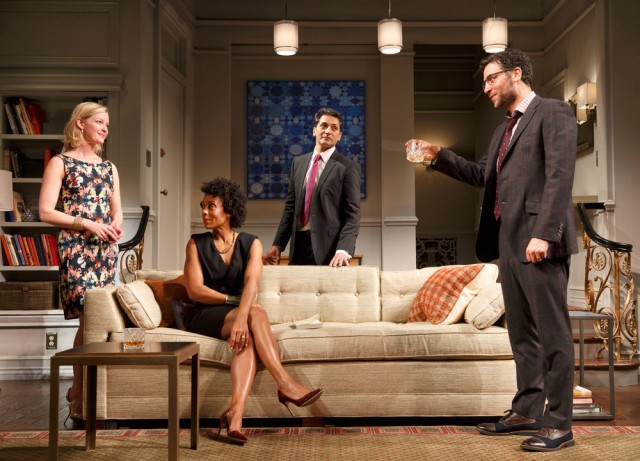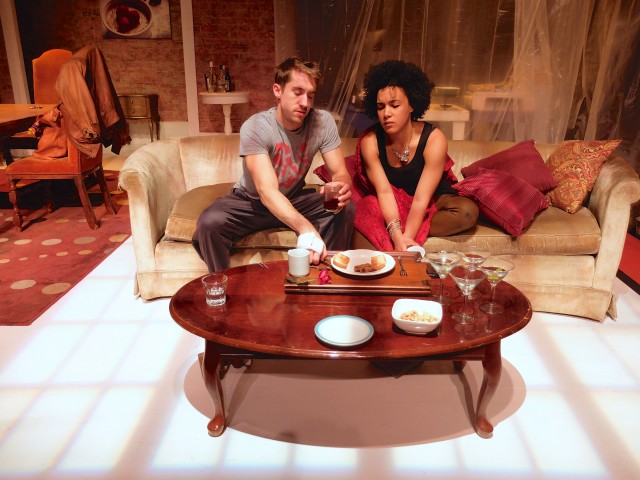
this week in theater

DONOGOO: A COMEDY

(photo by Richard Termine)

Lamendin (James Riordan) visits Dr. Rufisque (George Morfogen) to try to find purpose in his life in Mint revival of DONOGOO (photo by Richard Termine)

Mint Theater
311 West 43rd St. between Eighth & Ninth Aves.
Tuesday – Sunday through July 27, $27.50-$65
866-811-4111
www.minttheater.org

Perhaps the Mint Theater, usually so adept at digging up long-forgotten works and bringing them wonderfully to life (Katie Roche, London Wall), subtitled its latest unearthing, Jules Romains’s Donogoo, “A Comedy” to tell the audience that it is supposed to be funny. Unfortunately, there are few genuine laughs to be had in the disappointing farce, which has been performed in America only once before, in a 1961 production by the Greenwich Mews Theatre. In 1920, French writer Romains, author of the twenty-seven-volume Men of Good Will, published Donogoo-Tonka or the Miracles of Science: A Cinematographic Tale, and the satire about commercialism and colonialism was turned into a play ten years later. Newly translated and directed by Gus Kaikkonen, who did the same with the Mint’s 2010 revival of Romains’s Dr. Knock, or the Triumph of Medicine, the play, which the program describes as “A Comedy in 23 Tableaux,” follows the suicidal Jacques-Patrice Lamendin (James Riordan), who is saved from jumping off the Moselle Bridge by his friend Benin (Mitch Greenberg), who recommends that Lamendin see Dr. Miguel Rufisque (George Morfogen), a biometric psychotherapist who specializes in giving a reason to live to people considering ending it all. After putting Lamendin’s information into his computerlike apparatus — ingeniously concocted via live projections and real doors by set designer Roger Hanna and lighting designer Price Johnston — Dr. Rufisque gives him his prescription for life, which involves Lamendin’s having to serve a nose-blowing stranger.

Stage projections are only highlight of flat Mint revival (photo by Richard Termine)

Stage projections are only highlight of flat Mint revival (photo by Richard Termine)

Soon Lamendin dedicates himself to reestablishing the reputation of geographer Yves Le Trouhadec (Morfogen), who has been denied election to the Academy of Sciences because of a study he published about Donogoo-Tonka, a South American village that he made up. With the help of banker Margajat (Ross Bickell), Lamendin heads off to make Donogoo-Tonka a reality in order to get Le Trouhadec into the academy while also bringing purpose to his own renewed life. Donogoo evokes Monty Python’s adventure sketches, but there are more laughs to be found in five minutes of the latter as compared to the 140 minutes of the former. The intentionally broad overacting is actually too broad, and the jokes are old and flat. Magajat sort of sums things up when he tells Lamendin, “It’s a little lame. . . . No — no jokes!” However, Hanna and Johnston’s projections are phenomenal, as the actors magically spin globes, pull books off shelves, and open and close doors by interacting with film. But even those go away in the second act, as various prospectors head to Donogoo-Tonka to change their fortunes, a journey that is not worth joining.

MACBETH

(photo by John Persson)

Kenneth Branagh makes his rousing New York City stage debut in immersive production of MACBETH (photo by Johan Persson)

Park Avenue Armory
Wade Thompson Drill Hall
643 Park Ave. between 66th & 67th Sts.
May 31 – June 22
www.armoryonpark.org

Kenneth Branagh took care of a lot of firsts in the thrilling immersive production of Macbeth that just concluded its sold-out run at the Park Avenue Armory. Branagh makes his New York stage debut with the Scottish Play; it is also the first time he has appeared in Macbeth and marks his return to Shakespeare after a ten-year absence. Commissioned by the armory and the Manchester International Festival, this Macbeth was first presented in England in a deconsecrated church, but its impressive scope was further expanded for the armory production. Upon picking up tickets, each audience member also receives a wristband and clan designation, gathering in one of the rooms in the armory, then marching in unison into the Wade Thompson Drill Hall, which has been transformed into a dark and mysterious heath littered with tumbleweeds, rocks, and slowly moving figures in brown cloaks. The audience is seated by clan in two sets of bleachers separated by a narrow path of dirt: At one end of the path is an altar decorated with numerous candles and altarpieces of the adult and baby Jesus, Mary, and a saint, while on the other end is a Stonehenge-like arrangement of large stones.

MACBETH

Audience members are immediately put into the mood in thrilling version of the Scottish Play at the Park Ave. Armory (photo by Stephanie Berger)

The play, directed by Branagh and eight-time Tony nominee Rob Ashford (Thoroughly Modern Millie, How to Succeed in Business without Really Trying), begins with a breathtaking battle scene in the rain, which turns the dirt into mud as Macbeth and Banquo (Jimmy Yuill) lead King Duncan’s (John Shrapnel) army to victory. Following the fight, the Weird Sisters (Charlie Cameron, Laura Elsworthy, and Anjana Vasan), seemingly floating in the rock formation, make their prediction of Macbeth’s rise to the throne, and soon he and Lady Macbeth (Alex Kingston, in her New York City stage debut) are plotting their way to the top, with only Macduff (Richard Coyle) and Malcolm (Alexander Vlahos) in their way. A thoroughly convincing Branagh digs deep into Macbeth’s psyche, pulling out a wide range of intense emotions that give added depth to a familiar character, while Kingston plays Lady Macbeth with a mature, thoughtful vulnerability. The supporting cast, particularly Yuill, Shrapnel, Coyle, and Tom Godwin as the wretched porter, is outstanding as well, but they almost get swallowed up in the awe-inspiring stagecraft, highlighted by Christopher Oram’s terrific set — which often evokes a hellish pit of doom — Neil Austin’s divine lighting, and Christopher Shutt’s haunting sound design. The gripping two-hour intermissionless show feels right at home at the armory, which has its own military history, one that Branagh’s Macbeth is now a part of in its own unique way.

BROADWAY IN HD: THE NANCE

(photo by Joan Marcus)

Stagecast of THE NANCE starring Nathan Lane comes to Symphony Space as part of Broadway in HD series (photo by Joan Marcus)

Symphony Space, Leonard Nimoy Thalia
2537 Broadway at 95th St.
June 25 & 30, July 14 & 20, $23, 7:00
212-864-5400
www.symphonyspace.org
www.screenvision.com

Miss a big show because tickets were too expensive or too hard to get or the production took place overseas? Screenvision is now offering a second chance to check out select Broadway, Canadian, and British plays by showing them in movie theaters across the country. Earlier this month, the company, which specializes in movie-theater advertising, presented a filmed version of the Australian production of Alfred Uhry’s Driving Miss Daisy, starring Angela Lansbury and James Earl Jones. Now, in conjunction with Gay Pride Week, Screenvision and Broadway on Screen have teamed up with Lincoln Center Theater to present a stagecast of last year’s Broadway hit The Nance, Douglas Carter Beane’s poignant and engaging tale of a police clampdown on gay subculture in 1930s New York City. In the play, directed by Jack O’Brien (The Coast of Utopia, Much Ado About Nothing), Tony nominee Nathan Lane stars as Chauncey, a closeted burlesque performer who is trying to avoid getting arrested while picking up younger men in specific meeting points. The show also stars Andréa Burns, Jenni Barber, and Cady Huffman as a trio of strippers, Lewis J. Stadlen as Chauncey’s onstage partner, and Jonny Orsini as a one-night stand who turns into something more. The Nance will be screening June 25 & 30 and July 14 & 20 at 7:00 at Symphony Space as part of the Broadway in HD series, which also includes a June 24 showing of Christopher Plummer and Nikki M. James (The Book of Mormon, Les Misérables) in the 2008 Stratford Festival production of George Bernard Shaw’s Caesar & Cleopatra. In addition, Symphony Space will be screening the current revival of Alan Ayckbourn’s A Small Family Business on June 26 & 29 and July 9 & 17 as part of its ongoing National Theatre Live series.

VENUS IN FUR

VENUS IN FUR

The relationship between actor and director becomes an intense psychosexual battle in Roman Polanski’s VENUS IN FUR

VENUS IN FUR (Roman Polanski, 2013)
IFC Center, 323 Sixth Ave. at Third St., 212-924-7771
Lincoln Plaza Cinema, 1886 Broadway between 62nd & 63rd Sts., 212-757-2280
Opens Friday, June 20
www.ifcfilms.com

For his third stage adaptation in ten years, following 1994’s Death and the Maiden and 2011’s Carnage, Roman Polanski has created a marvelous, multilayered examination of the intricate nature of storytelling, consumed with aspects of doubling. David Ives’s Tony-nominated play, Venus in Fur, is about a cynical theater director, Thomas Novachek, who is auditioning actresses for the lead in his next production, a theatrical version of Leopold von Sacher-Masoch’s psychosexual novella Venus in Furs (which led to the term “sado-masochism”), itself a man’s retelling of his enslavement by a woman. In the film, as he is packing up and about to head home, Thomas (Matthieu Amalric) is interrupted by Vanda (Emmanuelle Seigner), a tall blond who at first appears ditzy and unprepared, practically begging him to let her audition even though she isn’t on the casting sheet, then slowly taking charge as she reveals an intimate knowledge not only of his script but of stagecraft as well. An at-first flummoxed Thomas becomes more and more intrigued as Vanda performs the role of Wanda von Dunayev and he reads the part of Severin von Kushemski, their actor-director relationship intertwining with that of the characters’ dangerous and erotic attraction.

Roman Polanski directs wife Emmanuelle Seigner in thrilling stage adaptation of Tony-winning play

Roman Polanski directs wife Emmanuelle Seigner in thrilling stage adaptation of Tony-nominated play

Ives’s English-language play, which earned Nina Arianda a Tony for Best Actress, was set in an office, but Polanski, who cowrote the screenplay with Ives, has moved this French version to an old theater (the Théâtre Récamier in Paris, rebuilt by designer Jean Rabasse) where a musical production of John Ford’s Stagecoach has recently taken place, with some of the props still onstage, including a rather phallic (and prickly) cactus. Polanski has masterfully used the machinations of cinema to expand on the play while also remaining true to its single setting. One of the world’s finest actors, Amalric, who looks more than a little like a younger Polanski, is spectacular as the pretentious Thomas, his expression-filled eyes and herky-jerky motion defining the evolution of his character’s fascination with Vanda, while Seigner, who is Polanski’s wife, is a dynamo of breathless erotic power and energy, seamlessly weaving in and out of different aspects of Vanda. Venus in Fur was shot in chronological order with one camera by cinematographer Paweł Edelman, who has photographed Polanski’s last five feature films, making it feel like the viewer is onstage, experiencing the events in real time. Alexandre Desplat’s complex, gorgeous score is a character unto itself, beginning with the outdoor establishing shot of the theater. The film also contains elements that recall such previous Polanski works as The Tenant, Bitter Moon, Tess, and The Fearless Vampire Killers, placing it firmly within his impressive canon. Polanski was handed Ives’s script at Cannes in 2012, and this screen version was then shown at Cannes for the 2013 festival, a whirlwind production that is echoed in Seigner’s performance; perhaps what’s most amazing is that it is only now finally getting its official U.S. theatrical release, beginning June 20 at the IFC Center and Lincoln Plaza.

SHAKESPEARE IN THE PARK: MUCH ADO ABOUT NOTHING

(photo by Joan Marcus)

Benedick (Hamish Linklater) and Beatrice (Lily Rabe) engage in a stirring battle of words in MUCH ADO ABOUT NOTHING (photo by Joan Marcus)

Central Park
Delacorte Theater
Tuesday – Sunday through July 6, free, 8:30
shakespeareinthepark.org

At the beginning of Jack O’Brien’s delightfully witty take on Much Ado About Nothing, the voice of Public Theater artistic director Oskar Eustis makes the usual announcements about rules concerning photography, cell phones, et al., mystifying members of the cast, who look around curiously, wondering where those sounds are coming from. That joke sets the stage for a playful evening that delves into the nature of love, romance, honor, and fidelity. In turn-of-the-twentieth-century Sicily, Don Pedro (Brian Stokes Mitchell) and his army stop by for a break at the home of Messina governor Leonato (John Glover). While soldier Claudio (Jack Cutmore-Scott) falls instantly in love with Leonato’s daughter, Hero (Ismenia Mendes), Leonato’s niece, Beatrice (Lily Rabe), engages in a heated battle of the sexes with soldier Benedick (Hamish Linklater), the words flying back and forth like an intimate swordfight. But when Don Pedro’s rascal of a brother, Don John (Pedro Pascal), who doesn’t believe in true love, purposely gets in the way, everyone’s loyalty is put to a severe test.

(photo by Joan Marcus)

Hero (Ismenia Mendes) and Claudio (Jack Cutmore-Scott) contemplate a future together in new MUCH ADO in Central Park (photo by Joan Marcus)

Much Ado has been a Shakespeare in the Park favorite for more than forty years, previously featuring the all-star Benedick-Beatrice pairings of Sam Waterston and Kathleen Widdoes in 1972, Kevin Kline and Blythe Danner in 1988, and Jimmy Smits and Kristen Johnston in 2004. It takes a while for the heat to rise between Linklater (The Comedy of Errors, Twelfth Night) and Rabe (As You Like It, Steel Magnolias), who previously appeared together in Seminar and the Al Pacino-led Merchant of Venice that moved from the Delacorte to Broadway; Rabe is a firecracker from the start, but Linklater’s clownish approach didn’t start working until some brilliant ad-libbing following a second-act rain delay the night we saw the show. The production is anchored by an expert performance by Glover, mixing elegance with sly humor, along with solid support from a steadfast Stokes Mitchell, a doe-eyed Mendes, a cartoonish John Pankow as local constable Dogberry, and Zoë Winters as alluring lady-in-waiting Margaret. Original music by David Yazbek adds to the fun, as does John Lee Beatty’s set, which includes a vegetable garden, a balcony, and a magic wall; costume designer Jane Greenwood’s dresses for the women are much stronger than the more mundane clothing for the men. Three-time Tony winner O’Brien’s (The Coast of Utopia, Hairspray) Shakespeare in the Park debut is a light and frothy evening that is a whole lot more than nothing.

(In addition to waiting on line at the Delacorte to get free tickets, you can also enter the daily virtual ticketing lottery online here.)

THE KILLER

(photo by Gerry Goodstein)

Michael Shannon stars as Eugène Ionesco everyman Berenger in TNA production of THE KILLER (photo by Gerry Goodstein)

Theatre for a New Audience, Polonsky Shakespeare Center
262 Ashland Pl. between Lafayette Ave. & Fulton St.
Tuesday – Sunday through June 29, $60-$100
866-811-4111
www.tfana.org

Michael Feingold’s new translation of Eugène Ionesco’s 1958 absurdist black comedy, The Killer, is a manic-depressive journey into such extremes as heaven and hell, life and death, and freedom and Fascism. Stage, screen, and television veteran Michael Shannon, who first starred as Ionesco everyman Berenger in a Chicago revival sixteen years ago, suggested doing a new production with Theatre for a New Audience, and it was a good call, a triumph from start to finish. As the three-hour, three-act play opens, Berenger, a schlumpy, shaggy-haired man in a long coat, scarf, and hat (and who would go on to appear in Ionesco’s A Stroll in the Air, Exit the King, and Rhinoceros), is in awe of a Garden of Eden-like paradise the Architect (Robert Stanton) is showing him. “I just knew that in the middle of our gloomy city, right in among all our sad, dark neighborhoods full of mud and dirt, I would find this bright, beautiful area, not rich or poor, with these sunny streets, these avenues streaming with light — this radiant city that you’ve built inside our city,” Berenger says, approaching the edges of the empty stage and reaching out as if the audience were colorful flowers there for the touching. While the Architect is pleased with Berenger’s reaction, he is also quick to note that he is merely a government official doing his job. “It’s all prearranged, all intentional,” the Architect explains. “Nothing can be left to chance.” But soon Berenger is lamenting another side of this heavenly area, which also features a hellish lagoon through a trapdoor where corpses are gathering, the handiwork of a mysterious murderer.

(photo by Gerry Goodstein)

Michael Shannon and BOARDWALK EMPIRE colleague Paul Sparks attempt to get to the bottom of things in existential black comedy (photo by Gerry Goodstein)

The second act takes place in and around Berenger’s room, in a house run by a sarcastic concierge (Kristine Nielsen). “Don’t talk to me about philosophy,” she says. “I once got it into my head to take the advice of the Stoics, and look at everything in perspective. They didn’t help me one bit, not even Marcus Aurelius. In the long run he was no use to anybody, no better or worse than you or me. We’ve all got to find our own way out. That is, if there was one, but there ain’t.” Soon Berenger is met by his friend Edward (Shannon’s Boardwalk Empire colleague Paul Sparks), a creepy, ghostly man dressed all in black, clutching a briefcase in a dastardly manner. They discuss the radiant city, the killer on the loose, negligence, and indifference before deciding to take action. And in the third act, candidate Ma Piper (Nielsen) is stumping for votes, promising “free soup for everybody” and to “de-alienate humanity,” while Edward and Berenger search for the former’s missing briefcase until the police show up and chaos ensues, concluding with an impossibly long monologue delivered by Berenger, looking death in the face.

(photo by Gerry Goodstein)

Kristine Nielsen gets a lift in second of two roles in THE KILLER (photo by Gerry Goodstein)

Shannon, who has been nominated for an Oscar for Revolutionary Road, won two Screen Actors Guild ensemble awards for his portrayal of Nelson Van Alden on Boardwalk Empire, and has been nominated for Lucille Lortel Awards for Bug and Mistakes Were Made, is mesmerizing as Berenger, ranging from ecstatic highs to deep lows as he contemplates joy and sadness, love and loss, and a complicated future. Director Darko Tresnjak, who just won a Tony for A Gentleman’s Guide to Love and Murder, keeps things peculiar all the way, mixing in bits of German Expressionism, film noir, and Italian neo-Realism on Suttirat Larlarb’s sparse set (which holds several little surprises) as Berenger continues his search for answers that are not easily forthcoming. Nielsen (Vania and Sonya and Masha and Spike) moves eagerly from frumpy concierge to goose-loving political candidate, while Sparks is plenty strange as the plenty strange Edward. At its center, The Killer is a captivating, perplexing allegory structured from the idea of original sin that follows humanity’s fall from grace. It’s also the third triumph in a row (after Julie Taymor’s A Midsummer Night’s Dream and Michael Pennington starring in King Lear) for Theatre for a New Audience in its intimate new home, the shining Polonsky Shakespeare Center in Brooklyn, which has quickly fit right in as part of the growing Fort Greene Garden of Eden that also includes BAM, BRIC, and the Mark Morris Dance Center.

PUBLIC FORUM: SHAKESPEARE IN AMERICA

James Earl Jones, who played the title role in the 1964 Shakespeare in the Park production of OTHELLO, will be back at the Delacorte as special evening honoring the Bard’s influence on America

James Earl Jones, who played the title role in the 1964 Shakespeare in the Park production of OTHELLO, will be back at the Delacorte as special evening honoring the Bard’s influence on America

FREE PUBLIC FORUM
Delacorte Theatre
Monday, June 30, free, 8:00
Tickets available June 30 at 12 noon at the Delacorte and online lottery
www.publictheater.org

The latest free public forum hosted by the Public Theater takes a look at the lasting and still-evolving impact of the works of William Shakespeare on American culture. The special evening is inspired by the new book Shakespeare in America: An Anthology from the Revolution to Now (Library of America, April 2014, $29.95), in which President Bill Clinton writes in the foreword, “Shakespeare only had a fleeting acquaintance with America, judging from his work, which brushed up against the New World on only a couple of occasions. . . . Nevertheless, our engagement with him as been long and sustained: generation after generation of Americans has fallen under his spell.” Taking place Monday, June 30, at the Delacorte, where Shakespeare in the Park is currently presenting a rousing version of Much Ado About Nothing, the forum will include James Earl Jones reading a scene from Othello, fifty years after he starred in a production at the Delacorte; Alec Baldwin reading from Macbeth and other works; Kelli O’Hara and Renée Elise Goldsberry singing a number from Shakespeare in the Park’s Twelfth Night; Steven Pasquale handling the male part of the “Tonight” duet from West Side Story; along with presentations from Elizabeth Alexander, Billy Collins, Brian Dennehy, Colin Donnell, Michael Friedman, André Holland, Harold Holzer, Stephen Merritt, Bryce Pinkham, Caesar Samoyoa, Vijay Seshadri, Sarah Amengual, Colman Domingo, Cynthia Nixon, Annie-B Parson, and Michael Stuhlbarg. “In a nation wrestling with great issues,” Shakespeare in America editor and Public Theater Shakespeare scholar in residence James Shapiro writes in the book’s introduction, “Shakespeare’s works allowed Americans to express views that may otherwise have been hard to articulate – or admit to.”