this week in theater

THE WAYSIDE MOTOR INN

(photo by Joan Marcus)

Ten people reevaluate their lives in a motel room in A. R. Gurney revival at the Signature (photo by Joan Marcus)

The Pershing Square Signature Center
The Alice Griffin Jewel Box Theatre
480 West 42nd St. between Tenth & Eleventh Aves.
Tuesday – Sunday through October 5, $55-$75
212-244-7529
www.signaturetheatre.org

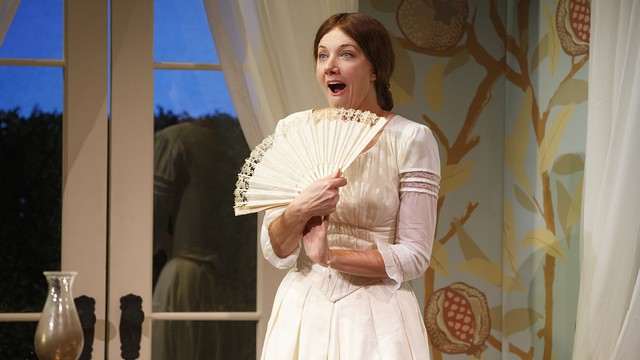
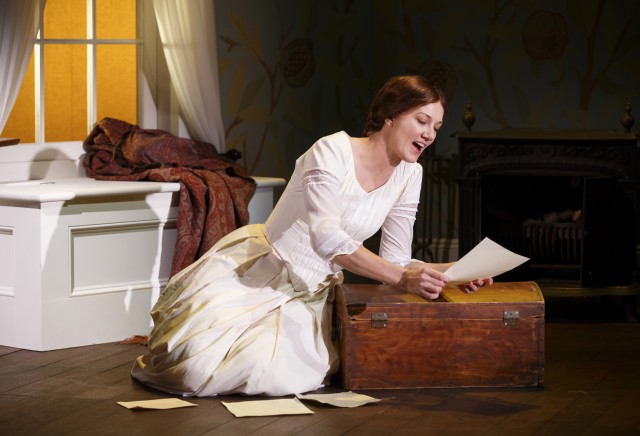
Award-winning playwright A. R. Gurney is currently represented by a pair of New York City revivals of two vastly different works. The Buffalo-born Gurney’s 1988 Love Letters, a Pulitzer Prize finalist, has recently begun a star-studded production at the Brooks Atkinson Theatre, directed by Gregory Mosher and featuring five pairs of big-time actors in succession — Mia Farrow and Brian Dennehy, Carol Burnett and Dennehy, Candice Bergen and Alan Alda, Diana Rigg and Stacy Keach, and Anjelica Huston and Martin Sheen — as a couple examining their long relationship by sitting down and reading letters they wrote to each other. Meanwhile, a bit southwest at the Signature Theatre, five two-character stories are being told simultaneously in a revival of Gurney’s 1977 densely packed drama The Wayside Motor Inn. Set outside Boston in the 1970s, the entire play takes place in a motel room where ten people come and go, as five unique stories occur at the same time in the same space. The set, designed by Andrew Lieberman, is a basic motel room with two queen-size beds in the center, a bathroom on the left, and a glass door with a small balcony at the right; it actually represents five separate rooms, but Gurney and director Lila Neugebauer ably guide the individual, overlapping narratives skillfully. Frank (Jon DeVries) and Jessie (Lizbeth Mackay) are an elderly couple visiting their new grandchild. Vince (Richard Topol filling in for Marc Kudisch the night we went) is an obsessed father determined that his son, Mark (Will Pullen), will get into Harvard, no matter what the moody teen really wants. Ray (Quincy Dunn-Baker) is a slick computer salesman and unfaithful spouse making a play for motel maid Sharon (Jenn Lyon). Andy (Kelly AuCoin) and Ruth (Rebecca Henderson) are in the midst of a contentious divorce. And young Phil (David McElwee) and Sally (Ismenia Mendes) are ready to make love for the first time.

(photo by Joan Marcus)

Five stories overlap in unique ways in THE WAYSIDE MOTOR INN (photo by Joan Marcus)

Over the course of two hours (with intermission), each character is forced to face some hard truths about their future while coming to terms with just what they want, expect, and, perhaps most important, need out of life. They reevaluate what they’ve done and where they’ve been as well as where they’re going. Some of the plots are more mundane and cliché-ridden than others, but Gurney, who was inspired by Verdi’s operas and the biblical parable of the sower and the seed in creating the play, makes them work as a uniform whole, with small elements from some relating to others as the actors from the different tales manage not to bump into one another or step on each other’s lines. In some ways, the five narratives can even be seen as events from a sixth, unseen life as couples first meet, fall in love, fall out of love, stick it out, send a child to college, have grandchildren, then face death. The Wayside Motor Inn might not accomplish all its lofty goals, but it is a compelling and entertaining exercise in formalist structure that always stays on track. The show, which runs through October 5, is part of Gurney’s Signature Residency, which continues in May 2015 with a revival of his 1981 play What I Did Last Summer, followed by the world premiere of a new play in the 2015-16 season.

WORKS & PROCESS AT 30

WORKS & PROCESS AT 30: ARTISTS AT WORK, ARTISTS IN PROCESS
New York Public Library for the Performing Arts, Dorothy and Lewis B. Cullman Center
40 Lincoln Center Plaza
Monday – Saturday through October 25, free
Thursday, September 25, “Three Choreographers Celebrate,” free with advance RSVP, 6:00
917-275-6975
www.nypl.org

WORKS & PROCESS
Solomon R. Guggenheim Museum, Peter B. Lewis Theater
1071 Fifth Ave. at 89th St.
October 5 – December 15, $30-$35
212-423-3500
www.guggenheim.org

For three decades, the Guggenheim has been presenting illuminating performances and discussions in its groundbreaking program Works & Process, in which emerging and established dancers, musicians, composers, and choreographers share their creative inspiration with glimpses at upcoming productions. The New York Public Library is honoring the series with “Works & Process at 30: Artists at Work, Artists in Process,” a collection of photographs, costumes, and printed ephemera from past events featuring some of the greatest directors, choreographers, and performers of the last thirty years. On September 25, the library will host “Three Choreographers Celebrate” in the Bruno Walter Auditorium (free with advance RSVP), bringing together a trio of W&P veterans, Karole Armitage, Larry Keigwin, and Pam Tanowitz, to talk about the importance of the program with Dance Theatre of Harlem artistic director Virginia Johnson; the event will also include footage from the library’s archives of nearly five hundred W&P performances. Meanwhile, tickets are now on sale and going fast for the fall 2014 W&P season, which continues October 5 with “The Kennedy Center: Little Dancer with Susan Stroman” (with Stroman, Boyd Gaines, Rebecca Luker, Tiler Peck, Lynn Ahrens, and Stephen Flaherty) and also includes Brian Brooks Moving Company on October 19-20, “Harlem Stage: Makandal” on October 27 (with Carl Hancock Rux, Yosvany Terry, Edouard Duval-Carrié, and Lars Jan), “In Process with Pam Tanowitz and David Lang” on November 2, and “Jerome Robbins: Fancy Free to On the Town” on November 9-10 (with Robert LaFosse, John Rando, Joshua Bergasse, Phyllis Newman, and Jamie Bernstein, moderated by Amanda Vaill).

THE VALLEY OF ASTONISHMENT

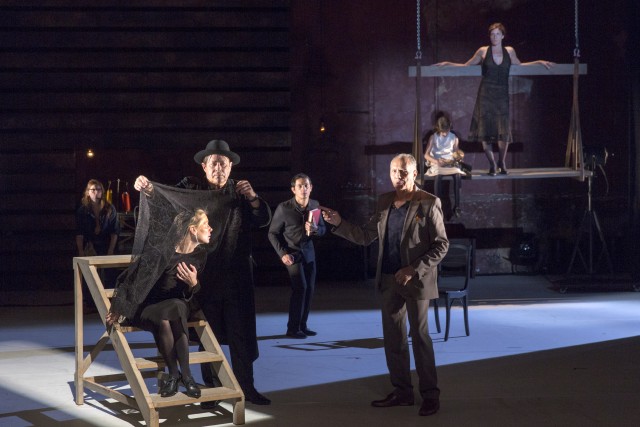
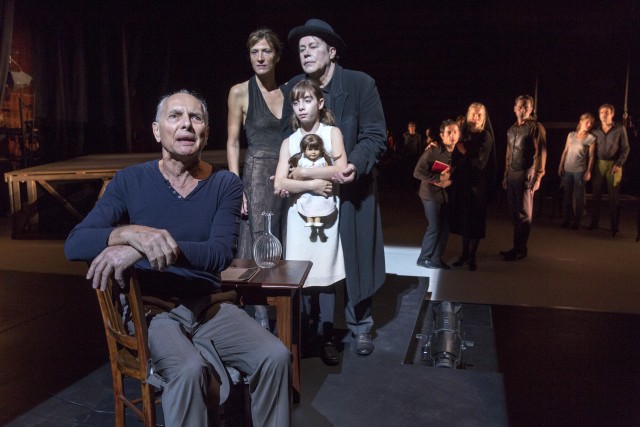
Jared McNeill and Kathryn Hunter explore rather unusual properties of the human brain in THE VALLEY OF ASTONISHMENT (photo by Pascal Victor / ArtComArt)

Jared McNeill and Kathryn Hunter explore rather unusual properties of the human brain in THE VALLEY OF ASTONISHMENT (photo by Pascal Victor / ArtComArt)

Theatre for a New Audience, Polonsky Shakespeare Center
262 Ashland Pl. between Lafayette Ave. & Fulton St.
Tuesday – Sunday through October 5, $60-$75
866-811-4111
www.tfana.org

The Valley of Astonishment, a fascinating, often thoroughly entrancing tale that delves into the magical mysteries of the human brain, comes from the endlessly creative minds of Peter Brook and Marie-Hélène Estienne and their C.I.C.T. / Théâtre des Bouffes du Nord company. The spare, eighty-minute production, running at Theatre for a New Audience through October 5, evokes elements of their previous works The Conference of the Birds, based on the twelfth-century poem by Farid ud-Din Attar, and The Man Who, inspired by Oliver Sacks’s The Man Who Mistook His Wife for a Hat, while going to new, exciting places. The great Kathryn Hunter (Brook and Estienne’s Fragments, The Bee) plays Samy Costas, a character inspired by the real-life Russian mnemonist Solomon Shereshevsky; Samy is a rather ordinary woman except that she has an extraordinary memory, able to recall everything that anyone has ever said to her through synesthesia, a process in which she associates words with images. Theatre de Complicité cofounding member Marcello Magni (Fragments with Hunter, The Birds directed by Hunter) portrays one of the scientists who studies Samy; a man with no proprioception who has to use his brain a special way in order to move his otherwise paralyzed body; and a one-armed magician inspired by René Lavand. And Jared McNeill (Brook and Estienne’s The Suit, Life of Galileo) plays a second scientist; a music-hall impresario; and a painter who sees colors when he listens to jazz. The live score is performed by composer and pianist Raphaël Chambouvet and Toshi Tsuchitori on strings and percussion; each man also takes his turn at center stage.

Kathryn Hunter is once again astonishing in Peter Brook / Marie-Hélène Estienne production (photo by Pascal Victor / ArtComArt)

Kathryn Hunter is once again astonishing in Peter Brook / Marie-Hélène Estienne production (photo by Pascal Victor / ArtComArt)

The scenes that explore the blessing/curse of synesthesia are dazzling; Hunter is delightfully mesmerizing, Magni is superb as the man relearning how to walk, and McNeill excels as he imagines painting a canvas on the floor, with the help of lighting designer Philippe Vialatte. (The set includes several unpainted chairs, a rolling desk, and a coatrack, with the musicians off to one side.) One of the scientists refers to Samy’s ability as “tricks,” and soon Brook and Estienne (Je suis un Phénomène, Woza Albert!) give the show over to the one-armed magician, who performs card tricks for some of the other characters as well as a pair of audience members pulled onstage. While the tricks are cool, the scene goes on far too long and appears relevant only in its final moment, by which time the narrative thread has nearly been lost. However, it does come together for a moving finale, especially as Samy grapples with the possibility that her unique powers might be reaching an end. The Valley of Astonishment is, at times, indeed astonishing, an intelligent yet playful exploration of some of the wondrous capabilities of the human brain and how supposed experts react to them, turning them into sideshow attractions rather than using them for a greater purpose. In conjunction with the show, TFANA is hosting “Celebrating Peter Brook,” a two-day film series honoring the eighty-nine-year-old writer, director, and author, consisting of screenings of son Simon Brook’s 2012 documentary Peter Brook: The Tightrope (followed by a Q&A with Simon) and 2002 doc Brook by Brook on September 29 and Peter’s 1968 film Tell Me Lies (introduced by Simon) on September 30.

EMBERS

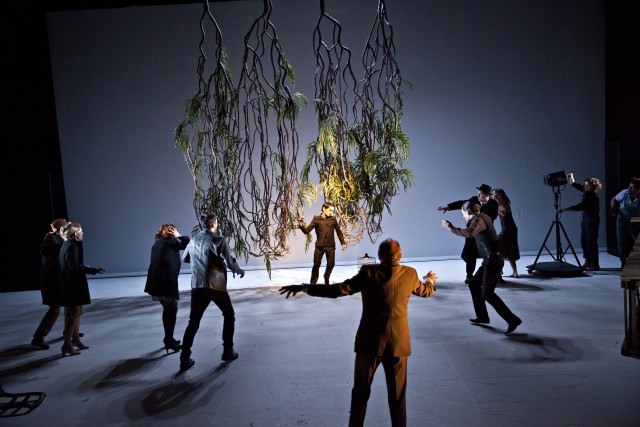
Andrew Bennett prepares to enter the mind of Henry in Samuel Beckett’s EMBERS (photo by Ros Kavanagh)

Andrew Bennett prepares to enter the mind of Henry in Samuel Beckett’s EMBERS (photo by Ros Kavanagh)

Brooklyn Academy of Music
BAM Harvey Theater
651 Fulton St. between Ashland & Rockwell Pl.
September 17-20, $35-$50
718-636-4100
www.bam.org
www.panpantheatre.com

Revivals of the absurdist works of Samuel Beckett can almost always be found somewhere in the city, but there’s been a surfeit of fine productions of late, including C.I.C.T. / Théâtre des Bouffes du Nord’s Fragments at BAC, Trevor Nunn’s All That Fall with Eileen Atkins and Michael Gambon at 59E59, Krapp’s Last Tape with John Hurt at BAM, and, most famously, this year’s Broadway version of Waiting for Godot with Sirs Patrick Stewart and Ian McKellen. Now Pan Pan Theatre, based in Beckett’s hometown of Dublin, has added quite a dash of panache to their production of his second radio play, Embers, a 1959 work that Beckett himself was disappointed with; “My fault, text too difficult,” he wrote to American director Alan Schneider in a letter after its first airing. As the fifty-five-minute U.S. premiere, running at the BAM Harvey through September 20 as part of the Next Wave Festival, begins, three men and one woman walk around a stage strewn with rocks, a large object in the center covered by a tarp, as dozens of cables holding eight evenly spaced small speakers apiece dangle from the ceiling, essentially announcing that this is very much about sound. Gentle, soothing surf can be heard as one of the men pulls the tarp off the object, revealing a stunning skull. Then Andrew Bennett and Áine Ní Mhuirí step behind the skull, the former, as Henry, occasionally visible through the right eyehole, the latter, as his wife, Ada, behind the left. They remain there as Henry, in a deep, booming voice made for radio, relates stories from his life, concentrating on the mysterious death of his father, his relationship with Ada, and his thoughts about their daughter, Addie. Various phrases repeat — “white world, great trouble, not a sound,” along with calls for hooves that are answered and screams of “Christ!” that are not — in Henry’s long monologues that open and close the show, framing a conversation between husband and wife that brings up old memories.

Áine Ní Mhuirí wanders the rocky shore of memory in Peter Pan Theatre production at BAM (photo by Ros Kavanagh)

Áine Ní Mhuirí wanders the rocky shore of memory in Pan Pan Theatre production at BAM (photo by Ros Kavanagh)

“Laugh, Henry, it’s not every day I crack a joke,” Ada says. “Laugh, Henry, do that for me.” “You wish me to laugh?” he asks. “You laughed so charmingly once,” she responds. His attempt at laughter is both funny and sad as he chortles, “Any of the old charm there?” Among the stories that crop up in Henry’s mind as he contemplates his failure as a writer, father, husband, and son and his own impending death are Addie getting scolded by her piano teacher and the odd tale of Bolton and Holloway, two men who might or might not represent Henry and/or his father (as might Ada and Addie, two names that are not only oddly similar but are close to “Dad” and “Daddy”). Indeed, there is an ambiguity throughout Embers that both confuses and delights; those looking for specific meaning are unlikely to find it, much like Henry’s search through his mind-skull for the meaning of his own existence. Director Gavin Quinn keeps things visually interesting through Aedín Cosgrove’s lighting, which focuses on different parts of Andrew Clancy’s skull, and Jimmy Eadie’s sound design, which melds the lapping of the ocean with changes in Henry’s vocal pitch. Ultimately, all that is left are “embers, sound of dying, dying glow,” Henry poetically says, as death stares him in the face, as it does to each and every one of us. (For more Beckett in Brooklyn, BAM will be presenting the Royal Court Theatre’s trio of one-woman plays, Not I, Footfalls, Rockaby, October 7-12 starring Lisa Dwan and directed by longtime Beckett collaborator Walter Asmus.)

OLYMPICS ÜBER ALLES

(photo by Carol Rosegg)

Show examines history of anti-Semitism through lens of 1936 Berlin Olympics (photo by Carol Rosegg)

St. Luke’s Theatre
308 West 46th St. between Eighth & Ninth Aves.
Wednesdays at 2:00, Thursdays at 8:00, Sundays at 1:00 through October 29 (extended), $39.50-$59.50
212-246-8140
www.stlukestheatre.com
www.olympicsuberalles.com

In 1936, U.S. Olympic runners Marty Glickman and Sam Stoller were unexpectedly removed from the 4×100-meter relay team the day before the event. Glickman, who went on to have a Hall of Fame career as a sports broadcaster, always claimed that the move was due to anti-Semitism, made to to appease the German furor over Jesse Owens’s having already won three gold medals. (The victories by the African American Owens infuriated Adolf Hitler, who had planned to use the Olympics to show off the dominance of the so-called master race.) However, Glickman’s claim was denied by U.S. Olympic Committee president Avery Brundage and head coach Lawson Robertson. Playwright Samuel J. Bernstein investigates the controversy in Olympics Über Alles, a two-hour debacle that is part didactic history lesson, part Purim shpiel, minus the humor. Glickman’s compelling story, which was recently told in an excellent HBO documentary, gets buried within a simplistic, heavy-handed exploration of centuries of anti-Semitism as Professor Steve Feinstein (Tim Dowd) attempts to convince college museum employee Kate McCarthy (Amy Handra) that the organization should mount his exhibition about Glickman (played by Michael Engberg in his younger years and Stewart A. Schneck as an adult) and the 1936 Nazi Olympics as part of its minority initiative. Director and dramaturg Debra Whitfield (The Banana Monologues, Trifles) cuts back and forth between various moments in the lives of Glickman and the Irish Catholic McCarthy, giving far too much time to the latter as Kate deals with a violent, alcoholic, virulently anti-Semitic father (Jim DiMunno) who refuses to allow her to have any Jewish friends.

olympics uber alles 2

Dowd and Handra are the only two members of the cast who portray one person; the six others take on multiple roles, but it’s not always clear who is who, and accents are primarily used only for Germans (although there is some Brooklynese as well). Glickman had a very distinctive voice, but neither Engberg nor Schneck attempt to re-create it. (Only one all-too-brief snippet of Glickman’s golden vocal cords is heard over the loudspeaker.) The stage includes six vertical screens that remain static for the first act — which ends with a mind-boggling performance of “HaTikvah,” the Israeli national anthem — but are moved around in the second half fairly randomly. Bernstein (Yank, Immortal Journey: Ponce de Leon and the Spring of Life), a Northeastern professor of English, collaborated on the play with coauthor Marguerite Krupp, who is officially credited with “bring[ing] the Catholic perspective to Olympics Über Alles,” although we’re not sure what that means. At one point, an influential Jewish businessman named Edelman (DiMunno) tries to convince Professor Feinstein that his exhibition will not be good for the Jews; unfortunately, the same thing can be said about the overly earnest Olympics Über Alles.

TRADE PRACTICES

(photo by Carl Skutsch)

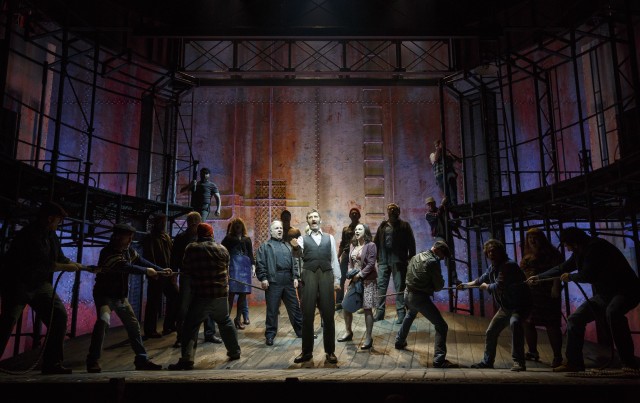
Site-specific HERE production on Governors Island puts the audience in the middle of the action (photo by Carl Skutsch)

Pershing Hall, Governors Island
September 10, 13, 14, 20, 21, $18
www.here.org

A little bit of Wall Street has ferried over to Governors Island for HERE’s new site-specific participatory production, Trade Practices. Conceived by David Evans Morris, who also designed the sets, and created by Morris with HERE artistic director Kristin Marting, who serves as director, the show takes place in several rooms in historic Pershing Hall, Governors Island’s administrative headquarters. It’s a treat just to go inside the usually off-limits building, which boasts terrific Federal Art Project murals in the lobby depicting Teddy Roosevelt going up San Juan Hill, Robert E. Lee surrendering to Ulysses S. Grant at Appomattox, Zachary Taylor falling on his horse at the end of the War of 1812, and scenes from other battles that hint at what’s about to come. Upon entering the building, each participant is given a colored ticket that assigns them to a story line, as Trade Practices follows Tender Inc., a successful family-owned paper company perhaps gearing up to go public in the early 2000s. The different episodes go behind the scenes with four sets of characters organized under Management (written by Robert Lyons), Communication (KJ Sanchez), Owners (Chris Wells), and Workers (Qui Nguyen) as the audience follows lots of infighting and backstabbing, from sexy public relations head Patricia Silver (Jenniffer Diaz), Odyssey-loving employee leader Franklin (Daniel Kublick), competing managerial fast-trackers Brenda McCall (Megan Hill) and Circe Boudreaux (Mariana Newhard), and the extremely ambitious and musical Polly Tender (Mary Rasmussen). The firm, loosely inspired by the actual, prestigious history and products of Crane & Co. (the contentiousness and market wranglings are all fiction), with more than a few hints of Dunder Mifflin, is at a crossroads, trying to evaluate its strengths and weaknesses, including those of its current CEO, the stiff-shirted Jim Tender (Peter McCabe). After the first scene, everyone gathers on the trading floor, a room with a digital stock ticker and numerous televisions tuned to a cable business channel, where Smith (Mike Iveson Jr.) and Jones (Daphne Gaines) share some intimate tips about the company (in skits written by Elisa Davis), and then everyone invests in the characters and story line they’d like to follow, using play money and certificates; trading floor meetings after each episode allow audience members to buy and sell stock to change story lines for succeeding vignettes.

The door opens to boom or bust in participatory show on Governors Island (photo by Carl Skutsch)

The door opens to boom or bust in participatory show on Governors Island (photo by Carl Skutsch)

Trade Practices is often too goofy and amateurish, but if you stick with the shaky premise and the purposeful overacting and invest yourself in it, you’ll certainly get your money’s worth, especially if others in the audience choose to get involved as well and don’t just hoard stock or hide in the background. As goal-oriented intern Darlene Tender (Brooke Ishibashi) warns early on, you will not be able to see everything during the two-hour indoctrination, so completionists, beware. In general, some scenes work much better than others, so your overall enjoyment is likely to be affected by the paths you choose, just as in life and business; we were partial to Patricia’s hot and fiery temperament and Franklin’s penchant for the unexpected, while musical theater enthusiasts would probably prefer Polly’s tale. It’s all rather low rent, which is part of its charm but also a drawback. The show doesn’t really shed much light on economics or business, but it’s still fun if you let yourself go and get immersed in the action. Trade Practices continues September 10 at 3:15, September 13 at 12:15, and September 14 and 20-21 at 12:15 and 3:45; tickets are eighteen dollars (cash only at the door; you can’t use real money to purchase stock), and the ferry is either free or two dollars depending on when you go.

20at20 FALL 2014

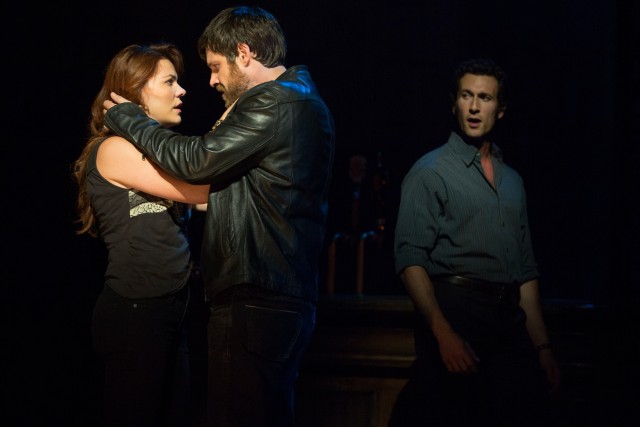
Famed drug smuggler Billy Hayes shares his real-life story in RIDING THE MIDNIGHT EXPRESS (photo by Carol Rosegg)

Famed drug smuggler Billy Hayes shares his real-life story in RIDING THE MIDNIGHT EXPRESS (photo by Carol Rosegg)

Multiple venues
September 9-28, $20, 20 minutes before showtime
www.20at20.com

In addition to Broadway Week (September 1-14), during which two-for-one tickets are available in advance for such Great White Way shows as Cabaret, Pippin, A Gentleman’s Guide to Love and Murder, Matilda, Kinky Boots, and others, 20at20 is about to get under way, with twenty-dollar seats on sale twenty minutes before curtain for nearly four dozen off-Broadway productions. For twenty days, September 9-28, a Jackson will get you in to such shows as Lee Blessing’s A Walk in the Woods with Kathleen Chalfant at the Clurman, Sean J Quinn’s Money Grubbin’ Whores at the Lion, Zoey Martinson’s Fringe 2013 hit Ndebele Funeral at 59E59, Samuel J. Bernstein and Marguerite Krupp’s Olympics Über Alles about Marty Glickman and Sam Stoller at St. Luke’s, Piece of My Heart: The Bert Berns Story at the Signature, Riding the Midnight Express with Billy Hayes at the Barrow Street Theatre, Conor McPherson’s Port Authority with Peter Maloney at DR2, Mario Correa’s Tail! Spin! with Sean Dugan and Rachel Dratch at the Lynn Redgrave Theater, George Kelly’s The Fatal Weakness at the Mint, and Tony winner Billy Porter’s While I Yet Live at Primary Stages. With the price of off-Broadway shows on the rise, this is a great opportunity to sample some fine theater on the cheap.