this week in theater

THE CURIOUS INCIDENT OF THE DOG IN THE NIGHT-TIME

(photo by Joan Marcus)

THE CURIOUS INCIDENT OF THE DOG IN THE NIGHT-TIME is lighting up the Ethel Barrymore Theatre (photo by Joan Marcus)

Ethel Barrymore Theatre
243 West 47th St. between Broadway & Eighth Ave.
Tuesday – Sunday (and some Mondays) through December 30, $27 – $225
www.curiousonbroadway.com
www.shubert.nyc

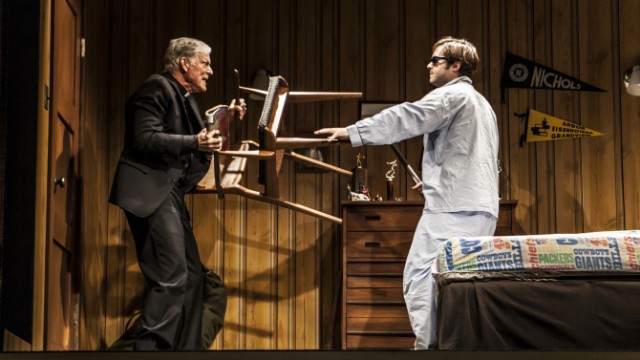
The National Theatre production of The Curious Incident of the Dog in the Night-time is an extraordinary multimedia journey through the mind of a fifteen-year-old boy with a kind of Asperger’s syndrome. Adapted with extraordinary care and insight by Simon Stephens (On the Shore of the Wide World, Punk Rock) from Mark Haddon’s award-winning novel and directed with flair by Marianne Elliott, the show takes place inside the created universe of truth-telling Christopher John Francis Boone (Alexander Sharp), an odd teen who is obsessed with prime numbers and mathematics, has a beloved pet rat named Toby, and does not like being touched. Upon discovering that the neighbor’s dog has been murdered, Christopher decides to play detective, interviewing people in the community to find the culprit. His father, Ed (Ian Barford), insists he stop sleuthing, as it will only lead to more trouble — Christopher has already been brought in by the cops, who considered him the chief suspect — but Christopher is determined to solve this mystery, as though it were a difficult but not impossible math equation. And when Christopher uncovers a shocking secret about his mother, Judy (Enid Graham), he sets out on another adventure, filled with dangers all its own.

(photo by Joan Marcus)

Christopher (Alexander Sharp) and his father (Ian Barford) bond in imaginative stage adaptation of Mark Haddon’s award-winning book (photo by Joan Marcus)

The Curious Incident of the Dog in the Night-time won seven Olivier Awards, including Best New Play, Best Director (Elliott), Best Actor (Luke Treadaway), and Best Supporting Actress (Nicola Walker), and it’s likely to win a bunch of prizes at next year’s Tonys as well. Elliott’s staging is captivating, the floor and three walls a grid on which Christopher draws emoticons, maps depict his travels, constellations appear, and video projections create a stunning escalator. Every technical element is worth praising: The sets and costumes are by Bunny Christie, lighting by Paule Constable, video by Finn Ross, choreography by Scott Graham and Steven Hoggett, music by Adrian Sutton, and sound by Ian Dickinson, combining to turn Haddon’s book into a treat for the senses. Twenty-five-year-old Sharp, a recent Juilliard graduate from London, is so immersed in his role that it is hard to believe he is acting, or that anyone else can play the part, but indeed, Luke Treadaway originated Christopher at the National Theatre, and Taylor Trensch gives Sharp a rest during matinees at the Ethel Barrymore Theatre. The cast members, several of whom play multiple roles, also includes Francesca Faridany as Siobhan, Christopher’s teacher and mentor who narrates brief passages from the book; Helen Carey as Mrs. Alexander, a gossipy neighbor who invites Alexander in for cookies; David Manis as Rev. Peters, who discusses God and heaven with the boy; and Mercedes Herrero and Richard Hollis as Mr. and Mrs. Shears, the owners of the dead dog. The repetitive, self-referential nods to the book as book are unnecessary, pulling the audience out of the immersive fantasy for a moment, and the postcurtain coda also takes the crowd out of the world of the play to allow the production to show off one more time, but otherwise The Curious Incident of the Dog in the Night-time is an absolute delight, a breathtaking, endlessly imaginative theatrical experience that is not to be missed. (As a bonus, some lucky ticketholders will find themselves in a Prime Number Seat, specially chosen by Christopher, which will win them a Curious button if the letters in their name add up to a prime number.)

JAMES DICKEY’S DELIVERANCE

(photo by Jason Woodruff)

Four friends are forced to reach deep inside themselves when trouble strikes in DELIVERANCE (photo by Jason Woodruff)

59E59 Theaters
59 East 59th St. between Madison & Park Aves.
Tuesday – Sunday through November 9, $25
www.59e59.org
www.godlighttheatrecompany.org

For twenty years, the Godlight Theatre Company has been specializing in stage adaptations of modern classic literature that has already been turned into well-known films. Among their previous works are One Flew Over the Cuckoo’s Nest, In the Heat of the Night, Slaughterhouse-Five, Fahrenheit 451, and The Third Man. They are now taking on James Dickey’s Deliverance, in a superb, stripped-down production making its world premiere at 59E59. In telling this harrowing story, playwright Sean Tyler and director Joe Tantalo have gone back to the source, Dickey’s 1970 novel, not John Boorman’s Oscar-nominated 1972 film, which starred Burt Reynolds, Jon Voight, Ned Beatty, and Ronny Cox as four friends whose Georgia canoe trip goes seriously wrong. So don’t expect to hear “Dueling Banjos” (Tantalo uses the Carter Family’s “Wildwood Flower,” from the book) or anyone squealing like a pig. But do expect to be chilled to the bone by this ever-insightful examination of what lurks in the pit of men’s souls.

(photo by Jason Woodruff)

Stark stage adaptation of James Dickey’s DELIVERANCE is told from the point of view of Ed Gentry (Nick Paglino) (photo by Jason Woodruff)

As Lewis Medlock (Gregory Konow), Ed Gentry (Nick Paglino), Bobby Trippe (Jarrod Zayas), and Drew Ballinger (Sean Tant) first set out on their country adventure, they have no idea what’s in store for them. When Griner (Eddie Dunn), a local mechanic, asks them why they’re planning on canoeing down the river, Lewis says, “Because it’s there,” to which Griner ominously replies, “It’s there, all right. But if you git in there and can’t git out, you’re goin’ to wish it wudn’t.” That prophecy comes true when they encounter two mountain men (Bryce Hodgson and Jason Bragg Stanley) who don’t take kindly to city folk, leading to tragedy that the four men might not be able to escape. Deliverance takes place on a shiny black twelve-foot-by-twelve-foot stage, with the audience sitting in two small rows on all four sides. Maruti Evans’s stark lighting and set design also includes dark walls (behind the audience) on which the characters’ reflections glow in the distance (below the biblical quote “The pride of thine heart hath deceived thee / thou that dwelleth in the clefts of the rock / whose habitation is high; that saith in his heart / Who shall bring me down to the ground?”). There are no props or projections, no water, no mountain imagery, no weapons — just the actors, who mimic drinking beer in a bar, paddling down the river, climbing over rocks, holding a rifle, and pulling back a bow. But it’s not gimmicky in the least; instead, it allows viewers to get immersed in the tale, using their imagination the way they would as if reading a book that comes alive in front of them. All of the actors are excellent, though the standout is Godlight regular Paglino, as the narrative unfolds from Ed’s perspective, especially during a long monologue during which he stares death in the face. At times you’ll think you are actually seeing the woods, the river, a deer, but it’s just your mind getting caught up in this thrilling, unique theatrical experience.

THE BELLE OF AMHERST

THE BELLE OF AMHERST

Joely Richardson stars as poet Emily Dickinson in off-Broadway revival of THE BELLE OF AMHERST

Westside Theatre
407 West 43rd St. between Ninth & Tenth Aves.
Tuesday – Sunday through January 25, $79
www.westsidetheatre.com

“Words are my life,” Joely Richardson declares as Emily Dickinson in the new revival of William Luce’s The Belle of Amherst that opened October 20 at the Westside Theatre. “I look at words as if they were entities, sacred beings.” In the one-woman show, Richardson (Nip/Tuck, Lady Chatterley’s Lover) stars as poet Emily Dickinson, a spinster-recluse who is sharing her life story with the audience. Now fifty-three, Dickinson, wearing a long white dress (designed by William Ivey Long), her auburn hair pulled back tight, whimsically discusses the importance of family (her sister Lavinia, known as Vinnie; her brother, Austin; her parents; and her aunt Libby), social graces, fame, solitude, nature, art, and romance, her monologue smoothly folding in her poetry along the way. Walking through Antje Ellermann’s bright, charming late-nineteenth-century drawing-room set, Dickinson is also bright and charming, though clearly a bit off-center, enthusiastically explaining that she is in full control of herself, even if the denizens of Amherst think she is crazy. “Oh, I do have fun with them. My menagerie,” she says. “I guess people in small towns must have their local characters. And for Amherst, that’s what I am. But do you know something? I enjoy the game. I’ve never said this to anyone before, but I’ll tell you. I do it on purpose. The white dress, the seclusion. It’s all deliberate.”

Emily Dickinson (Joely Richardson) proudly shares her life and poetry in THE BELLE OF AMHERST (photo by Carol Rosegg)

Emily Dickinson (Joely Richardson) proudly shares her life and poetry in THE BELLE OF AMHERST (photo by Carol Rosegg)

Over the course of one hundred minutes and two acts, Dickinson recites her poetry, very little of which was published during her lifetime, and reenacts short vignettes from her life, including attending a dance as a teenager, going to Mount Holyoke Female Seminary, receiving a gentleman caller, and seeing the Northern Lights, all while awaiting the arrival of her literary mentor, Thomas Wentworth Higginson. She excitedly digs through her treasure chest of poems, an ever-growing celebration of the written word that she is intensely proud of. Bravely fighting the sniffles and a few troubled line readings the night we went, Richardson is delightful as Dickinson, playing her with a wide-eyed sense of wonder and an inner freedom that often conflicts with the general perception of who Dickinson was. “In a way, the stories are true,” Dickinson says. “Oh, I believe in truth. But I think it can be slanted just a little.” And so it is with Luce’s (Lillian, Barrymore) extensively researched, skillful, though at times treacly, script. Richardson — the daughter of Vanessa Redgrave and Tony Richardson, granddaughter of Sir Michael Redgrave, and sister of the late Natasha Richardson — and director Steve Cosson (The Great Immensity; Mr. Burns, a Post-Electric Play) ably differentiate between the past and the present, as Richardson takes on a role that was made famous by Julie Harris, who won a Tony and a Grammy for her original 1976 performance. But Richardson stands tall, fully making it her own.

SPEAKEASY DOLLHOUSE: THE HALLOWEEN SHOW

(photo © Margee Challa, 2012)

Immersive production re-creates shady tale in 1930s New York City but will turn its attention to groovy ghouls on October 25 (photo © Margee Challa, 2012)

THE BLOODY BEGINNING
102 Norfolk St.
Saturday, October 25, $55, 5:00
800-838-3006
www.speakeasydollhouse.com

For three years, Cynthia von Buhler’s participatory Speakeasy Dollhouse has been charming audiences on the Lower East Side, involving everyone in the lurid tale of the mysterious murder of her grandfather Frank Spano. As has become tradition, the immersive show will take a little detour for Halloween; instead of ticket holders showing up in period garb, on October 25 they can choose which side they want to be on: vampires, werewolves, or zombies. (VIP unicorns are already sold out.) The more you put into Speakeasy Dollhouse, the more you’ll get out of it, so just go crazy at this special Halloween edition.

BILLY & RAY

(photo by Carol Rosegg)

Raymond Chandler (Larry Pine) and Billy Wilder (Vincent Kartheiser) get down to work on DOUBLE INDEMNITY in BILLY & RAY (photo by Carol Rosegg)

Vineyard Theatre
108 East 15th St. at Irving Pl.
Tuesday – Sunday through November 23, $79-$100
212-353-0303
www.vineyardtheatre.org

During his more-than-half-century career in show business, writer, director, producer, and actor Garry Marshall has been behind some of the oddest, most beloved couplings on television, including Mork & Mindy, Laverne and Shirley, Me and the Chimp (well, maybe not so beloved, but certainly odd), and, well, The Odd Couple. Now the Bronx-born director of such films as The Flamingo Kid, Pretty Woman, and Beaches is back in New York with the sitcom-y Hollywood-set show Billy & Ray, about the tense, difficult collaboration between bombastic Viennese writer-director Billy Wilder (Mad Men’s Vincent Kartheiser) and hardboiled-detective author Raymond Chandler (Casa Valentina’s Larry Pine). Having broken up with his previous writing partner, Charlie Brackett, with whom he wrote Ninotchka, Hold Back the Dawn, and Ball of Fire, each of which was nominated for a screenplay Oscar, Wilder decides to go with the little-known Chandler, who turns out to be a mild-mannered, soft-spoken married professorial type who doesn’t like Wilder’s cursing, shouting, drinking, and womanizing but sneaks sips of whiskey while claiming to be a teetotaler. The two eventually dive into James M. Cain’s novel, which Chandler calls “creaky, melodramatic nonsense,” attempting to get the lurid story about lust, greed, and murder past Joseph Breen and the ridiculously stringent Motion Picture Production Code. Ambitious young producer Joseph Sistrom (Drew Gehling) tries to navigate the murky waters with the code office and the studio while Wilder’s dedicated assistant, Helen Hernandez (Sophie von Haselberg), does whatever’s necessary to keep it all from falling apart.

Helen Hernandez (Sophie von Haselberg) and Joseph Sistrom (Drew Gehling) try to keep Chandler and Wilder together in BILLY & RAY (photo by Carol Rosegg)

Helen Hernandez (Sophie von Haselberg) and Joseph Sistrom (Drew Gehling) try to keep Chandler and Wilder together in BILLY & RAY (photo by Carol Rosegg)

Although not quite the screwball comedy Marshall and playwright Mike Bencivenga (Single Bullet Theory, Happy Hour) want it to be, Billy & Ray is an engaging behind-the-scenes look at the creation of one of the greatest works in film noir history, a seminal, genre-redefining movie whose overall effect and influence had repercussions throughout Hollywood and the world. Pine is gentle and calm as Chandler, a henpecked writer initially in it just to make a buck, while a miscast Kartheiser overplays the unpredictable, iconoclastic Wilder, who fights the system despite being part of it. Gehling (On a Clear Day You Can See Forever, Jersey Boys) and von Haselberg, in her New York theater debut, offer solid support, playing their parts with an energizing gusto that serves as a much-needed break from the conflicts between the two protagonists. (If von Haselberg reminds you of Bette Midler, that’s no surprise, because she’s the daughter of the Divine Miss M; her only film appearance came as a five-year-old in Marshall’s Frankie and Johnny.) Charlie Corcoran’s set is so charming and welcoming, it’s worth checking out the model in the downstairs lobby, near some archival photographs of stills from deleted scenes from the film. (The Vineyard has also re-created part of the office with a typewriter, suitcase, and other related ephemera.) Though not nearly as taut and literate as James Lapine’s Tony-nominated Act One, the recent Broadway play about the first collaboration between Moss Hart and George S. Kaufman, Billy & Ray is a treat especially for fans of Double Indemnity, as the play reveals what went into some of the key moments of the classic noir. However, after Chandler and Wilder discuss changing the ending of the movie by cutting a scene, the play concludes with a wholly unnecessary coda that is a disturbing departure from the trusting relationship that had been built between the actors and the audience and will hopefully wind up on the cutting-room floor.

LENNON: THROUGH A GLASS ONION

(photo by Joan Marcus)

Pianist Stewart D’Arrietta and John R. Waters tell the story of John Lennon in music and words in THROUGH A GLASS ONION (photo by Joan Marcus)

Union Square Theatre
100 East 17th St. between Park Ave. S. & Irving Pl.
Tuesday – Sunday through January 11, $68-$88
800-982-2787
www.lennononstage.com

The main poster image for Lennon: Through a Glass Onion shows a psychedelically colored John Lennon staring back at the viewer, with two huge white holes where his eyes would be. Too much of that round emptiness, unfortunately, can be found in the two-man musical play as well. British-born Australian actor and musician John R. Waters, who will turn sixty-six on December 8, the thirty-fourth anniversary of the murder of the Smart Beatle in New York City, and pianist Stewart D’Arrietta have been touring the stripped-down production for more than twenty years. For ninety minutes, Waters, dressed in jeans, a black T-shirt, and a leather jacket, does not try to imitate Lennon as much as embody his spirit in a kind of VH1 Storytellers manner, relating episodes from John’s life, told in the first person, to the songs he wrote. He also tries to get inside Lennon’s head, imagining what the musician and peace activist might have been thinking during some of those seminal moments, but these brief narrative vignettes often feel forced, especially when Waters is discussing the day of Lennon’s death, which open and close the show. (It’s more effective when Waters incorporates Lennon’s actual words, from interviews and writings.) The music, for the most part, is splendid; Waters lets Lennon’s skills as a wordsmith shine, the intelligent, intense lyrics reverberating throughout the hazy Union Square Theatre and inside your head. He wisely doesn’t even try to mimic Lennon’s singing voice or guitar playing, instead audaciously toying around with some of the music, reinventing such songs as “Help,” “Norwegian Wood,” “Crippled Inside,” and “Working Class Hero” in inventive, at times captivating ways, with a particular focus on the White Album.

In “How Do You Sleep?,” Lennon’s public attack on songwriting partner Paul McCartney, Anthony Barrett’s lighting casts Waters’s huge shadow on the back wall, highlighting the size of the boots Waters has dared to step into, but it also emphasizes one of the faults of the show; only a few times does it step out of its own boots, curiously using visual projections for just two songs (one of which, of course, is “Lucy in the Sky with Diamonds”). And the vast majority of the nearly three dozen tunes, from the Beatles and the Plastic Ono Band periods through John’s solo career, right up to Double Fantasy, are heard in snippets that merely tease. D’Arrietta, who has toured his own one-man show featuring the music of Tom Waits, is masterful at the keyboards, often sounding like an entire backing band, fleshing out the arrangements and contributing background vocals as well. Lennon: Through a Glass Onion is at its best when dealing with John’s relationship with Yoko, who many fans still insist was the cause of the Fab Four breakup; renditions of “Woman” and “Beautiful Boy (Darling Boy)” are among the highlights of the evening. “I’m just a lad from up north,” Waters says as Lennon at one point. John, of course, was so much more than that, but Lennon: Through a Glass Onion, though heartfelt, doesn’t quite add anything new about the man or the legend.

ROCOCO ROUGE

(photo by Phillip Van Nostrand)

Company XIV invites audiences to their new NoHo space with ROCOCO ROUGE (photo by Phillip Van Nostrand)

XIV
428 Lafayette St. between Astor Pl. & East Fourth St.
Thursday – Sunday through November 1, Le Galerie $65, Le Court $105
www.companyxiv.com

Austin McCormick’s Company XIV is inaugurating its intimate new home along Colonnade Row on Lafayette St. with Rococo Rouge, a Late Baroque-inspired evening of dance, music, acrobatics, sexy humor, and classy cocktails. The two-hour extravaganza is hosted by bawdy and buxom chanteuse Shelly Watson, who never met a double entendre she didn’t like, or an audience member she wouldn’t want to caress and grab. Channeling Bette Midler and Mae West, Watson riles up the crowd, telling jokes and expertly working the interstitials between the extravagantly costumed and elegant yet unusual acts. Performers include Allison Ulrich teaming with Steven Trumon Gray on the aerial hoop known as a lyra while Watson sings Dvořák’s “Song to the Moon”; the mustachioed Courtney Giannone twisting around on the Cyr wheel while Watson sings Rossini’s “La Danza”; soprano Brett Umlauf performing Lorde’s “Royals” while Davon Rainey, Cailan Orn, and Gray get down and dirty; Ulrich swinging around a pole while Umlauf, who has a lovely, ethereal voice, sings Julie London’s “Go Slow” with six-string virtuoso Rob Mastrianni on guitar; and Laura Careless dancing a sharp, striking solo while Katrina Cunningham sings Britney Spears’s “Toxic.” (Careless was also a standout in Company XIV’s Lover. Muse. Mockingbird. Whore., a burlesque play about Charles Bukowski and two of the women in his life.) Yes, it’s not all exactly from the time of Louis XIV, although Zane Pihlstrom’s gorgeous costumes, mostly in red with some black and white, reference bustiers and bustles, but there’s just too much fun to be had to worry about historical anachronisms and narrative lapses.

Laura Careless dazzles with a striking solo turn in ROCOCO ROUGE (photo by Phillip Van Nostrand)

Laura Careless dazzles with a striking solo turn in ROCOCO ROUGE (photo by Phillip Van Nostrand)

There are two intermissions, and the audience can either head into the front bar area, where Giannone might sit down at the piano and play some classical music (followed by her father, going the jump-and-jive route), or remain in the theater, where Mastrianni will do the entertaining. Among the specialty drinks ($14-$16 each) are the Opera Diva, the Maria Theresa, the Guillotine, and the Revolution, along with the Fountain of Versailles ($120), for “four to six drunkards.” Choreographed, conceived, and directed by McCormick, Rococo Rouge is a refreshing frolic through another time and place, an engaging spectacle that is like a French version of the Kit Kat Klub from Cabaret (without the dangerous edge) mixed with the variety of La Soirée. And everyone’s invited to stick around after the show, when bands such as Mastrianni’s Beatbox Guitar take the stage. Rococo Rouge runs Thursday to Sunday through November 1 and will be followed by Company XIV’s popular seasonal romp, Nutcracker Rouge.