this week in theater

A HUMAN BEING DIED THAT NIGHT

(photo by Richard Termine)

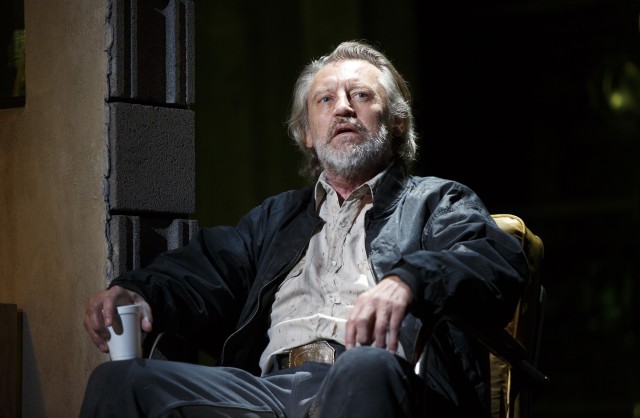
Pumla Gobodo-Madikizela (Noma Dumezweni) and Eugene de Kock (Matthew Marsh) discuss violence and murder, forgiveness and reconciliation in A HUMAN BEING DIED THAT NIGHT (photo by Richard Termine)

BAM Fisher, Fishman Space
321 Ashland Pl.
Tuesday-Sunday through June 21, $65
718-636-4100
www.bam.org

Near the beginning of Nicholas Wright’s sharp, powerful A Human Being Died That Night, inmate Eugene de Kock (Matthew Marsh) asks psychologist Pumla Gobodo-Madikizela (Noma Dumezweni), “Does this set-up that you’re looking at now make you think of a certain film?” It’s a question meant for the audience too, who are thinking the same thing as de Kock continues, “With Jodie Foster and Sir Anthony Hopkins? . . . Well, that’s what they think I am.” Set in a prison where de Kock is serving two life sentences plus 212 years for committing political crimes against black South Africans, earning the nickname “Prime Evil” for his involvement in numerous cold-blooded murders, A Human Being Died That Night instantly recalls Jonathan Demme’s The Silence of the Lambs; Marsh’s erudite manner as de Kock even mimics Hopkins’s portrayal of Hannibal the Cannibal. But there are two primary differences: First, de Kock is a real person, and his story is true. Second, where the fictional Hannibal Lecter reveled in his deeds, de Kock is exploring forgiveness and repentance. Based on Gobodo-Madikizela’s book, which details her meetings with de Kock in Pretoria Central Prison, the play takes place inside a prison cell (designed by Paul Wills), with Gobodo-Madikizela, who served on Nelson Mandela’s Truth and Reconciliation Commission, on one side of a rectangular table, de Kock, in leg irons that limit his movement, on the other. Over the course of eighty minutes, they discuss the nature of his killings, which included a public bombing, his victims and their families, and his fellow policemen, particularly his superiors, who gave him his orders but have paid no consequences. Gobodo-Madikizela is not interviewing de Kock in an official capacity but for her own personal and professional studies, although she does not want to get too close to him. “There’s a line that I don’t want to cross,” she explains, to which he responds, “You want to understand me, but you don’t want to cross a line? Isn’t that making things unnecessarily difficult for yourself?” But she is shocked when she suddenly does cross that line, leading the way to deeply intimate revelations.

(photo by Richard Termine)

Nicholas Wright’s play offers a different look at apartheid (photo by Richard Termine)

Originally staged by Cape Town’s Fugard Theatre, A Human Being Died That Night is a riveting exploration of forgiveness and reconciliation. Olivier Award winner Dumezweni (A Raisin in the Sun, The Bogus Woman) and Marsh (Proof, The Last of the Haussmans) are mesmerizing as their characters warm to each other and reach unforeseen conclusions. Director Jonathan Munby, a veteran of many a Shakespeare production at theaters around the world, maintains a tense calm throughout that is heightened by a moment that frightens Gobodo-Madikizela; meanwhile, the sound of de Kock’s rattling chains are occasionally heard, a reminder of what he has done, even as he speaks eloquently about what’s in his heart. In the latter part of the play, the two characters switch sides of the table, de Kock no longer tethered to his spot, as if each is now in the other’s shoes, offering a different perspective on what comes next. Haunting and harrowing yet with a gentle soul, A Human Being Died That Night is especially relevant given America’s reaction to the Boston Marathon bomber, with calls for his execution coming from even those who are usually against the death penalty. Meanwhile, in January of this year, de Kock was granted parole. The play will have you looking inside yourself, examining your own views on forgiveness and reconciliation, empathy and compassion, and the nature of good and evil, whether in relation to a mass murderer or a more personal and private matter. And you might be surprised what you learn about yourself.

JOAN OF ARC AT THE STAKE

Joan of Arc (Marion Cotillard) and Brother Dominique (Éric Génovèse) contemplate her fate as the stake awaits (photo by Startraks Photo/Rex Shutterstock)

Joan of Arc (Marion Cotillard) and Brother Dominique (Éric Génovèse) contemplate her fate as the stake awaits (photo by Startraks Photo/Rex Shutterstock)

Who: Actors Marion Cotillard, Éric Génovèse, and Christian Gonon, the New York Choral Artists, the Brooklyn Youth Chorus, conductor Alan Gilbert, the New York Philharmonic, and others
What: Honegger’s Joan of Arc at the Stake
Where: Avery Fisher Hall, 10 Lincoln Center Plaza, 212-875-5030
When: Saturday, June 13, $50-$164, 8:00
Why: Director Côme de Bellescize’s concert staging of Swiss composer Arthur Honegger’s 1935 oratorio Joan of Arc at the Stake might occasionally be more than a bit head-scratching (a court of adults and children in animal costumes?), but the music, conducted by Alan Gilbert, is glorious, with the Philharmonic joined by the New York Choral Artists, who hover in the back like an angelic jury, and the Brooklyn Youth Chorus, composed of children in a dazzling spectrum of outfits. Oscar-winning actress Marion Cotillard (La Vie en Rose) stars as Joan of Arc, the fifteenth-century French nationalist heroine who is accused of being a witch and a heretic. The production works best when Joan and Brother Dominique (Éric Génovèse) examine her life and fate, on a central wooden rectangular stage featuring a threatening stake in front of hellish red lighting. Other standouts include Faith Sherman as Catherine and Simone Osborne as Marguerite. The eighty-minute presentation is divided into a prologue followed by eleven scenes, with such titles as “The Voices of Heaven,” “Joan Given Up to the Beasts,” and “The Sword of Joan,” leading to a powerful, emotional conclusion.

AFGHANISTAN, ZIMBABWE, AMERICA, KUWAIT

(photo © Joan Marcus)

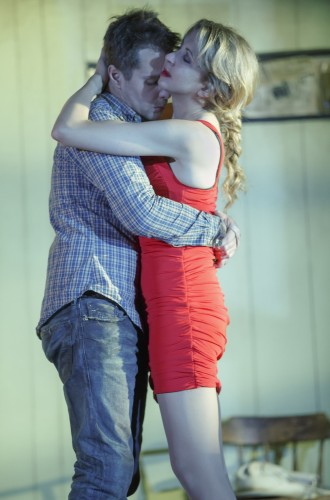
The maddening desperation of war hovers over Rattlestick production of AFGHANISTAN, ZIMBABWE, AMERICA, KUWAIT (photo © Joan Marcus)

The Gym at Judson
243 Thompson St. at Washington Square South
Through June 27, $18
866-811-4111
www.rattlestick.org
www.judson.org

Early on in Daniel Talbott’s Afghanistan, Zimbabwe, America, Kuwait, two American soldiers, Smith (Seth Numrich) and Leadem (Brian Miskell), are outside their desert bunker, burning up in the furious heat and talking about a bird that recently flew past them. “The f—in’ bitch thought we were going to die,” Smith says. “I waved at her. I waved. Like with both hands up. Gave her the f—in’ hang loose sign. The peace sign.” The time is the near future, and Smith and Leadem are in the middle of nowhere, fighting a war they don’t understand. They don’t even know what day it is, but they’re well aware that they’re running desperately short of food and water, with no way to call for help, and the vultures are circling. Their precarious existence becomes even more troublesome when a third soldier, Miller (Chris Stack), arrives, with no hope to offer them. “It’s like Chernobyl a week after the f—ing meltdown,” he says. “Just silence. Like f—ing New York, or DC, after China. It’s all gone.” Throughout the play, the soldiers are visited by various characters who could be ghosts, hallucinations, or memories as they discuss family and lovers, the past and the future, avoiding the central issue of the brutal effects of war. Leadem is particularly spooked by a Serbian woman (Jelena Stupljanin) who cries out in the night about being tortured and raped. “The only conversation we had was when I was begging them to kill me,” she explains. “That’s when they laughed. Their response was, ‘We don’t need you dead.’” But the soldiers are determined not to give up, not to die in this unstated location, which could be anywhere, for seemingly no reason at all.

(photo © Joan Marcus)

Soldiers search for a way out in bleak, devastating play (photo © Joan Marcus)

Raul Abrego’s set is harshly realistic, a small concrete shelter surrounded by hills of sand that trickle toward the audience. Above and behind them, David Tennent’s projections depict bright blue skies and approaching clouds. Rattlestick literary manager Talbott (Slipping, Yosemite) also directs the play with a sure hand, making powerful use of John Zalewski’s sound design and Joel Moritz’s lighting to indicate changes of scenes, turning the theater pitch black, filling the space with loud feedback, then bringing the lights back up with the actors in different positions to signify the passage of time. The fine cast also includes Jimi Stanton as Leadem’s brother and Kathryn Erbe as his mother, adding to the mystery of what exactly is unfolding onstage. Afghanistan, Zimbabwe, America, Kuwait is a dark, bleak experience, an existential exploration of the horrors of war without overtly political content. The narrative occasionally gets confusing and repetitive; even at a mere ninety intermissionless minutes, it feels too long, but Talbott is not out to make the audience comfortable in their seats, instead intent on sharing aspects of the soldiers’ physical and psychological terror. It’s not a pleasant catharsis, and it’s not supposed to be. (The June 16 performance will be followed by a panel discussion with Greg Grandin, Morgan Jenness, and Michael Ratner, moderated by the Reverend Micah Bucey.)

TICKET GIVEAWAY: CONSENT

CONSENT

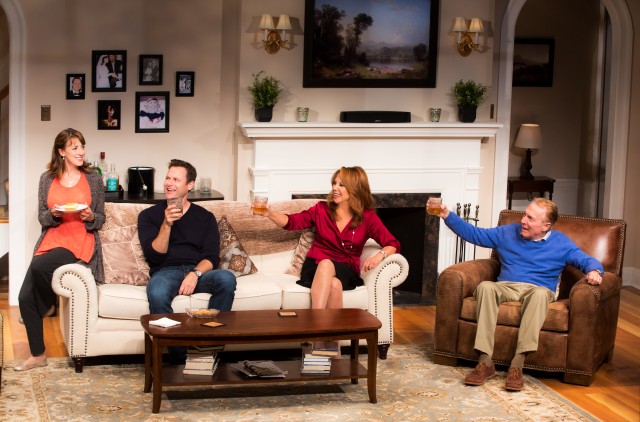
Susie (Angela Pierce) and Ron (Mark McCullough Thomas) share a tense moment in David Rhodes’s CONSENT

CONSENT
The Black Box Theatre
The Harold and Miriam Steinberg Center for Theatre
111 West 46th St. between Sixth & Seventh Aves.
Tuesday – Sunday through June 28, $60-$100 ($35-$85 with discount code UWANT2)
866-811-4111
www.consenttheplay.com

The matter of “consent” is a complex subject, one that writer-director David Rhodes explores in his new play, simply titled Consent. “Relationships can be incredibly sexy, but also incredibly scary, navigating power dynamics and personal needs while getting to know each other,” he says about the play in a statement. “My goal with Consent is to explore issues surrounding primal desire, vulnerability, passion, and shame and to let the audience make up their own minds as to what transpired.” In the play, Mark McCullough Thomas stars as Ron, an architect and former NFL player who has just come out as gay. The dramatic change in his life has an effect on his relationships with Emily (Catherine Curtin), Kurt (Michael Goldstein), and Susie (Angela Pierce), leading to professional and personal twists and tangles. Consent is written and directed by Rhodes, who has previously written and starred in the solo shows I’m Telling You and Rites of Privacy. The scenic design is by Scott Tedmon-Jones, with lighting by John Eckert, sound by Chad Raines of the punk band the Simple Pleasure, and video projection by Chelsie McPhilimy.

TICKET GIVEAWAY: Consent is running through June 28 at the Black Box Theatre at the Harold and Miriam Steinberg Center, and twi-ny has three pairs of tickets to give away for free for performances through June 21. Just send your name and daytime phone number to contest@twi-ny.com by Monday, June 8, at 3:00 to be eligible. All entrants must be twenty-one years of age or older; three winners will be selected at random.

THE 2015 TONY AWARDS

CURIOUS INCIDENT is nominated for six Tony Awards (photo by Joan Marcus)

CURIOUS INCIDENT is nominated for six Tony Awards (photo by Joan Marcus)

Radio City Music Hall
1260 Sixth Ave. at 50th St.
Sunday, June 7, red carpet 5:30, show 8:00
www.tonyawards.com
www.radiocity.com

The 2014-15 Broadway season was a strong one, breaking records for both gross and attendance. Quality was up as well as quantity, with a bevy of musicals and plays worthy of high praise indeed. The Tonys will be handed out on Sunday night at Radio City, and below are my predictions for who will take home the prize, named after actress, director, and producer Antoinette Perry, the cofounder of the American Theatre Wing. In addition, you can read my review of every nominated show (save for one) here.

BEST PLAY
The Curious Incident of the Dog in the Night-Time
Disgraced
Hand to God
Wolf Hall Parts One & Two
What Should Win: The Curious Incident of the Dog in the Night-Time, an utterly dazzling theatrical experience (by the way, was there really no room for Airline Highway in this category?)
What Will Win: The Curious Incident of the Dog in the Night-Time, a treat for the eyes, ears, and brain

BEST MUSICAL
An American in Paris
Fun Home
Something Rotten!
The Visit
What Should Win: Fun Home, because there’s nothing else quite like it
What Will Win: Something Rotten!, because it’s a clever Shakespearean musical that rewards the audience’s love of theater

BEST REVIVAL OF A PLAY
The Elephant Man
Skylight
This Is Our Youth
You Can’t Take It with You
What Should Win: This Is Our Youth, a powerful drama that not enough voters will remember (and hey, what about It’s Only a Play?)
What Will Win: You Can’t Take It with You, because it has aged so surprisingly well

BEST REVIVAL OF A MUSICAL
The King and I
On the Town
On the Twentieth Century
What Should Win: On the Twentieth Century, for its sheer glee and love of life
What Will Win: The King and I, because it’s The King and I

FUN HOME made a wildly successful move from the Public to Circle in the Square (photo by Joan Marcus)

FUN HOME made a wildly successful move from the Public to Circle in the Square (photo by Joan Marcus)

BEST ORIGINAL SCORE (MUSIC AND/OR LYRICS) WRITTEN FOR THE THEATRE
Fun Home, music by Jeanine Tesori, lyrics by Lisa Kron
The Last Ship, music and lyrics by Sting
Something Rotten!, music and lyrics by Wayne Kirkpatrick and Karey Kirkpatrick
The Visit, music by John Kander, lyrics by Fred Ebb
What Should Win: Fun Home, because of its originality and daring
What Will Win: Something Rotten!, because it’s a celebration of all things Broadway

BEST PERFORMANCE BY AN ACTOR IN A LEADING ROLE IN A PLAY
Steven Boyer, Hand to God
Bradley Cooper, The Elephant Man
Ben Miles, Wolf Hall Parts One & Two
Bill Nighy, Skylight
Alex Sharp, The Curious Incident of the Dog in the Night-Time
Who Should Win: Sharp, who boggles the mind as a boy on the autism spectrum, although Boyer is outrageous as a puppet-obsessed boy on the edge
Who Will Win: Sharp, in a very strong category where all are deserving

BEST PERFORMANCE BY AN ACTRESS IN A LEADING ROLE IN A PLAY
Geneva Carr, Hand to God
Helen Mirren, The Audience
Elisabeth Moss, The Heidi Chronicles
Carey Mulligan, Skylight
Ruth Wilson, Constellations
Who Should Win: Mulligan, who is sensational as a single woman coming to terms with her life
Who Will Win: Mirren, because she’s royalty on both sides of the pond

BEST PERFORMANCE BY AN ACTOR IN A LEADING ROLE IN A MUSICAL
Michael Cerveris, Fun Home
Robert Fairchild, An American in Paris
Brian d’Arcy James, Something Rotten!
Ken Watanabe, The King and I
Tony Yazbeck, On the Town
Who Should Win: Cerveris, who gives a complex, nuanced performance as a closeted husband and father
Who Will Win: Fairchild, who brings balletic elegance to Broadway while paying homage to Gene Kelly

BEST PERFORMANCE BY AN ACTRESS IN A LEADING ROLE IN A MUSICAL
Kristin Chenoweth, On the Twentieth Century
Leanne Cope, An American in Paris
Beth Malone, Fun Home
Kelli O’Hara, The King and I
Chita Rivera, The Visit
Who Should Win: Chenoweth, who is an unstoppable force of nature
Who Will Win: Chenoweth, because there’s just no stopping her

BEST PERFORMANCE BY AN ACTOR IN A FEATURED ROLE IN A PLAY
Matthew Beard, Skylight
K. Todd Freeman, Airline Highway
Richard McCabe, The Audience
Alessandro Nivola, The Elephant Man
Nathaniel Parker, Wolf Hall Parts One & Two
Micah Stock, It’s Only a Play
Who Should Win: Parker, for his novel, downright friendly interpretation of King Henry VIII, although Freeman and McCabe are exceptional as well
Who Will Win: Freeman, who is beguiling as transgender Sissy Na Na

BEST PERFORMANCE BY AN ACTRESS IN A FEATURED ROLE IN A PLAY
Annaleigh Ashford, You Can’t Take It with You
Patricia Clarkson, The Elephant Man
Lydia Leonard, Wolf Hall Parts One & Two
Sarah Stiles, Hand to God
Julie White, Airline Highway
Who Should Win: White, for her poignant portrayal of a brave woman struggling to get by day by day
Who Will Win: Clarkson, for her poignant portrayal of the brave woman who looks into John Merrick’s soul

Brad Oscar tries to predict the Tony future for him and Brian d’Arcy James in SOMETHING ROTTEN! (photo by Joan Marcus)

Brad Oscar tries to predict the Tony future for him and Brian d’Arcy James in SOMETHING ROTTEN! (photo by Joan Marcus)

BEST PERFORMANCE BY AN ACTOR IN A FEATURED ROLE IN A MUSICAL
Christian Borle, Something Rotten!
Andy Karl, On the Twentieth Century
Brad Oscar, Something Rotten!
Brandon Uranowitz, An American in Paris
Max von Essen, An American in Paris
Who Should Win: Oscar, for joyfully going way over the top as the other Nostradamus
Who Will Win: Karl, who has quickly become a Broadway favorite

BEST PERFORMANCE BY AN ACTRESS IN A FEATURED ROLE IN A MUSICAL
Victoria Clark, Gigi
Judy Kuhn, Fun Home
Sydney Lucas, Fun Home
Ruthie Ann Miles, The King and I
Emily Skeggs, Fun Home
Who Should Win: Lucas, for her marvelous turn as the youngest Alison Bechdel
Who Will Win: Lucas, who has a charming presence beyond her years

BEST DIRECTION OF A PLAY
Stephen Daldry, Skylight
Marianne Elliott, The Curious Incident of the Dog in the Night-Time
Scott Ellis, You Can’t Take It with You
Jeremy Herrin, Wolf Hall Parts One & Two
Moritz von Stuelpnagel, Hand to God
Who Should Win: Elliott, for the wildly inventive and constantly awe-inspiring Curious Incident
Who Will Win: Elliott, the mastermind behind an unforgettable production

BEST DIRECTION OF A MUSICAL
Sam Gold, Fun Home
Casey Nicholaw, Something Rotten!
John Rando, On the Town
Bartlett Sher, The King and I
Christopher Wheeldon, An American in Paris
Who Should Win: Gold, for reinventing Fun Home on its move from the Public to Broadway
Who Will Win: Sher, for his third straight beloved Rodgers & Hammerstein revival at Lincoln Center

BEST CHOREOGRAPHY
Joshua Bergasse, On the Town
Christopher Gattelli, The King and I
Scott Graham and Steven Hoggett, The Curious Incident of the Dog in the Night-Time
Casey Nicholaw, Something Rotten!
Christopher Wheeldon, An American in Paris
Who Should Win: Wheeldon, who has brought ballet back to Broadway
Who Will Win: Wheeldon, for his ingenuity and craftsmanship

WOLF HALL: PARTS ONE AND TWO

(photo by Johan Persson)

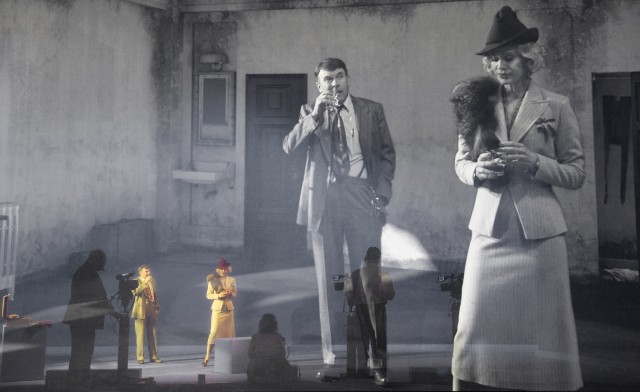
The Royal Shakespeare Company’s adaptation of Hilary Mantel’s WOLF HALL and BRING UP THE BODIES begins with music and dance before moving on to more dangerous activities (photo by Johan Persson)

Winter Garden Theatre
1634 Broadway between 50th & 51st Sts.
Wednesday – Sunday through July 5, $49.75-$122
wolfhallbroadway.com

Last season the Brits thrilled Broadway with Shakespeare’s Globe’s doubleheader of Twelfth Night and Richard III, performed as they were in the Bard’s time. This season’s biggest British theatrical event is the Royal Shakespeare Company’s twin bill — but this time they’re not doing Shakespeare. Instead, the Royal Shakespeare Company brings us its widely hailed stage production of Hilary Mantel’s Man Booker Prize–winning novels Wolf Hall and Bring Up the Bodies, set in the just pre-Elizabethan England of Henry VIII. The two plays, which run more than five hours together and can be seen either on separate nights or the same day (matinee and evening, with a break in between), follow the trials and tribulations of lawyer Thomas Cromwell (Ben Miles), a blacksmith’s son, as he deals with Cardinal Wolsey’s (Paul Jesson) battle with King Henry VIII (Nathaniel Parker), who wants an annulment from his marriage to Katherine of Aragon (Lucy Briers) so he can wed Anne Boleyn (Lydia Leonard) to provide an heir to the throne. The based-on-fact intrigue also involves the conniving, ambitious Stephen Gardiner (Matthew Pidgeon), the dangerous Sir Thomas More (John Ramm), the soon-to-be Archbishop of Canterbury Thomas Cranmer (Giles Taylor), Henry’s former mistress Mary Boleyn (Olivia Darnley), and untrustworthy court musician Mark Smeaton (Joey Batey). In the first part, Cromwell tries to balance his life with his wife, Lizzie Wykys (Darnley), and children, Gregory (Daniel Fraser) and Grace, while negotiating between the cardinal and the king. In the second part, Cromwell’s power has grown, as he is now adviser to the king, who has married Anne. But Cromwell has learned that the new queen, who has been unable to produce a surviving male heir, might have been unfaithful to the king, who has turned his attention to Jane Seymour (Leah Brotherhead). It all comes to a head in a gripping scene in which Cromwell grills the men who have purportedly bedded down with the queen.

Thomas Cromwell (Ben Miles) battles with Anne Boleyn (Lydia Leonard) in second part of WOLF HALL  (photo by Johan Persson)

Thomas Cromwell (Ben Miles) battles with Anne Boleyn (Lydia Leonard) in second part of WOLF HALL (photo by Johan Persson)

Expertly adapted by Mike Poulton (A Tale of Two Cities, Fortune’s Fool), the stage version of Wolf Hall and Bring Up the Bodies is very different from the recent six-part Masterpiece television series, which stars Rylance as Cromwell, Damian Lewis as Henry VIII, and Claire Foy as Anne Boleyn. Director Jeremy Herrin (The Nether, The Absence of War) keeps things stark and spare, with all of the action taking place on Christopher Oram’s minimalist set, which is usually empty, save for an occasional chair, desk, or table. Scene changes are indicated by Paule Constable’s lighting and the actors walking to the edge of the stage, then turning back around. Oram’s costumes are elegant and dramatic, seeming to have stepped right out of classic historical paintings. The rounded front of the stage juts out into the audience, making for a spectacularly intimate experience, particularly for those in the first few rows. The acting is exceptional, led by Miles’s (The Norman Conquests, Betrayal) sensational portrayal of the complex Cromwell, who would make quite a chief of staff in contemporary America. Parker (The Audience, Speed-the-Plow) is a marvelously devious Henry VIII, Briers (Top Girls, Some Kind of Bliss) is fiery as the embittered Katherine, Jesson (The Normal Heart, Mr. Turner) brings a warm sense of humor to the cardinal, and Joshua Silver, in his Broadway debut, is steadfast as Cromwell’s loyal ward and chief clerk, Rafe Sadler. Jealousy, desire, power, ambition, and vainglory collide in Wolf Hall Parts One & Two, another must-see theatrical event from across the pond.

AN ACT OF GOD

(Jeremy Daniel, 2015)

God takes over the body of Jim Parsons in sinful new Broadway comedy (photo by Jeremy Daniel, 2015)

Studio 54
254 West 54th St. between Seventh & Eighth Aves.
Tuesday – Sunday through August 2, $55-$159
212-719-1300
anactofgod.com

In the chapter “Sacred Word, Profane Image” in her book Taboo Memories, Diasporic Voices, author Ella Shohat writes, “Although according to the Bible God made man in his own image, a few films have projected God in man’s image, making casting an unusually difficult task,” citing portrayals of the Supreme Being by George Burns, Vittorio de Sica, Robert Mitchum, Morgan Freeman, Alanis Morissette, and others. David Javerbaum’s devilishly funny new Broadway comedy, An Act of God, addresses that right at the outset, as Jim Parsons descends from the heavens to take a seat on a couch and chat with the audience. “I reside in all forms, yet my essence is formless, for I transcend all dualities, including that of form and formlessness,” God (Parsons) explains. “Yet tonight I have chosen to appear in form; specifically that of beloved television star Jim Parsons. For lo, I have endowed him with a winning, likable personality; and know of a certainty that your apprehension of My depthless profundities will be aided by his offbeat charm. And then, the irony of him starring in a show called The Big Bang Theory . . . I just couldn’t resist.” For the next ninety minutes, a primarily relaxed, easygoing Almighty presents a revised and updated version of the Ten Commandments for the twenty-first century, with the help of archangels Gabriel (Tim Kazurinsky) and Michael (Christopher Fitzgerald). While Gabriel reads passages from the Bible, Michael roams the audience, taking questions, starting out with innocuous queries but quickly getting into much larger metaphysical and existential matters of the universe as God addresses slavery, abortion, evolution, homosexuality, prayer, the Holocaust, incest, masturbation, Noah, Adam and Eve, Abraham and Isaac, the history of Studio 54, and cell phones, all with tongue firmly planted in cheek. But as charming and friendly as he can be, this God can also show his wrath when necessary.

(photo by Jeremy Daniel)

Archangels Gabriel (Tim Kazurinsky) and Michael (Christopher Fitzgerald) pose for a selfie with the Supreme Being (photo by Jeremy Daniel, 2015)

Just as former Daily Show head writer Javerbaum’s book on which the play is based, The Last Testament: With 100 Top Tweets from @TheTweetOfGod, was billed as “A Memoir by God,” An Act of God is “A One-God Show” starring the Supreme Being Himself; He even gets His own paragraph in the Playbill, identifying Him as the Creator and pointing out that this “is His first work written directly for the stage.” Emmy winner Parsons, who dealt with another imaginary figure on Broadway in 2012 when he starred as Elwood P. Dowd in the Roundabout revival of Harvey, in which his character has a giant invisible rabbit for a best friend, is appealing and charismatic as the Lord, wearing sneakers with his long white robe and pushing the merch. He has the audience eating out of the palms of his hands from the get-go, and it willingly gives him the benefit of the doubt even when the script gets too clever for its own good or plays too fast and loose with some very serious subjects. SNL vet Kazurinsky (Police Academy) and two-time Tony nominee Fitzgerald (Finian’s Rainbow, Young Frankenstein) are fine foils for Parsons, the former standing steadfastly at his podium, worshiping his Bible, the latter moving about like Phil Donahue or Jerry Springer, ultimately angering his boss when demanding deeper insight. Tony-winning director Joe Mantello (Airline Highway, Other Desert Cities) maintains a graceful pace on Tony favorite Scott Pask’s (Pal Joey, The Book of Mormon) elegant set, highlighted by a staircase leading up to the stars (and evoking the Merrie Melodies logo), where Peter Nigrini’s projections add an extra touch. The breezy show might not quite answer the questions of the universe that have perplexed humankind throughout the centuries, but An Act of God is a wickedly sinful way to laugh your head off at the foibles of our modern-day, religion-crazed culture, where even the Almighty can be a celebrity.