this week in theater

BAM NEXT WAVE FESTIVAL: HELEN LAWRENCE

(photo by David Cooper)

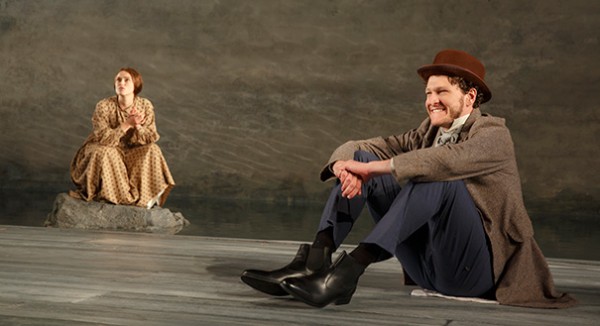
HELEN LAWRENCE tells an old-fashioned postwar noir tale using cutting-edge technology (photo by David Cooper)

BAM Howard Gilman Opera House
30 Lafayette Ave. between Ashland Pl. & St. Felix St.
October 14-17, $24-$95, 7:30
718-636-4100
www.bam.org

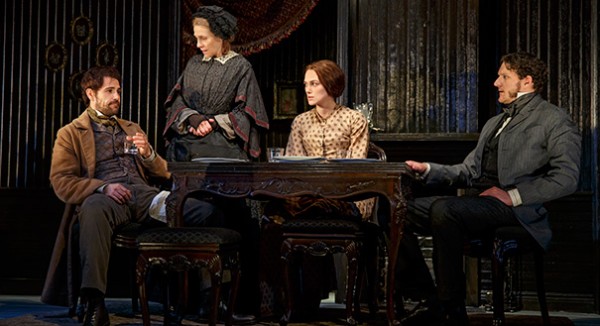
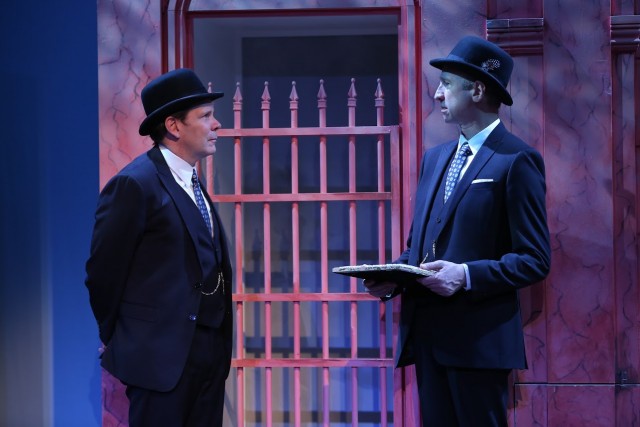
Photographer and film and video installation artist Stan Douglas and screenwriter Chris Haddock have teamed up for the multimedia theatrical presentation Helen Lawrence, running October 14-17 at BAM’s Howard Gilman Opera House as part of the 2015 Next Wave Festival. Douglas, who won a 2012 ICP Infinity Award for career achievement, and Haddock, the writer and creator of such Canadian television series as Da Vinci’s Inquest and Intelligence, set the post-WWII noir tale in Vancouver, where Douglas was born and is based. He directs a cast of twelve, including Lisa Ryder as the title character, Nicholas Lea as Percy Walker, Crystal Balint as Mary Jackson, and Greg Ellwand as Inspector Leonard Perkins, who interact with green screens, live camera projections, and 3-D computer imagery to give the proceedings a fantastical, surreal element. The set is by Kevin McAllister, with costumes by Nancy Bryant, lighting by Robert Sondergaard, sound by John Gzowski (who plays guitar on the recorded soundtrack), cinematography by Brian Johnson, and video programming by Peter Courtemanche.

TICKET GIVEAWAY: THE HONEYCOMB TRILOGY

THE HONEYCOMB TRILOGY
The Gym at Judson
243 Thompson St. at Washington Square South
October 13 – November 14, $25 for each of three parts
www.gideonth.com
www.judson.org

You can binge-watch a TV series, so why not a play? Mac Rogers’s (Viral, Asymmetric) sci-fi epic, the Honeycomb Trilogy, is back in New York for a return engagement, promising that “it’ll be about 20% more awesome than last time.” The original unfolded in three installments over six months in 2012, but now you can follow the Cooke family battle alien invasion and try to save the human race over the course of a week, or in one day, at the Gym at Judson. Advance Man, which won a New York Innovative Theatre Award for Outstanding Premiere Production, is being performed by itself October 13, 23, and 29 and November 3 and 13, Blast Radius on October 15, 20, and 30 and November 5 and 10, and Sovereign October 16, 22, and 27 and November 6 and 12. But on Saturdays and Sundays during the run, you can catch all three plays back-to-back-to back, at 2:00, 5:00, and 8:30.

TICKET GIVEAWAY: The Honeycomb Trilogy is running October 13 through November 14 at the Gym at Judson, and twi-ny has one pair of tickets to give away for all three shows to one lucky person. Just send your name, phone number, and favorite sci-fi binge-watching experience to contest@twi-ny.com by Wednesday, October 15, at 3:00 to be eligible. All entrants must be twenty-one years of age or older; one winner will be selected at random.

WILLIAM KENTRIDGE IN NEW YORK

William Kentridge invades New York this fall with an opera at the Met, a performance at BAM, and a number of discussions and lectures (photo courtesy the Metropolitan Opera)

William Kentridge invades New York this fall with an opera at the Met, a multimedia performance at BAM, and a number of discussions and lectures (photo courtesy the Metropolitan Opera)

When William Kentridge comes to town, he really comes to town. Back in 2010, the South African multidisciplinary artist was all over New York City, with the smashing “Five Themes” retrospective at MoMA, his production of Shostakovich’s The Nose at the Metropolitan Opera, a unique artist book at Dieu Donné, a screening of some of his animated films accompanied by live music at the World Financial Center, and a performance of his one-man show “I am not me, the horse is not mine” at MoMA. He’s back in the city this fall, with a host of wide-ranging events, exhibits, and performances all over town. On October 12 (free, 7:00), he’ll be giving a lecture, “The Sentimental Machine,” at the New York Studio School of Drawing, Painting & Sculpture. On October 13 ($30, 6:30), he’ll be at the Metropolitan Museum of Art, in conversation with printer Andrew Hoyem in the Grace Rainey Rogers Auditorium discussing the limited-edition letterpress book The Lulu Plays, delving into the nature of human imagination and time. On October 14 (free, 5:00), Kentridge will deliver the Belknap Lecture at Princeton, “O Sentimental Machine,” about his Trotsky-inspired multimedia installation.

From October 22 to 25 ($30-$100), Kentridge teams up with longtime collaborator Philip Miller for the audiovisual chamber opera Refuse the Hour at the BAM Harvey, a wildly inventive lecture-performance with dance, music, projections, and more, a companion piece to his wildly inventive “The Refusal of Time” 2013 installation at the Metropolitan Museum of Art. In conjunction with Refuse the Hour, Kentridge will be at BAM Rose Cinemas on October 24 ($15, 5:00) for a discussion with physicist and Refuse the Hour collaborator Peter Galison, moderated by Dennis Overbye. From November 2 to December 31 (free), the Marian Goodman Gallery will be showing works by Kentridge in the third-floor project room. From November 4 to 8 ($10-$40), The Lulu Plays will be on view at the IFPDA Print Fair at the Park Avenue Armory. And from November 5 through December 3 ($27-$335), there will be eight performances of Kentridge’s four-hour-plus version of Alban Berg’s Lulu at the Met, featuring Marlis Petersen in the title role, Susan Graham as Geschwitz, Paul Groves as the painter and the African prince, and Johan Reuter as Dr. Schön and Jack the Ripper, conducted by Lothar Koenigs. We’re exhausted just reading about all the sixty-year-old Kentridge has planned; we can’t even begin to imagine doing it all, but we’re going to see as many of these events as we can, and we urge you to do the same.

THE NEW MORALITY

(photo by Richard Termine)

Betty Jones (Brenda Meaney) has a bone to pick with her husband (Michael Frederic) in Mint revival of Harold Chapin’s THE NEW MORALITY (photo by Richard Termine)

Mint Theater
311 West 43rd St. between Eighth & Ninth Aves.
Tuesday – Sunday through October 25, $55-$65 (all seats $43 for the final week; $100 for last show, followed by a farewell party)
866-811-4111
www.minttheater.org

The Mint does the theater world another great service by reviving Harold Chapin’s deliciously delightful comedy of manners, The New Morality. In honor of the centennial of Chapin’s death — the Brooklyn-born British playwright and actor was killed in action in WWI in September 1915 at the age of twenty-nine, before this play was ever produced — Mint artistic director Jonathan Bank has finally brought it to New York for its first theatrical run; it previously played only a handful of matinees way back in 1921. The three-act, nearly two-hour show takes place in 1911 on a houseboat on the Thames, where local socialite Betty Jones (a devilishly vampy Brenda Meaney) has just laced into neighbor Muriel Wister with a loud string of unwomanly insults on a day so hot that the morning milk is going sour almost immediately. Her friend Alice Meynell (Clemmie Evans), a prim, proper, demure young woman, arrives for tea only to find Betty still in bed, bemoaning her outburst. “Did you or did you not hear me call that woman a —,” Betty begins to ask, cut off by Alice responding, “Well, she is . . . ,” to which Betty declares, “I know she is! But you can’t go calling people dog-show names on the deck of their own houseboat in a voice loud enough to be heard across the river.” Betty’s husband, the stodgy Colonel Ivor Jones (Michael Frederic), then comes in, demanding that his wife apologize to Muriel, but she insists she will do nothing of the sort. “Don’t you think it would be politic? I do,” Jones says, to which Betty replies, “A man always thinks the most politic thing he can do is to humiliate his wife.” It turns out that Betty verbally attacked her neighbor because Muriel more than tolerates Ivor’s infatuation with her; he follows her around like a puppy dog in full view of the rest of the community, wholly embarrassing his wife. After Alice departs, Betty and Ivor are visited by Muriel’s husband, E. Wallace Wister (Ned Noyes), a milquetoast stick in the mud who demands that Betty answer for her actions, but again she refuses to acquiesce. Soon Betty’s suave brother, lawyer Geoffrey Belasis (Christian Campbell), enters the fray as the discussions grow more and more heated in wildly funny ways, assessing not only the specific situation but the state of British high society and women’s place in it.

(photo by Richard Termine)

Playwright Harold Chapin examines love, marriage, and British society in stinging comedy (photo by Richard Termine)

As with so many Mint productions, the set, designed by Steven C. Kemp, is utterly charming; the first act takes place in Betty’s lovely chintz-covered bedroom, while the second and third acts are held on the spacious deck of their houseboat, with projections of the Thames and the shore on the back and sides of the stage. (Be sure to stick around during the first intermission to watch the magical change.) Meaney (Indian Ink, Venus in Fur) is superb as Betty, a clever, forward-thinking woman with a yearning sexuality and a fab wardrobe courtesy of costume designer Carisa Kelly. Chapin joins Shaw and Wilde in their investigations of the “New Woman” of the early twentieth century, breaking with Victorian ideas of propriety and forging a new identity in public and private spheres. Like them, he delivers his sociological thoughts via wickedly sharp dialogue skewering the British upper class, ably performed by a cast that also includes Kelly McCready as the Joneses’ curious maid, Lesceline, and Douglas Rees as their stout man-servant, Wooten. When Chapin died, the British theatrical press mourned his loss; St. John Ervine wrote in the Guardian, “It must be true that the taste for comedy, which is an educated taste, has very nearly disappeared from London. But it will, no doubt, come back again; and when it does this play will have its day.” The New Morality is finally having its day in New York City at the Mint, and one can only hope that more of Chapin’s works are on the horizon. Unfortunately, that won’t be happening in the Mint’s home of twenty years, 311 West Forty-Third St., where the company has become the latest victim of the real estate market. The Mint will continue — Bank has a full slate of plays lined for 2016 — but the location is up in the air as of now.

CINDERELLA: A BAROQUE BURLESQUE BALLET

(photo by Phillip Van  Nostrand)

Austin McCormick and Company XIV give a whole new look to beloved fairy tale (photo by Phillip Van Nostrand)

Minetta Lane Theatre
18 Minetta Lane between MacDougal St. & Sixth Ave.
Tuesday – Sunday through November 15, $40-$100
companyxiv.com
minettalanenyc.com

New York-based Company XIV brings a rather decidedly decadent edge to Cinderella, the anti-Disney version of Charles Perrault’s 1697 fairy tale about an orphaned and abused girl on the cusp of womanhood, seeking her Prince Charming despite severe family dysfunction. Billed as a “Baroque Burlesque Ballet,” this Cinderella boasts bold sexuality, acrobatics, cross-dressing, pole dancing, and a wildly imaginative score, all brought together by company artistic director Austin McCormick. Outfitted in Zane Pihlstrom’s dazzling, body-baring costumes that quote drag ball and S&M style — Pihlstrom also designed the small set, which features a lush curtain topped by a glittering crown, a baroque backdrop, and a fun-house mirror — the twelve dancers put on a dazzling show, with Allison Ulrich as Cinderella, Steven Trumon Gray as the strikingly handsome prince, Marcy Richardson and Brett Umlauf as the dastardly stepsisters, Katrina Cunningham as the heroic Fairy Godmother (who takes nurturing to a new extreme), and Davon Rainey as the devious stepmother, a fearlessly erotic combination of Tim Curry in The Rocky Horror Picture Show and Billy Porter in Kinky Boots as conceived by the Marquise de Sade and Louis XIV. The two-hour-plus show, with two intermissions, contains almost no dialogue; instead, details of the plot are revealed by performers Hilly Bodin, Lea Helle, Jakob Karr, Nicholas Katen, Malik Kitchen, and Mark Osmundsen, who walk across the stage with two-sided chalkboards announcing scenes and acts in addition to their other roles. Jeanette Yew’s lighting shows off the heated dancing and eye-opening costumes to great effect.

(photo by Phillip Van  Nostrand)

Company XIV reimagining of CINDERELLA is a decidedly adult undertaking (photo by Phillip Van Nostrand)

Highlights include a virtuoso solo by Rainey, a provocative duet between Ulrich and Cunningham, the beautifully choreographed ball scene, and a cage dance by Ulrich, turning the standard fairy-tale musical inside out with more than a touch of strip-club bravado. The score contains eerie versions of such songs as Lorde’s “Royals,” Lana Del Rey’s “Born to Die,” Roxy Music’s “Love Is the Drug,” and Nicki Minaj’s “Get on Your Knees,” as well as works by Prokofiev, Tchaikovsky, Verdi, and Irving Berlin. During the two intermissions, the performers display their vast talents in out-of-character burlesque vignettes that are well worth sticking around for. Company XIV has previously staged such compelling, cutting-edge shows as Rococco Rouge and Lover. Muse. Mockingbird. Whore, and in November they’ll be bringing back their popular Nutcracker Rouge, with their rendition of Snow White scheduled for January. We can’t wait to see what this immensely skilled and adventurous company has in store for that.

OLD TIMES

(photo by Joan Marcus)

Clive Own, Eve Best, and Kelly Reilly delve into the mysterious past in Roundabout revival of Harold Pinter’s OLD TIMES (photo by Joan Marcus)

American Airlines Theatre
227 West 42nd St. between Broadway & Eighth Ave.
Tuesday – Sunday through November 29, $67-$137
212-719-1300
www.roundabouttheatre.org

As the Roundabout’s Broadway revival of Harold Pinter’s Old Times opens, Deeley (Clive Owen) is man-spread on a fashionably modern chair, Kate (Kelly Reilly) lies on a matching couch, and Anna (Eve Best) stands between them, facing a large, rectangular block of ice, her back to the audience at the American Airlines Theatre. It looks as if something happened the night before, something no one wants to remember. “Dark,” Kate says to Deeley. Indeed, Old Times is dark. And this being Pinter, don’t expect there to be much light shed on exactly what might have happened the night before, or at all, during this seventy-minute journey into a never-defined past or present. Early on, Kate confesses to Deeley, her husband, that Anna was her best and only friend, that they once lived together, but she also admits, “I hardly remember her. I’ve almost forgotten her.” Meanwhile, Anna raves about the two women’s relationship in great detail, with verve and excitement, but she adds, “There are some things one remembers even though they may never have happened. There are things I remember which may never have happened but as I recall them so they take place.” They all discuss having seen Carol Reed’s IRA noir masterpiece, Odd Man Out, and at one time or another in the play, each of the characters becomes the “odd man out” as the other two bond by telling old stories, singing American classics, or debating a possible previous meeting. “Some people throw a stone into a river to see if the water’s too cold for jumping,” Anna says, continuing, “others, a few others, will always wait for the ripples before they will jump.” There are plenty of ripples in Old Times, which has a backdrop of ever-widening concentric circles that evoke the ripples in a lake, or the rays of a pitiless sun. Christine Jones’s (American Idiot, The Green Bird) set also features black clumps of dried lava (“I live on a volcanic island,” Anna says), a sharp counterpoint to the huge block of ice and the mural of rippling water or blazing sun, echoing the characters’ ability to go from hot to cold and back again in an instant.

(photo by Joan Marcus)

The sexy Anna (Eve Best) shares her memories in OLD TIMES (photo by Joan Marcus)

It’s been forty-four years since Old Times was last seen on Broadway, in its Great White Way debut with Robert Shaw, Rosemary Harris, and Mary Ure, and the Roundabout previously revived it in 1984 with Anthony Hopkins, Jane Alexander, and Marsha Mason. It is considered one of Pinter’s middle-period memory plays, which also include 1974’s No Man’s Land and 1978’s Betrayal, each of which has been revived on Broadway the last two years, the former a huge hit, the latter a major disappointment. Douglas Hodge, who has appeared in and directed many of Pinter’s works over the past two decades, makes his Broadway directorial debut here with a sure hand, keeping things appropriately mystifying, obscure, and utterly compelling, although the strobe lights and the onetime rotation of the stage seem unnecessary. Owen (A Day in the Death of Joe Egg, Closer) and Reilly (After Miss Julie, Russian Dolls) make strong impressions in their Broadway bows, he giving Deeley more than a little smarm, she imbuing Kate with an uncomforting yet sublime mystery, but Best, who was nominated for a Tony in 2008 for her performance as Ruth in Pinter’s The Homecoming, is an absolute whirlwind, dominating the stage in her gorgeous, sexy white pantsuit, making confident declarations with a commanding physicality. She mesmerizes even with a casual swipe of the floor with her bare foot. There are various theories exploring what Old Times is really about; perhaps Kate and Anna are two parts of the same person, or maybe one of the women has killed the other, or maybe they’re all dead, lingering in a kind of way station. Pinter never said, so we’ll never be sure. But we do know that there may be no one better at evoking the prismatic nature of time and memory and the brilliant refractions of human relationships than the iconoclastic British playwright.

CLOUD NINE

(photo © Doug Hamilton)

The cast of CLOUD NINE rehearses amid the unusual theater-in-the-round setup at the Atlantic (photo © Doug Hamilton)

Atlantic Theater Company
Linda Gross Theater
336 West 20th St. between Eighth & Ninth Aves.
Tuesday – Sunday through November 1, $20-$65
866-811-4111
atlantictheater.org

Caryl Churchill skewers British colonialism, patriarchy, and sexual oppression and obsession while examining intricate issues of gender identity and personal freedom in Cloud Nine, her 1979 play being wonderfully revived at the Atlantic. The first act, in which several characters are played by members of the opposite gender, takes place in the late nineteenth century, in an unnamed African nation where the natives are growing more than a little restless, the threat of revolt against their occupiers in the air. Set designer Dane Laffrey (the new Spring Awakening and Fool for Love revivals) has transformed the space into a theater-in-the-round, with several rows of uncomfortable steep wooden bleachers circling the center stage area. (A limited amount of cushions are available, or you can bring your own.) The play opens with Union Jack-waving British administrator Clive (Clarke Thorell) leading his family in a song praising jolly old England, during which he introduces his oddball clan in rhyme. He is married to Betty (Chris Perfetti, in a spectacular off-white gown, courtesy of costume designer Gabriel Berry), a shy, reserved woman who explains, “I live for Clive. The whole aim of my life / Is to be what he looks for in a wife. / I am a man’s creation as you see, / And what men want is what I want to be.” Their son, Edward (Brooke Bloom), prefers playing with dolls to playing catch, while the aptly named baby, Victoria, is an actual doll that the characters toss around. The children are cared for by Ellen (Izzie Steele), the young governess who is extremely dedicated to Betty. Betty’s mother, Maud (Lucy Owen), is a stern woman who thinks that her daughter has married beneath her. And their servant, Joshua (Sean Dugan, a white man playing a black man), goes about his duties with a blank, deadpan look that is fraught with impending danger; “My skin is black but oh my soul is white. / I hate my tribe. My master is my light. / I only live for him. As you can see, / What white men want is what I want to be,” he says without conviction. The family is visited by intrepid explorer and adventurer Harry Bagley (John Sanders), who apparently has never met a person, man or woman, adult or child, he doesn’t want to have sex with, and the widowed Mrs. Saunders (Steele), an independent, plucky sort. The first act plays out like a twisted comedy of manners with a Monty Python edge as most of the characters reveal their hidden sexual desires while arguing over what is proper in society. It’s both funny and poignant, wacky and incisive, but Churchill turns everything around marvelously in the second act.

(photo © Doug Hamilton)

The actors switch roles for the second act of CLOUD NINE, which takes place in 1979 (photo © Doug Hamilton)

Following intermission, the play moves to a London park in 1979, the red gravel of Africa replaced by fake green grass. A century might have passed, but the characters have aged a mere twenty-five years. The full cast and most of the characters are back, but they’re played by different actors; Churchill leaves this doubling up to each new production, and her longtime director, James MacDonald (Love and Information, Cock), recasts the second act ingeniously, adding multiple layers to the already complex story. Bloom (You Got Older), who played the effeminate Edward in the first act, is now playing his mother, Betty, a stronger, more determined woman who is considering a life on her own. Owen (The Village Bike), who was the serious, suspicious Maud, now plays her granddaughter, Victoria, formerly a doll, now a modern woman who is thinking about leaving her husband for Lin, a lesbian played by Steele (What I Did Last Summer), who, as Ellen in the first act, declared her love for Betty. Thorell (Annie, Hairspray), previously Clive, the staunch defender of Mother England, is now Lin’s baby daughter, Cathy, prancing around in pigtails and smearing himself in paint, as if Great Britain has not yet grown up, making the same mess as always. Sanders (Peter and the Starcatcher), who was the brave Harry, has become Martin, Victoria’s very practical husband who simperingly supports anything she wants to do. And Edward, now played by Perfetti (Sons of the Prophet), who was Betty in the first act, has come out of the closet, a park worker in love with the gruff Gerry, portrayed by Dugan (Next Fall). Got all that? It makes for a whole lot of curious, surprising, and at times mind-blowing pairings (Freud would have a field day with the shenanigans) if you really delve into what’s happening between the actors and the characters. The latter have been thrust into an era that has witnessed the civil rights and women’s liberation movements and free love, and they’re ready to move on with their lives, determining their own places in the world rather than being limited by societal norms and what is expected, or demanded, of them. They still have their secrets and are haunted by ghosts, and there’s plenty of difficult work ahead for them, but there’s no need to play hide-and-seek again, as they did in the first act. Even when the story turns extremely serious and you, and many others, are shifting around in your cramped seat, you will have a blast trying to follow who is who, and who was who, and what it all says about the state of our world, then and now.