this week in theater

PERFORMA 15

(photo by Alan Prada / courtesy of LUomo Vogue)

Francesco Vezzoli and David Hallberg’s FORTUNA DESPERATA kicks off tenth anniversary of biannual Performa arts festival (photo by Alan Prada / courtesy of L’Uomo Vogue)

Multiple venues
November 1-22, free – $500
15.performa-arts.org

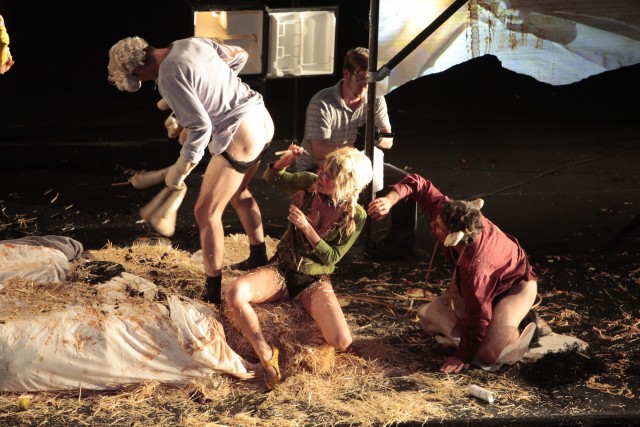
Performa is celebrating the tenth anniversary of its biennial with another diverse lineup of live, cutting-edge performances, taking place at venues in Manhattan and Brooklyn. The festivities begin November 1 with a special opening-night benefit gala presentation ($250-$500) of Francesco Vezzoli and David Hallberg’s Renaissance-inspired Performa commission, Fortuna Desperata, at St. Bart’s and conclude November 22 with a Grand Finale party ($45) at Hôtel Americano, with the awarding of the Malcolm McLaren prize, which has previously gone to Ragnar Kjartansson and Ryan McNamara. One of the key participants this year is dancer and choreographer Jérôme Bel, whose Ballet (New York) ($15-$25) will be at the Marian Goodman Gallery November 6-7, the Martha Graham Studio Theater November 14-15, and El Museo del Barrio November 19; Bel will also teach a free Artist Class on November 5 at the Performa Hub at 47 Walker St. and will sit down for the free conversation “Don’t Just Sit There; Talking About Dance” with Performa head RoseLee Goldberg and the great Yvonne Rainer at Albertine on November 8. Meanwhile, from November 1 to November 18, Ryan Gander’s Ernest Hawker will feature an actor portraying the British artist’s future self at various Performa events; he will also give a free Artist Talk at the Performa Hub on November 2 at 3:00 with curator Mark Beasley. Below are ten other highlights of this always fascinating festival.

Friday, November 6
and
Saturday, November 7

Volmir Cordeiro: Inês, Danspace Project, $15-$20, 9:00

Saturday, November 7
Simon Fujiwara and Christodoulos Panayiotou: Lafayette Anticipation Session, featuring welcome speeches, screening of Fujiwara’s New Pompidou followed by a discussion with Fujiwara and Stuart Comer, and Panayiotou’s lecture-performance Dying on Stage with Jean Capeille, Performa Hub, free, 3:00 – 7:00

Opening of My Silent One (In the Sweetness of Time), live exhibition environment by Doveman and Tom Kalin, Participant Inc., free, 6:00 pm – 12 midnight

Saturday, November 7
and
Sunday, November 8

Arnold Schönberg’s Erwartung — A Performance by Robin Rhode, Times Square between Forty-Second & Forty-Third Sts., free, 4:30

Thursday, November 12
and
Friday, November 13

Erika Vogt: Artist Theater Program, live exhibition with collaborators Math Bass, Shannon Ebner, and Adam Putnam, Roulette, $20-$25, 9:00

Claudia de Serpa Soares, Jim White, and Eve Sussman join together for MORE UP A TREE at BAM (photo by Eve Sussman)

Claudia de Serpa Soares, Jim White, and Eve Sussman join together for MORE UP A TREE at BAM (photo by Eve Sussman)

Friday, November 13
through
Sunday, November 15

Jesper Just: Untitled multimedia performance installation in collaboration with FOS, venue and price to be announced, 5:30

Monday, November 16
through
Sunday, November 22

Oscar Murillo: Lucky dip, live work about production, protest, and displacement, Alexander Hamilton U.S. Custom House, free, 12 noon – 5:00 pm

Thursday, November 19
“Unorthodox: On Art II,” with Austė, Brian Belott, Meriem Bennani, Brian DeGraw, Tommy Hartung, Nick Payne, Jeni Spota, Jamian Juliano Villani, and others, the Jewish Museum, free with pay-what-you-wish admission, 6:00

Thursday, November 19
through
Saturday, November 21

More up a Tree, by Claudia de Serpa Soares, Eve Sussman, and Jim White, BAM Next Wave Festival, BAM Fisher Fishman Space, $25, 7:30

Saturday, November 21
Ilija Šoškić: Maximum Energy — Minimum Time, re-creation of past works in commemoration of the suicide of Russian Soviet poet Vladimir Mayakovsky, WhiteBox, free, 6:00

RIPCORD

(photo © 2015 Joan Marcus)

Abby (Holland Taylor) and Marilyn (Marylouise Burke) do battle as Colleen (Rachel Dratch) looks on in RIPCORD (photo © 2015 Joan Marcus)

Manhattan Theatre Club
New York City Center Stage 1
Tuesday – Sunday through December 6, $90
212-581-1212
ripcordplay.com
www.nycitycenter.org

Pulitzer Prize winner David Lindsay-Abaire’s sixth collaboration with Manhattan Theatre Club is a hilarious battle of wits between two unlikely combatants: a pair of elderly ladies in a suburban New Jersey nursing home. Abby Binder (Holland Taylor) is a nasty, mean-spirited, and spiteful woman filled with vitriol she pours on everyone and everything, just wanting to be left alone. Marilyn Dunne (Marylouise Burke) is a kind, sweet-natured soul who loves life and wants only happiness for all. Marilyn explains that she has reached a point in her life where she no longer gets angry. “There’s really no point. It always leads to an ugly place. And I don’t care for ugly places,” she states. Meanwhile, Abby claims she doesn’t get scared: “Haven’t been in years. That’s what happens when you live long enough. Things disappear. Just like my taste buds. Just like your anger. Everything goes eventually.” Abby has chased off her previous roommates at the Bristol Place Assisted Living Facility and wants Marilyn gone as well, but Marilyn is determined to stay no matter what. So the two make a bet: If Abby can make Marilyn angry first, she gets the room to herself, but if Marilyn frightens Abby first, she gets the bed by the window, with a view of the park. So the gloves come off and the two go at it fiercely, with nothing off limits as they each try to win at any cost.

ripcord 2

Lindsay-Abaire, whose previous works include Rabbit Hole, Fuddy Meers, and Good People, has written a tight, smartly crafted story that calls to mind both The Gin Game and The Odd Couple (with a wee bit of Jackass) while feeling wholly fresh. It’s tons of fun, and it doesn’t let up for the full two hours (with intermission). Alexander Dodge’s (A Gentleman’s Guide to Love and Murder, Present Laughter) sets change from the shared bedroom to a haunted house and an airplane, the latter two working surprisingly well. Tony nominee Taylor (Ann, Bosom Buddies) and Obie winner Burke, in her sixth Lindsay-Abaire play, are utterly delightful as the two very different senior citizens resorting to ever-dirtier tricks, ranging from very funny to very serious, determined to be the victor. Nate Miller (Of Good Stock, Love and Information) is charming as Scotty, the gentle, courteous nursing-home attendant. SNL veteran Rachel Dratch (Tail! Spin!, Love’s Labour’s Lost) does double duty as an actress portraying a creepy mother in a haunted house as well as Marilynn’s daughter, Colleen, who gets involved in the bet despite the misgivings of her husband, Derek (Daoud Heidami). Heidami (American Hero, Aftermath) and Glenn Fitzgerald (Ivanov, Lobby Hero) play several small roles, including Heidami as a zombie butler and Fitzgerald as a killer clown in the house of horrors. Director David Hyde Pierce (It Shoulda Been You, Vanya and Sonia and Masha and Spike) keeps it all from getting too sitcom-y, something he knows a thing or two about; Ripcord had every right to turn into an expanded episode of The Golden Girls, but instead it’s one of the best comedies of the season, a deliciously clever, and ultimately poignant, look at family, old age, and the human need for companionship.

CLEVER LITTLE LIES

(photo by Matthew Murphy)

Kate Wetherhead, George Merrick, Marlo Thomas, and Greg Mullavey star in Joe DiPietro’s CLEVER LITTLE LIES (photo by Matthew Murphy)

Westside Theatre
407 West 43rd St. between Ninth & Tenth Aves.
Wednesday – Monday through March 20, $79-$89
www.cleverlittlelies.com
www.westsidetheatre.com

Two-time Tony winner Joe DiPietro has followed up his disappointing Broadway flop, the romantic drawing-room farce Living on Love, with the clever little romantic comedy Clever Little Lies. In contemporary suburbia, Billy (George Merrick) has admitted to his father, Bill Sr. (Greg Mullavey), that he his having an affair with a twenty-three-year-old trainer at the gym. That doesn’t make Dad happy, as Son has just had a baby with his wife, Jane (Kate Wetherhead). Bill Sr. promises to keep the secret and not tell Mom, his wife, Alice (Marlo Thomas), although he admits to his son, “Your mother has this way of extracting information from me,” and explains that he has never cheated on Alice. But Billy continues to defend his actions. “That’s the thing about lying to your spouse — it’s so easy to do,” he says. Of course, when Bill Sr. gets home, Alice, who owns a local bookstore, almost immediately recognizes that something is wrong, and she invites Billy, Jane, and the baby over so she can get to the bottom of things. During a tense evening, everyone is forced to reevaluate their lives and their relationships as they examine their past and look toward the future.

Marlo Thomas stars as a domineering mother determined to fix a family problem in CLEVER LITTLE LIES (photo by Matthew Murphy)

Marlo Thomas stars as a domineering mother determined to fix a family problem in CLEVER LITTLE LIES (photo by Matthew Murphy)

Directed by David Saint, the artistic director of the George Street Playhouse in New Brunswick, where this and other works by DiPietro have debuted, Clever Little Lies is primarily set in Bill Sr. and Alice’s comfy but cold living room, designed by Yoshi Tanokura. A scene in which Billy drives Jane and the baby in a car in front of a projection of a parkway goes on a bit long, especially because the car doesn’t flow together with the moving traffic behind it. But the cast is solid throughout, especially the seventy-seven-year-old Thomas (That Girl, The Shadow Box), who plays the domineering mother with a secret with a kittenish sex appeal, and the seventy-six-year-old Mullavey (The Last Seder, Mary Hartman, Mary Hartman), who gives Bill Sr. an understated charm as his simple life turns complicated over the course of one crazy day. The plot and dialogue teeter on the edge of sitcom cliché but have enough twists and turns to keep the play from becoming overly predictable and mundane, particularly when Alice rants about the current state of publishing or shares an intimate story from her past. “When we’re young, we all do foolish things, don’t we?” she says, but not everyone nods their head in agreement. New Jersey native DiPietro has had most of his success with musicals, including Memphis, Nice Work If You Can Get It, and I Love You, You’re Perfect, Now Change, but Clever Little Lies is a fun if slight diversion from those bigger productions, with a finale that will stay with you for quite some time.

HELEN LAWRENCE

(photo by David Cooper)

Stan Douglas’s HELEN LAWRENCE is quite a visual spectacle at BAM (photo by David Cooper)

BAM NEXT WAVE FESTIVAL
BAM Howard Gilman Opera House
30 Lafayette Ave. between Ashland Pl. & St. Felix St.
October 14-17, $24-$95, 7:30
718-636-4100
www.bam.org

Canadian visual artist Stan Douglas creates quite a spectacle with his multimedia theatrical presentation Helen Lawrence, but after the initial wonder wears off, he’s not able to fully exploit the cutting-edge technology, some of which was invented specifically for this show, to illuminate writer Chris Haddock’s noir narrative. The Vancouver native sets the tale in his hometown shortly after World War II, as femme fatale Helen Lawrence (Lisa Ryder) arrives, having emerged from a psych ward ready to seek vengeance for a wrong done her. She gets caught up in a world of corrupt cops (Ryan Hollyman, Greg Ellwand), a clever bookie (Nicholas Lea), a creepy hotel owner (Hrothgar Mathews), a hooker looking to get out of seedy Hogan’s Alley (Emily Piggford), a tomboy hotel clerk always looking for the inside scoop (Haley McGee), and a pair of very different men battling for control of the neighborhood (Allan Louis and Sterling Jarvis). The actors perform in front of a blue screen and behind a large translucent scrim that covers the entire stage; several camera operators move around filming them live, with the results projected onto the scrim, accompanied by John Gzowski’s noir score. The characters wear colorful clothing courtesy of costume designer Nancy Bryant — no, they are not by British fashion designer Helen Lawrence — with Lawrence’s yellow outfit particularly eye-catching, but their onscreen versions are seen in black-and-white. And although the actors walk on a primarily empty stage, 3-D imaging places them on street corners and in hotel rooms as they appear to interact with objects that are not really there. It’s a fantastic effect, especially set in a noir world, a kind of live cinema that takes the audience behind the scenes as the action plays out, a separation between color and black-and-white that brings together the past, present, and future of cinematic storytelling, but it fails to delve any deeper over the course of its ninety minutes. While the beginning is ridiculously cool, it starts to feel like a lost opportunity as more of the same continues. Such multimedia works as Reid Farrington’s Tyson vs. Ali, The Return, and Gin & “It,” Tina Landau’s Old Hats (which is returning to the Signature Theatre in January), and Josie Rourke’s The Machine have been able to make more effective use of technology in relation to the narrative. The Canadian Stage production of Helen Lawrence is still quite a sight, but it’s hard not to wonder what more could have been done with it.

FOOL FOR LOVE

(photo © 2015 Joan Marcus)

Eddie (Sam Rockwell) and May (Nina Arianda) are lovers with quite a past in FOOL FOR LOVE (photo © 2015 Joan Marcus)

Manhattan Theatre Club at the Samuel J. Friedman Theatre
261 West 47th St. between Broadway & Eighth Aves.
Tuesday – Sunday through December 13, $75-$150
foolforlovebroadway.com
www.manhattantheatreclub.com

In the published script for Fool for Love, Sam Shepard explains, “This play is to be performed relentlessly, without a break.” And as with many of Shepard’s plays, it is indeed relentless. In a seedy motel room on the edge of the Mojave Desert, Eddie (Sam Rockwell), a former rodeo cowboy, reclines in a shaky chair against the back wall, while May (Nina Arianda), a tall blonde, is hunched statue-like on the end of the bed, her face covered by her long hair, looking toward the ground. At the front of the stage near the corner, an older man (Gordon Joseph Weiss) sits back in a sturdy chair, hands grasping the armrests like the slick hipster from the Maxell commercials. The Old Man and May remain stock-still as Eddie begins talking and makes his way over to May, showing a slight limp. “I’m not goin’ anywhere. See? I’m right here. I’m not gone,” he tells her, and she eventually reaches out and grabs his leg, holding on for dear life. That sequence sets the stage for this seventy-five-minute one-act play about two people who both attract and repel each other, for reasons that become more clear with a surprise revelation about halfway through. May and Eddie have known each other since high school, and they have been on-and-off lovers ever since. “You’re just guilty. Gutless and guilty,” she says shortly before promising to kill both Eddie and the Countess, a woman he might be seeing. “I’m gonna torture her first, though. Not you. I’m just gonna let you have it. Probably in the midst of a kiss. Right when you think everything’s been healed up. Right in the moment when you’re sure you’ve got me buffaloed. That’s when you’ll die.” The ever-confident Eddie is sure that May will ultimately choose to come away with him, despite May’s claims that she has started a new life, dating a normal man, Martin (Tom Pelphrey). Every once in a while, the Old Man chimes in briefly, like a Greek chorus all by himself. “I wanna show you somethin’. Somethin’ real, okay? Somethin’ actual,” he says to Eddie, referring to a nonexistent picture on the wall. A moment later, after the Old Man has settled back in his chair, once again soundless and immobile, May tells Eddie how much she can’t stand him. “No matter how much I’d like not to hate you, I hate you even more. It grows. I can’t even see you now. All I can see is a picture of you. You and her.” We only see what we want to see, remember what we want to remember, mixing fiction and reality in our memories, much like theater itself. For Eddie and May, there’s one thing they can never forget. “You know we’re connected, May,” Eddie says. “We’ll always be connected. That was decided a long time ago.” To Shepard, destiny is a bitch.

(photo © 2015 Joan Marcus)

The Old Man (Gordon Joseph Weiss) is a Greek chorus unto himself in Broadway debut of Sam Shepard’s Pulitzer-nominated FOOL FOR LOVE (photo © 2015 Joan Marcus)

Nominated for a Pulitzer Prize, Fool for Love is part of the series of plays, including the Family Trilogy, that Shepard wrote between 1978 and 1985, consisting of Curse of the Starving Class, Pulitzer winner Buried Child, Pulitzer nominee True West, and A Lie of the Mind. Partly inspired by his relationship with Jessica Lange, Fool for Love is a treat for actors; previous versions have featured such Eddie-May pairings as Ed Harris and Kathy Baker, Ian Charleson and Julie Walters, Martin Henderson and Juliette Lewis, Bruce Willis and Denise Simone, and, in the 1985 Robert Altman film, Shepard and Kim Basinger (with Harry Dean Stanton as the Old Man and Randy Quaid as Martin). The original 1983 production was directed by Shepard, who includes extremely specific stage cues in his script. For the play’s Broadway debut, Daniel Aukin (Bad Jews, 4,000 Miles) takes the reins. Tony winner Arianda (Venus in Fur, Born Yesterday) and Rockwell (A Behanding in Spokane, Moon) have a fiery energy together, but their back-and-forth rapport gets repetitive, and you can feel the hands of Shepard (and Aukin) manipulating your emotions too much, especially when Rockwell puts his lasso to interesting use, bringing a little S&M into the proceedings. The story bounces between the physical and the metaphysical, occasionally getting caught within both at the same time. Pelphrey (Guiding Light, As the World Turns) plays Martin with just the right amount of cluelessness, and Weiss is terrifically perverse as the Old Man; while the rest of the action is going on, you can’t help but cast glances over at him sitting in the darkness. Shepard is a man’s man, and Fool for Love is very much a masculine tale; May might get in her digs, but Eddie is really calling the shots as he cleans his rifle and swigs tequila straight from the bottle. Love ain’t easy, and destiny is a bitch, Shepard is telling us. Damn straight.

THE GIN GAME

(photo by Joan Marcus)

James Earl Jones and Cicely Tyson reunite onstage in lovely Broadway revival of THE GIN GAME (photo by Joan Marcus)

Golden Theatre
252 West 45th St. between Broadway & Eighth Ave.
Tuesday – Sunday through January 10, $57 – $141
thegingamebroadway.com

Life is like a game of cards in D. L. Coburn’s Pulitzer Prize-winning The Gin Game, back at its original Broadway home, the Golden Theatre, in a lovely revival starring James Earl Jones and Cicely Tyson. But it’s also a whole lot more complicated than that. Weller Martin (Jones) and Fonsia Dorsey (Tyson) have both recently moved into a nursing home to live out their final years. “Is there something wrong with you — if you don’t mind my asking,” Fonsia says. “Oh my, I should say so,” Weller replies. “I have one of the most advanced cases of old age in the history of medical science. The mortality rate’s incredible.” Over numerous games of gin on the ramshackle back porch, Weller, who fancies himself a card sharp, and Fonsia, who claims to not have played in a long time, slowly and carefully reveal details about their lives and their families, none of whom come to visit them. They are two old, lonely people brought together by circumstance; as they play gin, the other residents are inside, taking advantage of more of what the nursing home has to offer. “I don’t understand all this ‘entertainment,’” Weller says. “I’m talking about this constant need to entertain us. Sometimes I get the idea that they feel like if they don’t have a choir up there, or if they don’t have a goddamn magician up there doing tricks or something, then we’re all going to drop dead right in front of their eyes. En masse.” Weller is a big, blustery man whose cynicism and deep-seated anger seep into his card playing, especially when he continues losing games to the God-fearing, slim, and demure Fonsia, who doesn’t take kindly to his language. “You know, I never heard my father say a curse word in his life,” she explains, to which Weller responds, “Obviously you never played gin with him.”

(photo by Joan Marcus)

Weller Martin (James Earl Jones) and Fonsia Dorsey (Cicely Tyson) play cards as a metaphor for life in THE GIN GAME (photo by Joan Marcus)

Coburn’s first play, The Gin Game sums up the whole of two people’s lives in clever, if at times sentimental and overly metaphorical, ways, while avoiding any easy, pat answers. At one point, Weller is not willing to accept that Fonsia’s success is just beginner’s luck. “I didn’t realize there was that much strategy to it,” she says. “There most certainly is. Anyone who tells you that gin is nothing but luck doesn’t know what the game is all about,” he says, referring to life as well. Riccardo Hernandez’s set is littered with broken-down sinks and refrigerators, old walkers and wheelchairs, but Weller and Fonsia are not ready for the garbage heap quite yet. Director Leonard Foglia (On Golden Pond, Master Class) sure-handedly makes a play that is mostly made up of games of cards mesmerizing and exciting, letting his stars do their stuff. (To see the cheat sheet Coburn created so the performers can keep track of the games, go here.) The two actors, who first worked together on Broadway nearly fifty years ago, in Roscoe Lee Browne’s 1966 show A Hand Is on the Gate, are sensational. The eighty-four-year-old Jones (You Can’t Take It with You, Gore Vidal’s The Best Man), who has won two Tonys, three Emmys, a Grammy, and a lifetime achievement Oscar, adds a complex sadness to Weller’s pomposity, his deep, mellifluous voice raising and lowering like a choreographed dance, while the ninety-year-old Tyson (The Trip to Bountiful, Sounder), who has won a Tony and three Emmys along with an Oscar nomination, is utterly charming and delightful as Fonsia, who turns out to be much stronger than she first appears. Both characters, despite their age, do some growing up during the course of the two-hour play, which has been previously performed by such pairs as Hume Cronyn and Jessica Tandy, E. G. Marshall and Maureen Stapleton, and Charles Durning and Julie Harris and won Tonys in 1977 for Best Play and in 1997 for Best Revival. (There is also a 2003 television adaptation starring Dick Van Dyke and Mary Tyler Moore.) The night I saw the show, both Jones and Tyson each had a moment when they accidentally dropped something. As they bent down to pick the items up, you could feel a tension build in the audience, wondering whether the actors would be able to do so without a problem. We should have had no such fears; it appears that there’s almost nothing this dynamic duo can’t accomplish.

SPRING AWAKENING

(photo © 2015 Joan Marcus)

Revival of SPRING AWAKENING combines deaf and hearing actors in ingenious ways (photo © 2015 Joan Marcus)

Brooks Atkinson Theatre
256 West 47th St. between Broadway & Eighth Ave.
Tuesday – Sunday through January 24, $49-$149
877-250-2929
www.springawakeningthemusical.com
www.deafwest.org

America would be in much better shape if every member of Congress went to see Deaf West Theatre’s thrilling revival of Duncan Sheik and Steven Sater’s Spring Awakening. The musical, which won eight Tony Awards in its initial 2006 Broadway run, deals with homosexuality, guns, teen pregnancy, child abuse, suicide, premarital sex, disabilities, masturbation, education, religion, the arts, and more. At its heart, it’s a story about the eternal generation gap, focusing on the miscommunication between adults and children, which is as critical today as it was in 1891, when German author Frank Wedekind wrote the original play on which it’s based. But this time around, director Michael Arden and choreographer Spencer Liff have made the mediocre songs and Shakespeare-does-YA story secondary to a spectacular staging that will take your breath away over and over again. Arden has paired each deaf member of the cast with a hearing actor to speak or sing their lines; both performers use sign language as well, their bodies moving in a very different, very beautiful kind of dance. Sometimes the dual performers are on opposite sides of the stage, and sometimes they follow each other around, as if linked together by an invisible chain. Lines that are not vocalized or signed are projected onto a blackboard or the back wall; cues for the deaf actors consist of physical touches from their hearing doppelganger, musical vibrations, multicolored lighting, offstage closed-captioned monitors, and the use of props, such as the opening of a letter. It all works as seamlessly as in the most heavily choreographed musical, so much so you’re likely to not even realize there’s not much actual dancing in the show, which is somewhat different from Deaf West’s previous Broadway production, 2003’s Big River.

(photo © 2015 Joan Marcus)

Melchior Gabor (Austin P. McKenzie) finds himself in the midst of big trouble in SPRING AWAKENING revival (photo © 2015 Joan Marcus)

The show takes place in 1891 Germany, a time when deaf people were discriminated against and sign language was banned in classrooms. Sandra Mae Frank stars as Wendla Bergmann, an adolescent girl who asks her mother, Frau Bergmann (Camryn Manheim), how babies are made. Frau Bergmann’s fear of telling her daughter the truth sets everything in motion, as parents and teachers battle their children and students, the lack of communication between the young and old serving as the major theme of the play. The bright and charming Melchior Gabor (Austin P. McKenzie) challenges his teacher, Herr Sonnenstich (Patrick Page), over the concept of “critical commentary on textual conjecture,” Moritz Stiefel (Daniel D. Durant) has sexual dreams he doesn’t understand, the geeky Georg (Alex Wyse) has the hots for his piano teacher, and the girls don’t want what happened to the bruised and battered Ilse (Krysta Rodriguez) to happen to Martha (Treshelle Edmond) and cause her to run away too. “When I have children, I’ll let them be free. And they’ll grow strong and tall,” Anna — portrayed by Ali Stroker, the first wheelchair-bound actor to ever play a part on Broadway, even more impressive because it’s a role that doesn’t call for it — says, to which Thea (Amelia Hensley) responds, “Free? But how will we know what to do if our parents don’t tell us?” Only Frau Gabor (Marlee Matlin), Melchior’s mother, is willing to give the kids the freedom to grow. “Surely, you boys are now of an age to decide for yourselves what is good for you and what is not,” she tells her son and Moritz. But Melchior makes their dire situation clear when leading everyone in the showstopper, “Totally Fucked,” declaring, “There’s a moment you know you’re fucked / Not an inch more room to self-destruct.”

The set is like an industrial warehouse, with several metal staircases leading to a second level where the adults often look down on the children, watching them in shame and embarrassment. The impeccable casting features Emmy winner Manheim, who studied sign language in college and used the skill on The Practice; Oscar winner Matlin (Children of a Lesser God), the grand dame of deaf actors, in her Broadway debut; and Page (Casa Valentina, Cyrano de Bergerac), whose deep, booming voice echoes throughout the Brooks Atkinson Theatre, reminding everyone of the power, and bombastic nature, of vocalized speech. As the show opens, Frank, a short brunette, looks into a glassless mirror; on the other side is Katie Boeck, a tall blonde with a guitar, who will follow Frank around for the rest of the show as they portray Wendla as a team, Boeck supplying the voice of the character while also playing music. Their relationship is a beauty to behold, as if every one of us, whether we’re deaf or hearing, has two parts that form our own whole. In a later scene, a deaf actor’s voice partner becomes more than just a talking, singing shadow, making for an unforgettable, magical moment that is what live theater is all about. Wedekind’s stories work amazingly well with music; in addition to Spring Awakening, German composer Alban Berg turned his Lulu plays, Earth Spirit and Pandora’s Box, into the opera Lulu, which is being performed at the Met in November and December in a new production directed by South African multimedia artist William Kentridge. So now, how do we get Congress to see Spring Awakening?