this week in theater

ADMISSIONS

(photo by Jeremy Daniel)

Sherri (Jessica Hecht), Bill (Andrew Garman), and Charlie (Ben Edelman) share a toast before things spiral out of control in new play at Lincoln Center (photo by Jeremy Daniel)

Lincoln Center Theater at the Mitzi E. Newhouse
150 West 65th St. between Broadway & Amsterdam Ave.
Tuesday – Sunday through April 29, $92
212-362-7600
www.lct.org

Joshua Harmon makes it three-for-three with his third professionally produced play, the timely and provocative Admissions, continuing at the Mitzi E. Newhouse at Lincoln Center through April 29. Harmon boldly skewers white privilege, a sizzling-hot topic in America today, in a work written by a white man, directed by a white man, performed by an all-white cast, and seen by a mostly white audience. Although criticized by some, it’s perversely critical that Harmon has included only white characters, because this kind of liberal racism and privilege is a specifically white problem that needs to be addressed by whites. Sherri Rosen-Mason (Jessica Hecht) and Bill Mason (Andrew Garman) both work at Hillcrest, a second-tier boarding school in New Hampshire where Sherri is head of admissions and Bill is headmaster. As the play opens, dyed-in-the-wool New Englander Roberta (Ann McDonough), who works in development, brings Sherri a draft of the admissions catalog, which infuriates Sherri when she sees very few people of color in the brochure. Her agenda is crystal clear: “When I first got to Hillcrest, the student body was ninety-four percent white, six percent students of color,” Sherri explains. “Now, I have worked like a dog the last fifteen years so that our school looks a little bit more like the country in which it is situated, and today, we’re eighteen percent students of color. Which is still an embarrassingly low number, but it’s three hundred percent better than where we were just fifteen years ago.” Roberta argues that she did her best and that she does not see color, that Sherri is overly concerned about race, leading to an uncomfortable discussion about just how black biracial student Perry Peters is. While Roberta says he is black, Sherri is worried that he doesn’t “read black” in the photo in the catalog. “He looks whiter than my son in this picture,” Sherri says, referring to Charlie (Ben Edelman), who, like Perry, is applying to colleges. But when Perry, whose mother, Ginnie (Sally Murphy), is good friends with Sherri, gets into Yale and Charlie gets wait-listed, Sherri starts singing a different tune, determined to do whatever she can to get her son back on the track of privilege and merit.

(photo by Jeremy Daniel)

Sherri (Jessica Hecht) and Roberta (Ann McDonough) debate diversity at New Hampshire boarding school in Joshua Harmon play (photo by Jeremy Daniel)

Admissions is anchored by a long, show-stopping monologue by Charlie, marvelously delivered by Edelman, in which the angry student rails against the current politically correct climate that he believes favors women and people of color over white males. The speech infuriates Bill, who calls his son a “spoiled little overprivileged brat.” Later, when Charlie decides to take responsibility and do what he thinks is the right thing, Sherri admonishes him: “We’re not talking about diversity, we’re talking about you, Charlie, you.” And therein lies the NIMBY dilemma as Harmon harpoons liberal ideas of diversity, racial equality, quotas, and what used to be called affirmative action: It’s all well and good until it (maybe) affects their child. Sherri even goes at it with Ginnie, believing that Perry got into Yale primarily because he checked the “black” box on his application. But Ginnie fights right back, claiming that Bill has a better job than her husband, Don, because Bill is white and Don is black. Again, it’s evident that Harmon has included only the white people in his story, that Perry, Don, and any other black men or women exist offstage, as opposed to Dominique Morisseau’s hard-hitting Pipeline, which ran at the Newhouse last summer and was also set at a school dealing with race and class issues. White privilege is still rampant throughout the nation, no matter how many white people, liberal or conservative, think it’s not and find the whole idea offensive. Yet it is not the job of black Americans to “wake up” white Americans to their own racism; the oppressed do not need to appear before a white audience to explain themselves to their oppressors, and thus they are absent from Harmon’s play. White people need to clean up their own side, however messy and painful the process may be.

(photo by Jeremy Daniel)

Ginnie (Sally Murphy) and Sherri’s (Jessica Hecht) friendship is tested in Admissions (photo by Jeremy Daniel)

Riccardo Hernandez’s open set serves as both the Masons’ kitchen and living room and Sherri’s office, equating the private and the professional. Director Daniel Aukin (4000 Miles, Bad Jews) navigates the tense, explosive dialogue seamlessly; theatergoers should pay close attention to the other characters when one is doing the talking, especially during the longer speeches. Tony nominee Hecht’s (The Assembled Parties, A View from the Bridge) hesitant style works well for Sherri, countering Garman’s (The Christians, Salomé) firmer, more direct approach. But it’s Edelman (Significant Other, The Idiot Box) who steals the show as Charlie, a confused kid trapped in the middle of an incendiary issue, a smart young man who has to find respite by running into the woods and screaming his head off. Harmon’s debut, 2012’s Bad Jews, was a dark comedy about three siblings fighting over a family heirloom; it began at the Roundabout’s subterranean Black Box before moving to the larger Laura Pels upstairs. His follow-up, 2015’s Significant Other, dealt with a gay twentysomething man who watches his three close girlfriends find love while he remains single; it started at the Laura Pels and then transferred to the Booth on Broadway. Admissions is about a lot more than just getting into college — and it certainly passes the test to qualify for a bigger house as well.

EDWARD ALBEE’S AT HOME AT THE ZOO

(photo by Joan Marcus)

Peter (Robert Sean Leonard) and Ann (Katie Finneran) have settled into a comfortable existence in Homelife (photo by Joan Marcus)

The Pershing Square Signature Center
The Irene Diamond Stage
480 West 42nd St. between Tenth & Eleventh Aves.
Tuesday-Sunday through March 25, $65-$85
212-244-7529
www.signaturetheatre.org

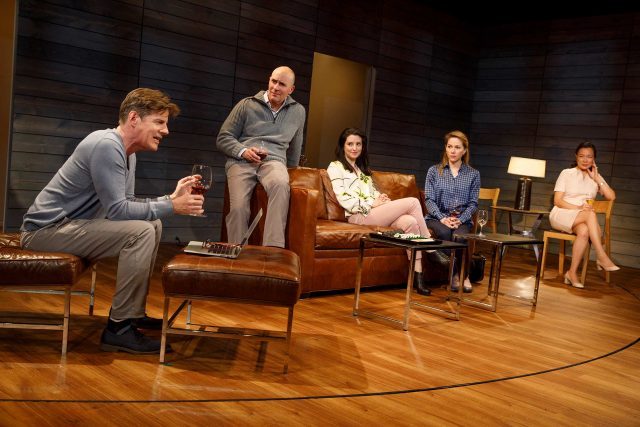
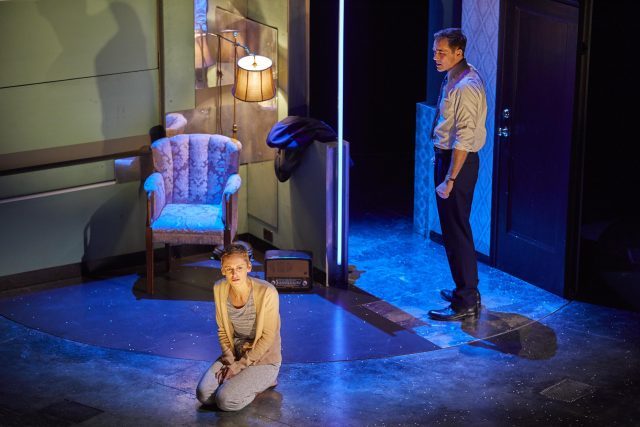
“We should talk,” Ann (Katie Finneran) says to Peter (Robert Sean Leonard) at the beginning of Edward Albee’s At Home at the Zoo, a two-act play running at the Signature through March 25. “Do you mind if we talk?” Jerry (Paul Sparks) asks Peter in the second act. Every word matters in Albee’s minimalist play about language, communication, and loneliness. The second half of the work, The Zoo Story, began as a one-act play first performed in West Berlin in 1959. Nearly fifty years later, in 2004, Albee added a prequel, Homelife, in order to flesh out the character of Peter. Initially known as Peter and Jerry, the retitled Edward Albee’s At Home at the Zoo opens with Peter sitting in a chair with a matching ottoman, reading a book under a lamp. Andrew Lieberman’s set is otherwise bare, except for Cy Twombly–like pencil scribbles on the white walls and floor that could be editors’ marks (Peter works for a text-book publisher) while evoking a certain randomness. The forty-five-year-old Peter and the thirty-eight-year-old Ann live on the Upper East Side and have settled into a cozy, rather ordinary life. While that pleases Peter, Ann appears to want more. She leads their discourse from daydreams of public nakedness to contemplations of morality and mortality; before we know it, the two are deep in polite conversation about the mundane violence visited upon upper-middle-class sex organs: from prophylactic breast removal to infant circumcision. “Once you hear of an idea you never know where it will lodge itself, when it will move from something learned to something . . . considerable, something you might think about, which is not far from being thought about, if you wanted to, or needed to,” Ann says. “We all die of something,” Peter responds. Ann: “Sooner or later.” Peter: “Yes, but . . .” Ann: “Yes, but! Oh, you do love pedantry so . . . dying of not doing something can be carelessness!” Much of their conversation involves the semantic use of words; the couple exists together — and indeed is still happy — more through language than action. In the world they’ve created, being comfortable is not really a problem; in fact, Peter is so comfortable that he spends virtually the entire act seated in his chair. “I love you dearly,” Ann says. “But where’s the . . . the rage, the . . . animal? We’re animals! Why don’t we behave like that . . . like beasts?! Is it that we love each other too safely, maybe? That we’re secure? That we’re too . . . civilized? Don’t we ever hate one another?” That will have to wait until after intermission.

(photo by Joan Marcus)

Peter (Robert Sean Leonard) and Jerry (Paul Sparks) talk it out in The Zoo Story (photo by Joan Marcus)

The second act, The Zoo Story, opens with Peter sitting on a park bench, reading. A stranger who later identifies himself as Jerry approaches him and says, “I’ve been to the zoo,” an ingenious transition from the first act, in which Ann was talking about animals and beasts. Speaking expressively in disjointed thoughts, Jerry is everything Peter is not; aggressive, unashamed, unfiltered, and, perhaps most important, potentially dangerous. “I don’t talk to many people,” Jerry tells Peter. “But every once in a while I like to talk to somebody, really talk, like to get to know somebody, know all about him.” Understandably uncomfortable, Peter responds, “And am I the guinea pig for today?” After a long, convoluted story about his landlady and her dog, Jerry does more than talk as he invades Peter’s space, leading to a shocking conclusion. Edward Albee’s At Home at the Zoo features fine performances from Tony winner Leonard (The Invention of Love, House) as the gentle, mild-mannered Peter and two-time Tony winner Finneran (Noises Off; Promises, Promises) as the curious and concerned Ann, but Albee saves the fireworks for Jerry, a bundle of nervous energy superbly embodied by Emmy nominee Sparks (House of Cards, Boardwalk Empire); he’s like a caged animal waiting to burst free, exacerbating a situation where anything can happen at any moment. (Perhaps the marks on the walls were made by human animals trying to escape their theatrical fate.) Drama Desk Award winner Lila Neugebauer (The Wolves, Everybody), who directed Albee’s 1959 one-act The Sandbox at the Signature in 2016, keeps the tension building in both sections of the play, which come together seamlessly. Of course, Albee, who was the Residency One Playwright at the Signature in 1993-94, is making a direct connection between theater and zoos, two places where humans pay money to watch others perform for them. Thus, Albee feels right at home at the Signature (as well as at the zoo; the author’s name in the title could be read as a possessive or as the subject of the sentence). And just like at the zoo, nobody likes to see sleeping animals; children and adults want to see some action, which is just what Albee gives them in the end.

JAPAN SOCIETY PLAY READING SERIES: MANHOOD

Japan Society

Japan Society Play Reading Series continues March 26 with Hideto Iwai’s Manhood

Japan Society
333 East 47th St. at First Ave.
Monday, March 26, $15, 7:30
212-715-1258
www.japansociety.org

Japan Society’s 110th anniversary season continues March 26 with the thirteenth installment of its popular Play Reading Series, which features staged readings of works by up-and-coming Japanese playwrights translated into English. The latest is Hideto Iwai’s Manhood, which follows four men facing the natural aging process. The play is directed by Sarah Hughes (Wood Calls Out to Wood, Afterward) with a gender-swapped cast of Kate Benson, Ugo Anyanwu, Zoë Geltman, Daniel K. Isaac, Kristine Haruna Lee, and Mia Katigbak. Playwright, actor, director, and Kishida Kunio Award winner Iwai (A Certain Woman, The Husband and Wife), a former hikikomori who spent four years as a recluse because of violence he suffered at the hands of his father and brother, and Hughes, who directs and produces theater and new media, will participate in a Q&A following the reading. Previous works in the Japan Society series include Ai Nagai’s Women in a Holy Mess, directed by Cynthia Croot, Suguru Yamamoto’s Girl X, directed by Charlotte Brathwaite, and Seiji Nozoe’s Dancing with the Bird, directed by James Yaegashi.

HARRY CLARKE: RETURN ENGAGEMENT

(photo by Carol Rosegg)

Tony winner Billy Crudup returns as a man in search of his genuine identity in Harry Clarke (photo by Carol Rosegg)

Minetta Lane Theatre
18 Minetta Lane between Sixth Ave. and Macdougal St.
Tuesday – Saturday through May 13, $47-$67
harryclarkeplay.com

Last fall, Billy Crudup starred in the one-man show Harry Clarke at the Vineyard Theatre. The play is now back, opening last night at the Minetta Lane Theatre, where it continues through May 13, produced by Audible, which recorded and released the Vineyard performance as an audiobook, adding interviews with director Leigh Silverman and playwright David Cale, among other bonus materials. Below is twi-ny’s review from the Vineyard Theatre run.

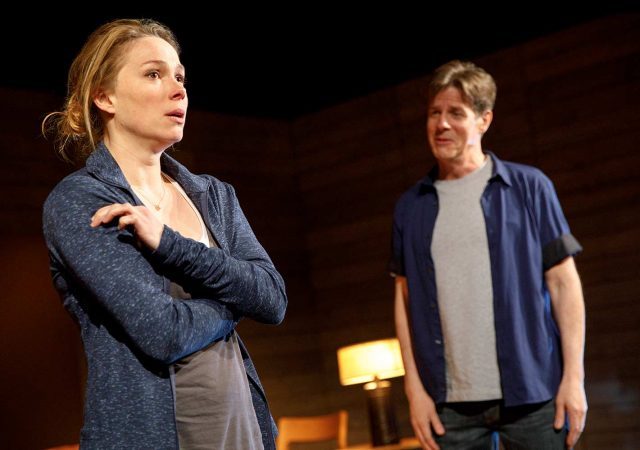
Tony winner Billy Crudup charms the audience much as the character he plays charms the Schmidt family in David Cale’s riveting one-man show, Harry Clarke. In his first solo performance, Crudup is captivating as Philip Brugglestein, a wayward midwesterner who invented an alter ego, the British-speaking Harry Clarke, as a psychological defense against bullying schoolmates and his mentally and physically abusive father. As an adult, Philip has moved to New York City, where he is floundering. One day, in the mood for an adventure, he follows a random guy in the street; later, he befriends the man, a wealthy financier named Mark Schmidt, but Philip introduces himself as his childhood creation, pretending to be the fun-loving Harry Clarke, a smooth operator from Elstree. (He even claims that he worked for Sade for twenty years.) Harry insinuates himself into Mark’s life, as well as that of Mark’s sister, Stephanie, and mother, Ruth, in a way reminiscent of Tom Ripley in Patricia Highsmith’s books except Harry is no mere con man out for money; he’s seeking connections, searching for his identity, as are most of the characters in the play. “I could be myself if I had an English accent,” he recalls saying as child, later telling his parents, “But it’s my real voice.” Soon Harry finds himself caught up in a situation that he didn’t quite expect.

(photo by Carol Rosegg)

Billy Crudup voices multiple characters in world premiere of David Cale one-man show at the Vineyard (photo by Carol Rosegg)

An actor, composer, and playwright who was born in London and moved to New York when he was twenty, Cale originally wrote Harry Clarke for himself — he has previously written and starred in such solo works as Lillian, Deep in a Dream of You, and The Redthroats and has appeared on The Good Wife and in The Total Bent at the Public — but he eventually opted for Crudup, who has been nominated for four Tonys, winning one (for The Coast of Utopa), and has had major roles in such films as Almost Famous and Jesus’ Son. In his third play at the Vineyard, following Chiori Miyagawa’s America Dreaming and Adam Rapp’s The Metal Children, Crudup commands the virtually bare stage with a tender fury; Alexander Dodge’s set features a lone chair on a deck, a small table where Crudup keeps a glass of water, and a scrim in back for abstract projections that hint at a blue sea and sky, with occasional changes. Two-time Obie winner and Tony nominee Leigh Silverman (Violet, In the Wake), who directed Marin Ireland in the searing one-woman show On the Exhale earlier this year, knows just when to get Crudup on the move. Crudup (Waiting for Godot, No Man’s Land) sits casually before at last getting up and really hitting his stride, doing different voices for every character; the writing is so sharp, and the performance so astute, with a cinematic fervor, that you can easily visualize the places Harry goes, from Sixth Ave. to a gay bar to relaxing on board the Schmidts’ boat, Jewish American Princess. Harry is a big movie fan, preferring noirs and thrillers and listening to records by French film composer Georges Delerue, and Cale’s play becomes like a noir thriller itself; it’s no coincidence that Mark wants to become a movie producer. When Harry and Mark meet for the second time, in a theater, Harry says, “This play’s like a mystery, in that sense, seems more like a movie.” Meanwhile, Philip, of course, is a completely unreliable narrator; all of the events are related through his warped, damaged, unpredictable view, as if he’s created his own movie, but that’s part of what makes the show so tantalizing.

CONSTANCE DeJONG AND TONY OURSLER: RELATIVES

(photo © Paula Court / courtesy of the artist and Bureau)

Constance DeJong in original 1989 performance of Relatives at the Kitchen (photo © Paula Court / courtesy of the artist and Bureau)

The Kitchen
512 West 19th St. between Tenth & Eleventh Aves.
Friday, March 23, and Saturday, March 24, $15-$20, 8:00
212-255-5793 ext11
thekitchen.org

Nearly thirty years ago, writer and performance artist Constance DeJong and multimedia artist Tony Oursler performed Relatives at the Kitchen, a duet between a human being and a television set that explored questions of family and genealogy through spoken and visual text and various forms of technology. The work, which was commissioned by the ICA Boston, incorporated aspects of art, language, video games, and cinema in telling the story of the fictional McCloud family in words and images. DeJong and Oursler — the two also collaborated with Stephen Vitiello for the 1995 online project Fantastic Prayers, and DeJong portrayed Madam X in Oursler’s recent 5-D Imponderable film and installation at MoMA — are bringing the piece back for two special performances this weekend, Friday and Saturday night at the Kitchen, where it played in 1989, a few years after the video revolution spurred by the success of MTV, so it should be fascinating to see how it has aged in the iPhone generation. “After seeing me perform, Tony invited me to see his work and, almost immediately, he suggested we collaborate,” the Cleveland-born DeJong tells Rachel Valinsky in a new interview on the Kitchen blog. “I was using prerecorded audio in performance and wanted to introduce video in my live work. Tony was like no one. His video sensibility was unique, partly a generational difference: he was twenty-six and had made, in single-channel videos, a very compelling comingling of DIY methods (drawing, paint, cardboard, etc.) and time-based technology. That early Oursler aesthetic is in Relatives.

relatives 3

Meanwhile, New York City native Oursler explains, “When constructing this work together we played with the idea of a dialogue between live and prerecorded characters and the duality and mutability of image and text. Relatives attempts to register these narrative relationships to a cast of bit players strewn across a vast history of mediums and technologies. As always, our memories have migrated in various forms to oil paintings, home movies and videos, snapshots, and social media, only to be reshuffled by successive generations. DeJong takes a circuitous route through this terrain, pointing out an unlikely family history while always returning to the dilemma of the relationship between the individual and the screen.” At one point in the show, DeJong, in character, looking at images on a small TV, says, “The emotive value of colors, of symbolic animals and plants, I am compelled to arrange my elements much as wind arranges leaves, as a magnet attracts from a pile of things. The number eleven, in this figure which attracts me like no other, my identity, Georgia McCloud, is revealed and yet concealed.” That duology is at the heart of Relatives, which is organized at the Kitchen by Matthew Lyons. “We were working in the dark in a way,” DeJong adds. “Neither of us had produced a performance like this, made of concurrent language and video.”

DISTANT OBSERVER: TOKYO/NEW YORK CORRESPONDENCE

Distant Observer

Takeshi Kawamura and John Jesurun have teamed up for Distant Observer at La MaMa

Ellen Stewart Theatre, La MaMa Experimental Theatre Club
66 East Fourth St. between Second & Third Aves.
Thursday to Monday, March 16 – April 1, $21-$26
212-475-7710
lamama.org

Japanese playwright and director Takeshi Kawamura and Michigan-born Obie and Bessie–winning multimedia artist John Jesurun have collaborated on Distant Observer: Tokyo/New York Correspondence, making its world premiere March 16 to April 1 at La MaMa. In a cross-cultural theatrical conversation, Kawamura (Japan Wars, A Man Called Macbeth) and Jesurun (Chang in a Void Moon, Deep Sleep) alternated writing chapters involving a murderer seeking to reinvent himself in Japan’s Suicide Forest; they will share both writing and directing credit for the piece, which features Anastasia Olowin, Kotoba Dan, Claire Buckingham, Kyle Griffiths, and Samuel Im. The March 18 performance will be followed by a talkback with Kawamura, Jesurun, and Japanese theater scholar and journalist Kyoko Iwaki, moderated by CUNY’s Dr. Frank Hentschker.

ESCAPE TO MARGARITAVILLE

(photo © Matthew Murphy)

Lisa Howard, Alison Luff, Paul Alexander Nolan, and Eric Petersen get wasted away again in Margaritaville (photo © Matthew Murphy)

Marquis Theatre
210 West 46th St. at Broadway
Tuesday – Sunday through July 1, $59-$169
escapetomargaritavillemusical.com

Greg Garcia and Mike O’Malley do a phenomenal job adapting Jimmy Buffet’s songs into the rousing Escape to Margaritaville, which opened tonight at the Marquis Theatre. The television veterans and first-time book writers have created a show that was well on its way toward being one of the best new musicals on Broadway — until the last half hour or so rapidly devolved into saccharine, lowest-common-denominator fluff. But up till then, it’s a tasty buffet featuring a bright young cast, astute direction by Christopher Ashley, playful choreography by Kelly Devine, and a flurry of Easter eggs that will delight laid-back Parrotheads everywhere. The plot is about as basic as it comes. Tammy (Lisa Howard) is preparing to marry the doltish, beer-swilling, sports-obsessed Chadd (Ian Michael Stuart). The week before the wedding, Tammy and her best friend, Rachel (Alison Luff), jet off on a Caribbean bachelorette vacation. While Tammy is looking forward to partying and flirting, Rachel, an environmental scientist, is more interested in getting cell service and collecting soil samples from the top of a volcano. The adorable Rachel is immediately pounced on by the love-’em-and-leave-’em Tully Mars (Paul Alexander Nolan), a Buffett-like singer-songwriter and islander who is the primary entertainment at the not-quite-luxurious Margaritaville Hotel and Bar, where work is a dirty four-letter word. Tully’s best friend, Brick (Eric Petersen), is a clueless but lovable bartender who takes an instant liking to Tammy. The hotel is owned and operated by Marley (Rema Webb), with Jamal (Andre Ward) in charge of keeping the guests happy; both characters are colonialist leftovers that should have been more sensitively developed instead of merely being outdated stereotypes. While Rachel lets down her hard-shell exterior and warms up to Tully’s incessant advances, Tammy is having such a good time with Brick that she is reconsidering her situation with Chadd. But when the volcano threatens to explode, everybody is forced to reevaluate their lives and loves.

(photo © Matthew Murphy)

Tammy (Lisa Howard) and Brick (Eric Petersen) hit it off in island paradise (photo © Matthew Murphy)

Garcia (My Name Is Earl, Raising Hope) and O’Malley (Survivor’s Remorse, Shameless) have done their homework, creating a tight book that is filled with myriad minor details that later pop up in the songs; Buffett fans might get an inkling of what’s to come, but even newbies will get a kick out of how it all comes full circle. For example, J.D. (Don Sparks), an older, one-eyed drunken pilot, is constantly misplacing the salt. When the company performs Buffett’s most famous tune, “Margaritaville,” J.D. takes the microphone when it comes time for the favorite line “Searchin’ for my lost shaker of salt.” Similarly, the diet that Chadd puts Tammy on, consisting of only carrot juice and sunflower seeds, is taken from “Cheeseburger in Paradise.” And if you’re wondering why Tammy and Rachel are from Cincinnati, just listen closely to the beginning of “Fins.” The show gets just about everything right, including inventive uses of wires to show characters snorkeling, until the last handful of scenes, when it degenerates suddenly into treacly Broadway clichés, turning its back on the risky plot choices that came before; to have really shaken up the genre and been a creative whole, it actually could have ended at intermission, or at least about halfway through the second act, and avoid the approaching shipwreck. Alas, the rest was so dreadful that I almost wanted to make my escape from Margaritaville, but I stuck it out.

(photo © Matthew Murphy)

Tully Mars (Paul Alexander Nolan) keeps ’em dancing and singing at the Margaritaville Hotel (photo © Matthew Murphy)

The music, of course, is a helluva lot of fun. For the most part, Michael Utley’s orchestrations remain faithful to Buffett’s originals, only occasionally going over the top and becoming Broadway-fied; Buffett was involved in the song selection and tweaked some tunes for the show in addition to writing “Three Chords” for Tully and Rachel. Walt Spangler’s hotel set makes you feel like you’re in the Caribbean, partying with the tourists. (Yes, there are margaritas available for purchase; at an early preview the theater reportedly ran out of Triple Sec because demand was so high.) Howard (It Shoulda Been You, The 25th Annual Putnam County Spelling Bee) has charm and energy to boot as Tammy, while Luff (Les Misérables, Matilda) is smart and sexy as Rachel. Petersen (School of Rock, Elf) provides plenty of comic relief, but Nolan (Bright Star, Doctor Zhivago) is a bit too smarmy as Tully, even as his heart warms up to unexpected possibilities. It’s a shame that the ending is so banal, running out of creative risks the way the theater bar ran out of Triple Sec.