this week in theater

KING LEAR

(photo by Ellie Kurttz)

Sir Antony Sher bids William Shakespeare adieu in final Bard role (photo by Ellie Kurttz)

Brooklyn Academy of Music
BAM Harvey Theater
651 Fulton St.
April 7-29, $35-$125, 7:30 (plus 1:30 and 3:00 weekend matinees)
718-636-4100
www.bam.org

The Brooklyn Academy of Music has a thing for King Lear. Since 2007, it has presented three major productions, starring Sir Ian McKellen, Sir Derek Jacobi, and Frank Langella. During that time period, New York has also seen the tragic ruler portrayed by John Lithgow at the Delacorte, Michael Pennington at TFANA, and Sam Waterston and Kevin Kline at the Public. Now comes sixty-eight-year-old South African-born English actor Sir Antony Sher, in what is being billed as his final Shakespeare role. The two-time Olivier Award winner, Tony nominee, and longtime Royal Shakespeare Company member has previously played the Fool in Lear, Shylock in The Merchant of Venice, Prospero in The Tempest, Falstaff in both parts of Henry IV at BAM, Leontes in The Winter’s Tale, and the title characters in Richard III, Titus Andronicus, and Macbeth. The RSC production runs at the BAM Harvey April 7-29, directed by Gregory Doran (Sher’s longtime partner), with sets by Niki Turner, lighting by Tim Mitchell, and music by Ilona Sekacz. The cast also features Nia Gwynne as Goneril, Kelly Williams as Regan, Mimi Ndiweni as Cordelia, and Graham Turner as the Fool. In conjunction with the show, RSC assistant director Anna Girvan and members of the company will give a class on April 24 at 1:00 ($25) at the Mark Morris Dance Center “for emerging professional actors,” and Girvan and company members will lead the open workshop “Inside the Storm” on April 26 at noon ($20) at Mark Morris “for curious adult (18+) theatergoers of all abilities.”

GOLDSTEIN: A NEW MUSICAL ABOUT FAMILY

(photo by Jeremy Daniel)

The Goldsteins finally agree on something in world premiere musical at the Actors Temple (photo by Jeremy Daniel)

Actors Temple Theatre
339 West 47th St. between Eighth & Ninth Aves.
Saturday – Thursday through July 29, $79 – $99
goldsteinmusical.com
actorstempletheatre.com

A man gets a whole lot more than he bargained for when he writes a family history in Goldstein, a new musical that opened last night at the Actors Temple Theatre. The frame story of the show, which features a book by Charlie Schulman and music and lyrics by Michael Roberts, is that Louis Goldstein (Zal Owen) is a writer, recent winner of a Pulitzer Prize for his tale, and he’s at the Actors Temple as part of an authors series. “We inherit so many things from our families: the color of our eyes, our senses of humor, even our high cholesterol,” he tells the audience. “But we also inherit our stories. That’s what binds families together. The stories we tell ourselves about ourselves. My parents and grandparents are no longer with us, but I know in my heart they would have been proud of me for having written this book. Even now I feel their presence like they’ve never left.” Indeed, they are all still there; white sheets are removed from the old furniture on Alexander Woodward’s homey set, bringing back the Goldsteins’ past—and the Goldsteins themsevles, as Louis’s dead relatives appear and relive scenes and argue that he has done them all a disservice with his book. “You distort and deceive, you torture and twist / and, while a fact may be true, its truth may be missed,” his grandfather Louie (Jim Stanek) sings. Louie’s wife, Zelda (Amie Bermowitz), adds, “You write with an axe / but, fine, take all your lies.” Louis handles it all rather well as he shares such stories as his grandmother falling in love with a man (Owen, who plays several parts) on the ship bringing her from Eastern Europe to America; his aunt Sherri’s (Megan McGinnis) desire to go to medical school; his uncle Nathan’s (Aaron Galligan-Stierle) time in the military and marriage to Eleanor (Sarah Beth Pfeifer); and his sister, Miriam (Julie Benko), who is perhaps the most practical of the clan. Not all the stories paint the Goldsteins in a positive light, but Louis sees it all as what made the family what it is, including several long-held secrets that finally come out.

(photo by Jeremy Daniel)

Goldstein follows the ups and downs of an immigrant clan on the Lower East Side (photo by Jeremy Daniel)

Goldstein is a quaint, bittersweet musical that moves seamlessly from humor to tragedy. The songs, which include “They Are Here,” “Up Ahead,” “Honest as the Day Is Long,” and “Tell Me All,” are accompanied by an unseen pianist and flutist and tend toward the conversational; there are no big, show-stopping numbers but instead light tunes that don’t get in the way of the plot. Roberts and Schulman, who previously collaborated on New York Fringe winner The Fartiste, and director Brad Rouse keep it relatively simple and straightforward. (The show is inspired by Schulman’s 2000 play The Kitchen, about eighty years in the life of one family; an early reading featured Danny Burstein, Marilyn Sokol, Rachel Botchan, and Larry Block.) Among the nice touches is the use of the center aisle as a pathway for death and birth. Owen (Fiddler on the Roof) is eminently likable as the narrator, a man facing his own personal issues, while McGinnis (Daddy Long Legs, Les Misérables) proves once again that she has a magical voice. The show fits in very well at the Actors Temple, a working shul that boasts photos and bios of such former members and worshippers as Jerry Lewis, Milton Berle, Sandy Koufax, the Three Stooges, Shelly Winters, Hank Greenberg, and Henny Youngman. While Goldstein might deal with a Jewish family, it is really about many of the immigrants who made their way to the Lower East Side in the late nineteenth and early twentieth centuries as they sought to balance assimilation with tradition, trying to establish their identity while building a family.

ROCKTOPIA

(photo by Matthew Murphy)

Rocktopia blends classic rock and classical music on Broadway (photo by Matthew Murphy)

The Broadway Theatre
1681 Broadway at 53rd St.
Through April 29, $39 – $187
rocktopia.com

Much of Rocktopia, which opened Tuesday night at the Broadway Theatre, is a curiosity, a blending of classic rock and classical music that in theory might be a cool idea but in execution could be problematic. Rocktopia is a different kind of jukebox musical, with no narrative, consisting of overly familiar songs performed by pop, rock, theater, reality show, and opera singers, a five-piece rock band, the thirty-person New York Contemporary Choir, and the twenty-piece New York Contemporary Symphony Orchestra. Conceived by Trans-Siberian Orchestra member and Broadway veteran Rob Evan (Jekyll and Hyde, Les Misérables) and American conductor Randall Craig Fleischer, the traveling project is an up-and-down affair, as vocal histrionics get carried away, the setlist is about as standard as it comes, and amateurish, seemingly unrelated visuals are projected onto fifteen large, vertical piano keys at the top rear of the stage. But then something magical happens, where it all suddenly comes together for an absolutely smashing last few numbers that brought the crowd to its feet, everyone singing and dancing with an intoxicating fervor.

(photo by Matthew Murphy)

Celtic violinist Máiréad Nesbit and vocalist Rob Evan rock out at the Broadway Theatre (photo by Matthew Murphy)

The show opens with the pairing of Richard Strauss’s “Also sprach Zarathustra” and the Who’s “Baba O’Riley,” sung by Evan and Tony Vincent (American Idiot, Jesus Christ Superstar), followed by Mozart’s “Eine kleine Nachtmusik” with Styx’s “Come Sail Away,” performed by Evan, Vincent (The Voice), Chloe Lowery (Trans-Siberian Orchestra), and Kimberly Nichole (The Voice). The double shot gets the point across but without any fireworks, as the melding of the two genres felt too obvious and separate. Special guest Pat Monahan of Train, who will be part of the show through April 6 (Twisted Sister’s Dee Snider is the guest April 9-15, followed by Cheap Trick’s Robin Zander April 23-29), takes center stage to get the Led out (first with Beethoven, then Puccini), but Stravinsky/Hendrix is out of place, as is Mussorgsky/U2, the latter accompanied by documentary footage of poor communities. However, it’s a thrill to see diva Alyson Cambridge, who has performed at the Met and the Washington National Opera, lend class to the festivities by singing Handel’s “Lascia ch’io pianga” and Lucio Dalla’s “Caruso” and also duetting with Evan. On nearly every song, Celtic violinist Máiréad Nesbitt sparkles, playing her fiddle as she flits about the stage like a mad fairy or sprite. There actually is a rhyme and reason for the visuals; in the online Rocktopia study guide, the evening moves from “Creation/Birth,” “Adolescence,” and “Experimentation” through “Dreams,” “Oppression/Rebellion,” and other aspects of the human condition, not that you would know that from what’s happening onstage. And we’re still trying to figure out the inclusion of John Denver in a video tribute to such dead rock stars as Jimi, Janis, Jerry, Jim, George, John, Prince, and Bowie, as well as photos of Eleanor Roosevelt, Amelia Earhart, and, yes, Anne Frank during the theme from Schindler’s List. Meanwhile, the woman vocalists and Nesbitt look like they just stepped out of a Mad Max movie, wearing postapocalyptic gowns designed by Cynthia Nordstrom, and Vincent appears to be doubling for Robin Lord Taylor’s Penguin on Gotham.

(photo by Matthew Murphy)

Rob Monahan of Train is Rocktopia’s special guest through April 6 (photo by Matthew Murphy)

And then it happens. Samuel Barber meets Queen, Beethoven takes on Journey, and Gershwin intertwines with Queen in all the ways Evan and Fleischer intended, the classical music and the classic rock coming together, weaving in and out of each other, sending electricity across a room that suddenly comes alive as one. Guitarist Tony Bruno, bassist Mat Fieldes, drummer Alex Alexander, pianist and music director Henry Aronson (Rock of Ages, Grease), Nesbitt, the choir, the orchestra, and the singers — if still not the projections — bring down the house, leaving no one in their seat. Sure, it’s cheesy and extremely safe, but it’s also tons of fun if you just let yourself go. It might not be quite the revolution Evan and Fleischer intended, and it’s far more likely to attract fans of American Idol and The Voice and baby boomers who go to Jones Beach to see 1970s retreads rather than classical music lovers who go to the Met and Lincoln Center for opera and the symphony, but you can’t have everything. And what’s wrong with a little mindless entertainment in these hard times?

YERMA

(photo by Stephanie Berger)

An unnamed woman (Billie Piper) and her partner (Brendan Cowell) consider starting a family in Simon Stone’s sizzling Yerma (photo by Stephanie Berger)

Park Ave. Armory, Wade Thompson Drill Hall
643 Park Ave. at 67th St.
Monday – Saturday through April 21, $40-$135
212-933-5812
www.armoryonpark.org

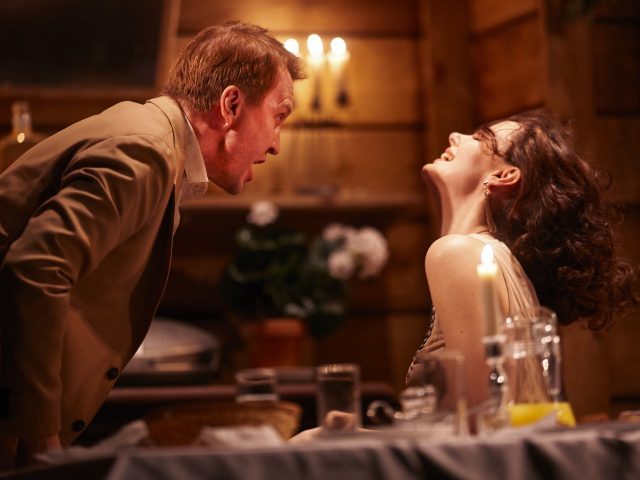
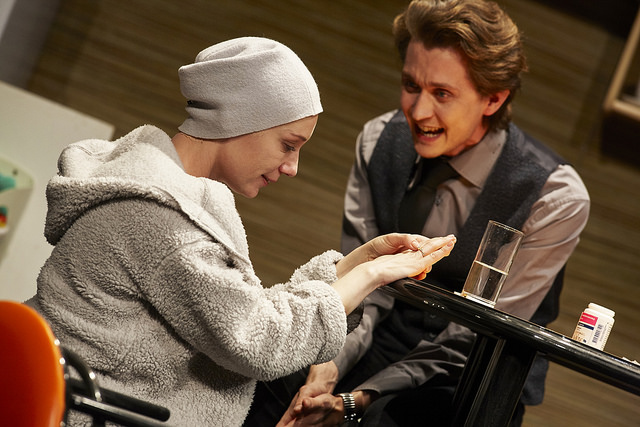
Australian director Simon Stone puts domesticity and obsession under a microscope in the blistering, no-holds-barred Yerma, which opened last night at the Park Avenue Armory. His adaptation of Federico García Lorca’s radical 1934 drama, part of the Spanish poet and playwright’s seminal Rural Trilogy that also includes Blood Wedding and The House of Bernarda Alba, digs deep into the heart and soul of a woman who wants to have a baby but is having trouble conceiving. In a coproduction between the armory and the Young Vic, Stone moves the play to modern-day London, where a thirty-three-year-old blogger identified only as “her” (Olivier Award winner Billie Piper) and her forty-three-year-old partner, international businessman John (Brendan Cowell), have just bought a three-floor apartment. At first the couple is deliriously happy with their life, thrilled to be free of bourgeois expectations, when the woman suddenly and surprisingly decides she wants to have a baby, but John’s enthusiasm is questionable. They have difficulty conceiving, and soon all kinds of connections to sex and reproduction appear, from her pregnant sister, Mary (Charlotte Randle), married to a philanderer, to a former boyfriend, Victor (John MacMillan), now father of a two-year-old, who gets a job at her office. Her twenty-one-year-old assistant, Des (Thalissa Teixeira), talks about her extremely active sex life while the woman’s mother, Helen (Maureen Beattie), can’t stop complaining about raising kids. In none of the situations is having children and being a parent ideal; instead, each person faces their own demons. Over several years, as the woman battles infertility, she descends into an ever-more-difficult struggle to maintain balance in her life as madness threatens.

(photo by Stephanie Berger)

Two sisters (Billie Piper and Charlotte Randle) evaluate their situations while their mother (Maureen Beattie) looks on in Park Ave. Armory production (photo by Stephanie Berger)

Yerma unfolds on Lizzie Clachan’s spectacular stage, reconfigured specifically for the massive fifty-five-thousand-square-foot Wade Thompson Drill Hall, which has previously been transformed in dazzling ways for productions of Eugene O’Neill’s The Hairy Ape, Matt Charman and Josie Rourke’s The Machine, and Rob Ashford and Kenneth Branagh’s Macbeth, among other plays, art installations, and music events. The audience is seated on risers on two sides of the stage, a horizontal space encased by glass, making everyone a voyeur peering into someone else’s personal life, as if turning the woman’s blog into a physical reality. The woman is trapped within the glass structure, which evokes her mind; she is the only one who ever makes contact with the walls, except for when her mother washes it early on, not wanting to get involved too much in her daughter’s problems. Each side of the audience can see the other through the glass; at first it looks like it could be a reflection, but it’s not, equating everyone, as if the story we’re all experiencing could be happening to any one of us.

At certain angles, the actors are reflected multiple times; thus, it is often possible to see four or five ghostly, unformed versions of Piper, visible far off to the right and left and across to the other side of the audience. It is a powerful dramatic effect that makes her deepening issues that much more universal. The lightning-fast set changes by lighting designer James Farncombe occur in sudden blackness as magisterial arias echo loudly throughout the space and a monitor announces the next chapter, which have such names as “Conception,” “Disillusion,” and “Deception,” followed by phrases both descriptive and ominous. In addition, the characters are mic’d in such a way that their voices seem transcendent as they echo above them. (The gorgeous music and sound design is by Stefan Gregory.) It’s a testament to Stone and the exceptional cast that they do not let the complex staging overwhelm the intimacy of the story. Nothing is done simply for show or to merely revel in the magic of theater; every aspect of the production has been ingeniously crafted to organically intersect into a wholly involving and shattering experience that will leave you physically and emotionally exhausted as well as thoroughly exhilarated.

(photo by Stephanie Berger)

A couple’s relationship evolves and devolves in Yerma at the Park Ave. Armory (photo by Stephanie Berger)

In her North American stage debut, Piper (The Effect, Treats) is electrifying as her character devolves from a fun-loving, sexy, multifaceted woman into a mental wreck falling into the lower depths of the human condition; it is a brave, bold, unforgettable performance that leaves it all out on the stage and on the glass, literally and figuratively. Cowell (Life of Galileo, The Dark Room) marvelously complements her as John, maintaining the mystery behind the man’s fears and desires as he reacts to his partner’s gut-wrenching unpredictability. As a collective unit, the cast displays the wide range of emotions associated with pregnancy, from conception, the morning after pill, and abortion to motherhood, postpartum depression, and separation. It never lets up for a second throughout its one hundred minutes, with no detail extraneous; an early discussion of a certain sexual position only later lends insight into John’s unspoken feelings about potentially becoming a father, and even the characters’ names have been carefully chosen, with biblical and historical references or descriptions of who they are and what they want. And yet Toneelgroep Amsterdam veteran Stone (The Wild Duck, Miss Julie) has opted to not call the woman “Yerma” even though that is the title of the play — the name is shouted out only once in Lorca’s original — emphasizing her lack of identity without a child while reminding us again that she is us. It’s a terrifying prospect, brought to life in this stunning, brutal production.

THE WINTER’S TALE

(photo by Carol Rosegg)

Leontes (Anatol Yusef) grows suspicious of Hermione (Kelley Curran) and Polixenes (Dion Mucciacito) in The Winter’s Tale at TFANA (photo by Carol Rosegg)

Theatre for a New Audience, Polonsky Shakespeare Center
262 Ashland Pl. between Lafayette Ave. & Fulton St.
Tuesday – Sunday through April 15, $90-$125
866-811-4111
www.tfana.org

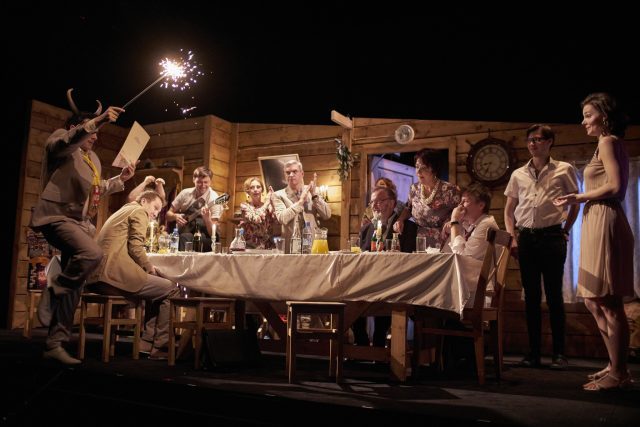
Theatre for a New Audience resident director Arin Arbus approaches William Shakespeare’s The Winter’s Tale — a tragicomedy and late romance that is considered one of the Bard’s problem plays — with sharp teeth and claws bared, like a grizzly bear just awakened from hibernation. In fact, a bear — well, a man in a bear suit (Arnie Burton) — is a key character in the nearly three-hour production, which opened Sunday night at the Polonsky Shakespeare Center in Fort Greene. The bear, who lives under the stage, impacts the narrative in each of the very different two acts, which are famously separated by a sixteen-year gap in the story, another kind of hibernation. With snow falling in Sicilia, King Leontes (Anatol Yusef) is hosting Polixenes (Dion Mucciacito), the king of Bohemia, When Polixenes considers leaving for home, Leontes suddenly, and without reason, becomes convinced that his pregnant wife, Hermione (Kelley Curran), and the Bohemian leader are in love and have made a cuckold of him. Leontes’s trusted friend, Camillo (Michael Rogers), assures the king that no such treachery has occurred, but the king refuses to listen to him, declaring, “Is whispering nothing? / Is leaning cheek to cheek? Is meeting noses? / Kissing with inside lip? Stopping the career / Of laughter with a sigh? — a note infallible / Of breaking honesty. Horsing foot on foot? / Skulking in corners? Wishing clocks more swift? / Hours minutes? Noon midnight? And all eyes / Blind with the pin and web but theirs, theirs only, / That would unseen be wicked? Is this nothing? Why, then the world and all that’s in ’t is nothing, / The covering sky is nothing, Bohemia nothing, / My wife is nothing, nor nothing have these nothings, / If this be nothing.” In accusing his wife, the king has also deeply troubled their young son, Maximillius (Eli Rayman). Leontes orders Camillo to kill Polixenes, but instead Camillo flees to Bohemia with him. In prison, Hermione gives birth to a girl, and Leontes tells Lord Antigonus (Oberon K. A. Adjepong), the husband of Hermione’s dedicated lady-in-waiting, Paulina (Mahira Kakkar), to take the baby away and abandon it. After heartbreaking tragedy, the baby is found on the shores of Bohemia by a shepherd (John Keating) and his clownish son (Ed Malone), who bring the infant, whom they name Perdita, home.

(photo by Carol Rosegg)

Autolycus (Arnie Burton) offers a phallic flower in Arin Arbus’s latest Shakespeare adaptation (photo by Carol Rosegg)

After intermission, the dire, dour mood changes dramatically. Father Time (Robert Langdon Lloyd) walks with a cane onto the stage as green leaves fall in Bohemia, announcing spring. Time, representing the chorus, explains that sixteen years have passed, filling in the details of what has become of the main characters. Most important, Perdita (Nicole Rodenburg) is now a teenager who is close with Florizel (Eddie Ray Jackson), the son of Polixenes, although no one knows her true lineage. As the region prepares for a sheep-shearing feast, Autolycus (Burton), a former servant of Florizel’s who has gone rogue, picks a few pockets, including that of an audience member in the first row. “Ha, ha, what a fool Honesty is! And Trust, / his sworn brother, a very simple gentleman! I have sold all my trumpery,” Autolycus, who serves as the play’s turning point, admits. Through a series of events, everyone winds up back in Sicilia, where a little bit of magic eases much, but not all, of the pain that spread through the first act and the bitterness of winter turns into the hopeful blossoming of spring as time marches ever forward.

(photo by Carol Rosegg)

Bohemians celebrate at the sheep-shearing fest (photo by Carol Rosegg)

Arbus (King Lear, The Skin of Our Teeth) juggles the play’s so-called problems deftly, balancing the darkly serious with the lightly comic, moving things relatively briskly on Riccardo Hernandez’s spare but austere, at times almost blindingly white set, which features a large arch in the back, behind which projections change from ominous clouds to blue skies. Emily Rebholz’s contemporary costumes take some getting used to, although they do shift from dignified black, white, and brown in the first act to a more casual look with splashes of color in the second. Much of the cast, which also includes Maechi Aharanwa as Mopsa, Liz Wisan as Dorcas, cellist Zsaz Rutkowski, and multi-instrumentalist Titus Tompkins, is allowed a wide berth, especially during the wacky sheep-shearing festival, but Curran (Present Laughter, Sense & Sensibility), Rogers (The Call, Sucker Punch), and RSC vet Yusef (Hamlet, Boardwalk Empire) keep it grounded just enough. The Winter’s Tale might be a lesser-performed Bard work, but it still has its gems. “If powers divine / Behold our human actions, as they do, / I doubt not then but innocence shall make / False accusation blush and tyranny / Tremble at patience,” Hermione says, speaking for all truths. And of course, the play also boasts perhaps Shakespeare’s most famous stage direction: “He exits, pursued by a bear.”

THE LOW ROAD

(photo by Joan Marcus)

Jim (Chris Perfetti) tries to unbalance the books while being celebrated by Old Tizzy (Crystal A. Dickinson) and Mrs. Trewitt (Harriet Harris) in The Low Road (photo by Joan Marcus)

Anspacher Theater, the Public Theater
425 Lafayette St. at Astor Pl.
Tuesday through Sunday through April 8, $85
212-539-8500
publictheater.org

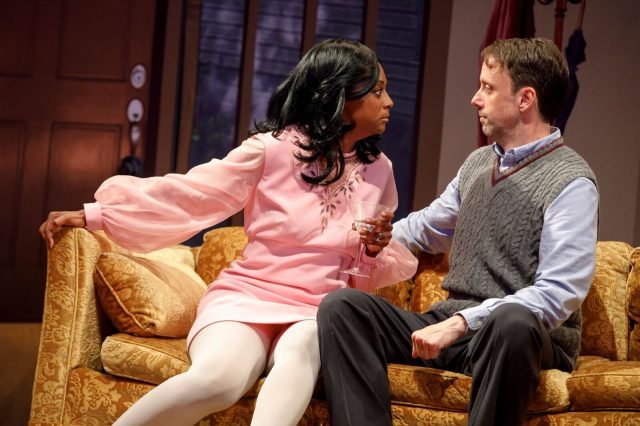
Pulitzer Prize winner Bruce Norris uses Adam Smith’s 1776 economic epic, An Inquiry into the Nature and Causes of the Wealth of Nations, as the basis for his potent and rollicking The Low Road, running at the Public’s Anspacher Theater through April 8. The Texas-born Norris follows the development of American capitalism through the trials and tribulations of one Jim Trewitt, from his birth in 1758 to the year of independence, 1776. The bitter yet playful satire is narrated by Smith (Daniel Davis), who hovers around the stage and in the aisles as he watches the shenanigans unfold along with the audience when he’s not front and center, using business-speak to introduce scenes. “As the ladies within had no marketable skills to speak of, they set about to purvey the only commodity available to them,” he says about a brothel, where the madam, Mrs. Trewitt (Harriet Harris), and her one-eyed slave, Old Tizzy (Crystal A. Dickinson), have taken in a baby left to them by one “G. Washington of Virginia,” according to a note that also promises they will be “generously compensated” upon the lad’s seventeenth birthday. One day, young Jim (Jack Hatcher) fortuitously comes upon a work-in-progress by Smith, reading a paragraph that will change his life: “Every individual endeavours as much as he can to employ his capital in support of domestic industry. He neither intends to promote the public interest nor knows how much he is promoting it. He intends only his own gain, and he is, in this, led by an invisible hand to promote an end that was never part of his intention. Nor is it the worse for society that it was no part of it.” Jim becomes a master with money, embezzling from Mrs. Trewitt without the slightest bit of guilt, and upon his seventeenth birthday, he (now played by Chris Perfetti) heads out on his own with a hidden stash under his hat. He buys himself a slave, John Blanke (Chukwudi Iwuji), loses a lot more than just his shirt to a mysterious masked thief, gets taken in by Brother Pugh (Max Baker), the presiding elder of the Bible-thumping New Light of Zion Colony of Waterfleet, and courts the daughter (Tessa Albertson) of the fabulously wealthy Isaac Low (Kevin Chamberlin). All the while, he is accompanied by Blanke, who turns out to be a lot more than the “deef . . . substandard product” he thought he purchased.

(photo by Joan Marcus)

Jim Trewitt (Chris Perfetti) belittles his new slave, John Blanke (Chukwudi Iwuji), in Bruce Norris play at the Public Theater (photo by Joan Marcus)

Tony winner Norris (Clybourne Park, A Parallelogram) fills The Low Road with economic language and potent platitudes that never get tedious or pedantic — and much of which is as true today as it was in Smith’s time, taking on income inequality, class, gender, legacy, luxury, labor, power, property, organized religion, the military, and race. “All profit is theft,” Constance Pugh (Susannah Perkins) declares. “As he considered the disparity betwixt himself and the man whose chamber-pot he presently emptied, he wondered what it should be that caused such divergence of fortune,” Smith says of Trewitt cleaning up after the Duke of Buccleuch (Gopal Divan) at the brothel. “Might I suggest you learn to value that which cannot be obtained at gunpoint?” Blanke tells Jim shortly after they had been shackled together, evoking Sidney Poitier and Tony Curtis in Stanley Kramer’s The Defiant Ones. “You provide commendable service to my men and in return we provide you with protection. Now, surely that’s a fair exchange, yes?” Captain Shirley (Richard Poe) reminds Mrs. Trewitt when explaining why he and his soldiers don’t have to pay for their jaunts with her ladies of the night. “Yet somehow it seemed that, as his authority increased, the affection of those within had diminished proportionally,” Smith says of Jim as he cheats Mrs. Trewitt and her coterie, continuing, “For, their needs were modest, and, as a future gentleman, his were understandably greater.” And just in case the audience doesn’t tune into how modern these ideas still sound, the second act begins with a brilliantly conceived scene that establishes Jim as the founding father of corporate greed.

(photo by Joan Marcus)

Isaac Low (Kevin Chamberlin) shares his good fortune with his wife (Harriet Harris) as their daughter (Tessa Albertson) and Adam Smith (Daniel Davis) look on in The Low Road (photo by Joan Marcus)

Four-time Tony nominee and three-time Obie winner Michael Greif (Dear Evan Hansen, A Parallelogram) superbly directs a cast of eighteen on the small Anspacher stage, which undergoes numerous changes by scenic designer David Korins, as chairs, tables, beds, barriers, a podium, and other elements are wheeled on and off; a short technical delay the night I went actually gave insight to the complexity behind the staging. Emily Rebholz’s period costumes and J. Jared Janas and Dave Bova’s wig and hair design are right on target, as is live music by violinist Josh Henderson, composed by Mark Bennett. Perfetti (Picnic, Cloud Nine) brings an engaging quirkiness to the role of Jim; you can’t help but root for him even though he does terrible things that will essentially lead to the subprime mortgage crisis of 2008. RSC veteran Iwuji (Hamlet, Hedda Gabler) is ferocious as John Blanke, representing America’s greatest shame and delivering the timeless line “But how much profit does one need? P’raps there ought be some penalty for the accumulation of unseemly wealth.” And Tony nominee Daniel Davis (Wrong Mountain, Talking Heads) lends it all a grand Shakespearean air. Thirty years ago, Gordon Gekko proclaimed, “Greed is good.” Norris ingeniously takes roads both low and high to reveal just how American that concept is, from the birth of the nation to this very minute.

HANOCH LEVIN SQUARED: THE LABOR OF LIFE & THE WHORE FROM OHIO

The Labor of Life

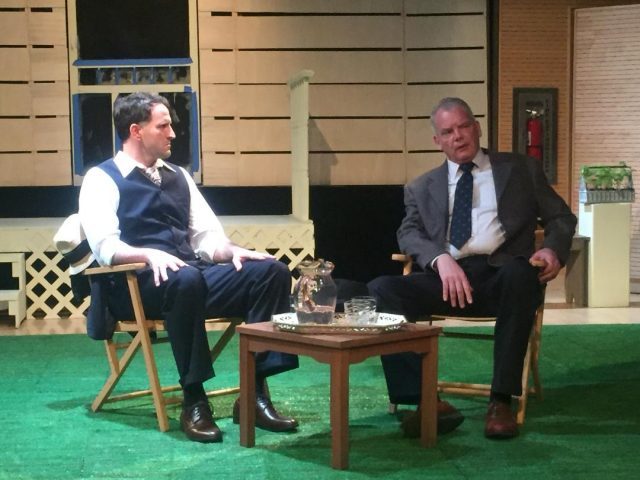
Yona Popoch (Gera Sandler) has had it with wife Leviva (Ronit Asheri-Sandler) in The Labor of Life

Theater at 224 Waverly
224 Waverly Pl. between Eleventh & Perry Sts.
Through March 29, $25 for one show, $45 for two, $65 for three, $75 for all four
866-811-4111
www.newyiddishrep.org

Perhaps New Yiddish Rep needs to take a break and catch its collective breath. The Jersey-based company was founded in 2013 to promote classic and contemporary Yiddish theater. It burst out of the gate with well-reviewed adaptations of Waiting for Godot in fall 2013 and the Drama Desk–nominated Death of a Salesman in fall 2015. (Sandwiched in between was a pair of one-act plays by Wolf Mankowitz.) But in the mere span of six months, New Yiddish Rep has staged a disappointing Rhinoceros, a lovely Awake and Sing!, and now the lackluster double bill Hanoch Levin Squared, two one-acts by the celebrated, controversial Israeli playwright who passed away in 1999 at the age of fifty-five. Levin was loved and hated for his political and religious satires (Hefez, The Dreaming Child) and triangular dramas (Yaakobi and Leidental, The Rubber Merchants); his works earned major prizes and were banned. New Yiddish Rep is currently performing Levin’s seventy-minute The Labor of Life and eighty-minute The Whore from Ohio in repertory at the Theater at 224 Waverly, both in Hebrew and in Yiddish, with English surtitles. I saw them both in Yiddish on the same night, and while each had its moments, they were far too workmanlike, losing the many nuances of Levin’s biting wit and sarcasm, instead played much too straightforward. The Labor of Life, from 1989, is directed by Ronit Muszkatblit (Hanna and the Moonlit Dress, Nature of Captivity) and stars Gera Sandler as Yona Popoch (played by Yosi Sokolsky in the Hebrew version) and Ronit Asheri-Sandler as his wife, Leviva. (Sandler and Asheri-Sandler are married in real life.) They’ve been married for thirty years, but Yona has had it and is ready to leave her. “I’m ruined,” he says. “How did it all melt away?” While Yona blames Leviva for his unhappiness, she blames him. “There’s no place for you to escape because wherever you go, you drag yourself with you,” she proclaims. It all takes place in, on, and around their bed (the sets for both plays are by Nathan Rhoden), where love does not seem to exist anymore, if it ever did. They are visited in the middle of the night by Gunkel (Eli Rosen, who translated both plays from Hebrew into Yiddish), who’s not exactly welcome in their home right then but sits down on the bed nonetheless and shares his fears of dying alone. Taking stock of his sad life, he says, “All in all, nothing but a Gunkel.” After Gunkel finally leaves, Yona cries, “We’re all Gunkels.” It’s a play about relationships, but none of the characters make any kind of connection with one another or the audience.

The Whore from Ohio

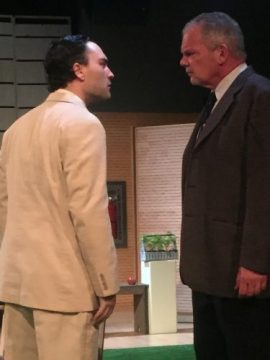
Bitterman (David Mandelbaum) and son (Eli Rosen) are thwarted by a prostitute in Hanoch Levin’s The Whore from Ohio

There’s a little more life in 1997’s The Whore from Ohio, directed by Obie winner Michael Leibenluft (I’ll Never Love Again, The Subtle Body), but it too fails to hit the key notes and also becomes a repetitive tale involving a trio of strange bedfellows. The raggedy Bitterman (New Yiddish Rep artistic director and cofounder David Mandelbaum) wants to celebrate his seventieth birthday by sleeping with a prostitute, in this case, Bronatsatski (Mary Black, played by Vered Hankin in the Hebrew version), who says she will let him do her in the dank, graffiti-laden yard for one hundred shekels. He haggles for a better price, but she is not budging. “What about a symbolic price?” he asks, offering her ten shekels, which she curtly refuses. “Just as I thought. There’s no respect for symbolism in the world anymore,” Bitterman opines. Eventually, he gives in, but his member has trouble getting started, complicating their arrangement. And it gets even more complicated when Bitterman’s grown boy, Bitterson (Rosen), shows up, defending his father and demanding his money back, which Bronatsatski is not about to do. Again, there’s lots of back and forth, discussions that should symbolize socioeconomic issues in Israel, the United States, and elsewhere but instead seems to just be about a son fighting for what he insists his father is due. “That hole will be locked up for good someday,” Bitterson tells Bronatsatski. The language in both plays can be surprisingly crude — however, you can’t hear the Yiddish word “tuches” enough — but it’s all too right-on-the-nose, lacking the symbolism that is in Levin’s words. Even at seventy and eighty minutes, both plays are too long, too tiresome, not offering the insight into the human condition that was so central to Levin. In the end, what we’re really left with are a couple of Gunkels.