this week in theater

LIGHT SHINING IN BUCKINGHAMSHIRE

(photo by Joan Marcus)

A diverse six-person cast performs Caryl Churchill’s Light Shining in Buckinghamshire at New York Theatre Workshop (photo by Joan Marcus)

New York Theatre Workshop
79 East Fourth St. between Second & Third Aves.
Tuesday – Sunday through June 3, $69
www.nytw.org

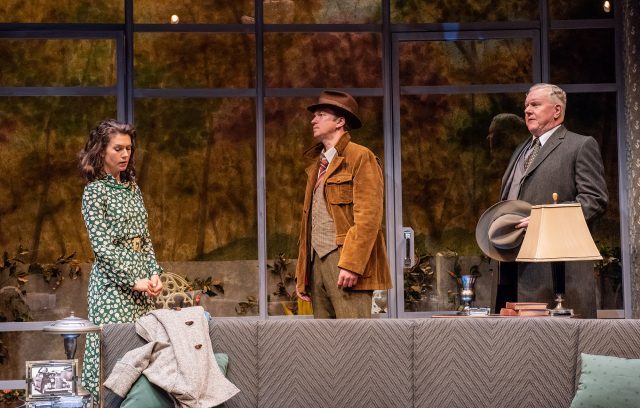
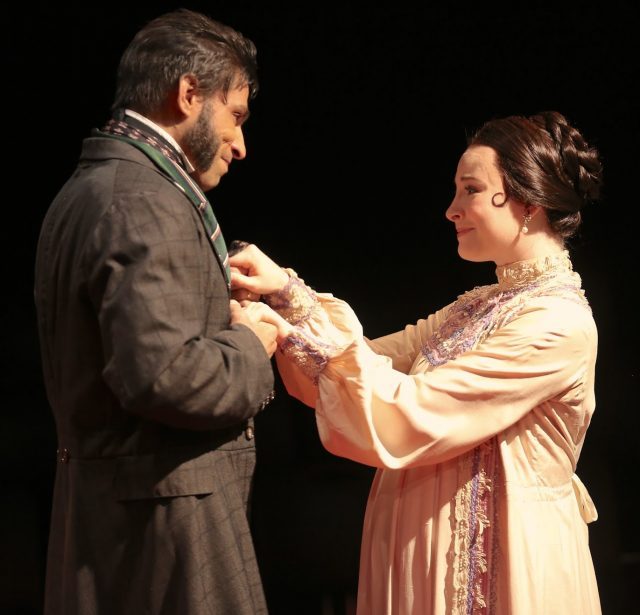
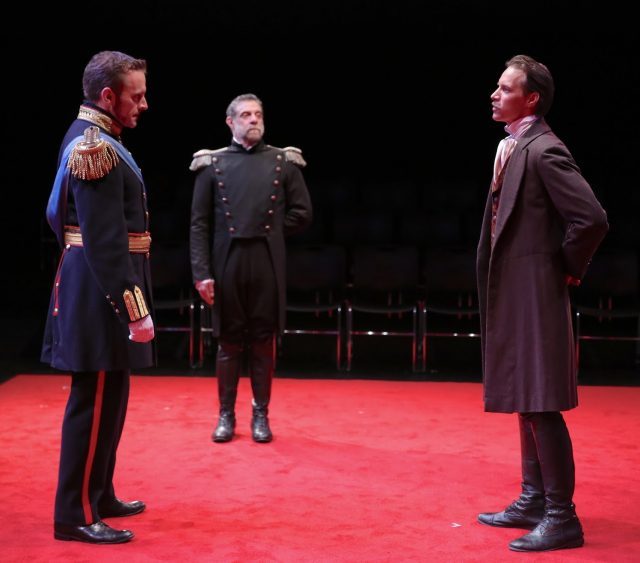
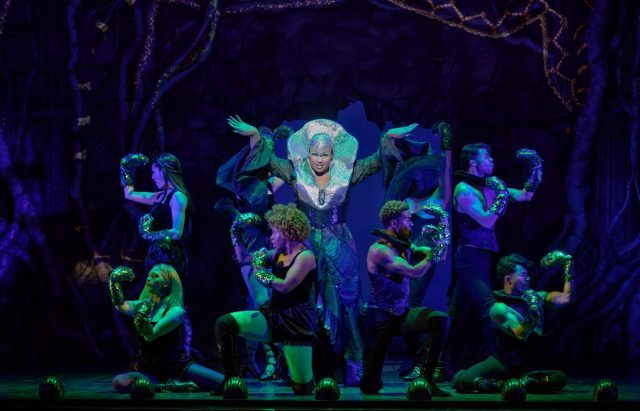
Light Shining in Buckinghamshire is the first play that New York Theatre Workshop has ever done twice, and initially it’s easy to see why. The 1976 play, written by the mighty Caryl Churchill, made its New York premiere at NYTW in 1991 and is now being revived there through June 3, in a new production directed by the sizzling hot Rachel Chavkin, the mastermind behind Hadestown, Small Mouth Sounds, Natasha, Pierre & the Great Comet of 1812, and other uniquely inventive shows. A talented, diverse cast of six performs multiple roles each, without regard to age, race, gender, or physical ability. The subject is the English Civil Wars of the seventeenth century, focusing on the rebellion involving the Diggers, the Levellers, and the Ranters, which in many ways parallels what is happening, or might happen, in the United States today. So what went wrong with this dream team?

In a production note, Churchill explains, “The audience should not have to worry exactly which character they are seeing. Each scene can be taken as a separate event rather than part of a story. This seems to reflect better the reality of large events like war and revolution where many people share the same kind of experience.” Unfortunately, only part of that concept works. Vinie Burrows, Rob Campbell, Matthew Jeffers, Mikéah Ernest Jennings, Gregg Mozgala, and Evelyn Spahr easily shift between characters on Riccardo Hernández’s spare set, a wooden platform on which various chairs and tables are moved around and taken away. But there are continuity issues; you don’t always know who someone is or what they’re doing. In other works, Churchill has magnificently shown that narrative flow is not always crucial; for example, the stunning Love and Information consists of very short scenes played by unidentified characters who arrive and depart in the blink of a strobe light. And in Cloud Nine, actors switch roles between acts, lending another level of depth to an already deep play.

Matthew Jeffers, Gregg Mozgala, and Rob Campbell in Light Shining in Buckinghamshire (photo by Joan Marcus)

Matthew Jeffers, Gregg Mozgala, and Rob Campbell in Light Shining in Buckinghamshire (photo by Joan Marcus)

To add to the tumult, in the first act the actors use handheld microphones, which perhaps was meant to bring the centuries-old story into the present but instead makes it look like any one of the characters might break into song or a comedy routine at any moment. (In fact, the play begins with a musical version of a biblical passage.) In the second act, the microphones are gone but the period costumes have been traded in for contemporary dress. (The costume design is by Toni-Leslie James.) Also, the entire show is open captioned on a small digital monitor near the back center of the stage. While it is admirable that four-time Obie winner and Olivier Award winner Churchill and three-time Obie winner and Tony nominee Chavkin want to make every word accessible to audience members with hearing difficulty, as well as emphasizing the idea of equality for all, its location is endlessly distracting. As the dialogue moves across the monitor in red LED lights, it’s hard not to look at it even if you can hear the words, your eyes caught by the movement; the monitor also displays the title of each scene — “The Vicar Talks to His Servant,” “Two Women Look in a Mirror,” “A Butcher Talks to His Customers,” for example — information that is not available elsewhere and is often necessary in order to know which characters are onstage. I’ve seen other productions that use open captioning at the side of the stage or in supertitles above, where it is far less distracting, so its positioning here is more than curious.

(photo by Joan Marcus)

Caryl Churchill’s Light Shining in Buckinghamshire is first play New York Theatre Workshop has tackled for a second time (photo by Joan Marcus)

And it’s a shame, because there are many wonderful lines — particularly dealing with sin — that get lost in the theatrical commotion. “What is worst, I am not praying to you about the worst sin. I sin in my fear of praying about that sin, I sin in denying my fear,” Cobbe (based on Abiezer Coppe) bemoans in an opening monologue. “I have come to see that there is no sin but what man thinks is sin,” says Claxton (loosely based on Laurence Clarkson), who continues, “So we can’t be free from sin till we can commit it purely, as if it were no sin. Sometimes I lie or steal to show myself there is no lie or theft but in the mind.” Then there’s this gem, offered by a preacher: “It is no sin to take up arms against the king. It is no sin if we fight singing praises to God, if we fight to bind an unjust king with chains.” In writing the play, Churchill used such sources as Walt Whitman, a Levellers newspaper and letter, a Ranters pamphlet, and excerpts from the Putney Debates of 1647, which involved Col. Thomas Rainborough, private soldier Edward Sexby, Col. Nathaniel Rich, civilian John Wildman, Commissary General Henry Ireton, and eventual Lord Protector Oliver Cromwell. The different styles of language don’t always meld together; while some scenes are exceptional, others fall flat.

In many ways, the Public Theater’s recent production of Bruce Norris’s brilliant The Low Road, inspired by Adam Smith’s The Wealth of Nations and taking place shortly before the American Revolution, covered much more successfully some of the same conceptual territory: slavery, property, capitalism, politics, religion, war, poverty, and independence, and there was even a roundtable discussion using contemporary technology. In the debates, Cromwell, speaking on a proposal regarding representation in government, asks, “But how do we know another company of men shall not put out a paper as plausible as this? And not only another, and another, but many of this kind. And what do you think the consequence of that would be? Would it not be confusion? Would it not be utter confusion? As well as the consequences we must consider the ways and means: whether the people are prepared to go along with it and whether the great difficulties in our way are likely to be overcome.” The same can be asked of this production of Light Shining in Buckinghamshire, in which a more-than-plausible script results in utter confusion, and judging from the number of people who left at intermission when I saw it, not everyone was prepared to go along with it.

PARADISE BLUE

(photo by Joan Marcus)

P-Sam (Francois Battiste) has some harsh words for Blue (J. Alphonse Nicholson) as Corn (Keith Randolph Smith) and Pumpkin (Kristolyn Lloyd) look on in Dominique Morisseau’s Paradise Blue (photo by Joan Marcus)

The Pershing Square Signature Center
The Romulus Linney Courtyard Theatre
480 West 42nd St. between Tenth & Eleventh Aves.
Extended through June 10, $30 through June 3, $65 after
212-244-7529
www.signaturetheatre.org

Paradise Blue, which opened tonight at the Romulus Linney Courtyard Theatre at the Pershing Square Signature Center, celebrates and extends the great tradition of exceptional sociopolitical American plays established by August Wilson. In 2013, actress, poet, and playwright Dominique Morisseau began “The Detroit Projects,” a three-play series centered on her Michigan hometown, inspired by Wilson’s “Century Cycle,” ten works set in each decade of the twentieth century in his native Pittsburgh. Paradise Blue, which comes after 2013’s Detroit ’67 and before 2016’s Skeleton Crew, takes place in the primarily black neighborhood of Black Bottom in Paradise Valley in 1949, on the eve of an urban renewal push. (Coincidentally, Wilson’s second Pittsburgh play was Ma Rainey’s Black Bottom.) The tortured Blue (J. Alphonse Nicholson) is a trumpet player who owns the Paradise Club, following in the footsteps of his father. He has just fired the bassist, leaving his bandmates, ornery drummer P-Sam (Francois Battiste) and thoughtful, considerate pianist Corn (Keith Randolph Smith), in the lurch as he prepares a solo that is proving difficult for him and arranging for the sweet and innocent Pumpkin (Kristolyn Lloyd), his lover who works at the club, to sing a number in public for the first time.

Amid rumors that Blue is going to sell the club as part of Detroit mayor Albert Cobo’s gentrification plan for Black Bottom — “Ain’t nobody pullin’ no more favors outta me. I been pullin’ favors up to my ears and I’m goin’ tone deaf,” Blue explains — the mysterious Silver (Simone Missick) struts in, renting a room at the Paradise for an extended period of time, paying cash up front. “If it’s somewhere that Colored folks is doing more than sharecroppin’ and reapin’ White folks’ harvest . . . I ought to be there,” she says. Silver is the opposite of Pumpkin, wearing silky, revealing black clothing, instantly commanding the attention of every man in any room she enters. “Spiderwoman. That’s what they call her,” P-Sam says. “She go walkin’ like that. . . . some kinda sexy spider . . . lurin’ fellas into her web. And then just when you get close to her . . . she stick into you and lay her poison.” As the night of the show approaches, P-Sam questions Blue’s loyalties, Corn and Pumpkin are both getting close to Silver, and Blue has to face some deep, dark demons.

(photo by Joan Marcus)

Blue (J. Alphonse Nicholson) takes hold of Pumpkin (Kristolyn Lloyd) in New York premiere at the Signature (photo by Joan Marcus)

Paradise Blue keeps the spirit of August Wilson alive while further confirming Morrisseau (Pipeline, Blood at the Root) as a rising star in her own right. The play is smoothly directed by Ruben Santiago-Hudson, like a bandleader orchestrating a jazz number, albeit more of a nocturne than swing or bebop. A close friend of Wilson’s, Santiago-Hudson is the co-artistic director of a New York Public Radio project that is recording all ten plays in Wilson’s American Century Cycle; he won a Tony for Best Featured Actor for his performance in Seven Guitars, earned another Tony for directing Jitney last year, and took home an Obie for directing The Piano Lesson at the Signature in 2013. (He also portrayed the writer in Wilson’s one-man show, How I Learned What I Learned, at the Signature.) Neil Patel’s two-part set features Silver’s bedroom in one corner and the interior of the nightclub on the rest of the stage; the audience sits in rising rows on the horizontal sides. Above it all is a rusty marquee that spells out the club’s name in lights. The facade separating the floor from the balcony is plastered with concert posters of icons who supposedly played the Paradise, from Muddy Waters, Billie Holiday, and Duke Ellington to Jimmie Lunceford, Howlin’ Wolf, and Louis Jordan.

Rui Rita’s sensitive lighting focuses between the two rooms as well as, occasionally, on Blue’s horn, which resides on a trumpet stand on the club stage, as if it’s his soul haunting him, while Darron L West’s fine sound design lets the music soar. Wilson regular Smith (Jitney, Fences, King Hedley II) is superb as the gentle, caring Corn; Smith has such a calming presence that watching him onstage, no matter what he’s doing, is warm and comforting. Obie winner Battiste (Head of Passes, The Good Negro) portrays the suspicious P-Sam with a fire in his belly; Lloyd (Dear Evan Hansen, Invisible Thread) is adorable as the vulnerable Pumpkin, a wide-eyed young woman in love with poetry but frightened of taking charge of her life; and Missick (Misty Knight in Luke Cage and The Defenders) is sexy and alluring as Silver, who is no mere femme fatale. However, Nicholson (Seven Guitars, Caleb Calypso and the Midnight Marauders) can only do so much as Blue (a role originated at the 2015 Williamstown Theatre Festival by Blair Underwood), who is not as fully drawn and fleshed out as the other characters, his motivations not as evident throughout the play. But that turns out to be a minor quibble in what otherwise is an exciting and captivating work that evolves with the rhythm of the blues as it explores race, class, and family legacy. Paradise Blue is the first of three Morrisseau plays that the Signature will present during her five-year residency; I’m already hungering for the next one.

SAINT JOAN

(photo by Joan Marcus)

A teenage farm girl (Condola Rashad) is on a mission from God in Bernard Shaw’s Saint Joan (photo by Joan Marcus)

Manhattan Theatre Club at the Samuel J. Friedman Theatre
261 West 47th St. between Broadway & Eighth Aves.
Tuesday – Sunday through June 10, $65-$159
saintjoanbroadway.com
www.manhattantheatreclub.com

“There is something about her,” men say of Saint Joan, the title character in Bernard Shaw’s 1923 play. There is also something about Condola Rashad, who portrays Joan in the current Manhattan Theatre Club revival at the Samuel J. Friedman Theatre. Rashad has now appeared in five Broadway shows, earning four Tony nominations, for Stick Fly, The Trip to Bountiful, A Doll’s House, Part 2, and Saint Joan. (She was also nominated for a Drama Desk Award for her 2009 off-Broadway debut, Ruined, but got shut out as Juliet in a misbegotten Broadway revival of Romeo and Juliet in 2013.) The thirty-one-year-old Rashad is charming as Joan, a teenage farm girl in 1429 who claims that Saint Margaret and Saint Catherine speak to her and that God has commanded her to lead the French to victory in Orleans against the occupying English so the hapless Dauphin (Adam Chanler-Berat) can claim the throne as King Charles VII. She joins a luminous roster of actresses who have played Saint Joan, including Wendy Hiller, Uta Hagen, Joan Plowright, Jean Seberg, Imelda Staunton, Imogen Stubbs, Amy Irving, and Diana Sands, the only other black woman to portray Joan in a major production, at Lincoln Center in 1968. Rashad’s Joan is sweet-natured but determined, gentle yet forceful, a kind of hero just right for the #MeToo and #BlackLivesMatter generation. Joan goes about the world of men — Rashad is the only woman in the cast, among twelve actors, save for a brief appearance by Mandi Masden as the Duchess de la Trémouille — with an ease that emanates from her faith.

Military squires, royals, and religious leaders disparage Joan until they meet her, slowly falling under her captivating spell. Robert de Baudricourt (Patrick Page) brags about how he “burns witches and hangs thieves,” but Joan tells him, “They all say I am mad until I talk to them, squire. But you see that it is the will of God that you are to do what He has put into my mind,” and he does. Captain La Hire (Lou Sumrall) calls her “an angel dressed as a soldier.” Charles might not want to be king, but Joan is on a holy mission to see that he is crowned at Rheims Cathedral. “If the English win, it is they that will make the treaty: and then God help poor France!” she tells Charles. “You must fight, Charlie, whether you will or no. I will go first to hearten thee. We must take our courage in both hands: aye, and pray for it with both hands too.” But after she impossibly takes Orleans despite being massively outnumbered and then urges the campaign continue on to recapture Paris, the military, the church, and the monarchy realize her power and turn on her, trying her for sins that could get her burned at the stake.

(photo by Joan Marcus)

The Dauphin (Adam Chanler-Berat) finds a savior in Joan (Condola Rashad) in Manhattan Theatre Club Broadway revival (photo by Joan Marcus)

Scott Pask’s set is dominated by large gold pipes hanging from above, as if the entire play takes place inside a giant church organ, spreading Joan’s religious message. “It is in the bells I hear my voices,” Joan tells Jack Dunois (Daniel Sunjata), who ably fights by her side. “Not today, when they all rang: that was nothing but jangling. But here in this corner, where the bells come down from heaven, and the echoes linger, or in the fields, where they come from a distance through the quiet of the countryside, my voices are in them.” Shaw (who preferred not to use the first name George) famously said, “I’m an atheist and I thank God for it”; in writing the play, he was trying to neither convert anyone nor convince them to leave the fold, nor was he creating a biblical-style story of good versus evil. In a preface to the published edition, Shaw wrote, “There are no villains in the piece. . . . It is what men do at their best, with good intentions, and what normal men and women find that they must and will do in spite of their intentions, that really concern us.” Shaw, who also wrote such works as Pygmalion, Major Barbara and Man and Superman and won the Nobel Prize shortly after Saint Joan, does not include any superheroes either. “I am not a daredevil: I am a servant of God,” Joan says to Dunois. “My heart is full of courage, not of anger. I will lead; and your men will follow: that is all I can do. But I must do it: you shall not stop me.”

The exemplary cast also features Max Gordon Moore as Bluebeard, Walter Bobbie as the Bishop of Beauvais, John Glover as the Archbishop of Rheims, Matthew Saldivar as Bertrand de Poulengey, Robert Stanton as Baudricourt’s steward, Russell G. Jones as Monseigneur de la Trémouille, and Jack Davenport as the Earl of Warwick. Most of the actors play more than one role; Page is particularly impressive as Baudricourt and the Inquisitor. Daniel Sullivan’s (The Little Foxes, Proof) direction can get a little bumpy though there are several deft touches, and at nearly three hours, the show can be a little trying. Which brings us to the rather campy epilogue. Shaw wrote Saint Joan in 1923, three years after her canonization, something he deals with in the somewhat surreal, comic, and arguably out-of-place conclusion. “As to the epilogue, I could hardly be expected to stultify myself by implying that Joan’s history in the world ended unhappily with her execution, instead of beginning there,” Shaw wrote. “It was necessary by hook or crook to shew the canonized Joan as well as the incinerated one; for many a woman has got herself burnt by carelessly whisking a muslin skirt into the drawing-room fireplace, but getting canonized is a different matter, and a more important one. So I am afraid the epilogue must stand.” And so it does, for better or worse.

REST IN PEACE, NEW YORK: THEATER, WOMEN, AND IMMIGRATION

(photo by Shirotama Hitsujiya)

Japan Society will host special reading on May 14 organized by artist Shirotama Hitsujiya (photo by Shirotama Hitsujiya)

Japan Society
333 East 47th St. at First Ave.
Monday, May 14, $10, 7:30
212-715-1258
www.japansociety.org

Tokyo-based performance artist and playwright Shirotama Hitsujiya will be at Japan Society on May 14 as part of her residency, leading the program “Rest in Peace, New York: Theater, Women, and Immigration.” Hitsujiya, the artistic director of YUBIWA Hotel and a founding member of AJOKAI (Asian Women Performing Arts Collective), has been collecting stories of Vietnamese women who have immigrated to New York City. Their interview-based words are being transcribed onto a makimono, a horizontal rice-paper handscroll, and will be read aloud Monday night by Catherine Filloux of Theatre Without Borders, Vietnam Heritage Center executive director Thùy Q. Phạm, Theatre Communications Group director of artistic and international programs Emilya Cachapero, Michi Barall of the Ma-Yi Theater Company, harunalee company director Kristine Haruna Lee, and Foundry Theatre artistic producer and founder Melanie Joseph, among others. The reading will be followed by an audience Q&A with the participants; tickets are only $10.

THE ICEMAN COMETH

(photo by Julieta Cervantes)

David Morse, Denzel Washington, and Colm Meaney star in George C. Wolfe’s Broadway revival of The Iceman Cometh (photo by Julieta Cervantes)

Bernard B. Jacobs Theatre
242 West 45th St. between Broadway & Eighth Ave.
Tuesday – Sunday through July 1, $79 – $209
icemanonbroadway.com

Two-time Oscar and Tony winner Denzel Washington is nothing short of majestic as traveling hardware salesman Theodore “Hickey” Hickman in George C. Wolfe’s powerful adaptation of Eugene’ O’Neill’s staggering masterpiece, The Iceman Cometh. Washington’s charm lights up the dark goings-on at the Bernard B. Jacobs Theatre, where set designer Santo Loquasto has transformed the stage into the No Chance Saloon, the Bedrock Bar, the End of the Line Café, a dank, depressing Greenwich Village dive in 1912 owned by Harry Hope (Colm Meaney) that is populated by a gang of luckless losers intent on drinking themselves into oblivion. The only thing they have to look forward to is the twice-a-year arrival of Hickey, who cheers them up by filling them with free drinks and telling wild stories from the real world outside. He’s like Jesus turning water into whiskey for his apostles, who consist of Larry Slade (David Morse), a former activist who has turned his back on life and wants nothing to do with anyone; Ed Mosher (Bill Irwin), a former circus performer; Harvard Law School graduate Willie Oban (Neal Huff); Boer War nemeses Piet Wetjoen (Dakin Matthews) and Cecil Lewis (Frank Wood); nighttime bartender Rocky Pioggi (Danny McCarthy), who also is a pimp for Margie (Nina Grollman), Pearl (Carolyn Braver), and Cora (Tammy Blanchard); Chuck Morello (Danny Mastrogiorgio), the daytime bartender who is in love with Cora; disgraced NYPD detective Pat McGloin (Jack McGee); communist revolutionary Hugo Kalmar (Clark Middleton), who sleeps through much of the show; Joe Mott (Michael Potts), the only African American at the bar, who wants to open a black-only gambling house; and Jimmy Tomorrow (Reg Rogers), a former journalist who believes he will return to society “tomorrow.”

Larry is deeply disturbed when Don Parritt (Austin Butler) shows up, the teenage son of an old lover from Larry’s anarchist days. Don desperately wants Larry’s approval and acceptance, but Larry refuses to care about anyone or anything, choosing to drink till he dies even though he’s probably the only person in the bar who could actually still play a role in society. As the men and women bicker, argue, joke around, and prepare for Harry’s birthday party, Hickey finally arrives, bigger and better than ever, immediately injecting life into the motley group of drunks. But this time around, Hickey, in his trademark straw hat, has something more to offer besides free drinks and Champagne: He is determined to help each man find a reason to stop being a worthless drunk and instead pick himself off his barstool, return to the real world, and make his “pipe dreams” come true. He is also armed with a secret that he’s not quite ready to share.

(photo by Julieta Cervantes)

Harry Hope’s (Colm Meaney) birthday party is reminiscent of “The Last Supper” in The Iceman Cometh (photo by Julieta Cervantes)

Four-time Pulitzer Prize winner O’Neill (Long Day’s Journey into Night, Strange Interlude) wrote The Iceman Cometh in 1939, but it was not staged until after WWII, in 1946, debuting at the Martin Beck Theatre. It deals with politics, racism, and the forgotten men of America, but O’Neill does not blame society, the economy, or war for their alcoholism and retreat from existence; these are men who would have given up no matter the era, lending the play a terrifying kind of timelessness. Hickey has never been their savior; ironically, he is the one who betrays them by suddenly trying to give meaning to their miserable lives. Wolfe even stages the party scene at a long table reminiscent of Leonardo da Vinci’s “The Last Supper.” Wolfe has trimmed the show down to a slim three hours and fifty minutes, with two intermissions and a pause, pacing the drama well, like drinking a smooth glass of high-end whiskey and not a shot, or full bottle, or rotgut. The cast is exceptional, a team of pros giving it everything they’ve got. Meaney brings depth to Harry, Rogers plays Jimmy with just the right tease of hope, Potts adeptly handles the racism angle, and Butler, in his Broadway debut, is bright-eyed and determined as the young Don, a part previously played by such future stars as Jeff Bridges and Robert Redford.

(photo by Julieta Cervantes)

Hickey (Denzel Washington) has quite a story to tell in Eugene O’Neill revival at the Jacobs Theatre (photo by Julieta Cervantes)

But the key to the success of the show is the relationship between Hickey and Larry; over the years, the former has been portrayed by Jason Robards, Kevin Spacey, Brian Dennehy, James Earl Jones, Lee Marvin, and Nathan Lane, while the latter has been played by James Cromwell, Robert Ryan, Patrick Stewart, Conrad Bain, Tim Pigott-Smith, and Dennehy. Washington and Morse, who both starred as doctors in the groundbreaking, Emmy-winning 1980s series St. Elsewhere, are staunch and deeply affecting in their roles. Morse’s Larry is loud and angry, often walking to the sides of the stage to just watch the other losers, as if he is better than them, even if he won’t admit it. Washington’s Hickey throws knowing glances at Larry; he wants his friend to change but knows it’s unlikely. Washington commands the stage with his full body, gesturing with his arms and legs, at times hunching over just a bit and leaning his head forward as he spreads his new ideas. He delivers the final monologue — on a chair, not a cross — beautifully as his disciples gaze intently from behind. Both Washington and Morse have received Tony nominations for their performances; the show has also been nominated for Best Revival, Best Scenic Design, Best Costume Design (Ann Roth), Best Lighting (Jules Fisher and Peggy Eisenhauer), Best Sound (Dan Moses Schreier), and Best Director. The title comes from Hickey’s classic story about returning home one day to unexpectedly find the ice salesman with his wife in the hay, but it also refers to the specter of death haunting each one of these characters.

CHILDREN OF A LESSER GOD

(photo by Matthew Murphy)

James Leeds (Joshua Jackson) and Sarah Norman (Lauren Ridloff) experience communications problems in Broadway revival of Children of a Lesser God (photo by Matthew Murphy)

Studio 54
254 West 54th St. between Seventh & Eighth Aves.
Tuesday – Sunday through May 27, $29-$159
www.childrenofalessergodbroadway.com

Every so often a previously successful play returns to Broadway in a revival that makes you wonder not only why it’s back but what the heck made it so special in the first place. Such is the case with Mark Medoff’s Children of a Lesser God, which just announced an early closing date of May 27 at Studio 54. Medoff wrote the play specifically for deaf actress Phyllis Frelich, loosely based on her real-life relationship with her husband, Robert Steinberg. The original 1980 production ran at the Longacre Theatre for more than two years and was nominated for four Tonys, winning Best Play, Best Actress (Frelich), and Best Actor (John Rubinstein). The British edition won the Olivier for Best New Play as well as Best Actress (Elizabeth Quinn) and Best Actor (Trevor Eve). And the 1986 film version was nominated for five Oscars, including Best Picture, and winning for Best Actress (Marlee Matlin). So went wrong this time around? Where should I begin?

(photo by Matthew Murphy)

There’s a whole lot of sitting around in ill-fated revival at Studio 54 (photo by Matthew Murphy)

Kenny Leon’s revival is stultifyingly dull — dare I say tone-deaf — as it explores the relationship between James Leeds (Drama League–nominated Joshua Jackson), a speech teacher at a school for the deaf, and Sarah Norman (Tony-nominated Lauren Ridloff), a twenty-six-year-old maid at the school who refuses to verbalize and fiercely rejects any attempt to help her do so. Sarah sees learning to speak as a betrayal of the nonhearing world she is proudly a part of, while James can’t understand why she wouldn’t want to speak or even use the latest technology that might allow her to at least pick up vibrations of sound. Very quickly, James falls for Sarah — well, it’s more like he stalks her — which upsets Sarah’s best friend, Orin (John McGinty), as well as the jealous Lydia (Treshelle Edmond), both students at the school. It also alarms the principal, Mr. Franklin (Anthony Edwards). In their Broadway debuts, Jackson (The Affair, Fringe) speaks too loudly and enunciates too clearly, never varying his speech pattern regardless of what he’s saying to whom, and Emmy winner Edwards speaks too softly, making it hard to hear much of what he has to say. All signed words are spoken out loud by the hearing actor being signed to, while all spoken words are shown in supertitles that are not always in sync with what is being said, often slightly ahead of the action. Whether all this is deliberate or not — Is the hearing world out of sync with the nonhearing? Does the experience of the hearing audience in such straits echo the experience of the nonhearing, faced with bad closed captions? — it just doesn’t work here. The sappy songs by Stevie Wonder and Wings don’t help, nor does Branford Marsalis’s tepid incidental music. It all feels more like a Hallmark Hall of Fame movie of the week than a Broadway production with lofty ticket prices. Tony, Obie, Drama Desk, and Emmy winner Derek McLane’s set consists of multiple open doorways that lead nowhere, least of all the exit. The title of the play comes from the “Passing of Arthur” section of Alfred, Lord Tennyson’s Idylls of the King, which now doubles as the passing of this well-meaning but hackneyed revival, after a mere 23 previews and, coincidentally enough, 54 regular performances at Studio 54.

DANCE NATION

Dance Nation

Dance Teacher Pat (Thomas Jay Ryan) leads the team through rehearsal in Dance Nation (photo by Joan Marcus)

Playwrights Horizons
Peter Jay Sharp Theater
416 West 42nd St. between Ninth & Tenth Aves.
Tuesday – Sunday through July 1, $59-$99
www.playwrightshorizons.org

Clare Barron’s Dance Nation is a brilliant, savvy comedy that moves and grooves to a magnetic beat that melds the present and the future in ingenious ways. The swiftly paced 105-minute play, which opened tonight at Playwrights Horizons, follows a Liverpool, Ohio, preteen dance team on the road to a potential championship in Tampa Bay. But the six girls and one boy, who are between eleven and fourteen, are played by grown-ups who range in age from their twenties to their sixties, imbuing the characters with the knowledge they have gained through experience. Barron considers it a “ghost play,” where the children haunt their adult selves and vice versa, as if the kids know what they will become. Through sharp, honest dialogue, tremendous humor, and more than a bit of anger and rage, Barron and Obie-winning director-choreographer Lee Sunday Evans employ stereotypes in order to reclaim and redefine them for the #MeToo generation. The team consists of star dancer Amina (Dina Shihabi), confidence-challenged Zuzu (Eboni Booth), practical Connie (Purva Bedi), not-as-talented Maeve (Obie winner Ellen Maddow), wise-beyond-her-years Sofia (Camila Canó-Flaviá), advanced, anarchic Ashlee (Lucy Taylor), and gentle, soft-spoken Luke (Ikechukwu Ufomadu), representing multiple races, ethnicities, classes, and body shapes. The tension between the intense bonds of an adolescent group and individual ambition is beautifully explored.

Dance Nation

The girls and Luke (Ikechukwu Ufomadu) prepare for their new piece in award-winning play by Clare Barron (photo by Joan Marcus)

The team is entering a group competition, but each dancer has his or her own dreams and goals; some want to stand out more than others, so when Vanessa (Christina Rouner) gets hurt at the end of a performance, blood oozing around a broken bone in her leg, her teammates run away or avoid her, knowing that such a fate could befall any of them. But their fearless leader, Dance Teacher Pat (Thomas Jay Ryan), readies them for the next competition, for which he has choreographed a dance drily hilarious in its topic and treatment: “an acro-lyrical” piece about a heroic male activist who brought about change in his country and around the world. The girls and Luke discuss who should play the lead, talk about masturbation, deal with their mothers, and celebrate the many strengths their discipline affords them. In unison they chant, “If I could dance and nobody would ever want to kill another person again / Or be racist again / Or feel alone at night again / Or abandon their pets without a home again / That’s what I would do / That’s what I would do / That’s what I want to do with my life.

Dance Teacher Pat (Thomas Jay Ryan) talks strategy with Zuzu (photo by Joan Marcus)

Dance Teacher Pat (Thomas Jay Ryan) talks strategy with Zuzu (Eboni Booth) as competition nears (photo by Joan Marcus)

In one of the play’s most amazing moments, the brash and bold Ashlee delivers a scathing monologue that essentially screams in the face of the gender gap, recognizing the terrifying power of sex, desire, beauty, and youth along with her own ambition. Focusing on her face and body but with deeper meaning, she describes her “epic bottom” and how men like to stroke it, brags about her penchant for math, and wonders how to handle it all. “I’m a little afraid of what would happen if I really went for it,” she says. “Like if I tried. If I really, really tried. Like if I acknowledged it. Just embraced it. Like if I walked down the street and looked those men straight in the eyes and said: ‘Yes, I’m beautiful and I’m gonna get a perfect score on the SAT, Math, Reading and Writing, motherfucker, and yes I’m only thirteen years old now but just wait ten more years. . . . I am your god. I am your second coming. I am your mother and I’m smarter than you and more attractive than you and better than you at everything that you love and you’re going to get down on your knees and worship my mind, my mind and my body and I’m gonna be the motherfucking KING of your motherfucking world.’” Barron makes it clear that this is a woman-dominated world; Rouner plays several of the dancers’ mothers, with fathers nary mentioned. Even the town’s incoming priest is a woman.

Dance Nation (photo by Joan Marcus)

The dance team is ready for action in Dance Nation at Playwrights Horizons (photo by Joan Marcus)

Dance Nation has much in common with The Wolves, Sarah DeLappe’s dazzling play about a girls soccer team. In fact, the two works shared the inaugural Relentless Award, given in honor of Philip Seymour Hoffman to plays that “are challenging,” “exhibit fearlessness,” “are not mainstream,” “exude passion,” and “are relentlessly truthful.” Dance Nation, which also won the Susan Smith Blackburn Prize, awarded to an outstanding English-language work by a woman, is all that and more. The Washington-born Barron was inspired to write Dance Nation after seeing the “horrific” reality show Dance Moms and also being insulted by a male theater journalist because she is a woman, regretting that she let him get away with his demeaning treatment of her. She calls out everything she can in this thrilling production, deftly addressing hot-button issues in both daring and subtle ways. In one critical locker-room scene, most of the girls change in full view of the audience, revealing their very different bodies without pride or shame. Ryan (The Amateurs, Travels with My Aunt) has a blast as the team’s conductor, ably guiding them across Arnulfo Maldonado’s set, primarily a rehearsal studio that morphs into a grassy hill and other scenes. The six women and one man playing the dancers are all outstanding, forming a terrific team; Barron (You Got Older, I’ll Never Love Again) and Obie winner Evans (Home, [Porto]) give each their moment to shine, but it is as an ensemble that this corps glows brightest.