this week in theater

INTRACTABLE WOMAN: A THEATRICAL MEMO ON ANNA POLITKOVSKAYA

(photo © Julieta Cervantes)

Nicole Shalhoub, Nadine Malouf, and Stacey Yen portray Anna Politkovskaya and other characters in US premiere of Intractable Woman: A Theatrical Memo on Anna Politkovskaya (photo © Julieta Cervantes)

Performance Space New York
122CC Second Floor Theater
150 First Ave. at East Ninth St.
Tuesday – Sunday through October 14, $35-$45
212-352-3101
playco.org

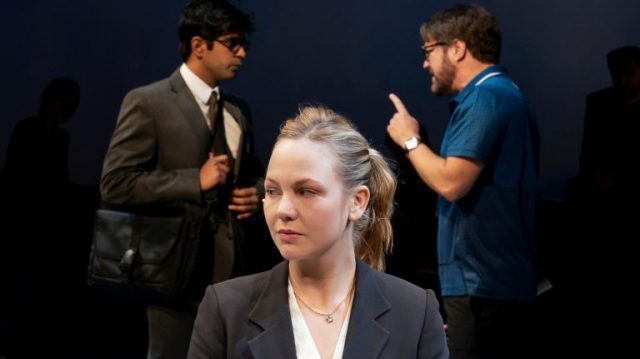
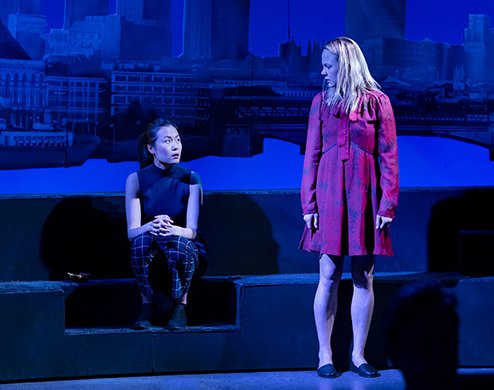
Heroic Russian journalist and activist Anna Politkovskaya dedicated her life to reporting the truth about what was going on in Russia and in particular Chechnya. In writing Intractable Woman: A Theatrical Memo on Anna Politkovskaya, Italian playwright Stefano Massini explains, “I wrote this text to go against the plan of those that decided to silence and muffle her voice.” Translated into English by Paula Wing, the 2008 play is now being given its US premiere by PlayCo, opening tonight at the 122CC Second Floor Theater at Performance Space New York in the East Village. The eighty-minute work features a cast of three women, Nadine Malouf, Nicole Shalhoub, and Stacey Yen, dressed in the same black pants, white collared shirt, and black jacket as if they are state officials or investigators (the costume designer is Junghyun Georgia Lee), portraying multiple characters, including Politkovskaya and various subjects she interviewed. In the prologue, the three women directly address the audience, interchanging lines as they share something that senior Kremlin official Vladimir Surkov wrote in an internal memo. “Enemies of the state are divided into two categories: the kind you can reeducate and the intractables. Discussion is not possible with the second kind and this makes reeducation impossible. The State requires us to clear our territory of these intractables.” Politkovskaya was considered an intractable.

The show consists of nineteen episodes of Politkovskaya’s reporting, involving a decapitated head put on public display; a nineteen-year-old soldier suffering from hunger who enlisted in the military, where he kills Chechens in “human bundles”; the Beslan massacre; a typical journalist’s day in Grozny, where citizens “get used to the idea of death”; and Ramzan Kadyrov, the corrupt thirty-year-old prime minister of Chechnya, installed by his father. “I find the behavior of this journalist unacceptable,” he says a day after the interview is published. “Doesn’t she know it’s the interviewer’s job to make the interviewee look good? What right did she have to publish my responses exactly as I gave them? Clearly this woman doesn’t want to be one of us.”

(photo © Julieta Cervantes)

Stefano Massini’s Intractable Woman features fictionalized re-creations of Russian journalist and activist Anna Politkovskaya interviewing subjects (photo © Julieta Cervantes)

Indeed, Politkovskaya never wanted to be one of “them.” Instead, she fearlessly wrote about hate crimes, imprisonment and torture, widespread rape, mass graves, and other degradations of humanity, risking her job and her life with her husband and two children. Marsha Ginsberg’s pristine press-room set contains carefully arranged rows of red chairs facing a table with microphones. A portrait of Vladimir Putin hangs on a wall. One of the most frightening aspects of Intractable Woman — which marks Massini’s US debut, to be followed in March with The Lehman Trilogy at the Park Avenue Armory — is how Politkovskaya and other reporters are considered propagandists and enemies of the state, echoing President Trump’s views of the free press. “Journalists like you write lies,” a colonel in command of an airborne unit tells Politkovskaya. “What should I write?” she asks him. He replies, “That we’re fighting for the motherland. Against enemies of the people and traitors.”

(photo © Julieta Cervantes)

Stacey Yen, Nicole Shalhoub, and Nadine Malouf star in English-language adaptation of powerful political play (photo © Julieta Cervantes)

Director Lee Sunday Evans (Dance Nation, HOME) does a superb job preventing the play from becoming didactic, pedantic, or just plain boring; the dialogue interplay among the three equally excellent actresses, who move chairs around in various scenes, keeps things proceeding at a fluid pace. The text does not necessarily quote Politkovskaya exactly; Massini, a novelist and the artistic director of the Piccolo Teatro of Milano, rewrote her words for dramatic impact, although the facts themselves are true. After the show is over, a curtain is opened at the back of the stage and the audience is invited to look inside, at a shelf of such items as Politkovskaya’s books, family photographs, and, most tellingly, a picture of a room of the same red chairs used in the production, on each one a photo of a murdered Russian journalist. The lobby is filled with posters of quotes from Politkovskaya, along with photographs. “I never write commentary, or speculation, or opinions. I have always believed – and I continue to believe – that it is not up to us to make judgements,” she wrote. “I am a journalist, not a court of law or a magistrate. I limit myself to reporting the facts. The facts: As they stand, as they are. It seems like the easiest thing, but here it’s the most difficult. And it exacts the highest price.”

THE TRUE

(photo by Monique Carboni)

Michael McKean, Edie Falco, and Peter Scolari star in New Group world premiere at the Signature Center (photo by Monique Carboni)

The New Group at the Pershing Square Signature Center
The Alice Griffin Jewel Box Theatre
480 West 42nd St. between between Ninth & Tenth Aves.
Tuesday – Sunday through October 28, $30-$125
www.thenewgroup.org
www.signaturetheatre.org

Obie-winning playwright Sharr White and director Scott Elliott manage to make a story about the 1977 mayoral election in Albany, New York, tense and exciting in The True, a world premiere from the New Group that opened tonight at the Pershing Square Signature Center. A fictionalized version of real events, the vastly entertaining play opens as Erastus Corning II (Michael McKean), who has been mayor of the capital of New York State since 1941, is facing a serious challenge to his long reign following the death of Democratic party leader Dan O’Connell. State senator Howard C. Nolan (Glenn Fitzgerald) is taking on Corning, with the support of Charlie Ryan (John Pankow), who wants to be the new party boss. But tough-talking fixer Dorothea “Polly” Noonan (Edie Falco) isn’t about to let that happen. Noonan, a foul-mouthed firebrand, pulls a lot of strings behind the scenes, and her down-and-dirty, no-holds-barred style gets things done as her calm, easygoing husband, Peter (Peter Scolari), stays out of it all. “I don’t hate politics, by the way. I just want nothing to do with it,” he says, even when confronted with rumors that Erastus, who is married to the mysterious Betty (Tracy Shayne), and Polly are longtime lovers. Desperate for Erastus to beat Nolan, who is leading big in the polls, Polly taps young Bill McCormick (Austin Cauldwell) to be named committeeman and support Erastus within the party machine. “Fuck that fucking Charlie Ryan,” she says. But when Erastus starts questioning whether he still wants Polly on his team, she practically explodes, while also hurting inside, since she has devoted her life to him and the Democrats.

(photo by Monique Carboni)

Dorothea “Polly” Noonan (Edie Falco) has some harsh things to say to Howard C. Nolan (Glenn Fitzgerald) in The True (photo by Monique Carboni)

Falco (Frankie and Johnny in the Clair de Lune, Side Man) is exceptional as Noonan, a kind of cross between Carmela Soprano from The Sopranos and Jackie Peyton from Nurse Jackie, two roles that earned her Emmys. (In fact, much of the cast and creative team have major television ties: Scolari starred on Bosom Buddies, The Bob Newhart Show, and Girls, McKean was on Laverne & Shirley and SNL and is currently on Better Call Saul, Pankow is a veteran of Mad About You and The Days and Nights of Molly Dodd, and White is a writer and producer for The Affair and Sweetbitter.) Falco plays Noonan with a brawling charm, whether she’s sitting at her sewing machine making a culotte or going face-to-face with her political enemies. White (The Other Place, Annapurna) gets right to the heart of the matter, showing how politics has changed over the decades, implying why the Democrats have been losing power in recent years. “Regular people,” Noonan tells Erastus. “They don’t give a shit what you do behind closed doors so long as their lives are working. But their lives aren’t working anymore. Committeeman. Used to know every. Single. Voter. In his district. Every single one. That voter had a problem, they told the committeeman, the committeeman went to the ward leader, the ward leader either solved it? Or went to Dan. And you know what happened at the end of the day? . . . It got taken care of.” Brief but telling references to shifting demographics, race, and women in politics reveal much as Noonan also makes clear that women are not treated the same as men in the political arena. “What I do for Erastus is no different than what you did for Dan. And yet I’m ostracized for it,” she tells Ryan.

(photo by Monique Carboni)

Dorothea “Polly” Noonan (Edie Falco) has plans for Bill McCormick (Austin Cauldwell) as her husband (Peter Scolari) looks on (photo by Monique Carboni)

McKean (The Little Foxes, Accomplice) and Scolari (The Foreigner, Hairspray) are both terrific, portraying best friends who try to keep politics — and Polly — from tearing them apart. New Group artistic director Elliott (Evening at the Talk House, Mercury Fur) expertly balances the humor amid powerful dramatic moments, never letting things go awry on Derek McLane’s elegant set, where small changes make dramatic differences. And watch out for a surprise, hilarious late scene that brings the house down — something that does not appear in the script. Kudos are also due Falco’s hair stylist and costume designer Clint Ramos, who capture 1977 in fabulous ways. Noonan represents a different time in the treatment of women, both personally and professionally; she might cook and sew, but she also curses and never backs down from a challenge, particularly from a man. It’s fascinating to imagine what Noonan, who died in November 2003 at the age of eighty-eight, would think of what’s going on in the political arena today, in Albany and the country itself; she would certainly be proud of her granddaughter, New York senator Kirsten Gillibrand, who calls her “my greatest political hero” and is keeping her grandmother’s legacy alive.

THE NATURALISTS

(photo by Richard Termine)

Billy Sloane (Tim Ruddy) and Josie Larmer (Sarah Street) wonder about life as Francis Xavier Sloane (John Keating) plays the piano in the background in The Naturalists (photo by Richard Termine)

Walkerspace
46 Walker St.
Tuesday – Sunday through September 23, $45
thepondtheatre.org

Irish playwright Jaki McCarrick makes her New York debut with the world premiere of The Naturalists, an intimate, involving drama that is having too short a run at Walkerspace, where it continues through September 23. It’s 2010, and brothers Francis Xavier (John Keating) and Billy Sloane (Tim Ruddy) are living together in a cluttered mobile home in a rural hamlet in County Monaghan. Francis is a tall, thin, calm man who engages with nature and tries to give people the benefit of the doubt. Billy is a paunchy, brooding brute who sits around watching soap operas and guzzling beer while spread over the couch, always leaving a mess behind. While Francis carefully takes off his boots and places them outside the door, Billy trudges into the house and kicks them off, spreading around whatever he stepped in. “Do ya not know how to live?” Francis asks. “Don’t do the easy thing. The drink, the telly. And couldn’t we leave the door open for a change and listen to the birds like we used ta? Oh, it’s a beautiful night — and so warm, Billy . . . and the tall trees, the darkness of them against the still bright sky. Aren’t we lucky in Ireland we have the long nights in May? We could be watchin’ somethin’ real, Billy, and not that oul shite.” To which a grumbling Billy replies, “What I want to be watchin’ the trees for? What am I? A bird? Haven’t we fecked our lives away on them long enough? I have anyway.”

Weary of the stasis and mess of two bachelors living together, Francis hires a part-time housekeeper, young Josie Larmer (Sarah Street), an airy, Honda 50-riding vegan who needs to make some money and doesn’t mind looking after the brothers, whose mother disappeared long ago. Francis is virtually obsessed with the natural world, and slowly it becomes clear why — a former IRA member, he spent twelve years in prison for having masterminded the 1979 Narrow Water bombing, which killed eighteen British soldiers. (Although the characters in the play are fictional, the bombing was real, but the perpetrators were never identified. Coincidentally, there was an attack on the Narrow Water memorial just this past weekend that is being treated by police as a hate crime.) Both Francis and Billy take a liking to Josie, who doesn’t mind the attention, but when an old IRA compatriot of Francis’s, John-Joe Doherty (Michael Mellamphy), aka Joey the Lip, unexpectedly shows up, the past threatens to overwhelm and destroy both Sloane brothers.

(photo by Richard Termine)

Francis Xavier Sloane (John Keating) and Josie Larmer (Sarah Street) share a love of nature as Billy Sloane (Tim Ruddy) looks on in world premiere play by Jaki McCarrick (photo by Richard Termine)

A presentation of the Pond Theatre Company, The Naturalists is warmly directed by Pond cofounders Colleen Clinton and Lily Dorment. (Street is the third cofounder; Clinton and Dorment have acted in the company’s previous shows, 2016’s Abigail’s Party and 2017’s Muswell Hill.) Chika Shimizu’s inviting set is wide open; a few scenes even take place on the floor, only a few feet away from the audience, as if everyone in the theater is taking part. It might be 2010, but the brothers seem trapped in time. They have an old TV console, a ratty record player with LPs strewn about, and no microwave. Cellphones are nowhere to be seen; it’s as if they are lost in Henry David Thoreau’s legacy. Music is integral to the show; while songs by Tom Waits play a major role, particularly “Martha,” Steely Dan’s “Josie” is a bit too obvious. All four actors are excellent, but Keating, whose long credits include many works at the Irish Rep, TFANA, and Irish Arts, is a standout; he gives a sweet, gentle humanity to Francis, who is essentially a mass murderer, yet we genuinely feel for him. There are minor structural issues, but those are mere quibbles; McCarrick’s (em>Belfast Girls, Leopoldville) play deals with ideas of atonement and solace in delicate, graceful ways, with a sly touch of trademark Irish black humor that seems as inescapable as that country’s troubled past.

THE EMPEROR

(photo by Gerry Goodstein)

Kathryn Hunter gives a tour-de-force performances as multiple characters in The Emperor (photo by Gerry Goodstein)

Theatre for a New Audience, Polonsky Shakespeare Center
262 Ashland Pl. between Lafayette Ave. & Fulton St.
Tuesday – Sunday through September 30, $90-$115
866-811-4111
www.tfana.org

The inestimable Kathryn Hunter is extraordinary as eleven characters subservient to Haile Selassie in the U.S. premiere of The Emperor, which opened tonight at Theatre for a New Audience, where it continues through September 30. The seventy-minute play was adapted by Colin Teevan from Polish journalist Ryszard Kapuściński’s 1978 book, which detailed the fall of the Ethiopian emperor as witnessed by those around him. The hoarse-throated Hunter portrays such figures as L.M., the emperor’s valet de chamber; F., the wiper of the emperor’s lapdog’s urine; Y.M., the keeper of the emperor’s private zoo; G.S.-D., the emperor’s pillow bearer; and Z.S.-K., the emperor’s minister of information. For each character, Hunter takes a different position onstage, uses a different voice and movement style, and makes small costume and prop changes, adding a hat, a cane, or epaulettes. Onstage with her is Ethiopian musician Temesgen Zeleke, who plays the krar, a multi-stringed bowl-shaped lyre, as well as taking a few parts himself: a rebel general and two students, one the son of G.S.-D. “Only memories / That is all that remains,” L.M. says. The subjects, who were all interviewed by Kapuściński, discuss how Selassie, who ruled Ethiopia from 1930 to 1974, slept, met with spies, fed the animals in his zoo, dealt with men he considered traitors, and prayed: “Lord save me from those who crawling on their knees, / Hide the knife that they would stick into my back.” T.K.B., the emperor’s chauffeur, recalls how he would drive Selassie in a Rolls, Lincoln, or Mercedes to the palace gate, where poor people would be seeking help, along with “dignitaries and officials, / Each burning with one desire; / To be noticed.”

(photo by Gerry Goodstein)

Ethiopian musician Temesgen Zeleke takes on a few roles in TFANA production (photo by Gerry Goodstein)

Together the brief monologues form a telling look at what life under the “King of Kings” and “Elect of God” was like for the general populace, his cabinet, and his numerous subordinates, who handled even his most bizarre and absurd proclivities with respect in order to protect their job — and their life. Ministry of the Pen recording clerk T.L. explains, “Everyone waited to see / What the Emperor would do next, / Everyone was ashamed of letting / This conspiracy occur. Everyone was fearful of His Majesty’s wrath.” Kapuściński found similarities between Selassie and the corruption occurring in his native Poland; forty years later, comparisons can be made to so many other autocrats and despots — including President Trump, who has shown a fondness for several dictators. After describing how Selassie was able to turn perception around following a peasant revolt, Z.S.-K. declares, “That is the art of governing!” But Selassie started losing control after Jonathan Dimbleby’s documentary, Ethiopia: The Unknown Famine, was seen around the world, revealing how the emperor was really taking care of his people, even as Z.S.-K. defended his boss.

(photo by Gerry Goodstein)

A key character can’t bear to see what happens next in The Emperor (photo by Gerry Goodstein)

A joint presentation of Young Vic, HOME, and Les Théâtres de la Ville de Luxembourg, The Emperor is directed by Walter Meierjohann, who previously collaborated with Hunter and Teevan on Young Vic’s Kafka’s Monkey. The play works well when Hunter is moving about Ti Green’s spare stage (Green also designed the costumes), expertly lit by Mike Gunning, and Zeleke sits in the corner, playing and singing. But when he gets up and interacts with Hunter, the pacing grows awkward; perhaps part of the problem is that we are so focused on Hunter (Fragments, The Valley of Astonishment) that we don’t want her dazzling performance to be interrupted for any reason, whether she’s just talking, doing calisthenics, or diving across the floor with a royal pillow. It’s even a treat to watch the way she runs offstage at the end of the show. But the message about power, corruption, and dictatorships still comes across loud and clear, especially at a time in America when an administration appears to be at war with itself and many citizens believe the emperor has no clothes.

TICKET GIVEAWAY: A LOVELY SUNDAY FOR CREVE COEUR

lovely sunday

A LOVELY SUNDAY FOR CREVE COEUR
Theatre at St. Clement’s
423 West 46th St. between Ninth & Tenth Aves.
Wednesday – Sunday through October 21, $55-$85 (use code LOVELYRED for discount)
866-811-4111
www.lafemmetheatreproductions.org

In a 2007 interview with The Tennessee Williams Annual Review, actress Charlotte Moore recounts the chaotic beginnings of Williams’s 1978 play, A Lovely Sunday for Creve Coeur, a companion piece with his 1970 one-act, The Demolition Downtown. She describes director Keith Hack fighting with Williams over rewrites, Williams talking distractingly in the audience during performances, and a cast change on opening night. “The opening night was nothing like the closing night at Spoleto. By the time it was over, it was pretty good!” she remembers. “Tennessee loved Creve Coeur. ‘It’s a bijou,’ he would say, ‘a bijou.’ A small jewel.” The rarely revived play, about four women trying to get by in Depression-era St. Louis, was one of six major works Williams wrote in the last four years of his life; it is now being brought back by La Femme Theatre Productions, running at the Theatre at St. Clement’s through October 21. (Opening night, which should be less hectic than the one at the Spoleto Festival nearly forty years ago, is September 23.) The impressive cast — the original featured Moore, Shirley Knight, and Jane Alexander — consists of Kristine Nielsen, Annette O’Toole, Jean Lichty, and Polly McKie, with the ubiquitous Austin Pendleton directing. “I think that A Lovely Sunday for Creve Coeur is one of the gentlest, funniest, loveliest, and most moving of Tennessee’s later plays, actually of all his plays,” Pendleton said in a statement. “And they could not be better served than by our brilliant cast. These women know all about acting, about Tennessee, about life, and the idea of all four of them together makes me tingle.”

TICKET GIVEAWAY: A Lovely Sunday for Creve Coeur runs through October 21 at the Theatre at St. Clement’s, and twi-ny has three pairs of tickets to give away for free. Just send your name, daytime phone number, and favorite Tennessee Williams play to contest@twi-ny.com by Friday, September 21, at 3:00 pm to be eligible. All entrants must be twenty-one years of age or older; three winners will be selected at random.

SATELLITE COLLECTIVE’S ECHO & NARCISSUS

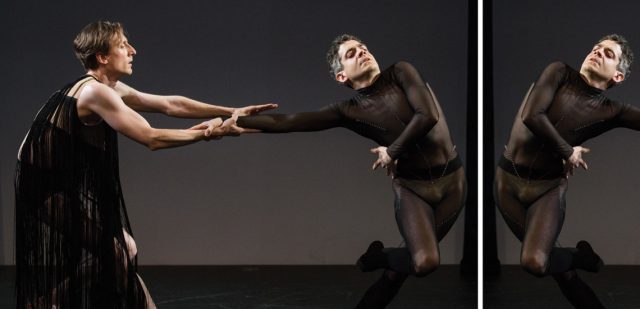
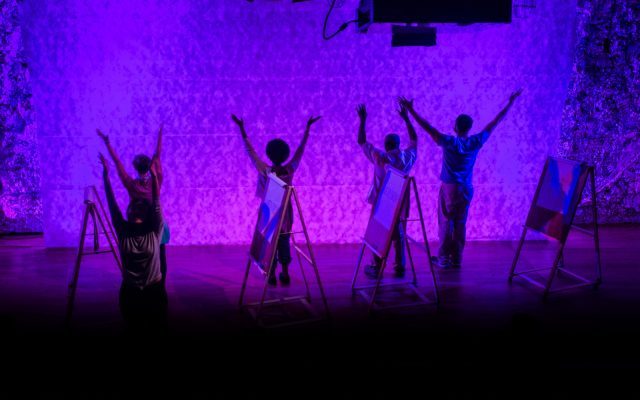
Satellite Collectives Echo & Narcissus debuts at the BAM Fisher this weekend

Satellite Collective’s Echo & Narcissus debuts at BAM Fisher this weekend

BAM Fisher, Fishman Space
321 Ashland Pl.
Friday, September 14, 8:00, and Saturday, September 15, 7:30, $25
www.bam.org
satellitecollective.org

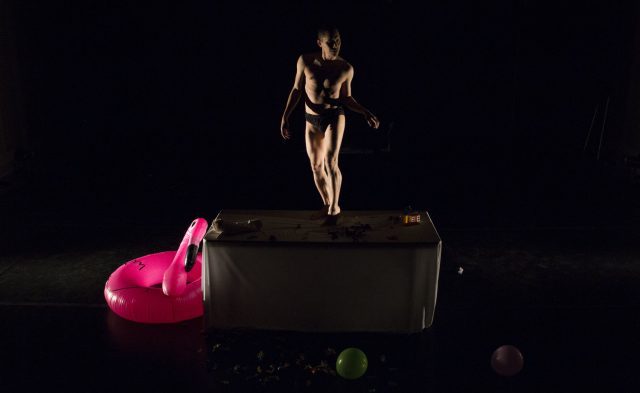
New York City–based Satellite Collective is presenting the world premiere of its latest interdisciplinary ballet collaboration, Echo & Narcissus, at BAM Fisher’s Fishman Space on September 14 and 15. Some forty artists participated in the creation of the immersive work, which includes music, dance, opera, visual art, digital multimedia, and more, with live music and movement by ShoutHouse. The seventy-minute piece is set in New York City in 1971 and deals with such themes as selfishness, love, madness, and transformation in a world where people are obsessed with their own reflections. It was written by Satellite Collective artistic director Kevin Draper, composed by Aaron Severini, choreographed by Norbert De La Cruz III, and directed by Philip Stoddard, with film by Lora Robertson, projection design by Simon Harding, sets by Libby Stadstad, and production design by Draper. Among the performers are dancers Matteo Fiorani, Timothy Stickney, Joslin Vezeau, and Tara Youngmen and singers Christine Taylor Price and Stoddard. “We work at the intersection of dance, visual art, and music — and we use architects and poets as the glue,” Draper said in a statement. “Echo & Narcissus will be our first, focused, evening-length work where group action has to resonate in service to the story. We’re crafting a pretty high level of intensity for the audience.”

BERNARD SHAW’S HEARTBREAK HOUSE

(photo by twi-ny/mdr)

Gingold Theatrical Group presents a unique take on Shaw at the Lion Theatre (photo by Carol Rosegg)

The Lion Theatre at Theatre Row
410 West 42nd St. between Ninth & Tenth Aves.
Tuesday – Sunday through September 29, $69
gingoldgroup.org
www.theatrerow.org

The Lion Theatre at Theatre Row has been transformed into a London air-raid shelter during the Blitz for the world premiere of the Gingold Theatrical Group’s unique, rather scattershot adaptation of George Bernard Shaw’s Heartbreak House. Initially written as a Chekhov-inspired drama prior to WWI, tweaked after the war, and first performed in 1920, Heartbreak House was meant as a wake-up call to a complacent Britain. During WWII, the prominent English actress Hermione Gingold presented plays, including Heartbreak House, in a theater basement. “The notion of your audiences calling out for my dusty old play in the basement of your historic temple of art seems a suitable accompaniment to the dreaded nightly Beethoven,” Shaw wrote to Gingold about the work. “You will remember from our meeting last year that I had never been given the privilege of sharing my original manuscript until long after the graves had been filled and forgotten, requiring a substantial refashioning for its debut. Since our nightly All Clears are not greeting Londoners until the dawn I should think you would have abundant time to make it through to Keep the Home Fires Burning, and I urge you to avoid the wistful finale as published along with all those tiresome directives of people sleeping. It’s too late for that.” Now Gingold Theatrical Group founding artistic director David Staller — who named the company after the English star, a great friend of his — has refashioned the narrative, using the original handwritten version and adding elements from Shaw’s letters, various production scripts, and Gingold’s personal experiences to create a twenty-first-century iteration of the show. Unfortunately, it is haphazard and confusing, all over the place and no place at the same time.

(photo by twi-ny/mdr)

Captain Shotover (Raphael Nash Thompson) and Ellie Dunn (Kimberly Immanuel) look down from above in Heartbreak House (photo by Carol Rosegg)

The play, originally subtitled A Fantasia in the Russian Manner on English Themes, is set in the ratty, dusty basement of London’s Ambassadors Theatre, where a valiant troupe and the audience have gathered as German bombers fly overhead. This night the company decides to present Heartbreak House, which Shaw saw as an activist, antiwar tale. It’s September 1914, and Ellie Dunn (Kimberly Immanuel) has arrived at the Sussex villa owned by the gruff Captain Shotover (Raphael Nash Thompson), having been invited by one of the captain’s daughters, Hesione Hushabye (Karen Ziemba). They are joined by Hesione’s sister, Lady Ariadne Utterword (Alison Fraser), who has been away a long time and is not immediately recognized by her sibling. Entering next are Mazzini Dunn (Lenny Wolpe), Ellie’s good-natured but not-so-savvy father, and wealthy industrialist Boss Mangan (Derek Smith), who is Ellie’s intended despite being much her elder and Ellie’s having fallen for a handsome stranger she met in the National Gallery — who turns out to be the dashing Hector Hushabye (Tom Hewitt), Hesione’s husband. A little later, Hesione is kissed by a mysterious gentleman who is actually Randall Utterword (Jeff Hiller, who plays several roles), her sister’s spouse. The rules of society, family dysfunction, and the end of the world all take on key roles in the show within a show, which can’t quite figure out if it’s a drawing-room farce, a romantic comedy, or a sociopolitical commentary.

(photo by twi-ny/mdr)

Hesione Hushabye (Karen Ziemba) takes Ellie Dunn (Kimberly Immanuel) under her wing in Gingold’s WWII-set adaptation of Shaw’s Heartbreak House (photo by Carol Rosegg)

Barbara A. Bell’s costumes are elegantly comic and Brian Prather’s set is appropriately crowded, but Staller can’t make the best of the small theater. Many of the characters enter and leave by the rear door behind the audience, tramping up and down the solitary aisle in an endless march that quickly becomes distracting. The acting is inconsistent, as some of the cast play overblown caricatures and others keep it more down to earth, with Ziemba, Thompson, and Immanuel standing out. (The 1984 Broadway revival earned Tony nominations for Rex Harrison as Captain Shotover, Rosemary Harris as Hesione, Philip Bosco as Boss Mangan, and Dana Ivey as Lady Utterword.) Be prepared to sing along to such old-time ditties as “Pack Up Your Troubles in Your Old Kit-Bag” and “Let Me Call You Sweetheart”; the lyrics can be found in a pamphlet that includes information on what to do “in the event of an air raid” as well as an advert in which Hermione Gingold praises Ovaltine. “A man’s interest in the world is only the overflow from his interest in himself,” Shotover tells Ellie. “When you are a child your vessel is not yet full; so you care for nothing but your own affairs. When you grow up, your vessel overflows; and you are a politician, a philosopher, or an explorer and adventurer. In old age the vessel dries up: there is no overflow: you are a child again.” Despite a narrative that involves antiwar sentiment and class and gender differences, the Gingold production never feels fresh and relevant but instead remains more of a curiosity, a play cobbled together from too many ingredients in a way that can’t quite fill or overthrow the vessel.