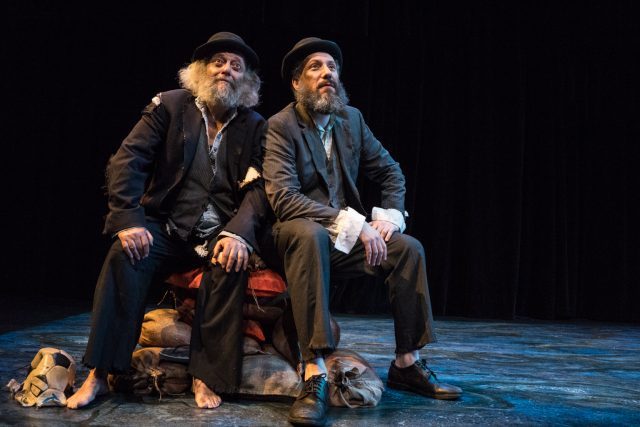
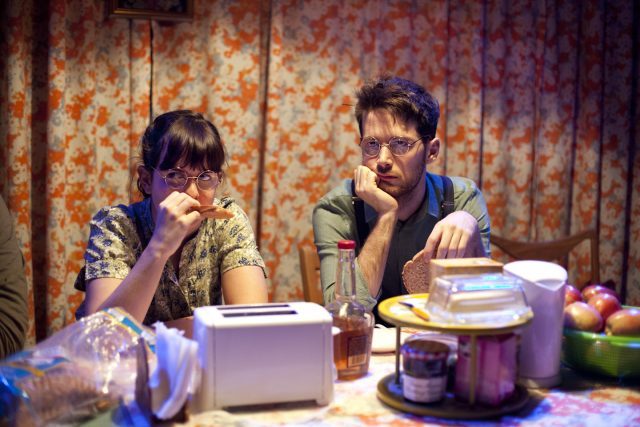
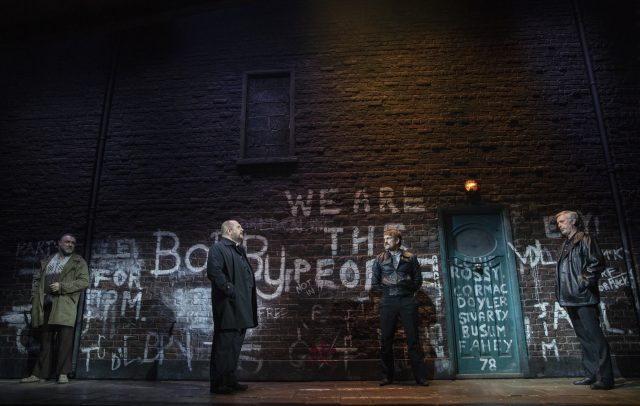
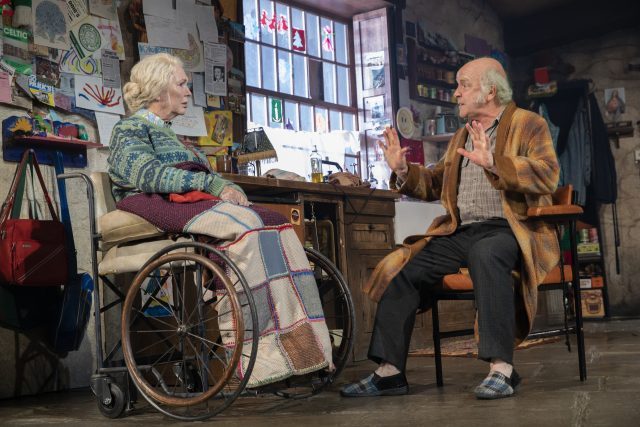
David Mandelbaum is Gogo and Eli Rosen is Didi in New Yiddish Rep production of Waiting for Godot (photo by Dina Raketa)
VARTN AF GODOT
Theater at the 14th Street Y
344 East 14th St. at First Ave.
Saturday – Tuesday through January 27, $35
646-395-4310 www.newyiddishrep.org 14streety.com
In October 2013, New Yiddish Rep teamed up with the Castillo Theatre to present the first-ever Yiddish version of Samuel Beckett’s Waiting for Godot (Vartn af Godot) in honor of the play’s sixtieth anniversary. New Yiddish Rep has now brought it back for an encore run at the Theater at the 14th Street Y, shedding new light on the oft-produced masterwork about the futility of human existence. I’ve recently seen it in English with septuagenarians Sir Patrick Stewart as Vladimir (Didi) and Sir Ian McKellen as Estragon (Gogo) on Broadway and with thirtysomething Irish actors Marty Rea as Didi and Aaron Monaghan as Gogo in the Druid’s adaptation at Lincoln Center’s White Light Festival. I heard Bill Irwin discuss the play at length in his one-man presentation On Beckett last year at the Irish Rep. But none of that prepared me for the NYR version, in which Beckett’s existential antiheroes Vladimir and Estragon are portrayed as a pair of alter kockers, heavily bearded old Jewish men complaining about life. Eli Rosen, a late replacement for Rafael Goldwaser, is the tall, thinner Vladimir, while company cofounder and artistic director David Mandelbaum reprises his 2013 role as the short and stout Estragon in this translation by Shane Baker (who played Didi in 2013), directed by Ronit Muszkablit.
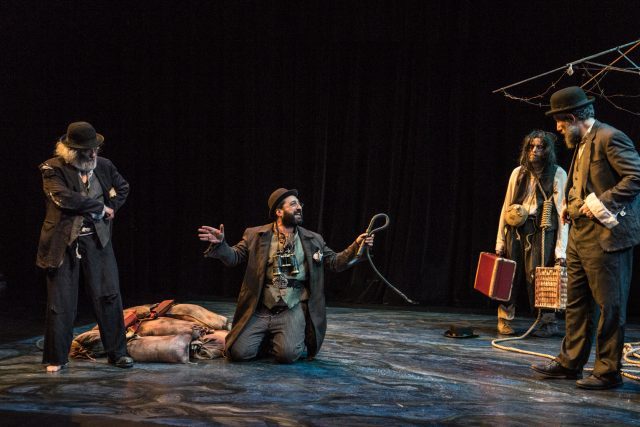
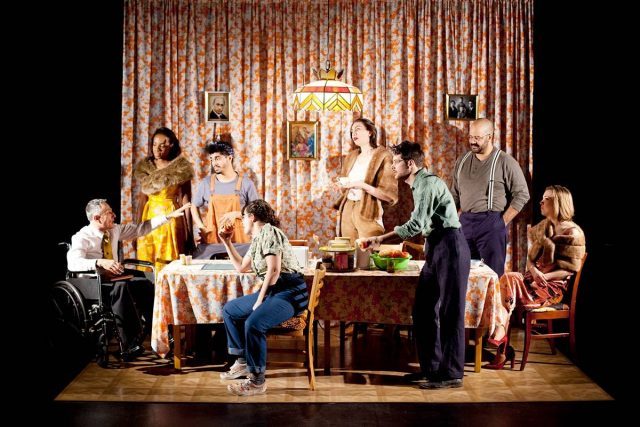
Pozzo (Gera Sandler) tries to explain himself as Estragon (David Mandelbaum), Lucky (Richard Saudek), and Didi (Eli Rosen) look on (photo by Dina Raketa)
“Nothing to be done,” Estragon says at the beginning, and such desultory phrases, so familiar to Beckett enthusiasts, have an astonishing resonance in Yiddish, as if the old man with the thick accent is carrying the burden of his people’s legacy. (English surtitles are crookedly projected on crooked wood at the back of the stage.) Later, Vladimir asks, “Was I sleeping, while the others suffered?” The two men are waiting for someone named Godot to arrive, but they don’t know why. While wandering around the small, rectangular space — which features a collection of junk that has been organized into a place to sit, along with a dilapidated backyard umbrella serving as a tree, bare save for a few dead leaves and some string (the set designer is George Xenos) — they talk about carrots, body odor, suicide, and memory. They also bring up Jesus, the Bible, repentance, the Dead Sea, crucifixion, and other religious topics that take on sometimes startling connotations when coming from Jews. For example, several references, including to a charnel-house, a camp, the loss of basic human rights, and skeletons and corpses, recalled the Holocaust, something that did not leap out at me when watching other productions or reading the play. And Pozzo’s (Gera Sandler) treatment of Lucky (Richard Saudek) evokes both anti-Semitism and the enslavement of the Jews. Beckett was not about to address such direct interpretations, but he did write Godot in the aftermath of WWII, during which he was part of the French Resistance and at one point escaped the Gestapo. So it’s not far-fetched to believe the Holocaust was on his mind to some degree while writing the play (in French), although in no way am I asserting that’s what it is specifically about.
The NYR adaptation moves too slowly, and the slapstick — Beckett includes moments of vaudeville-like physical comedy, inspired by his love of Laurel and Hardy — is tentative and ineffective, which is unfortunate, since so much of the rest of the production is solid and engaging. Rosen and Mandelbaum, who both appeared in NYR’s God of Vengeance and Awake and Sing! (among others), make a lovely pair — it’s easy to believe that the characters have been waiting for the mysterious Godot for a long, long time, arguing over who is suffering more. Saudek (Eager to Lose,Balls) excels as Lucky, delivering the protracted stream-of-consciousness monologue in a breathless fury that sounds sensational in Yiddish. And through it all is an unmistakable Jewishness, as if Godot is coming to guide Gogo and Didi to freedom in Israel, which had become a state only a few months before Beckett began work on the play. “I remember the maps of the Holy Land. Coloured they were. Very pretty,” Estragon tells Vladimir, continuing, “The Dead Sea was pale blue. The very look of it made me thirsty. That’s where we’ll go, I used to say, that’s where we’ll go for our honeymoon. We’ll swim. We’ll be happy.” Vartn af Godot will continue to bring happiness to theatergoers of all religious — or nonreligious — persuasions at the 14th Street Y through January 27 as part of the institution’s Season of War + Peace. (Fans of Yiddish theater should also check out the return of Tevye Served Raw at the Playroom Theater and the much-deserved extension of the National Yiddish Theatre Folksbiene’s Fiddler on the Roof in Yiddish at Stage 42.)
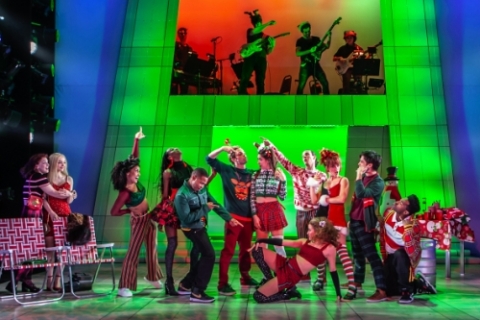
Amy Heckerling has adapted her 1995 hit comedy, Clueless, into an off-Broadway musical (photo by Monique Carboni)
The New Group at the Pershing Square Signature Center
The Alice Griffin Jewel Box Theatre
480 West 42nd St. between between Ninth & Tenth Aves.
Through January 12 www.thenewgroup.org www.signaturetheatre.org
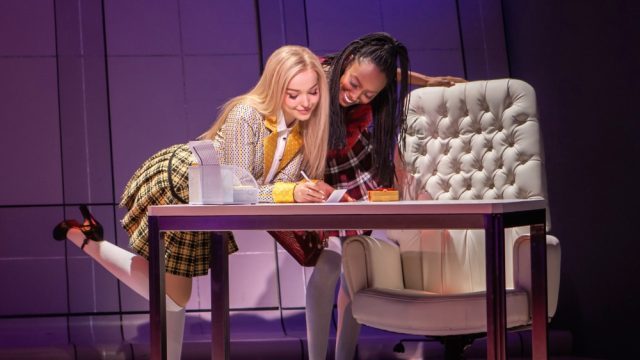
Amy Heckerling’s eagerly anticipated musical adaptation of her 1995 hit comedy, Clueless, is, well, I hate to say, pretty clueless. The sold-out New Group production, which closes tonight at the Signature Center, tries to recapture the hip success of the film, a contemporary retelling of Jane Austen’s Emma, but instead it is a dreary, cliché-ridden mess that fails to provide the necessary pizzazz that energized, for example, Tina Fey’s Broadway musical version of her 2004 movie, Mean Girls. Heckerling, whose directorial debut was another teen giant, Fast Times at Ridgmont High (she’s also made several films in the Look Who’s Talking series and the 2000 disappointment Loser), brings back the whole gang for the musical, centered around superficial fashion-plate Cher (Dove Cameron), who decides to become a matchmaker at posh Beverly Hills High with her bestie, Dionne (Zurin Villanueva), starting with the seemingly implacable Mr. Hall (Chris Hoch) and the mousey Mrs. Geist (Megan Sikora).
Cher (Dove Cameron) and Dionne (Zurin Villanueva) hatch out another plan in Clueless (photo by Monique Carboni)
Cher, whose father, Mel (Chris Hoch), is a master litigator and whose former stepbrother, Josh (Dave Thomas Brown), is considering law as a career as well, tries her negotiating skills to get better grades from several teachers while also taking on scruffy new student Tai (Ephie Aardema) as a project. Tai is interested in stoner Travis (Will Connolly), but Cher wants to see her with stud muffin Elton (Brett Thiele). Cher herself falls hard for hot new guy Christian (Justin Mortelliti); Dionne, however, is stuck with her longtime boyfriend, Murray (Gilbert L. Bailey II), who doesn’t exactly treat her right. Also making appearances are such peripheral characters from the film as gym teacher Ms. Stoeger (Sikora), stuck-up plastic surgery lover Amber (Tessa Grady), students Summer (Talya Groves) and Sean (Darius Jordan Lee), an unfortunate driving instructor (Hoch), and Cher’s maid, Lucy (Danielle Marie Gonzalez). Passing references to contemporary political correctness are scattered throughout the ragged narrative, accompanied by uninspired projections. (Did they spell “Goverment” that way on purpose, or is it a mistake they never fixed?)
The cast never comes together to form a cohesive whole the way the film actors did; of course, the movie was spoiled with Alicia Silverstone, Stacey Dash, Brittany Murphy, Paul Rudd, Dan Hedaya, Wallace Shawn, Julie Brown, Donald Faison, Breckin Meyer, and Jeremy Sisto. Heckerling, who wrote the book, and director Kristin Hanggi can’t achieve any flow, while Kelly Devine’s choreography is occasionally fun but mostly unmemorable. Amy Clark’s costumes are fashionably clever, even making their way into Beowulf Boritt’s set design. The real problem, however, lies in the music and lyrics. Heckerling takes ’90s favorites by Ace of Base, the Spin Doctors, TLC, Des’ree, Michael Bolton, and others and rewrites the lyrics to match the story, but the new words fail to ignite, too often coming off as silly and trite or overly gimmicky. For example, MC Hammer’s “U Can’t Touch This” is turned into “She Can’t Hit This,” as the female students struggle to play tennis in gym class. (“I-I-I-I hate P.E. / [It’s] so lame / I’m gonna say I got menstrual pain,” Dionne sings.)
Two songs that were featured in the movie show up, Jill Sobule’s “Supermodel” (with an added reference to Mean Girls) and the Muffs’ version of Kim Wilde’s “Kids in America,” but the latter feels like it came right out of Rock of Ages, which Hanggi directed and Devine choreographed. Reviving Austen’s classic jewel of a story about a matchmaker whose innocent arrogance requires a comeuppance, a young woman who sees all but can’t see herself, is never a bad idea, but in this case the ’90s setting for that gem just seems dated and uninspired. Perhaps that’s what’s just not right about Clueless the Musical; it’s too much of a paint-by-numbers production, with little originality or uniqueness. It’s staged so enthusiastically that you want to love it — Cameron’s nonstop energy is reminiscent of a young Kristin Chenoweth — but it continually lets you down, much like many kids’ high school experience.
New Saloon reinterprets Chekhov’s Uncle Vanya in Minor Character at the Public Theater (photo by Elke Young)
MINOR CHARACTER: SIX TRANSLATIONS OF UNCLE VANYA AT THE SAME TIME
Martinson Hall, the Public Theater
425 Lafayette St. at Astor P.
January 11-13, $30
212-539-8500 www.publictheater.org www.newsaloon.org
“Everyone’s a freak,” Astrov declares in Minor Character, New Saloon’s ingenious, outrageously entertaining adaptation of Anton Chekhov’s 1898 play, Uncle Vanya. But the freakiest thing is the play itself, a mash-up of six different translations, by Marian Fell, Laurence Senelick, Paul Schmidt, Carol Rocamora, company cofounder Milo Cramer, and, perhaps most profoundly, Google Translate. The result is an exhilarating procession of unpredictable language; sometimes the dialogue, performed by an outstanding cast, takes one line from one translation, the next from another, etc. But at other times a line is repeated in up to six different phrasings, highlighting the subtle and extreme ways translations differ from one another — and ultimately, of course, how different communication itself can be. For example, in his opening monologue Astrov says, “I’m over-worked, Nanny. I work too hard, Nanny. I’ve been working too hard, Nanny old girl. And I’m bored. Life is boring, it’s stupid, it stinks, boring, stupid, squalid, dreary, silly, filthy. . . . It drags you down, this life.”
Life is a little bleak for most of the characters in unique adaptation of Uncle Vanya (photo by Elke Young)
This version of the play, which lends itself to reinterpretation (see Louis Malle’s film Vanya on 42nd St., Sally Burgess’s opera Sonya’s Story, and Markus Wessendorf’s theater piece Uncle Vanya and Zombies; Chekhov himself revised it from a previous work of his, The Wood Demon), stands in stark contrast to the recent Hunter Theater Project version, which featured a carefully streamlined translation by Richard Nelson with Richard Pevear and Larissa Volokhonsky, emphasizing characters and relationships over time, place, and situation. New Saloon doesn’t streamline as much as explode the play: Most characters are portrayed by three actors at a time regardless of gender, race, or age, and each character is indicated by a distinctive piece of clothing (a mink wrap, a bow, a vest; the costumes are by Emily Oliveira), so at certain moments what seems to be a conversation is just the same character speaking, with the words coming out of three different actors’ mouths in deliciously mannered deliveries that often emphasize the wrong syllables for added effect — just as translations often just miss the beat and rhythm of the original. But none of this is done to confuse the audience; instead, it enlivens the theater — in this case, the Public’s Martinson Hall, where the work continues through January 13 as part of the experimental Under the Radar Festival. The specifics of the plot, complete with gleeful anachronisms, are not always easy to follow, but what happens is more than clear enough; of course, it helps if you are familiar with the story. Bonus kudos go out to director and company cofounder Morgan Green, who has a firm grasp of the festivities, and dramaturg Elliot B. Quick, who must have been one busy fella.
A group of friends and relatives have come together at a country estate owned by a wheelchair-bound elderly professor with a much younger wife, Yelena. The estate is run by the unhappy, disgruntled Vanya and the professor’s daughter from his first marriage, the mousey Sonya, with help from Vanya’s mother, Maria, and a nurse, Marina. Also on hand are the local doctor, Astrov, who has the hots for Yelena, and neighboring landowner Waffles. The characters — wonderfully portrayed by a rotating cast consisting of Cramer, Ron Domingo, Rona Figueroa, Fernando Gonzalez, David Greenspan, LaToya Lewis, Caitlin Morris, and company cofounder Madeline Wise — discuss life, love, and the pursuit of happiness. Although there’s not a whole lot of joy in store for most of these folks, there is a whole lot of fun for audiences, who are not likely to find the show — which has been “condensed and expanded” from the 2016 iteration presented at the Invisible Dog — stupid, boring, squalid, dreary, silly, or filthy.
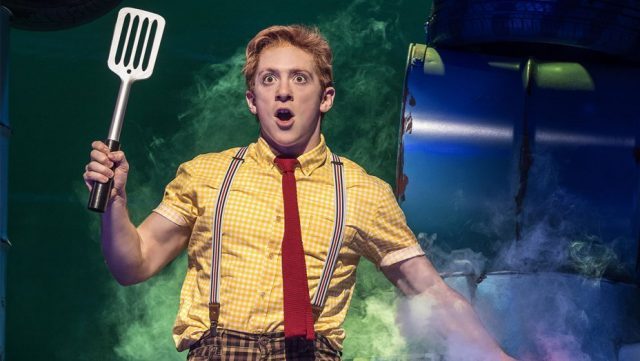
Tony nominee Ethan Slater will perform the key role of Jordan in staged benefit reading of Significant Other at the JCC (photo by Joan Marcus)
Arts + Ideas
Marlene Meyerson JCC Manhattan
334 Amsterdam Ave. at West 76th St.
Thursday, January 31, $25, 7:00
646-505-5708 jccmanhattan.org
I had the privilege of seeing Joshua Harmon’s wonderful Significant Other both off Broadway at the Laura Pels Theatre in 2015 as well as on Broadway at the Booth in 2017, completely falling for this tale of four friends searching for love in New York City and beyond. The Roundabout production had an undeserved short run on Broadway, but it’s being brought back for a special one-night-only staged reading on January 31 at the Marlene Meyerson JCC Manhattan, benefiting the institution’s “Out at the J” LGBTQIA programming. SpongeBob SquarePants himself, Tony nominee Ethan Slater, will play Jordan, with Midori Francis as Laura, Latoya Edwards as Vanessa, Cathryn Wake as Kiki, Kathryn Kates as Helene, and Isaac Powell as Zach, Evan, and Roger. (The casting of the actor who will play Will, Conrad, and Tony is TBD.) Rising star Harmon has also written Skintight,Admissions, and Bad Jews, so his career is off to a rousing start. Tickets for the Arts + Ideas event, which is directed by Daniella Caggiano and produced by Rachel Kunstadt, are only twenty-five dollars and go to a great cause, so you can’t go wrong with this special evening, part of the JCC’s Arts + Ideas initiative.
Bernard B. Jacobs Theatre
242 West 45th St. between Broadway & Eighth Ave.
Tuesday – Sunday through July 7, $79 – $209 theferrymanbroadway.com
Winner of three Olivier Awards for Best New Play, Best Director (Sam Mendes), and Best Actress (Laura Donnelly), British import The Ferryman is a staggering achievement, everything a Broadway play should be and more. Jez Butterworth, whose three-hour Jerusalem dazzled audiences in 2011 and earned Mark Rylance a Tony, followed in 2014 by the underwhelming eighty-five-minute The River, returns to the Great White Way with a searing 215-minute tale set during the height of the Troubles in Northern Ireland in the late summer of 1981, while Irish Republican political prisoners are on a five-month hunger strike that has divided Great Britain. Quinn Carney (Paddy Considine) and his extended family are living on a farm in rural County Armagh — including his always ailing wife, Mary (Genevieve O’Reilly); their children, J.J. (Niall Wright), Michael (Fra Fee), Shena (Carla Langley), Nunu (Brooklyn Shuck), Mercy (Willow McCarthy), Honor (Matilda Lawler), and a nine-month-old son; Quinn’s elderly Uncle Patrick (Mark Lambert) and wheelchair-bound Aunt Maggie Far Away (Fionnula Flanagan); fierce IRA supporter Aunt Patricia (Dearbhla Molloy); and Quinn’s sister-in-law, Caitlin (Donnelly), and her son, Oisin (Rob Malone).
They are all preparing for the harvest feast, with the help of their trusted farmworker, Tom Kettle (Justin Edwards), an addled, simple Englishman, and teenage cousins Shane (Tom Glynn-Carney), Diarmaid (Conor MacNeill), and Declan Corcoran (Michael McArthur), who know how to have a good time. Quinn has been trying to escape his IRA past, but it all comes hurtling back when the body of his brother, Seamus, Caitlin’s husband, is found in a bog and IRA strongman Frank Magennis (Dean Ashton) and leader Muldoon (Stuart Graham) show up unexpectedly at the house to send a very specific message. Caught in the middle is Father Horrigan (Charles Dale), who wants to do the right thing but is threatened by Magennis and Muldoon as well.
Tony winner Mendes (American Beauty, Cabaret) superbly navigates the play’s many complexities, making three hours and fifteen minutes virtually float by. Rob Howell’s crowded, busy set (he also designed the costumes), a kind of purgatory where various sins are revealed, is able to contain the large cast as the characters sing, dance, argue, cook, tell stories, love, and fight. Numerous cast changes have been made since it first opened at the Bernard B. Jacobs Theatre in October (and where it has been extended through July 7), but The Ferryman is an ensemble piece, not dependent on any individual performances, although a baby and a goose stand out. That said, it is a treat to see English actor Considine, who has starred in such films as Michael Winterbottom’s 24 Hour Party People, Edgar Wright’s Hot Fuzz, Paul Greengrass’s The Bourne Ultimatum, and Armando Iannucci’s The Death of Stalin, make his stage debut as Quinn, a proud man who just wants to go on with his family life but is pulled back into his past. “Let’s just stay like this. Let me just dream for a moment. Imagine what it feels like to have won. I just want to stay like this,” he tells Caitlin early on, before news of Seamus’s fate reaches them. Butterworth, who has cowritten screenplays for such films as Fair Game, Black Mass, and Spectre, was inspired to write The Ferryman by the true story of the murder of Donnelly’s uncle Eugene, who disappeared in 1981 and whose body was discovered three years later. Butterworth wrote the part of Caitlin specifically for Donnelly (Outlander, The River), his partner, who was pregnant during the initial London run. Donnelly gave birth to a daughter, while Butterworth delivered what is currently the best play on Broadway.
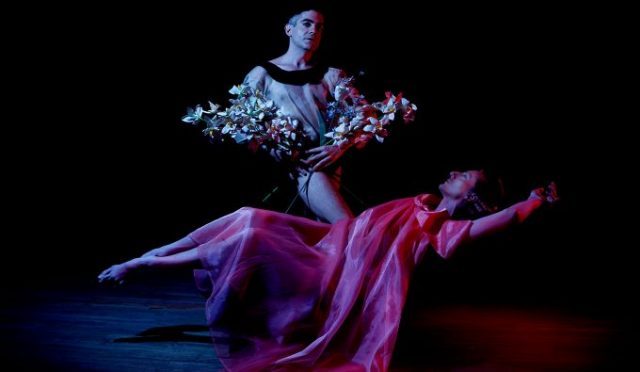
Jack Ferver collaborates with Reid Bartelme as well as James Whiteside, Lloyd Knight, and Garen Scribner in the world premiere of Everything Is Imaginable at New York Live Arts (photo by Jason Akira Somma)
New York Live Arts
219 West 19th St. between Seventh & Eighth Aves.
January 7-12, $15-$35, 8:00 or 10:00
212-924-0077 americanrealness.com newyorklivearts.org
Jack Ferver’s Everything Is Imaginable returns this week to New York Live Arts as part of the multidisciplinary American Realness festival. Below is our review of the work’s world premiere in April 2018; don’t miss this second chance to catch this extraordinary piece.
A few weeks before the world premiere of Everything Is Imaginable, New York City treasure Jack Ferver tore his calf while preparing a piece for Reid Bartelme and Harriet Jung at the Guggenheim. But leave it to the Wisconsin-born actor, writer, dancer, choreographer, teacher, and director to incorporate the injury into the narrative of the two-act, seventy-minute show. As the audience enters the theater at New York Live Arts, the curtain is down, a rarity at the venue, upping the growing sense of anticipation that accompanies every Ferver work. The curtain soon opens on Jeremy Jacob’s playful set, consisting of four white cardboard columns with drawings of leaves on them, along with a central cardboard chandelier hovering at the top of a screen in the back. It immediately immerses the crowd into the wonders of Ferver’s imagination while exposing the artifice behind staged productions in general. The first act features four queer men in sheer, butt-revealing outfits dancing solos inspired by their childhood memories and one major role model: American Ballet Theater principal James Whiteside, in a short, glittering dress of silver sequins, pays tribute to Judy Garland, dancing to Garland’s version of Cole Porter’s “I Happen to Like New York”; Martha Graham principal dancer Lloyd Knight honors Graham, moving to a recording of the legendary choreographer speaking about dance; dancer and actor Garen Scribner slides across the stage in socks and does spins like his hero, champion skater Brian Boitano, to the sound of ice skates being sharpened and gliding across the ice; and longtime Ferver collaborator Bartelme, a former ballet dancer and current costume designer (as part of Reid and Harriet Design, who made the costumes for the show), wears a long orange mane and dances with horse movements, since his idol is My Little Pony. Each solo combines humor with beautiful movement, taking advantage of each dancer’s strengths while adding the charm and whimsy that are mainstays of Ferver’s choreography. The four star turns are followed by a solo about sunglasses and then an ensemble piece danced to “club music,” including a Martha Graham–esque sexualized orgy that is uproariously funny.
After a ten-minute intermission (with the curtains closed), the second act begins with Ferver (Chambre,Night Light Bright Light) by himself onstage, standing over a miniature version of the set from the first act, evoking Stonehenge from This Is Spinal Tap. In a sheer bodysuit recalling Michelle Pfeiffer’s garb as Catwoman in Batman Returns, the compact Ferver towers over the tiny columns and chandelier, emphasizing his power as a creator while also poking fun at it. Ferver talks about his calf injury, explaining how that limited his ability to dance — his doctor advised him not to move forward, which is not part of his vocabulary, literally or figuratively — and forced him to reimagine the work, and discusses his difficult childhood, friendless and bullied for his overt homosexuality; growing up gay is a regular theme in his oeuvre. As always, his stage persona is that of a devilish cherub, wild and wacky one moment, making the audience roll around their seats with laughter, and then deadly serious the next, raising disturbing elements from his life that may or may not be true, causing everyone to reconsider their reactions. He’s joined by Bartelme, who looks lovely in a fringe dress, and the two dance together to heartbreaking effect while Ferver, soldiering on despite his injury, goes on to describe his process of writing a memoir, which took place alone, terrified, in a strange house, in the dark. Ferver is no longer friendless or alone, as evidenced not only by the crowd response to the supremely personal show but by the long line of well-wishers who waited to hug and congratulate him for giving them yet another unique, meaningful, and vastly entertaining experience, shining a light on his life, and ours, as only he can.