this week in theater

GIRL FROM THE NORTH COUNTRY

(photo by Joan Marcus)

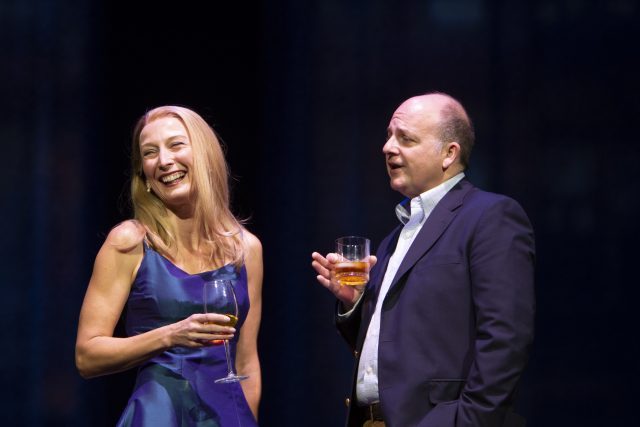
Mare Winningham and Stephen Bogardus play a married couple facing multiple dilemmas in Girl from the North Country (photo by Joan Marcus)

The Public Theater, Newman Theater
425 Lafayette St. by Astor Pl.
Tuesday – Sunday through December 23, $120
212-967-7555
www.publictheater.org

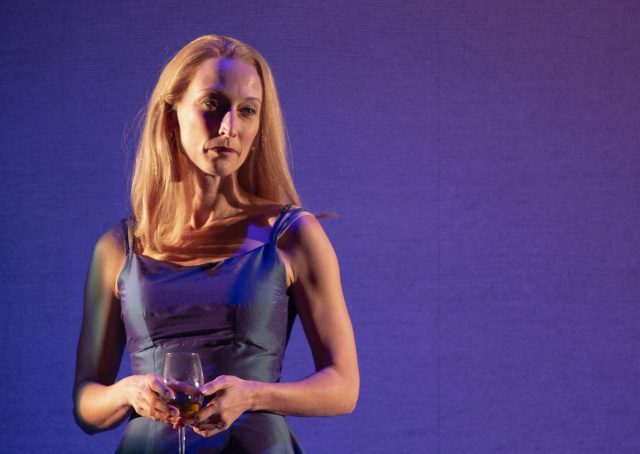
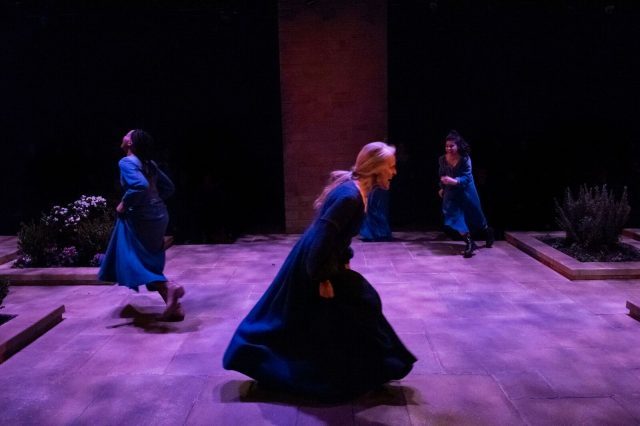
Conor McPherson’s Girl from the North Country is like a grand, epic Bob Dylan song brought to life — think “Desolation Row,” “Stuck Inside of Mobile with the Memphis Blues Again,” “Lily, Rosemary, and the Jack of Hearts,” and “Brownsville Girl” (which he wrote with playwright Sam Shepard). It’s long (about two and a half hours), it has multiple key characters and subplots, and it’s not always clear exactly what’s going on. The show, which has been extended through December 23 at the Public’s Newman Theater, is also deeply involving, honest, and poetic. The elegiac story is a flashback to the iron-ore shipping town of Duluth, Minnesota, in the winter of 1934, where Dylan was born Robert Zimmerman seven years later. It’s set in a failing guesthouse run by Nick Laine (Stephen Bogardus), a kind soul who is taking care of his mentally ill wife, Elizabeth (Mare Winningham), and their troubled twenty-year-old biological son, Gene (Colton Ryan), who can’t commit to a job or his ex-girlfriend, Kate Draper (Caitlin Houlahan). The white couple also has a bright and lovely nineteen-year-old adopted black daughter, Marianne (Kimber Sprawl), who is pregnant.

Among those staying at the guesthouse — skillfully designed by Rae Smith, who also did the period costumes — are stalwart businessman Frank Burke (Marc Kudisch), his wife, Laura (Luba Mason), and their on-the-spectrum grown son, Elias (Todd Almond); Mrs. Neilsen (Jeannette Bayardelle), a recent widow who is having an affair with Nick and waiting on money from her late husband’s estate; and Bible salesman Reverend Marlowe (David Pittu) and formerly incarcerated boxer Joe Scott (Sydney James Harcourt), who arrive together. Determined to find a spouse for Marianne, Nick has invited sixty-nine-year-old shoe mender Mr. Perry (Tom Nelis) to come over and offer his hand to her. Dr. Walker (Robert Joy) serves as an Our Town–like narrator. “My name is George Arthur Walker. I’m a doctor. Least I was. Back when this was our world,” he says at the beginning. “I healed some bodies in pain. But as we know pain comes in all kinds. Physical, spiritual. Indescribable.”

(photo by Joan Marcus)

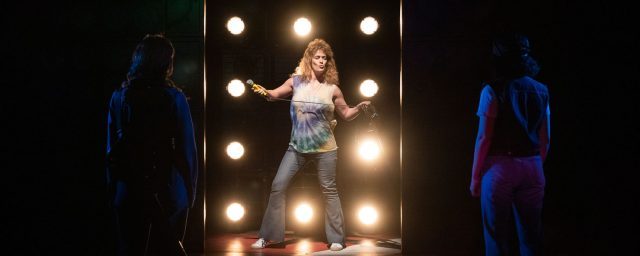
Elias Burke (Todd Almond) takes center stage for a surreal version of “Duquesne Whistle” in Dylan musical at the Public (photo by Joan Marcus)

Two-time Tony nominee McPherson (Shining City, The Seafarer), who wrote and directed the production, does a marvelous job incorporating songs from throughout Dylan’s wide-ranging fifty-plus-year career, selecting well-known favorites (“Like a Rolling Stone,” “Idiot Wind”) along with lesser-known gems (“Went to See the Gypsy,” “Tight Connection to My Heart [Has Anyone Seen My Love?”], “True Love Tends to Forget”). The characters and plot elements are not taken directly from Dylan songs; instead, they add depth to each other, creating a compelling mood and atmosphere of 1930s America, a time when many a dream died hard. (It’s actually a little disappointing when Scott starts singing “Hurricane,” Dylan’s ode to wrongly imprisoned black boxer Rubin “Hurricane” Carter, as it’s the only predictable musical moment of the show.) The music also exists in a different period of time and space than the narrative; the songs are sung by the actors out of character, at a microphone, as the rest of the cast carries on in the background.

(photo by Joan Marcus)

Kimber Sprawl and Sydney James Harcourt team up for a duet in Conor McPherson’s Girl from the North Country (photo by Joan Marcus)

Among the musical highlights are Winningham delivering a stunning reimagining of “I Want You”; several performers joining in for a soulful medley of “Slow Train” and “Jokerman”; and a rousing rendition of “You Ain’t Goin’ Nowhere” that brings the house down to start the second act. Nearly every song has been significantly rearranged by orchestrator and music supervisor Simon Hale with McPherson, which works exceptionally well and makes sense, since Dylan has been reinventing his tunes for decades, often rendering them nearly unrecognizable (which you can hear for yourself when Dylan and his band come to the Beacon Theatre November 23 to December 1). It’s all played with heart by a four-piece band situated in a far corner, consisting of music director Marco Paguia on piano and harmonium, Ross Martin on guitar, Martha McDonnell on violin and mandolin, and Mary Ann McSweeney on bass (with various actors occasionally sitting at the drum kit at the front of the stage). The ensemble also features Matthew Frederick Harris, John Schiappa, Rachel Stern, and Chelsea Lee Williams, who play minor characters and sing. Girl from the North Country is a haunting look at America’s past — and future, perhaps? — from two extraordinary storytellers.

SUDDENLY

(photo by Victor Llorente)

John Baron (Drew Allen) talks to a crony while a terrified Ellen Benson (Phoebe Dunn) watches in Suddenly (photo by Victor Llorente)

HERE Arts Center
145 Sixth Ave. at Dominick St.
Tuesday – Saturday through October 20, $35, 8:30
212-647-0202
www.here.org
www.live-source.org

Live Source Theatre Group’s Suddenly is a taut if clumsily rendered adaptation of Lewis Allen’s 1954 thriller, with adroit changes to Richard Sale’s screenplay that add contemporary relevance. Adapted by Gianfranco Settecasi and directed by Tyler Mercer, the play, which continues at HERE through October 20, takes place on a Saturday afternoon in the summer of 1954, in a suburban house overlooking the train station. Living in the home is Ellen Benson (Phoebe Dunn), who has a hatred of guns ever since her husband was killed in the war; her young son, Pidge (Henry Fin Berry), who wants to be a sheriff when he grows up; and her father, Pop (Joseph J. Menino), a former Secret Service agent who once took a bullet for President Calvin Coolidge. Local sheriff Tod Shaw (Brendan Walsh) has a habit of stopping by, as he’s in love with Ellen, who is not ready to move on from her husband’s death. Ellen is furious when Pidge comes home with a toy gun Tod bought him, one that looks very much like the real thing. As the family waits for Jud Kelly (Sean A. Kaufman) to arrive to fix the busted television, three other men unexpectedly show up, identifying themselves as federal agents: John Baron (Drew Allen), Bart Wheeler (Chris Dieman), and Benny Conklin (Ariel Estrada). Baron claims that they are there because the president will be making a train stop in Suddenly later that afternoon and the Benson house provides a perfect vantage point for someone to attempt an assassination. However, it turns out that Baron and his cronies are the assassins, and the depraved Baron threatens to slice Pidge’s throat if anyone tries to stop them.

(photo by Victor Llorente)

John Baron (Drew Allen) takes over the Benson household in theatrical adaptation of 1954 thriller Suddenly (photo by Victor Llorente)

While the original, which evoked such claustrophobic classics as The Petrified Forest and Key Largo, focuses on the demonic character of Baron, Mercer (Bohemian Lights, The Incredible Fox Sisters) and Settecasi’s update (Uncle Gifff’s Christmas Special) concentrates on the 1950s sensibility of a traditional American family, seen through a lens more than sixty years later, with an important twist: Instead of being proud that her husband died for his country, Ellen is angry. And she doesn’t want her son to follow in his father’s footsteps — nor does she want Pidge to have even a toy gun. The gun plays a pivotal role in this adaptation, given the current furor over gun control in America and police shootings of people, including children, holding fake pistols or other objects. The acting is stylized: midcentury plain with a touch of noir. Mercer wisely chooses not to have Allen, Walsh, and Menino compete with Frank Sinatra, Sterling Hayden, and James Gleason, who played their respective parts in the film. However, Dunn brings a modern edge to Ellen, portrayed by Nancy Gates in movie, giving her more strength and a deeper texture. Where Gates’s Ellen faints, Dunn’s takes action. The cast stumbles over some lines, Allen removes his hat way too much, the video projections are relatively unimaginative (except for the opening credits sequence), Pop says he wants to watch the White Sox-Cubs game but it’s a Pittsburgh-New York matchup that ultimately comes on, and the climactic scene in which Jud and Pop try to electrocute Baron using the broken television is completely botched — what’s with those black wires running across the stage through the whole show anyway? But there’s still enough to enjoy in this straightforward adaptation, which includes an in-your-face ending that differs greatly from the film’s conclusion.

WHAT THE CONSTITUTION MEANS TO ME

(photo by Joan Marcus)

Heidi Schreck shares intimate details of what the Constitution means to her at New York Theatre Workshop (photo by Joan Marcus)

New York Theatre Workshop
79 East Fourth St. between Second & Third Aves.
Tuesday – Sunday through October 28, $79
www.nytw.org

The atmosphere was thick with foreboding as the audience entered New York Theatre Workshop on October 5 to see Heidi Schreck’s What the Constitution Means to Me. Earlier that day, the Judiciary Committee had voted to advance the nomination of Brett Kavanaugh for Supreme Court Justice to the Senate floor. But it didn’t take long for Schreck, acknowledging the situation without specific details or names, to establish a cathartic relationship that had everyone laughing, adding substantial doses of hope to offset our lurking fear. When she was a fifteen-year-old girl in the “abortion-free zone” of Wenatchee, Washington, in the mid-1980s, Schreck earned money for college by participating in debates in American Legion Halls about the Constitution. She eventually decided to adapt that experience into a primarily one-woman show, moving back and forth between her current self, a Brooklyn-based actress and writer (Nurse Jackie, I Love Dick, The Consultant), and her past, as she explores her burgeoning sexuality, her family’s history of mental illness, and her personal connection to the Constitution. But her focus is on the “living document” that was written in 1787 and ratified the next year. “Is it protecting us, or is it the source of our problems?” she asks.

(photo by Joan Marcus)

Fourteen-year-old Rosdley Ciprian goes face-to-face in debate with Heidi Schreck in play about the Constitution (photo by Joan Marcus)

Schreck, whose inspirations include such other autofiction writers as Chris Kraus and Lisa Kron, the 1950 book Your Rugged Constitution, and Patrick Swayze in Dirty Dancing, addresses the audience directly throughout, either as twenty-first-century theatergoers or representatives of the older white men who attended the American Legion debates (as well as the older white men who still dominate Congress?). Rachel Hauck’s set consists of a few chairs and small tables, a central podium, and three sides of a wall displaying more than a hundred framed photographs of legionnaires, uniformly white men in caps. Jen Schriever’s lighting stays on through much of the show, maintaining a close relationship between audience and performers. Schreck concentrates primarily on the Ninth and Fourteenth Amendments, dealing with enumerated rights and equal protection under the law, examining them from a distinctly feminist point of view. “When I started making this ten years ago, I had fundamental faith in this document. One I think most of us share,” she says. “I knew it was born in corruption. I knew that the people who made it were slave owners, who didn’t think women and people of color were fully human. But I believed in the genius of this document, in its ability to evolve over time. Now I wonder, though, what does it mean that the document will not protect us from the violence of men?” It’s a poignant, powerful question that is ripped right from the headlines in an ever-more-divided country where even the validity of sexual assault seems to be based on party affiliation. Schreck also offers ideas for a better future. “There are two kinds of rights: negative rights and positive rights,” she explains. “Negative rights protect us from the government taking our stuff, locking us up, killing us. Positive rights include things like the right to a free education, and in some countries to health care, and a basic standard of living. . . . Why shouldn’t we have a positive rights constitution that actively protects all of us?”

(photo by Joan Marcus)

Mike Iveson keeps a close watch on Heidi Schreck in What the Constitution Means to Me (photo by Joan Marcus)

Over the course of ninety-plus minutes, Schreck openly and honestly shares intimate moments from her life, often receiving understanding nods of agreement and acknowledgment from the audience. She never changes her outfit or her voice, making it occasionally difficult to tell which part of her life she is talking about, somewhere between the ages of fifteen and forty-seven. At one point she defends the play’s structure, arguing that a critic who claimed it was flawed is just plain wrong. There are indeed a few minor structural flaws, but that doesn’t prevent the show from being vastly entertaining, thought-provoking, and damn important. She is joined onstage by Mike Iveson (The Sound & the Fury, Plenty), who at first portrays an American Legion Hall moderator but has a surprise in store later, and either Thursday Williams or Rosdley Ciprian, two high school students who engage in a live debate with Schreck. Director Oliver Butler (The Amateurs, The Open House) keeps it grounded; although there is a basic script, there is also plenty of room for extemporaneous speech. And the final topic, about whether the Constitution should be preserved as is, updated, or abolished, could not be more timely as chatter about a constitutional crisis follows the current administration. Perhaps Schreck should present her work in front of a joint session of Congress. Not that it would do any good these days. Yet there is hope to be found in such future political stars as Williams and Ciprian.

KURT VONNEGUT’S MOTHER NIGHT

(photo by Carol Rosegg)

Howard W. Campbell Jr. (Gabriel Grilli) and his wife, Helga (Trish Lindstrom), try to forget the war in Mother Night (photo by Carol Rosegg)

59E59 Theaters
59 East 59th St. between Park & Madison Aves.
Tuesday – Sunday through November 3, $35
212-279-4200
www.59e59.org
www.custommade.org

Early in the Custom Made Theatre Company’s theatrical adaptation of Kurt Vonnegut’s 1961 novel, Mother Night, a Nazi partygoer jokingly asks protagonist Howard W. Campbell Jr., “Could you be a little less seductive and charming?” Unfortunately, the play, which opened tonight at 59E59, could stand to be a whole lot more seductive and charming. Adaptor and director Brian Katz has previously staged Vonnegut’s Slaughterhouse-Five, in which the Campbell character also appears. In this production, Katz remains almost too faithful to Vonnegut’s words while capturing little of his nuance; the show is bland and overly serious, lacking the satirical edge that was a Vonnegut trademark. The play begins in 1961, with Campbell (Gabriel Grilli) in an Israeli prison, writing his memoirs while awaiting trial for war crimes, his remembrances coming to life in front of him. Campbell, a Schenectady-born expat who moved to Berlin with his family when he was eleven, gave popular radio addresses supporting the Nazis during WWII, while rather unwittingly working secretly for the American government. His professional and social circles included Auschwitz commandant Rudolf Hoess, Minister of Propaganda Joseph Goebbels, Russian agent Col. Iona Potapov (aka George Kraft), American agent Wirtanen, and his wife, popular German actress Helga Noth. He is curiously blank about the war itself, not even taking sides; instead, he prefers to live in a “Nation of Two,” just him and Helga. It is this indifference to the war that leads to his downfall, which includes Final Solution orchestrator Adolf Eichmann asking him for writing advice.

(photo by Carol Rosegg)

Eric Rice, Matthew Van Oss, and Dared Wright play multiple roles in Kurt Vonnegut adaptation at 59E59 (photo by Carol Rosegg)

In the editor’s note at the beginning of Vonnegut’s novel, the author claims to be serving merely as the editor of the American edition of Campbell’s memoirs, explaining, “I will risk the opinion that lies told for the sake of artistic effect — in the theater, for instance, and in Campbell’s confession, perhaps — can be, in a higher sense, the most beguiling forms of truth.” Truth is lacking in this fictional tale, as is artistic effect. The play, which takes its title from Goethe’s Faust (“I am a part of the part that at first was all, part of the darkness that gave birth to light, that supercilious light which now disputes with Mother Night her ancient rank and space, and yet cannot succeed.”), just falls flat. The cast, which also features Andrea Gallo, Trish Lindstrom (who fares best), Matthew Van Oss, Eric Rice, Dave Sikula, and Dared Wright all playing multiple roles, either underacts or overacts as Katz struggles to make efficient use of Daniel Bilodeau’s cluttered set, with doors that clumsily open and close and a confusing back entrance and exit. Most telling, however, is that the two-and-a-half-hour production has very few laughs; yes, it is about the Nazis and the Holocaust, but Vonnegut’s book is filled with a seductive and charming tongue-in-cheek cynicism that is just plain funny while exposing the darker side of the human condition. Vonnegut fans might do better by checking out Wheelhouse Theater Company’s adaptation of the author and playwright’s Happy Birthday, Wanda June, which is moving to the Duke on 42nd St. for a return engagement from October 18 to November 29.

A LOVELY SUNDAY FOR CREVE COEUR

(photo by Joan Marcus)

Jean Lichty, Annette O’Toole, Kristine Nielsen, and Polly McKie star in rare revival of Tennessee Williams’s A Lovely Sunday for Creve Coeur (photo by Joan Marcus)

Theatre at St. Clement’s
423 West 46th St. between Ninth & Tenth Aves.
Wednesday – Sunday through October 21, $65-$85 (use code LOVELYRED for discount)
866-811-4111
www.lafemmetheatreproductions.org

At the world premiere of Tennessee Williams’s A Lovely Sunday for Creve Coeur forty years ago at the Spoleto Festival, the Missouri-born playwright was still revising lines at the last minute and even made a cast change on opening night. As a rare revival by La Femme Productions at the Theatre of St. Clement’s demonstrates, it still could use more than a little work. Directed by the ubiquitous Austin Pendleton, the play is drab and plain, a mishmash of such previous Williams triumphs as A Streetcar Named Desire and The Glass Menagerie, from Harry Feiner’s confusing set — a series of rooms without walls, making it difficult to know who can see whom at any given moment — to the plot, which is more of a short story than a fully developed stage show. It’s 1937 in St. Louis, and Bodey (Kristine Nielsen) is preparing for the weekly Sunday picnic in Creve Coeur with her roommate, Dorothea (Jean Lichty), and Bodey’s unseen twin brother, Buddy. Amid her morning calisthenics, Dorothea is interrupted by Helena (Annette O’Toole), a fellow teacher at the Blewett school who is planning on moving into a better apartment on the right side of town with her. Dorothea, however, is obsessed with Ralph Ellis, her principal and principle love interest; she is sure he is going to ask her out again and eventually propose, which infuriates Bodey, who believes that she should marry Buddy, who is not necessarily a primo catch. Also stopping by to add to the mess is their neighbor Miss Gluck (Polly McKie), who is not very mobile or talkative. While Dorothea waits for the phone to ring, expecting her gentleman caller, the women exchange various insults and share some of their dreams, although not playing very nice.

(photo by Joan Marcus)

Tennessee Williams’s A Lovely Sunday for Creve Coeur is being revived by La Femme Productions at Theater at St. Clement’s (photo by Joan Marcus)

At St. Clement’s, A Lovely Sunday for Creve Coeur — a companion piece to Williams’s 1970 one-act, The Demolition Downtown — is stale and repetitive, wasting the talents of some very fine actresses, particularly the usually flawless Obie-winning, Tony-nominated Nielsen (Vanya and Sonia and Masha and Spike; Eunice Hubbell in the 2005 Broadway revival of Streetcar) and Emmy nominee O’Toole (Man from Nebraska, Hamlet in Bed). Early on, Bodey is embarrassed about wearing a hearing aid, so Dorothea reminds her that she can put a fake flower in her hair to cover it up. However, despite fussing over the placement of the flower, Bodey ends up leaving it where it doesn’t even come close to hiding any part of her ear. It’s an uncomfortable moment that is followed by many more. The piece was originally a one-act, then expanded and performed with an intermission; Pendleton’s version runs one hundred minutes with no break. In a 2007 interview with The Tennessee Williams Annual Review, actress Charlotte Moore discussed the play’s beginnings at the 1978 Spoleto Festival, where she portrayed Helena opposite Shirley Knight’s Dorothea. “Well, we didn’t get any bad reviews, which we deserved. Who knew what we were doing at that point?” she says. Forty years later, who does know what they’re doing with this late Williams play?

CROSSING THE LINE: JEANNE BALIBAR IN LES HISTORIENNES

French star Jeanne Balibar will be at FIAF for three special events during October

French star Jeanne Balibar will present the world premiere of her one-woman show, Les Historiennes, at FIAF on October 13

French Institute Alliance Française, Florence Gould Hall
55 East 59th St. between Madison & Park Aves.
October 13, $30-$60, 7:00
Film series continues Tuesdays through October 30
212-355-6100
crossingthelinefestival.org
heymancenter.org

On October 13, extraordinary French actress Jeanne Balibar will be at Florence Gould Hall for the world premiere of Les Historiennes (“The Historians”), a one-woman show that concludes FIAF’s annual Crossing the Line multidisciplinary festival. Balibar, the daughter of a renowned philosopher and a well-respected physicist, will portray three characters in the presentation: the Murderer, based on Anne-Emmanuelle Demartini’s writings on Violette Nozière, a teenager who killed her father in the 1930s; the Slave, based on Charlotte de Castelnau’s writings on several historical issues; and the Actress, about French stage and film star Delphine Seyrig and her father, archaeologist Henri Seyrig. In conjunction with Les Historiennes, FIAF has been hosting “Brilliant Quirky: Jeanne Balibar on Film,” consisting of ten Balibar movies on Tuesdays through October 30. On October 9 she will be at FIAF for a Q&A following the 7:30 sneak preview screening of Barbara, directed by Mathieu Amalric, who was celebrated at FIAF three years ago with his own film series and his US theatrical debut in Le Moral des ménages (“Fight or Flight”).

Jeanne Balibar

Jeanne Balibar will be at FIAF on October 9 to discuss her latest film, Mathieu Amalric’s Barbara

In addition, Maison Française at Columbia is hosting several free, related discussions with the scholars that inspired Les Historiennes, in French with English translations. Last night, “Writing History from a Crime: The Violette Nozière Case” featured Demartini in conversation with Stephane Gerson and Judith Surkis. On October 10 at 6:00, “Marriage and Slavery in the Early Portuguese Atlantic World” features de Castelnau-L’Estoile in conversation with Amy Chazkel and Roquinaldo Ferreira, followed on October 11 at 6:00 by “Biography and the Social Sciences: the Case of Claude Lévi-Strauss” with Loyer in conversation with Emmanuelle Saada and Camille Robcis. And on October 12, Balibar will join Demartini, Loyer, and de Castelnau-L’Estoile for “Women’s voices, women’s stories” at 1:00. “Brilliant Quirky: Jeanne Balibar on Film” continues with such other Balibar flicks as Raúl Ruiz’s Comedy of Innocence and 2013’s Par exemple, Électre, her first film as a director, a collaboration with Pierre Léon in which she also stars.

SPEAKEASY DOLLHOUSE: THE GIRL WHO HANDCUFFED HOUDINI

The Girl Who Handcuffed Houdini

The Girl Who Handcuffed Houdini investigates the mysterious death of Harry Houdini in a very adult immersive production

Theatre 80
78-80 St. Marks Pl. at First Ave.
Wednesday – Saturday through November 10, $100-$200, 7:00
www.minkywoodcock.com
theatre80.wordpress.com

Ehrich Weisz, better known as Harry Houdini, died under mysterious circumstances on October 31, 1926, at the age of fifty-two. Writer, artist, musician, and immersive theater impresario Cynthia von Buhler investigates the events surrounding the possible murder of the master magician in The Girl Who Handcuffed Houdini, which opened last night at Theatre 80 on St. Marks Pl. Adapted from the four-part comic-book series von Buhler wrote and illustrated (featuring cover collaborations with David Mack, Robert McGinnis, Dean Haspiel, and others), the show invites audience members to follow one of three conceptual narratives: the Pragmatists, led by Bennie Woodcock (Luka Fric), Sam Smiley (Ryan Salvato), and Nurse La Chatte (choreographer Delysia La Chatte); the Spiritualists, represented by Sir Arthur Conan Doyle (Lord Kat), Margery of Boston (Veronica “the Love Witch” Varlow), J. Gordon Whitehead (E. James Ford), and Lady Marler (Celeste Hudson); and the Magician’s Favored Guests, VIPs connected to Harry Houdini (director Vincent Cinque), Bess Houdini (Robyn Adele Anderson), and Minky Woodcock (Pearls Daily), the fictional detective trying to find out the truth about Houdini’s death. Most of the characters and situations are inspired by actual events; ticket holders receive advance emails pointing to newspaper accounts and other ephemera as well as the introduction to the comic book, which establishes the setup. The different groups make their way through multiple rooms on several floors of the three-story townhouse, site of a former jazz nightclub and movie revival house that was a popular Prohibition destination (Scheib’s Place) and now is home to the Museum of the American Gangster and the William Barnacle Tavern as well as a hotel.

The Girl Who Handcuffed Houdini

Dancer and choreographer Delysia La Chatte plays Nurse La Chatte in The Girl Who Handcuffed Houdini

The plot focuses on Houdini’s desperate need to find a true medium who could actually contact the spirit world; he dedicated the last years of his life to debunking frauds who were bilking grieving customers. To get close to the magician, Minky becomes Houdini’s assistant, much to the displeasure of Bess, who assumes Minky will become her husband’s next lover. Houdini was friends with Doyle, the creator of Sherlock Holmes and a leading advocate of spirit photography; his wife, Lady Doyle, was believed to have psychic abilities. Both play important roles in a séance led by Margery, who is heckled by Dr. Kretzka, who thinks it is all a bunch of nonsense. Houdini is also at odds with Madame Marcia (Sidney Morss), who is fearful that Houdini is trying to put an end to her and her colleagues’ business. Meanwhile, Houdini’s lawyer, Bernard Ernst (Tony Noto), wanders around with his parrot. Also making appearances are Houdini’s muscled assistant, Jim Collins (Mat Leonard); Jack Price (Will Davis), a McGill University student who witnessed a key moment that might have impacted Houdini’s death; and a pianist (Anna Stefanic) performing period songs.

girl who handcuffed houdini

As with von Buhler’s earlier theatrical productions, including Speakeasy Dollhouse, The Brothers Booth, and The Bloody Beginning, the audience is encouraged to dress up in period costumes, which adds to the atmosphere, although the night we went the audience was disappointingly garbed. It helps if you are open to just about anything; participation is encouraged but not mandatory. (I ended up playing a critical role in Houdini’s death.) As with so many immersive shows, there is a significant FOMO factor, since multiple scenes are going on in separate rooms at the same time, so just be resigned that you are not going to see everything. The transitions in The Girl Who Handcuffed Houdini are ragged from the very start; we arrived on schedule yet still managed to not be guided to an opening séance. At other times groups are led into locations where something is already going on, ends, and then a new scene begins, causing confusion. It is also awkward having to walk outside in order to go upstairs and downstairs; there may be no other way to do that in this building, but it takes away from your immersion in the Houdini mystery as you suddenly encounter people on the street who have no idea what you’re doing. After the show, everyone receives the hardcover edition of von Buhler’s graphic novel. (They were supposed to be signed, but ours weren’t, which was fine but curious.) Regardless, it’s all still a lot of fun. Von Buhler, who serves as producer, writer, art director, set designer, music director, and puppet designer, has a great feel for the Prohibition era, and she knows how to titillate her audience, with song, dance, magic, drink, and ample nudity. You might not change your mind about whether spirits exist, but you’ll still enjoy a spirited evening — complete with a lovely absinthe station you can indulge in at the bar, if you get there early enough and/or decide to stay late.