this week in theater

INDIA PALE ALE

(photo by Joan Marcus)

Basminder “Boz” Batra (Shazi Raja) dreams of owning a bar in Madison, Wisconsin, in Jaclyn Backhaus’s India Pale Ale (photo by Joan Marcus)

Manhattan Theatre Club
MTC at New York City Center – Stage I
Tuesday – Sunday through November 18, $69-$89
212-581-1212
indiapalealeplay.com
www.manhattantheatreclub.com

Jaclyn Backhaus’s India Pale Ale takes on even greater meaning in the wake of the synagogue shooting that left eleven Jewish worshipers dead in Pittsburgh on October 27. Her follow-up to Men on Boats, which was about an 1869 expedition to the Grand Canyon, India Pale Ale, a Manhattan Theatre Club production that opened last week at City Center, shuttles between the current day in Raymond, Wisconsin, and a pirate ship traveling from Calcutta to England in 1823. Desperate to try something new, twenty-nine-year-old Basminder “Boz” Batra (Shazi Raja) is secretly planning on leaving her extremely close Punjabi community to open a bar in Madison, Wisconsin, near the college. She dreams of being like one of her ancestors, Brownbeard (Alok Tewari), a wild pirate and explorer who led a mutiny of an East India Company ship two centuries before. “His cargo was beer / as mine’ll be! / In my bar / in Madison, Wisconsin,” she declares in a pirate accent. “Aye, the lineage is full circle now. / Oim leaving home to see the world. / The world in this yar instance: / a bar that sells alcoholic drinks / in a place that is not here.” Boz, who recently broke off an engagement with Vishal Singh (Nik Sadhnani), has not yet told her rather traditional parents, Deepa (Purva Bedi) and Sunny (Tewari), or her younger brother, Iggy (Sathya Sridharan), who is engaged to Lovi (Lipica Shah), about the bar. Deepa actually finds out about Boz’s plans from her gossipy cousin, Simran Rayat (Angel Desai). Overseeing it all is the family matriarch, Sunny’s mother, Dadi Parminder (Sophia Mahmud), who imparts wisdom as necessary.

(photo by Joan Marcus)

The Batra family prepares for langar following horrific tragedy in India Pale Ale (photo by Joan Marcus)

A year later, Boz is tending bar with only one patron, who she finds out is the lonely Tim (Nate Miller), described in the script as “just so white it’s honestly painful.” Tim is a stand-in for much of white society (and much of the City Center audience) when he assumes that Boz is an immigrant, not a second-generation American born and raised in Wisconsin, and she doesn’t make it easy for him to get out of the hole he keeps digging. “So like your family / what are they . . . like what are you / what are they / where are they from,” he says, stumbling over the words. She eventually decides to be friendly, as Tim seems to be harmless, not a dangerous bigot. It’s a powerful, critical scene that beautifully lays out what so much of the play is about. Their conversation is ultimately cut short when Vishal unexpectedly shows up to bring Boz back to Madison, as there’s been a terrible tragedy in their Sikh community. They return home, where the family is preparing langar, a traditional feast that will try to bring the community together following the awful event.

(photo by Joan Marcus)

A scene between Tim (Nate Miller) and Basminder “Boz” Batra (Shazi Raja) plays a central role in Jaclyn Backhaus drama (photo by Joan Marcus)

Backhaus was inspired to write the play by the Muslim travel ban executive order Donald Trump signed as well as a real tragedy that took place in Oak Creek, Wisconsin, in 2012. The contemporary scenes are poignant, funny, and heartfelt, but Backhaus and director Will Davis spend too much time on Brownbeard and his dancing pirates. Neil Patel’s set switches from the spare langar hall, with chairs and tables brought in and out, to the dark bar Boz runs, to a disco-like stage for the pirates; Arnulfo Maldonado has fun with the costumes, ranging from traditional Punjabi clothing to wild pirate apparel. Raja (Milk Like Sugar) excels as Boz, avoiding the stereotypical transitional figure that is found in so many plays involving a clash between the old and the new. She and Bedi (Dance Nation, An Ordinary Muslim) develop a wonderful rapport as the daughter-mother characters. The play is dragged down by late pedantic speeches by Deepa and Sunny that are wholly unnecessary, merely explaining what we’ve already seen. Otherwise, India Pale Ale is a compelling drama that offers new ways to look at shocking, all-too-real events that continue the hatred overwhelming America.

FIREFLIES

(photo by Ahron R. Foster)

Reverend Charles Emmanuel Grace (Khris Davis) and his wife, Olivia (DeWanda Wise), take a hard look at their life in Fireflies (photo by Ahron R. Foster)

Atlantic Theater Company
Linda Gross Theater
336 West 20th St. between Eighth & Ninth Aves.
Tuesday – Sunday through November 11, $45-$65
866-811-4111
atlantictheater.org

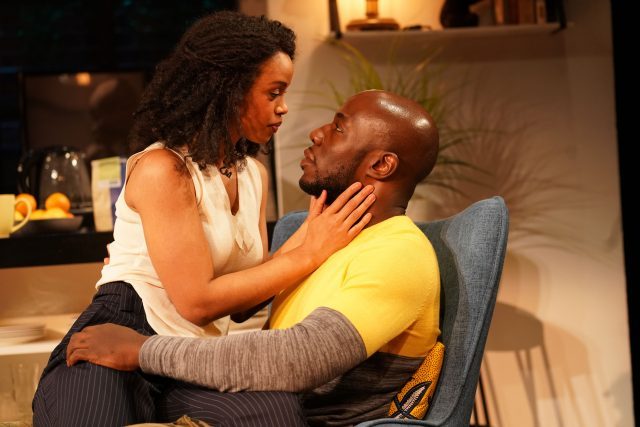
Donja R. Love’s Fireflies is a heartbreaking, eerily relevant drama about bigotry and hate, desire and passion. The second in the Afro-Queer playwright’s trilogy of the black experience in America — Sugar in Our Wounds dealt with slavery, while the forthcoming In the Middle takes place during the Black Lives Matter movement — Fireflies is set in the fall of 1963, at the rise of the civil rights movement. Reverend Charles Emmanuel Grace (Khris Davis) has just given a speech in Birmingham, Alabama, about the four black girls who were killed in the 16th St. Baptist Church bombing. (The preacher’s name, but not the character itself, was inspired by Harlem evangelist Charles Manuel “Sweet Daddy” Grace, who died in 1960.) A big, bold man, Charles comes home to his wife, Olivia Grace (DeWanda Wise), who was just sneaking a smoke. Olivia is deeply troubled by what’s happening in the world, her body suddenly shuddering at certain moments. “You still seeing fire and hearing bombs in your head?” Charles asks, and she answers yes. It’s as if she can feel every tragedy as it happens. Meanwhile, the sky, which hovers in the background throughout the play, behind Arnulfo Maldonaldo’s note-perfect 1960s kitchen set, does indeed often become overcast in a bloodred color. And slowly, what appears to be a beautiful, natural love between husband and wife becomes something else as they talk about having a child and each reveals a dark secret, threatening their supposedly idyllic life.

(photo by Ahron R. Foster)

A bloodred sky hovers over Donja R. Love’s Fireflies at the Atlantic (photo by Ahron R. Foster)

Fireflies features terrific performances from Davis (The Royale, Sweat) and Wise (She’s Gotta Have It, Sunset Baby) as a couple struggling to preserve their family in times of crisis, troubles that Olivia can’t shake. “Last night I had a dream the sky wasn’t on fire anymore,” she says. “The sky was filled with . . . fireflies. . . . So I start to pray. I ask, what does it all mean? And I hear him. I hear God. His voice is real faint. I was struggling to hear Him. But I do. He says, ‘Each firefly is one of my colored kids flying home.’ That scare me even more because it was so many. I would much rather have fire. I’m used to that. I’m used to the bombings, and crosses burning, and all of that. I’m not used to seeing God’s children fly home.” That brief monologue captures the immense fear still felt by so many people of color and minorities, especially in light of the neverending shootings in churches, schools, and synagogues across America in the twenty-first century. Directed by Saheem Ali (Sugar in Our Wounds, Kill Move Paradise), the play, which continues at the Atlantic through November 11, features a final monologue that is far too preachy and melodramatic, laying things out too simply, and the scenes in the porch can be physically awkward and jarring. But throughout it all the blue sky keeps turning red, which it still seems to do more than fifty years later.

EMMA AND MAX

(photo by Joan Marcus)

Upper West Siders Jay (Matt Servitto) and Brooke (Ilana Becker) laugh as they fire their nanny, Britanny (Zonya Love), in Emma and Max (photo by Joan Marcus)

Flea Theater, the Sam
20 Thomas St. between Broadway & Church St.
Wednesday – Monday through November 11, $47-$102
866-811-4111
theflea.org

Eclectic auteur Todd Solondz, the creator of such offbeat, unusual indie films as Welcome to the Dollhouse, Happiness, and Storytelling, doesn’t disappoint with his first play, the dark, acerbic Emma and Max, which has been extended at the Flea through November 11. Solondz reveals the dark underbelly of suburbia in the ninety-minute show, which is wickedly funny and all too real. Wealthy white Upper West Siders Brooke (Ilana Becker) and Jay (Matt Servitto) are attempting to fire their black nanny, Britanny (Zonya Love), who has been taking care of their kids, three-year-old Emma and two-year-old Max (played by Sawyer Manning and Mason Goldstein, respectively, seen only briefly in video and photographs). “The children adore you,” Brooke tells Brittany, who looks at her blond boss stone-faced. “You’re more than we could ever have hoped for. So much more,” Jay adds. Brooke and Jay are acting like it is harder for them to get rid of her than it is for Brittany to get kicked out; they’re terrified of saying anything that can be construed as even the slightest bit politically incorrect. “What I do wrong?” Brittany asks. “Nothing,” Brooke replies, to which Brittany says, “Can’t be nothing. A person don’t get fired for nothing.” When Brooke explains that she is being replaced by an au pair from Holland, Brittany says, “What’s that? A white girl?” A disturbed Brooke answers, “Actually we don’t know her ethnicity. We didn’t ask,” as if a Dutch woman named Famke (Lacy Allen, also seen in video only) could be anything else.

(photo by Joan Marcus)

Brooke (Ilana Becker) and Jay (Matt Servitto) discuss privilege and more in world premiere of Todd Solondz’s first play (photo by Joan Marcus)

Brooke takes an instant liking to Famke but feels guilty that she doesn’t feel guilty over firing Brittany, who spends most of her time in bed listening to Meryl Streep singing “The Winner Takes It All” from Mamma Mia! and not responding to Brooke’s constant phone calls and texts asking her to return her keys to their house. When she’s not at home, Brittany is making the set changes, as if she is a slave still working for Brooke and Jay, who watch her opening and closing doors and pushing and pulling furniture, occasionally making faces at her if they think she is taking too long. It’s an ingenious conceit that extends beyond the narrative world of the play, as if Solondz the director is also abusing Love the actress, who portrays Brittany with a steely, decidedly unglamorous demeanor. (The storage-like set with aluminum-siding-like covering and clever props are designed by Julia Noulin-Mérat.) Brooke and Jay go on vacation in Barbados, where Brittany is from, rubbing yet more salt in the wound without even realizing it. Complaining about certain aspects of her own childhood, Brooke says, “The point is, I know something about what it means to feel marginalized . . . My experience, my pain . . . I wish I’d been born black — then at least I could’ve shared the pain, the injustice of it all.”

(photo by Joan Marcus)

Britanny (Zonya Love) finally gets to share her tragic story in Emma and Max at the Flea (photo by Joan Marcus)

Everything comes full circle as Brittany finally gets to share her own story, telling it to a woman named Padma (Rita Wolf, who also plays flight attendant Mira) who is recording the mostly one-sided conversation. “I believe in things I know and understand and see. I’m not good at make-believe. I’m not invisible,” Brittany explains. “White people see me. Black people see me. White people see my blackness. Black people see my blackness. That’s what they see. But I see water.” The concept of water is essential to Solondz, a New Jersey native who is married and has two young children; images of water are projected by Adam Thompson onto the set as well as forming the entrance to a resort swimming pool. Emma and Max is about how people see and judge one another, but primarily how whites see and judge blacks. Brooke and Jay get flustered by white people’s problems, reveling in their ingrained, unearned white privilege while believing the world owes them everything, from wealth and success to exceptional children and servants. The play is a sharply observant skewering of the status quo in a Trump America that continues to encounter racism, bigotry, and hatred every day and where the term “privilege” has become a dirty word to about half the country. It’s also a place where payback can be a bitch, where there are consequences for physical, psychological, and sexual abuse. It’s not a happy situation, but it’s damn funny and frighteningly realistic, a mirror brilliantly held up to a society in crisis.

KURT VONNEGUT’S HAPPY BIRTHDAY, WANDA JUNE

Wanda June

Penelope (Kate MacCluggage) meets her husband-to-be (Jason O’Connell) in stellar revival of Kurt Vonnegut’s Wanda June

The Duke on 42nd Street
229 West 42nd St. between Seventh & Eighth Aves.
Thursday – Tuesday through November 29, $49-$109
www.wheelhousetheater.org

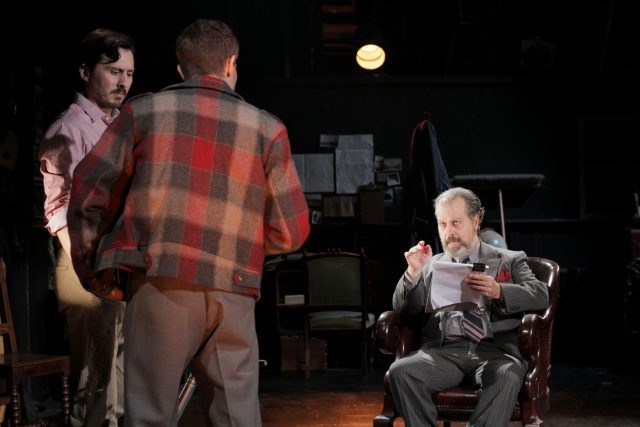
Wheelhouse Theater Company is throwing quite a party eight times a week at the Duke on 42nd St., presenting its wickedly funny, devilishly clever adaptation of Kurt Vonnegut’s first play, Happy Birthday, Wanda June. The glorious production, which (re)opened last night following an earlier sold-out run at the Gene Frankel Theater, is everything a work by Vonnegut should be: surreal, unpredictable, laugh-out-loud hysterical, extraordinarily intelligent, bold, daring, and challenging while taking on such wholly contemporary themes as war, misogyny, racism, capitalism, religion, gun control, animal rights, white privilege, machismo, and feminism. Brittany Vasta’s urban-jungle set immerses the audience in the show from the very beginning, as ticket holders walk down a lobby with fake plants and real prints by Vonnegut, then go through a bamboo curtain to enter the main space, the same entrance the characters use to come in and leave. The walls are covered with animal-head trophies. The doorbells emit animal sounds instead of rings or chimes. “How do you do. My name is Penelope Ryan,” a woman (Kate MacCluggage) says, standing in a line with four male actors. “This is a simple-minded play about men who enjoy killing — and those who don’t.”

The quartet slowly introduces itself: Harold Ryan (Jason O’Connell), a professional soldier and adventurer who is married to Penelope but has been missing for eight years; Dr. Norbert Woodly (Matt Harrington), a peacenik who believes in healing and is in love with Penelope; Col. Looseleaf Harper (Craig Wesley Divino), a pilot who dropped the bomb on Nagasaki and is missing with Harold in the Amazon rainforest; Paul Ryan (Finn Faulconer), Harold and Penelope’s twelve-year-old son, who is hoping his father will show up unexpectedly because it’s the father’s birthday; and Herb Shuttle (Kareem M. Lucas), a vacuum-cleaner salesman who also is in love with Penelope. The wonderfully absurdist story also involves a trio of heavenly ghosts: Mildred (MacCluggage), one of Harold’s previous wives; Major Siegfried von Konigswald (O’Connell), the “Beast of Yugoslavia” who was killed by Harold; and ten-year-old Wanda June (Charlotte Wise or Brie Zimmer), whose name is on Harold’s birthday cake. When Harold and Looseleaf do indeed return, the brutish Harold sniffs around his apartment like an animal come home to roost. He grunts and snorts (like a male chauvinist pig?) and even makes out with one of the trophy heads, reclaiming every inch of his territory. However, while he hasn’t changed much, Penelope has gone through a major transformation, attending college and learning that she can make her own decisions about what she wants out of life — and what she doesn’t. Harold may not consider Norbert and Herb legitimate threats, but he still has to contend with Penelope herself. Meanwhile, he is not the least bit frightened when he finds out that there’s been a series of murders in the park just outside; fear is never on his agenda.

O’Connell is an accomplished actor who has played Bottom, Puck, and Egeus in the Pearl’s A Midsummer Night’s Dream, Mr. Darcy in Primary Stages’ Pride and Prejudice, and Edward and Robert Ferrars in Bedlam’s Sense and Sensibility — the latter two adapted by his wife, Kate Hamill — as well as appearing as himself in the one-man show The Dork Knight, about his lifelong relationship with Batman. He is ferocious in Wanda June, a force of nature who moves across the stage like a caged animal waiting to pounce. He’s like a caveman, a person from another age, unwilling to accept that things have changed dramatically while he was away, that the old-fashioned white man is no longer in charge, but it’s hard not to like him despite his shenanigans. “Hello there, young man,” he says to an empty picture frame that apparently is a photo of him. “In case you’re wondering, I could beat the shit out of you. And any woman choosing between us — sorry, kid, she’d choose me. I must say, this room is very much as I left it.” The furniture and accoutrements might be the same, but nothing else is. As exceptional as O’Connell is as Harold, MacCluggage (The Farnsworth Invention, The 39 Steps) stands her ground, going toe-to-toe and face-to-face with him in an epic battle between old and new, male and female, forward-thinking and backward-living. Oh, and be sure to pay close attention to Christopher Metzger’s costumes, particularly the color of Penelope’s dress late in the second act.

Wanda June

Vacuum-cleaner salesman Herb Shuttle (Kareem M. Lucas) has the hots for Penelope Ryan (Kate MacCluggage) in Wheelhouse revival at the Duke

Homer’s Odyssey meets Eugene O’Neill’s The Hairy Ape by way of Ernest Hemingway in the seldom-revived Happy Birthday, Wanda June, which initially failed in its 1970 Broadway debut (with Kevin McCarthy as Harold, Marsha Mason as Penelope, and William Hickey as Looseleaf) and then the next year in Mark Robson’s big-screen version, with Rod Steiger as Harold, Susannah York as Penelope, and Hickey again as Looseleaf. Director Jeffrey Wise (DANNYKRISDONNAVERONICA), a founding member of Wheelhouse, has a firm grasp of the material, in total control of the chaos, with outstanding support from lighting designer Drew Florida and sound designer Mark Van Hare. It’s pure Vonnegut: a potent look at America — and how much it hasn’t changed in nearly fifty years. “I just have one more thing to say,” Shuttle tells Woodly as they argue about whether fighting is ever necessary, continuing, “If you elect a president, you support him, no matter what he does. That’s the only way you can have a country!” Woodly responds, “It’s the planet that’s in ghastly trouble now.” Happy Birthday, Wanda June is an all-around triumph, one of the best plays of the season, and a sharp reminder of Vonnegut’s immense legacy.

ONE-MAN SHOWS: JOHN KEVIN JONES / AASIF MANDVI / BILL IRWIN

(photo by Joey Stocks)

John Kevin Jones pays tribute to Edgar Allan Poe at historic Merchant’s House Museum (photo by Joey Stocks)

KILLING AN EVENING WITH EDGAR ALLAN POE: MURDER AT THE MERCHANT’S HOUSE
Merchant’s House Museum
29 East Fourth St. between Lafayette St. and the Bowery
October 12-31, $18
212-777-1089
merchantshouse.org
www.summonersensemble.org

Purely by coincidence, I saw three one-man shows this week, on three successive nights, and all three have strong reasons for me to recommend them. On Tuesday, I was at the historic Merchant’s House Museum on East Fourth St. to see John Kevin Jones in Killing an Evening with Edgar Allan Poe: Murder at the Merchant’s House. Jones has a kind of cult fan club for his annual one-man version of A Christmas Carol at the museum, a home built in 1831-32 that was occupied continuously by the Tredwell family from 1835 to 1933. The nineteenth century feels very present in the house, which was one of the first twenty buildings to gain landmark status under the city’s 1965 law and functions as a museum, preserving the Tredwell family’s furnishings as they would have appeared when Poe, coincidentally, lived nearby for a time at 85 West Third St. and later in a cottage in the Bronx. Dressed in nineteenth-century-style jacket, vest, top hat, and ascot, Jones celebrates Edgar Allan Poe with three of his most popular writings, preceded by short introductions about each work and Poe’s career.

Forty people are squeezed into the Tredwells’ candlelit double parlor — with a coffin at one end and a dining table at the other — and Jones walks up and down the narrow space between, where the audience is seated on three sides, boldly delivering two classic Poe tales of treachery and murder, “The Tell-Tale Heart” and “The Cask of Amontillado,” both from memory. His deep, theatrical voice resonates through the room as he catches the eye of audience members, adding yet more chills and thrills to the mystery in the air. He then sits down with a book for the long poem “The Raven,” evoking the great Poe actor Vincent Price. Jones, director Dr. Rhonda Dodd, and stage manager Dan Renkin, the leaders of Summoners Ensemble Theatre, keep the focus on Poe’s remarkable narrative technique; you might be watching one man, but you’ll feel like you’re seeing each of Poe’s characters in vivid detail. The sold-out show continues October 22, 23, and 31; tickets for A Christmas Carol, however, are still available.

Asaaf Mandvi brings back his Obie-winning (photo by Lisa Berg)

Aasif Mandvi brings back his Obie-winning Sakina’s Restaurant to the Minetta Lane (photo by Lisa Berg)

SAKINA’S RESTAURANT
Audible Theater at Minetta Lane Theatre
18 Minetta Lane between Sixth Ave. and MacDougal St.
Tuesday – Sunday through November 11, $57-$97
sakinasrestaurantplay.com

On Wednesday night I headed to the Minetta Lane Theatre, where Audible has been staging one-person shows that are also available as audios. First, Billy Crudup starred in David Cale’s modern noir Harry Clarke, then Carey Mulligan excelled in Dennis Kelly’s intense Girls & Boys, and now Aasif Mandvi has brought back his Obie-winning 1998 show, Sakina’s Restaurant. Born in India and raised in England, Mandvi studied with acting teacher Wynn Handman, whose students have also included solo specialists Eric Bogosian and John Leguizamo. In the slightly revamped autobiographical tale, directed by Kimberly Senior (Disgraced, The Niceties), Mandvi plays six characters, beginning with Agzi, an eager young man who is leaving his small, tight-knit Indian village to go to America, where he will be sponsored by Hakim (his father’s real name) and Farrida, who run Sakina’s Restaurant on, of course, East Sixth St. Before leaving, Agzi promises his mother he will write to her from all across the United States. “I will even write to you from Cleveland! Cleveland, Ma! Home of all the Indians!”

Mandvi (Disgraced, Halal in the Family) creatively slips into each character, adding glasses, a tie, a dress, or a Game Boy to delineate among Hakim, a serious man who wants only the best for his family; Farrida, who desires more out of her mundane life; their high-school-age daughter, Sakina, who has an American boyfriend and wants to immerse herself in Western culture but who has already been promised to an Indian man by their fathers; their younger son, Samir, who doesn’t really care about anything but his immediate enjoyment; Ali, Sakina’s nervous intended in the arranged marriage; and Agzi, who is not having as exciting a time as he imagined in America. Wilson Chin’s set looks just like several Sixth St. Indian restaurants I’ve been to. The story itself occasionally drags and has trouble skirting stereotypes, but Mandvi is superb, warm and likable, particularly when he talks directly to the audience as Agzi, sharing his hopes and dreams.

(photo by Carol Rosegg)

Bill Irwin shares his love of all things Samuel Beckett at the Irish Rep (photo by Carol Rosegg)

ON BECKETT
Irish Repertory Theatre
Francis J. Greenburger Mainstage
132 West 22nd St. between Sixth & Seventh Aves.
Tuesday – Sunday through November 4, $50-$70
212-727-2737
irishrep.org

On Thursday night I was at the Irish Rep to see On Beckett, Bill Irwin’s very personal exploration of the work of Samuel Beckett and, in many ways, a combination of the two previous one-man shows I saw, evoking John Kevin Jones’s mastery of Edgar Allan Poe’s texts and Aasif Mandvi’s expert handling of multiple characters. For eighty-seven minutes, Tony-winning actor and certified clown Irwin delves into his vast enthusiasm for Beckett’s writings without ever becoming professorial or pedantic. “I am not a ‘Beckett scholar’ — nooo. Nor am I a Beckett biographer,” he admits. “Mine is an actor’s relationship with this language. By which I mean the deep knowledge that comes from committing words to memory, and speaking them to audiences.” Irwin (Old Hats, Who’s Afraid of Virginia Woolf?) performs selections from Beckett’s 1955 collection Texts for Nothing, his 1950s novels The Unnamable and Watt, and the Irish writer’s most famous play, Waiting for Godot, significantly altering his delivery style, voice, and rhythm for each work.

Irwin adds fascinating insight to Beckett and his oeuvre, discussing the Nobel Prize winner’s punctuation and pronoun usage, his identity and heritage, the possible influence of vaudeville on his work, his detailed stage directions, and other intricacies. “Was Beckett a writer of the body, or of the intellect?” Irwin asks. “Smells like a question you could waste a lot of time on, but I think you can say that he was a writer acutely attuned to silhouette.” His appreciation of Beckett echoes that of Jones’s for Poe, while his simple but effective costume changes — switching among numerous bowlers, putting on baggy pants and clown shoes — work like Mandvi’s to distinguish individuals. Irwin spends a significant part of the show on Waiting for Godot, discussing the correct pronunciation of the title character’s name, examining the role of Lucky, and reminiscing about the production he appeared in with Robin Williams, John Goodman, Steve Martin, and Nathan Lane. Charlie Corcoran’s spare black set consists only of a podium and two rectangular boxes that Irwin can rearrange for various purposes. Irwin is a delight to watch, his passion for Beckett infectious. He occasionally goes off topic in comic ways, wrestling with a microphone and toying with the podium, but he eventually gets back on track for an enchanting piece of theater about theater.

The following evening, my string of one-man shows came to an end with the Wheelhouse Theater’s new adaptation of Kurt Vonnegut’s Happy Birthday, Wanda June, opening Tuesday at the Duke. Bringing the theme full circle, Wanda June features a ferocious performance by Jason O’Connell, whom I saw last year in his own solo outing, The Dork Knight, about his lifelong affinity for Batman.

PRETTY WOMAN: THE MUSICAL

(photo by Matthew Murphy 2018)

Andy Karl and Samantha Barks have some pretty big shoes to fill in Pretty Woman (photo by Matthew Murphy 2018)

Nederlander Theatre
208 West 41st St. between Seventh & Eighth Aves.
Tuesday – Sunday through June 8, $99-$275
877-250-2929
prettywomanthemusical.com

The very enjoyable Broadway musical adaptation of Garry Marshall’s 1990 Cinderella story, Pretty Woman, is more about finding one’s place in the world, both geographically and psychologically, than merely the tale of a hooker with a heart of gold finding her Prince Charming. And speaking of place, Samantha Barks, who plays Vivian, the role that made Julia Roberts a star in the movie, has found where she belongs, center stage on Broadway, delivering an inspiring, Tony-worthy performance. The story is fairly straightforward: Vivian Ward (Barks), a broke prostitute, meets a wealthy financier, Edward Lewis (Andy Karl taking on the Richard Gere part), who treats her to the high life in order to pull off a major deal. As their public deception proceeds, both wonder whether something more is going on as they each search for somewhere to call home. (She lives in a walk-up rat trap, while he resides in a posh hotel.) “Tell me, what’s your dream? / I know you’ve got one / It’s like a map to your life / You’ll be lost until you’ve caught one,” sings a shabbily dressed Happy Man (Eric Anderson) on the seedier side of Hollywood Blvd., where he offers free maps to help people find their way.

(photo by Matthew Murphy 2018)

Eric Anderson does double duty as the Happy Man and Mr. Thompson in Broadway adaptation of hit movie (photo by Matthew Murphy 2018)

“Don’t you want to get out of here?” Vivian asks her friend, fellow prostitute Kit De Luca (Orfeh, Karl’s real-life wife), who replies, “Get out of where? Where do you want to go?” A moment later Vivian sings, “I look around and what I see / Is I don’t belong here, this isn’t me. . . . I know where I’d choose to go / If I could disappear / Anywhere but here / Anywhere but here.” When Vivian meets Edward, he has taken a few wrong turns and does not know how to get back to his hotel. She asks him to pay ten dollars for her help and he says, “You can’t charge me for directions.” She smartly replies, “I can do anything I want to, baby. I ain’t lost.” But of course, they both are lost. “I can take you anywhere / ’Cause anything’s possible,” the Happy Man says as he dramatically changes into a regal concierge outfit and the set transforms into the exclusive Beverly Wilshire Hotel, where Edward lives on the top floor, even though he’s afraid of heights. Edward is working with his shifty lawyer, Phillip Stuckey (Jason Danieley), attempting a hostile takeover of a ship-building company owned by James Morse (Kingsley Leggs); it’s no accident that Edward has no real care for the business itself, which specializes in making vessels that take people to other places primarily for pleasure. As Vivian blossoms à la Eliza Doolittle, she and Edward grow very close, but they have a deal with an end date; at the start they were both in it for the money, but soon they’re thinking about the future in a different way.

(photo by Matthew Murphy 2018)

Samantha Barks busts out in rip-roaring performance in Pretty Woman (photo by Matthew Murphy 2018)

One of my regular theater companions refused to join me, concerned that the show would be offensive, that it would celebrate outdated, antifeminist views about women as decorative possessions, to the point that a woman realizes survival means selling herself — and her love — like a product. But the book, by Garry Marshall and the film’s screenwriter, J. F. Lawton, and the music and lyrics, by Bryan Adams (yes, the Canadian pop star) and Jim Vallance, often put Vivian in charge, or at least have her and Edward on equal footing, although it occasionally teeters on the edge. “Don’t want this feelin’ to go away / When I think about where I was yesterday / It’s so amazing — I can’t believe / That a billionaire would care about a girl like me / I’ve got money to spend / I’ve got champagne on ice / There’s a smile on my face / I’m getting’ treated real nice,” she sings like a classic golddigger before reevaluating what she wants out of life. Barks (Les Misérables, Chicago) and three-time Tony nominee Karl (Groundhog Day, Rocky) have an instant chemistry together, with solid support from Tony nominee Orfeh (Legally Blonde, Footloose) and Anderson (Waitress, Kinky Boots), who nearly steals the show as both the Happy Man and Mr. Thompson. (Keep a watch out for Tommy Bracco, who purloins some moments of his own as Giulio, the hotel bellman.) David Rockwell’s set design rockets between wealth and poverty, while Gregg Barnes’s costumes, particularly for Barks, are fab. Gleefully directed and choreographed by Tony winner Jerry Mitchell (Kinky Boots, Legally Blonde), Pretty Woman turns out to be a rather pleasant surprise — led by a breakout performance by Barks.

ME & MR. JONES: MY INTIMATE RELATIONSHIP WITH DAVID BOWIE

Raquel Cion brings her deeply personal David Bowie tribute to Pangea on May 11 & 12 (photo by Jody Christopherson)

Raquel Cion continues her fall residency at Pangea in October and November (photo by Jody Christopherson)

Pangea NYC
178 Second Ave. between Eleventh & Twelfth Sts.
Friday, October 19, and Saturday, October 20, $20 in advance, $25 at the door, $20 food/beverage minimum, 9:30
Friday, November 16, and Saturday, November 17, $20 in advance, $25 at the door, $20 food/beverage minimum, 9:30
212-995-0900
www.meandmrjonesshow.com
www.pangeanyc.com

In a November 2015 twi-ny talk, Raquel Cion said, “Isn’t it great to be amidst a flurry of Bowie activity?” referring to Bowie’s sudden resurgence with an off-Broadway musical, new album, and various other new songs. “Oh, I have so much to say,” she added. Cion continues to have much to say as the show keeps evolving, especially following Bowie’s death in January 2016 at the age of sixty-nine; the massive success of the immensely popular “David Bowie is” exhibition at the Brooklyn Museum, for which you need to get timed tickets in advance; and Cion’s own battle with breast cancer, which she bravely documented on social media.

In Me & Mr. Jones: My Intimate Relationship with David Bowie, librarian and chanteuse Cion reflects on her life through her worship of Bowie — who was born David Jones — singing Bowie songs and sharing deeply personal anecdotes that are both moving and funny. She is not a Bowie impersonator; she interprets Bowie’s extraordinary music with intelligence, verve, and love. She continues the fall residency of her glittery multimedia performance, which was nominated for a 2015 New York Cabaret Award for Best Musical Comedy or Alt Cabaret Show, at Pangea October 19-20 and November 16-17, joined by Jeremy Bass on guitar, Daniel Shuman on bass, Michael Ryan Morales on drums, and music director Karl Saint Lucy on piano. If you’ve seen it before, Cion is promising significant ch-ch-ch-changes for this iteration. The show is directed by Cynthia Cahill, and Cion’s glam outfits are by David Quinn. Tickets are $20 in advance and $25 at the door, with a $20 food and beverage minimum.