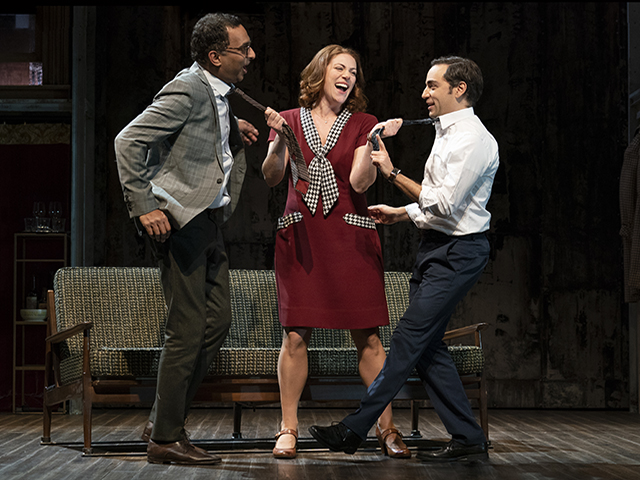
this week in theater

BERNHARDT/HAMLET

Janet McTeer stars as Sarah Bernhardt in new play by Theresa Rebeck (photo by Joan Marcus)

American Airlines Theatre
227 West 42nd St. between Broadway & Eighth Ave.
Tuesday – Sunday through November 18, $59-$159
212-719-1300
www.roundabouttheatre.org

When turn-of-the-twentieth-century theater superstar Sarah Bernhardt played the Melancholy Dane in Hamlet at the Adelphi in London, actress and writer Elizabeth Robins wrote in her December 1900 review: “Madame Bernhardt’s assumption of masculinity is so cleverly carried out that one loses sight of Hamlet in one’s admiration for the tour de force of the actress. This is not to say that she gives us a man, but rather Sarah Bernhardt playing, with amazing skill, a spirited boy; doing it with an impetuosity, a youthfulness, almost childish.” Much the same can be said of Tony-winning actress Janet McTeer, who plays Bernhardt playing Hamlet in Theresa Rebeck’s uneven though often exciting Bernhardt/Hamlet, a celebration not only of Bernhardt but of the collaborative process of theater. The Roundabout production, continuing at the American Airlines Theatre through November 18, is set in 1897 Paris, where Bernhardt has decided to play the male part and is rehearsing with Constant Coquelin (Dylan Baker), François (Triney Sandoval), Raoul (Aaron Costa Ganis), and Lysette (Brittany Bradford). Bernhardt’s lover, the married Edmond Rostand (Jason Butler Harner), is not fond of her decision. “You want to be a man,” he tells her. “I do not want to be a man,” she replies. “You crave a man’s power,” he accuses her. “No man has more power than I do,” she says. “Shakespeare does,” he retorts. But she has the last word, proclaiming, “I will not go back to playing flowers for you fools. Not because I am too old. But because I was never a flower, and no matter how much you loved how beautifully I might play the ingenue, it was always beneath me. It is beneath all women.”

(photo by Joan Marcus)

Edmond Rostand (Jason Butler Harner) watches Constant Coquelin (Dylan Baker) perform in Bernhardt/Hamlet at the American Airlines Theatre (photo by Joan Marcus)

Bernhardt demands that Rostand rewrite Hamlet specifically for her, but soon he is working on another play, Cyrano de Bergerac, which also gets her juices flowing. The same cannot be said for Rostand’s rightly jealous wife, Rosamond (Ito Aghayere); Bernhardt’s teenage son, Maurice (Nick Westrate); and acerbic critic Louis (Tony Carlin), wielding his poisoned pen with undeserved power. Meanwhile, Czech artist Alphonse Mucha (Matthew Saldivar) hovers around, creating the poster for the controversial show; in Shakespeare’s time, men might have played all the parts, but in the late Victorian/Edwardian era, a woman portraying the title character in the Bard’s greatest work is practically theater — and gender — treason. “And now we come to your tragedy,” Edmond says to Sarah, who responds, “I am not a tragic figure.” Edmond explains, “You are Sarah Bernhardt. But Sarah Bernhardt is a woman. And people do not want to see a woman play Hamlet.” To which Sarah argues, “I do not play him as a woman! I play him as myself.

Directed by Moritz von Stuelpnagel (Present Laughter, Hand to God), Bernhardt/Hamlet works best when it sticks to its title, when McTeer plays Sarah Bernhardt playing Hamlet. A lot of the rest is detritus that only gets in the way. McTeer (Mary Stuart, God of Carnage) is a joy to watch as her character, complete with crazy hairstyle, questions Hamlet’s motives as well as Shakespeare’s, romping around Beowulf Borrit’s handsome sets, which include an outdoor Paris café, the Adelphi stage, and Bernhardt’s elegant dressing room. Rebeck’s (Seminar, Downstairs) plot meanders; it feels like she tries to squeeze too much in and doesn’t trust that the audience will get the shock factor of Bernhardt’s ambition, especially in this modern era in which so much casting is gender (and race) blind. For example, in 2016, McTeer starred as Petruchio in Phyllida Lloyd’s all-female adaptation of The Taming of the Shrew at the Delacorte. But then McTeer proclaims, “Oh what a rogue and peasant slave am I! / Is it not monstrous that this player here, / But in a fiction, in a dream of passion, / Could force his soul,” and all is right again.

ENCORE ENGAGEMENT: SCHOOL GIRLS; OR, THE AFRICAN MEAN GIRLS PLAY

(photo by Joan Marcus)

MCC’s School Girls; or, the African Mean Girls Play is back for an encore run at the Lucille Lortel (photo by Joan Marcus)

MCC Theater at the Lucille Lortel Theatre
121 Christopher St. between Bleecker & Hudson Sts.
Tuesday – Sunday through December 9, $49-$115
212-352-3101
mcctheater.org

Following its initial run last fall, MCC’s School Girls; or, the African Mean Girls Play, which earned a Drama Desk Award for Best Ensemble, is back at the Lucille Lortel Theatre for an encore engagement running through December 9. Below is an update of twi-ny’s original review from November 2017, with the new dates and actors added.

Actress Jocelyn Bioh’s professional playwriting debut is a sharp, uproarious tale of a clique of young boarding school students in central Ghana who can be as nasty as they wanna be, able to go toe-to-toe with Cady, Regina, Gretchen, Janis, and Karen from Mark Waters’s 2004 hit movie, Mean Girls. Bioh, who has appeared in such plays as Suzan-Lori Parks’s In the Blood, Branden Jacobs-Jenkins’s Everybody and An Octoroon, and Jaclyn Backhaus’s Men on Boats, even references the film, which was written by Tina Fey (and the musical adaptation of which has been extended on Broadway through July 7), in the title of her show, School Girls; or, the African Mean Girls Play, which is back for an encore engagement at the Lucille Lortel through December 9. It’s 1986, and the students at Aburi Girls Boarding School are getting ready to audition for the Miss Ghana beauty pageant. Paulina Sarpong (MaameYaa Boafo) is the egotistical, narcissistic leader of a group of girls, willing to say or do just about anything to remain in charge. She brags about her soccer-playing boyfriend and how she is a shoo-in to be named Miss Ghana while brazenly putting down the rest of her crew, which consists of the tall, bright Ama (originally Níkẹ Kadri, now Latoya Edwards), the innocent, overweight Nana (Abena Mensah-Bonsu), and the twinlike duo of Gifty (Paige Gilbert) and Mercy (Mirirai Sithole). The power dynamic immediately shifts when headmistress Francis (Myra Lucretia Taylor) introduces a new student, Ericka Boafo (previously Nabiyah Be, now Joanna A. Jones), a beautiful, talented, and bold young woman who quickly challenges Paulina’s authority. Of course, putting Paulina on the defensive is not something you want to do, unless you’re ready for the barrage that will follow. So when Miss Ghana 1966, Eloise Amponsah (originated by Zainab Jah, now Zenzi Williams), whom Francis knows all too well, arrives to select one of the girls to compete in the pageant, the gloves are off and sides are chosen in a no-holds-barred battle for supremacy. “Headmistress likes to make everyone feel like they have a fair chance,” Paulina declares, “but we all know I’m the best.”

School Girls; or, the African Mean Girls Play was inspired by the true story of Yayra Erica Nego, the 2009 Miss Minnesota who went on to be named Miss Ghana 2011, a controversial decision for several reasons, including her fair skin, as well as by Rosalind Wiseman’s nonfiction book Queen Bees and Wannabes. In the seventy-five-minute play, Bioh, a first-generation Ghanaian American who went to boarding school in Hershey, Pennsylvania, explores such issues as body image and colorism, beauty and friendship, and race and class in this microcosmic Lord of the Flies scenario. Arnulfo Maldonado’s scenic design is simple but effective, a few tables in the school cafeteria, while Dede M. Ayite’s costumes change from the standard green-and-white school uniform to fancy dresses for the competition, giving each character a moment to shine. Tony-winning director Rebecca Taichman (Indecent, Familiar) keeps it all in check, never letting things get out of hand or become too clichéd. School Girls; or, the African Mean Girls Play is no mere African American version of Mean Girls; instead, it is as smart and entertaining, as sweet and honest, its characters as obnoxious and horrible and lovable and vulnerable, as teen girls themselves. The encore engagement will feature a series of special postshow events, including audience conversations on November 14 and 18 and a talkback on November 19.

THE THANKSGIVING PLAY

(photo by Joan Marcus)

Greg Keller, Jennifer Bareilles, Jeffrey Bean, and Margo Seibert star in The Thanksgiving Play at Playwrights Horizon (photo by Joan Marcus)

Playwrights Horizons
Peter Jay Sharp Theater
416 West 42nd St. between Ninth & Tenth Aves.
Tuesday – Sunday through December 2, $49-$89
www.playwrightshorizons.org

I am not a fan of Thanksgiving. But I am a fan of Larissa FastHorse’s extremely funny and spot-on The Thanksgiving Play, which opened last night at Playwrights Horizons. Not to sound holier than thou, but I’ve long given up stuffing my face with turkey and watching football while celebrating genocide on the fourth Thursday of November; my pescatarian wife and I try very hard to leave the country every Thanksgiving weekend just to avoid it all — and to not have to choose whose family we will be going to each year. But you don’t have to love or hate the holiday to get a huge kick out of the show. After years of being told that her plays were uncastable because theaters had no access to Native American actors, Sicangu Lakota playwright FastHorse came up with the rather simply titled The Thanksgiving Play, a wild and woolly farce that takes on important indigenous issues — in real life and on the stage — while featuring four characters played by white-presenting performers. The festivities begin with a preamble, as three members of the cast (Jennifer Bareilles, Margo Seibert, and Greg Keller), dressed in pilgrim costumes, and the fourth (Jeffrey Bean), in a giant, silly turkey outfit, stand in front of the curtain and sing “On the First Day of Thanksgiving” (sample verse: “On the third day of Thanksgiving the natives gave to me / three Native headdresses, two turkey gobblers, and a pumpkin in a pumpkin patch”). At the end of the song, the turkey explains, “Teacher’s note: This song can do more than teach counting. I divide my students into Indians and pilgrims so the Indians can practice sharing.”

(photo by Joan Marcus)

Logan (Jennifer Bareilles) and Jaxton (Greg Keller) have a slight disagreement as they collaborate on school play about first Turkey Day (photo by Joan Marcus)

Ridiculously PC drama teacher Logan (Bareilles) is starting rehearsals for the annual school Thanksgiving play, which will star her boyfriend, Jaxton (Keller), a yoga practitioner and street performer; Caden (Bean), an elementary school history teacher and amateur actor and writer; and Alicia (Seibert), an ambitious, if not very bright, LA actress whose resume contains numerous Disney roles at theme parks and the like. Logan wants to make a devised piece about the first Thanksgiving, with all four of them participating in the show’s development. While Caden seeks to delve deep, deep, deep into the history of Thanksgiving and Alicia is looking forward to a lovely story with all the trimmings, Logan and Jaxton are absurdly careful about each word, each prop (the costumes and puppets are by Tilly Grimes), each plot point. “We start with this pile of jagged facts and misguided governmental policies and historical stereotypes about race, then turn all that into something beautiful and dramatic and educational for the kids,” Jaxton explains. Meanwhile, Logan, who is worried that she will lose her job if the play goes wrong, calls Thanksgiving “the holiday of death.” Logan and Jaxton keep painting themselves into a corner as they reject characters, dialogue, costumes, and situations that they believe are racist, ethnocentric, stereotypical, and/or insulting to indigenous peoples, especially since their play is being written and performed without any input at all from Native Americans. And the further into the corner they recede, the more unlikely it is they will ever be able to accomplish anything.

(photo by Joan Marcus)

Caden (Jeffrey Bean) has trouble keeping his eyes off Alicia (Margo Seibert) in sociopolitical farce by Larissa FastHorse (photo by Joan Marcus)

Director Moritz von Stuelpnagel (Hand to God, Present Laughter) lets Bareilles, Bean, Seibert, and Keller run rampant on Wilson Chin’s schoolroom set, which includes posters of student productions of some rather adult shows. The farce gets out of hand at times, working better when it stays more grounded, since it is easy to believe that there are people like this who are so politically correct that they trap themselves in inaction and an innate inability to say anything, unaware of how to actually be an ally. One of the main reasons why The Thanksgiving Play, which runs until the day after the holiday [ed. note: it has now been extended through December 2], works so well, despite the occasional bumpiness, is because we recognize parts of ourselves in the four characters; of course, off-Broadway audiences tend to be significantly liberal — and often privileged — terrified of uttering or doing the wrong thing when it comes to people of color yet rather clueless about their own giant blind spots. Thus, there are moments in the show when you are likely to hesitate before laughing, wondering whether you are being insensitive by enjoying yourself too much.

FastHorse, a former television writer and ballet dancer, has dedicated her playwrighting career to establishing an authentic indigenous voice in American theater, as seen in such previous shows as Cherokee Family Reunion, Urban Rez, and What Would Crazy Horse Do? But she has met significant resistance; even her casting note for The Thanksgiving Play is controversial: “[People of color] who can pass as white should be considered for all characters.” She is attempting to level the playing field by increasing diversity and pushing an own-voices sensibility. The Thanksgiving Play, in which all participants, cast and crew, are new to Playwrights Horizons, is a big step in that direction. Be sure to get to the theater early so you can check out the exhibition on the third floor, a collection of works curated by Emily Johnson, who is of Yup’ik descent, from Johnson and Maggie Thompson’s “Then a Cunning Voice and a Night We Spend Gazing at Stars” quilts and Shan Goshorn’s “The Value of Integrity” container to Maria Hupfield’s “Solidarity Acknowledgment Banner” and “Plays to Be: all the plays by Indigenous playwrights not yet produced and/or not yet written,” such as A Rez’n in the Sun, Lasting of the Mohegans, Six Degrees of Blood Quantum, and Who’s Afraid of Virginia Colony? Even the bathrooms are involved, displaying such quotes as this one from Winona LaDuke in 2017: “It is possible to have an entire worldview that does not relate to empire.” Happy Turkey Day, everyone!

HUNTER THEATER PROJECT: UNCLE VANYA

(photo by Joan Marcus)

Uncle Vanya is presented in new streamlined adaptation at Hunter’s Kaye Theater (photo by Joan Marcus)

The Kaye Theater, Hunter College
East 68th St. between Lexington & Park Aves.
Tuesday – Sunday through November 18, $37 ($15 for students)
www.huntertheaterproject.org

Tony- and Obie-winning playwright Richard Nelson gives Anton Chekhov’s Uncle Vanya the Apple and Gabriel family treatment in the inaugural production from Gregory Mosher’s Hunter Theater Project, which has been extended several times at the Kaye Theater at Hunter College, now running through November 18. In such plays as That Hopey Changey Thing and Sweet and Sad about the Apples and Hungry and Women of a Certain Age about the Gabriels, writer-director Nelson tells family stories often centered around important events, taking place in the kitchen as everyone comes together to eat. This new adaptation of Chekhov’s 1898 play, translated by Nelson with Richard Pevear and Larissa Volokhonsky, is set in the kitchen of the Serebryakóv country estate. As the audience enters the small theater, where they sit on all four sides, chairs and tables are piled at the center of Jason Ardizzone-West’s intimate set. The characters enter and, before speaking, arrange the room; it’s almost as if we’re sitting with them as food is served and the plot unfolds. Ványa (Jay O. Sanders), who manages the estate, is preparing for the visit of elderly professor Alexánder Serebryakóv (Jon DeVries) and his much younger wife, Eléna (Celeste Arias). A soft-spoken man, Ványa has feelings for Eléna, as does Mikhaíl Ástrov (Jesse Pennington), a local doctor. Sónya Alexándrovna (Yvonne Woods), the professor’s daughter by a previous marriage, assists Ványa; she is interested in the doctor, who is taken with Eléna. The household is run by Sónya’s former nanny, Marína (Kate Kearney-Patch), who is watched over by Sónya’s grandmother, Márya (Alice Cannon), Ványa’s mother. They calmly discuss life and beauty, love and happiness as well as finances, which are not in good shape. And then it all explodes.

(photo by Joan Marcus)

Mikhaíl Ástrov (Jesse Pennington) and Ványa (Jay O. Sanders) share a passion in Chekhov classic (photo by Joan Marcus)

Shakespeare in the Park regular Sanders (The Sinner, Unexplored Interior), one of New York’s finest character actors and who played Richard Apple and George Gabriel in Nelson’s family plays, is a hulking, heartfelt, forthright, and decidedly American Vanya in this tender production; a bear of a man, he gently waits for his moment to erupt in a classic role previously played by such British royalty as Michael Redgrave, Ralph Richardson, Nicol Williamson, Tom Courtenay, Derek Jacobi, and Anthony Hopkins. And when he does finally let it out, his fury is something we can all identify with, the rage and anger we keep buried inside, desperate to release. Woods (Goodnight Children Everywhere, Franny’s Way) portrays Sónya with a haunting sadness, while Arias, who played Masha in Jaclyn Backhaus’s The Three Seagulls, or MASHAMASHAMASHA!, is a sweet-natured Eléna, who is not looking to stir up gossip or hurt anyone. The translation is direct and straightforward, streamlined to 110 minutes without intermission. Time and place are not essential here; Nelson instead focuses on the characters and the relationships, keeping it all right on point. With Uncle Vanya, the egalitarian Hunter Theater Project has gotten off to quite a start: There are no membership programs or VIP access; all tickets are $15 for students and $37 for everyone else. And don’t be misled by the affiliation with the college; the project is a fully professional venture, with students working the front of the house and ushering.

THE NAP

(photo by Joan Marcus)

Dylan Spokes (Ben Schnetzer) is none too happy with what his mother (Johanna Day) has gotten him into in The Nap (photo by Joan Marcus)

Manhattan Theatre Club at the Samuel J. Friedman Theatre
261 West 47th St. between Broadway & Eighth Aves.
Tuesday – Sunday through November 11, $79-$199
thenapbroadway.com

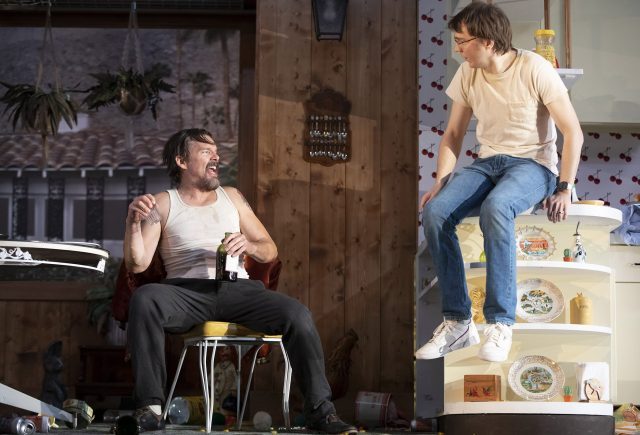
You don’t have to know the slightest bit about snooker to have a jolly good time at The Nap, the rousing London transfer making its American premiere at Manhattan Theatre Club’s Samuel J. Friedman Theatre through November 11. Written by Olivier Award nominee Richard Bean, who wrote the uproarious hit One Man, Two Guvnors, which exploded the career of a young James Corden, The Nap is a tense and very funny crime thriller built around the highly contested world of snooker, the nineteenth-century cue sport similar to pocket billiards and pool. Twenty-three-year-old Dylan Spokes (Ben Schnetzer) is on the rise, preparing for a big-time match. He’s practicing in the British Legion basement in Sheffield with his grumpy, not-too-bright father, the numbers-challenged and ersatz snooker historian Bobby (John Ellison Conlee). Dylan is an easygoing fellow who believes in self-actualization. “It’s the highest possible state of human happiness, when your mind and body come together in, like, a beautiful symphony,” he tells his father, a former amateur snooker player who doesn’t get it at all, responding, “Do you want an orange? Got a bag full.” They are unexpectedly visited by Mohammad Butt (Bhavesh Patel), who identifies himself as an integrity officer for the International Centre for Sport Security, and Eleanor Lavery (Heather Lind), of the National Crime Agency.

(photo by Joan Marcus)

Dylan Spokes (Ben Schnetzer) gets a little too cozy with crime investigator Eleanor Lavery (Heather Lind) in Richard Bean’s The Nap (photo by Joan Marcus)

They claim that Dylan is involved in match fixing and global illegal betting, a charge he adamantly denies. “I am not vulnerable. I honour my game,” he declares. “Snooker is the result of a century of human negotiation. A celebration of cooperation and civilisation. It doesn’t exist other than in the hearts of players and fans.” After Mo and Eleanor leave, Dylan and Bobby are first joined by Dylan’s oh-so-stylish, fast-talking manager, Tony DanLino (Max Gordon Moore), then by Dylan’s wacky mother, Stella (Johanna Day), and her new boyfriend, Danny Killeen (Thomas Jay Ryan), a boring driving instructor. It turns out that Stella, Bobby’s ex, needs money, and she wants Dylan to get it for her — by going against his principles and throwing a frame. It turns out that Dylan has financial issues he wasn’t aware of; he’s in deeper than he ever realized, and the only way out is to listen to transgender gangster Waxy Bush (Alexandra Billings), who has a way with words. “Dylan, let me give you some advice,” she says. “Life, for us vertebrates, is a series of disappointments and appointments. The key to happiness is to forget your disappointments and remember your appointments; in fact, write them down, preferably in a dairy.” As Dylan’s matches with Abdul Fattah and Baghawi Quereshi (both played by former snooker champion Ahmed Aly Elsayed) approach, he has to decide where his loyalties lie and what he is willing to risk, and for whom.

(photo by Joan Marcus)

The Nap features a pair of very tense, live snooker matches with champion Ahmed Aly Elsayed (photo by Joan Marcus)

The title of the show is a snooker term referring to the smoothness of the table, which Dylan explains to Eleanor early on. “Playing with the nap, the ball will run straight with the natural line,” he says. “Playing against the nap, the ball can deviate and drift off line. I play straight. I honour the god of snooker, and he, or let’s be fair, she, looks after me.” Bean (The Heretic, Harvest) and Tony-winning director Daniel Sullivan (The Little Foxes, Proof) honour the god of the stage in this triumphant comedy while not being afraid to deviate and drift off line. Snooker might be an individual sport, but theater requires significant collaboration, and The Nap demonstrates that in all facets. The ensemble, which also includes Ethan Hova as Seth and a snooker referee, is terrific, with a particular shout-out to American actor Ryan (Dance Nation, The Amateurs), one of the city’s most underrated and understated treasures. David Rockwell’s sets rotate from the dank legion basement to a historic hotel room, from a country hideout to a championship snooker match, complete with riotously funny voice-over commentary that is partially improvised. The snooker matches themselves are tense and exciting, occurring live onstage. But once again, it doesn’t matter what you think about sports and gambling, as Bean has plenty to say about dysfunctional families, straight and LGBTQ romance, the criminal element, and vegetarianism. The Nap is a champion on all counts, clearing the table, knocking every ball into the right pocket.

TICKET GIVEAWAY — KENNEDY: BOBBY’S LAST CRUSADE

David Arrow plays Bobby Kennedy in one-man show he also wrote (photo by Russ Rowland)

David Arrow plays Bobby Kennedy in one-man show he also wrote (photo by Russ Rowland)

KENNEDY: BOBBY’S LAST CRUSADE
Theatre at St. Clement’s
423 West 46th St. between Ninth & Tenth Aves.
Wednesday – Sunday through December 9, $55-$85 (use code KNDYGEN for discount)
866-811-4111
www.kennedybobbyslastcrusade.com
www.stclementsnyc.org

On June 6, 1968, Robert F. Kennedy was assassinated by Sirhan Sirhan at the Ambassador Hotel in Los Angeles during a presidential campaign stop. This month Bobby, the former US attorney general and, at the time of his death, New York senator, would have turned ninety-three. The new one-man show Kennedy: Bobby’s Last Crusade honors the legacy of the man known as RFK upon the fiftieth anniversary of his murder. The world premiere at the Theatre at St. Clement’s was written by and stars David Arrow as Kennedy; “The Kennedys are a political dynasty and have had a lasting effect on America, and fifty years later the words of Bobby Kennedy need to be repeated so that we as Americans can remember that politics used to be about ideas and ideals, not about us versus them,” Arrow notes in a statement. The story focuses on Kennedy’s 1968 presidential campaign and is drawn from his public speeches and lesser-known private events; Arrow previously portrayed Kennedy in Jack Holmes’s solo show RFK, winning the San Francisco Bay Area Theatre Critics Circle Award for his performance, topping Anna Deavere Smith, Steven Abbott, and Geoff Sobelle. The play is directed by Eric Nightengale, with set design by Jim Morgan and lighting by Miriam Crowe.

TICKET GIVEAWAY: Kennedy: Bobby’s Last Crusade runs through December 9 (with a November 8 opening) at the Theatre at St. Clement’s, and twi-ny has three pairs of tickets to give away for free. Just send your name, daytime phone number, and favorite play involving a real-life politician to contest@twi-ny.com by Wednesday, November 7, at 3:00 pm to be eligible. All entrants must be twenty-one years of age or older; three winners will be selected at random.

WHITE LIGHT FESTIVAL: WAITING FOR GODOT

(photo by Matthew Thompson)

Druid’s Waiting for Godot shows up at Lincoln Center November 2-13 (photo by Matthew Thompson)

WAITING FOR GODOT
Gerald W. Lynch Theater at John Jay College
November 2-13, $55-$95
www.lincolncenter.org
www.druid.ie

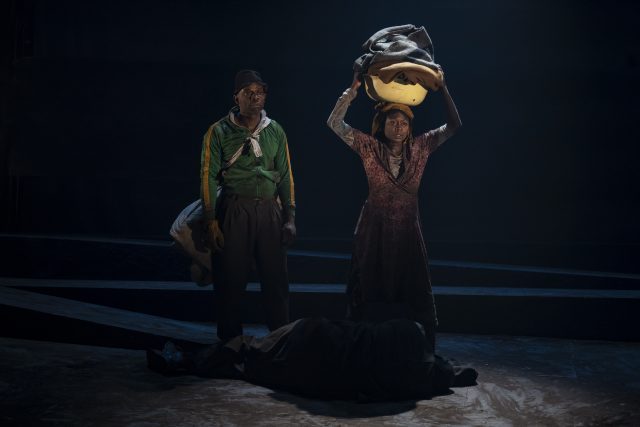
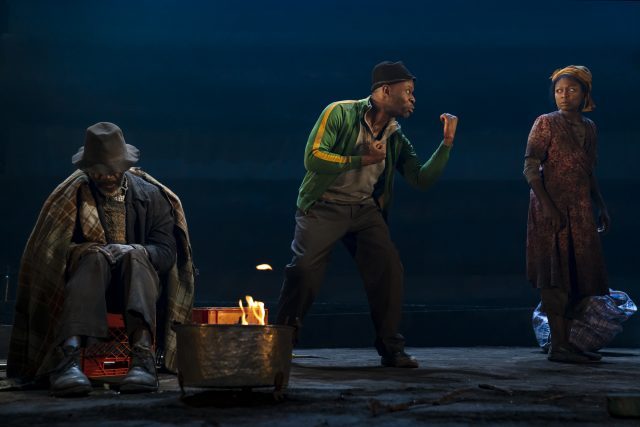
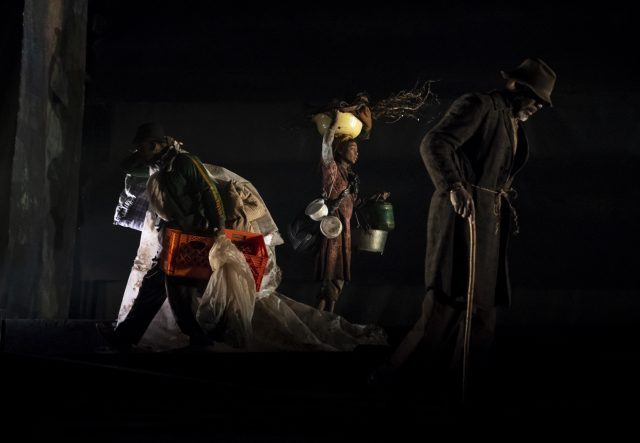
In his delightful one-man show On Beckett at the Irish Rep, Bill Irwin spends a significant portion of time discussing Samuel Beckett’s most famous play, Waiting for Godot, including delving into the correct pronunciation of “Godot.” In addition to GOD-oh and guh-DOH, Irwin brings up a third version, suggested to him by Irish Rep producing director Ciaran O’Reilly: godjo. From November 2 to 13, you can see how Ireland’s Druid theater company says the name when its widely hailed slapstick version of Waiting for Godot is presented at the Gerald W. Lynch Theater at John Jay College as part of Lincoln Center’s annual White Light Festival. (The Druid was last at Lincoln Center with DruidShakespeare in 2015, an epic work that brings together Richard II, both parts of Henry IV, and Henry V.) The comic reimagining features Garrett Lombard as Lucky, Aaron Monaghan as Estragon, Rory Nolan as Pozzo, and Marty Rea as Vladimir, with Nathan Reid and Jaden Pace alternating as the boy.

The play is helmed by Druid artistic director Garry Hynes, who won a Tony in 1998 for The Beauty Queen of Leenane, with sets and costumes by Francis O’Connor, lighting by James F. Ingalls, sound by Greg Clarke, and movement by Nick Winston. The 7:30 show on November 3 will be preceded by a 6:15 talk with Hynes and opera and theater producer, essayist, and consultant Robert Marx. The multidisciplinary White Light Festival continues through November 18 with such other productions as The Distant Light with the Latvian Radio Choir, conducted by Sigvards Kļava at the Church of St. Mary the Virgin, The Creation with Les Arts Florissants, conducted by William Christie at Alice Tully Hall, and Only the Sound Remains, composed by Kaija Saariaho and directed by Peter Sellars at the Rose Theater.