this week in theater

INTERESTING/NOT-INTERESTING: SARAH RUHL’S EURYDICE REVIVED AT SIGNATURE

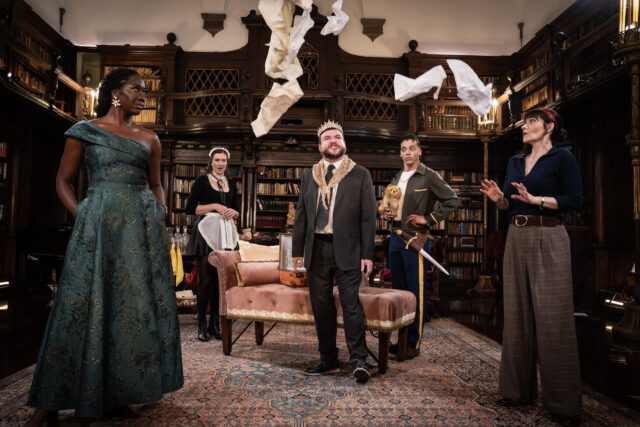
Big Stone (David Ryan Smith), Loud Stone (Maria Elena Ramirez), and Little Stone (Jon Norman Schneider) serve as an oddball Greek chorus in Sarah Ruhl’s Eurydice at the Signature (photo by HanJie Chow)

EURYDICE
The Pershing Square Signature Center
The Romulus Linney Courtyard Theatre
480 West 42nd St. between Tenth & Eleventh Aves.
Tuesday-Sunday through June 27, $105-$172
www.signaturetheatre.org

The Signature Theatre’s revival of Sarah Ruhl’s Eurydice is nothing if not “interesting.” In fact, that word appears in the ninety-minute show nearly two dozen times.

Originally staged in 2003, the play reimagines the Ancient Greek legend of the master musician Orpheus; his true love, Eurydice; and Hades, lord of the underworld, reframing it from the point of view of Eurydice and adding her father to the story, making their relationship the center of the narrative. Also known as a Nasty Interesting Man, the lord of the underworld is single, his wife, Persephone, having been eliminated from this plot, in which he sets his desires on Eurydice.

Eurydice: I read a book today.
Orpheus: Did you?
Eurydice: Yes. It was very interesting. . . . It had very interesting arguments.
Orpheus: Oh. And arguments that are interesting are good arguments?
Eurydice: Well — yes. . . .
Orpheus: I made up a song for you today.
Eurydice: Did you!?
Orpheus: Yup. It’s not interesting or not-interesting. It just — is.

Eurydice (Maya Hawke) and Orpheus (Caleb Eberhardt) decide to get married, and on their wedding day she is lured by the Nasty Interesting Man (T. Ryder Smith) to his nearby fancy loft with the promise of seeing a letter from her deceased father (Brian d’Arcy James). “I’m not interesting, but I’m strong. You could teach me to be interesting. I would listen,” the man tells Eurydice. “Orpheus is too busy listening to his own thoughts. There’s music in his head. Try to pluck the music out and it bites you. I’ll bet you had an interesting thought today, for instance. I bet you’re always having them.” The meeting, in which the man declares his love for her, results in Eurydice’s death.

She arrives in the underworld via an elevator during a downpour. She is greeted by a trio of odd munchkin-like clowns who serve as an unhelpful Greek chorus: Big Stone (David Ryan Smith), Little Stone (Jon Norman Schneider), and Loud Stone (Maria Elena Ramirez). Her trip across the River of Forgetfulness has erased her memories; she does not recognize her father, who is excited to see her and must teach her the language of the underworld so she can remember who she is. He builds her a room made of string and they bond all over again, including reading to her from King Lear, not exactly the best example of a father’s relationship with his daughters: “We two alone will sing like birds i’ the cage. / When thou dost ask my blessing, I’ll kneel down / And ask of thee forgiveness; so we’ll live, / And pray and sing.”

Up above, Orpheus writes her letters and composes a symphony that he is able to get to her through a mail slot. Meanwhile, the Nasty Interesting Man is determined to make Eurydice his bride, wooing her by riding around on a tricycle like he’s a deranged young kid at a birthday party. Orpheus figures out a way to enter hell without dying, and he and the lord of the underworld battle for Eurydice’s affections as her father wants whatever she thinks is best for her.

Father (Brian d’Arcy James) and daughter (Maya Hawke) reconnect in the underworld in Signature revival (photo by HanJie Chow)

Ruhl wrote the play as a way to connect with her father, who passed away in 1994 when she was twenty. Much of the ninety-minute show feels overly personal and esoteric, difficult to follow, as if we are being taught a different language that will take more time to understand. Les Waters (Dana H., Recent Alien Abductions), who has directed the play numerous times over the years, might be too close to it, unable to smooth out the many bumps in the narrative. Set designer Scott Bradley and sound designer Bray Poor return from Waters’s 2007 production at Second Stage; the action takes place in a tilted, tiled spa with exposed piping. Oana Botez’s costumes range from Eurydice’s father’s tailored suit to the lord of the underworld’s bizarre get-ups and the Stones’ devilishly clownish, colorful attire.

Five-time Tony nominee d’Arcy James (Shrek: The Musical, Something Rotten) is the star of the show, portraying the kind of caring father anyone would want; from constructing the string room to pretending to walk Eurydice down the aisle, he is hypnotic and charming. Hawke is enticing in her off-Broadway debut, but she and Eberhardt (The Comeuppance, On Sugarland) never quite ignite. Smith (Oslo, Our Lady of Kibeho) is game but appears to have pedaled in from another theater. The character’s appearances made me think of a favorite Looney Tunes cartoon, Hair-Raising Hare, in which Bugs Bunny, giving the orange Gossamer a manicure, says, “My, I’ll bet you monsters lead innnteresting lives. . . . I’ll bet you meet a lot of innnteresting people too. I’m always innnterested in meeting innnteresting people.”

The Orpheus story has been dazzling Broadway audiences since Hadestown opened in 2019; Ruhl’s Eurydice, the conclusion to her three-play series at the Signature following Letters from Max and Orlando, is, well, to put it in one word, “interesting.”

[Mark Rifkin is a Brooklyn-born, Manhattan-based writer and editor; you can follow him on Substack here.]
STRIKING CHOICES: THE WASH AT WP THEATER

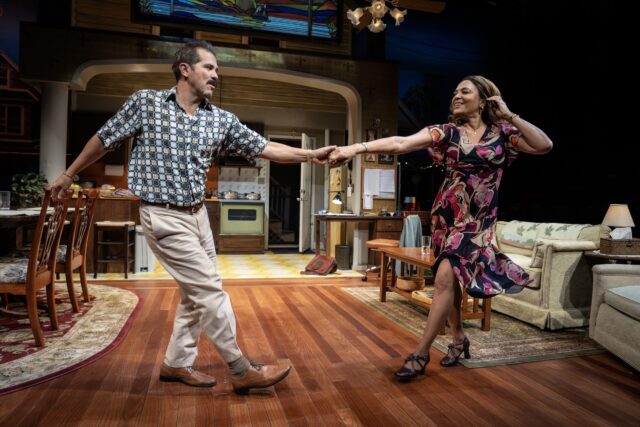
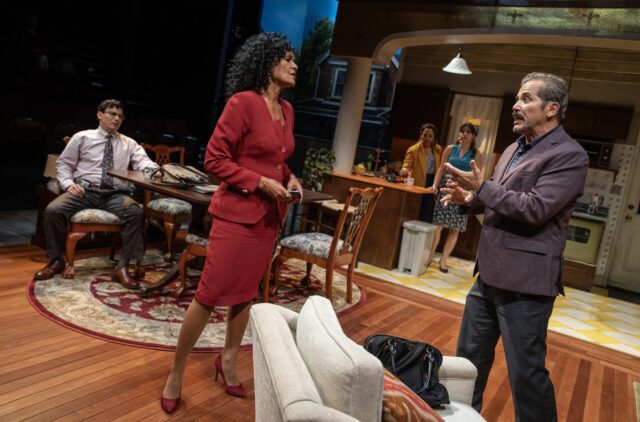
A group of Black laundresses prepares to strike in Kelundra Smith’s The Wash (photo by Hollis King)

THE WASH
WP Theater
2162 Broadway at 76th St.
Tuesday – Sunday through June 29, $30-$45
www.newfederaltheatre.com

The real Atlanta Washerwomen’s Strike of 1881 is the setting of Kelundra Smith’s moving if earnest The Wash, making its New York premiere at the WP Theater. A production of Woodie King Jr.’s New Federal Theatre, the fictionalized story is an account of one of first workers’ strikes in American history, all too often left out of our national narrative. Smith powerfully reclaims Black history, as well as her own; the seven characters all carry the names of Smith’s actual female ancestors and family members.

The play begins as a kind of symphony, as five Black women go about their business, washing and drying white people’s clothes using buckets, irons, and washboards, in front of two movable walls onto which are projected colorful abstract images that evoke the work of Georgia-born African American artist Alma Thomas.

The walls are soon spun around to reveal the inside of a double barrel shotgun house where the women gather to clean, gossip, and share their personal stories. The home is rented by Anna (Eunice Woods), a practical widow who runs a sort of workers’ cooperative, washing laundry collected from white Atlanta households. Anna wants to make sure everyone working there gets paid, although their clients aren’t paying them, evading their bills and paying in beans and rice instead of cash. Among the women is Anna’s closest friend, the god-fearing Jeanie (Bianca LaVerne Jones), who lives upstairs. Anna dreams of having her own bakery where she can sell her honeycomb cornbread and Jeanie’s “oh my” pies.

Jeanie: We been over this a thousand times. We ain’t answerin’ to white folks. We done got us a system. We only gots to talk to dem when we pick up they dirty clothes and drop off the clean ones. Dey pissed about it.
Anna: War been over almost twenty years. We oughta be past dis by now.
Jeanie: Dem crackers just killed the president. It ain’t over to dem.
Anna: It’s getting worse. I don’t know how much longer we can go on like this. No mo rice, beans, and hand-me-downs.

Jeanie has just found out that her son and daughter-in-law are going to have a baby, so she needs to make enough money to afford a bus ticket to Rochester. Thomasine (Margaret Odette), who has four young children, is married to an abusive husband. The newly married and madly in love Charity (Alicia Pilgrim) is looking forward to having kids. And Jewel (Kerry Warren) is in college, where she is very good friends with another woman student. The women are fed up with doors being slammed in their faces when they ask for payment, so they start considering striking, and a heated discussion ensues.

Anna: What else are we gonna to do? We tried waiting. We tried asking. We supposed to go the police?
Charity: They’ll arrest us for callin ’em.
Jewel: We wouldn’t be the first. Remember a few years ago in Galveston and Jackson? They did it.
Thomasine: They tried that here last year and the year before. Police pulled washerwomen’s hair out in the street.
Charity: But this a new day. Mrs. Anna say the Cotton Expo comin’.
Jewel: Plus, after they stole the election from that Negro alderman last year, I think folks will hear us out.
Anna: Jeanie, we did say —
Jeanie: We was just talkin’.
Anna: That’s the problem. It’s a lot of talkin’ ’round here, but now it’s time to demand. No pay, no wash.
Jeanie: Strike? If we ain’t workin’, how we gonna pay the property tax?
Thomasine: I got four kids comin’ up like dandelions. Somethin’ is better than nothin’.

The real Atlanta Washerwomen’s Strike of 1881 inspired play making NYC premiere at WP Theater (photo by Hollis King)

Anna: Something ain’t paying my property taxes. Matter of fact, we not even gettin’ something. We’re gettin’ anythang, and that’s worse. If we can set our own rates, I can pay my taxes ’fore the law come.
Jeanie: Think about this, Anna. What good it’ll do if we strike? It’s plenty of washerwomen in this city. Folk’ll take dey laundry to somebody else, and we’ll have a stain on us.
Jewel: She’s right. It’ll only work if everyone does it. We have to get more women to join us.
Jeanie: More womens? This Atlanta. Dem crackers will have us swingin’ from a Georgia pine.
Jewel: Times are changing. Negroes comin’ up around here.

They gather in a church basement, where they establish their makeshift headquarters for the strike, forming a union called the Washing Society. They are surprised and suspicious when Mozelle (Rebecca Haden), a single white mother, shows up, offering to help get the white laundry women in Castleberry to join the fight. As the number of strikers increases dramatically and the newspapers pick up the story, Anna, Jeanie, Thomasine, Charity, and Jewel reexamine what they want out of their lives, as individuals and as Black women.

The Wash is the conclusion of Smith’s Reconstruction Trilogy, following The Vote and The Knot. She and director Awoye Timpo (In Old Age, Good Grief) build a heartwarming portrait of community among the women, six unique characters who come together while facing their complicated personal situations. The narrative becomes repetitive, and the continual turning around of Jason Ardizzone-West’s set is time consuming and grows a bit tedious; perhaps the play would benefit from being streamlined from 135 minutes with intermission to a more concise 90 minutes without a break.

Gail Cooper-Hecht’s period costumes capture the look of the time, while Belynda M’baye’s wide-ranging props fill the shelves of Anna’s kitchen and workspace. Abhita Austin’s projections include shots of actual newspaper articles weighing in on the strike. Choreographers Adesola Osakalumi and Jill Vallery create scenes with movement that are like dances, all lit by Victor En Yu Tan, achieving what Smith explains in the script: “This play is meant to move like the wind; it’s gentle and breezy in some moments and swift and sharp in others.”

Pulling no punches, The Wash might wear its heart on its sleeve, but it tells an important, little-known story in a way that makes it relevant today, rather than just another episode from America’s shameful past.

[Mark Rifkin is a Brooklyn-born, Manhattan-based writer and editor; you can follow him on Substack here.]
AWAITING THE PENUMBRA: LUNAR ECLIPSE AT SECOND STAGE

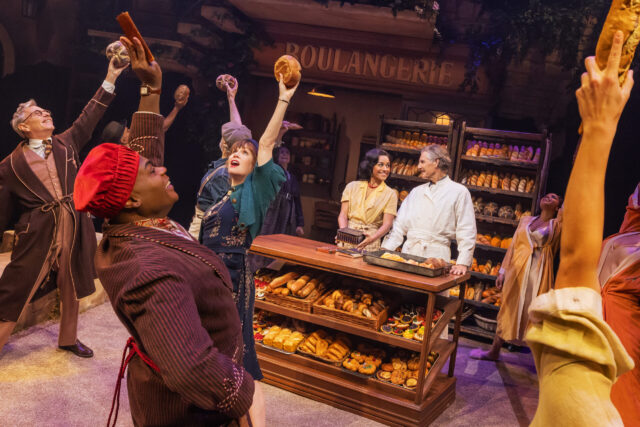
Em (Lisa Emery) and George (Reed Birney) take stock of their life together in Donald Margulies’s Lunar Eclipse (photo by Joan Marcus)

LUNAR ECLIPSE
The Pershing Square Signature Center
The Irene Diamond Stage
480 West 42nd St. between Tenth & Eleventh Aves.
Tuesday – Sunday through June 22, $74-$114
2st.com

Donald Margulies’s immeasurably moving and intelligent Lunar Eclipse begins with a man (Reed Birney) sitting in a folding chair under a tree in the middle of a grassy field, crying inconsolably. He tries to hide his sorrow when a woman (Lisa Emery) arrives, but soon they are both digging deep into their lives as the earth passes between the sun and the moon.

The couple is named George and Em, after George Gibbs and Emily Webb, the neighbors who fall in love in Thornton Wilder’s Our Town. Although the play is not specifically about those two characters, it does echo Wilder’s approach, making them represent any wife and husband looking back after fifty years, the good times and the bad. It’s nearly impossible to not imagine yourself in one of those chairs — regardless of your current age — next to your longtime partner, taking stock of your accomplishments and failures as the sky turns from bright to dark to bright again.

For ninety minutes, George and Em bicker over minute things, discuss their children, remember their first night together, and honor the many dogs they had, buried around them in that field. Although no time period is given, cellphones never appear. George and Em talk about their health problems; George is afraid he’s starting to lose his mind. He says, “Feel like I’m at sea, sometimes, in the middle of a storm. Looking for a place to land only there’s no land in sight.” Em replies, “You’re the sharpest man I know.” But George insists he is changing, and not for the better. “Isn’t that something? To think that we’re here? At this stage? Already? Look at us: Almost done. Lights out.”

As the total eclipse begins, George pulls out his binoculars, laments having had his telescope stolen, and hopes to see the rare Japanese Lantern Effect. Em asks George why he was crying, and although he is initially hesitant, he eventually tells her. They talk a lot about love and death.

Describing a troubling experience he’d had very early that morning, a kind of walking nightmare, George says, “My heart . . . was racing . . . I could feel blood rushing to my head. I could hear it in my ears. Afraid if I said anything, if I made any sound at all, if I’d budged one inch, everything would just . . . crack.”

She kisses his hand, and he wonders why she did that. He is worried about the future of humanity. She asks if she has ever done anything that surprised him. He’s sorry to hear about her sadness. In some ways they evoke not only Wilder’s George and Emily but also Edward Albee’s George and Martha from Who’s Afraid of Virginia Woolf?, although not nearly as extreme, nonviolent, and relatively sober.

They’re not rich, they don’t have a close, loving family, and they recently said goodbye to their last dog, but they still care about each other, even if he doesn’t want to admit it.

George: Anything I can do to help . . .
Em: You mean that?
George: Of course I mean that.
Em: Thank you. That’s kind of you to say.
George: I’m not being kind. I’m your husband.

Em (Lisa Emery) and George (Reed Birney) remember the good times and the bad in beautiful Second Stage play (photo by Joan Marcus)

Em sums up their life — all of our lives — when she then says, “The worst thing in the world that could possibly happen happens and you go to sleep and morning comes and whataya know, you wake up and you’re still breathing. You didn’t die during the night. That’s your punishment, I guess: You live another day. And all the days after that.”

Presented by Second Stage at the Signature Center, Lunar Eclipse is a near-masterpiece by the Brooklyn-born, New Haven–based Margulies, who won the Pulitzer Prize in 2000 for Dinner with Friends, was a finalist for two other Pulitzers (for Sight Unseen and Collected Stories), and won the Thornton Wilder Prize for literary translation in 2018. Margulies dedicated the work to his father-in-law, George Street, a Kentucky farmer who died in 2010.

Walt Spangler’s set is a lovely, inviting grassy expanse beautifully lit by Amith Chandrashaker, with Sinan Refik Zafar’s nature sounds encompassing the theater, immersing the audience in the experience, along with Grace Mclean’s gentle music. S. Katy Tucker’s video projections follow the course of the eclipse in the sky behind the actors, who are dressed in Jennifer Moeller’s casual costumes. My lone quibble is when dark clouds are projected as George mentions dark clouds hanging over him.

Drama League nominee Kate Whoriskey (Clyde’s, Sweat) directs the show with a compassionate, tender hand, giving plenty of room for Margulies’s poetic dialogue to shine out of the shadows. For the next lunar eclipse, you’ll want to find a grassy, private space where you can sit next to your loved one and enjoy the event, but be careful what you share.

Tony winner Birney (Chester Bailey, The Humans) and Drama Desk nominee Emery (Six Degrees of Separation, A Kind of Alaska) are sensational together, he both gentle and brash as George, who admits to being disappointed with how his life ended up, she touching and considerate as Em, who believes she did the best she possibly could.

Which is all any of us can ask for.

[Mark Rifkin is a Brooklyn-born, Manhattan-based writer and editor; you can follow him on Substack here.]
STOPPING BY A DINER ON A SNOWY EVENING: WILLIAM INGE AT CLASSIC STAGE

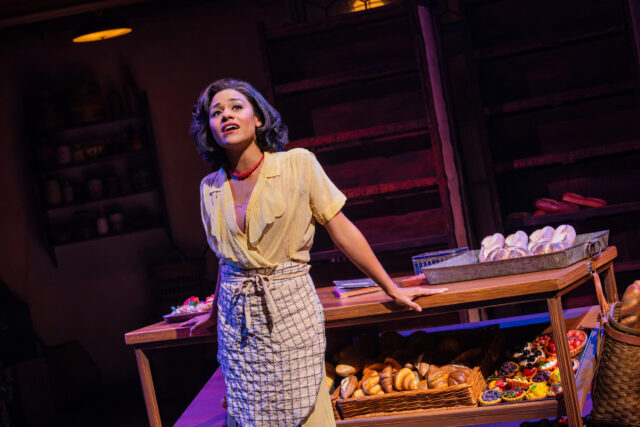
Bus Stop takes place in a comfy diner in small-town Kansas during a snowstorm (photo by Carol Rosegg)

BUS STOP
Classic Stage Company, Lynn F. Angelson Theater
136 East Thirteenth St. between Third & Fourth Aves.
Through June 8, $76-$132
www.classicstage.org

This is the last weekend to see Jack Cummings III’s ravishing adaptation of William Inge’s Bus Stop, the 1955 play that was expanded into a popular film in 1956 — famously starring Marilyn Monroe — and turned into a musical, Cherry, in 1972.

A coproduction of Classic Stage Company, the National Asian American Theatre Company (NAATCO), and Transport Group, the story takes place in a small-town Kansas diner, where a bus has been sidelined because of road closures during a March storm. Working the night shift are Elma (Delphi Borich), a high school student saving money for college, and the older Grace (Cindy Cheung), who needs a jolt of excitement in her life.

The local sheriff, Will (David Lee Huynh), prepares them for the bus’s arrival, letting them know that it will be at least several hours before the roads are cleared. Soon the bus driver, Carl (David Shih), enters, followed by Dr. Lyman (Rajesh Bose), a professor attracted to literature, alcohol, and Elma; Cherie (Midori Francis), a nightclub chanteuse; Bo (Michael Hsu Rosen), a twenty-one-year-old Montana rancher determined to marry Cherie; and his right-hand man, the loyal Virgil (Moses Villarama), who travels with his guitar.

Over the course of one evening, the men approach the women and a variety of encounters ensue: couplings motivated by convenience, lechery, and thunderstruck first love that would raise a few questions about consent today. With deft artistry, the company makes the story work without raising the hackles of every woman in the audience, which it could well do. The characters rhapsodize about love and loss, sex and grief, either looking back at where their life went wrong or gazing into a future they hope will be filled with something better.

Peiyi Wong’s diner set is realistic and charming, while Mariko Ohigashi’s costumes evoke midcentury America. As the narrative focuses on various pairs having conversations, R. Lee Kennedy’s lighting shifts on them but keeps the others in clear view. Cummings III, who previously directed Inge’s Picnic, The Dark at the Top of the Stairs, and Come Back, Little Sheba, maintains an even flow during the show’s two hours, including one pause and one intermission. The all-Asian ensemble is excellent, although it takes time for one of the key plots to heat up.

The diner might not have rye bread, cheese, or booze, but it’s still a lovely place to settle in for a few hours, especially when you need a break from what’s going on outside.

[Mark Rifkin is a Brooklyn-born, Manhattan-based writer and editor; you can follow him on Substack here.]

A COFFEE HOUSE TONY AWARDS PREVIEW WITH MARK RIFKIN, SIMON JONES, DAVID BARBOUR, AND MARTHA WADE STEKETEE

Who: Simon Jones, David Barbour, Martha Wade Steketee, and Mark Rifkin, plus Steve Ross
What: Tony Awards preview and cabaret concert
Where: The Coffee House Club at the Salmagundi Club, 47 Fifth Ave. between Eleventh & Twelfth Sts.
When: Wednesday, June 4, free for members, $10 for nonmembers, 5:30
Why: The seventy-eighth annual Tony Awards take place Sunday, June 8, at Radio City Music Hall, but you can get a sneak peek at who the winners might be when the prestigious Coffee House Club hosts its popular Tony Awards preview on June 4. Discussing the shows nominated in the major categories will be the inimitable Martha Wade Steketee, the incomparable David Barbour, and me, moderated by the wonderful actor and raconteur Simon Jones. You can read our bios below.

The event begins at 5:30 at the Salmagundi Club and will be followed at 6:30 by “Steve Ross & Friends: Cole Porter, Sung & Unsung,” in which the legendary Crown Prince of New York Cabaret will perform favorite and surprise Porter tunes. Admission is free for members and $10 for guests; everyone is invited to an a la carte dinner afterward to continue the party with advance RSVP.

Simon Jones will moderate Tony Awards preview at the Coffee House Club on June 4 (photo by Conrad Blakemore)

Simon Jones has starred opposite Joan Collins, Lauren Bacall, Rex Harrison, Claudette Colbert, and Angela Lansbury over thirteen productions on Broadway. His most recent appearance was in Trouble in Mind at the Roundabout Theatre in 2021–22. He has recorded more than two hundred audio books. He played King George V in the first Downton Abbey movie, and his other film credits include Miracle on Thirty-Fourth Street, Twelve Monkeys, Brazil, and Monty Python’s The Meaning of Life. In a TV career spanning forty years, he remains well known for his performances as Arthur Dent in The Hitchhiker’s Guide to the Galaxy, Bridey in Brideshead Revisited, and Sir Walter Raleigh in Blackadder, and currently he is one of the stars of The Gilded Age on HBO/MAX, as Bannister the butler. Season three begins June 22.

Martha Wade Steketee is a theater-loving public policy researcher who currently practices in the fields of dramaturgy, criticism, and theater research. She serves as chair of the Drama Desk nominating committee and on several play prize committees, is a member of the Henry Hewes Design Awards Committee and past chair of the American Theatre Critics/Journalists Association, and author of the Women Count report series analyzing gender in hiring trends off Broadway since 2010.

David Barbour is editor-in-chief of Lighting & Sound America, which covers design and technology in live entertainment. He is also copresident of the Drama Desk and a member of the New York Drama Critics Circle and the Henry Hewes Design Awards Committee.

Mark Rifkin is a member of the Drama Desk and the American Theatre Critics/Journalists Association and has been running the online newsmagazine This Week in New York since 2001, covering art, film, theater, literature, dance, music, food, and anything else that requires someone to leave their apartment in the five boroughs. You can follow his “mad transit” adventures on Substack.

RIFF’S RANTS & RAVES: THE FACT OF THE MATTER ON BROADWAY

George Clooney stars as Edward R. Murrow in Good Night, and Good Luck at the Winter Garden (photo by Emilio Madrid)

GOOD NIGHT, AND GOOD LUCK
Winter Garden Theatre
1634 Broadway between 50th & 51st Sts.
Tuesday – Sunday through June 8, $329-$849
goodnightgoodluckbroadway.com

In 2005, Good Night, and Good Luck., a film directed by George Clooney and written by Clooney and Grant Heslov, was a big hit, earning six Oscar nominations, for Best Picture, Best Director, Best Original Screenplay, Best Cinematography, Best Production Design, and Best Actor, for David Strathairn’s portrayal of famed newsman Edward R. Murrow, focusing on his battles with Sen. Joseph McCarthy and his reckless search for communist sympathizers in politics and the entertainment industry. Clooney had a supporting role as Fred W. Friendly, coproducer of Murrow’s popular See It Now television program.

Heslov, Clooney, and Tony-winning director David Cromer have now adapted the film into a Broadway play — deleting the period at the end of the title — and for the most part it is an efficient, satisfying show, although it relies too heavily on the film rather than making the most of the opportunities live theater presents.

This time around Clooney takes on the starring role of Murrow, a cigarette-smoking investigative journalist who prefers hard-hitting news stories to celebrity fluff pieces, although he’s told he needs to do the fluff for ratings and to keep the network heads happy; Glenn Fleshler is Friendly, who offers as much support and advice as he possibly can. The narrative is bookended by a speech Murrow gave at the October 1958 Radio-Television News Directors Association Convention in Chicago, where he posits, “This just might do nobody any good. At the end of this discourse, a few people may accuse this reporter of fouling his own comfortable nest, and you all may be accused of giving hospitality to heretical and even dangerous thoughts. It is my desire, if not my duty, to try to speak to you with some candor about what is happening in our mass media. You should know at the outset that I appear here voluntarily, by invitation, and that these remarks are strictly of a do-it-yourself nature.”

The play, about actual events that occurred more than seventy years ago, could not be more relevant today, as the current administration sues television and print media for stories they view as unfavorable and seeks to deport legal and illegal immigrants while eliminating habeas corpus. The production makes its points but can get heavy-handed; what works onscreen does not always work onstage, even one dominated by screens. The projections, by David Bengali, range from archival footage of McCarthy to live video feeds of Murrow’s program. There’s always a lot happening on Scott Pask’s expansive studio set, so, combined with the projections, it is often difficult to know where to look. The musical interludes with Ella (Georgia Heers) singing such jazzy numbers as “When I Fall in Love” and “I’ve Got My Eye on You” help create atmosphere but feel extraneous in a one-hundred-minute show. And the subplots involving anchorman Don Hollenbeck (Clark Gregg) and secret romantic partners Shirley (Ilana Glazer) and Joe (Carter Hudson) get lost.

In his Broadway debut, Clooney is stellar as Murrow, capturing the newsman’s serious demeanor and dedication to his responsibility of telling the truth to the American public. It’s his show, and he commands the stage with grace and elegance. Good Night, and Good Luck has so much to say about then and now that it sometimes overplays its hand, as with an unnecessary political video montage. But it’s solid entertainment and a clarion call for all of us to stand up to bigotry and hatred before it’s too late.

The June 7 performance will be streamed live on CNN for free. In the announcement, Clooney stated, “It doesn’t matter what political bend you are on — when you hear things like, you know, ‘We must not confuse dissent with disloyalty. We must remember always that accusation is not proof and a conviction depends on evidence and due process of law, and we will not walk in fear of one another. We won’t be driven by fear into an age of unreason,’ I think those are extraordinarily powerful words for who we are at our best.”

As the play reveals, we’re going to need a lot more than good luck to get out of the mess we’re in.

Jeremy Jordan stars as the title character in Floyd Collins at Lincoln Center (photo by Joan Marcus)

FLOYD COLLINS
Vivian Beaumont Theater at Lincoln Center Theater
150 West 65th St. between Broadway & Amsterdam Ave.
Tuesday – Saturday through June 22, $58-$299
www.lct.org

On January 30, 1925, while spelunking to find a cave that could be turned into a tourist attraction, thirty-seven-year-old William Floyd Collins got wedged into a small space, his foot caught under a rock. As members of his family and the community tried to rescue him, Bee Doyle’s farm became a media circus. The tale served as part of the inspiration behind Billy Wilder’s underrated 1951 masterpiece, Ace in the Hole, aka The Big Carnival, starring Kirk Douglas and Jan Sterling.

In February 1996, book writer and director Tina Landau and composer and lyricist Adam Guettel adapted the true story into the musical Floyd Collins, which had a short run at Playwrights Horizons. It is now dazzling audiences at Lincoln Center’s Vivian Beaumont Theater in a thrilling production, again directed by Landau, that has been nominated for six Tonys, including Best Revival of a Musical.

Jeremy Jordan is sensational as Collins, spending most of the show in the front corner of the stage, immobile on a rock shaped like a chaise longue. His brother, Homer (Jason Gotay), and sister, Nellie (Lizzy McAlpine), are desperate to save him, while his father, Lee (Marc Kudisch), is angry that Floyd has gotten into this predicament and his stepmother, Miss Jane (Jessica Molaskey), is concerned but won’t argue with her husband, except when he offers money to Dr. Hazlett (Kevyn Morrow) to go inside the cave. Engineer H. T. Carmichael (Sean Allan Krill) decides that he and his company, Kentucky Rock Asphalt, will handle the rescue, incorporating shafting efforts that Homer believes will be too dangerous and take too long to save his brother, while Lee wants him to stay out of it. Documenting it all is Louisville Courier-Journal reporter Skeets Miller (Taylor Trensch), who becomes deeply involved in the story, even risking his safety by going into the cave to attempt to free Collins himself.

The stage design, by dots, begins as a kind of obstacle course as Floyd makes his way deeper and deeper into the cave, with dark rocklike formations popping up and down as he calls into the void, listening for the echoes to let him know if he’s close to what he’s looking for. The eerie sound is by Dan Moses Schreier, with shadowy lighting by Scott Zielinski and projections by Ruey Horng Sun on a rear screen that change colors as the sun rises and sets. Bruce Coughlin’s bluegrass orchestrations maintain a country feel, save for a few traditional ballads that slow the narrative dramatically, and Anita Yavich’s costumes have an appropriately earthy palette.

Floyd Collins is an exemplary cautionary tale about capitalist greed and a predatory media as well as a tribute to American know-how and dedication, the importance of family, and how freedom can so often be just out of reach. It was a different time, but it still feels real as adults and children continue to get trapped in wells and caves, the world holding its collective breath as rescue is not always possible. It also serves as a potent metaphor for our ability to escape from certain situations we see no way out of, both individually and as a republic.

You can find out more about Collins by visiting the Sand Cave Trail in Kentucky, which leads you to Mammoth Cave National Park, where it all took place.

It’s Audra McDonald’s turn at an iconic role, and her performance is unforgettable (photo by Julieta Cervantes)

GYPSY
Majestic Theatre
247 West 44th St. between Broadway & Eighth Aves.
Tuesday – Sunday through August 17, $46-$421
gypsybway.com

Has there ever been more pressure on a performer taking on an iconic musical theater role? In George C. Wolfe’s splendid revival of Gypsy at the Majestic Theatre, six-time Tony winner Audra McDonald is not just following in the lauded footsteps of Ethel Merman, Betty Hutton, Angela Lansbury, Tyne Daly, Linda Lavin, Bernadette Peters, Patti LuPone, Imelda Staunton, Betty Buckley, Tovah Feldshuh, Leslie Uggams, and Beth Leavel in portraying the stage-mother-from-hell — not to mention Rosalind Russell in the 1962 film and Bette Midler in a 1993 TV movie — but her name is essentially part of the title: The marquee and all marketing materials declare: Audra Gypsy. Perhaps not surprisingly, just about everything comes up roses.

Featuring a book by Arthur Laurents, music by Jule Styne, and lyrics by Stephen Sondheim, Gypsy was “suggested” by the 1957 memoir by burlesque legend Gypsy Rose Lee, whose mother, Rose Evangeline Hovick, was obsessed with making her daughters, Rose Louise Hovick and June Havoc, show business superstars. The 1959 Broadway premiere and its numerous revivals have earned a multitude of Tony Awards, and this iteration has been nominated for five, including Best Revival of a Musical and Best Leading Actress for McDonald, the first Black woman to play the part in a major New York production. (Uggams portrayed Mama Rose in 2014 at the Connecticut Repertory Theatre.)

While the three most popular tunes from the show are “May We Entertain You,” “Together, Wherever We Go,” and “Everything’s Coming Up Roses,” the narrative reaches its apex with “Rose’s Turn,” in which Mama Rose grabs center stage and states her raison d’être. “You either got it / or you ain’t. / And boys, I got it! / You like it?” she sings. “Well, someone tell me, when is it my turn? / Don’t I get a dream for myself?” At the end of the song, she repeats over and over again, “For me!,” then takes a series of bows, but it’s not McDonald accepting rapturous applause from the electrified crowd at the Majestic; it’s Mama Rose, basking in the glow of an audience that exists only in her head. The vulnerability of both the performer and the character is almost too much to bear as she reaches out her hands, nods her head, and looks out over an all-encompassing emptiness.

It’s not Mama Rose as monster; it’s every one of us, wondering what could have been, perhaps even what should have been. It’s an unforgettable moment that cements this revival as a unique and celebratory experience.

JUST IN TIME
Circle in the Square Theatre
1633 Broadway at 50th St.
Tuesday – Sunday through December 27, $300 – $916
justintimebroadway.com
www.circlesquaretheatre.com

“I’m Jonathan. I’ll be your Bobby Darin tonight. How about these digs? Not bad for the basement of Wicked,” Jonathan Groff says after the opening medley of “This Could Be the Start of Something Big” and “Just in Time” that kicks off the electrifying biomusical Just in Time at Circle in the Square, underneath the Gershwin, where Wicked has been running for more than twenty years.

Developed and directed by two-time Tony winner and Emmy and Grammy nominee Alex Timbers, Just in Time tells Darin’s life story as if it’s a chronological nightclub act in a flashy, elegant space designed by Derek McLane. The band performs at one end, with a center section of audience members sitting at candlelit tables. Groff is spectacular as a version of himself, not impersonating Darin but embodying his spirit as he belts out such familiar songs as “Beyond the Sea,” “Splish Splash,” “Dream Lover,” and “Mack the Knife.” Andrew Resnick’s arrangements practically explode as the book, by Tony winner Warren Leight and Isaac Oliver, follows Darin, born Walden Robert Cassotto in 1936 in East Harlem, from his childhood, to his earliest songwriting, and through his personal and professional ups and downs in a career that found him going from one of the most popular entertainers on the planet to living alone in the woods, recording folksongs no one wanted to hear.

Darin, who had a weak heart as a result of rheumatic fever as a child, partnered with Don Kirshner (Caesar Samayoa), made records for Ahmet Ertegun (Lance Roberts), fell in love with Connie Francis (Gracie Lawrence), married Sandra Dee (Erika Henningsen), had a son, released more than two dozen albums, appeared in twelve movies (including garnering an Oscar nomination for Captain Newman, M.D.), and never stopped writing and singing right up until his death in 1973 at the age of thirty-seven.

He loved his mother, Polly Walden (Tony winner Michele Pawk), and had a difficult relationship with his sister, Nina Cassotto (Emily Bergl), at least until he found out a shattering truth about them. He hired Nina’s husband, Charlie Maffia (Joe Barbara), to go on the road with him.

While the first act unfurls at a ravishing pace, the show slows down considerably in the second act, when Darin’s troubles mount; there’s not much Leight and Oliver can do, since it’s a true story. But Shannon Lewis’s choreography, Catherine Zuber’s costumes, Justin Townsend’s lighting, and Peter Hylenski’s sound ensures that it all still looks and sounds grand.

The staging is magnificent as Groff and his fantastic trio of sirens (Christine Cornish, Julia Grondin, Valeria Yamin), serving as both backup singers and Greek chorus, roll through Darin’s impressive songbook. “They’re with me everywhere I go — stage left, stage right . . . They’re gonna help me out tonight — and boy, do I need their help — and boy, are they gonna get spat on. And sweated on,” Groff explains. “I’m a wet man, I’m just generally extremely very wet when I do this, and I’m sorry in advance.” He ain’t kidding; folks at the tables might want to cover their drinks when he floats by.

Tony winner and Emmy and Grammy nominee Groff (Merrily We Roll Along, Hamilton) is the heart and soul of the show, and he is utterly mesmerizing every step of the way. It’s a dazzling performance that will take you sailin’ up a lazy river and beyond the sea, splishing and splashing as you hold on to your dream lover and inhale the scent of eighteen yellow roses because Bobby’s back in town.

A cast of five tells the remarkable story of a secret Allied WWII mission in Operation Mincemeat (photo by Julieta Cervantes)

OPERATION MINCEMEAT
Golden Theatre
336 West 20th St. between Eighth & Ninth Aves.
Tuesday – Sunday through February 15, $59-$499
operationbroadway.com

The people behind Operation Mincemeat must have given one of the most bizarre pitches in the history of theater: a musical comedy based on a WWII military operation involving a corpse, written and performed by a brand-new madcap troupe of little-known comic thespians known as SpitLip. But it has succeeded magnificently, from its 2019 origins to its two 2024 Oliviers — for Best New Musical and Best Actor in a Supporting Role in a Musical, Jak Malone — and now its 2025 nominations for four Tonys, including Best Musical and Best Performance by an Actor in a Featured Role in a Musical, again for Malone.

It’s 1943, and the Allies are desperate to stop the Axis Powers’ march through Europe. Col. Johnny Bevan tells his MI5 Military Deception team, “Now, as we’re all painfully aware, Hitler’s boys have taken control of mainland Europe, which means the only route back in is through the islands to the South. So the next Allied invasion target is Sicily. And the key to invading Sicily is not invading Sicily. . . . We’re going to convince the Nazis that we’re headed for somewhere else instead. Sardinia, to be exact.”

Intelligence officers Charles Cholmondeley, Ewen Montagu, John Masterman, Reggie Tar, and aspiring spy novelist Ian Fleming submit their ideas to Bevan, who ultimately chooses a plan devised by Cholmondeley and coopted by Montagu with the assistance of clerk Jean Leslie: They handcuff a briefcase to the body of a dead man and have him wash ashore in Spain, with detailed papers revealing that the Allies will be attacking Sardinia, not Sicily.

Joined by MI5 employee Hester Leggatt, the trio of Meryl, Beryl, and Cheryl, pathologist Sir Bernard Spilsbury, submarine captain Bill Jewell, British vice consul Francis Haselden, pilot Willie Watkins, and others, the very strange Operation Mincemeat is underway, but it quickly becomes more complicated than they ever expected.

Boasting such songs as “Born to Lead,” “God That’s Brilliant,” and “Das Übermensch” — along with a glitzy finale titled, well, “A Glitzy Finale” — Operation Mincemeat is like Monty Python on speed, performed by an ultratalented company of only five playing all the roles: The book, music, and lyrics were written by David Cumming (Cholmondeley), Natasha Hodgson (Montagu), and Zoë Roberts (Bevan), and the cast also features Claire-Marie Hall (Leslie) and Malone (Leggatt). Director Robert Hastie somehow manages to have it all make sense amid Ben Stones’s fast-paced set and costume changes.

There have been numerous books written about the military operation, including Ben Macintyre’s 2010 Operation Mincemeat: How a Dead Man and a Bizarre Plan Fooled the Nazis and Assured an Allied Victory, which was first made into a documentary, then adapted into a 2021 film starring Colin Firth, Matthew Macfadyen, Kelly Macdonald, and Jason Isaacs. But none of those prepared anyone for this hilarious musical comedy, which the show references itself.

Hester: And yes it was true, though they’d never believe it.
Jean: They’ll say it’s all true, they’ll never believe it.
Hester: We did all we could do, and if they’d never see it,
Jean: We did what we do, and they’ll never see it.
Hester: We worked and we prayed and it wasn’t in vain.
Jean: And we’ll keep on going.
Hester: We knew pain could be strength and that strength could be pain.
Jean: Even though they’ll never know we . . .
Hester and Jean: . . . forced all their forces to fly!

Believe it or not, Operation Mincemeat flies high.

[Mark Rifkin is a Brooklyn-born, Manhattan-based writer and editor; you can follow him on Substack here.]
GHOST LIGHTS: NAT “KING” COLE’S MUSICAL FEVER DREAM

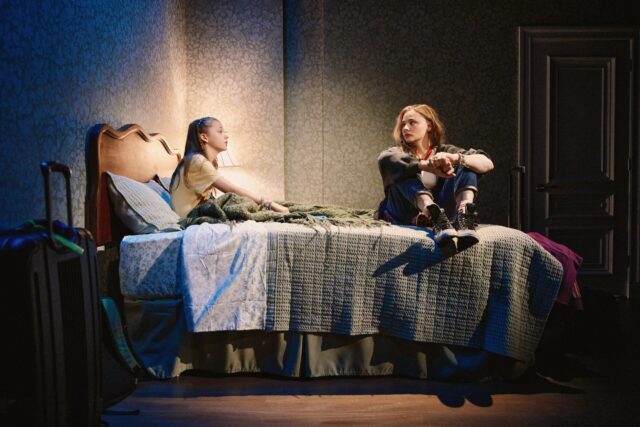
Sammy Davis Jr. (Daniel J. Watts) and Nat King Cole (Dulé Hill) form a unique partnership in Lights Out (photo by Marc J. Franklin)

LIGHTS OUT: NAT “KING” COLE
New York Theatre Workshop
79 East Fourth St. between Second & Third Aves.
Tuesday – Sunday through June 29, $49-$59
www.nytw.org

According to the Sleep Foundation, a fever dream can be “vivid and unpleasant,” involving feelings of “discomfort” that can be “unsettling.”

That’s precisely how I felt while watching the bio-jukebox musical Lights Out: Nat “King” Cole at New York Theatre Workshop.

“How is everybody doing tonight? Fine and dandy? Wonderful. Some of you thought you were going to get a nice and easy holiday show. No! Welcome to the fever dream,” Sammy Davis Jr. (Tony nominee Daniel J. Watts) tells the audience at one point. “My dear friend is wrapped up at the moment. Wrapped up in his mind. The mind is a terrible thing. Is that the way the saying goes? Anyway. When my friend is wrapped up, he does what any musician will do. He will try to work it out. Work it out in a song.”

Lights Out takes place on December 17, 1957, at NBC studios in New York City, as Cole (Emmy nominee Dulé Hill), the friend Davis is referring to, is preparing for the final episode of his television variety program. Despite its critical and popular success, the year-old show could not garner a single national sponsor, primarily because it was being hosted by a Black man. “Madison Avenue is afraid of the dark,” Cole famously announced to the press.

Candy (Kathy Fitzgerald), the makeup designer, enters Cole’s dressing room, ready to apply the usual white powder that will make him look less Black, but he asks for a lighter touch this time; he’s determined to go out with his “head held high.” He walks onstage and is upset that someone has left the ghost light on, a sign of bad luck; according to theater superstition, it should only be on when the theater is empty overnight, for the spirits wandering around. As soon as he turns the light off, the narrative switches over to the fever dream, where anything can happen, from traveling into the past to speaking one’s innermost thoughts like never before.

Serving as the emcee of the dream is Davis, one of Cole’s closest friends, but in this case he is a devilish trickster, manipulating some of the action and regularly addressing the audience directly, advising Cole that they will be “taking it off the rails.” What follows is a haphazard mess of a story interspersed with classic Cole tunes from his remarkable songbook, which boasts eighty-six singles and seventeen albums in the top 40 between 1943 and 1964 and total sales of more than fifty million records.

Cole assures the stage manager (Elliott Mattox) that Peggy Lee (Ruby Lewis), who is late, will make it in time to perform the opener with him. When he gets too close to Betty Hutton (Lewis) during “Anything You Can Do,” a “Racial distance appropriateness” yardstick is thrust between them. Eartha Kitt (Krystal Joy Brown) purrs to the producer and stage manager, “Piss off!” after they tell Cole to “keep it clean.” Cole tells the eleven-year-old piano prodigy Billy Preston (Mekhi Richardson or Walter Russell III) that he could become president one day, although the cue cards use racist tropes involving sports and prison. The Randy Van Horne Singers join Cole for “It’s a Good Day,” which features the line “It’s a good day for shining your shoes / And it’s a good day for losin’ the blues,” as if Cole’s Blackness is being whitewashed.

These set pieces all pass through in a chaotic, confusing jumble, with Davis continually interrupting with an annoying demeanor. The most effective scene occurs when Cole’s long-deceased mother, Perlina (Kenita Miller), arrives to deliver love and support, singing “Orange Colored Sky” and reminding her son (played as a child by Richardson or Russell III), “Don’t let ’em get the best of you. Keep your head held high.” Another highlight is Cole and Davis tap-dancing to “Me and My Shadow” right after Cole fires his producer (Christopher Ryan Grant). “You can’t fire me. You don’t wield that kind of power!” the producer argues. Cole responds, “I absolutely-positively wield that kind of power.” Cole then kicks him out when the producer declares, “How dare you, after all I’ve done for you people.”

Cole took some heat from the Black community for not being more aggressive in fighting racism, and Lights Out posits that while he was well aware of that criticism, he opted to take a different path, by being successful and paving the way for other Black entertainers, on television and Madison Ave. During one fake commercial, Sammy and Perlina promote toothpaste, referencing the racist caricature of smiling Blacks. Sammy: “When you’re feeling down / And all you want to do is frown / Use this tube of magic / To avoid a life that’s tragic / Brush up and smile bright / Some things ain’t worth the fight.” Perlina: “I know deep down that you’re right.” Perlina and Sammy: “Next time I will try to smile bright.” Other ads are for beer and cigarettes.

Emmy nominee Dulé Hill star as Nat “King” Cole in biomusical at New York Theatre Workshop (photo by Marc J. Franklin)

Lights Out was written by Tony and Oscar nominee Colman Domingo and Patricia McGregor with a nonstop ferocity, trying to squeeze too much into ninety minutes. McGregor (Hamlet, Hurt Village) directs at a feverish pace, making it hard for the audience to catch its breath as they attempt to figure out what is going on. Clint Ramos’s TV show set is effective, with Cole’s dressing room stage right and the band in the back, but the inclusion of an angled video screen for live projections by David Bengali feels unnecessary, further hampering the abstract narrative. Katie O’Neill’s costumes range from practical to lavish, with Cole always looking superbly elegant and pristine.

The orchestrations and arrangements by John McDaniel are lovely, evoking the time period while paying respect to composer and bandleader Nelson Riddle, although some songs are performed only in part and, curiously, the producer warbles “Mona Lisa.” Edgar Godineaux’s choreography has a keen sense of humor, while Jared Grimes’s tap choreography shines.

Like most biomusicals, the script plays hard and loose with some of the facts. While Cole’s final show was on December 17, 1957, the actual guests were the Cheerleaders and Billy Eckstine, and the opening song was “When You’re Smiling.” Davis, Hutton, Kitt, and Lee all appeared on one episode of the show, but not the last one. In addition, Davis makes a joke referencing the slogan of the United Negro College Fund, “A mind is a terrible thing to waste,” but that began in 1972, seven years after Cole died; even though Davis is an otherworldly figure in the dream, everything else relates to 1957.

Hill (After Midnight, Stick Fly) beautifully captures the dichotomy tearing Cole apart inside, but Watts (Richard III, Tina: The Tina Turner Musical) overplays Davis to the point of cutting down the impact of many scenes.

The story of Nat “King” Cole, who died of lung cancer in 1965 at the age of forty-five — there is a whole lot of smoking in the show — is a crucially important one. In February 1958, Cole wrote in Ebony magazine, “For 13 months I was the Jackie Robinson of television. I was the pioneer, the test case, the Negro first. I didn’t plan it that way, but it was obvious to anyone with eyes to see that I was the only Negro on network television with his own show. On my show rode the hopes and tears and dreams of millions of people. . . . Once a week for 54 consecutive weeks I went to bat for these people. I sacrificed and drove myself. I plowed part of my salary back into the show. I turned down $500,000 in dates in order to be on the scene. I did everything I could to make the show a success. And what happened? After a trailblazing year that shattered all the old bugaboos about Negroes on TV, I found myself standing there with the bat on my shoulder. The men who dictate what Americans see and hear didn’t want to play ball.”

At one point, Cole’s daughter Natalie (Brown) duets with her father, singing “Unforgettable.” It’s a touching moment, but it’s a shame that too much of the rest of the show is forgettable.

[Mark Rifkin is a Brooklyn-born, Manhattan-based writer and editor; you can follow him on Substack here.]