this week in theater

DOOM SCROLLING AT THE APOCALYPSE: THE LAST BIMBO

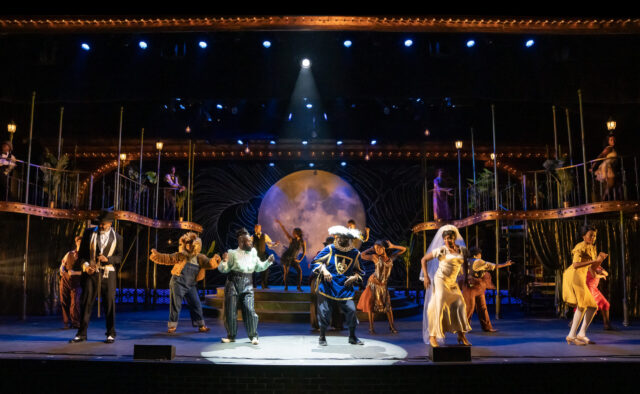
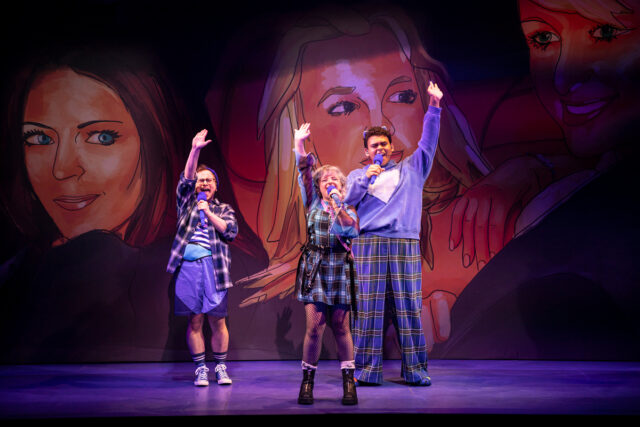
The Worms (Patrick Nathan Falk, Milly Shapiro, and Luke Islam) dig deep into an internet rabbit hole in The Last Bimbo of the Apocalypse (photo by Monique Carboni)

THE LAST BIMBO OF THE APOCALYPSE
The New Group at the Pershing Square Signature Center
The Alice Griffin Jewel Box Theatre
480 West 42nd St. between between Ninth & Tenth Aves.
Tuesday – Sunday through June 1, $38-$94
thenewgroup.org

Michael Breslin and Patrick Foley take an iconic 2006 photo and build an exciting mystery around it in The Last Bimbo of the Apocalypse, zeroing in on the allure of online celebrity through pop-culture obsession.

On November 29, 2006, the New York Post published a cover photograph of Lindsay Lohan, Britney Spears, and Paris Hilton in the front seat of a car with the headline “Bimbo Summit”; the accompanying story was called “3 Bimbos of the Apocalypse — No Clue, No Cares, No Underwear: Meet the Party Posse of the Year,” labeling Britney as Bashful, Paris as Dopey, and Lindsay as Sleepy.

Nearly twenty years later, a young woman known as She/Her Sherlock (Milly Shapiro) has a popular online true crime channel devoted to finding missing girls. “Wars and hurricanes / Botched elections, mass infections / Apocalypse is in my veins,” she sings. “So I stay inside and fixate on / Girls who disappeared / I find what no one sees or hears / I crack crimes in the end times / And I haven’t been outside in four years / No one looked for me / No one looked for me / Which means / I don’t exist unless I’m online / On their screens.” She’s excited by her latest case, announcing, “I’ve never been more stumped! This new girl is from an archaic, regressive, primitive civilization that I know nothing about. I need evidence! I need experts!”

At the same time, a pair of young men, Earworm (Luke Islam) and Bookworm (Patrick Nathan Falk), with their own channel, devoted to ’00s (the “aughts”) pop culture, that rarely gets any viewers at all, are analyzing the Post picture, seen behind them as a painting on a large canvas. “Have you ever wondered how this one photo from twenty years ago created the digital dystopia we live in today?” Earworm asks. When their only viewer logs out, they wonder if their show is over. “No!” Bookworm declares. “The first time I heard you talk about Juicy Couture tracksuits, I felt like I finally understood the cultural context of 9/11.” Earworm responds, “And I never understood why Britney Spears shaved her head until you taught me about Operation Iraqi Freedom.”

Earworm and Bookworm are surprised when Sherlock herself makes a comment, pointing out that there is a fourth girl in the photo: Barely visible extending from the backseat is a hand with a bracelet around the wrist that says Coco. They next show a 2006 video from Coco (Keri René Fuller), a wannabe star who posted a YouTube song called “Something out of Nothing” in which she declares, “I don’t wanna do / Anything / And I wanna be rewarded for it. . . . Uh huh / Gonna shoot a massive blank / Bang bang! / Gonna rob an empty bank / Am I a manifesto or a prank? / I don’t think therefore I am! / The future of this world of cameras! / I’ll take a picture on my phone / And post it so I’m not alone.”

The video tanked and, according to gossipmonger Perez Hilton, Coco was dead a few days later. Rebranding herself Brainworm, Sherlock teams up with Earworm and Bookworm to find out exactly what happened to Coco, but the only other clue they have is a selfie of Coco and two other women in a clothing store with palm trees outside. They zoom in on the photo (re-created by the cast) and decide to refer to the older woman as Coco’s mother (Sara Gettelfinger) and the other as Hoodie Girl (Natalie Walker); the Worms come up with an outrageous murder scenario that they have to abandon, but it sends them down a, well, wormhole as they dig deeper and deeper, especially when the bracelet suddenly appears on Brainworm’s doorstep.
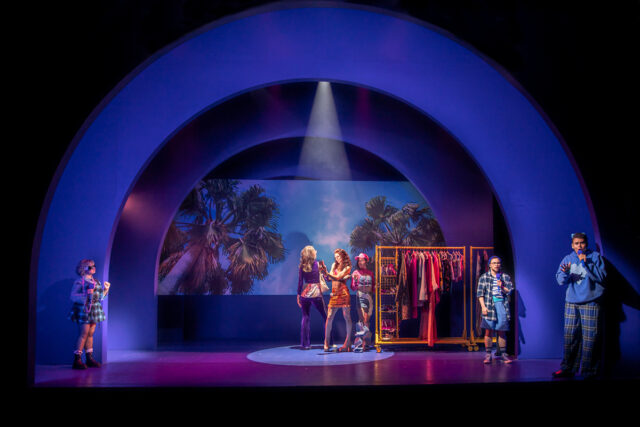
An old selfie provides important clues in world premiere musical from the New Group (photo by Monique Carboni)

Developed and directed by Obie winner Rory Pelsue, who worked with Breslin and Foley on This American Wife and Pulitzer Prize finalist Circle Jerk, and featuring fun choreography by Jack Ferver, The Last Bimbo of the Apocalypse is a lively, appealing ninety-minute pop opera about a group of unique characters trying to figure out who they are and what they want, seeking answers by using social media from the distant (to them) past instead of going out into the current real world. They are terrified of actual contact with other humans; Brainworm hasn’t been outside in four years and hides her face when she is online, having been traumatized by a single cruel comment from an anonymous user when she was twelve. Earworm, who is gay, and Bookworm, who claims he is straight, do not broadcast from the same space but are a thousand miles apart, the former in Staten Island, the latter in Nebraska — and afraid of sharing their true feelings with each other. The three actors might be onstage together, but their fears and physical distance are palpable; they are near but so far.

The book does meander a few times, particularly with references to the old MTV show Total Request Live, but it always manages to come back around, complete with a cool double twist.

Stephanie Osin Cohen’s set consists of a series of concentric semicircles from which various elements occasionally drop down, providing information about the Worms’ search. Amith Chandrashaker’s lighting casts ever-shifting colors across the stage, along with illumination from the phones when things get dark. Cole McCarty’s costumes get funky, from hoodies and T-shirts with emojis to internet chic, while Matthew Armentrout’s hair and wig designs are fab. The sound design, by Megumi Katayama and Ben Truppin-Brown, is loud and clear, effectively shifting between live music and online discussions. The rocking orchestrations are by music director Dan Schlosberg, who plays the keyboards, joined by Jakob Reinhardt on guitar and ukulele, Brittany Harris on bass and cello, and Emma Ford on drums and percussion; the back wall rises whenever the group is performing so we can see them in action.

The cast is an exuberant delight, highlighted by Tony winner Shapiro (Matilda the Musical, You’re a Good Man, Charlie Brown) and Fuller (Six, Jagged Little Pill), who embody the loneliness that comes with online addiction. About halfway through the show, during the song “Stop Scrolling,” a character yells at Brainworm, “You think you know about the world, little girl? You know nothin’! Why don’t you get your own life and live it yourself?” then screams out the chorus: “Stop scrolling! / Stop scrolling! / Log off and live / It’s controlling you! / You will never reach the end of your feed! / This will never fill the pit of your need!” The message is delivered by a villainous figure, but it still packs a punch and strikes a nerve, for the Worms and the audience.

In 2006, many young girls considered Lindsay, Britney, and Paris role models. In her program note, one of the dramaturgs, Ariel Sibert, writes, “On TikTok, I see a lot of comments from Millennials under videos of enlightened high schoolers explaining economic inequality, or teaching their homeroom teacher what ‘twink death’ means — comments like, ‘the kids are alright’ [emojis]!!! Are the kids alright, really? Have you checked? Were they ever alright? I mean, were you?”

As the internet age continues and we all spend more and more time on our devices, are any of us alright?

[There will be a series of talkbacks taking audiences behind the scenes of the making of The Last Bimbo of the Apocalypse, including “Designing The Last Bimbo of the Apocalypse and the Y2K Era” on May 17 at 2:00 with Armentrout, assistant costume designer Jason A. Goodwin, fashion designer Cynthia Rowley, and dramaturg Cat Rodríguez; LGBTQ+ Night on May 22, moderated by Preston Crowder; and on May 27 a conversation with the cast and creative team, moderated by Bryan Campione.]

[Mark Rifkin is a Brooklyn-born, Manhattan-based writer and editor; you can follow him on Substack here.]
LEARNING IS A SEDUCTION: SEXUAL MISCONDUCT WITH HUGH JACKMAN AND ELLA BEATTY

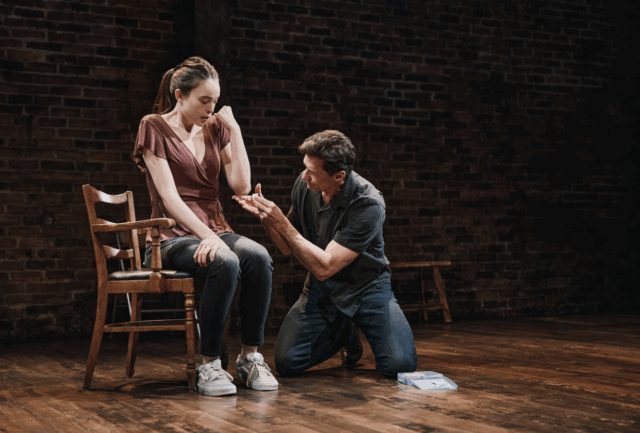
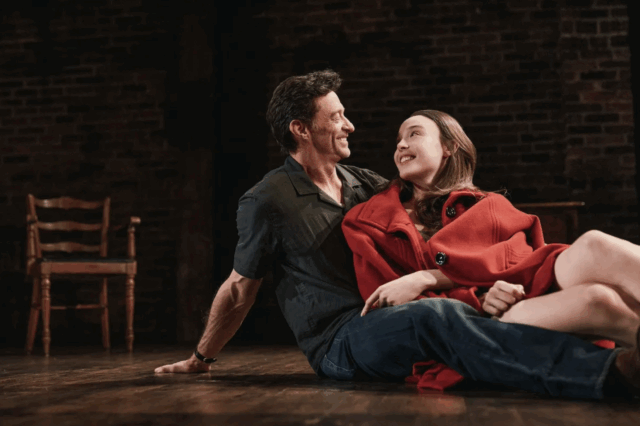
Author and professor Jon (Hugh Jackman) tends to student and fan Annie (Ella Beatty) in Sexual Misconduct of the Middle Classes (photo by Emilio Madrid)

SEXUAL MISCONDUCT OF THE MIDDLE CLASSES
Audible’s Minetta Lane Theatre
18 Minetta Lane between Sixth Ave. and MacDougal St.
Through June 18, $35-$298.50
www.audible.com

Sexual Misconduct of the Middle Classes might not quite be the story of the Big Bad Wolverine and Little Red Riding Hood, but it is an intriguing and thought-provoking adult fairy tale with a marvelous final twist and purposely ambiguous moral.

Hugh Jackman makes a curious choice for his off-Broadway debut and the inaugural show from his new company, Together, a collaboration with Audible, but it is an alluring and tantalizing success.

Cofounded by the Emmy–, Grammy–, and Tony–winning and Oscar-nominated Jackman with megaproducer Sonia Friedman, Together is “dedicated to live theater that is intimate and accessible . . . driven by a commitment to offering audiences a chance to experience theater in a fresh and engaging way” — including making half of the tickets available for free or $35. That’s precisely what happens with the New York premiere of Canadian playwright Hannah Moscovitch’s 2020 Sexual Misconduct of the Middle Classes, a pre-#metoo story about a relationship between a hunky college professor and a nineteen-year-old student that offers new insights on a familiar subject.

As audience members are still taking their seats, a young woman (Ella Beatty) moves around furniture on Brett J Banakis and Christine Jones’s long, narrow, and relatively sparse set, consisting of a few chairs and tables, a desk, and a floor lamp that morph from an office to a porch to a hotel room. She’s not part of the crew, and why she is arranging the set will become clear later. Jon Macklem (Jackman), a professor and famous novelist, enters and starts speaking in the third person, addressing the audience directly while Annie sits off to the side, watching closely but dispassionately. We soon find out that she is Annie, a shy, somewhat awkward teenager who did not enjoy high school and is hoping college will bring her more confidence and freedom.

As he narrates, Jon surveys the audience, making eye contact with as many people as he can, in the orchestra and the balcony. A real charmer, he reacts in a friendly manner when he hears a particularly loud laugh, gasp, or titter. At one point he sits over the lip of the stage, his feet dangling mere inches from people in the first row. Isabella Byrd keeps the lights only slightly dimmed during his monologues, then lowers them to a more accustomed level when Jon interacts with Annie.

Jon (Hugh Jackman) and Annie (Ella Beatty) begin a complex relationship in Hannah Moscovitch play (photo by Emilio Madrid)

“Well, he was agitated: he didn’t know why, nothing came to him” are his first words. He wonders, “Could it be a fragment of . . . ? His publishers were waiting on a novel about turn-of-the-century lumberjacks, so hopefully this girl was a part of that, or . . . could be shoehorned into it? Because also: come on, a girl, a young girl? Wasn’t there something deadly about the ‘young girl’ as an object of fiction? Wasn’t it where writers went to expose their mediocrity? Because wasn’t it so often the ‘young girl’ who was grossly underwritten, a cipher, a sex object, reduced to a cliché by lust-addled men?”

He knows precisely why he’s agitated, and it has everything to do with the young girl as opposed to the third divorce he’s going through. He adds, sounding like the literature professor he is, “He was on the side of the Greeks: learning is a seduction. . . . The erotics of pedagogy . . . That was the sort of thing you couldn’t say out loud without getting fired.”

Annie sits in the front row of his class and lives right across the street from Jon. He is surprised when he sees her standing at his house while he mows the lawn, but another day he writes outside on his porch, hoping she stops by. With a hesitating naivete, she tells him she loves his work, that it means a lot to her that someone else in the world thinks like she does.

When she suffers an injury, he asks her inside so he can patch her up, making “an ashamed, apologetic face” at the audience. He knows where this might lead, understanding that it is wrong and feeling panic. “Well, this, he recognized, was very bad,” he admits to us, trying to find a way to “get her the fuck out of his house.” But instead, he is soon locked in her embrace.

Jackman (A Steady Rain, The Music Man) is terrific as Jon; the actor is so handsome, so charming — so physically close — and Jon is so aware of what he is doing that we don’t want to see him as a villain, instead giving him the benefit of the doubt whenever we possibly can, despite, as he is well aware, “the horrible predictability of it all.” (In addition, Jackman is performing his Live from New York with Love concert twice a month through October.)

In her third play, following the recent Appropriate and Ghosts, Beatty, whose parents are Warren Beatty and Annette Bening, brings to Annie a nearly impenetrable quality, never giving away just how innocent she may or may not be, whether she is predator or prey, victim or ingénue, or whether a nineteen-year-old student can ever take responsibility for an affair with her college professor. When Jon is addressing the audience in third person, Annie sits in one of the chairs at stage left, with her ever-present red coat — the only burst of color in Ásta Bennie Hostetter’s otherwise subdued, naturalistic costumes — watching Jon, her eyes riveted but not in the same way ours are.

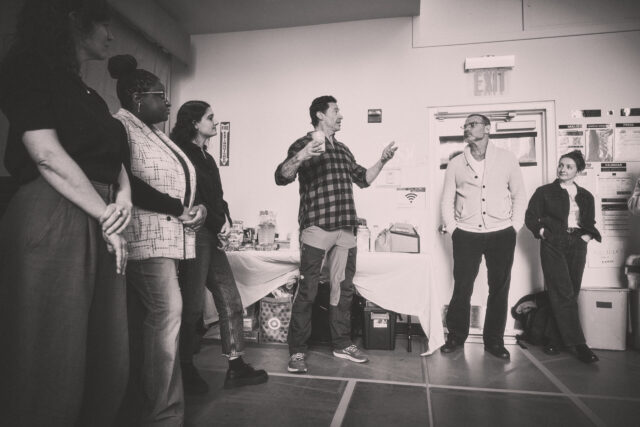
Hugh Jackman, Liev Schreiber, and others rehearse for two Together plays running in repertory at Audible theater (photo by Guy Aroch)

Three-time Olivier winner Ian Rickson (Jerusalem, The Weir), who previously directed Jackman in Jez Butterworth’s The River, guides the proceedings with a sure hand, maintaining an air of mystery as the relationship grows more complicated, perhaps more like that between J. D. Salinger and Joyce Maynard than the one in David Mamet’s two-character Oleanna. Moscovitch, whose 2016 Bunny also involves a sexual liaison between a male professor and one of his female students, avoids falling into any traps; her dialogue is concise and believable, and Jon and Annie are no mere cardboard cutouts but complex characters who are not sure what they want — or what they don’t.

Sexual Misconduct of the Middle Classes, which is running in repertory through June 18 with Jen Silverman’s new adaptation of August Strindberg’s Creditors, with Liev Schreiber, Maggie Siff, and Justice Smith, is not a he said/she said cliché-ridden narrative but a tense, realistic parable with plenty of bite and a finale that will have the drama spinning back through your mind for a long time to come.

[Mark Rifkin is a Brooklyn-born, Manhattan-based writer and editor; you can follow him on Substack here.]
EVERYTHING’S NOT COMING UP ROSES: OLD FRIENDS ON BROADWAY

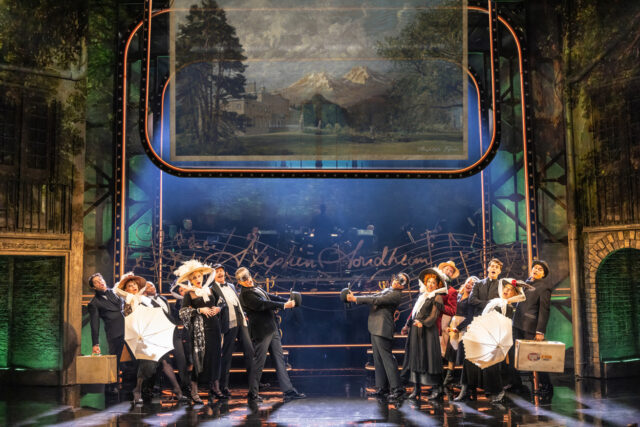
Stephen Sondheim’s Old Friends honors the theater legend on Broadway (photo by Matthew Murphy)

OLD FRIENDS
Samuel J. Friedman Theatre
261 West Forty-Seventh St. between Broadway & Eighth Ave.
Tuesday – Sunday through June 15, $110-$422
www.manhattantheatreclub.com

During intermission of Stephen Sondheim’s Old Friends at the Samuel J. Friedman Theatre, I thought about how much the surprisingly underwhelming MTC production felt more like a gala fundraiser than a fully fledged musical — especially one that bills itself as “a great big Broadway show.”

When I got home, I discovered that was precisely the case: It started out as a one-night-only concert presented on May 3, 2022, in London’s West End, a collaboration between Stephen Sondheim and producer Cameron Mackintosh to celebrate their long friendship. Sondheim had died on November 26, 2021, but the show went on, and the concert turned into a tribute to the eight-time Tony winner and New York City native. It was then adapted for a run at the Gielgud Theatre in London on its way to the Great White Way.

Old Friends is two and a half hours (with intermission) of Sondheim songs, performed by an ensemble of nineteen actors, highlighted by two-time Tony winner and four-time Emmy and Grammy nominee Bernadette Peters, who has appeared in five Sondheim shows, and Tony winner and two-time Grammy nominee Lea Salonga, whose only previous Sondheim credit is a 2019 Manila production of Sweeney Todd in which she played Mrs. Lovett. Peters and Salonga introduce the show to uproarious applause but neither is the standout, as a few others steal the spotlight.

The show consists of forty-two songs from fourteen musicals, mostly staged in front of a glittery raised bandstand where the fourteen-piece orchestra performs. The singers and dancers come out for each number in different costumes by Jill Parker, often inspired by the original production, and range from classy to silly. Matt Kinley’s set also features two sliding towers on either side; George Reeve adds projections of the New York City skyline, a forest, and other locations on the back brick wall and on small screens that descend from the ceiling.

Director Matthew Bourne and choreographer Stephen Mear are never able to achieve any kind of flow in the proceedings, primarily because the members of the cast all have distinct styles, vocal ranges, and physical abilities. In addition, the numbers just don’t stand up on their own; Peters tries to bring heft to “Children Will Listen” (Into the Woods), “Send in the Clowns” (A Little Night Music), and “Losing My Mind” (Follies) and Salonga belts out “Everything’s Coming Up Roses” (Gypsy), but it feels more like a cabaret revue with syrupy arrangements.

Faring much better are understudy Paige Faure, who is hilarious as the disgruntled bride-to-be in “Getting Married Today” from Company, Bonnie Langford, who nails “I’m Still Here” as Carlotta Campion from Follies, and Tony winner Beth Leavel, who knocks it out of the park as Joanne in “The Ladies Who Lunch” from Company.

The men, led by Gavin Lee (“Live Alone and Like It” from Dick Tracy), Jason Pennycooke (“Buddy’s Blues” from Follies), Jeremy Secomb (“My Friends” from Sweeney Todd), and Kyle Selig (“Everybody Ought to Have a Maid” from A Funny Thing Happened on the Way to the Forum with Lee and Secomb), all overplay their hand, trying too hard.

Songs from West Side Story, Sweeney Todd, Into the Woods, and Sunday in the Park with George receive more detailed stagings but get lost in the shuffle. There are also tunes from Anyone Can Whistle, Passion, Merrily We Roll Along, Bounce, and The Mad Show with such other performers as Jacob Dickey, Kevin Earley, Jasmine Forsberg, Kate Jennings Grant, Bonnie Langford, Joanna Riding, Maria Wirries, and Daniel Yearwood.

There’s an adorable clip of Sondheim at the piano with Andrew Lloyd Webber from the two-day June 1998 concert Hey, Mr. Producer!, which lauded Mackintosh’s career, but it also reinforces how bumpy and uneven the evening is and how much better it could have been. There’s a reason why Old Friends received no Tony nominations and only one Drama Desk nod, for Mick Potter’s sound design; I can confirm that the show sounds terrific.

[Mark Rifkin is a Brooklyn-born, Manhattan-based writer and editor; you can follow him on Substack here.]
THE FRAGILITY OF LIFE AND THE PASSAGE OF TIME: FOUR BY CARYL CHURCHILL

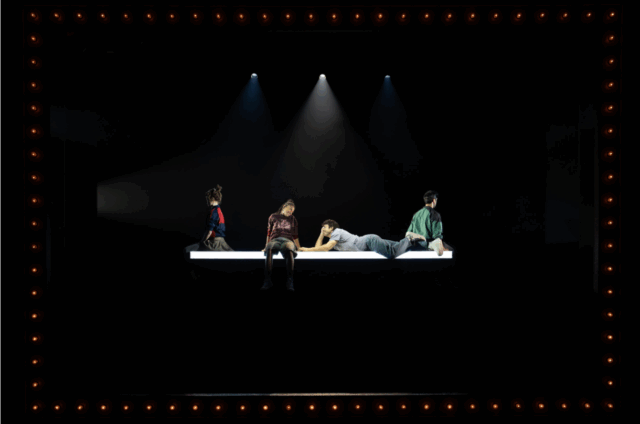
Caryl Churchill’s Glass. takes place on a glowing, floating platform (photo by Joan Marcus)

GLASS. KILL. WHAT IF IF ONLY. IMP.
Martinson Theater, the Public Theater
425 Lafayette St. at Astor Pl.
Tuesday through Sunday through May 25, $89
212-539-8500
publictheater.org

British playwright Caryl Churchill burrows into the fragility of human life and the concept of impermanence in Glass. Kill. What If If Only. Imp., four short works being performed together at the Public’s Martinson through May 25.

For more than fifty years, Churchill, now eighty-six, has been writing inventive, experimental plays that challenge audiences through abstract narratives and unique, unexpected stagings, from Cloud Nine and Top Girls to Vinegar Tom and Love and Information, creating her own genre, with flourishes of Beckett, Pinter, and Brecht mixed in. The four-time Obie winner has penned more than fifty works for the stage, radio, and television; three of the pieces at the Public were written in 2019, the fourth in 2021. (Glass., Kill., and Imp. were originally performed with Bluebeard’s Friends at the Royal Court Theatre in September 2019 but has been replaced here by What If If Only, her latest play.)

The 135-minute show (with intermissions) is a triumph for both Churchill and Miriam Buether, whose breathtaking sets lift Churchill’s themes to the next level, along with stunning lighting by Isabella Byrd and compelling sound by Bray Poor, making it a visual and sonic treat. First up is Glass., which unfolds on a glowing rectangular platform hanging in the middle of the space, surrounded by darkness. It’s a kind of mantel where a Girl Made of Glass (Ayana Workman), a Clock (Sathya Sridharan), a Vase (Japhet Balaban), and a Red Plastic Dog (Adelind Horan) interact, attempting to define their existence and importance.

“She doesn’t want to be touched. She’s afraid of being broken,” the Girl’s protective mother says, explaining how there are many cracks in her daughter, who needs bubble wrap to go out.

The defensive Clock tells the Girl, “You’re beautiful but I’m also useful.” The Girl responds, “A clock isn’t useful anymore. Who looks at you? Time’s on the phones.” The Clock answers back, “They look at me because I’m worth looking at. Time from me is richer because I’m old and time’s run through me since before their parents were born. And you see it flow because my second hand goes round and my minute hand goes round and my hour hand goes slowly round and there’s none of this digital jumping. You gaze at me and think how long a minute lasts. Pain for a whole minute would be torture. Joy for a whole minute would be exceptional. And even if I stopped I’d be kept as an object because my history is intriguing and my shape is graceful and my value is unquestioned.”

The Dog says she is a reminder of happy times, even if she’s dusty and hasn’t been played with in years. The Vase is thrilled when the Girl says he is beautiful even without flowers. A group of schoolgirls stop by and taunt the Girl. A friend tells her a secret.

The play ends with a moving monologue in which the Girl expresses her fears in a way we can all relate to, how easy it is to become physically and emotionally damaged.

During the first break, hand balancer Junru Wang performs remarkable feats on canes in the pit in front of the stage as the set is changed behind the red velvet curtain. Wang pushes herself high into the air, stretching, switching hands, and contorting her limbs, a dazzling display of what the human body is capable of, a thrilling counterpoint to the delicate Girl Made of Glass.

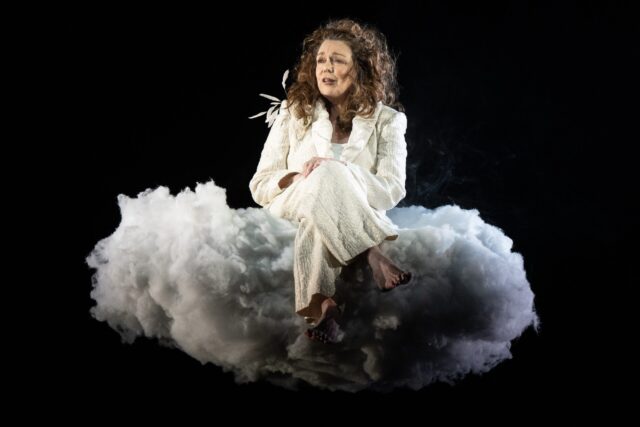
Deirdre O’Connell relaxes on a cloud while talking about death in Kill. (photo by Joan Marcus)

In the solo Kill., Tony winner Deirdre O’Connell, wearing all white, sitting comfortably on a floating cloud in a black sky, delivers a treatise on the gods’ power over humans, treating them as playthings as they watch them murder one another as if orchestrating a Greek tragedy for fun. Fathers, mothers, husbands, brothers, cousins, lovers, and kings are brutally murdered, sent to hell, eaten, brought back for more punishment — it’s a vicious cycle of death and destruction put on for pleasure, a sly comment on the theater itself as well as the violence inherent in everyday life.

She begins, “We take this small box and shut the furies up in it, they’re furious and can’t get out, they say let us out and we’ll be kind. We gods can do that sometimes, quieten the furies, we can’t do everything, we don’t exist, people make us up, they make up the furies and how they bite. They’re after the boy, they won’t let him sleep or wake or sleep and he suffers. He suffers and suffers because he kills his mother, which we’re against and so is everyone but he has his reason so he’s right and wrong. He kills his mother, hoping she’ll die quickly, it can’t be over quickly enough, he doesn’t want her unrecognisable but still here, both slipping in the blood, his duty to do it, everyone thinks that and so do we, and he kills her lover happy to kill him but taking out the knife he remembers loving his mother and the nonsense words they’d say to each other though he still has the same hate in his heart coming home as when he’s little and runs away when she’s killing his father.”

It’s a tour de force for O’Connell, the words spilling out in a nonstop poetic assault that underlines humanity’s penchant for real and fictional violence; Churchill also questions the notion of faith, people’s belief that someone else is pulling the strings, be it a supreme being or, perhaps, a playwright, from Ancient Greece or twenty-first-century England. As the god says multiple times, “We don’t exist.”

During the second break, Maddox Morfit-Tighe juggles clubs, involving a few audience members; it’s not as awe-inspiring as what Wang did, and the metaphor is more obvious, but it is still entertaining as the stage is prepared for the third tale.

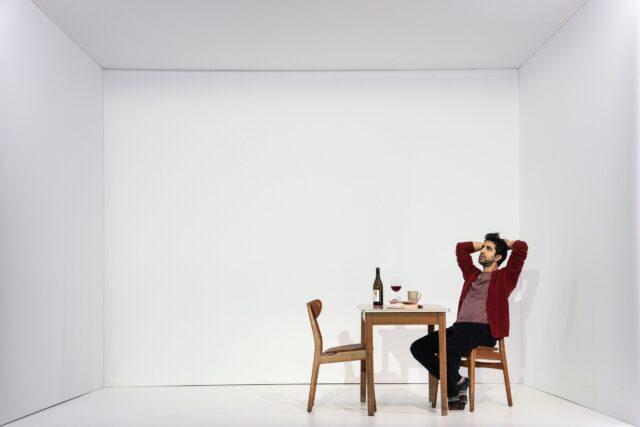
A man (Sathya Sridharan) faces loss in What If If Only. at the Public (photo by Joan Marcus)

What If If Only. is set in a mysterious large white cube reminiscent of Churchill’s Love and Information. A man identified in the script as Someone on Their Own (Sridharan) is sitting at a small table with a bottle of wine and two chairs; it is apparent that he is waiting for a person who is unlikely to come.

“If I was the one who was dead would you still be talking to me? We once said if one of us died if there was any way of getting in touch we should do it, I thought we’d be old. Are you not trying?” he says. “If you’d wanted to talk to me you could have stayed alive. I’ve nothing to say really, I just miss you. I once thought I saw a ghost, not spooky like Halloween, just a wisp of something standing in the door. I’ve told you this already, do you remember? Is remembering something you can do or has it all gone now? I miss you I miss you I miss you I miss you. I miss you. Please, can you? Just a wisp would be fine. If you can, please. Please, I miss you. A small thing, just any small thing, let me know you’re there somewhere. If you can.”

A woman (Workman) does arrive, but the man is not sure what or who she is. They agree she is at least a little like his lost love, then talk about regrets and possibilities, living and dying. She tells him, “I’m the ghost of a dead future. I’m the ghost of a future that never happened. And if you can make me happen then there would be your beloved real person not a ghost your real real living because what happened will never have happened what happened will be different will be what you want will be a happy happy.”

Soon the walls of the white cube rise and others enter, including a young girl (Cecilia Ann Popp), Asteroid, Empire, Silver, Nature, Small, and a calm, supportive older man (John Ellison Conlee) who tries to help the younger man face the reality of his situation, that there are so many futures but only one that will happen. It’s a gorgeous existential conversation with a surprise conclusion.

Imp. concludes quartet of existential works by Caryl Churchill (photo by Joan Marcus)

Imp. follows a full intermission (without acrobatics), featuring another brilliant set, this time a raggedy living room with a couch, a comfy chair, a floor lamp, and a red oriental rug on a slanted platform. It is the home of nonkissing cousins Jimmy (Conlee) and Dot (O’Connell), who bicker like an old married couple with nothing better to do. While the widowed Jimmy occasionally gets up to go running, training for a half marathon, the divorced Dot never leaves her chair.

Their several-times-removed Irish niece, Niamh (Adelind Horan), was recently orphaned, so she is visiting Jimmy and Dot while making a new life for herself in England. When Niamh says she needs to lose a stone by summer, Dot disagrees and says, “You’re lovely how you are. Don’t do it.” Jimmy argues, “Leave her alone, goals are good, you want everyone not to be fit so they’re no better than you. Just like you want everyone to be miserable.” Dot barks back, “You’re fattist is what he is, not he’s the fattest, Niamh, I mean like racist.” It’s rarely easy to parse Dot’s logic.

Another day they are speaking with the homeless Rob (Sridharan), a world traveler who’s been sleeping in a cemetery, wanting to go back to his son and estranged wife. The ever-suspicious Dot worries that if they let him stay in their house, he might kill them and take the residence for himself. “Why would he want to do that? He’s not stupid,” Jimmy says. Dot replies, “But if he could get away with it and have the flat. Don’t tell me you’ve never thought it.” Rob deadpans, “I’ve never thought it.” Soon Dot and Jimmy are hoping that Niamh and Rob get together.

They delve into faith and religion, with Niamh wondering what being Catholic ever did for her except make her terrified of sin and hell. Dot, a former nurse, is afraid of her temper, which might have cost her her marriage and career. Rob is deeply worried about his immediate future. Meanwhile, Jimmy is an eternal optimist.

But when Jimmy tells Rob about the bottle Dot keeps that she claims has a wish-giving imp in it, new questions arise about what’s next.

There might be a period after the name of each part of Glass. Kill. What If If Only. Imp., but they form a cohesive whole in this stellar production, gorgeously directed by longtime Churchill collaborator James Macdonald (Infinite Life, Escaped Alone). In three of the four plays, the characters wear Enver Chakartash’s casual, naturalistic costumes (O’Connell is in heavenly garb in Kill.), equating them with the audience, making the otherworldliness more believable. The pain of loss, the brittleness of life, the lack of power humans have over their destiny hover over all four plays. In each one, there is also trepidation about the future of each character, the sets tilted and suspended in ways that make it seem like the actors could at any moment fall off into the darkness or be trapped in blazing white light.

Churchill and Macdonald practically implore us to take a look at ourselves and examine how we deal with faith, grief, and, perhaps most important, time. “I sit on the mantelpiece and time goes by,” the Girl says in Glass. The characters in the other three works also are often sitting down, not taking action but watching and waiting.

It’s enough to force you to face your own future once you get out of your theater seat and venture back into the real world.

[Mark Rifkin is a Brooklyn-born, Manhattan-based writer and editor; you can follow him on Substack here.]
CABIN FEVER: FACING GRIEF AT SUMMER CAMP

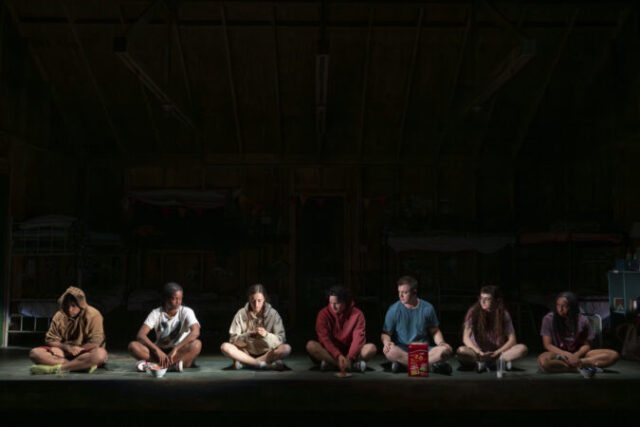
Six campers and a counselor search for healing in Grief Camp (photo by Ahron R. Foster)

GRIEF CAMP
Atlantic Theater Company, Linda Gross Theater
336 West 20th St. between Eighth & Ninth Aves.
Tuesday – Sunday through May 11, $56.50-$111.50
866-811-4111
atlantictheater.org

There has been a surfeit of plays about grief the last few years, most of them involving children and/or adults sitting around in circles in group or family therapy, sharing their personal stories. In her off-Broadway debut, twenty-seven-year-old Eliya Smith, who is in her final semester in the University of Texas at Austin’s MFA playwriting program, takes a different approach in the fiendishly clever Grief Camp, continuing at the Atlantic through May 11.

Bereavement camps have been popping up all over, offering healing for those who have lost loved ones; they have such names as Camp Good Grief, Comfort Zone Camp, and Camp Hope. Smith sets her tale at an unnamed summer camp in the real town of Hurt, Virginia. (It was named for a local landowner and attorney, not the pain of loss.)

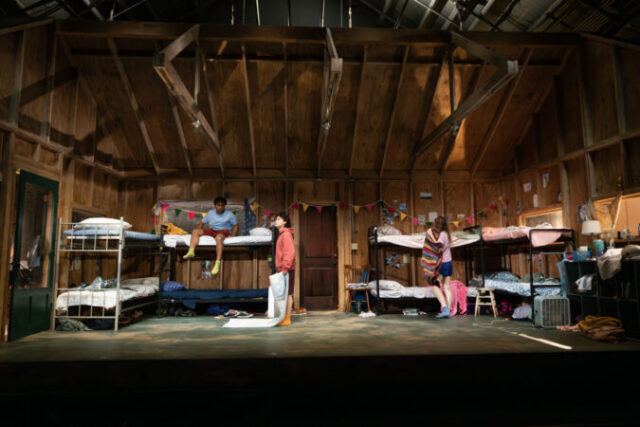
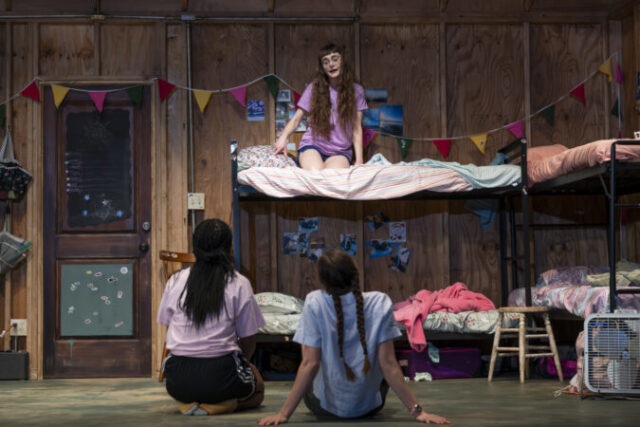
Louisa Thompson’s set is a large, somewhat disheveled cabin with four double bunk beds, two electric box fans on the floor, a bathroom in the back, and a small porch with a swing chair outside. On the natural wood walls are pages torn out of magazines, postcards, and a string of colored pennants.

It is home to six campers and one counselor: Bard (Arjun Athalye), who is addicted to Duolingo; Luna (Grace Brennan), a Los Angeles vegetarian who wants to be an artist; Blue (Maaike Laanstra-Corn), who is writing the rather strange musical untitled mansion island purple house project for her high school; Gideon (Dominic Gross), a cool dude who can’t swim and is worried about his missing green dinosaur; Olivia (Renée-Nicole Powell), who doesn’t look forward to any of the scheduled activities; her younger sister, Ester (Lark White), who hates grief camp; and Cade (Jack DiFalco), a former camper who is now a counselor, living and working with the others in the cabin.

Grief Camp continues at the Atlantic through May 11 (photo by Ahron R. Foster)

Each morning, everyone is woken up by the camp’s founder, the never-seen Rocky, who blows a terrible reveille on the trumpet, makes announcements, gives the weather report, and advises some form of “Rise and shine, kids! Welcome to another perfect day from which to begin the rest of your lives.” It’s not the most encouraging or original bromide.

Over the course of about ten days — the script calls it a “time soup” — the campers bond, argue, battle with the counselors, and avoid getting caught up in woe-is-me self-pity. Esther is afraid she is a terrible person and confides in Luna. Blue holds readings of her ever-morphing musical. Campers are sick of chores, pray to the toenail god, and fight over the bathroom. A guitarist sits in the swing chair and sings Debbie Friedman’s rendition of “Mi Shebeirach,” the Jewish prayer for healing. The campers don’t mope around in mourning or compare one another’s tragedies, although there is a palpable feeling of grief permeating the atmosphere.

In a one-on-one with Olivia, Cade tells her to take out her journal and address the following prompt: “Sometimes, in our grief, we invent guilt in order to feel control over a situation. Sound familiar? Of course it does. So go ahead. Address that guilt head on. Apologize to the person to whom you feel guilt. Explain how you would —”

Olivia cuts him off, wanting to just talk instead. They discuss college, flirting, and Olivia’s different-colored eyes. Olivia asks Cade why he keeps coming back to the camp; he replies, “This place saved my life.” A moment later, Olivia says, “If I had to come back here I suspect I would kill myself.”

Blue (Maaike Laanstra-Corn) discusses the high school musical she’s writing in Eliya Smith’s off-Broadway debut at the Atlantic (photo by Ahron R. Foster)

In another scene, Cade strongly advises, “At some point, Olivia, you’re gonna have to stop acting like you’re broken.” That line serves as the centerpiece of the ninety-minute play. Smith and Tony-nominated director Les Waters (Dana H., Big Love) carefully avoid any lapses into sentimentality or solipsism, treating Cade and the campers like unique characters in their own right and not as plot points to rhapsodize about grief. In fact, we don’t even learn the specific loss that each camper experienced, only some of them. In addition, Blue’s oddball musical slowly twists into focus but without becoming obviously metaphorical.

The ensemble, several of whom are making their off-Broadway debut, engagingly portray complex characters about to move on with their lives but not yet ready to face the world. The realistic costumes are by Oana Botez, with sharp lighting by Isabella Byrd and terrific sound design by Bray Poor, from rainstorms to Rocky’s staticky announcements to Luna singing into a floor fan.

Early on, Luna encourages Bard to curl up in the fetal position. He is tentative at first, but when he eventually tries it, he declares he is the biblical Moses in a basket on a river. “Why can’t you just be like a regular baby,” Luna says. Smith explains in the script, “The children are not precocious wunderkind iconoclasts or tiny prophets. They are not special. Something extraordinarily bad happened to each of them. They are ordinary.”

In other words, just like the rest of us.

[Mark Rifkin is a Brooklyn-born, Manhattan-based writer and editor; you can follow him on Substack here.]
UPTOWN SHAKESPEARE IN THE PARK: CTH IS DETERMINED TO STILL HOLD IT IN HARLEM

Free CTH summer productions such as A Midsummer Night’s Dream might be no longer possible after NEA withdraws funding (photo © 2024 by Richard Termine)

HOLD ’EM IN HARLEM
Renaissance New York Harlem Hotel Ballroom
233 West 125th St.
Thursday, May 22, $100-$1500, 6:00 – 11:00
Memnon: Marcus Garvey Park, July 5–27, free (tentative)
www.cthnyc.org

On May 22, the Classical Theatre of Harlem (CTH) will have its annual fundraising gala, at the Renaissance New York Harlem Hotel. Tickets for the “Hold ’Em in Harlem” benefit, comprising gambling games, a silent auction, an open bar, passed hors d’oeuvres, celebrity guests, and prizes, start at $100 for nonplayers and go up to $150 per poker player, $1,500 for a full player table, and $50,00 for exclusive sponsorship. The 2025 special guests are Malik Yoba, Grantham Coleman, Laila Robins, Russell Hornsby, Felix Solis, and Kevin “Dot Com” Brown. The money raised helps support CTH’s mission “to maintain a professional theatre company dedicated to returning the classics to the stages of Harlem; to create employment and educational outreach opportunities in the theatre arts; to create and nurture a new, young, and culturally diverse audience for the classics; and to heighten the awareness of theatre and of great art in Harlem.”

One of the highlights of each season is Uptown Shakespeare in the Park, free summer shows put on in Marcus Garvey Park; past years have featured Shakespeare’s A Midsummer Night’s Dream, Twelfth Night, and Macbeth in addition to Betty Shamieh’s Malvolio, Will Power’s Seize the King, and A Christmas Carol in Harlem.

However, this year’s summer production, Power’s Memnon, about an Ethiopian king who travels to Troy to fight for the Trojans, is in danger of being canceled because the National Endowment for the Arts has just started cutting arts funding to New York institutions, including CTH.

The letter from the NEA blatantly states, “Pursuant to the Offer letter, the tentative funding recommendation for the following application is Withdrawn by the Agency and the National Endowment for the Arts will no longer offer award funding for the project. The NEA is updating its grantmaking policy priorities to focus funding on projects that reflect the nation’s rich artistic heritage and creativity as prioritized by the President. Consequently, we are terminating awards that fall outside these new priorities. The NEA will now prioritize projects that elevate the Nation’s HBCUs and Hispanic Serving Institutions, celebrate the 250th anniversary of American independence, foster AI competency, empower houses of worship to serve communities, assist with disaster recovery, foster skilled trade jobs, make America healthy again, support the military and veterans, support Tribal communities, make the District of Columbia safe and beautiful, and support the economic development of Asian American communities. Funding is being allocated in a new direction in furtherance of the Administration’s agenda. Your project, as noted below, unfortunately does not align with these priorities.”

CTH’s free performances result in tens of thousands of audience members, hundreds of jobs, and an economic impact of more than $600,000 on Harlem. CTH also hosts indoor theater, a literary series at Harlem Stage, acting classes for kids, the Behind the Curtain exclusive interview and Icons series, and career development resources. Apparently, those are no longer priorities for the current administration.

“This isn’t just a line item — it’s a devastating blow to the working artists, small businesses, and Harlem families who count on this production every year,” CtH producing artistic director Ty Jones said in a statement. “This is a fight for cultural equity, artistic freedom, and the soul of Uptown.”

In order for the show to go on — Memnon is scheduled to run July 5–27 — donations are needed now. If you can give, please do so; every $60 equals a free seat at the show, while $500 supports a week of rehearsals for one performer.

[Mark Rifkin is a Brooklyn-born, Manhattan-based writer and editor; you can follow him on Substack here.]
SEARCHING FOR HAPPINESS: ANDREW SCOTT AND SARAH SNOOK GO SOLO

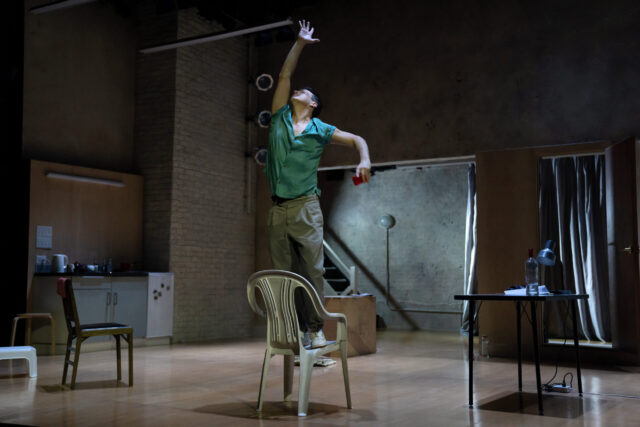
Andrew Scott reaches for dying hope in Vanya at the Lucille Lortel (photo by Julieta Cervantes)

VANYA
Lucille Lortel Theatre
121 Christopher St. between Bleecker & Hudson Sts.
Tuesday – Sunday through May 11
lortel.org/currently-playing

There are currently two extraordinary solo shows, one on Broadway, one off, based on classic literary works from the 1890s, and they could not be more different.

Both feature extremely talented and sexy award-winning actors from English-speaking countries overseas; in one, the performer creates a warm, intimate space, attempting to make individual eye contact with each of the 299 audience members, while in the other the star spends nearly the entire show looking directly into onstage cameras, although every one of the 1,025 audience members will feel the power and intelligence in that gaze.

At the Lucille Lortel in the West Village, Dublin-born Andrew Scott, a three-time Emmy nominee and two-time Olivier winner who has portrayed Moriarty in Sherlock, the hot priest in Fleabag, the title character in Ripley, and Adam in Andrew Haigh’s well-received 2023 film, All of Us Strangers, is taking on all eight roles in Simon Stephens’s adaptation of Anton Chekhov’s 1899 Uncle Vanya, called simply Vanya.

Meanwhile, Adelaide-born Sarah Snook, an Emmy and Olivier winner who is most well known as Siobhan “Shiv” Roy in Succession, plays all twenty-six parts in Kip Williams’s adaptation of Oscar Wilde’s 1890 novella, The Picture of Dorian Gray.

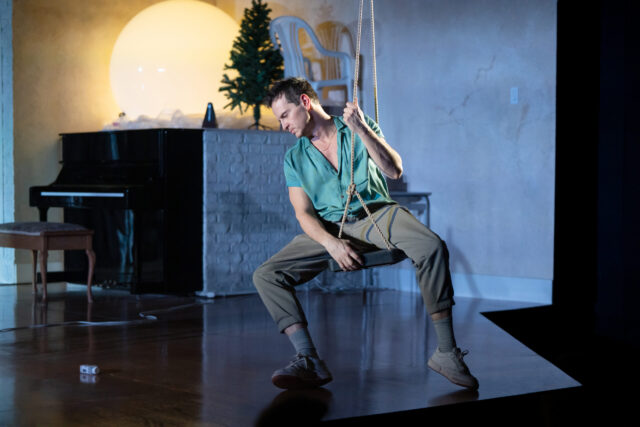
Under the whimsical direction of Sam Yates — who created the show with Scott, writer Stephens, and scenic designer Rosanna Vize — Scott, whose only previous New York stage appearance was in David Hare’s The Vertical Hour in 2006–7, employs only subtle shifts in his performance to indicate which character he is at any given moment, with slight vocal changes and the use of such objects as a tennis ball, sunglasses, a necklace, and a scarf. Vize’s attractive set includes a kitchen with a working sink, a door standing by itself in the center, a piano with a small Christmas tree on it, a glowing orb, a table with a lamp and bottle of booze, a large swing, and a curtained back wall that opens to reveal a mirror in which the audience can glimpse themselves, a way to combat the solitude of the solo performer and involve the audience even further.

It definitely helps to know the basics; as one colleague noted to me after the show, “I enjoyed it, but was it Uncle Vanya?” Over the years, the play has proved to be malleable, reshaped and reimagined into various time periods and locations and methods of storytelling. Tony winner Stephens, who has written such diverse presentations as The Curious Incident of the Dog in the Night-Time, Heisenberg, and Blindness, sets his version in an undefined time and place, although it seems to be the latter part of the twentieth century, before cell phones and home computers; he has Anglicized the names, added nearly three dozen F-bombs, and references the 1994 Johnny Depp movie Don Juan de Marco.

Ivan (Ivan Petrovich “Vanya” Voynitsky) and his niece, Sonia (Sofya Alexandrovna), run the family estate owned by Alexander (Aleksandr Vladimirovich Serebryakov), Sonia’s father; a pompous film director, he was married to Anna, Ivan’s late sister and Sonia’s mother. Alexander has arrived with his much younger second wife, Helena (Yelena Andreevna), who is lusted after by Ivan and the local country doctor and environmentalist, Michael (Mikhail Lvovich Astrov). Ivan’s cranky, well-read, aging mother, Elizabeth (Maria Vasilevna Voynitskaya), lives at the estate, along with the old nurse Maureen (Marina Timofeevna) and Liam (Ilya Ilich “Waffles” Telegin), a poor landowner and family friend who has not gotten over his wife’s desertion with another man years before, opting to remain faithful to her until her utterly unlikely return.

Andrew Scott takes a swing and scores as eight characters in solo Uncle Vanya (photo by Julieta Cervantes)

The play opens with a conversation between Michael and Maureen that relates to all the characters:

Michael: How long have we known each other, Maureen?
Maureen: Oh my god, Jesus. Let me think. You came here for the first time, when was it, when Anna, Sonia’s mother, was sick? Then you had to come again the next year. That was two visits in two summers before . . . before she died. So that’s eleven years, is it?
Michael: Have I changed, do you think?
Maureen: Oh god yeah. You have. You used to be so handsome. And you were so young then, Michael, and now you’re old. And of course you drink more than you used to, Michael.
Michael: Yeah . . . Yeah I’ve worked myself to the bone. I’m on my feet all day. I never rest. And then you get home and you pray to God a patient isn’t going to call you out again. But they do, they always do. So in all the time I’ve known you, Maureen. In the last decade. I’ve not had a single day off. What do you expect me to do but get old? And then you look around you and all you can see are lunatics. The people here are lunatics, Maureen. Every single one of them. And when you surround
yourself with lunatics, after a while, you become a lunatic too. I’ve started growing my own carrots. Little tiny carrots. How did that happen? See, I’ve become a lunatic too. It’s not that I’m losing my mind. My brain is still largely in the right place. But my feelings are dull and dead. I don’t want anything. I don’t need anything. I don’t love anybody. Except you. I love you, Maureen.
Maureen: Are you sure you don’t want a drink?

Shortly after that, Ivan, who deeply resents Alexander, explains to Michael and Maureen that he hasn’t been sleeping well, “ever since Alexander and his new wife got here. They’ve knocked our lives completely out of kilter. I sleep really deeply at absolutely the wrong times of day. I’m eating all this weird food. From, like, Kabul. I’m drinking wine in the day. It’s not good for me, Doctor. It’s not good for me at all. Before they got here I didn’t have a moment to spare, did I, Maureen? I was working all the time. Me and Sonia were. Preparing the harvest. Managing the orders. Making deliveries. Now it’s just Sonia that’s doing everything, because all I do is eat, sleep, drink, repeat, eat, sleep, drink, repeat!”

But when Alexander reveals his plans for the estate and Ivan catches Michael with Helena, one of the most famous guns in the history of theater explodes.

Vanya is a unique and thrilling experience. Scott is absolutely magnetic; you won’t be able to take your eyes off him, just as it feels like he can’t take his eyes off you. There are odd moments; turning Alexander into a film director feels unnecessary, and a sex scene is both steamy and awkward, given that Scott is playing both roles.

But overall, the hundred-minute show is as wistful and funny as it is heart-wrenching and touching. The incorporation of the piano to recall Anna is haunting, and the swing evokes a more innocent childhood for Ivan, Scott, and the audience.

Early on, Elizabeth tells Ivan, “You’ve changed, Ivan. Sorry, Sonia, but it’s true. You’ve become cynical. I barely recognize you these days. You had a good soul. You used to be so clear in your convictions. They used to shine from you. . . . What’s odd, Ivan, is that it’s like you blame your misery on your convictions. Your convictions aren’t the problem. You’re the problem. You never put your convictions into practice. You could have gone out and done something. You never did.” Vanya responds, “Done something? Do you have any idea, Mother, how difficult it is to go out and ‘do something’ nowadays?” That’s an exchange everyone can relate to in 2025.

So is it Uncle Vanya?

In Andrew Scott’s capable hands, does it matter?

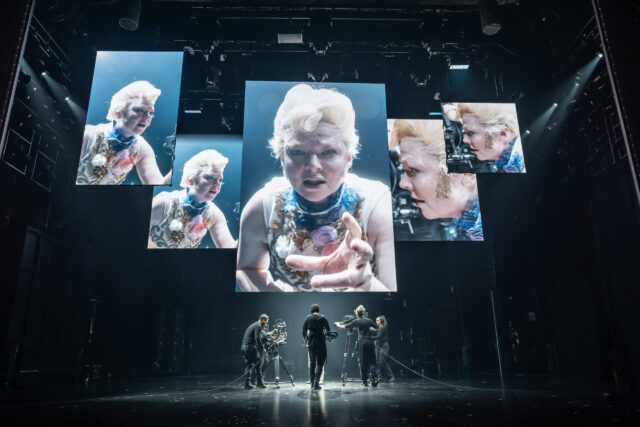
Sarah Snook portrays all the characters in unique staging of Oscar Wilde classic (photo by Marc Brenner)

THE PICTURE OF DORIAN GRAY
Music Box Theatre
239 West 45th St. between Broadway & Eighth Aves.
Tuesday – Sunday through June 29, $74–$521
doriangrayplay.com

Sarah Snook is sensational in her New York stage debut, portraying all the characters in Kip Williams’s exciting solo adaptation of Oscar Wilde’s beloved homoerotic gothic horror morality tale, The Picture of Dorian Gray. For two hours without intermission, Snook, who won an Olivier for her performance in London, ambles across the stage, followed by several mobile cameras operated by Clew, Luka Kain, Natalie Rich, Benjamin Sheen, and Dara Woo, dressed in black, stopping behind and in front of several large screens hanging from the ceiling. A giant Snook is projected onto the screens, dominating the theater as she smiles, winks, and nods knowingly while the dark story unfolds.

The genius in the Sydney Theatre Company production is that the onstage Snook interacts with prerecorded versions of herself as the other characters; thus, the live Snook is seen having conversations with the others on the screens, sometimes several at a time, all aware that they are being looked at and reveling in that connection.

Artist Basil Hallward has painted a portrait of a beautiful young man named Dorian Gray. Showing the work to his aristocratic friend Lord Henry “Harry” Wotton, who wants it to be shown publicly at a prestigious event, Hallward declines, explaining, “I know you will laugh at me, but I really can’t exhibit it. I have put too much of myself into it. . . . Harry, every portrait that is painted with feeling is a portrait of the artist, not of the sitter. The reason I will not exhibit this picture is that I am afraid that I have shown in it the secret of my own soul.”

Dorian arrives at the studio to continue to pose for Basil, who does not want Lord Wotton to corrupt his innocent young model and new friend. He tells Harry to stay away from him, offering, “He has a very bad influence over all his friends, with the single exception of myself.” Dorian asks, “Have you really a very bad influence, Lord Henry? As bad as Basil says?” Lord Wotton replies, “There is no such thing as a good influence, Mr. Gray. All influence is immoral.” Saying he is glad to have met Lord Wotton, Dorian admits, “I wonder shall I always be glad?”

Upon seeing the finished portrait, Dorian is blissful yet taken aback. “How sad it is! How sad it is! I shall grow old, and horrible, and dreadful. But this picture will remain always young. It will never be older than this particular day of June,” he declares. “If it were only the other way! If it were I who was to be always young, and the picture that was to grow old! For that — for that — I would give everything! Yes, there is nothing in the whole world I would not give! I would give my soul for that!”

And thus, the deal is done.

Sarah Snook briefly takes a seat in The Picture of Dorian Gray (photo by Marc Brenner)

Dorian is taken under the wing of Lord Wotton’s aunt, Lady Agatha, and meets such high-society types as the Duchess of Harley, parliamentarian Sir Thomas Burdon, the charming gentleman Mr. Erskine of Treadley, and the silent Mrs. Vandeleur, an old friend of Lady Agatha’s who decided she had “said everything that she had to say before she was thirty.” Among the others who enter Dorian’s kaleidoscopic world are his housekeeper, Mrs. Leaf; actress and puppeteer Sibyl Vane; Francis Osborne, the doorman; chemist Alan Campbell; Dorian’s friend Adrian Singleton; and Sybil’s younger brother, sailor James Vane.

Murder, suicide, and other forms of mayhem ensue as Dorian’s bloom of youth and beauty never seem to fade despite his depravities while the portrait depicts an ever older and more decrepit figure.

Marg Horwell’s set is mostly spare except for a few props that appear briefly, such as a long table, a puppet show, and an elegant couch with flowers; Horwell’s period costumes and the many wigs Snook wears are fanciful and ornate. The pinpoint precision of Nick Schlieper’s lighting, Clemence Williams’s sound and music, and David Bergman’s video makes it all feel real, especially one scene in which a group is seated at a long table; it is not immediately clear which Snook is the live one. Williams and Bergman also have fun using face filters as Snook cheekily poses for the camera.

The only time Snook is not looking directly into the camera is when she is in the nursery, admiring herself in a handheld mirror; in one corner is a collection of portraits based on paintings by such artists as Sebastiano del Piombo, Jean-Étienne Liotard, and Bronzino, but each now with Snook’s face.

Snook is remarkable as the narrator and all the characters, able to engage with an audience she never actually looks at, acting to be seen on a screen as if the audience is watching a morphing portrait. Despite our being well aware of the artificiality of it all, we fall for the gambit hook, line, and sinker, sucked into this technological marvel; it is a Dorian Gray made for 2025.

It is also an excellent companion piece to Andrew Scott’s Vanya. Just as multiple characters in Stephens’s Chekhov retelling discuss how much others have changed, that concept is key to Dorian Gray as well, and not just in how the man in the portrait deteriorates but Dorian does not. “It’s nigh on eighteen years since I met him. He hasn’t changed much since then. I have, though,” Violet acknowledges. “You are quite perfect, Dorian. Pray, don’t change,” Lord Wotton insists. And Dorian asks of himself, “Was it really true that one could never change?”

In addition, an elusive happiness hovers over Vanya. “I may not have my happiness, Ivan. But I’ve got my pride,” Liam says. Michael debates whether he is happy or not. Sonia asks Helena if she is happy and she answers no. And Alexander brags, “I’m the only happy one in this whole bloody house.” Meanwhile, Lord Wotton says, “Pleasure is Nature’s test, her sign of approval. When we are happy, we are always good, but when we are good, we are not always happy.” And Dorian admits, “I have never searched for happiness. Who wants happiness? I have searched for pleasure.”

In completely different ways, both shows offer pleasures galore, delivering a happiness that will stay with you long after you leave the theater.

[Mark Rifkin is a Brooklyn-born, Manhattan-based writer and editor; you can follow him on Substack here.]