this week in theater

BLUE RIDGE

(photo by Ahron R. Foster)

Marin Ireland is riveting as a woman with anger issues in Abby Rosebrock’s Blue Ridge (photo by Ahron R. Foster)

Atlantic Theater Company
Linda Gross Theater
336 West 20th St. between Eighth & Ninth Aves.
Through January 27, $86.50
866-811-4111
atlantictheater.org

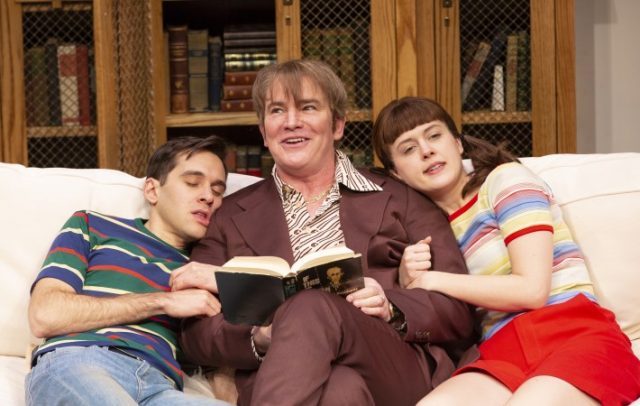
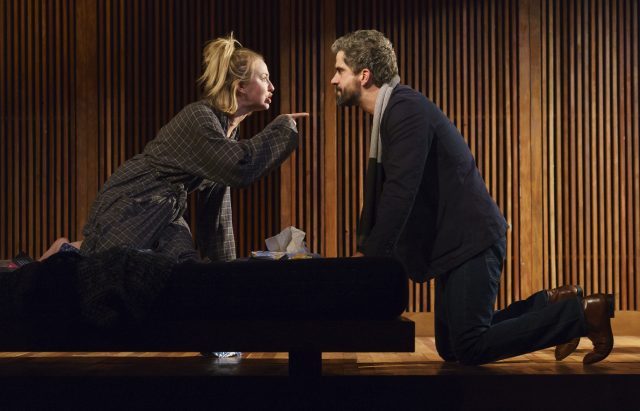
Marin Ireland sizzles as a high school English teacher with anger management issues in Abby Rosebrock’s Blue Ridge, which continues through January 27 at the Atlantic’s Linda Gross Theater. Ireland is Alison, a single woman who has been sentenced to six months at St. John’s Service House, a faith-based halfway home in western North Carolina, for having taken an ax to her principal’s car. The facility is run by Pastor Hern (Chris Stack) and his assistant, Grace (Nicole Lewis), who hold daily sessions in which either they or the residents read a Bible passage of their own choosing and then relate it to their life and addiction. Also living at the house is Cherie (Kristolyn Lloyd), another teacher; Wade (Kyle Beltran), a wannabe guitarist and songwriter; and the newly arrived Cole (Peter Mark Kendall), a young man who appears to be a bit addled. Alison has lost her license and been told she will never teach again, but she is determined to get a second chance and has opted for St. John’s because “the Yelp review said, ‘Best in Appalachia.’” Each of the characters has their own problems to solve, and Alison can’t help but get in the middle of most of them, unable to control her passion for what she considers the right thing to do, turning everything upside down as her inner rage threatens to bust out again.

(photo by Ahron R. Foster)

Blue Ridge is set in a halfway house for recovering addicts (photo by Ahron R. Foster)

Blue Ridge takes place in a quaint living room with a back window looking out at the woods behind the house, where freedom awaits. (The set design is by Adam Rigg.) Rosebrock (Dido of Idaho, Different Animals) creates well-drawn characters, each with their own touch of mystery, and she avoids being condescending to them, although it occasionally comes close. Cole’s game of “Tree or Stalin,” in which people have to guess an object in a twist on “Twenty Questions” (“Is it bigger than a breadbox?”), is odd and confusing, and one of the main conflicts seems forced, but Obie-winning director Taibi Magar (Is God Is, The Great Leap) wisely keeps the focus on Ireland. You can’t take your eyes off her; she’s constantly making small gestures and scrunching up her malleable face in extraordinary ways, each movement adding insight to her character, and you won’t want to miss a second of it. Ireland, who has won an Obie (Cyclone) and been nominated for a Tony (reasons to be pretty), two Drama Desk Awards (On the Exhale, Ironbound), and an Independent Spirit Award (Glass Chin), is one of New York’s finest actors; she makes anything she’s in worth seeing, and makes it better merely by her glowing presence.

BETWEEN THE THREADS / THE CONVENT

(photo by Ahron R. Foster)

A group of women seek answers about their unhappy lives in The Convent (photo by Ahron R. Foster)

THE CONVENT
Mezzanine Theatre at A.R.T./New York Theatres
502 West 53rd St. between Tenth & Eleventh Aves.
Tuesday – Sunday through February 17, $45
weathervanetheater.org
www.rattlestick.org

In the world premiere of Jessica Dickey’s The Convent, which opened last night at A.R.T./New York Theatres, six nondenominational spiritual seekers, all women, go on a weeklong retreat to find out who they are and what they want in life. In the world premiere of Coral Cohen’s Between the Threads, which opened tonight at HERE, five Jewish women talk about the limitations of growing up female in a religious tradition that limits their freedom to determine their own identity. There are numerous intriguing similarities between the two superb plays, from the very outset. In Between the Threads, the women are informally chatting with one another as the audience enters the space, the stage dotted with knitted dreamcatcher-like objects referencing weaving, which is traditionally considered women’s work, while in The Convent, one of the women is sweeping up leaves as the audience comes in; she then sits down and starts to sew. Both works also examine matriarchal lineages and the relationship among daughters, mothers, and grandmothers.

(photo by Ahron R. Foster)

Patti (Samantha Soule) watches Jill (Margaret Odette) express herself in new Jessica Dickey play (photo by Ahron R. Foster)

“I remember when I first climbed those stairs. I was penniless, lost, exhausted, but more than that — I was spiritually bankrupt,” Mother Abbess (Wendy vanden Heuvel) says after a new group of women enter the courtyard of the Convent. “No matter what has brought you, what you sacrificed to get here — no matter your past, your beliefs, if you’re rich or broke, thanks to the support of a generous few — you are welcome here.” Jill (Margaret Odette), Wilma (Lisa Ramirez), Tina (Brittany Anikka Liu), and Patti (Samantha Soule) have joined Dimlin (Annabel Capper) and Bertie (Amy Berryman) in the south of France, seeking insight into their lives. They all don similar long blue robes and share intimate details about themselves, filtering them through the nomen card they each select from a deck of female saints. (Nomen is Latin for “name,” but it also can be read as “no men.”) For example, Jill picks Teresa of Avila, Patti chooses Mechthild of Magdeburg, and Dimlin gets Catherine of Siena.

Each day is filled with chores and rituals, prayers and discussion sessions. While some of the characters are free and open, others are more tightly wound and self-protective; there is also a fierce tension between Patti and Mother Abbess. “You’re trespassing, you are not welcome at this retreat,” Mother Abbess tells the snarky Patti, who responds, “Now where’s the fun in that?” Mother Abbess strongly retorts, “I will do it. They’ll drag you cuffed and screaming. Don’t you dare fuck this up for this group of women.” They might be in a convent praying regularly to God, but this is no typical house of worship. In fact, Mother Abbess surprisingly declares, “I never liked church. I hated being told what to say, I hated being talked to through the words ‘he’ and ‘mankind.’ I felt like spirituality was this little peephole I was allowed to look through, into this room that other people got to be in. But spirituality is exactly what I was seeking. Sovereignty. True sovereignty.” Of course, not everyone gets what they were seeking.

(photo by Ahron R. Foster)

Mother Abbess (Wendy vanden Heuvel) faces her own demons in The Convent (photo by Ahron R. Foster)

Evoking Small Mouth Sounds, in which a diverse group of people join a silent retreat, The Convent takes place in the middle of the theater, the audience sitting on either side of Raul Abrego’s long, narrow, horizontal stage, which features medieval-style architecture and several plantings. The cast, wearing Tristan Raines’s costumes, often carries chairs on and off the concrete patio during prayers and discussions; Katherine Freer’s projections depict flowers blowing in the wind outside as well as Middle Ages paintings. Soule has the meatiest part, and she tackles it with relish as her character chortles, rolls her eyes, flirts with others, and often stands alone. Odette is excellent as Jill, a married woman with deep wounds, and vanden Heuvel (the artistic director of Weathervane Theater, which is presenting the play with Rattlestick) nails Mother Abbess, who harbors some dark secrets of her own. Dickey’s dialogue crackles with truth while Daniel Talbott’s direction is both warm and energetic.

(photo by Emily Hewitt)

Cousins gather for a bat mitzvah in Coral Cohen’s Between the Threads (photo by Emily Hewitt)

BETWEEN THE THREADS (JEWISH WOMEN PROJECT)
HERE Arts Center
145 Sixth Ave. at Dominick St.
Wednesday – Sunday through February 10, $25
212-647-0202
www.here.org
www.facebook.com

Truth is also central to Between the Threads (Jewish Women Project), in which co-creators Hannah Goldman, Lea Kalisch, Luisa Muhr, Daniella Seidl, and Laura Lassy Townsend essentially play themselves, telling their personal stories about the impact the Jewish religion has had on who they are and who they want to be. Hailing from the Ashkenazi, Sephardic, and Mizrahi traditions, they are joined by klezmer musician Zoë Aqua, who sits in a far corner playing the violin. “It’s not fair that people grow up. It’s not fair that you suddenly have to have your bat mitzvah and suddenly become a woman now and suddenly you can’t play with us,” Daniella says to Laura, adding, “Eventually, we will join your side for a lifetime of suffering. We too will become women.” The five women wear similar types of white or off-white clothing, either a skirt, a dress, or pants, and all are barefoot. (The costumes are by Johanna Pan, with set design by Lauren Barber.) The women prance about the stage fancifully, move about chairs to sit or stand on, and occasionally sing and dance as they relate the feminine aspects of their heritage, even including snippets of their mothers and grandparents talking.

(photo by Emily Hewitt)

Laura Lassy Townsend reads as Zoë Aqua plays the violin and the other women come together in world premiere at HERE (photo by Emily Hewitt)

The young women discuss immigration, rituals, weddings, funerals, the Torah, Christmas, and the mechitza, the partition that separates the men from the women in Orthodox synagogues. “I dream of a world without barriers. Where everyone has space. Where everyone has freedom,” Hannah says, while Lea explains, “I love the mechitza — it makes me feel more woman.” Lea, who previously described herself as a rebel, also says, “I am a twenty-first-century woman / I am in charge. . . . I’m yearning to be where the men are / as a man / Yearning for a dream / Is that what it means to be a Jewish woman? / I want to be where the men are / Want to feel like they feel,” getting right to the heart of the conflict within each of them. Throughout the seventy-five-minute show, the women make direct eye contact with the audience, reaching out for catharsis, and it’s easy to respond to them as they lay their feelings bare with humor and intelligence. In some ways they recall Tevye’s daughters from Fiddler on the Roof, trying to find their place in Judaism and the world outside. It’s no simple task; it might be a matrilineal religion, but it’s still the men who call the shots in the more fundamentalist branches.

(photo by

Lea Kalisch is one of five women who share intimate details of their lives from the Jewish Women Project (photo by Emily Hewitt)

The Convent and Between the Threads are both in harmony and counterpoints to each other. (They are also both general admission seating and performed without an intermission.) Each focuses on women’s identity in contemporary society and how faith and family impact that. Each show includes singing — in The Convent it’s a Madonna song, of course — as well as same-sex relationships. They also look at the concept of God and the power of motherhood; specific men are rarely mentioned. In Between the Threads, Luisa says, “My religion is culture, is art. I found Judaism through music. My mother found Judaism through music. You can’t silence music and you can’t silence the voices that sing it. We break down the bars. We break down the walls. And yes, we break the male gaze.” In The Convent, Mother Abbess explains, “Women cannot follow men. They can learn from them, they can partner with them, but they cannot follow them. . . . A woman can only follow herself. Which means a woman must lead herself. Which means a woman must always strive to be both — the one who is following, and the one who is leading.” The primary difference between the two shows is that in The Convent, the characters are hurt and angry, severely disappointed with their lives, but in Between the Threads the women are joyous and happy even as they grapple with disturbing aspects of their religion. The women in Between the Threads are not in need of a spiritual retreat, nor would the women in The Convent likely find the answers they are seeking in Judaism.

LABUTE NEW THEATER FESTIVAL

(photo by Russ Rowland)

A man (Eric Dean White) treasures a special little painting in Neil LaBute’s The Fourth Reich (photo by Russ Rowland)

Davenport Theatre
354 West 45th St. between Eighth & Ninth Aves.
Friday – Wednesday through January 27, $47-$57
davenporttheatre.com

The work of controversial writer-director Neil LaBute returns to the New York City stage for the first time since MCC suddenly ended their longtime relationship last February with the fourth annual LaBute New Theater Festival, which has moved from its previous home at 59E59 to the Davenport Theatre. Without publicly stating any reason, MCC canceled LaBute’s Reasons to Be Pretty Happy, the follow-up to Reasons to Be Pretty and Reasons to Be Happy, but he has plenty of reasons to be pretty happy with this three-pack of one-acts, presented in conjunction with the St. Louis Actors’ Studio, where the festival began in 2013. Never one to back away from hot-button, controversial issues, LaBute begins the ninety-minute evening with the New York premiere of The Fourth Reich, in which Eric Dean White plays a middle-aged white man speaking directly to the audience about his belief that Adolf Hitler has been unfairly chastised just because he lost the war. “Let’s be honest: The man made some mistakes, that’s what he did. Made a few mistakes,” he says matter-of-factly, sitting on a long bench. Next to him is a pitcher of water and a small painting. A few moments later he adds, “As I have already conceded, he lost, he did, fine . . . but he actually had a few very smart things to say about life and politics and . . . warfare — the Jews, of course — all of those subjects . . . but it’s just ‘baby with the bathwater’ every time in these sort of situations and it shouldn’t be!” White is so calm and, well, not unlikable that it’s a testament to his acting and LaBute’s writing that you don’t want to just go up and punch him in the face. (One gentleman walked out immediately after it was over.) It’s also possible that in this age of social media, we all know that arguing about divisive subjects, including the possibly fascist tendencies of our current president, is not going to change anyone’s mind. Director John Pierson lets it all unfold naturally, so I was surprised that I did not get deeply angry at what he was saying and even wanted to give that painting a closer look, such is LaBute’s deft mimicry of the way genocidal lies are told these days to make them go down easy.

(photo by Russ Rowland)

Jerri (Brenda Meaney) and Tom (KeiLyn Durrel Jones) go on a first date in second of three Neil LaBute one-acts at the Davenport (photo by Russ Rowland)

The next two pieces are both world premieres, starting with Great Negro Works of Art, in which LaBute uses an internet date to address racism and white privilege. Jerri (Brenda Meaney) has chosen to meet Tom (KeiLyn Durrel Jones) in a museum gallery displaying “Great Negro Works of Art” in order to demonstrate how enlightened she is. However, he is more quickly affected by their names, pointing out that together they are Tom and Jerri, like the cartoon (Tom and Jerry), something that had not occurred to her. LaBute and Pierson — and Meaney and Jones — do a terrific job managing the initial intricacies of a first date, the nervousness and uncomfortability, particularly as they discuss lying. But as some truths come out, they each try to defend their biases, one more than the other. At the beginning of their date, you want them to bond, to be a good match, perhaps partly to satisfy your own need to prove you do not have old-fashioned racist ideas; costume designer Megan Harshaw stirs the pot even further by having Tom wear a T-shirt depicting NFL outcast quarterback Colin Kaepernick kneeling, his afro turned into a powerful fist. It all ends up being a little too quaint as LaBute takes the easy way out, but it still packs a punch to the gut.

(photo by Russ Rowland)

A young woman (Gia Crovatin) remembers an old boyfriend in Unlikely Japan (photo by Russ Rowland)

In the finale, Unlikely Japan, a young woman (Gia Crovatin) is talking to her unseen therapist about Tim, a high school boyfriend who was one of the victims of the 2017 Las Vegas concert shooting. She found out from a television news report, explaining, “I’m sitting with my salad there . . . just watching this . . . and I’m not sad, really, I don’t think that’s what I feel because it’s been so long and we’ve both done so many things and gone so many places since then. . . . but I do feel bad . . . don’t get me wrong, I do feel that. Obviously. I feel bad because this person has died, someone that I know . . . or at least have ‘known,’ I’ve known him, in the past, and now he’s . . . dead. Shot dead. So yeah . . . I don’t feel good. I’m not happy about it.” The woman is the kind of self-obsessed person who twists everything to make it about herself; she includes tiny, insignificant details in an attempt to delay the real reason she is sharing the story, and yes, it has more to do with her than with Tim, who had become a successful photographer. Like the man praising Hitler in the first play and Jerri trying to justify her lack of prejudice in the second, the young woman in the third is defending something she believes, only in this case she is seeking a kind of forgiveness for questionable choices she’s made. Art plays an important role in each work, as Tony nominee LaBute (All the Ways to Say I Love You, In the Company of Men) uses his own art to explore the human condition and venture into controversial territory yet again.

NYC BROADWAY WEEK WINTER 2019

(photo by Matthew Murphy)

King Kong is one of two dozen shows offering BOGO tickets during Broadway Week (photo by Matthew Murphy)

BROADWAY WEEK: 2-for-1 Tickets
January 21 – February 10, buy one ticket, get one free
www.nycgo.com/broadwayweek

Tickets are on sale for the winter edition of Broadway Week, which runs January 21 to February 10 and offers theater lovers a chance to get two-for-one tickets in advance to see new and long-running productions on the Great White Way. Two dozen shows are participating, but two are already sold out — Dear Evan Hansen and Come from Away — so you need to act fast. You can still grab seats, however, for Aladdin, Beautiful: The Carole King Musical, Anastasia, The Band’s Visit, The Book of Mormon, The Cher Show, Chicago, Choir Boy, The Ferryman, Frozen, King Kong, Kinky Boots, The Lion King, Mean Girls, My Fair Lady, The Phantom of the Opera, Pretty Woman, The Prom, True West, Waitress, The Waverly Gallery, and Wicked. You can also get $20 upgrades for better seats.

NEW YIDDISH REP: WAITING FOR GODOT (VARTN AF GODOT)

(photo by Dina Raketa)

David Mandelbaum is Gogo and Eli Rosen is Didi in New Yiddish Rep production of Waiting for Godot (photo by Dina Raketa)

VARTN AF GODOT
Theater at the 14th Street Y
344 East 14th St. at First Ave.
Saturday – Tuesday through January 27, $35
646-395-4310
www.newyiddishrep.org
14streety.com

In October 2013, New Yiddish Rep teamed up with the Castillo Theatre to present the first-ever Yiddish version of Samuel Beckett’s Waiting for Godot (Vartn af Godot) in honor of the play’s sixtieth anniversary. New Yiddish Rep has now brought it back for an encore run at the Theater at the 14th Street Y, shedding new light on the oft-produced masterwork about the futility of human existence. I’ve recently seen it in English with septuagenarians Sir Patrick Stewart as Vladimir (Didi) and Sir Ian McKellen as Estragon (Gogo) on Broadway and with thirtysomething Irish actors Marty Rea as Didi and Aaron Monaghan as Gogo in the Druid’s adaptation at Lincoln Center’s White Light Festival. I heard Bill Irwin discuss the play at length in his one-man presentation On Beckett last year at the Irish Rep. But none of that prepared me for the NYR version, in which Beckett’s existential antiheroes Vladimir and Estragon are portrayed as a pair of alter kockers, heavily bearded old Jewish men complaining about life. Eli Rosen, a late replacement for Rafael Goldwaser, is the tall, thinner Vladimir, while company cofounder and artistic director David Mandelbaum reprises his 2013 role as the short and stout Estragon in this translation by Shane Baker (who played Didi in 2013), directed by Ronit Muszkablit.

(photo by Dina Raketa)

Pozzo (Gera Sandler) tries to explain himself as Estragon (David Mandelbaum), Lucky (Richard Saudek), and Didi (Eli Rosen) look on (photo by Dina Raketa)

“Nothing to be done,” Estragon says at the beginning, and such desultory phrases, so familiar to Beckett enthusiasts, have an astonishing resonance in Yiddish, as if the old man with the thick accent is carrying the burden of his people’s legacy. (English surtitles are crookedly projected on crooked wood at the back of the stage.) Later, Vladimir asks, “Was I sleeping, while the others suffered?” The two men are waiting for someone named Godot to arrive, but they don’t know why. While wandering around the small, rectangular space — which features a collection of junk that has been organized into a place to sit, along with a dilapidated backyard umbrella serving as a tree, bare save for a few dead leaves and some string (the set designer is George Xenos) — they talk about carrots, body odor, suicide, and memory. They also bring up Jesus, the Bible, repentance, the Dead Sea, crucifixion, and other religious topics that take on sometimes startling connotations when coming from Jews. For example, several references, including to a charnel-house, a camp, the loss of basic human rights, and skeletons and corpses, recalled the Holocaust, something that did not leap out at me when watching other productions or reading the play. And Pozzo’s (Gera Sandler) treatment of Lucky (Richard Saudek) evokes both anti-Semitism and the enslavement of the Jews. Beckett was not about to address such direct interpretations, but he did write Godot in the aftermath of WWII, during which he was part of the French Resistance and at one point escaped the Gestapo. So it’s not far-fetched to believe the Holocaust was on his mind to some degree while writing the play (in French), although in no way am I asserting that’s what it is specifically about.

waiting for godot poster

The NYR adaptation moves too slowly, and the slapstick — Beckett includes moments of vaudeville-like physical comedy, inspired by his love of Laurel and Hardy — is tentative and ineffective, which is unfortunate, since so much of the rest of the production is solid and engaging. Rosen and Mandelbaum, who both appeared in NYR’s God of Vengeance and Awake and Sing! (among others), make a lovely pair — it’s easy to believe that the characters have been waiting for the mysterious Godot for a long, long time, arguing over who is suffering more. Saudek (Eager to Lose, Balls) excels as Lucky, delivering the protracted stream-of-consciousness monologue in a breathless fury that sounds sensational in Yiddish. And through it all is an unmistakable Jewishness, as if Godot is coming to guide Gogo and Didi to freedom in Israel, which had become a state only a few months before Beckett began work on the play. “I remember the maps of the Holy Land. Coloured they were. Very pretty,” Estragon tells Vladimir, continuing, “The Dead Sea was pale blue. The very look of it made me thirsty. That’s where we’ll go, I used to say, that’s where we’ll go for our honeymoon. We’ll swim. We’ll be happy.” Vartn af Godot will continue to bring happiness to theatergoers of all religious — or nonreligious — persuasions at the 14th Street Y through January 27 as part of the institution’s Season of War + Peace. (Fans of Yiddish theater should also check out the return of Tevye Served Raw at the Playroom Theater and the much-deserved extension of the National Yiddish Theatre Folksbiene’s Fiddler on the Roof in Yiddish at Stage 42.)

CLUELESS THE MUSICAL

(photo by Monique Carboni)

Amy Heckerling has adapted her 1995 hit comedy, Clueless, into an off-Broadway musical (photo by Monique Carboni)

The New Group at the Pershing Square Signature Center
The Alice Griffin Jewel Box Theatre
480 West 42nd St. between between Ninth & Tenth Aves.
Through January 12
www.thenewgroup.org
www.signaturetheatre.org

Amy Heckerling’s eagerly anticipated musical adaptation of her 1995 hit comedy, Clueless, is, well, I hate to say, pretty clueless. The sold-out New Group production, which closes tonight at the Signature Center, tries to recapture the hip success of the film, a contemporary retelling of Jane Austen’s Emma, but instead it is a dreary, cliché-ridden mess that fails to provide the necessary pizzazz that energized, for example, Tina Fey’s Broadway musical version of her 2004 movie, Mean Girls. Heckerling, whose directorial debut was another teen giant, Fast Times at Ridgmont High (she’s also made several films in the Look Who’s Talking series and the 2000 disappointment Loser), brings back the whole gang for the musical, centered around superficial fashion-plate Cher (Dove Cameron), who decides to become a matchmaker at posh Beverly Hills High with her bestie, Dionne (Zurin Villanueva), starting with the seemingly implacable Mr. Hall (Chris Hoch) and the mousey Mrs. Geist (Megan Sikora).

(photo by Monique Carboni)

Cher (Dove Cameron) and Dionne (Zurin Villanueva) hatch out another plan in Clueless (photo by Monique Carboni)

Cher, whose father, Mel (Chris Hoch), is a master litigator and whose former stepbrother, Josh (Dave Thomas Brown), is considering law as a career as well, tries her negotiating skills to get better grades from several teachers while also taking on scruffy new student Tai (Ephie Aardema) as a project. Tai is interested in stoner Travis (Will Connolly), but Cher wants to see her with stud muffin Elton (Brett Thiele). Cher herself falls hard for hot new guy Christian (Justin Mortelliti); Dionne, however, is stuck with her longtime boyfriend, Murray (Gilbert L. Bailey II), who doesn’t exactly treat her right. Also making appearances are such peripheral characters from the film as gym teacher Ms. Stoeger (Sikora), stuck-up plastic surgery lover Amber (Tessa Grady), students Summer (Talya Groves) and Sean (Darius Jordan Lee), an unfortunate driving instructor (Hoch), and Cher’s maid, Lucy (Danielle Marie Gonzalez). Passing references to contemporary political correctness are scattered throughout the ragged narrative, accompanied by uninspired projections. (Did they spell “Goverment” that way on purpose, or is it a mistake they never fixed?)

The cast never comes together to form a cohesive whole the way the film actors did; of course, the movie was spoiled with Alicia Silverstone, Stacey Dash, Brittany Murphy, Paul Rudd, Dan Hedaya, Wallace Shawn, Julie Brown, Donald Faison, Breckin Meyer, and Jeremy Sisto. Heckerling, who wrote the book, and director Kristin Hanggi can’t achieve any flow, while Kelly Devine’s choreography is occasionally fun but mostly unmemorable. Amy Clark’s costumes are fashionably clever, even making their way into Beowulf Boritt’s set design. The real problem, however, lies in the music and lyrics. Heckerling takes ’90s favorites by Ace of Base, the Spin Doctors, TLC, Des’ree, Michael Bolton, and others and rewrites the lyrics to match the story, but the new words fail to ignite, too often coming off as silly and trite or overly gimmicky. For example, MC Hammer’s “U Can’t Touch This” is turned into “She Can’t Hit This,” as the female students struggle to play tennis in gym class. (“I-I-I-I hate P.E. / [It’s] so lame / I’m gonna say I got menstrual pain,” Dionne sings.)

Two songs that were featured in the movie show up, Jill Sobule’s “Supermodel” (with an added reference to Mean Girls) and the Muffs’ version of Kim Wilde’s “Kids in America,” but the latter feels like it came right out of Rock of Ages, which Hanggi directed and Devine choreographed. Reviving Austen’s classic jewel of a story about a matchmaker whose innocent arrogance requires a comeuppance, a young woman who sees all but can’t see herself, is never a bad idea, but in this case the ’90s setting for that gem just seems dated and uninspired. Perhaps that’s what’s just not right about Clueless the Musical; it’s too much of a paint-by-numbers production, with little originality or uniqueness. It’s staged so enthusiastically that you want to love it — Cameron’s nonstop energy is reminiscent of a young Kristin Chenoweth — but it continually lets you down, much like many kids’ high school experience.

UNDER THE RADAR: MINOR CHARACTER

(photo by Elke Young)

New Saloon reinterprets Chekhov’s Uncle Vanya in Minor Character at the Public Theater (photo by Elke Young)

MINOR CHARACTER: SIX TRANSLATIONS OF UNCLE VANYA AT THE SAME TIME
Martinson Hall, the Public Theater
425 Lafayette St. at Astor P.
January 11-13, $30
212-539-8500
www.publictheater.org
www.newsaloon.org

“Everyone’s a freak,” Astrov declares in Minor Character, New Saloon’s ingenious, outrageously entertaining adaptation of Anton Chekhov’s 1898 play, Uncle Vanya. But the freakiest thing is the play itself, a mash-up of six different translations, by Marian Fell, Laurence Senelick, Paul Schmidt, Carol Rocamora, company cofounder Milo Cramer, and, perhaps most profoundly, Google Translate. The result is an exhilarating procession of unpredictable language; sometimes the dialogue, performed by an outstanding cast, takes one line from one translation, the next from another, etc. But at other times a line is repeated in up to six different phrasings, highlighting the subtle and extreme ways translations differ from one another — and ultimately, of course, how different communication itself can be. For example, in his opening monologue Astrov says, “I’m over-worked, Nanny. I work too hard, Nanny. I’ve been working too hard, Nanny old girl. And I’m bored. Life is boring, it’s stupid, it stinks, boring, stupid, squalid, dreary, silly, filthy. . . . It drags you down, this life.”

Life is a little bleak for most of the characters in unique adaptation of Uncle Vanya(photo by Elke Young)

Life is a little bleak for most of the characters in unique adaptation of Uncle Vanya (photo by Elke Young)

This version of the play, which lends itself to reinterpretation (see Louis Malle’s film Vanya on 42nd St., Sally Burgess’s opera Sonya’s Story, and Markus Wessendorf’s theater piece Uncle Vanya and Zombies; Chekhov himself revised it from a previous work of his, The Wood Demon), stands in stark contrast to the recent Hunter Theater Project version, which featured a carefully streamlined translation by Richard Nelson with Richard Pevear and Larissa Volokhonsky, emphasizing characters and relationships over time, place, and situation. New Saloon doesn’t streamline as much as explode the play: Most characters are portrayed by three actors at a time regardless of gender, race, or age, and each character is indicated by a distinctive piece of clothing (a mink wrap, a bow, a vest; the costumes are by Emily Oliveira), so at certain moments what seems to be a conversation is just the same character speaking, with the words coming out of three different actors’ mouths in deliciously mannered deliveries that often emphasize the wrong syllables for added effect — just as translations often just miss the beat and rhythm of the original. But none of this is done to confuse the audience; instead, it enlivens the theater — in this case, the Public’s Martinson Hall, where the work continues through January 13 as part of the experimental Under the Radar Festival. The specifics of the plot, complete with gleeful anachronisms, are not always easy to follow, but what happens is more than clear enough; of course, it helps if you are familiar with the story. Bonus kudos go out to director and company cofounder Morgan Green, who has a firm grasp of the festivities, and dramaturg Elliot B. Quick, who must have been one busy fella.

A group of friends and relatives have come together at a country estate owned by a wheelchair-bound elderly professor with a much younger wife, Yelena. The estate is run by the unhappy, disgruntled Vanya and the professor’s daughter from his first marriage, the mousey Sonya, with help from Vanya’s mother, Maria, and a nurse, Marina. Also on hand are the local doctor, Astrov, who has the hots for Yelena, and neighboring landowner Waffles. The characters — wonderfully portrayed by a rotating cast consisting of Cramer, Ron Domingo, Rona Figueroa, Fernando Gonzalez, David Greenspan, LaToya Lewis, Caitlin Morris, and company cofounder Madeline Wise — discuss life, love, and the pursuit of happiness. Although there’s not a whole lot of joy in store for most of these folks, there is a whole lot of fun for audiences, who are not likely to find the show — which has been “condensed and expanded” from the 2016 iteration presented at the Invisible Dog — stupid, boring, squalid, dreary, silly, or filthy.