this week in theater

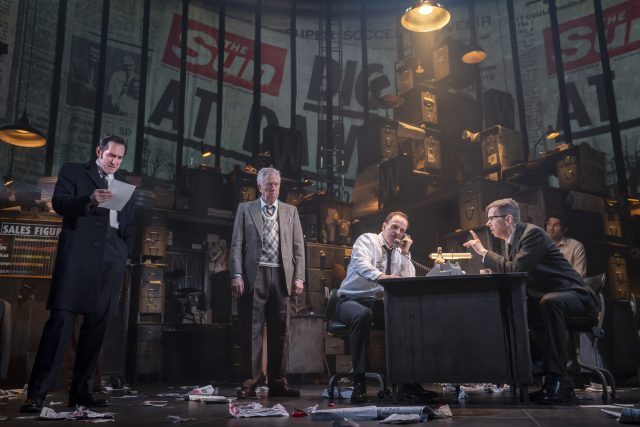
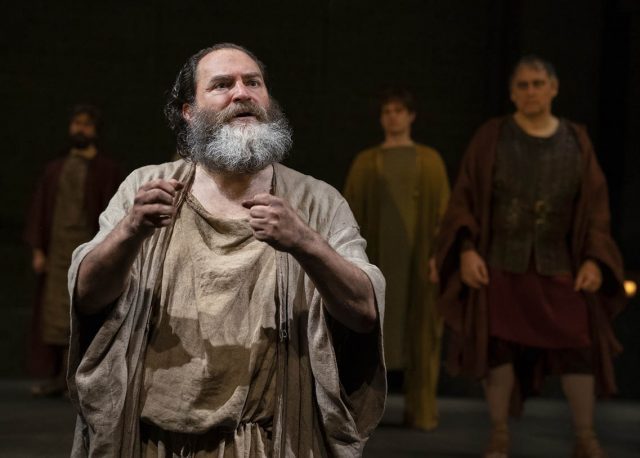
A MAN FOR ALL SEASONS

(photo by J. Daniel)

Harry Bouvy’s Common Man guides the audience through revival of A Man for All Seasons at the Acorn (photo by J. Daniel)

The Acorn Theatre at Theatre Row
410 West 42nd St. between Ninth & Tenth Aves.
Tuesday – Sunday through March 3, $30-$95
212-560-2183
fpatheatre.com
www.theatrerow.org

It’s one of the great moments of film and theater, an exchange of such brilliance that it wraps you in the sheer beauty of what the English language can achieve. It comes in the latter part of Robert Bolt’s A Man for All Seasons, which is currently enjoying a superb revival at the Acorn at Theatre Row. Sir Thomas More is being interrogated because of his refusal to approve of King Henry VIII’s divorce from Catherine of Aragon so he can marry his lover, Anne Boleyn, and have a male heir to the throne, a divorce the pope will not approve. More’s friend the Duke of Norfolk argues, “Can’t you do what I did, and come with us, for fellowship?” Ever so calmly and reasonably, More replies, “And when we stand before God, and you are sent to Paradise for doing according to your conscience, and I am damned for not doing according to mine, will you come with me, for fellowship?” First written for radio in 1954 and then live television in 1957, A Man for All Seasons was expanded to a full-length play in 1960, when it opened at the Globe, followed by a Broadway run the next year, winning Tonys for Best Actor (Paul Scofield), Best Director (Noel Willman), and Best Play. Bolt’s 1966 cinematic adaptation won six Oscars, for Best Picture, Best Director (Fred Zinnemann), Best Actor (Scofield), Best Adapted Screenplay (Bolt), Best Cinematography (Ted Moore), and Best Costume Design (Elizabeth Haffenden and Joan Bridge).

(photo by J. Daniel)

King Henry VIII (Trent Dawson) names Thomas More Lord Chancellor in Robert Bolt’s A Man for All Seasons (photo by J. Daniel)

Over the years, More has been portrayed by such actors as Charlton Heston, Sir Ian McKellen, Frank Langella, and Charles Dance. In the aptly named Fellowship for Performing Arts (FPA) production at the Acorn, where it has been extended through March 3, More is played by Michael Countryman with an amiable grace. Tall and thin, Countryman has a mild-mannered demeanor that belies More’s intense dedication to his steadfast belief in right and wrong — and the separation between church and state. First, Cardinal Wolsey (John Ahlin), then the Duke of Norfolk (Kevyn Morrow), Thomas Cromwell (Todd Cerveris), Archbishop of Canterbury Thomas Cranmer (Sean Dugan), and the king himself (Trent Dawson), try to get More to change his mind, but he’s not budging. He’s also very careful not to say anything that could eventually get him imprisoned and executed. As matters become more serious, his daughter, Margaret (Kim N. Wong), her partner, Will Roper (Dugan), and More’s beloved wife, the strong-willed Lady Alice (Carolyn McCormick), don’t understand why he won’t bend. But even at the possibility of never seeing his cherished family again, he is a resolutely principled man who lives by his conscience. “There is my right arm. Take your dagger and saw it from my shoulder, and I will laugh and be thankful, if by that means I can come with Your Grace with a clear conscience,” More explains to the king, who replies a few moments later, “No opposition, I say! No opposition! Your conscience is your own affair.” Later, More tells Cromwell, his inquisitor, “In matters of conscience, the loyal subject is more bounden to be loyal to his conscience than to any other thing.”

(photo by J. Daniel)

Thomas Cromwell (Todd Cerveris) and Richard Rich (David McElwee) plot to bring down Sir Thomas More in stellar revival (photo by J. Daniel)

Director Christa Scott-Reed restores the Common Man, who is often cut from film and theatrical adaptations; played by Harry Bouvy, he frames the story, serves as narrator, and appears in multiple roles, including More’s steward, a boatman, and a jury foreman, all of which Bouvy plays with a wink and a nod at the audience. “All right! A Common Man! A sixteenth-century butler!” he declares in the beginning. “The sixteenth century is the Century of the Common Man. Like all the other centuries.” He also changes clothing often (the classy period costumes are by Theresa Squire) and rotates parts of Steven C. Kemp’s set to indicate moving from the More home and garden to Cardinal Wolsey’s office, a dock, a private room in an inn, and a prison. The pacing of the two-and-a-half-hour show matches Sir Thomas’s approach to life, dignified and steady; it’s a talky play, but it never gets bogged down, since the words are so exquisite. The cast is uniformly excellent, with particularly strong turns by McCormick as More’s ever-loyal wife, Ahlin as both the scheming Wolsey and the sneaky Spanish ambassador Chapuys, and David McElwee as the overly ambitious, conniving Richard Rich. In addition, Scott-Reed doesn’t force contemporary relevance onto the narrative, as references to fake news, governmental corruption, and lies arise naturally in the audience’s mind; explicit references would only get in the way. Though fictionalized by Bolt (Lawrence of Arabia, Doctor Zhivago), A Man for All Seasons is primarily about perhaps the most devoted, principled character in the history of film and theater, a man willing to risk it all for his belief in the truth. “A clear and innocent conscience fears nothing,” Elizabeth I said to the Spanish ambassador decades after More’s death — but his values live on in Bolt’s marvelous play.

THE DANCE OF DEATH / MIES JULIE

(photo by Joan Marcus)

Julie (Elise Kibler) tempts John (James Udom) with more than just wine in Mies Julie (photo by Joan Marcus)

Classic Stage Company, Lynn F. Angelson Theater
136 East 13th St. between Third & Fourth Aves.
Tuesday – Sunday through March 10, $82-$127
www.classicstage.org

Classic Stage Company gives Swedish playwright August Strindberg a decidedly twenty-first-century edge in adaptations of Mies Julie and The Dance of Death, which opened last night and continue through March 10 in repertory, both shedding light on seemingly impossible relationships. South African writer and director Yaël Farber moves Strindberg’s 1888 naturalistic Miss Julie to Freedom Day in her native country in 2012, an annual holiday celebrating the 1994 post-Apartheid expansion of voting rights to all adult South Africans, regardless of race or gender. Freedom might have come to the nation, but John (James Udom) and his mother, Christine (Vinie Burrows), have nothing, sharecropping on a farm owned by a wealthy Afrikaner family. Julie (Elise Kibler), the farmer’s daughter, is attending a fancy party but prefers to hang out with John, teasing him with sexual come-ons that both titillate and frighten him: He is well aware of the consequences if he is caught so much as touching her. “Don’t test me, Mies Julie. I’m only a man,” he tells her. When she doesn’t back away, he adds, “This is just a game to you. But my mum and I — we have nowhere else to go. She was born on this farm. Her sweat is in these walls. Her blood — in this floor. Now I must risk everything. Because you’re drunk and bored tonight.”

(photo by Joan Marcus)

Christine (Vinie Burrows) clutches her Bible as her son (James Udom) and Julie (Elise Kibler) look on in Classic Stage production (photo by Joan Marcus)

The stakes are high for John and his black coworkers, who live in a squatters’ shack on the farm. Meanwhile, the tiny, hunched, elderly Christine performs her chores dutifully, but she is ever mindful of her heritage and those who came before, several of whom are buried under the kitchen and the surrounding acreage, including Ukhokho (Patrice Johnson Chevannes), who occasionally walks through the room, a reminder of their ancestors and their connection to the land that was once theirs. (Farber subtitles the play Restitutions of Body & Soil since the Bantu Land Act No. 27 of 1913 & the Immorality Act No. 5 of 1927.) Referring to a tree just outside, Christine says to her son, “We planted it over your great grandmother’s grave. And under the roots likes Ukhokho. This tree saps from her bones. Your great grandmother won’t let me sleep until I free them from beneath. . . . They can cover what they’ve done but the roots keep breaking through. These roots will never go away. Never. Ever. Go away.” The roots might never go away, but John and Julie have some tough choices to make after an unpredictable evening.

(photo by Joan Marcus)

Christine (Vinie Burrows) is haunted by an ancestor (Patrice Johnson Chevannes) in Strindberg play relocated to South Africa (photo by Joan Marcus)

Mies Julie is a razor-sharp examination of race and power; it might take place in South Africa in 2012, but it just as easily could be set any time in post–Civil War America, including today. There is nothing in the play or in David L. Arsenault’s design — a simple kitchen on a tiled oval platform, a ceiling fan rotating slowly above — that identifies a specific time. Udom (Father Comes Home from the Wars, The Revolving Cycles Truly and Steadily Roll’d) is fierce as John; when he declares, “I’m not going to spend my life cleaning your father’s boots,” you believe him to his core, even though there might be no way out for him. Kibler (London Wall, Indian Summer) knows just how to flaunt Julie’s privilege, an ingenue in a striking red dress who doesn’t quite understand the depth of her power. Farber (Nirbhaya, Salomé) and Afropolitan director Shariffa Ali (The Year of the Bicycle, We Are Proud to Present) keep the heat up through a fiercely tense seventy-five minutes that takes Strindberg’s original apart and puts it together in a whole new way.

(photo by Joan Marcus)

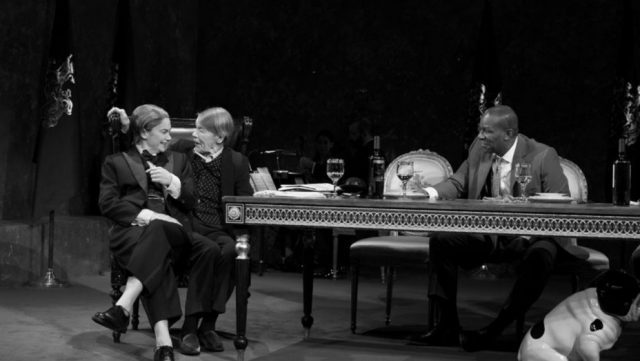
Edgar (Richard Topol) and Alice (Cassie Beck) have trouble communicating after twenty-five years of marriage in The Dance of Death (photo by Joan Marcus)

Irish playwright and filmmaker Conor McPherson (The Weir, Shining City) explores another problematic relationship in his seriocomic 2012 adaptation of Strindberg’s The Dance of Death. Edgar (Richard Topol) is a bitter and paranoid military captain exiled to a coastal fortress. Alice (Cassie Beck) is a former actress whose dreams of fame still linger. It’s 1900, and they’ve been married for twenty-five years, but they hate each other and life itself. “You see, what you do is, you take a mackerel, grill it, drizzle a little lemon on it, serve it up with a huge glass of white zinfandel — and one doesn’t feel quite like blowing one’s brains out anymore, does one?” Edgar says. “You’re asking the wrong person,” Alice responds. There’s an important party going on nearby at the doctor’s house, but Edgar and Alice are not on the guest list. When Alice taunts him, he states, “Do you want to know why I wasn’t invited? Shall I tell you? Because I refuse to mix with that scum – and because they all know I’m not afraid to speak my mind, that’s why.” Expecting her cousin Kurt (Christopher Innvar), the newly appointed quarantine master who introduced them to each other, to stop by, Alice says, “Well, he did bring us together.” Edgar replies, “He certainly did! And what a match!” Alice laughs and Edgar adds, “You may laugh. It’s me that’s had to live with it!” She responds, “And me!” Their jabs only get worse upon Kurt’s arrival, as they never miss an opportunity to attack. Edgar makes Kurt, who has plenty of his own personal baggage, a target as well, as they all talk about life and death and loneliness.

(photo by Joan Marcus)

Kurt (Christopher Innvar), Alice (Cassie Beck), and Edgar (Richard Topol) share a brief smile in Conor McPherson adaptation at Classic Stage (photo by Joan Marcus)

Director Victoria Clark (Newton’s Cradle, The Trouble with Doug) emphasizes the more comic aspects of the story, making Edgar and Alice look more and more ridiculous as Alice fires the maid and Edgar warbles on about the manual he wrote. They are both haunted by what could have been. A photograph of Alice in her acting days hangs over them like a grim reminder (she was based on the first of Strindberg’s three wives, actress Siri von Essen), and occasionally she sits down at an imaginary piano and plays music that can be heard. Their inability to communicate extends to Edgar’s distrust of the telephone; instead, he has a telegraph that he uses to correspond with the outside world via Morse code. As with Mies Julie, Arsenault’s set design is relatively basic, with some furniture on the same oval platform, the audience again sitting on all four sides. The black comedy, which has influenced such other works with bickering couples as Edward Albee’s Who’s Afraid of Virginia Woolf? and John Guare’s The House of Blue Leaves, is too long at nearly two hours without intermission and occasionally gets tiresome with repetition, but Topol (Indecent, The Normal Heart) and Beck (The Humans, The Whale) hold nothing back in roles that have been previously performed onstage and -screen by such pairs as Robert Shaw and Zoe Caldwell, Ian McKellen and Helen Mirren, Paul Verhoeven and Lilli Palmer, and Laurence Olivier and Geraldine McEwan, with Innvar (’Tis Pity She’s a Whore, Big Love) adding the appropriate sleaziness as Kurt. “Life is terrible,” Edgar says to Kurt. “I could never understand people like you. People who actually want more life, some in eternal hereafter. More life! Why?” As both Mies Julie and The Dance of Death reveal at Classic Stage, it’s hard to want more life when love can be so difficult.

THE LIGHT

(photo by Joan Marcus)

Genesis (Mandi Masden) and Rashad (McKinley Belcher III) are ready for a special night in Loy A. Webb’s The Light (photo by Joan Marcus)

Susan & Ronald Frankel Theater, the Robert W. Wilson MCC Theater Space
511 West 52nd St. between Tenth & Eleventh Aves.
Tuesday – Sunday through March 17
www.mcctheater.org

MCC inaugurates its cozy new one-hundred-seat Susan & Ronald Frankel Theater at the Robert W. Wilson MCC Theater Space on West Fifty-Second St. with the New York premiere of Loy A. Webb’s The Light, a slow-building incendiary drama that opened last night and continues through March 17. Rashad (McKinley Belcher III) and Genesis (Mandi Masden) are celebrating a special evening, exchanging gifts and getting frisky in her beautiful Hyde Park condo, which features two skylights, a long marble kitchen island, a large window looking out on a small garden, and several paintings and photographs by African American artists, including one from Carrie Mae Weems’s highly influential Kitchen Table series. (The impressive set, surrounded on three sides by the audience, is by Kimie Nishikawa.) Rashad is a hunk of a fireman with a young daughter; Genesis is a teacher at an all-black charter school. “You’ve been a tremendous blessing in both our lives, baby,” Rashad says to Genesis, who is curious at his sudden honesty and eloquence. He adds, “Specially mine. It used to get me down thinking about all the failed relationships I had before you. But I realized that wasn’t nothing but life pruning me. Just as it would a tree. Cutting out all the old, damaged, and diseased branches that didn’t belong. Making room for the one that did . . . you.” She laughs, and he responds, “Really? I’m trying to have a serious moment and you laugh?” To which she replies, “This is so suspect, Shad. You were one Drake lyric away from singing.” What starts out as a romantic occasion becomes something very different when he presents her with a surprise gift that dredges up painful memories.

(photo by Joan Marcus)

Mandi Masden and McKinley Belcher III heat up the stage in inaugural production at new Susan & Ronald Frankel Theater at the Robert W. Wilson MCC Theater Space (photo by Joan Marcus)

Webb’s full-length debut is a potent look at the fragility of love in a #MeToo, #BlackLivesMatter world fraught with ever-evolving complications as people walk tenderly around matters of race, sexuality, abuse, and power exemplified by such controversial public cases as the Brett Kavanaugh confirmation hearings and the accusations against such celebrities as R. Kelly and Chris Brown. Over the course of seventy-five minutes, Rashad and Genesis’s relationship, so inspired at the beginning, goes through a series of challenges that tests their future as each one opens up their heart, moving through joy, pain, and redemption. “Please, don’t nobody want you. And the only reason I do is because my biological clock is ticking and I’m desperate,” she teases him, but when she sees he is hurt, she says, “I’m joking, baby.” Drama Desk Award winner Belcher III (The Royale, Ozark) and Masden (Saint Joan, Our Lady of Kibeho) are a formidable duo, each one balancing strength with vulnerability as some deep truths emerge. Webb and director Logan Vaughn (The Agitators) focus on the actors’ electric chemistry, which only intensifies as the friction increases; Ben Stanton’s lighting design keeps the full space partially illuminated so we can see our fellow attendees while also feeling implicated in the characters’ actions, wondering how we would react to the questions Rashad and Genesis ask each other. The play falters somewhat as the end approaches and Webb throws in too many late twists, but the finale hits the mark. Originally developed at the New Colony in Chicago (with Jeffery Owen Freelon Jr. and Tiffany Oglesby, directed by Toma Langston), The Light will leave you gasping for breath — and examining your own meaningful relationships, trying to stay away from the darkness.

BILL CHATS

Oskar Eustis and Bill T. Jones will talk about their roles as artistic directors on February 11 at NYLA

Oskar Eustis and Bill T. Jones will talk about their roles as artistic directors on February 11 at NYLA

Who: Bill T. Jones and Oskar Eustis
What: Bill Chats
Where: New York Live Arts, 219 West 19th St. between Seventh & Eighth Aves., 212-924-0077
When: Monday, February 11, $8-$10, 7:00
Why: New York Live Arts artistic director Bill T. Jones sits down with Public Theater artistic director Oskar Eustis for the next edition of his “Bill Chats” series, taking place February 11 at 7:00. Jones, an award-winning choreographer — among his many prizes are the Tony, the Obie, the 2013 National Medal of Arts, the 2010 Kennedy Center Honors, and the 1994 MacArthur Genius Award — and Eustis, who directed the controversial 2017 Shakespeare in the Park production of Julius Caesar that turned the Roman leader into Donald Trump, will discuss the current sociopolitical climate and how it impacts their decisions as artistic directors.

CHOIR BOY

(photo © Matthew Murphy, 2018)

Pharus Jonathan Young (Jeremy Pope) pursues his singing dreams in Choir Boy (photo © Matthew Murphy, 2018)

Manhattan Theatre Club at the Samuel J. Friedman Theatre
261 West 47th St. between Broadway & Eighth Aves.
Tuesday – Sunday through February 24, $79-$169
choirboybroadway.com
www.manhattantheatreclub.com

Oscar-winning screenwriter Tarell Alvin McCraney’s Broadway debut, Choir Boy, offers a new twist on a classic dramatic trope: life at an all-male boarding school. But Charles R. Drew Prep School is not quite like the schools depicted in such well-regarded films as Rushmore, Dead Poets Society, Tom Brown’s School Days, Heaven Help Us, or If… The students and the teachers at Drew are all men of color. “My daddy say they used to let you get away with a lil bit because they know how hard it is to be a black man out there,” student Bobby Marrow (J. Quinton Johnson) tells fellow student David Heard (Caleb Eberhardt). “Now, everything got to be watched, gotta be careful, gotta be cordial. Don’t say nothing, don’t say that word, don’t look like that, this shit Pandemic.” Bobby, whose uncle is Headmaster Marrow (Chuck Cooper), is one of several young men in the school’s prestigious choir, along with Pharus Jonathan Young (Jeremy Pope), Junior Davis (Nicholas L. Ashe), Anthony Justin “AJ” James (John Clay III), and David. The show opens with Pharus singing the school song, a much-coveted opportunity, but he takes an unfortunate pause when he is secretly harassed by Bobby, who questions Pharus’s sexual orientation. Afterward, in explaining why he stopped but without snitching on Bobby, Pharus asks the headmaster, “Would you rather be feared or respected?” which becomes an underlying theme of the play as the boys deal with issues of race, gender, homophobia, family, class, and education.

(photo © Matthew Murphy, 2018)

Bobby Marrow (J. Quinton Johnson) and Pharus Jonathan Young (Jeremy Pope) are at odds in boarding-school drama (photo © Matthew Murphy, 2018)

The play suffers dramatically upon the arrival of Mr. Pendleton, a former teacher at the school who has been brought back by the headmaster for inexplicable reasons, unless it is merely to force racial conflict, as Pendleton is white and, oddly, played by the ubiquitous Austin Pendleton, blurring the line between theater and real life in an obtrusive way. The scenes with Mr. Pendleton, who uses racist cracks to supposedly educate the kids, bring the show to a screeching halt and are best forgotten as the story proceeds. Fortunately, there is much to enjoy in the rest of the Manhattan Theater Club production, which has been extended at the Samuel J. Friedman Theatre through February 24.

Pope (Ain’t Too Proud, Invisible Thread) makes a dazzling Broadway debut as Pharus, a proud, flawed, young gay man who refuses to muzzle himself while often disregarding the feelings of others; it’s an electrifying performance of a role given complex subtleties by McCraney, who cowrote the Oscar-winning Moonlight with Barry Jenkins. The supporting cast portraying the other teens are terrific as well, including Clay III (Encores’ Grand Hotel) as AJ, Pharus’s roommate, who is sensitive to his friend’s situation; Johnson (Hamilton) as the troubled Bobby, who is dealing with his mother’s death; Eberhardt (Is God Is) as David, who is hiding his own secrets; and Ashe (Kill Floor) as Junior, a follower who makes questionable decisions. They might have their share of disagreements, but when they sing such spirituals as “Keep Your Eyes on the Prize” and “Rockin in Jerusalem” they show just what they can accomplish together. (Alas, “There’s a Rainbow ’round My Shoulder” feels a bit too obvious and heavy-handed.) Tony winner Cooper (The Life) is splendidly august as the headmaster, who only gets involved when truly necessary, understanding that the students grow when they figure things out for themselves, even if that’s sometimes painful. Thoughtfully directed by Trip Cullman (Lobby Hero, Six Degrees of Separation), Choir Boy is ultimately about tolerance, about the basic human dignity everyone deserves, while for the most part steering clear of grand statements and politically correct sentimentality.

EDDIE AND DAVE

(photo by Ahron R. Foster)

Playwright Amy Staats is Eddie Van Halen and Megan Hill is David Lee Roth in new play about 1970s hard rockers (photo by Ahron R. Foster)

Atlantic Stage 2
330 West 16th St. between Eighth & Ninth Aves.
Tuesday – Sunday through February 17, $56.50
atlantictheater.org

I have a difficult confession to make: I have never been a fan of Van Halen, the 1970s/’80s hard rockers with such hits as “Jump,” “Jaimie’s Cryin’,” “Hot for Teacher,” and “Runnin’ with the Devil.” But I am a big fan of Eddie and Dave, first-time playwright Amy Staats’s very funny show about the on-again, off-again relationship between the band’s songwriters, guitarist and composer Eddie Van Halen and lyricist and lead singer David Lee Roth — which has been extended at Atlantic’s Stage 2 through February 17. The story is told in flashback by a former MTV VJ based somewhat on Kurt Loder (“This is my memory play,” she says), centering on the group’s very brief reunion at the 1996 MTV Video Music Awards, when Eddie; his brother, drummer Alex Van Halen; bassist Michael Anthony; and Roth got together for the first time in more than a decade to present a prize. At the podium, Alex leans over and whispers something to Dave; what was said is the mystery behind the play and a solid-enough excuse to dig into the band’s strange and bizarre history. But Staats pulls an outrageous gender switch in her casting: She plays Eddie, Megan Hill is Dave, Adina Verson is Alex, Omer Abbas Salem is Valerie Bertinelli (Eddie’s eventual wife), and Vanessa Aspillaga is the VJ, a roadie, the Van Halens’ father, Quincy Jones, and other minor male characters. Anthony is portrayed by a framed photograph.

(photo by Ahron R. Foster)

Van Halen brothers Eddie (Amy Staats) and Alex (Adina Verson) look on as David Lee Roth (Megan Hill) struts his stuff at Atlantic Stage 2 (photo by Ahron R. Foster)

Scenic designer Reid Thompson has filled the theater with posters and flyers advertising such other 1970s/’80s groups as Pantera, Misfits, Iron Maiden, Dead Kennedys, Bruce Springsteen and the E Street Band, and the Ramones; as the audience enters the space, music by Journey, AC/DC, Black Sabbath, and Aerosmith is likely to have attendees of a certain age singing along and playing air guitar. Montana Levi Blanco’s costumes are send-ups of what the band really wore, including Eddie’s overalls and flannel shirt and Diamond Dave’s flashy over-the-top style. Cookie Jordan is responsible for the fab hair and wigs, featuring some damn fine mullets. Whether because of rights issues or as an artistic (financial?) choice, there is no actual Van Halen music in the show, only instrumental snippets (by Michael Thurber) heard here and there or seen in Shawn Boyle’s projections; in fact, no original Van Halen songs or albums are even mentioned by name except for their 2012 comeback record, A Different Kind of Truth.

(photo by Ahron R. Foster)

Van Halen rocks out — and fights — all over again in new play Eddie and Dave (photo by Ahron R. Foster)

None of the actors attempts to impersonate the famous people they portray, instead turning them into eccentric characters who say and do a lot of dumb but endearing stuff, the key word being “dumb.” Thus, Anthony comes off as the most intelligent member of the group, since he never speaks. (“We can’t talk about him; there’s not enough time,” the VJ explains.) Gleefully directed by Margot Bordelon, Eddie and Dave is a highly original mini-soap-rock opera that would delight Wayne and Garth (“Wayne’s World! Excellent!”), a fun and snarky account of a group of grown-up men, and one woman, who are not the brightest bulbs in the chandelier but managed to carve out some pretty successful careers. I’m still not a Van Halen fan, but I definitely have a newfound admiration for their wild and wacky tale.

ABOUT ALICE

(photo by Henry Grossman)

Alice Stewart (Carrie Paff) and Calvin Trillin (Jeffrey Bean) chat each other up at a party in About Alice (photo by Henry Grossman)

Theatre for a New Audience, Polonsky Shakespeare Center
262 Ashland Pl. between Lafayette Ave. & Fulton St.
Tuesday – Sunday through February 3, $90-$115
866-811-4111
www.tfana.org

Calvin Trillin brings to life his inspiring relationship with his wife, Alice Stewart, in the heartfelt, beautifully rendered About Alice, continuing through February 3 at Theatre for a New Audience’s intimate Polonsky Shakespeare Center. The eighty-three-year-old Kansas City–born, New York City–based memoirist and humorist’s first full-length play is a love letter to, well, true love, based on his 2006 book, also called About Alice. The story is told in flashback, as Calvin (Jeffrey Bean) shares details of his life with Alice (Carrie Paff), re-creating important and mundane moments; she also corrects him when necessary and takes playful shots at him. Speaking of their meeting at a party in 1963, she says, “I thought you were very funny. I thought you’d be an interesting person to have to dinner after my boyfriend and I were married. At least, that’s what I told myself . . . You have never again been as funny as you were that night.” He responds, “You mean I peaked in December of 1963?” With a smile, she answers, “I’m afraid so.”

(photo by Henry Grossman)

Jeffrey Bean stars as Calvin Trillin in world premiere at Theatre for a New Audience (photo by Henry Grossman)

Looking out at the audience, they discuss their careers — his as a journalist, food writer, poet, novelist, and popular talk-show guest, hers as an educator, author, film producer, and muse — as well as their families, their upbringing, and their friends. Their repartee is warm and funny, even as they turn to the cancer that would eventually take her life. But she also understood the seriousness of her plight. “For a long time after I found out that I had cancer, I loved hearing stories about people who had simply decided that they would not be sick,” she says. “The thought that my children might grow up without me was ridiculous. I simply had to be there. Not being there was unacceptable. But I also knew that some unacceptable things happen.”

(photo by Henry Grossman)

Carrie Paff is absolutely radiant as Alice Stewart Trillin in new play based on Calvin Trillin memoir (photo by Henry Grossman)

Their relationship was a love affair for the ages, each of them complementing the other with a natural grace, his wry sense of humor a great match for her bubbly enthusiasm for living. At one point Calvin says they were compared to Burns and Allen, although she was George and he was Gracie. David C. Woolard’s costumes are a key part of who they are; while Calvin wears the same ordinary light shirt, brown pants, and dark sports jacket throughout the seventy-five-minute show, which is charmingly directed by Leonard Foglia (Notes from the Field, Master Class), Alice changes myriad times, sometimes in a magically short time, revealing a keen, elegant fashion sense, even when her fancy dresses are put aside for a hospital robe. Riccardo Hernandez’s set consists of a center table with two chairs and two walls with doors, one leading to the back, the other to Alice’s closet. Bean (The Thanksgiving Play, Bells Are Ringing) is terrific as Calvin, calm and easygoing, his eyes aglow with his deep love for his wife. And Paff (Ideation, Stage Kiss) is luminous as an extraordinary, multifaceted woman with a passion for everything she did; it won’t take long before you fall in love with her too. Alice was often a character in Calvin’s writing, but she becomes so much more in this moving tribute to a lovely human being. We should all be so lucky to find someone so special in our lives, no matter how long we have them for.

(Note: Trillin will participate in postshow TFANA Talks following the 2:00 matinees on February 2 and 3, moderated by Budd Mishkin and Alisa Solomon, respectively. In addition, there are printouts in the lobby of two major articles Alice wrote, one for the New Yorker, the other for the New England Journal of Medicine.)