this week in theater

BOESMAN AND LENA

(photo by Joan Marcus)

Boesman (Sahr Ngaujah) and Lena (Zainab Jah) arrive in the middle of nowhere in stark Fugard revival at the Signature (photo by Joan Marcus)

The Pershing Square Signature Center
The Alice Griffin Jewel Box Theatre
480 West 42nd St. between between Ninth & Tenth Aves.
Tuesday – Sunday through March 17, $35
www.signaturetheatre.org

For its fiftieth anniversary, South African playwright and director Yaël Farber reimagines Athol Fugard’s 1969 Boesman and Lena as an anti-Apartheid Waiting for Godot at the Signature, where it opens tonight and continues through March 17. Coincidentally, Farber’s fierce adaptation of Mies Julie, which transports August Strindberg’s Miss Julie to South Africa in 2012, is being performed at Classic Stage through March 10. At the Signature, the audience enters the Alice Griffin Jewel Box, where a large translucent plastic tarp flutters across the front of the stage like a sad, empty flag, blocking most of the set from view, except for the people in the center of the first row, who have to go under it to sit down. Boesman (Sahr Ngaujah) and Lena (Zainab Jah) come in through the aisles, laden with heavy bags that look like garbage, carrying their physical and metaphorical burdens with them. They are homeless, looking for a place to rest their weary, worn-out bodies. Boesman tears down the tarp, revealing a barren landscape in the middle of nowhere, the mud flats of the Swartkops River, save for one bare tree, echoing Samuel Beckett’s Godot. Susan Hilferty’s dark, drab set creates just the right atmosphere of dread; Hilferty also designed the appropriately ratty costumes for the play, which was inspired by an actual incident that Fugard experienced in 1965.

“Why did you walk so hard? In a hurry to get here? Jesus, Boesman! What’s here?” Lena asks as Boesman sets up a makeshift camp in the liminal space. “Look at us! Boesman and Lena with the sky for a roof again. What you waiting for?” While he tries to set up a place for them to sleep using the tarp and the tree, she rambles on about the sad circumstances of their life, which annoys him to no end. “‘When she puts down her bundle, she’ll start her rubbish.’ You did,” he says. “Rubbish?” she asks. “That long turd of nonsense that comes out when you open your mouth!” he replies. They bicker like George and Martha in Who’s Afraid of Virginia Woolf?, although she does most of the complaining. Lena: “This is a lonely place. Just us two. Talk to me.” Boesman: “I’ve got nothing left to say to you. Talk to yourself.” Lena: “I’ll go mad.” Boesman: “What do you mean ‘go’ mad?” But behind it all is the unspoken state of the nation, a South Africa mired in racism, where the white minority brutally rules over the dispossessed black majority.

(photo by Joan Marcus)

Boesman (Sahr Ngaujah) mock-threatens Lena (Zainab Jah) as the Old African (Thomas Silcott) sits quietly in Boesman and Lena (photo by Joan Marcus)

A third person arrives, a slow-moving, raggedy Old African (Thomas Silcott) who mumbles in his tribal Xhosa language, which neither Boesman nor Lena understands. (The script translates his dialogue; he essentially explains that he is looking for his relatives but got lost.) Boesman is not about to share what little they have with the old man, or Outa, as Boesman calls him (he also refers to him with the offensive slang term “kaffir”), but Lena has sympathy for his situation. “To hell! He doesn’t belong to us,” Boesman cries out. “There was plenty of times his sort gave us water on the road,” Lena says. The couple keep up their war of words, arguing about happiness, geography, names, and dogs as they soldier on with what little they have. Lena also shows the Old African the bruises she has from where Boesman hits her. “And now? What’s going to happen now?” Boesman asks. “Is something going to happen now?” Lena responds. It’s both a pure Beckett moment as well as a commentary on how their miserable lives, and the lives of all the black and brown people of South Africa, are not about to change for the better any time soon.

(photo by Joan Marcus)

Three lost souls try to escape the darkness of their world in Signature revival (photo by Joan Marcus)

Ngaujah (Mlima’s Tale, Fugard’s The Painted Rocks at Revolver Creek at the Signature) and Jah (School Girls; or, the African Mean Girls Play, Eclipsed) fully embody the desperation of their characters, a pair of lost souls with nowhere to go. The roles have previously been played onstage by Keith David and Lynne Thigpen in 1992 at City Center, on film by Danny Glover and Angela Bassett in 2000, and, in the original 1969 South African theatrical production, by Fugard and Yvonne Bryceland, both of whom are white; Glynn Day, who is also white, portrayed the Old African, reportedly in blackface. Silcott (Fugard’s Coming Home; Bring in ’Da Noise, Bring in ’Da Funk) is unrecognizable as the old man, beaten down to the point where he is practically invisible, fading into the darkness.

By having the characters wander through the aisles several times, Farber (Salomé, Amajuba: Like Doves We Rise) is implicating each one of us in their futility, as if Boesman and Lena are homeless and searching for a warm bed in an overcrowded New York City or refugees seeking a new life in an America that no longer welcomes them with open arms. Boesman treats the Old African much the same way. While there is hope and optimism in Godot, which has more than its fair share of comedic moments, the future is bleak for Boesman and Lena. “Now’s the time to laugh. This is also funny. Look at us!” Lena says, but their meager existence is no joke. This is the sixth Fugard play the Signature has produced as part of his ongoing residency since the company moved to its current building in 2012, including Blood Knot, The Train Driver, and Master Harold . . . and the Boys, and all those involved, from the cast and crew to the audience, have clearly benefited from so much time spent with Fugard.

TICKET GIVEAWAY: ACTUALLY, WE’RE F**KED

actually

ACTUALLY, WE’RE F**CKED
Cherry Lane Mainstage Theatre
38 Commerce St.
Tuesday – Sunday through April 7, $55-$95
212-989-2020
www.cherrylanetheatre.org

If you’ve been paying attention at all to what’s going on around the globe these days, you might very well think that the world has finally, truly gone to hell in a handbasket. That’s the theory behind Actually, We’re F**ked, debuting at the Cherry Lane this week. Mairin Lee, Keren Lugo, Ben Rappaport, and Gabriel Sloyer star as millennials who want to do something about it — until a surprise changes their future. The play is written by Emmy nominee Matt Williams (Bruce Lee Is Dead and I’m Not Feeling Too Good Either, Jason and the Nun) and directed by Obie winner John Pasquin (Moonchildren, Landscape of the Body); the two men have previously collaborated on the Tim Allen television series Home Improvement, with Williams one of the creators and Pasquin a producer and director on the first two seasons. Williams was also the creator of Roseanne and a writer and producer for The Cosby Show, while Pasquin’s working relationship with Allen continued on the movies The Santa Clause and Jungle 2 Jungle and the current series Last Man Standing. Williams is the secretary of the Cherry Lane, which is owned by his wife, artistic director Angelina Fiordellisi. The set is by Robin Vest, with costumes by Theresa Squire, lighting by Paul Miller, sound by ML Dogg/MuTTT, and projections by Brad Peterson.

TICKET GIVEAWAY: Actually, We’re F**ked runs February 26 through April 7 (with a March 7 opening) at the Cherry Lane, and twi-ny has three pairs of tickets to give away for free. Just send your name, phone number, and favorite play or movie with a curse in the title to contest@twi-ny.com by Thursday, February 28, at 3:00 pm to be eligible. All entrants must be twenty-one years of age or older; three winners will be selected at random.

MEET MISS BAKER: THE PRICE OF THOMAS SCOTT

(photo by Todd Cerveris)

Ellen Scott (Tracy Sallows) looks on as her husband, Thomas (Donald Corren), makes a point to her daughter, Annie (Emma Geer), in US premiere at the Clurman (photo by Todd Cerveris)

The Mint Theater
The Clurman Theatre at Theatre Row
410 West 42nd St. between Ninth & Tenth Aves.
Tuesday – Sunday through March 23, $65
minttheater.org
www.theatrerow.org

Footloose meets A Man for All Seasons in the US debut of Elizabeth Baker’s 1913 play, The Price of Thomas Scott, which opened last night in a lovely Mint production at the Clurman at Theatre Row. It’s the first presentation of the Mint’s “Meet Miss Baker” series, a two-year program that will feature three fully staged works by the little-known British playwright in addition to readings of two one-acts and the publication of a book on Baker, similar to the company’s ongoing Tessa Davey Project. The Price of Thomas Scott, which previously had only one production more than a century ago, at the Gaiety Theatre in Manchester, takes place over two days in the early 1910s in the back parlor of a drapery, as clothing shops were called then, owned by Thomas Scott (Donald Corren), where he works with his wife, Ellen (Tracy Sallows), and daughter, Annie (Emma Geer), an expert hat trimmer who dreams of going to Paris to hone her craft and return to “bust up the town.” Meanwhile, the Scotts’ fifteen-year-old son, Leonard (Nick LaMedica), is hoping to sit for a scholarship; if he wins and the family can support some supplementary fees, it will send him to a better school that will put him on track for a respectable career in the civil service. “It’s hateful to be poor,” Annie says.

(photo by Todd Cerveris)

Annie (Emma Geer) wants to go dancing with May (Ayana Workman) in The Price of Thomas Scott (photo by Todd Cerveris)

Thomas is a devout churchgoer, a member of one of several conservative Protestant denominations known as Nonconformists in Great Britain. He’s ready to sell the store after decades of toil, waiting for an offer so he and Ellen can retire to the middle-class suburb of Tunbridge Wells, a print of which hangs on the wall, beckoning them. A deeply religious man, Thomas is firmly against dancing, believing it to be immoral; he also rejects drinking and theater. When Annie asks if she can go to a dance at the town hall with her friend May Rufford (Ayana Workman), her father is at first hesitant to even consider such a request. “You don’t suppose I like keeping her back, do you — saying no to her?” Thomas asks May’s father, George (Mark Kenneth Smaltz), continuing, “The flesh is weak at times, George, and the way of righteousness is hard.” So when a surprisingly large offer is made on the shop by Wicksteed (Mitch Greenberg), a longtime acquaintance working for a company opening dance halls in the neighborhood, Thomas is faced with a difficult dilemma, whether to stand by his conscience or sell and improve the family’s situation significantly.

Directed by Mint artistic director Jonathan Bank (Katie Roche, Temporal Powers), The Price of Thomas Scott is a well-staged drama that evokes the conflict at the center of Robert Bolt’s A Man for All Seasons, in which Sir Thomas More must decide whether to go against his conscience and his religious beliefs in order to save his life and help his family. (Coincidentally, a fine revival of the play is now running at Theatre Row as well.) It also is reminiscent of Herbert Ross’s 1984 film, Footloose, in which a small Utah border town has banned dancing and rock music for religious reasons. Corren (Torch Song Trilogy, Balls) portrays Thomas not as a villain but as a deeply principled man who is tortured by the decision he must make; Corren’s body is as tense and rigid as Thomas is stubborn and unyielding. It is apparent Scott has never danced a day in his life and that he couldn’t even if he desired to. Still, as much as his friends and family wish him to sell, it is difficult not to admire the courage of his convictions. “He’s a dear old thing, of course, but you know he’s just frightfully old-fashioned,” Annie tells Johnny Tite (Andrew Fallaize), the Scotts’ lodger who is in love with her. However, Johnny’s friend Hartley Peters (Josh Goulding) says, “Every man has his price.”

(photo by Todd Cerveris)

Wicksteed (Mitch Greenberg) makes Scott (Donald Corren) an offer he thinks he can’t refuse in US debut of Elizabeth Baker play (photo by Todd Cerveris)

Sallows (Angels in America, Pushkin) is ever-so-gentle as Ellen, who is so devoted to her husband that she will not try to change his mind, no matter how much she wants to let Annie go to a dance, encourage Leonard to compete for the scholarship, and urge her husband to sell the shop. Amid the British suffragist movement, she is not ready to cast her vote against her husband, although the shop is arguably as much hers as his, and she deserves a say in the family’s financial future. The Mint’s sets are always exceptional, and Vicki R. Davis’s parlor room has a charm that posits the Scotts’ precarious station. The only disappointment is that the intermissionless ninety-minute play has only one location; watching Mint set changes during intermission has become an event valued by those in the know. As for meeting Miss Baker: Born in 1876, Baker was a teetotaler raised in a strict, religious lower-middle-class family that was in the drapery business; she didn’t go to the theater until she was nearly thirty and didn’t marry until nearly forty. The semiautobiographical nature of The Price of Thomas Scott imbues it with an honesty that is potent, with a slyly funny bonus at curtain call. “Meet Miss Baker” continues March 3 with readings of Edith and Miss Tassey, followed in summer 2020 by repertory performances of Partnership and her debut, the breakthrough Chains; The Price of Thomas Scott runs through March 23.

The Passion Project // BrandoCapote Workshop

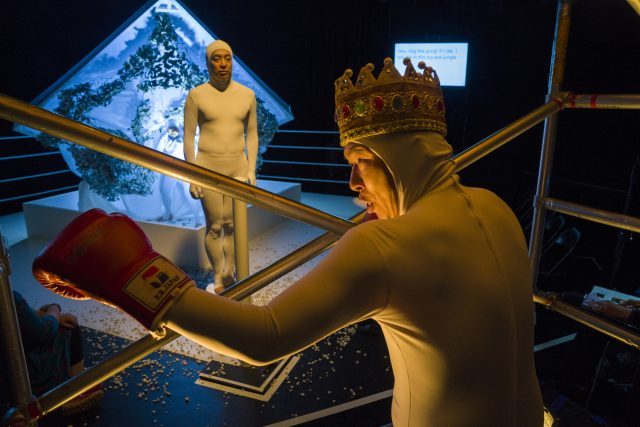
Director Reid Farrington, writer Sara Farrington, and performer/choreographer Laura K. Nicoll will present work-in-progress Brando/Capote at Art House Productions

Director Reid Farrington, writer Sara Farrington, and performer/choreographer Laura K. Nicoll will present work-in-progress Brando/Capote at Art House Productions

Art House Productions, Inc.
262 17th St., Jersey City
February 21 – March 3, $20-$30
201-918-6019
www.arthouseproductions.org
www.ladyfarrington.com
www.reidfarrington.com

In 2011, we called The Passion Project “a breathtaking tour de force for both creator and director Reid Farrington and performer Laura K. Nicoll.” Farrington and Nicoll are bringing back the show, a mesmerizing and intimate multimedia reimagining of Carl Th. Dreyer’s 1928 silent film The Passion of Joan of Arc, for eight performances February 21 – March 3 as part of a special repertory program at Art House Productions in Jersey City. On March 1, 2, and 3, Reid and his wife and collaborator, writer Sara Farrington, will also be presenting the work-in-progress BrandoCapote, inspired by Truman Capote’s 1957 New Yorker profile of Marlon Brando while the star was making Sayonara in Tokyo. The piece is performed by Roger Casey, Sean Donovan, Lynn R. Guerra, Gabriel Hernandez, and Nicoll, who also serves as choreographer. The audience is encouraged to stay after the show and offer feedback.

“Though Brando is not a teetotaller, his appetite is more frugal when it comes to alcohol,” Capote writes in the article. “While we were awaiting the dinner, which was to be served to us in the room, he supplied me with a large vodka on the rocks and poured himself the merest courtesy sip. Resuming his position on the floor, he lolled his head against a pillow, drooped his eyelids, then shut them. It was as though he’d dozed off into a disturbing dream; his eyelids twitched, and when he spoke, his voice — an unemotional voice, in a way cultivated and genteel, yet surprisingly adolescent, a voice with a probing, asking, boyish quality — seemed to come from sleepy distances. ‘The last eight, nine years of my life have been a mess,’ he said.”

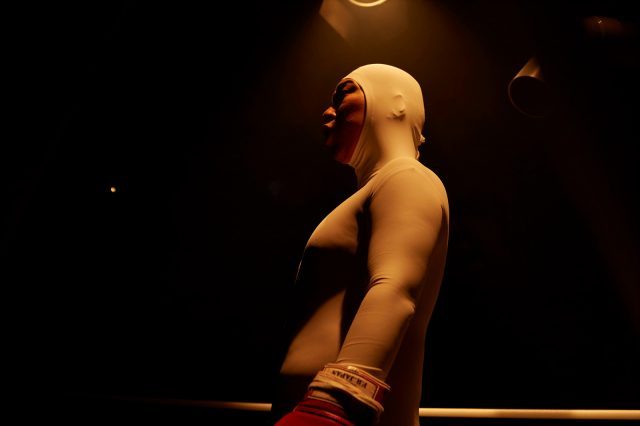
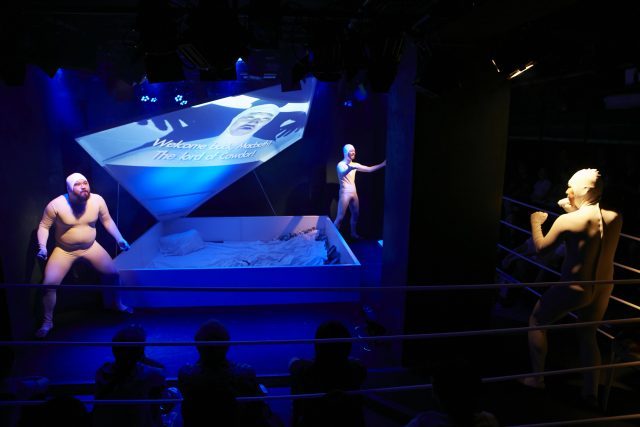
In addition, on February 27 at 7:00, Art House Productions will host a rough cut of a 3D movie of Reid’s 2014 multimedia work Tyson vs. Ali, a dream match-up pitting Mike Tyson against Muhammad Ali, using live actors, a boxing ring, and movable screens. Admission is pay what you can, and the film will be followed by an informal gathering with the cast and crew. (Tickets for The Passion Project and Brando/Capote are $20 each or $30 for both.)

BY THE WAY, MEET VERA STARK

(photo by Joan Marcus)

Gloria Mitchell (Jenni Barber) holds court as maids Vera Stark (Jessica Frances Dukes) and Lottie McBride (Heather Alicia Simms) look on in Lynn Nottage revival (photo by Joan Marcus)

The Pershing Square Signature Center
The Irene Diamond Stage
480 West 42nd St. between Tenth & Eleventh Aves.
Tuesday-Sunday through March 3, $35 after $60
212-244-7529
www.signaturetheatre.org
www.meetverastark.com

As the name of Lynn Nottage’s 2011 play suggests, the title character in By the Way, Meet Vera Stark is an afterthought, an aside. And indeed, as the rowdy and wild Signature revival, which opened tonight at the Irene Diamond Stage, reveals, Stark is central in the fictional world of the play but represents the sad legacy of Tinseltown racism from the Golden Age of Hollywood through to the present day. The story begins in 1933, when “America’s Sweetie Pie,” glamorous actress Gloria Mitchell (Jenni Barber), is rehearsing with her maid, Vera Stark (Jessica Frances Dukes), for the lead in the upcoming Hollywood film The Belle of New Orleans, about an octoroon prostitute and her maid, Tilly. While Gloria has trouble with her lines, Vera has a firm handle on the part of the maid; in fact, she wants to audition for the film too. When Vera returns to her tiny apartment — a far cry from Gloria’s absurdly ritzy, overdecorated home — she tells one of her roommates, Lottie McBride (Heather Alicia Simms), about the movie. “A Southern epic! Magnolias and petticoats. You know what else it means, cotton and slaves,” Vera says. “Slaves? With lines?” Lottie responds excitedly. They both decide that getting a job in the film is worth it no matter how demeaning or stereotypical the part might be.

(photo by Joan Marcus)

Leroy (Warner Miller) attempts to charm Vera (Jessica Frances Dukes) in By the Way, Meet Vera Stark (photo by Joan Marcus)

Meanwhile, the third roommate, Anna Mae Simpkins (Carra Patterson), is passing as South American instead of black to date big-time director Maximillian Von Oster (Manoel Felciano). Later, outside the audition stage, Vera meets jazz and blues musician Leroy Barksdale (Warner Miller), who claims to be Von Oster’s Man Friday. When he hears that Vera is interested in playing Tilly, he belittles the role and she calls him a fool. “You find that funny, do ya?” he replies. “Don’t get me wrong. I’m up for a good laugh as much as the next fella, but why we still playing slaves. Shucks, it was hard enough getting free the first damn time.” Later, at a party, studio head Mr. Slavsick (David Turner) expresses his displeasure at hearing some of the details of the film, which he fears will violate the Hays Code, the industry’s morality guidelines that banned such elements as miscegenation, profanity, licentiousness, and white slavery. The second act moves ahead to 1973 and 2003 as we see the aftereffects of the events that occurred back in 1933, placing them in a contemporary context that questions just how much things have not changed in Hollywood and society at large.

(photo by Joan Marcus)

Carra Patterson, Heather Alicia Simms, and Warner Miller change roles for second act of Lynn Nottage play at the Signature (photo by Joan Marcus)

Nottage’s second work in her Signature residency (following a fine revival of Fabulation, or The Re-Education of Undine), By the Way, Meet Vera Stark tackles such issues as slavery, class, and racism by indicting everyone involved in the system. Vera, Lottie, and Anna Mae are not left unscathed by their participation in Hollywood’s portrayal of blacks, willing to sacrifice a part of themselves in order to be successes, even though their options are few in depression-era America. “It tickles me how half the Negroes in this town are running around like chickens without heads, trying to get five minutes of shucking and jiving time, all so they can say they’re in the pictures. It’s just lights and shadows, what’s the big deal?” Leroy says to Vera, adding, “If you wanna be in pictures, where you gonna begin, and where are you gonna end?” Two-time Pulitzer Prize winner Nottage (Sweat, Ruined) has crafted clever caricatures of real Hollywood people, including Miriam Hopkins and Carole Lombard (Gloria), Hattie McDaniel and Ruby Dandridge (Lottie), Dolores del Rio and Carmen Miranda (Anna Mae), Adolph Zukor and Darryl Zanuck (Slavsick), Erich von Stroheim and King Vidor (Von Oster), and Theresa Harris and Nina Mae McKinney (Vera). Despite the slapstick, the characters are so believable that you might think that Vera Stark was a real actress; for its 2012 run at the Geffen Playhouse, a faux documentary was made, with Peter Bogdanovich discussing her impact on film and culture, fooling many people into thinking Vera actually existed.

Director Kamilah Forbes’s (Between the World and Me, Detroit ’67) production nails the screwball comedies of the 1930s in the first act and the world of celebrity in the second. Dede M. Ayite’s period costumes and Mia Neal’s on-target hair and wig design meld well with Clint Ramos’s sets, which range from Gloria’s posh pad to a 1973 talk show. Obie winner Dukes (Bootycandy, Yellowman) is a delight as Stark (originated by Sanaa Lathan at Second Stage in 2011), a woman who wants to push the boundaries while all too aware of its limitations. The rest of the solid cast takes on multiple roles, playing different parts in each act. Nottage (Mlima’s Tale, Intimate Apparel) makes her points, focusing on the little-known history of black actors in the early history of cinema, without getting heavy-handed; the play, which has been extended through March 10 at the Signature, is particularly relevant as the Oscars approach, a Hollywood awards show that only a few years ago was labeled #OscarsSoWhite.

SWITZERLAND

(photo by Rona Faure)

Patricia Highsmith (Peggy J. Scott) is none too happy when Edward Ridgeway (Daniel Petzold) shows up at her Swiss Alps hideaway in Switzerland (photo by Rana Faure)

59E59 Theaters
59 East 59th St. between Park & Madison Aves.
Tuesday – Sunday through March 3, $35
212-279-4200
www.59e59.org

In her later years, Texas-born misanthropic thriller grand master Patricia Highsmith, the author of such beloved books as The Talented Mr. Ripley and Strangers on a Train, retreated to a small home in the outskirts of the Swiss Alps, avoiding the American publishing world that she felt had never truly accepted her as an important author. In Joanna Murray-Smith’s murky 2015 play, Switzerland, which continues at 59E59 through March 3, that world intrudes on Highsmith’s (Peggy J. Scott) privacy when ambitious young editor Edward Ridgeway (Daniel Petzold) arrives from New York City, determined to get her to sign a contract to write another Ripley book, something she is loath to do. Despite Highsmith’s continuous barbs and not-too-veiled threats, Ridgeway stands his ground, refusing to go away until the writer, well known for her nasty demeanor, anti-Semitism, racism, and smoking and drinking, agrees to bring back Ripley. “I’m done with Ripley,” she declares. “You think you don’t want to write a final Ripley,” Edward says, adding, “I know that you do.” Improbably, the two are soon collaborating on the next Ripley novel, bonding over their mutual love of weaponry.

(photo by Rona Faure)

Edward Ridgeway (Daniel Petzold) and Patricia Highsmith (Peggy J. Scott) consider a new Ripley novel in Joanna Murray-Smith play (photo by Rana Faure)

Mystery bookstore owner and Highsmith publisher Otto Penzler once described the author as “a mean, cruel, hard, unlovable, unloving human being. I could never penetrate how any human being could be that relentlessly ugly…. But her books? Brilliant.” In the first half of the eighty-minute show, it’s fun getting to know this “ugly” woman as she skewers Edward and virtually every topic he brings up, from Hollywood to white bread, from religion to his views on her abilities, on James J. Fenton’s intimate set, a room with a plush rug, gun and knife displays, and the wooden desk where Highsmith works, with a small fan, an electric typewriter, a photo of Alfred Hitchcock, and a bust of Sophocles. The back-and-forth banter is reminiscent of Ira Levin’s Deathtrap, in which a playwright and one of his students get involved in a literary cat-and-mouse game, but Murray-Smith, one of Australia’s most popular and successful writers, spends too much time putting platitudes in the mouths of the characters, who make lofty statements about Literature with a capital L. Petzold (Pushkin, In the Line) and Scott (Daniel’s Husband, Is He Dead?) play off each other well, establishing an enjoyable chemistry — there’s more to Edward than meets the eye — but the big plot twist unravels the narrative, giving rise to major flaws that director Dan Foster (You Will Remember Me, The Chocolate Show!) can’t cover up. And as the real Highsmith and Hitchcock would know, there’s no coming back from that.

MAVERICK

(photo by John Painz)

George Orson Welles (George Demas) collaborates with Frank Beacham (Stephen Pilkington) in Maverick at the Connelly Theater (photo by John Painz)

Connelly Theater
220 East Fourth St. between Aves. A & B
Tuesday – Saturday through March 2, $30-$50
646-343-1584
mavericktheplay.com
www.connellytheater.org

In 1985, Frank Beacham, the owner of Television Matrix, which produced the hit series Lifestyles of the Rich and Famous, got a surprise phone call from George Orson Welles, the radio, film, and theater legend behind such masterpieces as Citizen Kane, The Magnificent Ambersons, and The War of the Worlds. Welles had found out that Beacham’s company was using one of the first Betacams, a Sony portable video camera, and Welles wanted to create a one-man show with it. The story of their little-known collaboration is revealed in the inventive Maverick, cowritten by Beacham and George Demas, who portrays Welles in the two-act play, which runs at the Connelly Theater through March 2. “When I met Orson, he was seventy and looking quite old,” Beacham (Stephen Pilkington) says near the beginning. “But I didn’t see him that way. You couldn’t see him that way. It’s as if you met Salvador Dalí when he was in a wheelchair with tubes coming out of his nose. You don’t think of being with an old man who struggles to make it through the day. Far from it. You-are-with-Dali! And this is Orson, as I see him. And here I am, as a narrator too —” In true Wellesian fashion, Orson emerges out of the darkness and cuts Beacham off. “There’s no need to say that,” he explains. “What?” Beacham asks. “It’s obvious you’re a narrator. You’re narrating,” Welles says. “I’m sorry, Orson, I’m not a theater person,” Beacham responds. “Well, you better get up to speed. You’re standing on a stage as we speak,” Welles replies. Beacham apologizes to Welles and turns back to the audience: “John Houseman once said, if your life is ever touched by a genius, a real one, you are never the same again. And this is my life, my memories, my . . . imaginings. And I’m . . . still piecing it all together.”

(photo by John Painz)

Maverick tells the story of Frank Beacham (Stephen Pilkington) and Orson Welles’s (George Demas) foray into video production (photo by John Painz)

Beacham’s memories include lunching with Welles and his beloved dog, Kiki, at Ma Maison in Los Angeles; shooting a Welles pitch for funding for King Lear with his personal cameraman, Gary Graver (Brian Parks), who sidelined in porn to earn extra cash; discussing Touch of Evil and stained carpeting with Zsa Zsa Gabor (Alex Lin); and Welles trying to solicit money from a hot young director. Welles also shares memories of his tense relationship with Houseman (Pilkington) going back to the Mercury Theatre days and his battle with Universal Pictures head Ed Muhl (Jed Peterson) over the editing of Touch of Evil. Tekla Monson’s affectionately cluttered garagelike set is strewn with all kinds of props on the sides; tables, chairs, and other elements are carried center stage as scenes change. Codirectors Demas and David Elliott (Edison’s Elephant, Arrivals and Departures) employ Wellesian flourishes throughout the 110-minute Cliplight Theater production, with unexpected breaks of the fourth wall and a herky-jerky narrative inspired by many of Orson’s later films, including the recently released The Other Side of the Wind.

(photo by John Painz)

Orson Welles (George Demas) takes charge in world premiere of Cliplight Theater’s Maverick (photo by John Painz)

Axis Company regular Demas (High Noon, Last Man Club), who was an understudy as Kenneth Tynan in Austin Pendleton’s Orson’s Shadow, is terrific as the auteur-magician; he might not be as big as Welles was in 1985, and his voice is not as deep and resonant, but he wonderfully captures Welles’s deceptively whimsical nature, intense curiosity, fondness for wine and cigars, distaste of begging for funding, and endless imagination and charm. “I was very much encouraged to create myself,” Welles tells a reporter (Parks). “Ever since I can remember, someone was whispering to me that I was a genius. Of course, I didn’t find out until much later that I wasn’t!” Demas makes you feel like you are in Welles’s awesome presence. Pilkington (The Winslow Boy, The Home Place) plays Beacham with a wide-eyed innocence as befits a young producer suddenly thrust into his hero’s domain. Lin, Mundy, Parks, and Peterson do a good job shuffling quickly between minor characters, including Beacham’s line producer, an attentive Ma Maison waiter, a UCLA film school administrator, a loan officer, Merv Griffin, and Robin Leach. There’s a franticness to it all that matches the legends of Welles’s working methods, where anything could happen at any moment, all overseen by an iconoclastic mastermind and ambitious visionary who was so often ahead of his time.