this week in theater

IF PRETTY HURTS UGLY MUST BE A MUHFUCKA

(photo by Joan Marcus)

Tori Sampson’s If Pretty Hurts Ugly Must Be a Muhfucka investigates beauty through adult fairy tale (photo by Joan Marcus)

Playwrights Horizons, Mainstage Theater
416 West 42nd St. between Ninth & Tenth Aves.
Tuesday – Sunday through April 5, $49-$89
www.playwrightshorizons.org

“There can only be one star. So why you hatin’?” Chorus (Rotimi Agbabiaka) asks at the beginning of Tori Sampson’s chaotic If Pretty Hurts Ugly Must Be a Muhfucka, which opened tonight at Playwrights Horizons. The 110-minute play is a contemporary folktale investigating the concept of beauty, both inner and outer, as it relates to black women, a mashup of “Cinderella” and “Snow White” as seen through the lens of Beyoncé’s “Pretty Hurts” video. Akim (Níkẹ Uche Kadri), considered the most beautiful young woman in the village of Affreakah-Amirrorkah, is about to turn eighteen, but her overprotective parents (Maechi Aharanwa and Jason Bowen) have forbid her to attend a society party honoring the milestone. Three of her frenemies (think evil stepsisters), Massassi (Antoinette Crowe-Legacy), Adama (Mirirai Sithole), and Kaya (Phumzile Sitole), are going and lord it over her as they jealously plot.

(photo by Joan Marcus)

Local beauty Akim (Níkẹ Uche Kadri) shimmies with her mother (Maechi Aharanwa) in world premiere at Playwrights Horizons (photo by Joan Marcus)

“She’s not afraid of us rubbing off on her. Akim’s scared if people see her too closely then we’ll notice that she’s flawed like the rest of us,” Kaya says, to which Akim responds, “Actually, I’d like that very much. Maybe you can discover a flaw I’ve tried but to no avail.” Massassi gets particularly perturbed when her supposed intended, local slacker Kasim (Leland Fowler), starts hanging out with Akim. Kaya says, “We have to find a way to make her ugly. ’Cause for real, that’s the only way Kasim will chill.” Massassi offers, “Oh! Let’s pour Nair in her shampoo! All her hair will fall out.” Adama adds, “She’ll just end up looking like a better version of Lupita N’yongo.” As the party approaches, the stakes grow higher, reminiscent of Jocelyn Bioh’s recent School Girls; or, the African Mean Girls Play, in which a group of students seek to be named Miss Ghana. (In fact, two members of the fine If Pretty Hurts ensemble, which also includes Carla R. Stewart as the Voice of the River and musicians Rona Siddiqui and Erikka Walsh, appeared in School Girls.)

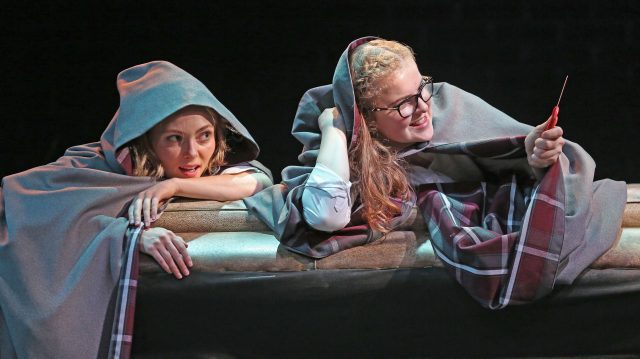
(photo by Joan Marcus)

Adama (Mirirai Sithole), Massassi (Antoinette Crowe-Legacy), and Kaya (Phumzile Sitole) are like the three stepsisters in Cinderella in If Pretty Hurts Ugly Must Be a Muhfucka (photo by Joan Marcus)

Directed by Obie winner Leah C. Gardiner (Born Bad, The Ruins of Civilization) and choreographed by Raja Feather Kelly (The Death of the Last Black Man in the Whole Entire World, Everybody), If Pretty Hurts Ugly Must Be a Muhfucka is all over the place, with a scattershot, choppy narrative that often feels unfocused. However, it makes some smart observations about beauty, self-esteem, and envy in both poignant and humorous ways. “Beauty is neither your accomplishment nor your failure,” Akim points out, while Chorus, a living cellphone who is a wildly fashionable mix of the stage manager from Our Town, the Fairy Godmother from Cinderella, and Flavor Flav from Public Enemy, tells the audience, “Hierarchy makes the world go round, folks. And if given the chance, we’d all covet that number one spot.” Louisa Thompson’s bright set feels like a game show, with a round central platform surrounded by a semicircle of dozens of rows of lightbulbs that turn on and off to create frames and doorways while often evoking the feeling of a giant makeup mirror as the characters look at themselves and at us, letting us all know that each one of us is a star. (The lighting is by Matt Frey.) The bittersweet finale firmly situates the fable in the real world, reminding us of the struggle so many women face every day.

THE PROM / THE CAKE

(photo by Deen van Meer)

Broadway stars Dee Dee Allen (Beth Leavel) and Barry Glickman (Brooks Ashmanskas) find a common cause after their Eleanor Roosevelt musical gets panned in The Prom (photo by Deen van Meer)

THE PROM
Longacre Theatre
220 West 48th St. between Broadway & Eighth Ave.
Tuesday – Sunday through October 20, $49-$169
212-239-6200
theprommusical.com

In 2012, Colorado baker Jack Phillips refused to make a wedding cake for a gay couple because of his religious beliefs, leading to a Supreme Court case and a battle with the Colorado Civil Rights Commission. In 2010, a Mississippi high school canceled its prom after being sued for barring a lesbian student from attending with her girlfriend. These two ripped-from-the-headlines situations have inspired a pair of shows currently running in the city that deal with issues of faith, prejudice, and LGBTQ rights in very different ways, both sparked by the struggle of gay couples to celebrate happy milestone events just like straight culture does. They also both explore the possibility of changing people’s minds, asking for tolerance of the intolerant. In The Prom, a musical comedy at the Longacre, the setup is theatrical: Great White Way veterans Dee Dee Allen (Beth Leavel) and Barry Glickman (Brooks Ashmanskas) are looking for a quick way to rebound from their instant flop Eleanor! — The Eleanor Roosevelt Musical by finding a cause they can support to get them some positive press attention. “People need to know it’s possible to change the world, whether you are a homely middle-aged first lady or a Broadway star,” Dee Dee, who played Eleanor, says. Barry adds, “The moment I first stepped into FDR’s shoes, and by shoes I mean wheelchair, I had an epiphany. I realized there is no difference between the president of the United States and a celebrity. We both have power. The power to change the world.”

They are joined by lesser-known minor actors Trent Oliver (Christopher Sieber) and Angie (Angie Schworer) and producer Sheldon Saperstein (Josh Lamon) and decide their best opportunity is to head to Edgewater, Indiana, where high school student Emma (Caitlin Kinnunen) is being harassed by the other students because Mrs. Greene (Courtenay Collins), the head of the PTA, has canceled the prom since Emma was going to go with another girl. Little does Mrs. Greene know that Emma is dating her daughter, Alyssa (Isabelle McCalla), who is understandably terrified of coming out to her mother. As this self-centered crackpot Justice League demands equal rights (“We’re all lesbians!”), Dee Dee unexpectedly falls for the soft-hearted, clear-sighted principal, Mr. Hawkins (Michael Potts), who takes the case to the state attorney’s office. He’s also none too happy when he begins thinking that the city folk might be in it only for the publicity, not the cause.

(photo by Deen van Meer)

Angie (Angie Schworer) gets a leg up speaking with gay teen Emma Greene (Caitlin Kinnunen) (photo by Deen van Meer)

Directed and choreographed by Tony winner Casey Nicholaw (The Book of Mormon, Something Rotten!), The Prom features a book by Bob Martin and Chad Beguelin, with music by Matthew Sklar and lyrics by Beguielin, who have a blast skewering not only the concept of narcissistic celebrities but musical theater itself. It’s loaded with inside jokes; for example, when Barry says to Angie, “I thought you were in Chicago,” she replies, “I just quit. Twenty years in the chorus and they still wouldn’t let me play Roxie Hart.” Schworer played Go to Hell Kitty for three years in a tour of Chicago while also understudying the Hart role. At nearly two and a half hours, The Prom is too long and overly repetitive, and it’s pretty easy to see where it’s going as it uses a sledgehammer to bring home its sociological perspective.

(photo by Deen van Meer)

Dee Dee Allen (Beth Leavel) seeks good publicity in Indiana fighting for an inclusive prom (photo by Deen van Meer)

Before leaving for Indiana, the five New Yorkers sing, “We’re gonna teach them to be more P.C. / the minute our group arrives. That’s right! Those / fist pumping / Bible thumping / Spam eating / cousin humping / cow tipping / shoulder slumping / tea bagging / Jesus jumping / losers and their inbred wives / They’ll learn compassion / and better fashion / once we at last start changing lives!” Mrs. Greene sticks to her guns, declaring, “You and your friends know nothing about us, about our town, about our people. And yet, you feel justified in telling us what to do.” It’s the privileged elitists against the deplorables, each side proclaiming that the other is the villain. The show inadvertently shoots itself in the foot by having a multiracial, color-blind cast at the school; if the town is so bigoted against gays and lesbians, it’s unlikely to be so accepting of blacks, Latinx, and Asians, so the homosexual fear/hatred feels like a plot device, which it is. Of course, the producers would have taken a different kind of hit if they had indeed hired only white actors to portray the children and adults of Edgewater. The Prom can be wacky and poignant, but it also can be preachy and predictable, whether to liberal theatergoers from the blue states or conservative tourists from red states. Nobody loses!

(photo © Joan Marcus, 2019)

Della (Debra Jo Rupp) is a sweet baker who opts not to make a cake for a gay wedding in MTC production at City Center (photo © Joan Marcus, 2019)

THE CAKE
Manhattan Theatre Club
MTC at New York City Center – Stage I
Tuesday – Sunday through March 31, $89
212-581-1212
thecakeplay.com

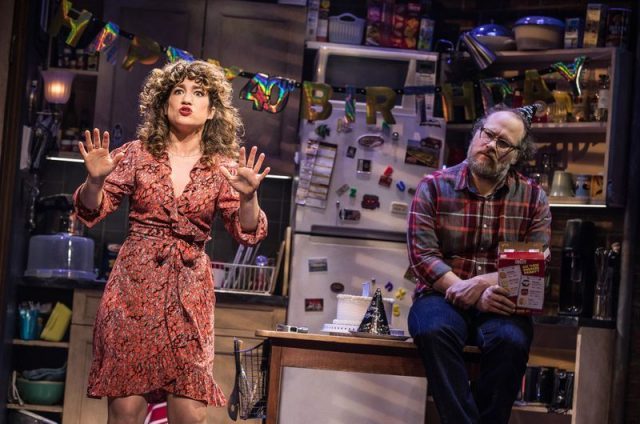
Meanwhile, Bekah Brunstetter’s The Cake, which opened this week at Manhattan Theatre Club’s Stage I at City Center, takes place in a small, tight-knit community in North Carolina, where the delightful Della (Debra Jo Rupp) runs a bakery specializing in extraordinary cakes for special occasions. Della, who is scheduled to be a contestant on The Great American Baking Show, is visited by Jen (Genevieve Angelson), the daughter of her late best friend, who has come to tell her that she is getting married and wants her to make the cake for the special event. But when Della finds out that Jen’s fiancée is Macy (Marinda Anderson), a black gluten-free Brooklynite, she changes her mind and claims that she is too busy to bake for her. While Macy is furious, Jen wants to give Della the benefit of the doubt.

When it seems that Della might be rethinking her decision (which is based on sexual orientation, not race, as Bella notes, “I don’t see color”), her husband, Tim (Dan Daily), demands that she not bake the cake because of their religion. “We know we can’t pick and choose the Bible, honey,” he explains. “That’s when the edges start to blur. Fabric starts to fray. We can be sad for her, though. We can love her, still.” Later, he says, “It’s — it’s just not natural.” Della responds, “Well, neither is confectioner’s sugar!” Tim: “You’re not making that cake.” Della: “I’ll make it if I want to.” Tim: “What’s that?” Della: “Nothing.” Tim and Della are quite a couple; she bakes delicious items that go in people’s mouths, while he, a plumber, fixes problems involving what comes out the other end.

(photo © Joan Marcus, 2019)

Baker Della (Debra Jo Rupp) and plumber Tim (Dan Daily) discuss sex and religion in The Cake (photo © Joan Marcus, 2019)

Much like the Broadway elitists want to change the mind of Edgewater, Indiana, Macy feels that Jen can help Della avoid making the wrong choice. “You could change her,” Macy says. “Della? No thank you,” Jen replies. Macy: “But if you don’t push her to change, then they never will. “Jen: “They?” Macy: “All of them.” . . . Jen: All I ask is that you just try and be respectful of the people down here.” Macy: “I don’t respect these people.” Jen: “But I’m one of them.” Macy: “No you’re not.” Brunstetter, a writer and producer on the first three seasons of This Is Us who identifies as a straight white woman, was raised in a conservative North Carolina household; she loves and respects her family even though she disagrees with them on many social issues, and The Cake might her attempt to convince theatergoers who are not fond of bigots and homophobes to have more compassion and empathy for these down-home plain folk.

(photo © Joan Marcus, 2019)

Della (Debra Jo Rupp) is happy for Jen (Genevieve Angelson) and Macy (Marinda Anderson) despite her religious beliefs in Bekah Brunstetter play (photo © Joan Marcus, 2019)

But it’s not that easy; no matter how cute and adorable Della is — and she’s portrayed wonderfully by Rupp, the mother on That ’70s Show and Linda on This Is Us; in fact, all four actors are terrific — it’s a lot for Brunstetter to ask of the audience. At the beginning of the play, which is engagingly directed by three-time Tony nominee Lynne Meadow (The Assembled Parties, The Tale of the Allergist’s Wife) and boasts an attractive set by John Lee Beatty that consists of ever-shifting ingredients, Della says, “See, what you have to do is really, truly follow the directions. That’s what people don’t understand.” She’s talking not only about baking but about her religion, following kitchen directions like she follows the Bible. Della also occasionally speaks with a disembodied voice from The Great American Baking Show, booming down from above as if God himself, judging if she’s worthy of being on the program. Each of the characters gets at least a little bit woke about something, resulting in a story that has tasty icing but too much fluff. “Ambivalence is just as evil as violence,” Macy argues after Della says she is not a political person, as if that excuses her from addressing the hot-button topics of the day. It’s also an excuse for Brunstetter to try to get us to accept her own family’s insensitivity to certain types of people. But being tolerant of the intolerant is not going to change things the way they need to be changed.

“DADDY”

(photo by Matt Saunders)

Franklin (Ronald Peet) has some slippery father issues in New Group / Vineyard Theatre world premiere (photo by Matt Saunders)

The New Group/Vineyard Theatre at the Pershing Square Signature Center
The Romulus Linney Courtyard Theatre
480 West 42nd St. between between Ninth & Tenth Aves.
Tuesday – Sunday through March 31, $40-$135
www.thenewgroup.org
www.vineyardtheatre.org

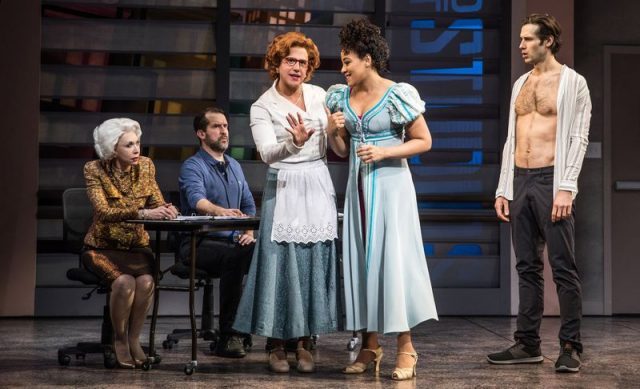
Jeremy O. Harris’s “Daddy” is a monumental work of bold genius, a searing, audacious investigation into the creation and ownership of both art and people, constructed around the sins of the father. The play, a joint production of the New Group and the Vineyard that opened tonight at the Signature Center’s Romulus Linney Courtyard Theatre, takes place in and around an infinity pool in a Bel Air mansion; Matt Saunders’s delightful set prominently features several chaise longues on a deck and a gleaming blue pool in the front that was inspired by David Hockney paintings, particularly Portrait of an Artist (Pool with Two Figures), which sold at auction for more than ninety million dollars this past November, as well as A Bigger Splash, Peter Getting Out of Nick’s Pool, and Portrait of Nick Wilder. (In 1966-67, a twenty-nine-year-old Hockney lived with Wilder, an older art dealer, in the latter’s Hollywood home, although this is not their story.)

Ronald Peet stars as Franklin, a twentysomething black artist who has recently moved to Los Angeles. Following an opening at a hot new gallery, Franklin has come home with Andre (Alan Cumming), an absurdly wealthy fiftysomething white art collector. Andre worships Franklin’s lithe body, comparing his legs to Naomi Campbell’s, while a very high Franklin, who is preparing for his first gallery show, expounds on the intrinsic value of art, arguing that “art loses its worth the minute it can be bought. . . . It becomes worthless once its owned.” He’s not referring merely to Andre’s holdings — which includes works by Cy Twombly, Cindy Sherman, Diane Arbus, and Alexander Calder and a room of Basquiats — but also colonialism and slavery. Andre and Franklin debate the artistic value of Kara Walker’s A Subtlety installation of a giant white “mammy” figure in the old Domino Sugar Factory in Williamsburg, and it’s no coincidence that Andre purchases Basquiats, a black artist who gained fame through his close association with the white Andy Warhol.

(photo by Monique Carboni)

Franklin (Ronald Peet) explains his art to his gallerist, Alessia (Hari Nef), in “Daddy” at the Signature (photo by Monique Carboni)

Franklin is soon at home in Andre’s place, inviting over his crew: fashion-obsessed Bellamy (Kahyun Kim) and struggling white actor Max (Tommy Dorfman), who supply comic relief through their jealousy of Franklin; each of them would love to have a “sugar daddy” too, although Franklin bristles at the term. He believes his relationship with Andre is something other than a clichéd fling. Nevertheless, Franklin has taken to calling Andre “Daddy” during sex, which occurs often throughout the play — there is ample nudity and graphic simulations. Absent fathers are everywhere: While Franklin never met his father, which haunts him, Andre’s father got him started collecting art, giving him a Degas. Franklin’s gallerist, the young, white Alessia (Hari Nef), also hails from a wealthy family (she took over the gallery from her father) and believes Franklin’s upcoming show will help put her on the map; it’s yet another example of a rich white person “owning” a black person, made all the more clear when we see the tiny soft-sculpture dolls Franklin is making for the exhibition. When Franklin’s Bible-thumping mother, Zora (Charlayne Woodard), arrives, she is not exactly thrilled about her son’s living situation or artwork. As Franklin tries to find his place in this superficial Hollywood world, he is accompanied by a kind of Greek chorus in the form of a three-woman gospel choir (Carrie Compere, Denise Manning, and Onyie Nwachukwu) that represents his heart and soul, which are up for grabs.

(photo by Monique Carboni)

Andre (Alan Cumming) looks on as Max (Tommy Dorfman) moves closer to Bellamy (Kahyun Kim) in Jeremy O. Harris’s “Daddy” (photo by Monique Carboni)

In the script, Harris (Xander Xyst, Dragon: 1, WATER SPORTS; or insignificant white boys) explains, “When lost look to melodrama for direction (see: [Peter] Brooks’s Melodramatic Imagination), because this play moves from melodrama’s dream to melodrama’s nightmare.” Director Danya Taymor (Familiar, Pass Over) has no such problem delivering the melodrama, from dream to nightmare; it’s a phenomenal staging, with vibrant, colorful costumes by Montana Levi Blanco, glistening lighting by Isabella Byrd (especially when the reflection of the pool’s waves dance across the walls), lovely original music adapted from a standard ring tone by Lee Kinney, and inspirational vocal music and arrangements by Darius Smith and Brett Macias. Peet (Spill, Kentucky) makes a major breakthrough as Franklin, giving a brave performance in which he lets it all hang out, emotionally and physically, combining sex appeal with an overt neediness and a major father complex. Tony and Olivier winner Cumming (Cabaret, The Good Wife) is utterly charming as Andre, a commanding, cultured man who loves collecting pretty things. “Beauty is beauty is beauty, Franklin. No matter whose eyes are seeing it,” he tells his lover. And two-time Obie winner and Tony nominee Woodard (Ain’t Misbehavin’, The Witch of Edmonton) ratchets it up as Zora, especially in the third act, when Kim and Dorfman get to strut their stuff while the masterful Cumming unfortunately has a lot less to do.

Harris’s fierce, polarizing Slave Play recently ran at New York Theater Workshop, and the three-act, 165-minute “Daddy” (with two intermissions) deals with some of the same topics (race, sex, power) but takes them to a whole new level, exploring the concept of a father as reality and fantasy, metaphor and obsession, presence and absence: Andre spanks Franklin like he’s a child, Zora prays to the Lord for guidance, Franklin discusses the origin of his dolls, the choir sings, “Daddy won’t nothing but a ‘shhhhhhh,’” and several characters get in the pool and blast out a hysterically relevant George Michael song. The pool is more than a cool part of the set; it also serves as a baptismal font, making us all believe in the power of art and theater, which becomes even more palpable when the first few rows get splashed. Even though the ending is muddy, “Daddy” is an extraordinary piece of storytelling, a masterful work of art that demands to be seen.

MERRILY WE ROLL ALONG

(photo by Joan Marcus)

Merrily We Roll Along goes backward to tell the story of three old friends bursting with dreams (photo by Joan Marcus)

Laura Pels Theatre
Harold and Miriam Steinberg Center for Theatre
111 West 46th St. between Sixth & Seventh Aves.
Tuesday – Sunday through April 12, $109
212-719-1300
www.roundabouttheatre.org
www.fiascotheater.com

Ever since it famously flopped on Broadway in 1981, Stephen Sondheim and George Furth’s Merrily We Roll Along has gone through numerous iterations; the show has a beloved score but a challenging narrative. As part of its Roundabout residency, New York–based Fiasco Theater, who delivered a gorgeous Into the Woods at the Laura Pels in 2015 — in addition to several unique takes on Shakespeare at Theater for a New Audience, Classic Stage, and the New Victory in the last few years — now tackles Merrily, but not even this extremely talented company can get past the fatal flaws of the plot. Working in elements from the 1981, 1987, and 1994 versions, including rehearsal drafts, along with the original 1934 play by George S. Kaufman and Moss Hart on which the musical is based, Fiasco has trimmed the play down to its essentials, but there’s still not much meat on the bones. The story begins in 1980, with the six-actor ensemble singing, “Yesterday is done, / See the pretty countryside / Merrily we roll along, roll along, / Bursting with dreams.” The action then travels back in time, through the 1970s, ’60s, and ’50s, following three main characters — Franklin Shepard (Ben Steinfeld), Mary Flynn (Jessie Austrian), and Charley Kringus (Manu Narayan) — as they reverse their development from jaded, unhappy adults to energetic teens “bursting with dreams.”

(photo by Joan Marcus)

Fiasco Theater tries to wrap its arms around elusive Sondheim/Furth musical at the Laura Pels (photo by Joan Marcus)

The main problem is that none of the three characters in this tale of friendship, betrayal, and selling out is particularly likable, so their personal trials and tribulations are just not that interesting. Frank is a narcissistic movie producer and musical theater composer who has difficulty remaining faithful to his wives or Charley, his songwriting partner, while Mary burned herself out on her debut novel. Also making the scene are Frank and Charley’s producer, Joe (Paul L. Coffey), and his wife, Gussie (Emily Young); their early supporters the Spencers (again, Coffey and Young); Frank’s first wife, Beth (Brittany Bradford); and Meg (also played by Bradford), the star of Frank’s debut movie. Derek McLane’s set is meant to evoke the backstage area of the Alvin Theatre on Broadway, where the show opened on November 16, 1981, and closed on November 28, after forty-four previews and only sixteen performances. Merrily is very much insider theater, and the set makes that plain, with rows and rows of props, from masks and lamps to cameras and bottles, that reach up to the ceiling, while Paloma Young’s costumes are hung up at floor level, allowing the actors to make quick changes as necessary.

A Fiasco tradition, the cast members who are not involved in the action often sit on the side, watching the proceedings with the audience. The orchestrations and new arrangements by Alexander Gemignani — whose father, Paul Gemignani, was the music director for the show’s brief Broadway tenure — are rather basic and standard; songs such as “Old Friends,” “Not a Day Goes By,” “It’s a Hit,” and “Our Time” need much more nuance and oomph, especially since the vocal chops of the cast are inconsistent. Director Noah Brody (Into the Woods, Measure for Measure) can’t quite get it all to flow together, merrily or not. “Why can’t it be like it was? / I liked it the way that it was,” Mary sings early on. But looking back — and going into the past — is not always the best answer, in real life or in fiction.

TILT: THE YOUNG GIRL, THE DEVIL AND THE MILL

(photo © Christophe Raynaud)

The Young Girl, the Devil and the Mill will make its English-language world premiere at the TILT festival this weekend (photo © Christophe Raynaud)

TILT Kids Festival
French Institute Alliance Française, Florence Gould Hall
55 East 59th St. between Madison & Park Aves.
March 2-3, $25-$45, 2:00
Festival runs March 2-31
212-355-6100
tiltkidsfestival.org
www.fiaf.org

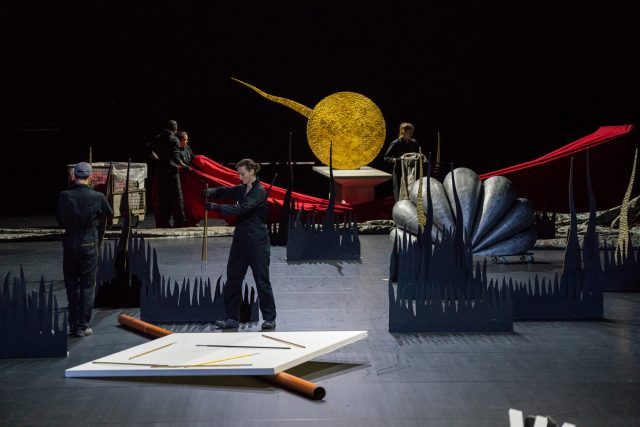
The fourth annual family-friendly TILT festival kicks off March 2-3 at FIAF with the English-language world premiere of Festival d’Avignon director Olivier Py’s The Young Girl, the Devil and the Mill, a musical fairy tale inspired by the Brothers Grimm fairy tale “The Girl without Hands.” Adapted from the original French production, La Jeune Fille, le Diable et le Moulin, the specially commissioned fifty-minute show explores such complex topics as memory, death, and faith as a father contemplates a deal with an unholy character. Alex Burnette plays the Prince, Nadia Duncan the Girl, Whit K. Lee the Devil, and Ben Rauch the Gardener; the music is by Stéphane Leach, with text and direction by Py. Presented by the Cultural Services of the French Embassy and the French Institute Alliance Française, the festival, cocurated for the first time by Laurent Clavel and Courtney Geraghty, focuses on diversity. “Today, in a world where everyone is discussing politics, it’s important to emphasize that this is where it all starts,” Geraghty said in a statement. “This year’s TILT provides mind-expanding content to children so that they can further develop their imagination and critical thinking about serious issues surrounding their daily lives. The arts can inspire a new generation of cultural thinkers, political leaders, and responsible citizens of the world.” TILT continues through March 31 with such other shows as Marc Boutavant’s The Dumpster Ball at the French Embassy (free with RSVP), Okwui Okpokwasili’s Adaku’s Revolt at Abrons Arts Center ($15-$20), and Guillaume Pigé and Theatre Re’s The Nature of Forgetting at the New Victory Theater ($17-$42).

HACHIOJI KURUMA NINGYO PUPPET THEATER

Hachioji Kuruma Ningyo Puppet Theater

Hachioji Kuruma Ningyo Puppet Theater presents two programs at Japan Society this week

Japan Society
333 East 47th St. at First Ave.
February 28 – March 2, $40, 7:30
212-715-1258
www.japansociety.org

Hachioji Kuruma Ningyo Puppet Theater rolls into Japan Society this week with its unique brand of storytelling, led by fifth grand master Koryu Nishikawa V. Moving large puppets on a three-wheeled dolly, the company will present two female-centric programs, one consisting of Yugao, Date Musume Koi Higanoko, and Tsuri On’na, the other Yugao, Date Musume Koi Higanoko, and Kuzunoha; Yugao is a new work by Nishikawa V based on a story from The Tale of Genji. Each show will be preceded by a lecture by Dr. Claudia Orenstein of Hunter College; opening night will be followed by a reception with the artists. The works will be performed by Ryuji Nishikawa V, Ryusha Nishikawa, Ryuki Nishikawa, Ryukei Nishikawa, and Yoshiteru Nishikawa, led by Nishikawa V, with gidayu chanter Koshiko Takemoto and live shamisen music by Sansuzu Tsuruzawa and Yaya Tsuruzawa. In addition, there will be a “Hachioji Kuruma Ningyo Performance and Workshop” for students on Friday and a “Master Class on Kuruma Ningyo Puppetry” on Saturday and Sunday. And on March 10, Nishikawa V will be at the Metropolitan Museum of Art for Family Afternoon — Pens & Poems for children ages twelve and under with an adult.

TRUE WEST

(photo by Joan Marcus)

Ethan Hawke and Paul Dano star in Roundabout revival of Sam Shepard’s True West on Broadway (photo by Joan Marcus)

American Airlines Theatre
227 West 42nd St. between Broadway & Eighth Ave.
Tuesday – Sunday through March 17, $59-$352
212-719-1300
www.roundabouttheatre.org

Sam Shepard’s Pulitzer-nominated True West is an oft-produced star-driven 1980 vehicle that offers an epic sibling rivalry with a few parental complications as it deconstructs the American dream and the creation of film and theater itself. The two brothers, the younger Austin, a screenwriter with a wife and kids, and the older Lee, a ne’er-do-well thief and transient, have been played by such duos as Tommy Lee Jones and Peter Boyle, Gary Sinise and John Malkovich, Dennis Quaid and Randy Quaid, Kit Harington and Johnny Flynn, Bruce Willis and Chad Smith, Bob Hoskins and Antony Sher, and, in its Broadway debut in 2000, Philip Seymour Hoffman and John C. Reilly, who occasionally switched roles. The black comedy is now back on Broadway at the American Airlines Theatre in a ferociously funny Roundabout revival, directed by James Macdonald, with Paul Dano as Austin and Ethan Hawke as Lee. This new production benefits from close ties with Shepard, who died in 2017 at the age of seventy-three: Macdonald previously helmed such Shepard works as Fool for Love and Simpatico and directed Shepard in Caryl Churchill’s A Number, while Hawke has directed Shepard’s A Lie of the Mind and starred with Shepard in Michael Almereyda’s 2000 Hamlet, which featured Hawke as the title character and Shepard as the ghost of his father. Hawke also directed Dano in the New Group’s Things We Want in 2007.

(photo by Joan Marcus)

Siblings Lee (Ethan Hawke) and Austin (Paul Dano) go at each other in Sam Shepard revival at American Airlines Theatre (photo by Joan Marcus)

A quiet, focused man, Austin is house-sitting their mother’s (Marylouise Burke) suburban home in Southern California. She is off in Alaska — essentially the polar opposite of Cali — and he is taking care of her plants while writing a screenplay that independent producer Saul Kimmer (Gary Wilmes) is interested in. The gruff, uncouth Lee shows up unexpectedly, claiming to have spent years in the desert and visiting with their father. Austin does not want Lee around for an upcoming meeting with Saul, but Lee not only interferes but is soon pitching his own film project, a contemporary Western based on his adventures on the road, pitting the two brothers against one another while they also consider working together. Macdonald, Hawke, and Dano play up the physical slapstick in this raucous version. “You probably think that I’m not fully able to comprehend somethin’ like that, huh?” the less-educated Lee asks. “Like what?” Austin responds. “That stuff yer doin’. That art. You know. Whatever you call it,” Lee replies, as Shepard, who represented manliness and masculine achievement during his lifetime as an actor, writer, and rancher, questions the very notion of storytelling. When they’re trying to outline the narrative, which Austin thinks is bad, Lee says, “What? It’s too what? It’s too real! That what ya’ mean, isn’t it? It’s too much like real life!” Austin answers, “It’s not like real life! It’s not enough like real life. Things don’t happen like that.”

In the second half of the play, the brothers basically switch places in a riotous swap of psyches and body movement. Even Mimi Lien’s long horizontal set, meant to evoke a widescreen movie, is divided in two, one side a kitchen, the other an alcove with plants and a table with a typewriter. The pairs of cherries on the wallpaper are a particularly deft touch, evoking testicles as well as how brothers are naturally stuck with each other. “I always wondered what’d be like to be you,” Lee admits, to which Austin explains, “And I used to say to myself, ‘Lee’s got the right idea. He’s out there in the world and here I am. What am I doing?” In True West, Shepard, who had the public persona of a rugged man’s man, a shining example of the American male, delves into the dual nature of identity and art, separating who we are from who we want to be, what’s real from what’s fantasy. California is home to Hollywood, the ultimate myth maker, as well as the empty desert and vast landscapes where cowboys roam the land. While Austin writes about romance, we never learn anything about his relationship with his family; the only things that exist for him are written on pages. Lee is living a rough-and-tumble life but suddenly wants to slow down and set it down on paper. It is as if they are enacting the two sides of Shepard himself. All hell breaks loose at the conclusion, which is as hysterical as it is horrifying, leaving you both exhausted and exhilarated, exploring the mythology of your own identity and family bonds.