this week in theater

TICKET GIVEAWAY: MIRACLE IN RWANDA

miracle in rwanda

MIRACLE IN RWANDA
The Lion Theatre, Theatre Row
410 West 42nd St. between Ninth & Tenth Aves.
April 4 – May 11, $39-$90
212-560-2183
miracleinrwanda.nyc
bfany.org

“This is my story, told as I remember it . . . and I remember it as though it happened yesterday,” Immaculée Ilibagiza writes in Left to Tell: Discovering God Amidst the Rwandan Holocaust, about her experience trying to stay alive during the 1994 Rwandan genocide of the Tutsi people by the Hutu government. Leslie Lewis and Edward Vilga have adapted her harrowing tale into a one-woman show, Miracle in Rwanda, which begins previews April 4 at the Lion Theatre at Theatre Row. Rwandan actress, poet, and activist Malaika Uwamahoro (Measure Back, Our Lady of Kibeho), a Fordham grad, portrays Ilibagiza and two dozen other characters in the play, including a pastor, a machete-wielding murderer, refugees, friends, family members, soldiers, and more. The role was originally played by cocreator Lewis on its world tour.

TICKET GIVEAWAY: Directed by George Drance, Miracle in Rwanda runs April 4 through May 11 (with an April 9 opening) at the Lion Theatre at Theatre Row, and twi-ny has three pairs of tickets to give away for free. Just send your name, phone number, and favorite one-woman show to contest@twi-ny.com by Wednesday, April 3, at 5:00 pm to be eligible. All entrants must be twenty-one years of age or older; three winners will be selected at random.

KISS ME, KATE

(photo by Joan Marcus 2019)

Kelli O’Hara and Will Chase star as a divorced couple making a musical version of The Taming of the Shrew in Kiss Me, Kate (photo by Joan Marcus 2019)

Studio 54
254 West 54th St.
Through June 30, $59-$352
212-719-1300
www.roundabouttheatre.org

The #MeToo makeover of golden age Broadway musicals continues with Roundabout’s Kiss Me, Kate, which opened March 14 at Studio 54. In the last year, major or minor changes have been made to My Fair Lady, Carousel, and Oklahoma! in order to deal with their troublesome presentations of sexism, misogyny, domestic violence, and gender inequality. Tony nominee Amanda Green (Hands on a Hardbody, Bring It On), who tweaked Roundabout’s 2015 revival of On the 20th Century, now does the same with Kiss Me, Kate, implementing small fixes that most audience members won’t notice in director Scott Ellis’s exuberant adaptation of one of Cole Porter’s most beloved shows, which in 1949 won the first-ever Tony for Best Musical and in 2000 won for Best Revival of a Musical. The book by Sam and Bella Spewack (Boy Meets Girl, My Favorite Wife), inspired by the real-life relationship of legendary actors Alfred Lunt and Lynn Fontanne during their 1935 revival of William Shakespeare’s The Taming of the Shrew at the Guild Theatre (now known as the August Wilson), also won a 1949 Tony.

The tale is set in the summer of 1948, as a company prepares for opening night of a musical version of Shrew at Baltimore’s Ford Theatre, hoping for an eventual Broadway run. The show is produced and directed by Fred Graham (Will Chase), who also plays Petruchio, opposite his ex-wife, movie star Lilli Vanessi (Kelli O’Hara), who is returning to the stage as Katharine (Kate), the character who supposedly needs taming. The backstage shenanigans mimic Shakespeare’s plot with an extra dollop of Hollywood screwball comedy as Petruchio woos Kate for her father’s (Mel Johnson Jr., who also plays stage manager Harry Trevor) money despite her resistance, for she wants no part of any man, while Fred and Lilli become enmeshed in a battle of the sexes over fame, fortune, and love. Fred is fooling around with the sweet but not-so-innocent ingénue Lois Lane (Stephanie Styles), who is dating Bill Calhoun (Corbin Bleu), a cad with a $10,000 gambling debt he has surreptitiously signed over to Fred. In the musical within the musical, Lois is Bianca, Kate’s younger sister, who has a trio of suitors, Gremio (Will Burton), Hortensio (Rick Faugno), and Lucentio, the last played by Bill. Lilli has just gotten engaged to General Harrison Howell (Terence Archie), a rigid military man who is not as devoted to his fiancée as he is to his country or other women. Meanwhile, Fred is being closely watched by two gangsters (John Pankow and Lance Coadie Williams) who are sticking around to collect their boss’s ten grand and who even take roles in the show to make sure Fred doesn’t go anywhere.

(photo by Joan Marcus 2019)

“Too Darn Hot” is a highlight of Roundabout revival of Kiss Me, Kate (photo by Joan Marcus 2019)

Ellis’s revival takes a while to get going, building too slowly. It isn’t until the second act opener, the sizzling “Too Darn Hot,” led by James T. Lane as Paul, Fred’s assistant, that the show starts hitting its mark. The chemistry between Tony nominee Chase (The Mystery of Edwin Drood, Nashville) and Tony winner O’Hara (The King and I, South Pacific) is just not there at the beginning; Fred is too unsympathetic, and Lilli is not shrewish enough, especially as compared to Petruchio and Kate. You just don’t want them to fall back in love. In her Broadway debut, Styles (Kingdom Come, Roman Holiday) is a delight as Lois/Bianca, and Pankow (Twelve Angry Men, The Iceman Cometh) and Williams (Sweat, Bootycandy) have fun as the gangsters, although “Brush Up Your Shakespeare” goes on too long. Paul Gemignani’s orchestrations of such Porter tunes as “Another Op’nin’, Another Show,” “Wunderbar,” “Why Can’t You Behave,” and “Where Is the Life That Late I Led?,” performed by a band positioned in the audience boxes on either side of the stage, go from syrupy to extravagant, with O’Hara cutting it loose with her operatic voice and making Lilli’s point exceedingly clear in “I Hate Men” (“I hate men. / Though roosters they, I will not play the hen. / If you espouse an older man through girlish optimism, / He’ll always stay at home at night and make no criticism, / Though you may call it love the doctors called it / Rheumatism. / Oh, I hate men.”).

The choreography by Tony winner Warren Carlyle (After Midnight; Hello, Dolly!) is highlighted by “Too Darn Hot,” which includes tap and lots of heat, and “Tom, Dick or Harry,” as Gremio, Hortensio, and Lucentio make their case to Bianca through dazzling moves. David Rockwell’s sets change to a choreography all their own. But even as Lilli strikes back at Fred, literally and figuratively, her ultimate choice does not feel as liberating as one might wish. “Come, come you wasp; i’ faith, you are too angry,” Petruchio tells Kate, who replies, “If I be waspish, best beware my sting.” Eight-time Tony nominee Ellis’s (Curtains, 1776) Shrew lacks the necessary sting, but it does have bite.

SEA WALL / A LIFE

Tom Sturridge stars in (photo by Joan Marcus)

Tom Sturridge stars in Simon Stephens’s Sea Wall at the Public (photo by Joan Marcus)

The Public Theater, Newman Theater
425 Lafayette St. by Astor Pl.
Tuesday – Sunday through March 31
212-967-7555
www.publictheater.org

The Public Theater’s pairing of two one-act solo plays, Simon Stephens’s Sea Wall and Nick Payne’s A Life, is no mere combination of works by star British playwrights performed by a Tony nominee and an Oscar nominee, respectively. Instead, it’s a powerhouse double header of intimate explorations of loss and love, of what it means to be a husband, a father, and a son, that will leave you emotionally exhausted and exhilarated. American actor Jake Gyllenhaal and English actor Tom Sturridge wanted to work together, and they ultimately decided to share an evening of one-man shows written by playwrights they felt a kinship with; Gyllenhaal was previously in Payne’s If There Is I Haven’t Found It Yet and Constellations, while Sturridge was in Stephens’s Punk Rock and Wastwater.

As the audience is entering the Newman Theater, Sturridge walks onstage, looking more like a member of the crew. He grabs a beer from a small desk, adjusts a light, and sits at the top of a ladder, having a drink and checking his cell phone. When the audience realizes it’s the star and instantly hushes, he says, “That’s all right; you don’t have to be quiet yet.” It’s a line that might not be in the script but establishes him as just one of us. A few minutes later, he turns off the lights himself and becomes Alex, starting a riveting monologue about his daughter, Lucy, his wife, Helen, and his father-in-law, a proud soldier. He wanders slowly all over Laura Jellinek’s strikingly bare set, which features a piano to one side and a large brick landing in the back. Talking about photography, he advises that “if you possibly can, then take [a picture] from below the subject. It renders the subject actually oddly, what it does is it renders them not more heroic, not more god-like, oddly it renders them more human.” Having been so instructed, we understand that when he climbs the ladder and walks along the higher part of the stage in the back, he’s just another person, no different from anyone else. He talks about Lucy’s birth, going diving with his father-in-law, the existence of God, and the surging strength of the ocean. Forty-five minutes after he begins, he turns out the lights, and intermission offers a brief chance to recover from the affecting drama we have all experienced.

(photo by Joan Marcus)

Jake Gyllenhaal plays a man dealing head-on with life and death in Nick Payne’s A Life (photo by Joan Marcus)

Next Gyllenhaal takes the stage and turns out the lights, standing in one spotlight for nearly his entire fifty-five-minute monologue, which also deals with family. (The actual lighting designer is Peter Kaczorowski.) A Life was originally Payne’s deeply personal memory about his father’s illness, but he has expanded it by adding the story of the birth of his daughter, so it fits extraordinarily well with Stephens’s Sea Wall. As Abe, Gyllenhaal quickly goes back and forth between his character taking care of his ailing father and getting ready for his wife to give birth to their first child. It all happens so fast that it’s sometimes hard to follow the transitions, but it adds to the excitement as the tale plays out like a procedural. Payne avoids most of the traps of a clichéd life-death exchange as each part heads toward its gripping conclusion, with graphic details that will make you squirm in your seat. Like with Sturridge’s Alex, Gyllenhaal’s Abe is so honest and forthright, capturing every key moment, that you’ll think you’re seeing the events they’re describing with vivid clarity, watching his father’s decline and his wife’s tense pregnancy as they collide toward a bittersweet ending.

There are numerous similarities between the two shows, several of which are purely coincidental; both include lines about aging, skin cracking, the television show ER, three generations of family, and holes in the body, real and metaphorical. Director Carrie Cracknell (A Doll’s House, The Deep Blue Sea) skillfully allows them to intertwine ever so subtly with deft touches that pack a terrific one-two punch. Early in A Life, Gyllenhaal says something that zeroes in on many aspects of each play: “I remember reading somewhere or maybe someone telling me about this idea that there are three kinds of deaths. . . . The first is when the body ceases to function. The second is when we bury the body, or I guess set it on fire. And the third is the moment, sometime way in the future, when our names are said, spoken aloud, for the very last time. I’m thinking to myself but I don’t say it, I wonder who’s gonna say our child’s name for the last time?” Gyllenhaal (Sunday in the Park with George, Brokeback Mountain) and Sturridge (Orphans, 1984) might not be acting face-to-face onstage, but the characters and the actors’ individual performances relate organically to each other; they rehearsed together to make it all feel cohesive and tried out many variations in previews, and the actors still make minor adjustments every night depending on audience reaction. Sea Wall flows beautifully into A Life, as if Stephens (Heisenberg, The Curious Incident of the Dog in the Night-Time) and Payne (Elegy, Incognito) had collaborated extensively from start to finish, which is not the case, but Cracknell, Sturridge, and Gyllenhaal transform them into one interconnected piece that deals with some very difficult yet compelling topics.

FLEABAG

(photo by Joan Marcus)

Phoebe Waller-Bridge’s brings her television show Fleabag to life at SoHo Playhouse (photo by Joan Marcus)

SoHo Playhouse
15 Vandam St. between Varick St. & Sixth Ave.
Wednesday – Monday through April 14, $125
212-691-1555
fleabagnyc.com
www.sohoplayhouse.com

Thirty-three-year-old London native Phoebe Waller-Bridge has rocketed to cult stardom in a short period of time; since 2016, she has created, written, and starred in two British television series, Crashing and Fleabag, created and wrote the Emmy-nominated BBC America crime drama Killing Eve, and played Lando Calrissian’s (Donald Glover) droid L3-37 in Solo: A Star Wars Story. Her breakthrough came with the 2013 Edinburgh Fringe debut of her solo show, Fleabag (later developed into the television series), which earned her an Olivier nomination. Waller-Bridge has now brought the sexy, cringy comedy to SoHo Playhouse, where the sold-out coproduction with Annapurna Theatre continues through April 14. Waller-Bridge is the unnamed title character, a strong, defiant woman who doesn’t hide her sexual desires and says what’s on her mind, no matter how politically incorrect or unfeminist it may be. She owns a small guinea-pig-themed café that she started with her best friend, Boo, who has recently died in a bizarre, tragic accident. She flubs a job interview when she starts to take off her sweater, forgetting that she does not have a top on underneath, leading the male interviewer, who is heard in prerecorded voiceover, to demand that she leave immediately. But Waller-Bridge adds a subtle touch that underscores the situation brilliantly: The man says almost as an afterthought, “I’m sorry. That won’t get you very far here anymore.” It’s one of many clever counterbalances that portray the character’s tendency to pursue cringeworthy situations worthy of Lena Dunham and Larry David, all in the name of uncovering truths about daily life.

(photo by Joan Marcus)

Phoebe Waller-Bridge makes her New York City stage debut in Fleabag (photo by Joan Marcus)

She also has run-ins with her maybe-boyfriend, Harry; Joe, the “cockney geezer” who comes into the café every morning at eleven; Tube Rodent, a man with a tiny mouth who flirts with her on the train; her father, who is not exactly thrilled when she arrives drunk at his doorstep; and her fashionable married sister, Claire, who meets her at a lecture entitled “Women Speak.” When the speaker says, “Please raise your hands if you would trade five years of your life for the so-called ‘perfect body,’” the sisters are the only ones in the auditorium who throw their hands in the air. “Four hundred women stare at the two of us horrified. We are bad feminists,” Waller-Bridge says. But are they? She is playing a brave woman who is not ashamed of the choices she makes — whether it’s masturbating to Barack Obama while in bed with a lover or wondering about the size of her naughty bits — and even when she knows she’s gone too far, she understands clearly why she’s done it, offering poignant perspective even as she can’t hold back. When her sister tells her “to stop talking to people like I’m doing a stand-up routine,” adding that “some things just aren’t fucking funny,” she tells the audience, “I laugh. And then I don’t laugh.” That exchange gets to the heart of Waller-Bridge’s humor and her unique storytelling ability.

However, Fleabag the play doesn’t work nearly as well as Fleabag the television series. Perhaps it’s partly because many of the episodes described in the play will already be familiar, and feel a bit stale, to fans at the SoHo Playhouse. Director Vicky Jones, the cofounder and co-artistic director of DryWrite with Waller-Bridge and who has worked with her on Fleabag and Killing Eve, keeps it all fairly simple; Waller-Bridge, wearing a red top and thick red lipstick, spends most of the sixty-five minutes sitting on a tall chair with red cushions, on a rectangular red rug. BAFTA winner Waller-Bridge performs the voices of some of the other characters, while a speaker to her right broadcasts the rest, along with various random sound effects, the inconsistency of which is off-putting. (Waller-Bridge’s sister, composer, artist, and musician Isobel Waller-Bridge, did the sound design; the bare set is by Holly Pigott and lighting by Elliot Griggs.) It’s all like a seriocomic confessional, except Waller-Bridge isn’t asking for the audience’s forgiveness, its sympathy, or its approval; she is merely detailing the life of a confident woman trying to maintain control in a complex, judgmental world, dealing with joys and tragedies, sex and love, glamor and ugliness. And that can be a beautiful thing, even when it’s far from perfect.

STRANGERS IN THE WORLD

(photo by Pavel Antonov)

Axis Company’s Strangers in the World is set in a stark would-be paradise (photo by Pavel Antonov)

Axis Company
One Sheridan Sq. between West Fourth & Washington Sts.
Wednesday – Saturday through April 6, $20-$30
866-811-4111
www.axiscompany.org

In 1587, a small English colony of about 115 men, women, and children was established on Roanoke Island. Three years later, the settlement was gone; the only evidence Europeans had ever been there was the word “Croatoan” carved into a wooden post. Axis Company artistic director Randy Sharp uses the mysterious tale of the Lost Colony of Roanoke as inspiration for her dark, flummoxing new play, Strangers in the World, which opened last night at the company’s home on Sheridan Square, inaugurating Axis’s twentieth anniversary season. The play is set in 1623, but many of the Lost Colony elements are there as a group of starving, traumatized Puritans wander almost zombielike through scary woods of barren trees. The addled survivors consist of their selectman, Killsin Henry (Brian Barnhart), who mutters on about his murdered son and dead wife, Jane (Britt Genelin); William Chase (Andrew Dawson), the old teacher; John Coldweather (Jon McCormick), whose wife died on the ship, followed by their twin daughters; Distance (Spencer Aste), Killsin’s brother who is married to Honor (Katie Rose Summerfield); and Constance (Emily Kratter), the youngest, who arrived later on a ship bringing more Puritans and desperately needed supplies.

On a cold day, an odd young man is spotted in the woods. Olean (Phil Gillen) explains his cutter sank on a fishing expedition from its larger vessel, a big ship that should return shortly to give them all salvation. But the marooned castaways suspect he’s a thief come to rob and murder them or else in cahoots with the “savages” they claim have already stolen from them, leaving them with nothing but the ragged clothes on their backs and a few dozen apples. Filled with fear, the Puritans consider locking Olean in a makeshift cage that sports a sign that reads “The Wayward Child” and, curiously, a surreal picture of an eye. There are several clues as to who Olean might be, which lead only to more confusion as the crisis grows ever more discombobulated.

(photo by Pavel Antonov)

The arrival of an odd man (Phil Gillen) brings yet more fear to a colony of Puritans in Randy Sharp’s world premiere (photo by Pavel Antonov)

In Strangers in the World, writer-director Sharp (Last Man Club, Dead End, High Noon) has created a Beckett-like story of the settling of America, except in this case Godot may have shown up in the personage of Olean — although the characters don’t realize it. The seventy-five-minute show explores ideas of humanity’s puritanical nature, with numerous references to sin and salvation (such as their names themselves, which include Killsin and Honor); sex and childbirth loom large, as does child murder; they also debate whether Olean might be a Jonah come to reprimand them, not free them. But foraging for meaning in the play is like getting lost in the woods: Is it a parable about the Garden of Eden gone terribly wrong? (Olean begs for water but William only offers him a half-eaten apple.) The return of Jesus? Is it about the dangers of fundamentalist religious beliefs, then and now? Fear of the other, relating to the current battle over immigration? (At one point, they discuss a “godless southern city . . . with a wall round it.”) Or perhaps it’s a stark look at the future of the planet because of climate change? As with all Axis productions, Strangers in the World is technically adept, with solid acting, a compelling set (by Chad Yarborough), fab costumes (by Karl Ruckdeschel), and an appropriately creepy sound design (by Paul Carbonara). But the narrative is as cold and distant as the hellish land where the Puritans have been apparently sentenced to spend eternity. Over the last few years, archaeologists think they may have found what happened to the Lost Colony of Roanoke; maybe next they can turn their attention to the overly puzzling Strangers in the World.

DYING IN BOULDER

(photo by Carlos Cardona)

A family gathers to prepare for the death of a loved one in Dying in Boulder at La MaMa (photo by Carlos Cardona)

Downstairs, La MaMa Experimental Theatre Club
66 East Fourth St.
Tuesday – Sunday through March 17, $25-$30
212-475-7710
lamama.org

When it comes time to meet your maker, a fine spot would be a place like Yu-Hsuan Chen’s lovely, welcoming set for the otherwise mundane Dying in Boulder, which is having its world premiere through March 17 at La MaMa Downstairs. Just a few feet from the seats are a rock garden consisting of three circles of cairns and sand, a wooden bench, a bedroom partially hidden by curtains, and an open sun room with a couch, chairs, a table, and a trio of spare, large-scale oil paintings of nude middle-aged women. It’s hard to resist the urge to sit on the bench or meditate among the stacked stones (but don’t, of course). However, the narrative doesn’t live up to the design. Written by Filipino American Linda Faigao-Hall, who was inspired by her involvement as a caretaker for her sister-in-law, Dying in Boulder is a fairly standard work about death and aging.

It’s the spring of 2001, and Jane (Bernadette Quigley) has chosen to die in Boulder, with the support of her husband, Tai chi teacher Bayani (Fenton Li); their pregnant daughter, Nikki (Mallory Ann Wu), who is waiting for her husband to arrive; and crunchy local monk Max (Michael Rabe). Jane has prepared several binders that detail the Buddhist rituals she wants, outlining specific chores for relatives and friends. Her sister, Lydia (Jan Leslie Harding), a successful television and movie actress going through a rough patch, arrives only to find out that Jane has made her the DC, the death coordinator, a role that includes some extremely detailed and difficult responsibilities that Lydia sees as punishment. Lydia also doesn’t understand how everyone can be so resigned to her sister’s condition, seemingly acting like it’s no big deal. As Jane’s time approaches, she and Lydia finally face issues that have been tearing at each of them for years, threatening Jane’s peaceful departure into the great unknown.

(photo by Carlos Cardona)

Sisters Lydia (Jan Leslie Harding) and Jane (Bernadette Quigley) finally let loose in Linda Faigao-Hall’s Dying in Boulder (photo by Carlos Cardona)

The play — which is subtitled “the perfect place to die if you have good karma!” — is as much about sisters as it is death, but neither Jane nor Lydia is a compelling character. Lydia is too shrill and disbelieving, while Jane is overly woo-woo. The story works significantly better when it focuses on the cheerful Bayani, sweetly played by Li, and the concerned Nikki, who is portrayed nicely by Wu; the likable Rabe, the son of David Rabe and Jill Clayburgh (and brother of Lily Rabe), is not given enough to do as Max, particularly in the second act. All three add needed humor, while Jen Hill’s lighting emits a gentle mystery. Director Ian Morgan (The Accomplices, Faigao-Hall’s Sparrow) is unable to grab hold of any significant conflict to drive the story until it’s too late; it would have benefited by being trimmed from two acts and two hours to about eighty minutes without intermission. “Death is a great adventure,” Nikki says at the beginning of Dying in Boulder. That might be the case, but you can’t tell from this overbaked melodrama.

THE MOTHER

(photo by Ahron R. Foster)

Isabelle Huppert and Chris Noth star in US premiere of Florian Zeller’s The Mother at the Atlantic (photo by Ahron R. Foster)

Atlantic Theater Company
Linda Gross Theater
336 West 20th St. between Eighth & Ninth Aves.
Tuesday – Sunday through April 13, $101.50
866-811-4111
atlantictheater.org

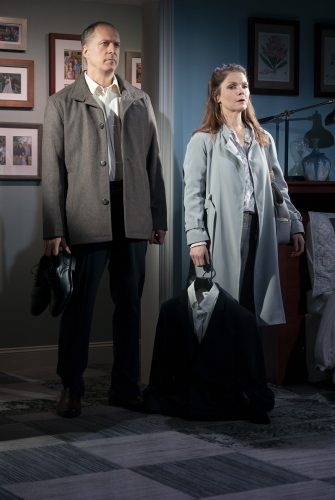
In 2016, Frank Langella won a Tony as the title character in the US premiere of French playwright and novelist Florian Zeller’s The Father, a gripping tale of an elegant Parisian gentleman suffering from dementia. Now Oscar nominee Isabelle Huppert stars in the US premiere of Zeller’s The Mother, a less-successful work that opened last night at the Atlantic. Written in 2010, four years before The Father, The Mother is a companion piece that follows an empty nester’s descent into depression. As the audience enters the Linda Gross Theater, Anne (Huppert) is already seated on a ridiculously long, almost blindingly white sectional couch that runs the length of the stage. She is reading a book but seems to not be paying close attention to it. Under several cushions and a small table are bottles and bottles of pills, and a wine bottle rests on the floor by a mirror. Mark Wendland’s powerful set is backed by a brick wall, as if there is no escape for any of the characters in Anne’s closed-in world. Everything is black, white, and gray, like a dream, except for a red dress. When Anne’s husband, Peter (Chris Noth), comes home from work, she is cold and distant. He asks her how her day was, and she replies, “I stayed in, did nothing. Waited. . . . I’m aware of a great void.”

(photo by Ahron R. Foster)

The prodigal son (Justice Smith) returns in The Mother (photo by Ahron R. Foster)

In the morning, he’s scheduled for a four-day seminar in Buffalo, but she thinks he’s going away with another woman. “I’ve been had. That’s the truth of it,” she says accusingly. “I’ve been had. All the way down the line.” She is also deeply upset that her son, Nicolas (Justice Smith), never returns her calls or comes to visit, and she is intensely jealous of his girlfriend, Emily (Odessa Young). However, she doesn’t seem to care much about her daughter. “I realize now. I should never have had children. Especially with someone like you,” she tells her husband. “You’ve lost your mind, Anne,” he says. There’s a flash, and then the scene repeats, albeit with significant differences as the play explores alternate planes of reality in the mind of a woman living on the edge, leaving the audience unsure: Are we watching events unfold in a straight dramatic narrative or only in Anne’s imagination?

(photo by Ahron R. Foster)

Anne (Isabelle Huppert) wants nothing to do with her son’s girlfriend (Odessa Young) in play about depression (photo by Ahron R. Foster)

Although Huppert (Quartett, 4.48 Psychose) and Noth (Law & Order, Sex and the City) are excellent as the troubled couple, they don’t quite pass as being in their late forties, despite Huppert’s youthful elegance. (They are both in their mid-sixties.) The “redos” of the scenes, done so effectively in Nick Payne’s Constellations, present more of a conundrum here. Director Trip Cullman (Lobby Hero, Six Degrees of Separation) includes some deft touches, particularly involving the use of Emily and a bed later in the play, but a projection near the end is emblematic of the play’s insistence on keeping things confusing and its inability to get to the heart of the matter. Zeller (The Lie, The Truth) and translator Christopher Hampton (The Philanthropist, Appomattox), who refer to The Mother as “a black farce,” attempt to equate the two men in Anne’s life in sexual ways (pay attention to the black jacket and the red dress), but the attempt to capture Anne’s failing sanity ultimately gets lost. “I know how to tell the difference between dreams and reality,” Anne tells Peter. The play doesn’t, even though that’s part of the point.